India Aerospace Assembly Hardware Market Size & Growth Rate
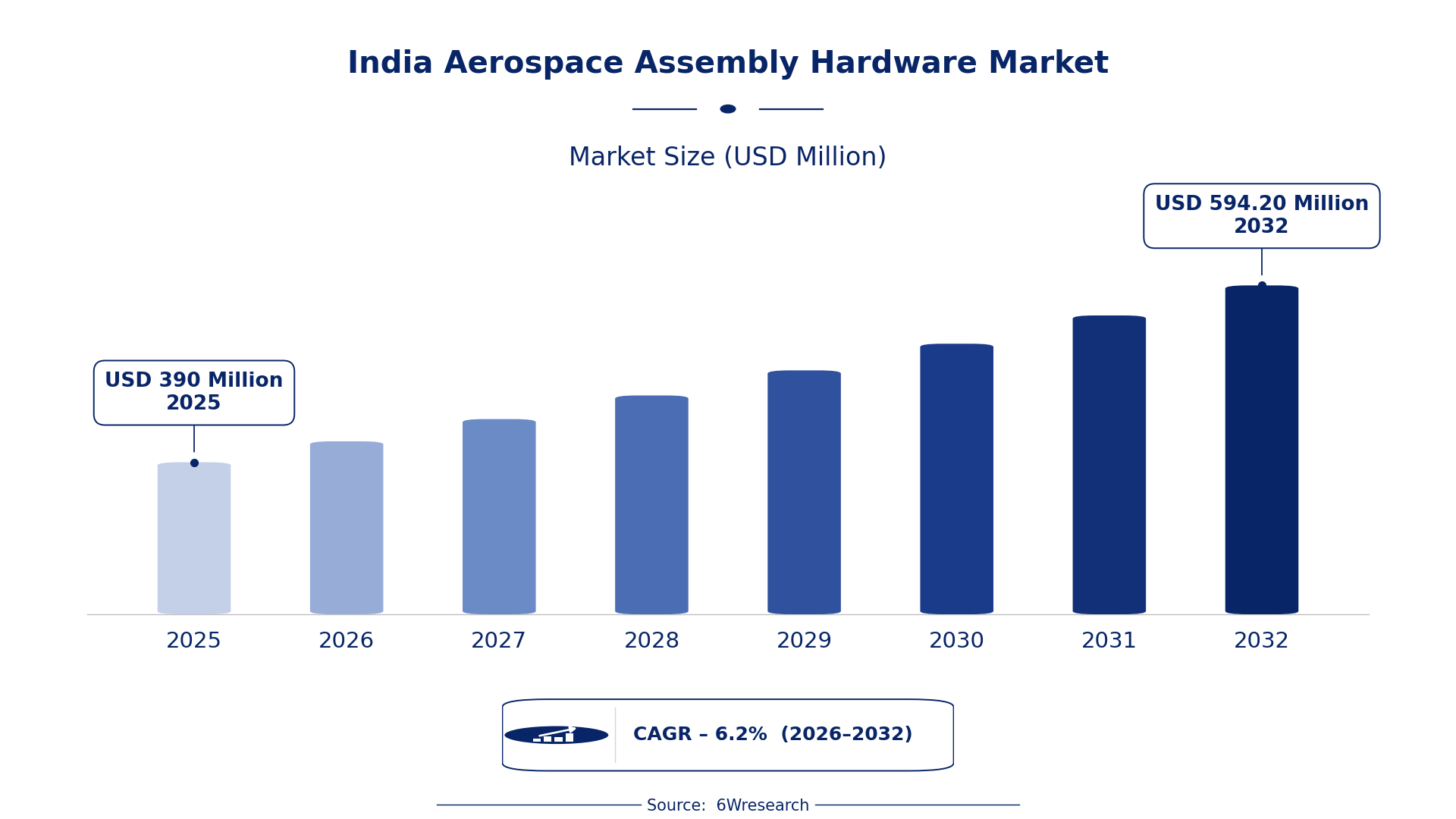
According to 6Wresearch internal database and industry insights, the India Aerospace Assembly Hardware Market was valued at USD 390.0 million in 2025 and is projected to reach USD 594.20 million by 2032, growing at a CAGR of approximately 6.2% during 2026–2032.
India Aerospace Assembly Hardware Market Highlights
| Report Metric | Details |
| Report Name | India Aerospace Assembly Hardware Market |
| Market Size 2025 | USD 390.0 million |
| Market Size 2032 | USD 594.20 million |
| Absolute Growth 2025–2032 | USD 204.20 million |
| CAGR 2026–2032 | 6.2% |
| Peak Annual Growth | 7.6% in 2032 |
| Forecast Period | 2026–2032 |
| Historical Data | 2022–2025 |
| Base Year | 2025 |
| Leading Hardware Type, 2025 | Fasteners (51% share) |
| Leading Material Type, 2025 | Aluminum (39% share) |
| Leading Distribution Channel, 2025 | Industrial Suppliers (40% share) |
| Leading End User, 2025 | Aerospace Manufacturing Units (49% share) |
| Fastest-Growing Hardware Type | Rivets (7.9% CAGR) |
| Fastest-Growing Material Type | Titanium (8.5% CAGR) |
| Fastest-Growing Distribution Channel | OEMs (7.5% CAGR) |
| Fastest-Growing End User | MRO Facilities (9.0% CAGR) |
| Growing Sector | MRO Facilities |
| Key End Users | Aerospace Manufacturing Units, Aircraft Assemblers, MRO Facilities, Engine Manufacturers |
India Aerospace Assembly Hardware Market Year-wise Growth Rate and Key Drivers (2022–2032)
This graph illustrates the annual growth rates of the market from 2022 to 2032, highlighting a steady upward trajectory and projected market expansion over the forecast period.
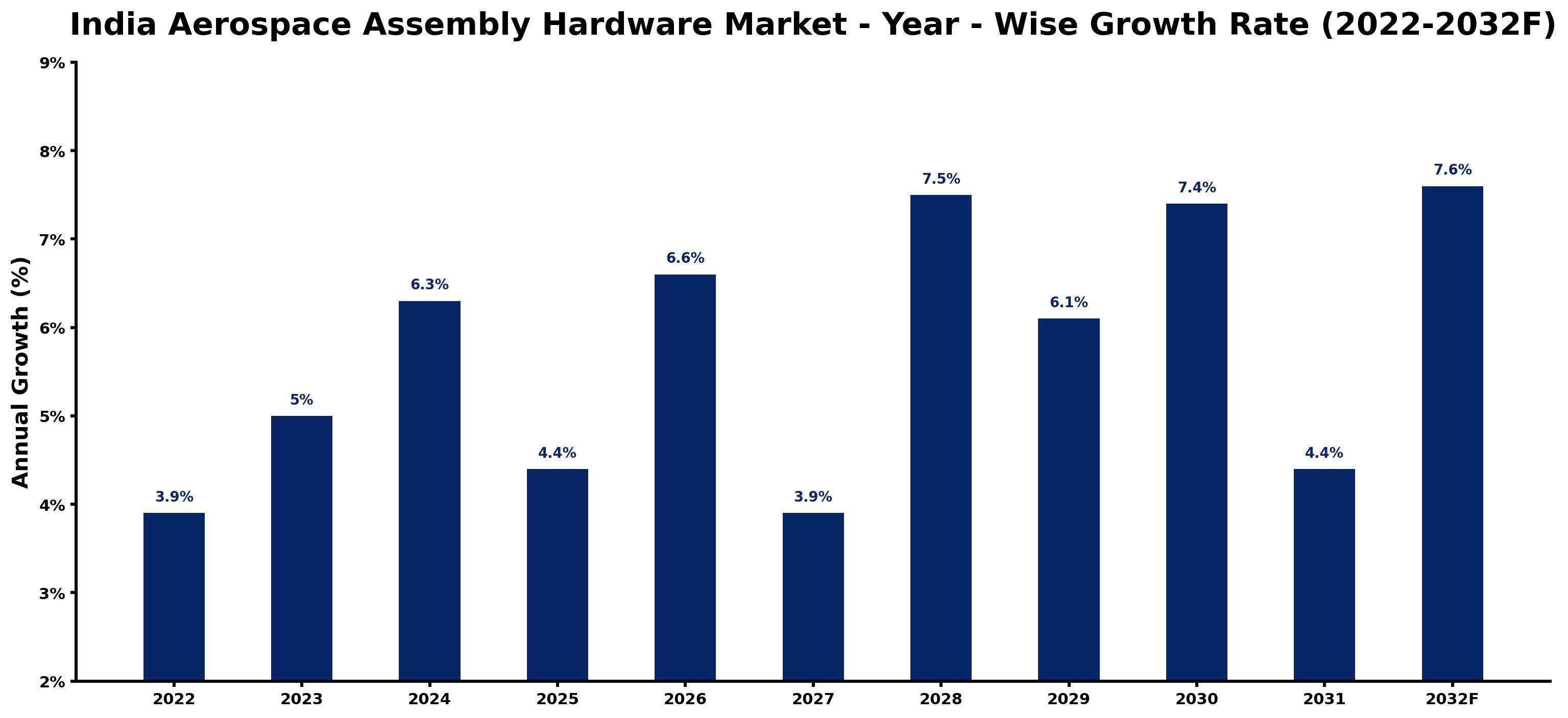
Year by year, the estimates below pair each growth rate with the development that shaped it.
| Year | Estimated Annual Growth (%) | Market Rationale |
| 2022 | 3.9 | The market experienced steady growth due to the 'Make in India' initiative promoting local production. |
| 2023 | 5.0 | Demand rose as domestic manufacturers ramped up aircraft component production in response to increased orders. |
| 2024 | 6.3 | Growth accelerated with the implementation of the 'Aerospace and Defence Manufacturing Policy' enhancing local capabilities. |
| 2025 | 4.4 | A slowdown occurred as production faced temporary supply chain disruptions affecting component availability. |
| 2026 | 6.6 | The market rebounded with rising investments in aerospace infrastructure, particularly in Maharashtra. |
| 2027 | 3.9 | Growth slowed as manufacturers adapted to evolving regulatory requirements under international standards. |
| 2028 | 7.5 | Demand surged as MRO facilities expanded operations and capabilities to meet rising aircraft maintenance needs. |
| 2029 | 6.1 | A slowdown was noted as competition intensified among local producers in the aerospace sector. |
| 2030 | 7.4 | Growth accelerated again with increased government support for local manufacturing initiatives. |
| 2031 | 4.4 | A slowdown occurred as the market adjusted to new standards and regulations set by the Directorate General of Civil Aviation. |
| 2032 | 7.6 | The market peaked as domestic production reached targeted levels set by the government. |
Note: Market size estimations and growth projections presented in this report are based on 6Wresearch's proprietary forecasting methodology, utilizing the latest available industry data, government publications, and primary research inputs.
India Aerospace Assembly Hardware Market Synopsis
Aerospace Assembly Hardware in India encompasses components such as fasteners, rivets, and clamps used in aircraft assembly and maintenance. These components are manufactured from materials like aluminum and titanium, essential for the aerospace sector. The India Aerospace Assembly Hardware Market is projected to grow, driven by rising domestic manufacturing and government initiatives. The Indian government aims to boost local production to 70% by 2025, which is a key factor in this growth. The establishment of over 400 MRO facilities further supports the rising demand for assembly hardware.
Market Dynamics Impact Analysis (2026–2032)
| Factor | Type | Impact | Primary Segment Affected |
| Increasing domestic production of aircraft components | Driver | High | Fasteners |
| Expansion of MRO facilities across the country | Driver | High | MRO Facilities |
| Growing demand for lightweight materials in aerospace | Opportunity | Medium | Aluminum |
| Investment in aerospace infrastructure development | Opportunity | High | Aerospace Manufacturing Units |
| Supply chain disruptions affecting material availability | Restraint | High | Rivets |
| High costs associated with specialized aerospace components | Restraint | Medium | Clamps |
| Regulatory compliance costs impacting small manufacturers | Challenge | High | OEMs |
| Competition from international aerospace suppliers | Challenge | Medium | Industrial Suppliers |
Evaluation of Drivers in India Aerospace Assembly Hardware Market (2026–2032)
The factors lifting demand, and the evidence behind each, are summarised below.
| Drivers | Primary Segment Affected | Why It Matters (Evidence) |
| Increasing demand for lightweight materials in aircraft manufacturing | Rivets | Titanium usage is increasing due to its strength-to-weight ratio, driving demand for rivets. |
| Expansion of MRO facilities across India | MRO Facilities | The growth of over 400 MRO facilities is driving demand for assembly hardware in maintenance operations. |
| Government support for local manufacturing initiatives | OEMs | The 'Make in India' initiative encourages local production, boosting demand from OEMs for assembly hardware. |
| Rising production of aircraft components | Fasteners | India produced approximately 1,000 aircraft components per month, increasing demand for fasteners. |
| Growing investments in aerospace infrastructure | Aluminum | The government allocated $1 billion for aerospace infrastructure development, enhancing production capabilities. |
Growth across the Aerospace Assembly Hardware market in India is anchored in rising domestic production, expanding MRO facilities, and support for local manufacturing. The country produced approximately 1,000 aircraft components per month, boosting demand for fasteners. With over 400 MRO facilities, the need for assembly hardware remains high, especially in maintenance and repair operations.
Evaluation of Restraints in India Aerospace Assembly Hardware Market
The main factors holding the market back are set out below.
| Market Restraint | Primary Segment Affected | Why It Matters (Evidence) |
| Supply chain disruptions affecting material availability | Rivets | Recent disruptions have delayed deliveries, causing project timelines to extend and increasing costs for manufacturers. |
| High costs associated with specialized aerospace components | Clamps | Manufacturers face increased expenses, limiting their ability to compete effectively in the market. |
| Regulatory compliance costs impacting small manufacturers | OEMs | Smaller firms struggle to meet regulations, affecting their market presence and competitiveness. |
| Intense competition from international suppliers | Industrial Suppliers | Local suppliers face pressure from established foreign companies, impacting pricing and market share. |
| Limited access to advanced manufacturing technologies | Fasteners | Some manufacturers lack the technology needed to produce high-quality components, hindering their competitiveness. |
India Aerospace Assembly Hardware Market Challenges
The India Aerospace Assembly Hardware market encounters rising raw material costs, especially for titanium and aluminium, which can increase production expenses for manufacturers by up to 15%. Supply chain disruptions impact over 400 MRO facilities, causing delays in obtaining essential components and extending operational downtime. Regulatory challenges complicate processes; compliance with international standards like AS9100 can lengthen approval timelines, costing manufacturers valuable time and resources. Buyers face difficulties sourcing components domestically, as the government's goal of achieving 70% local manufacturing by 2025 remains unfulfilled, limiting their options and driving up prices.
Trends in the India Aerospace Assembly Hardware Market
The trends below show where the India Aerospace Assembly Hardware Market is heading.
- Shift towards Lightweight Materials: The aerospace sector in India is increasingly adopting lightweight materials such as titanium, with demand expected to rise by 8.5% through 2032. This shift is motivated by the need for enhanced fuel efficiency in aircraft manufacturing.
- Expansion of MRO Facilities: The growth of over 400 MRO facilities in India is driving demand for assembly hardware, with an anticipated rise in maintenance operations reflecting the sector's expansion.
- Focus on Local Manufacturing: The 'Make in India' initiative is encouraging local production of aerospace components, targeting a 70% domestic manufacturing share by 2025. This focus is likely to strengthen local supply chains and decrease reliance on imports.
- Increase in Government Investment: In 2023, the Indian government allocated $1 billion for aerospace infrastructure development, which is expected to have a substantial impact on the growth of the aerospace assembly hardware market by improving production capabilities.
Investment Opportunities in the India Aerospace Assembly Hardware Market
Several openings in the India Aerospace Assembly Hardware Market merit attention from investors.
- Increasing Demand for Lightweight Components: The aerospace sector's transition towards lightweight materials presents an opportunity to supply titanium components. This trend aligns with the increasing requirements of aerospace manufacturing units, particularly in Maharashtra, where demand is on the rise.
- Investment in Aerospace Infrastructure: The recent $1 billion government investment in aerospace infrastructure offers a chance for local suppliers to collaborate with manufacturers. Partnering with MRO facilities in Karnataka can facilitate market entry and growth.
- Expansion of MRO Operations: The growth of MRO facilities generates a demand for assembly hardware, particularly fasteners. Suppliers can target these facilities, especially in regions with high aircraft activity, to capture market share.
- Local Production Initiatives: The ongoing 'Make in India' initiative promotes investment in local production of aerospace components. Suppliers can enter the market through joint ventures with local manufacturers, enhancing their competitive position.
Government Initiatives in the India Aerospace Assembly Hardware Market
The 'Aerospace and Defence Manufacturing Policy' launched by the Ministry of Civil Aviation in 2020 aims to boost local manufacturing by reducing import dependency. This policy encourages domestic production and sets a target of increasing local manufacturing to 70% by 2025. Additionally, the 'National Aerospace and Defence Policy' introduced in 2021 enhances competitiveness in the sector, ensuring that local manufacturers meet international standards. The 'Skill India' programme aims to train 1 million individuals in aerospace and defence skills by 2025, supporting workforce development in the industry.
MRO facilities benefit from government initiatives like the 'Make in India' programme, which promotes local production of aerospace components. The Ministry of Defence's 'Defence Production Policy' aims for a $25 billion aerospace and defence industry by 2025, providing funding and support for local manufacturers. These measures enable MRO facilities to source components domestically, reducing reliance on imports and improving operational efficiency.
Future Insight of the India Aerospace Assembly Hardware Market
By 2032, buyers and suppliers in the India Aerospace Assembly Hardware market can expect improved manufacturing capabilities driven by a $1 billion government investment in aerospace infrastructure. The establishment of the Aerospace and Defence Sector Skill Council will enhance workforce skills, ensuring a more proficient labour pool for manufacturers. Technological advancements led by the Indian Space Research Organisation will stimulate innovation in component production. A gradual shift towards local manufacturing will lessen reliance on imports, resulting in competitive pricing and better availability of crucial components.
Market Segmentation Analysis
The report offers a comprehensive study of the following market segments and their leading categories in the market.
By Hardware Type – Fasteners Dominated, Rivets Expected to Grow Fastest
According to Ravi Bhandari, Research Head at 6Wresearch, Fasteners held a 51% share of the India Aerospace Assembly Hardware Market by hardware type in 2025. Fasteners dominate the market share in India as they are essential for securely joining components during aircraft assembly. The extensive network of over 400 MRO facilities underscores the ongoing demand for fasteners in both manufacturing and maintenance operations. Over 2026–2032, Rivets are expected to post the fastest growth, at a CAGR of 7.9%. Rivets are experiencing the fastest growth rate due to their increasing preference for permanent fastening in aircraft structures. The production of around 1,000 aircraft components monthly significantly contributes to this upward trend. Suppliers should enhance their fastener offerings to meet the growing requirements in the aerospace assembly hardware market.
By Material Type – Aluminum Dominated, Titanium Expected to Grow Fastest
Aluminum accounted for a 39% market share by material type in 2025. Aluminum commands the largest market share as it is favoured for its lightweight properties, which are crucial for aerospace applications. The Indian government's ambition to elevate domestic manufacturing to 70% by 2025 solidifies aluminum's vital role in aircraft production. The quickest growth will come from Titanium, forecast to expand at a CAGR of 8.5% between 2026 and 2032. Titanium is the fastest-growing material type, driven by its superior strength-to-weight ratio, making it ideal for high-stress aerospace components. The ongoing expansion of the aerospace sector is expected to significantly boost titanium demand. Buyers should consider sourcing more titanium components to enhance the performance and durability of their aerospace products.
By Distribution Channel – Industrial Suppliers Dominated, OEMs Expected to Grow Fastest
With a 40% revenue share in 2025, Industrial Suppliers was the largest distribution channel category. Industrial suppliers lead in market share as they serve as key distributors for aerospace hardware, providing essential components to manufacturers and MRO facilities. Their established networks and relationships within the industry ensure a steady supply of necessary materials. OEMs are projected to grow fastest, at a CAGR of 7.5% during 2026–2032. OEMs are the fastest-growing distribution channel, primarily because they are the main customers for assembly hardware. As the production of aircraft ramps up, OEMs are increasingly seeking reliable sources for hardware components. Suppliers should strengthen partnerships with OEMs to capitalise on the growing demand for assembly hardware in the aerospace sector.
By End User – Aerospace Manufacturing Units Dominated, MRO Facilities Expected to Grow Fastest
The largest end user category in 2025 was Aerospace Manufacturing Units, with a 49% share of total revenue. Aerospace manufacturing units capture the largest market share as they are the primary end-users of aerospace assembly hardware in aircraft production. Their pivotal role in the industry ensures a consistent demand for various hardware components. MRO Facilities are set to record the highest CAGR in this split, 9.0% over 2026–2032. MRO facilities represent the fastest-growing end-user segment, driven by the increasing need for aircraft maintenance and repair. The growth of the aerospace sector is anticipated to further elevate the demand for MRO services, propelling this segment's expansion. Suppliers should target MRO facilities to effectively address the rising demand for maintenance-related aerospace hardware.
Key Attractiveness of the Report
- 10 Years of Market Numbers
- Historical Data Starting from 2022 to 2025
- Base Year 2025
- Forecast Data until 2032
- Key Performance Indicators Impacting the Market
- Major Upcoming Developments and Projects
Key Highlights of the Report:
- India Aerospace Assembly Hardware Market Outlook
- Market Size of India Aerospace Assembly Hardware Market, 2025
- Forecast of India Aerospace Assembly Hardware Market, 2032
- Historical Data and Forecast of India Aerospace Assembly Hardware Revenues & Volume for the Period 2022 - 2032F
- India Aerospace Assembly Hardware Market Trend Evolution
- India Aerospace Assembly Hardware Market Drivers and Challenges
- India Aerospace Assembly Hardware Price Trends
- India Aerospace Assembly Hardware Porter's Five Forces
- India Aerospace Assembly Hardware Industry Life Cycle
- Historical Data and Forecast of India Aerospace Assembly Hardware Market Revenues & Volume By Hardware Type for the Period 2022 - 2032F
- Historical Data and Forecast of India Aerospace Assembly Hardware Market Revenues & Volume By Fasteners for the Period 2022 - 2032F
- Historical Data and Forecast of India Aerospace Assembly Hardware Market Revenues & Volume By Rivets for the Period 2022 - 2032F
- Historical Data and Forecast of India Aerospace Assembly Hardware Market Revenues & Volume By Clamps for the Period 2022 - 2032F
- Historical Data and Forecast of India Aerospace Assembly Hardware Market Revenues & Volume By Pins & Bushings for the Period 2022 - 2032F
- Historical Data and Forecast of India Aerospace Assembly Hardware Market Revenues & Volume By Material Type for the Period 2022 - 2032F
- Historical Data and Forecast of India Aerospace Assembly Hardware Market Revenues & Volume By Stainless Steel for the Period 2022 - 2032F
- Historical Data and Forecast of India Aerospace Assembly Hardware Market Revenues & Volume By Aluminum for the Period 2022 - 2032F
- Historical Data and Forecast of India Aerospace Assembly Hardware Market Revenues & Volume By Titanium for the Period 2022 - 2032F
- Historical Data and Forecast of India Aerospace Assembly Hardware Market Revenues & Volume By Alloy Steel for the Period 2022 - 2032F
- Historical Data and Forecast of India Aerospace Assembly Hardware Market Revenues & Volume By Distribution Channel for the Period 2022 - 2032F
- Historical Data and Forecast of India Aerospace Assembly Hardware Market Revenues & Volume By Industrial Suppliers for the Period 2022 - 2032F
- Historical Data and Forecast of India Aerospace Assembly Hardware Market Revenues & Volume By Direct Sales for the Period 2022 - 2032F
- Historical Data and Forecast of India Aerospace Assembly Hardware Market Revenues & Volume By OEMs for the Period 2022 - 2032F
- Historical Data and Forecast of India Aerospace Assembly Hardware Market Revenues & Volume By Online Platforms for the Period 2022 - 2032F
- Historical Data and Forecast of India Aerospace Assembly Hardware Market Revenues & Volume By End User for the Period 2022 - 2032F
- Historical Data and Forecast of India Aerospace Assembly Hardware Market Revenues & Volume By MRO Facilities for the Period 2022 - 2032F
- Historical Data and Forecast of India Aerospace Assembly Hardware Market Revenues & Volume By Aircraft Assemblers for the Period 2022 - 2032F
- Historical Data and Forecast of India Aerospace Assembly Hardware Market Revenues & Volume By Aerospace Manufacturing Units for the Period 2022 - 2032F
- Historical Data and Forecast of India Aerospace Assembly Hardware Market Revenues & Volume By Engine Manufacturers for the Period 2022 - 2032F
- India Aerospace Assembly Hardware Import Export Trade Statistics
- Market Opportunity Assessment By Hardware Type
- Market Opportunity Assessment By Material Type
- Market Opportunity Assessment By Distribution Channel
- Market Opportunity Assessment By End User
- India Aerospace Assembly Hardware Top Companies Market Share
- India Aerospace Assembly Hardware Competitive Benchmarking By Technical and Operational Parameters
- India Aerospace Assembly Hardware Company Profiles
- India Aerospace Assembly Hardware Key Strategic Recommendations
Market Covered
Segments analysed in this report are listed below.
By Hardware Type
- Fasteners
- Rivets
- Clamps
- Pins & Bushings
By Material Type
- Stainless Steel
- Aluminum
- Titanium
- Alloy Steel
By Distribution Channel
- Industrial Suppliers
- Direct Sales
- OEMs
- Online Platforms
By End User
- MRO Facilities
- Aircraft Assemblers
- Aerospace Manufacturing Units
- Engine Manufacturers































