India Aerospace & Defense Components Market Size & Growth Rate
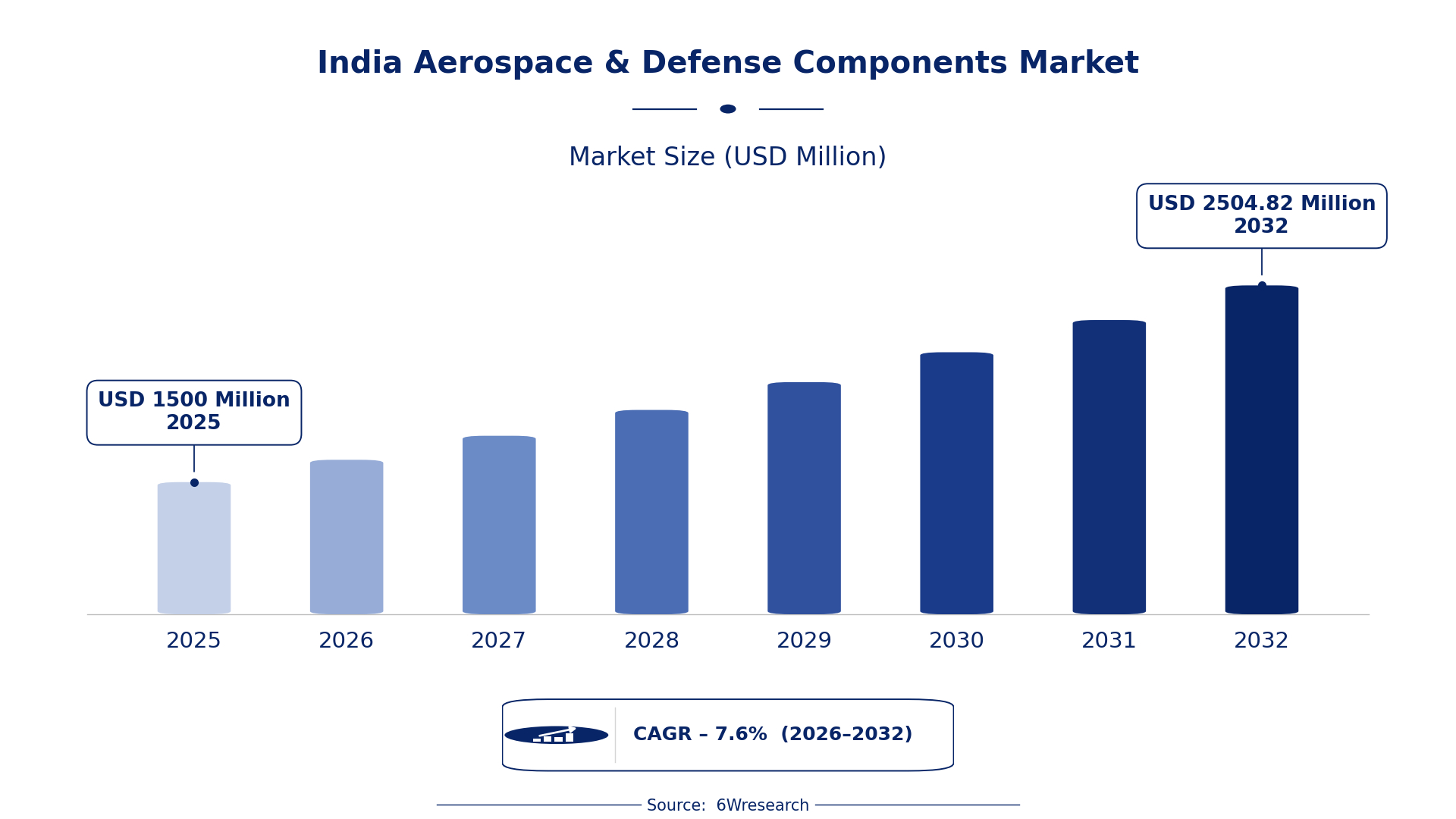
According to 6Wresearch internal database and industry insights, the India Aerospace & Defense Components Market was valued at USD 1,500 million in 2025 and is projected to reach USD 2,504.82 million by 2032, growing at a CAGR of approximately 7.6% during 2026–2032.
India Aerospace & Defense Components Market Highlights
| Report Metric | Details |
| Report Name | India Aerospace & Defense Components Market |
| Market Size 2025 | USD 1,500 million |
| Market Size 2032 | USD 2,504.82 million |
| Absolute Growth 2025–2032 | USD 1,004.82 million |
| CAGR 2026–2032 | 7.6% |
| Peak Annual Growth | 9.7% in 2028 |
| Forecast Period | 2026–2032 |
| Historical Data | 2022–2025 |
| Base Year | 2025 |
| Leading Component Type, 2025 | Structural Components (40% share) |
| Leading Material Type, 2025 | Titanium Alloys (48% share) |
| Leading Distribution Channel, 2025 | Government Contracts (37% share) |
| Leading End User, 2025 | Aircraft Manufacturers (39% share) |
| Fastest-Growing Component Type | Avionics (9.9% CAGR) |
| Fastest-Growing Material Type | Composites (10.3% CAGR) |
| Fastest-Growing End User | Defense Equipment Vendors (10.0% CAGR) |
| Growing Sector | Aerospace Manufacturing |
| Key End Users | Aircraft Manufacturers, Defense Equipment Vendors, Military Aviation Units |
India Aerospace & Defense Components Market Year-wise Growth Rate and Key Drivers (2022–2032)
This graph illustrates the annual growth rates of the market from 2022 to 2032, highlighting a steady upward trajectory and projected market expansion over the forecast period.
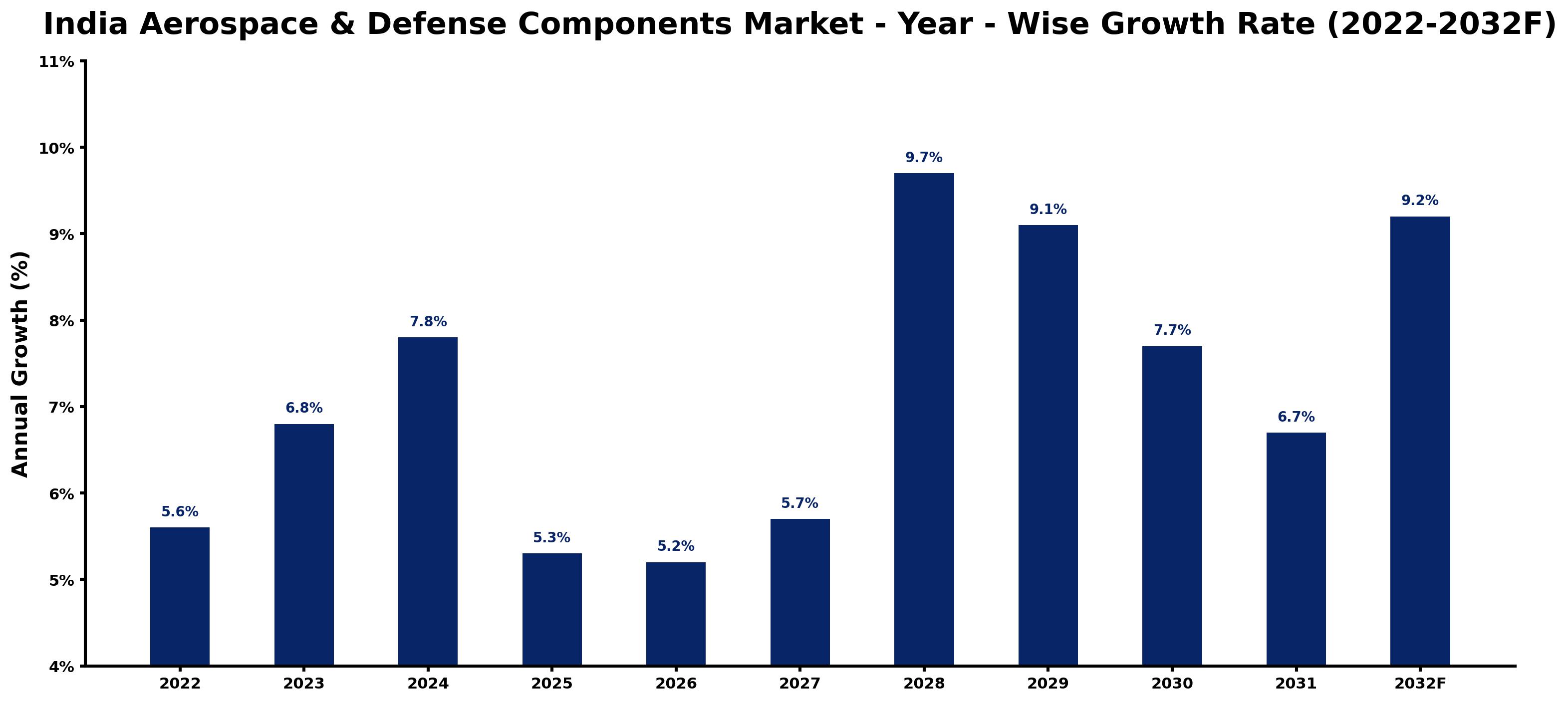
The following table presents the estimated annual growth rate for each year together with the principal factor influencing market performance.
| Year | Estimated Annual Growth (%) | Market Rationale |
| 2022 | 5.6 | The market exhibited steady growth driven by ongoing government contracts and the Make in India initiative. |
| 2023 | 6.8 | Growth accelerated due to increased defense spending and the implementation of the Make in India initiative. |
| 2024 | 7.8 | Demand continued to rise as the defense budget expanded, supporting local aerospace production. |
| 2025 | 5.3 | Growth slowed as the market adjusted to prior rapid increases in demand and production capacity. |
| 2026 | 5.2 | A further slowdown is expected as manufacturers face challenges in scaling operations effectively. |
| 2027 | 5.7 | Demand is projected to rebound with renewed focus on indigenous defense capabilities and technology development. |
| 2028 | 9.7 | The market is expected to peak as government contracts surge, reflecting heightened defense priorities. |
| 2029 | 9.1 | Growth is anticipated to slow slightly as the market begins to stabilise after rapid expansion in previous years. |
| 2030 | 7.7 | A continued slowdown is projected as production capacities reach maturity and competition increases. |
| 2031 | 6.7 | Demand growth is expected to moderate further as the market adjusts to new operational standards and requirements. |
| 2032 | 9.2 | The market is expected to grow faster again due to increased investments in aerospace technology. |
Note: Market size estimations and growth projections presented in this report are based on 6Wresearch's proprietary forecasting methodology, utilizing the latest available industry data, government publications, and primary research inputs.
India Aerospace & Defense Components Market Synopsis
The Aerospace & Defense Components Market in India includes parts used in aircraft and defense systems, such as structural elements and avionics. These components are crafted from advanced materials like titanium alloys and composites, enhancing performance and safety. Growth in the India Aerospace & Defense Components Market is fuelled by increasing defense budgets, with the defense budget for 2023-24 estimated at around $73 billion. The Make in India initiative promotes local production, aiming to reduce imports and boost self-reliance. This expansion presents substantial opportunities for suppliers, driven by domestic manufacturers and government contracts.
Market Dynamics Impact Analysis (2026–2032)
| Factor | Type | Impact | Primary Segment Affected |
| Rising defense budget allocations | Driver | High | Defense Equipment Vendors |
| Focus on indigenous manufacturing | Driver | High | Aircraft Manufacturers |
| Growing demand for advanced avionics | Opportunity | High | Avionics |
| Increasing investment in aerospace technology | Opportunity | High | Structural Components |
| Supply chain disruptions | Restraint | High | Propulsion Systems |
| High production costs for advanced materials | Restraint | Medium | Titanium Alloys |
| Dependence on government contracts | Challenge | High | Government Contracts |
| Skilled labor shortages in aerospace manufacturing | Challenge | Medium | Industrial Suppliers |
Evaluation of Drivers in India Aerospace & Defense Components Market (2026–2032)
Key forces behind demand, with the segment each one moves most, are listed below.
| Drivers | Primary Segment Affected | Why It Matters (Evidence) |
| Increased defense spending | Defense Equipment Vendors | India's defense budget reached approximately $73 billion in 2023, driving demand for components. |
| Indigenous manufacturing initiatives | Aircraft Manufacturers | The Make in India program encourages local sourcing, boosting component purchases from domestic manufacturers. |
| Technological advancements in avionics | Avionics | Growing demand for sophisticated navigation systems has led to a rise in avionics component orders. |
| Expansion of aerospace hubs | Structural Components | Bangalore, a major aerospace hub, supports increased production capacity and component supply. |
| Government contracts for defense projects | Government Contracts | A significant share of revenue comes from government contracts, which are projected to grow. |
The defense budget reached about $73 billion in 2023, spurring demand for components. The focus on advanced avionics technology has led to a surge in component orders for navigation systems. Furthermore, the growth of aerospace hubs like Bangalore is improving production capacity, increasing the supply of components.
Evaluation of Restraints in India Aerospace & Defense Components Market
The table below lists the restraints and the evidence behind each.
| Market Restraint | Primary Segment Affected | Why It Matters (Evidence) |
| Supply chain disruptions | Propulsion Systems | Ongoing global supply chain issues have delayed component deliveries, impacting production timelines. |
| High production costs for advanced materials | Titanium Alloys | The rising costs of titanium alloys limit profit margins for manufacturers in the aerospace sector. |
| Regulatory compliance challenges | Avionics | Strict quality standards set by the Bureau of Indian Standards complicate the approval process for new products. |
| Limited access to skilled labor | Industrial Suppliers | A shortage of skilled workers in aerospace manufacturing hampers production efficiency and growth. |
| Dependence on government contracts | Government Contracts | A leading supplier on government contracts makes manufacturers vulnerable to policy changes affecting defense budgets. |
India Aerospace & Defense Components Market Challenges
Buyers and suppliers in the India Aerospace & Defense Components market are grappling with a skills shortage, as the Aerospace and Defense Skill Sector Council has yet to address workforce training needs. This gap causes production delays, costing manufacturers up to 20% more in recruitment and training. Regulatory challenges complicate operations, with stringent compliance requirements from the Ministry of Civil Aviation potentially extending project timelines by six months. Technology adoption is also sluggish, as many firms struggle with advanced materials, leading to a 15% rise in production costs, which undermines competitiveness for buyers.
Trends in the India Aerospace & Defense Components Market
The trends below show where the India Aerospace & Defense Components Market is heading.
- Shift towards Indigenous Manufacturing: The Make in India initiative is promoting a shift towards indigenous manufacturing in aerospace components, targeting a turnover of $25 billion in defense manufacturing by 2025.
- Expansion of Aerospace Hubs: Bangalore is establishing itself as a major aerospace manufacturing hub, with over 400 registered aerospace companies as of 2023, boosting local production capabilities.
- Increased Focus on Avionics Technology: There is a rising emphasis on advanced avionics technology, with demand for sophisticated navigation systems increasing, reflecting the market's move towards high-tech solutions.
- Investment in Defense Modernization: The Indian government allocated $1.5 billion for defense modernization in 2023, demonstrating a strong commitment to upgrading defense capabilities and infrastructure.
Investment Opportunities in the India Aerospace & Defense Components Market
Investors looking at the India Aerospace & Defense Components Market should consider the following areas.
- Aircraft Manufacturers Seeking Advanced Components: Aircraft manufacturers are increasingly looking for advanced components due to the need for improved performance and safety, with the defense budget reaching approximately $73 billion in 2023.
- Supply of Titanium Alloys for Lightweight Components: There is an opportunity to supply titanium alloys, essential for lightweight components, particularly as the defense budget continues to grow.
- Partnerships for Local Production: Establishing joint ventures with local manufacturers can facilitate entry into the market, particularly for companies looking to supply advanced avionics components.
- Expansion in Bangalore's Aerospace Sector: Investing in facilities in Bangalore, a key aerospace hub, offers opportunities to tap into the growing demand for aerospace components driven by local manufacturers.
Government Initiatives in the India Aerospace & Defense Components Market
The Defense Production Policy 2020 aims for a turnover of $25 billion in defense manufacturing by 2025, spearheaded by the Ministry of Defence. This policy promotes local sourcing and manufacturing, enhancing the competitiveness of domestic producers. The Atmanirbhar Bharat initiative, launched in 2020, encourages self-reliance in defense production, focusing on indigenous capabilities. Additionally, the Technology Development Fund (TDF) was established by the Ministry of Defence in 2021 to support R&D in defense technologies with a budget of $1.3 billion, promoting innovation in the sector.
The Technology Development Fund (TDF) backs research and development in defense technologies, allowing manufacturers to innovate and improve their product offerings. The Aerospace and Defense Skill Sector Council aims to enhance workforce skills, ensuring a skilled labour pool for manufacturers. The Ministry of Civil Aviation regulates commercial aviation, ensuring compliance with safety standards. Furthermore, the Draft National Policy on Aerospace and Defense, released in 2022, seeks to streamline regulations and encourage investment in the sector, facilitating smoother operations for producers and buyers.
Future Insight of the India Aerospace & Defense Components Market
The India Aerospace & Defense Components market is set for considerable evolution by 2032, driven by key developments. The updated National Aerospace and Defense Policy will strengthen local manufacturing capabilities, reducing reliance on imports. Investment in advanced manufacturing technologies, particularly automation, is expected to rise, supported by a $1.5 billion allocation for defense modernization in 2023. The 'Make in India' initiative is likely to attract foreign direct investment, with a 74% FDI limit in defense manufacturing, creating further opportunities for local producers.
Market Segmentation Analysis
Each segment group is reviewed below, with the leader by share and the fastest grower by CAGR.
By Component Type – Structural Components Dominated, Avionics Expected to Grow Fastest
According to Ravi Bhandari, Research Head at 6Wresearch, with a 40% revenue share in 2025, Structural Components was the largest component type category. Structural components are essential for the integrity and performance of aircraft, making them a primary focus for manufacturers. The installed base of over 1,500 aircraft operated by the Indian Air Force underscores the demand for these critical parts. The quickest growth will come from Avionics, forecast to expand at a CAGR of 9.9% between 2026 and 2032. Avionics are experiencing rapid growth due to their critical role in navigation and control systems, which are increasingly sophisticated. The push for advanced avionics in military applications is a key factor driving this segment's expansion. Suppliers should prioritise innovation in avionics to capture the growing demand from both military and commercial sectors.
By Material Type – Titanium Alloys Dominated, Composites Expected to Grow Fastest
The largest material type category in 2025 was Titanium Alloys, with a 48% share of total revenue. Titanium alloys hold a substantial share in the market as they are critical for producing lightweight and durable components essential for aircraft performance. Their extensive use in various aerospace projects, including military and commercial applications, solidifies their leading position in the material segment. Composites are projected to grow fastest, at a CAGR of 10.3% during 2026–2032. Composites are rapidly gaining traction due to their ability to significantly reduce weight and improve fuel efficiency in aerospace applications. The growing focus on sustainability and cost-effectiveness in manufacturing processes is propelling the demand for composite materials. Buyers should consider investing in composite materials to enhance fuel efficiency and reduce operational costs in their aerospace projects.
By Distribution Channel – Government Contracts Dominated and Is Expected to Record the Fastest Growth
In 2025, Government Contracts led the distribution channel split with a 37% share. Government contracts are the primary distribution channel, representing a vital source of revenue for defense components. The substantial defense budget of approximately $73 billion for 2023-24 highlights the importance of these contracts in sustaining market growth. Government Contracts are also forecast to expand faster than any other category, at a CAGR of 9.7% over 2026–2032. Government contracts are also experiencing the fastest growth, driven by a strong emphasis on indigenous defense technology development and ongoing modernization initiatives. The government's commitment to local manufacturing through the 'Make in India' programme ensures sustained demand in this channel. Suppliers must align their strategies with government initiatives to maximise opportunities in the lucrative defense sector.
By End User – Aircraft Manufacturers Dominated, Defense Equipment Vendors Expected to Grow Fastest
Aircraft Manufacturers accounted for a 39% market share by end user in 2025. Aircraft manufacturers dominate the end user segment as they are the main consumers of aerospace components, driving considerable demand. Their ongoing projects and collaborations with the government further reinforce their leading position in the market. Over 2026–2032, Defense Equipment Vendors are expected to post the fastest growth, at a CAGR of 10.0%. Defense equipment vendors are experiencing rapid growth due to the increasing demand for advanced military aircraft and systems. The Indian government's focus on modernising its defense capabilities significantly contributes to this segment's expansion. Suppliers should strengthen partnerships with defense equipment vendors to capitalise on the rising demand for military aerospace components.
Key Attractiveness of the Report
- 10 Years of Market Numbers
- Historical Data Starting from 2022 to 2025
- Base Year 2025
- Forecast Data until 2032
- Key Performance Indicators Impacting the Market
- Major Upcoming Developments and Projects
Key Highlights of the Report:
- India Aerospace & Defense Components Market Outlook
- Market Size of India Aerospace & Defense Components Market, 2025
- Forecast of India Aerospace & Defense Components Market, 2032
- Historical Data and Forecast of India Aerospace & Defense Components Revenues & Volume for the Period 2022 - 2032F
- India Aerospace & Defense Components Market Trend Evolution
- India Aerospace & Defense Components Market Drivers and Challenges
- India Aerospace & Defense Components Price Trends
- India Aerospace & Defense Components Porter's Five Forces
- India Aerospace & Defense Components Industry Life Cycle
- Historical Data and Forecast of India Aerospace & Defense Components Market Revenues & Volume By Component Type for the Period 2022 - 2032F
- Historical Data and Forecast of India Aerospace & Defense Components Market Revenues & Volume By Structural Components for the Period 2022 - 2032F
- Historical Data and Forecast of India Aerospace & Defense Components Market Revenues & Volume By Avionics for the Period 2022 - 2032F
- Historical Data and Forecast of India Aerospace & Defense Components Market Revenues & Volume By Propulsion Systems for the Period 2022 - 2032F
- Historical Data and Forecast of India Aerospace & Defense Components Market Revenues & Volume By Interior Components for the Period 2022 - 2032F
- Historical Data and Forecast of India Aerospace & Defense Components Market Revenues & Volume By Material Type for the Period 2022 - 2032F
- Historical Data and Forecast of India Aerospace & Defense Components Market Revenues & Volume By Titanium Alloys for the Period 2022 - 2032F
- Historical Data and Forecast of India Aerospace & Defense Components Market Revenues & Volume By Semiconductors for the Period 2022 - 2032F
- Historical Data and Forecast of India Aerospace & Defense Components Market Revenues & Volume By Superalloys for the Period 2022 - 2032F
- Historical Data and Forecast of India Aerospace & Defense Components Market Revenues & Volume By Composites for the Period 2022 - 2032F
- Historical Data and Forecast of India Aerospace & Defense Components Market Revenues & Volume By Distribution Channel for the Period 2022 - 2032F
- Historical Data and Forecast of India Aerospace & Defense Components Market Revenues & Volume By OEMs for the Period 2022 - 2032F
- Historical Data and Forecast of India Aerospace & Defense Components Market Revenues & Volume By Direct Sales for the Period 2022 - 2032F
- Historical Data and Forecast of India Aerospace & Defense Components Market Revenues & Volume By Government Contracts for the Period 2022 - 2032F
- Historical Data and Forecast of India Aerospace & Defense Components Market Revenues & Volume By Industrial Suppliers for the Period 2022 - 2032F
- Historical Data and Forecast of India Aerospace & Defense Components Market Revenues & Volume By End User for the Period 2022 - 2032F
- Historical Data and Forecast of India Aerospace & Defense Components Market Revenues & Volume By Aircraft Manufacturers for the Period 2022 - 2032F
- Historical Data and Forecast of India Aerospace & Defense Components Market Revenues & Volume By Defense Equipment Vendors for the Period 2022 - 2032F
- Historical Data and Forecast of India Aerospace & Defense Components Market Revenues & Volume By Military Aviation Units for the Period 2022 - 2032F
- Historical Data and Forecast of India Aerospace & Defense Components Market Revenues & Volume By Commercial Airlines for the Period 2022 - 2032F
- India Aerospace & Defense Components Import Export Trade Statistics
- Market Opportunity Assessment By Component Type
- Market Opportunity Assessment By Material Type
- Market Opportunity Assessment By Distribution Channel
- Market Opportunity Assessment By End User
- India Aerospace & Defense Components Top Companies Market Share
- India Aerospace & Defense Components Competitive Benchmarking By Technical and Operational Parameters
- India Aerospace & Defense Components Company Profiles
- India Aerospace & Defense Components Key Strategic Recommendations
Market Covered
This report examines the market across the segments below.
By Component Type
- Structural Components
- Avionics
- Propulsion Systems
- Interior Components
By Material Type
- Titanium Alloys
- Semiconductors
- Superalloys
- Composites
By Distribution Channel
- OEMs
- Direct Sales
- Government Contracts
- Industrial Suppliers
By End User
- Aircraft Manufacturers
- Defense Equipment Vendors
- Military Aviation Units
- Commercial Airlines































