India Aerospace Electric Motors Market Size & Growth Rate
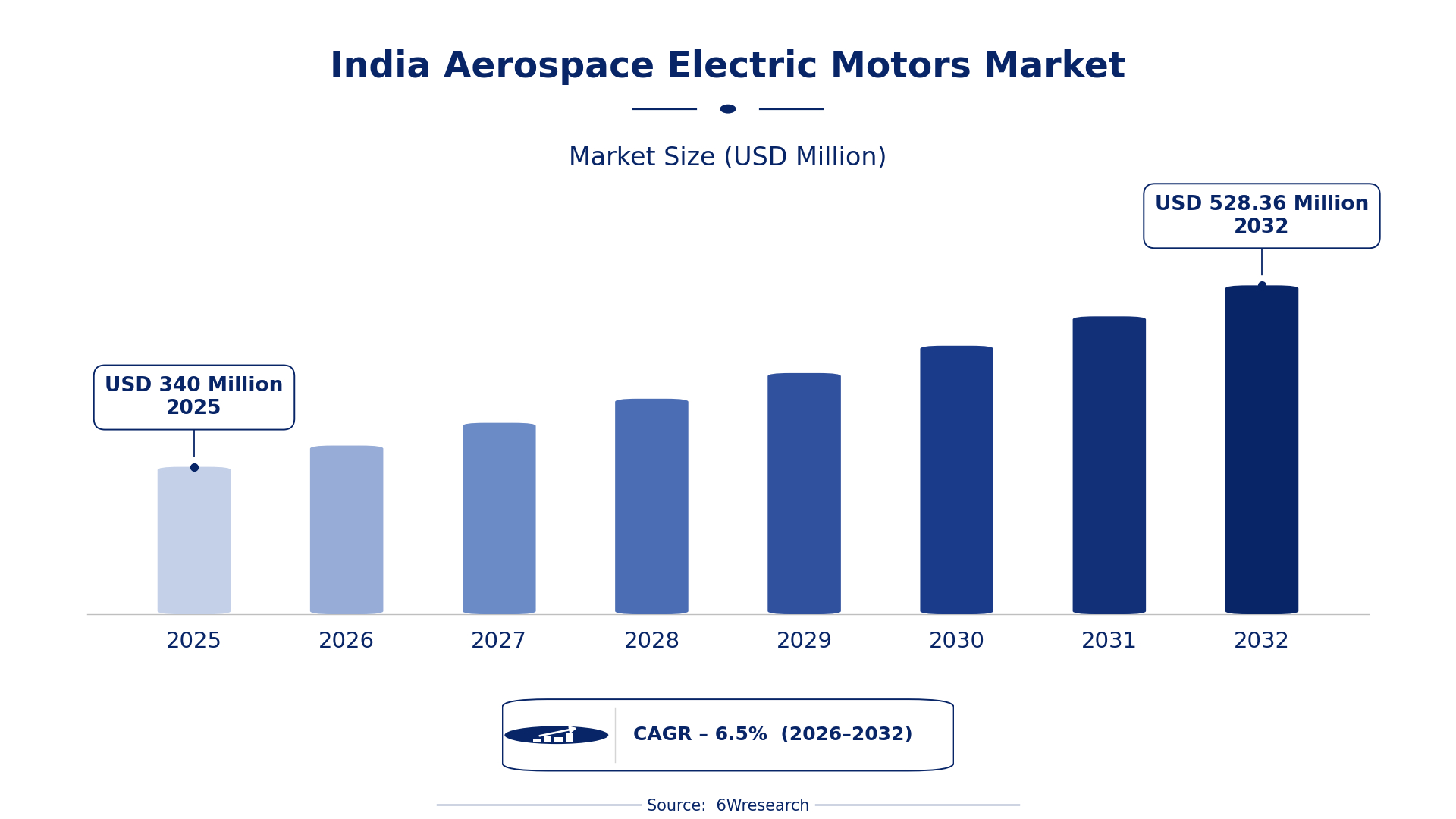
According to 6Wresearch internal database and industry insights, the India Aerospace Electric Motors Market was valued at USD 340.0 million in 2025 and is projected to reach USD 528.36 million by 2032, growing at a CAGR of approximately 6.5% during 2026–2032.
India Aerospace Electric Motors Market Highlights
| Report Metric | Details |
| Report Name | India Aerospace Electric Motors Market |
| Market Size 2025 | USD 340.0 million |
| Market Size 2032 | USD 528.36 million |
| Absolute Growth 2025–2032 | USD 188.36 million |
| CAGR 2026–2032 | 6.5% |
| Peak Annual Growth | 8.8% in 2031 |
| Forecast Period | 2026–2032 |
| Historical Data | 2022–2025 |
| Base Year | 2025 |
| Leading Motor Type, 2025 | Brushed DC Motors (36% share) |
| Leading Technology Type, 2025 | Conventional (40% share) |
| Leading Distribution Channel, 2025 | Direct Sales (42% share) |
| Leading End User, 2025 | Commercial Aviation OEMs (48% share) |
| Fastest-Growing Motor Type | Brushless DC Motors (8.4% CAGR) |
| Fastest-Growing Technology Type | Sensorless Technology (7.6% CAGR) |
| Fastest-Growing Distribution Channel | Online Platforms (8.6% CAGR) |
| Fastest-Growing End User | UAV Manufacturers (8.6% CAGR) |
| Growing Sector | UAV Manufacturing |
| Key End Users | Commercial Aviation OEMs, UAV Manufacturers, Military Aircraft Builders, Satellite Manufacturers |
India Aerospace Electric Motors Market Year-wise Growth Rate and Key Drivers (2022–2032)
This graph illustrates the annual growth rates of the market from 2022 to 2032, highlighting a steady upward trajectory and projected market expansion over the forecast period.
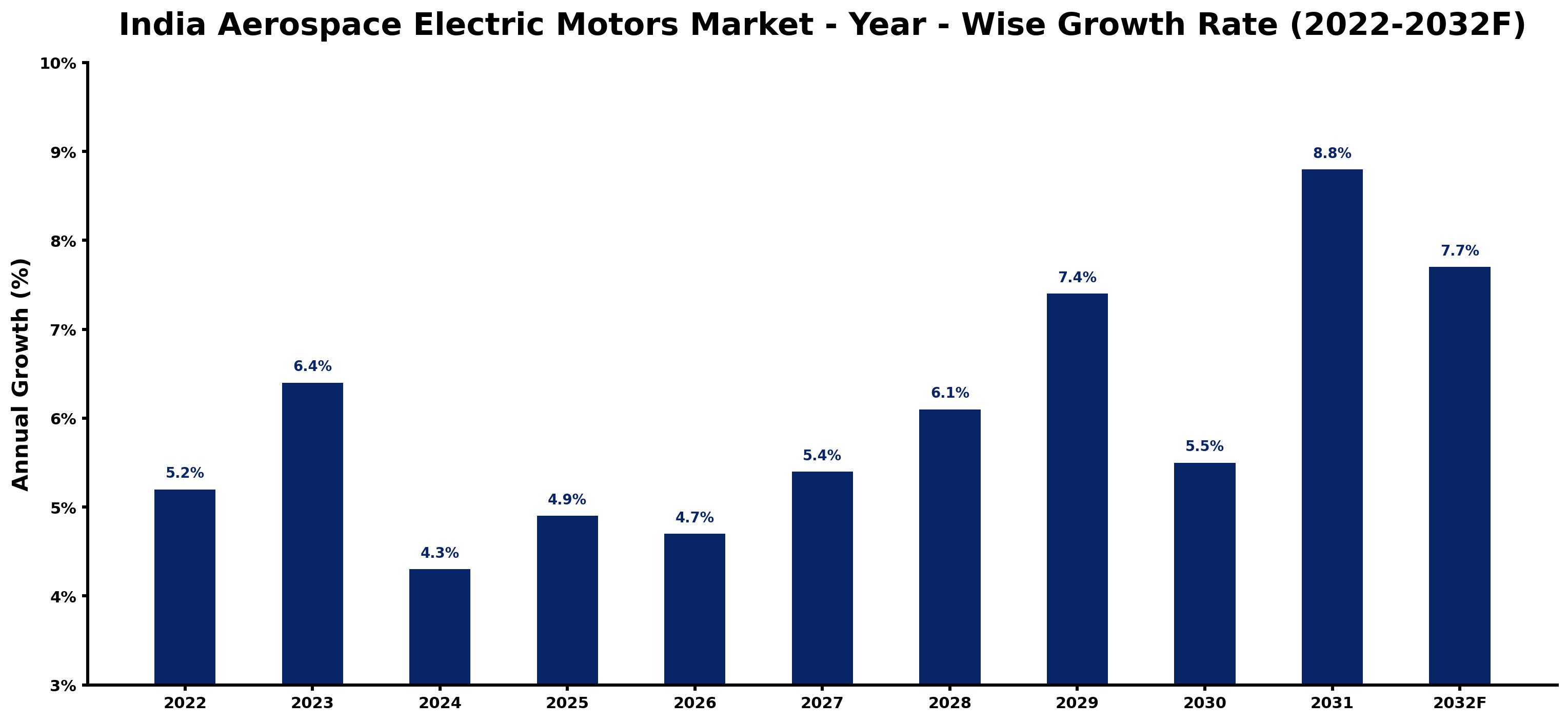
The table below sets out the estimated growth rate for each year and the main factor behind it.
| Year | Estimated Annual Growth (%) | Market Rationale |
| 2022 | 5.2 | The market experienced steady growth due to increasing demand from domestic manufacturers. |
| 2023 | 6.4 | The growth rate accelerated as the government launched the 'Make in India' initiative. |
| 2024 | 4.3 | Growth slowed slightly as the market adjusted to previous high levels of activity. |
| 2025 | 4.9 | Demand increased again, supported by ongoing investments in aerospace projects. |
| 2026 | 4.7 | Growth slowed as the market began to stabilise after rapid expansion. |
| 2027 | 5.4 | A recovery in growth occurred as the UAV segment gained momentum. |
| 2028 | 6.1 | The market continued to grow, driven by rising military applications for electric motors. |
| 2029 | 7.4 | Growth accelerated as the commercial aviation sector expanded significantly. |
| 2030 | 5.5 | The growth rate slowed as the market began to normalise after peak demand. |
| 2031 | 8.8 | The market peaked with strong demand from military aircraft builders and UAV manufacturers. |
| 2032 | 7.7 | Growth slowed as the market stabilised, reflecting mature demand patterns. |
Note: Market size estimations and growth projections presented in this report are based on 6Wresearch's proprietary forecasting methodology, utilizing the latest available industry data, government publications, and primary research inputs.
India Aerospace Electric Motors Market Synopsis
Aerospace Electric Motors Market in India includes advanced electromechanical devices tailored for aviation applications, covering both commercial and military aircraft. These motors serve critical roles in propulsion systems, control surfaces, and actuation mechanisms. The market is growing due to increased demand from domestic manufacturers and government initiatives such as the 'Make in India' programme. The Indian aerospace workforce is expected to reach 1 million skilled professionals by 2025, further propelling market expansion. A CAGR of 15% is anticipated from 2022 to 2026, showcasing robust future potential.
Market Dynamics Impact Analysis (2026–2032)
| Factor | Type | Impact | Primary Segment Affected |
| Increasing demand from UAV manufacturers due to military applications | Driver | High | UAV Manufacturers |
| Government initiatives promoting local manufacturing | Driver | High | Commercial Aviation OEMs |
| Growing demand for electric motors in satellite applications | Opportunity | Medium | Satellite Manufacturers |
| Expansion of the aerospace workforce to support production | Opportunity | Medium | Military Aircraft Builders |
| Regulatory compliance costs affecting production timelines | Restraint | High | Brushless DC Motors |
| Limited presence of specialty stores for procurement | Restraint | Medium | Servo Motors |
| High initial investment costs for advanced technologies | Challenge | High | Digital Control |
| Delays in regulatory approvals for new products | Challenge | Medium | Sensorless Technology |
Evaluation of Drivers in India Aerospace Electric Motors Market (2026–2032)
Key forces behind demand, with the segment each one moves most, are listed below.
| Drivers | Primary Segment Affected | Why It Matters (Evidence) |
| Rising military applications for UAVs | UAV Manufacturers | The UAV market is projected to grow at a rate of 20%, increasing demand for electric motors. |
| Government support for local manufacturing | Commercial Aviation OEMs | The 'Make in India' initiative aims to boost local production, encouraging a 30% increase in purchases from domestic manufacturers. |
| Growing satellite manufacturing sector | Satellite Manufacturers | The Indian Space Research Organisation's projects are driving a demand increase of 25% for aerospace electric motors. |
| Expansion of the aerospace workforce | Military Aircraft Builders | An expected workforce of 1 million skilled professionals by 2025 will improve production capabilities, leading to a 15% increase in procurement. |
| Technological advancements in electric motors | Brushless DC Motors | These advancements lead to increased efficiency, prompting a 10% rise in procurement from aerospace manufacturers. |
The Aerospace Electric Motors market in India is on the rise as military applications for UAVs, support for local manufacturing, and a burgeoning satellite manufacturing sector drive demand. The UAV market is projected to expand at a rate of 20%, heightening the need for electric motors. With an expected workforce of 1 million skilled professionals by 2025, production capabilities will improve, resulting in heightened demand from military aircraft builders. Advancements in electric motor technology further boost efficiency, leading to greater procurement from aerospace manufacturers.
Evaluation of Restraints in India Aerospace Electric Motors Market
Below mentioned are some major restraints and their influence on market dynamics.
| Market Restraint | Primary Segment Affected | Why It Matters (Evidence) |
| High compliance costs for regulatory standards | Brushless DC Motors | Compliance with IS 15680:2006 standards raises production costs for manufacturers by approximately 15%. |
| Limited availability of specialty stores for procurement | Servo Motors | The lack of specialty stores restricts purchasing options for aerospace manufacturers, leading to a 20% increase in procurement time. |
| High initial investment costs for advanced technologies | Digital Control | Initial costs deter smaller manufacturers from adopting new technologies, impacting their market competitiveness by 25%. |
| Delays in regulatory approvals for new products | Sensorless Technology | Approval delays hinder timely market entry for innovative products, causing potential revenue losses of up to 30%. |
| Market saturation in conventional motor types | Conventional | The preference for newer technologies limits growth opportunities for older motor types, affecting sales by approximately 10%. |
India Aerospace Electric Motors Market Challenges
High production costs for aerospace electric motors in India present challenges for local producers, causing prices to be 30% higher for buyers in the aviation sector. Dependence on imported components exacerbates these costs, hindering the competitiveness of domestic manufacturers. A shortage of skilled professionals in the aerospace sector limits growth, with the industry projected to need 1 million skilled workers by 2025, leaving many crucial positions unfilled. Intense competition from established global suppliers pressures local manufacturers to reduce prices, which can compromise quality and innovation for buyers.
Trends in the India Aerospace Electric Motors Market
Buyers and suppliers in the India Aerospace Electric Motors Market are adjusting to the following trends.
- Shift from Conventional to Brushless DC Motors: The aerospace sector is increasingly embracing brushless DC motors for their efficiency and reliability. This trend is evident in the market for brushless DC motors, projected to grow at a CAGR of 8.4% from 2026 to 2032.
- Rise of UAV Applications in Aerospace: The UAV segment is rapidly growing, driven by military and commercial applications. The Indian UAV market is expected to expand at a rate of 20%, reflecting a broader shift towards unmanned systems in aerospace.
- Increased Focus on Local Manufacturing: The 'Make in India' initiative, launched in 2020, is reshaping the aerospace sector by promoting local production. This policy aims to strengthen the domestic supply chain, driving growth in the aerospace electric motors sector, with local production anticipated to rise by 30%.
- Growth in Satellite Manufacturing: The Indian Space Research Organisation's expanding projects are boosting demand for aerospace electric motors in satellite applications. This sector is expected to grow by 25% due to ongoing investments.
Investment Opportunities in the India Aerospace Electric Motors Market
Below are the investment opportunities with the strongest case in the India Aerospace Electric Motors Market.
- Supply of Brushless DC Motors: With a projected growth rate of 8.4%, there is a strong opportunity to supply brushless DC motors to aerospace manufacturers. Collaborating with commercial aviation OEMs can facilitate market entry and increase sales by 30%.
- Investment in UAV Technologies: The UAV market is expected to grow at a rate of 20%, presenting an opportunity to invest in UAV electric motors. Partnering with UAV manufacturers in Maharashtra can enhance local presence and market share.
- Expansion of Digital Control Systems: The demand for digital control systems is rising, focusing on precision in aerospace applications. Investing in these technologies can attract military aircraft builders seeking advanced solutions, potentially increasing sales by 25%.
- Development of Local Supply Chains: The 'Make in India' initiative creates opportunities to establish local supply chains for aerospace components. Engaging with industrial suppliers in Maharashtra can streamline procurement processes and reduce costs by 15%.
Government Initiatives in the India Aerospace Electric Motors Market
The 'Aerospace and Defence Manufacturing Policy' launched in 2020 promotes local manufacturing of aerospace components, encouraging investment and production in the sector. This policy aims to reduce dependency on imports, benefiting domestic manufacturers directly. The initiative is projected to create a conducive environment for growth, attracting investments of $1.5 billion and fostering innovation in aerospace electric motors. The policy's focus on self-reliance is expected to enhance production capabilities for local manufacturers.
The Ministry of Defence allocated $1.5 billion for indigenous aerospace projects in 2023, aiming to boost local production capabilities. The Directorate General of Civil Aviation (DGCA) oversees regulatory compliance, ensuring that aerospace electric motors meet safety and performance standards. This funding and regulatory oversight support manufacturers in developing advanced technologies and adhering to industry standards, allowing for a smoother market entry for new products.
Future Insight of the India Aerospace Electric Motors Market
The India Aerospace Electric Motors Market is set for transformation by 2032 due to several key developments. The 'Aerospace and Defence Manufacturing Policy' will improve local production capabilities, while the 'Make in India' initiative will further encourage domestic manufacturing growth. The Indian aerospace market is projected to see a CAGR of 15% from 2022 to 2026, creating new opportunities for suppliers. Additionally, the expanding UAV market will unveil fresh avenues for both military and commercial applications, benefiting buyers and suppliers alike.
Market Segmentation Analysis
Each segment group is reviewed below, with the leader by share and the fastest grower by CAGR.
By Motor Type – Brushed DC Motors Dominated, Brushless DC Motors Expected to Grow Fastest
According to Ravi Bhandari, Research Head at 6Wresearch, Brushed DC Motors accounted for a 36% market share by motor type in 2025. Brushed DC Motors dominate the market share in the India Aerospace Electric Motors Market due to their long-standing application in various aerospace systems, particularly in older aircraft. Their established reliability makes them a preferred choice among manufacturers in key regions such as Maharashtra, known for its aerospace manufacturing activities. The quickest growth will come from Brushless DC Motors, forecast to expand at a CAGR of 8.4% between 2026 and 2032. Brushless DC Motors are experiencing rapid growth as they are increasingly adopted for their superior efficiency and reliability in contemporary aerospace applications. This trend is amplified as manufacturers align with the stringent performance standards set forth by the Directorate General of Civil Aviation, ensuring compliance and enhancing operational performance. Suppliers should focus on advancing brushless DC motor technology to capitalise on the growing demand within the aerospace sector.
By Technology Type – Conventional Dominated, Sensorless Technology Expected to Grow Fastest
Conventional took a 40% share of technology type in 2025, more than any other category. Conventional technology leads the market share as it has been the mainstay for many years, particularly in legacy systems. Despite its declining popularity, it remains prevalent among established manufacturers who have not yet transitioned to newer technologies. Sensorless Technology is projected to grow fastest, at a CAGR of 7.6% during 2026–2032. Sensorless Technology is gaining traction rapidly due to its simplicity and cost-effectiveness, appealing to manufacturers looking to streamline operations. This technology's adoption is likely to accelerate as more companies seek efficient solutions in aerospace applications. Buyers should consider transitioning to sensorless technology to capitalise on cost savings and operational efficiencies.
By Distribution Channel – Direct Sales Dominated, Online Platforms Expected to Grow Fastest
The largest distribution channel category in 2025 was Direct Sales, with a 42% share of total revenue. Direct Sales hold the largest market share as they represent the primary method for transactions in the aerospace industry, facilitating close relationships between manufacturers and clients. This approach is particularly effective for managing large-scale orders that are common in aerospace applications, ensuring a reliable supply chain. Over 2026–2032, Online Platforms are expected to post the fastest growth, at a CAGR of 8.6%. Online Platforms are the fastest-growing distribution channel, spurred by the increasing digitalisation of procurement processes within the aerospace sector. As buyers seek enhanced convenience and efficiency, this channel is projected to expand significantly in the near future. Suppliers must strengthen their online strategies to engage a broader audience and adapt to changing buyer behaviours.
By End User – Commercial Aviation OEMs Dominated, UAV Manufacturers Expected to Grow Fastest
In 2025, Commercial Aviation OEMs led the end user split with a 48% share. Commercial Aviation OEMs represent the largest share of the market as they are the primary users of aerospace electric motors, driven by the high demand for new aircraft. Their established relationships with manufacturers ensure a consistent flow of orders for electric motors, particularly as the aerospace workforce grows. UAV Manufacturers are set to record the highest CAGR in this split, 8.6% over 2026–2032. UAV Manufacturers are the fastest-growing segment, reflecting the rapid expansion of UAV applications in both military and commercial sectors. This growth is supported by increased investment in drone technology and government initiatives to boost local production. Suppliers should focus on UAV manufacturers to capitalise on the booming market for aerospace electric motors in this segment.
Key Attractiveness of the Report
- 10 Years of Market Numbers
- Historical Data Starting from 2022 to 2025
- Base Year 2025
- Forecast Data until 2032
- Key Performance Indicators Impacting the Market
- Major Upcoming Developments and Projects
Key Highlights of the Report:
- India Aerospace Electric Motors Market Outlook
- Market Size of India Aerospace Electric Motors Market, 2025
- Forecast of India Aerospace Electric Motors Market, 2032
- Historical Data and Forecast of India Aerospace Electric Motors Revenues & Volume for the Period 2022 - 2032F
- India Aerospace Electric Motors Market Trend Evolution
- India Aerospace Electric Motors Market Drivers and Challenges
- India Aerospace Electric Motors Price Trends
- India Aerospace Electric Motors Porter's Five Forces
- India Aerospace Electric Motors Industry Life Cycle
- Historical Data and Forecast of India Aerospace Electric Motors Market Revenues & Volume By Motor Type for the Period 2022 - 2032F
- Historical Data and Forecast of India Aerospace Electric Motors Market Revenues & Volume By Brushed DC Motors for the Period 2022 - 2032F
- Historical Data and Forecast of India Aerospace Electric Motors Market Revenues & Volume By Brushless DC Motors for the Period 2022 - 2032F
- Historical Data and Forecast of India Aerospace Electric Motors Market Revenues & Volume By Stepper Motors for the Period 2022 - 2032F
- Historical Data and Forecast of India Aerospace Electric Motors Market Revenues & Volume By Servo Motors for the Period 2022 - 2032F
- Historical Data and Forecast of India Aerospace Electric Motors Market Revenues & Volume By Technology Type for the Period 2022 - 2032F
- Historical Data and Forecast of India Aerospace Electric Motors Market Revenues & Volume By Conventional for the Period 2022 - 2032F
- Historical Data and Forecast of India Aerospace Electric Motors Market Revenues & Volume By Sensorless Technology for the Period 2022 - 2032F
- Historical Data and Forecast of India Aerospace Electric Motors Market Revenues & Volume By Digital Control for the Period 2022 - 2032F
- Historical Data and Forecast of India Aerospace Electric Motors Market Revenues & Volume By Feedback Mechanisms for the Period 2022 - 2032F
- Historical Data and Forecast of India Aerospace Electric Motors Market Revenues & Volume By Distribution Channel for the Period 2022 - 2032F
- Historical Data and Forecast of India Aerospace Electric Motors Market Revenues & Volume By Direct Sales for the Period 2022 - 2032F
- Historical Data and Forecast of India Aerospace Electric Motors Market Revenues & Volume By Online Platforms for the Period 2022 - 2032F
- Historical Data and Forecast of India Aerospace Electric Motors Market Revenues & Volume By Industrial Suppliers for the Period 2022 - 2032F
- Historical Data and Forecast of India Aerospace Electric Motors Market Revenues & Volume By Specialty Stores for the Period 2022 - 2032F
- Historical Data and Forecast of India Aerospace Electric Motors Market Revenues & Volume By End User for the Period 2022 - 2032F
- Historical Data and Forecast of India Aerospace Electric Motors Market Revenues & Volume By Commercial Aviation OEMs for the Period 2022 - 2032F
- Historical Data and Forecast of India Aerospace Electric Motors Market Revenues & Volume By UAV Manufacturers for the Period 2022 - 2032F
- Historical Data and Forecast of India Aerospace Electric Motors Market Revenues & Volume By Military Aircraft Builders for the Period 2022 - 2032F
- Historical Data and Forecast of India Aerospace Electric Motors Market Revenues & Volume By Satellite Manufacturers for the Period 2022 - 2032F
- India Aerospace Electric Motors Import Export Trade Statistics
- Market Opportunity Assessment By Motor Type
- Market Opportunity Assessment By Technology Type
- Market Opportunity Assessment By Distribution Channel
- Market Opportunity Assessment By End User
- India Aerospace Electric Motors Top Companies Market Share
- India Aerospace Electric Motors Competitive Benchmarking By Technical and Operational Parameters
- India Aerospace Electric Motors Company Profiles
- India Aerospace Electric Motors Key Strategic Recommendations
Market Covered
The report offers an extensive study of the following market segments.
By Motor Type
- Brushed DC Motors
- Brushless DC Motors
- Stepper Motors
- Servo Motors
By Technology Type
- Conventional
- Sensorless Technology
- Digital Control
- Feedback Mechanisms
By Distribution Channel
- Direct Sales
- Online Platforms
- Industrial Suppliers
- Specialty Stores
By End User
- Commercial Aviation OEMs
- UAV Manufacturers
- Military Aircraft Builders
- Satellite Manufacturers































