India Aerospace Subsystems Market Size & Growth Rate
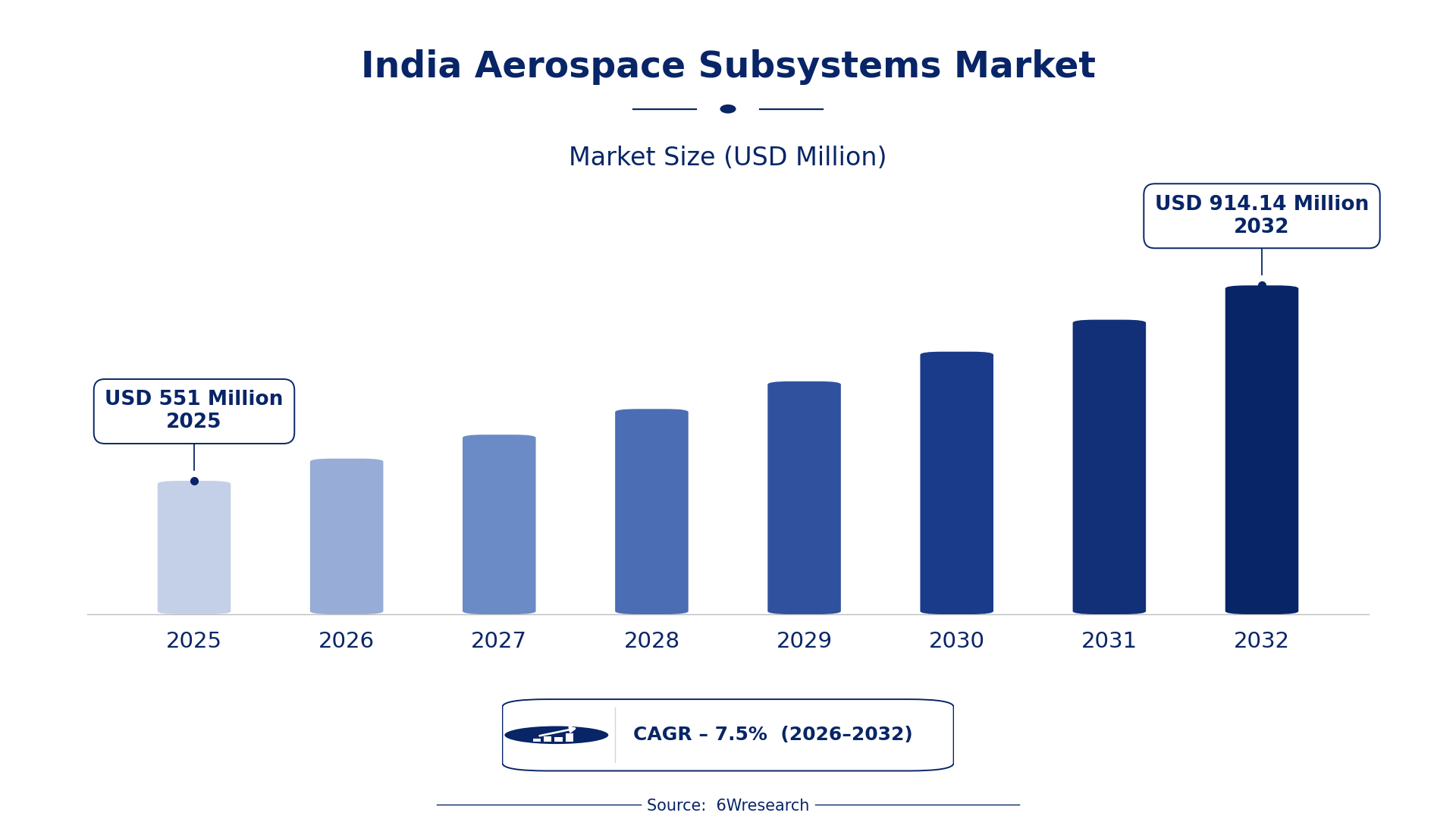
According to 6Wresearch internal database and industry insights, the India Aerospace Subsystems Market was valued at USD 551.0 million in 2025 and is projected to reach USD 914.14 million by 2032, growing at a CAGR of approximately 7.5% during 2026–2032.
India Aerospace Subsystems Market Highlights
| Report Metric | Details |
| Report Name | India Aerospace Subsystems Market |
| Market Size 2025 | USD 551.0 million |
| Market Size 2032 | USD 914.14 million |
| Absolute Growth 2025–2032 | USD 363.14 million |
| CAGR 2026–2032 | 7.5% |
| Peak Annual Growth | 9.7% in 2030 |
| Forecast Period | 2026–2032 |
| Historical Data | 2022–2025 |
| Base Year | 2025 |
| Leading Aerospace Subsystems, 2025 | Flight Control (38% share) |
| Leading Subsystem Type, 2025 | Electrical (56% share) |
| Leading Technology Type, 2025 | Power Electronics (38% share) |
| Leading Distribution Channel, 2025 | OEMs (44% share) |
| Leading End User, 2025 | Commercial Aviation (38% share) |
| Fastest-Growing Aerospace Subsystems | Power Subsystems (9.0% CAGR) |
| Fastest-Growing Subsystem Type | Digital (9.4% CAGR) |
| Fastest-Growing Distribution Channel | Tier-1 Suppliers (9.9% CAGR) |
| Fastest-Growing End User | UAVs (8.6% CAGR) |
| Growing Sector | Commercial Aviation |
| Key End Users | OEMs, Tier-1 Suppliers, Military, Civil Aviation |
India Aerospace Subsystems Market Year-wise Growth Rate and Key Drivers (2022–2032)
This graph illustrates the annual growth rates of the market from 2022 to 2032, highlighting a steady upward trajectory and projected market expansion over the forecast period.
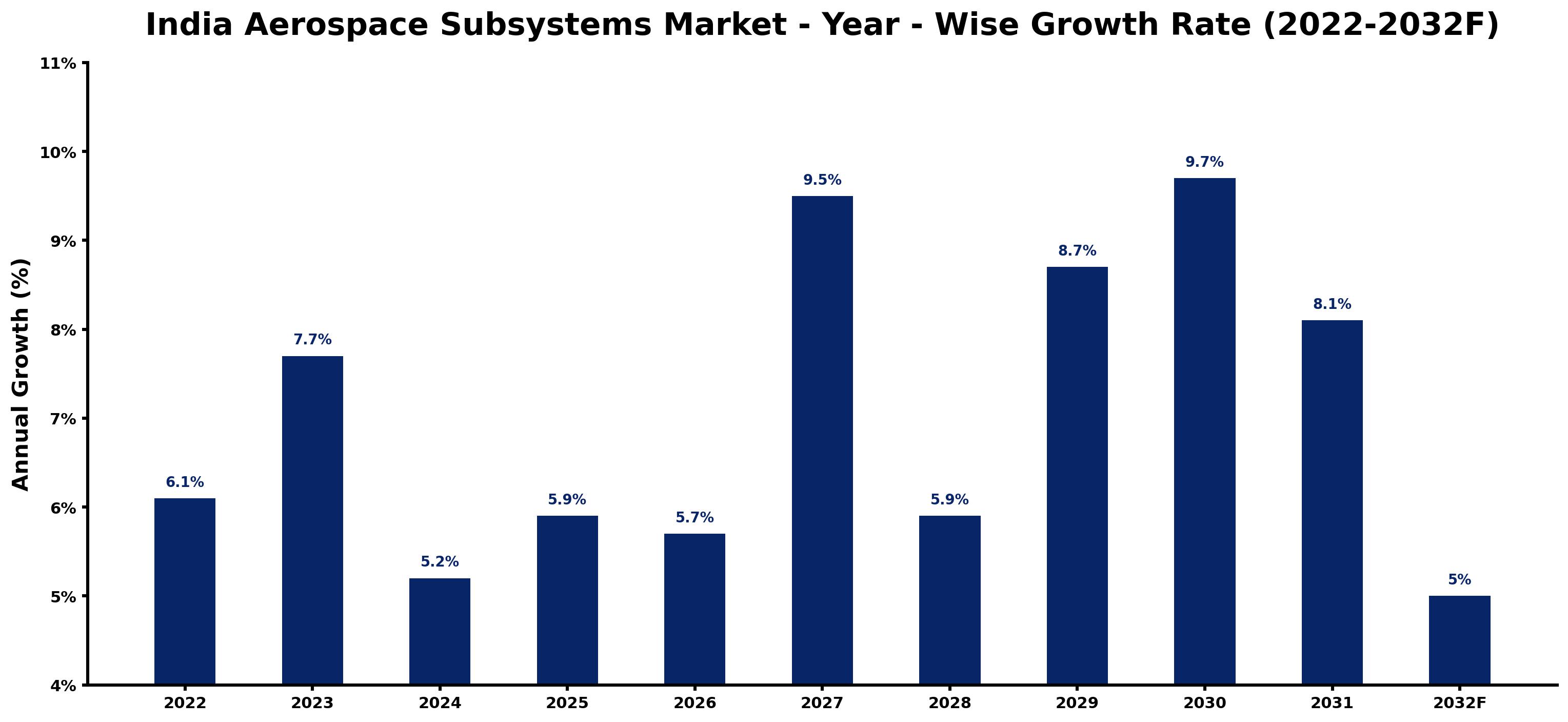
Each row of the following table gives one year's estimated growth and the event or demand shift that explains it.
| Year | Estimated Annual Growth (%) | Market Rationale |
| 2022 | 6.1 | The market showed steady growth due to ongoing aerospace projects and demand. |
| 2023 | 7.7 | Growth accelerated as the Indian Air Force expanded its fleet and capabilities. |
| 2024 | 5.2 | A slowdown occurred as project timelines adjusted and demand stabilised. |
| 2025 | 5.9 | Demand picked up again with increased focus on domestic manufacturing initiatives. |
| 2026 | 5.7 | Growth slowed due to market adjustments and project completion phases. |
| 2027 | 9.5 | A surge in demand was driven by advancements in UAV technologies. |
| 2028 | 5.9 | The market experienced a slowdown as demand normalised after rapid growth. |
| 2029 | 8.7 | Demand rose again as investments in aerospace infrastructure increased. |
| 2030 | 9.7 | The market peaked due to significant government support and initiatives. |
| 2031 | 8.1 | Growth slowed as the market adjusted to new operational standards. |
| 2032 | 5.0 | A further slowdown occurred as the market stabilised after peak growth. |
Note: Market size estimations and growth projections presented in this report are based on 6Wresearch's proprietary forecasting methodology, utilizing the latest available industry data, government publications, and primary research inputs.
India Aerospace Subsystems Market Synopsis
Aerospace Subsystems Market in India encompasses vital components necessary for the operation of aircraft and spacecraft. These subsystems, which include navigation, environmental control, and power systems, are produced through sophisticated engineering processes. The market is growing due to initiatives promoting domestic production and international partnerships, with an anticipated size of USD 914.14 million by 2032. Key growth drivers include the expanding fleet of the Indian Air Force and the Make in India initiative, aimed at enhancing local manufacturing capabilities.
Market Dynamics Impact Analysis (2026–2032)
| Factor | Type | Impact | Primary Segment Affected |
| Increasing domestic production initiatives | Driver | High | Flight Control |
| Expansion of the Indian Air Force fleet | Driver | High | Flight Control |
| Growing demand for UAV technologies | Opportunity | High | Flight Control |
| Investment in aerospace infrastructure | Opportunity | High | Flight Control |
| Challenges in meeting quality standards | Restraint | High | Flight Control |
| Dependence on skilled workforce | Restraint | High | Flight Control |
| High costs of advanced technology adoption | Challenge | Medium | Flight Control |
| Long lead times for procurement processes | Challenge | Medium | Flight Control |
Evaluation of Drivers in India Aerospace Subsystems Market (2026–2032)
Below mentioned are some major drivers and their influence on market dynamics.
| Drivers | Primary Segment Affected | Why It Matters (Evidence) |
| Increased government investment in aerospace R&D | Flight Control | The government allocated ₹1,000 crores for aerospace research and development in 2022, driving demand for innovative subsystems. |
| Expansion of the Indian Air Force fleet | Flight Control | The Indian Air Force operates over 1,500 aircraft, creating a consistent demand for subsystems. |
| Make in India initiative promoting local manufacturing | Flight Control | The initiative aims for 70% localization by 2025, boosting domestic production of aerospace components. |
| Growth in commercial aviation sector | Commercial Aviation | Commercial aviation is the largest market segment, accounting for 38% of the aerospace subsystems market. |
| Advancements in UAV technologies | Flight Control | The UAV segment is growing rapidly, with an expected CAGR of 8.6% from 2026 to 2032. |
With over 1,500 aircraft in operation, the Indian Air Force generates steady demand for these components. The commercial aviation sector, which represents 38% of the market, continues to expand, further driving purchases. Moreover, advancements in UAV technologies are projected to contribute to a CAGR of 8.6% from 2026 to 2032, boosting the need for specialised subsystems.
Evaluation of Restraints in India Aerospace Subsystems Market
The table below lists the restraints and the evidence behind each.
| Market Restraint | Primary Segment Affected | Why It Matters (Evidence) |
| Challenges in meeting quality standards | Flight Control | The Bureau of Indian Standards sets stringent quality requirements, impacting production timelines and costs. |
| Dependence on skilled workforce | Flight Control | The aerospace industry requires highly skilled professionals, and a shortage can delay project completions. |
| High costs of advanced technology adoption | Flight Control | Investing in advanced technologies can strain budgets, particularly for smaller manufacturers, limiting their competitiveness. |
| Long lead times for procurement processes | Flight Control | The Defence Acquisition Procedure can extend timelines, affecting project delivery schedules and overall efficiency. |
| Limited access to international markets | Flight Control | Regulatory hurdles can restrict export opportunities for Indian aerospace manufacturers, impacting growth potential. |
India Aerospace Subsystems Market Challenges
The India Aerospace Subsystems Market faces several practical problems, starting with regulatory hurdles. The Bureau of Indian Standards enforces stringent quality standards, leading to delays in product approvals for manufacturers, which affects their ability to meet market demand promptly. A lack of skilled professionals is another challenge; with the aerospace workforce projected to reach only 1 million by 2025, this limits the availability of qualified engineers and technicians for production roles. Technology limitations persist as many local firms struggle with outdated engineering processes, which hampers innovation and operational efficiency. Competition from established international players further pressures local suppliers, compelling them to lower prices, which can compromise quality and profitability for domestic manufacturers.
Trends in the India Aerospace Subsystems Market
Several trends are reshaping the India Aerospace Subsystems Market; the most important are set out below.
- Shift towards UAV Technologies: The Indian aerospace sector is increasingly prioritising UAV technologies, driven by military and commercial applications. The UAV segment is projected to grow at a CAGR of 8.6% from 2026 to 2032, indicating a shift in investment priorities.
- Growing Emphasis on Local Manufacturing: The Make in India initiative is transforming the aerospace sector, targeting 70% localization by 2025. This focus on local manufacturing is expected to strengthen supply chain resilience and decrease reliance on imports.
- Transition from Traditional to Digital Systems: Aerospace manufacturers are embracing digital technologies to boost efficiency and integration. The Digital subsystem segment is anticipated to grow at a CAGR of 9.4% from 2026 to 2032, reflecting this transition.
- Increased Investment in Aerospace Infrastructure: Bangalore is emerging as a key hub for aerospace manufacturing, hosting numerous companies and research institutions. This region is expected to attract substantial investments, further supporting the aerospace sector.
Investment Opportunities in the India Aerospace Subsystems Market
Some of the investment opportunities in the India Aerospace Subsystems Market are mentioned below.
- Investment Gap in Advanced Technologies: With the Indian government aiming to increase the aerospace sector's GDP share to 3% by 2025, there is a notable investment gap in advanced technologies. This presents opportunities for Tier-1 suppliers to enhance their offerings.
- Supply of Power Electronics Components: Power Electronics is a critical subsystem expected to see significant growth. Suppliers can target OEMs in the aerospace sector to meet rising demand for these components.
- Partnerships for Local Manufacturing: The Make in India initiative encourages partnerships between local firms and international players. Collaborating with local manufacturers in Bangalore can facilitate entry into the aerospace market.
- Development of Environmental Control Systems: With increasing focus on passenger comfort, there is a growing demand for Environmental Control Systems. Suppliers can target the commercial aviation sector, which is set to expand significantly.
Government Initiatives in the India Aerospace Subsystems Market
The National Aerospace and Defence Policy was updated in 2021 by the Ministry of Defence to strengthen local production capabilities and improve quality standards for aerospace subsystems. This policy aims to reduce reliance on imports and enhance indigenous capabilities. Additionally, the Aerospace and Defence Manufacturing Policy introduced in 2020 promotes domestic manufacturing and foreign investment, further supporting the growth of the sector.
The Defence Research and Development Organisation (DRDO) launched a ₹500 crore programme in 2022 to develop advanced aerospace technologies. This initiative stimulates innovation and supports local manufacturers in creating advanced subsystems. The Ministry of Civil Aviation also approved the National Civil Aviation Policy in 2016, which promotes growth in the aerospace sector and enhances infrastructure, benefiting both producers and buyers.
Future Insight of the India Aerospace Subsystems Market
Several forward-looking factors should support the India Aerospace Subsystems Market over the coming years. The National Aerospace Policy aims to position India as a global aerospace hub by 2035, driving investment and innovation in the sector. The Make in India initiative will enhance domestic manufacturing capabilities, creating a more robust supply chain. By 2025, the Indian government intends to increase the aerospace sector's GDP contribution to 3%, which will provide additional funding and resources for development. The Indian Air Force's operation of a fleet exceeding 1,500 aircraft will continue to stimulate demand for advanced subsystems.
Market Segmentation Analysis
Each segment group is reviewed below, with the leader by share and the fastest grower by CAGR.
By Aerospace Subsystems – Flight Control Dominated, Power Subsystems Expected to Grow Fastest
According to Ravi Bhandari, Research Head at 6Wresearch, Flight Control took a 38% share of aerospace subsystems in 2025, more than any other category. Flight control systems are vital for ensuring aircraft maneuverability and safety, which is why they dominate the market. The Indian Air Force's fleet of over 1,500 aircraft consistently drives demand for these essential subsystems. Power Subsystems are set to record the highest CAGR in this split, 9.0% over 2026–2032. Power subsystems are experiencing rapid growth due to the increasing focus on energy-efficient technologies in modern aircraft. This trend aligns with government initiatives aimed at boosting local production in the aerospace sector. Suppliers should concentrate on developing advanced power subsystem solutions to cater to the rising demand in the aerospace market.
By Subsystem Type – Electrical Dominated, Digital Expected to Grow Fastest
Electrical accounted for a 56% market share by subsystem type in 2025. Electrical subsystems are crucial for powering various electronic components in aircraft, establishing their leading position in the market. The aerospace industry's growth increases reliance on electrical systems for enhanced functionality and efficiency. Digital is projected to grow fastest, at a CAGR of 9.4% during 2026–2032. Digital subsystems are gaining prominence as they are essential for data processing and system integration in advanced aircraft. The complexity of aerospace technologies drives the demand for sophisticated digital solutions, contributing to their rapid growth. Buyers should prioritise sourcing advanced digital subsystems to maintain competitiveness in the evolving aerospace sector.
By Technology Type – Power Electronics Dominated and Is Expected to Record the Fastest Growth
The largest technology type category in 2025 was Power Electronics, with a 38% share of total revenue. Power electronics are fundamental for efficient power management in aerospace subsystems, securing their leading position in the market. As the aerospace sector seeks to optimise performance and reduce energy consumption, power electronics play a critical role. Its lead should widen, with a projected CAGR of 10.1% during 2026–2032, the highest in this split. The power electronics segment is also the fastest-growing due to the increasing demand for energy-efficient technologies in aircraft. This dual role as both leader and fastest indicates a sustained focus on power management solutions in aerospace. Suppliers must invest in power electronics innovations to capitalise on the growing market opportunities.
By Distribution Channel – OEMs Dominated, Tier-1 Suppliers Expected to Grow Fastest
In 2025, OEMs led the distribution channel split with a 44% share. OEMs are the primary manufacturers of aerospace subsystems, securing the largest share in the distribution channel. Their established capabilities and relationships in producing high-quality components generate substantial demand in the market. Over 2026–2032, Tier-1 Suppliers are expected to post the fastest growth, at a CAGR of 9.9%. Tier-1 suppliers are rapidly expanding their market presence as they provide critical components to OEMs, reflecting a shift towards collaborative supply chains in the industry. This growth signifies a trend towards outsourcing and partnerships in aerospace manufacturing. Suppliers should consider strategic partnerships with Tier-1 suppliers to enhance their market reach and competitiveness.
By End User – Commercial Aviation Dominated, UAVs Expected to Grow Fastest
Commercial Aviation held a 38% share of the India Aerospace Subsystems Market by end user in 2025. Commercial aviation represents the largest market segment for aerospace subsystems, bolstered by the increasing number of air travel passengers in India. With a population of approximately 1.4 billion, demand for commercial aviation subsystems is projected to rise significantly. UAVs are set to record the highest CAGR in this split, 8.6% over 2026–2032. UAVs are emerging as the fastest-growing segment in aerospace, driven by the rising interest in unmanned aerial technologies for various applications. Government initiatives promoting aerospace innovation and development support the expansion of UAV usage. Buyers should explore opportunities in the UAV segment to leverage rapid growth and technological advancements in aerospace.
Key Attractiveness of the Report
- 10 Years of Market Numbers
- Historical Data Starting from 2022 to 2025
- Base Year 2025
- Forecast Data until 2032
- Key Performance Indicators Impacting the Market
- Major Upcoming Developments and Projects
Key Highlights of the Report:
- India Aerospace Subsystems Market Outlook
- Market Size of India Aerospace Subsystems Market, 2025
- Forecast of India Aerospace Subsystems Market, 2032
- Historical Data and Forecast of India Aerospace Subsystems Revenues & Volume for the Period 2022 - 2032F
- India Aerospace Subsystems Market Trend Evolution
- India Aerospace Subsystems Market Drivers and Challenges
- India Aerospace Subsystems Price Trends
- India Aerospace Subsystems Porter's Five Forces
- India Aerospace Subsystems Industry Life Cycle
- Historical Data and Forecast of India Aerospace Subsystems Market Revenues & Volume By Aerospace Subsystems for the Period 2022 - 2032F
- Historical Data and Forecast of India Aerospace Subsystems Market Revenues & Volume By Flight Control for the Period 2022 - 2032F
- Historical Data and Forecast of India Aerospace Subsystems Market Revenues & Volume By Power Subsystems for the Period 2022 - 2032F
- Historical Data and Forecast of India Aerospace Subsystems Market Revenues & Volume By Navigation Systems for the Period 2022 - 2032F
- Historical Data and Forecast of India Aerospace Subsystems Market Revenues & Volume By Environmental Control for the Period 2022 - 2032F
- Historical Data and Forecast of India Aerospace Subsystems Market Revenues & Volume By Subsystem Type for the Period 2022 - 2032F
- Historical Data and Forecast of India Aerospace Subsystems Market Revenues & Volume By Mechanical for the Period 2022 - 2032F
- Historical Data and Forecast of India Aerospace Subsystems Market Revenues & Volume By Electrical for the Period 2022 - 2032F
- Historical Data and Forecast of India Aerospace Subsystems Market Revenues & Volume By Digital for the Period 2022 - 2032F
- Historical Data and Forecast of India Aerospace Subsystems Market Revenues & Volume By Pneumatic for the Period 2022 - 2032F
- Historical Data and Forecast of India Aerospace Subsystems Market Revenues & Volume By Technology Type for the Period 2022 - 2032F
- Historical Data and Forecast of India Aerospace Subsystems Market Revenues & Volume By Hydraulic for the Period 2022 - 2032F
- Historical Data and Forecast of India Aerospace Subsystems Market Revenues & Volume By Power Electronics for the Period 2022 - 2032F
- Historical Data and Forecast of India Aerospace Subsystems Market Revenues & Volume By GPS/INS for the Period 2022 - 2032F
- Historical Data and Forecast of India Aerospace Subsystems Market Revenues & Volume By HVAC Systems for the Period 2022 - 2032F
- Historical Data and Forecast of India Aerospace Subsystems Market Revenues & Volume By Distribution Channel for the Period 2022 - 2032F
- Historical Data and Forecast of India Aerospace Subsystems Market Revenues & Volume By OEMs for the Period 2022 - 2032F
- Historical Data and Forecast of India Aerospace Subsystems Market Revenues & Volume By Tier-1 Suppliers for the Period 2022 - 2032F
- Historical Data and Forecast of India Aerospace Subsystems Market Revenues & Volume By Online Platforms for the Period 2022 - 2032F
- Historical Data and Forecast of India Aerospace Subsystems Market Revenues & Volume By Direct Sales for the Period 2022 - 2032F
- Historical Data and Forecast of India Aerospace Subsystems Market Revenues & Volume By End User for the Period 2022 - 2032F
- Historical Data and Forecast of India Aerospace Subsystems Market Revenues & Volume By Commercial Aviation for the Period 2022 - 2032F
- Historical Data and Forecast of India Aerospace Subsystems Market Revenues & Volume By Military Aircraft for the Period 2022 - 2032F
- Historical Data and Forecast of India Aerospace Subsystems Market Revenues & Volume By UAVs for the Period 2022 - 2032F
- Historical Data and Forecast of India Aerospace Subsystems Market Revenues & Volume By Spacecraft for the Period 2022 - 2032F
- India Aerospace Subsystems Import Export Trade Statistics
- Market Opportunity Assessment By Aerospace Subsystems
- Market Opportunity Assessment By Subsystem Type
- Market Opportunity Assessment By Technology Type
- Market Opportunity Assessment By Distribution Channel
- Market Opportunity Assessment By End User
- India Aerospace Subsystems Top Companies Market Share
- India Aerospace Subsystems Competitive Benchmarking By Technical and Operational Parameters
- India Aerospace Subsystems Company Profiles
- India Aerospace Subsystems Key Strategic Recommendations
Market Covered
Segments analysed in this report are listed below.
By Aerospace Subsystems
- Flight Control
- Power Subsystems
- Navigation Systems
- Environmental Control
By Subsystem Type
- Mechanical
- Electrical
- Digital
- Pneumatic
By Technology Type
- Hydraulic
- Power Electronics
- GPS/INS
- HVAC Systems
By Distribution Channel
- OEMs
- Tier-1 Suppliers
- Online Platforms
- Direct Sales
By End User
- Commercial Aviation
- Military Aircraft
- UAVs
- Spacecraft






































