China Aerospace Subsystems Market Size & Growth Rate
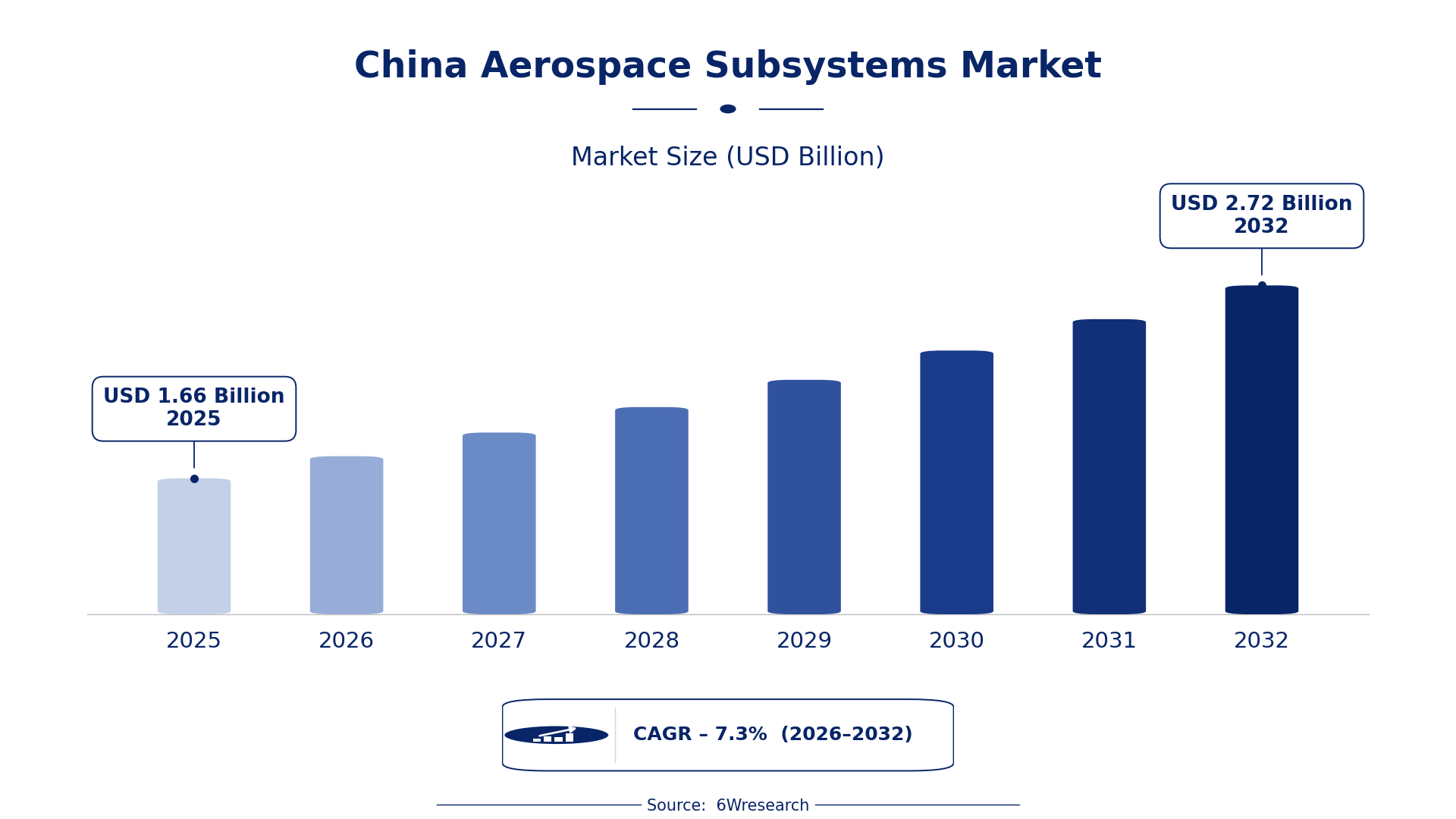
According to 6Wresearch internal database and industry insights, the China Aerospace Subsystems Market was valued at USD 1.66 billion in 2025 and is projected to reach USD 2.72 billion by 2032, growing at a CAGR of approximately 7.3% during 2026–2032.
China Aerospace Subsystems Market Highlights
| Report Metric | Details |
| Report Name | China Aerospace Subsystems Market |
| Market Size 2025 | USD 1.66 billion |
| Market Size 2032 | USD 2.72 billion |
| Absolute Growth 2025–2032 | USD 1.06 billion |
| CAGR 2026–2032 | 7.3% |
| Peak Annual Growth | 9.6% in 2028 |
| Forecast Period | 2026–2032 |
| Historical Data | 2022–2025 |
| Base Year | 2025 |
| Leading Aerospace Subsystems, 2025 | Flight Control (48% share) |
| Leading Subsystem Type, 2025 | Mechanical (39% share) |
| Leading Technology Type, 2025 | Hydraulic (40% share) |
| Leading Distribution Channel, 2025 | OEMs (41% share) |
| Leading End User, 2025 | Commercial Aviation (51% share) |
| Fastest-Growing Aerospace Subsystems | Power Subsystems (8.6% CAGR) |
| Fastest-Growing Subsystem Type | Electrical (9.2% CAGR) |
| Fastest-Growing Technology Type | Power Electronics (8.9% CAGR) |
| Fastest-Growing Distribution Channel | Tier-1 Suppliers (9.1% CAGR) |
| Fastest-Growing End User | Military Aircraft (9.5% CAGR) |
| Growing Sector | Military Aircraft |
| Key End Users | Commercial Aviation, Military Aircraft, UAVs, Spacecraft |
China Aerospace Subsystems Market Year-wise Growth Rate and Key Drivers (2022–2032)
This graph illustrates the annual growth rates of the market from 2022 to 2032, highlighting a steady upward trajectory and projected market expansion over the forecast period.
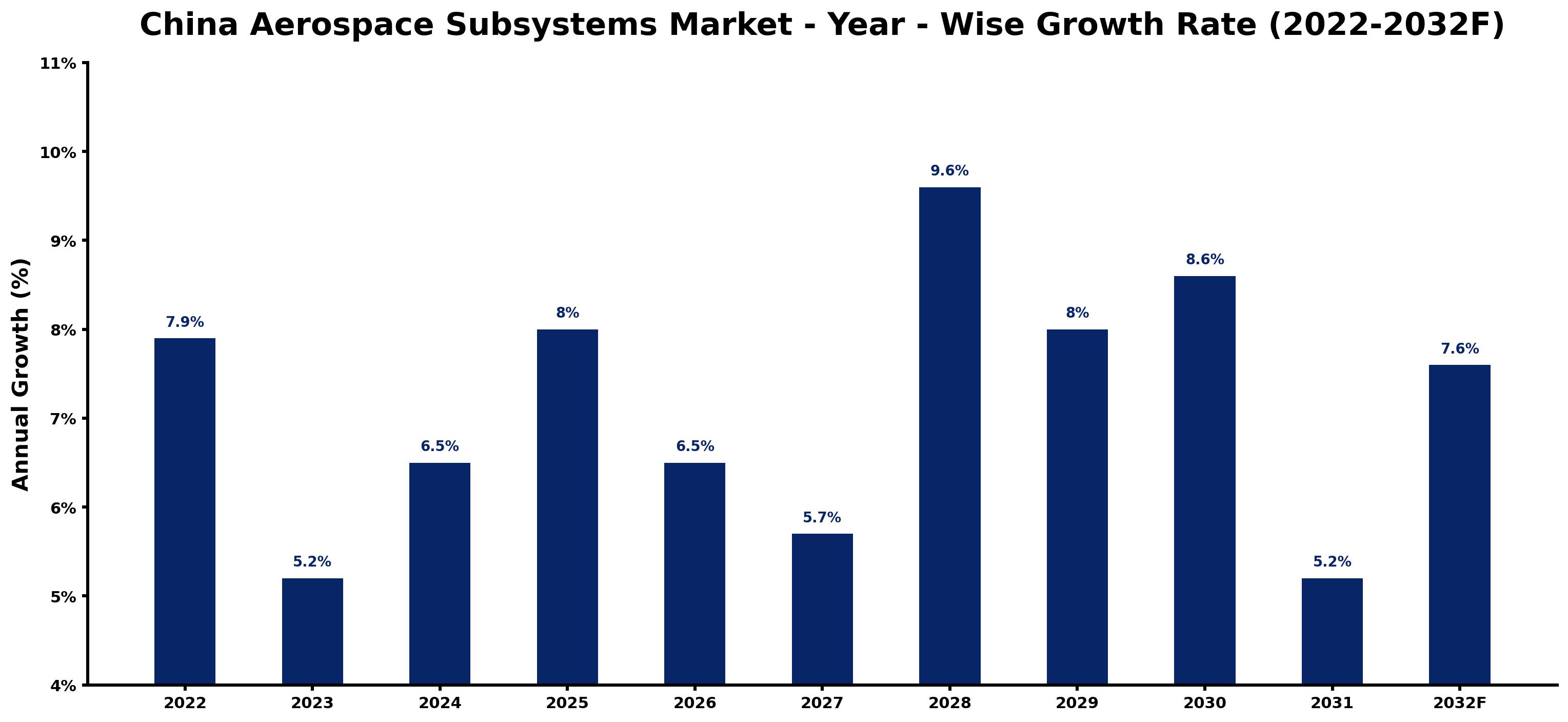
The table below sets out the estimated growth rate for each year and the main factor behind it.
| Year | Estimated Annual Growth (%) | Market Rationale |
| 2022 | 7.9 | The market experienced solid growth due to increased domestic demand for aerospace subsystems. |
| 2023 | 5.2 | Growth slowed as the sector adjusted to supply chain challenges and market conditions. |
| 2024 | 6.5 | A recovery in growth occurred as investments in aerospace technology began to pick up pace. |
| 2025 | 8.0 | The market reached its historical peak, driven by significant military budget allocations for aerospace development. |
| 2026 | 6.5 | Growth slowed again as the market faced challenges in meeting rising production demands. |
| 2027 | 5.7 | Continued supply chain issues contributed to a further slowdown in growth rates. |
| 2028 | 9.6 | A surge in demand for military aircraft drove the market to its peak annual growth rate. |
| 2029 | 8.0 | Growth slowed as the market stabilised after the peak demand period. |
| 2030 | 8.6 | An increase in commercial aviation demand contributed to a faster growth rate. |
| 2031 | 5.2 | Growth slowed again as the market adjusted to previous high levels of activity. |
| 2032 | 7.6 | The market is expected to grow as investments in space exploration and technology continue. |
Note: Market size estimations and growth projections presented in this report are based on 6Wresearch's proprietary forecasting methodology, utilizing the latest available industry data, government publications, and primary research inputs.
China Aerospace Subsystems Market Synopsis
Aerospace Subsystems Market in China encompasses critical components essential for aircraft and spacecraft operations. These subsystems include flight control, power management, and navigation systems, manufactured using advanced materials and technologies. The China Aerospace Subsystems Market is expanding due to robust domestic demand from both commercial and military sectors. Investments in space exploration and military aerospace technology are driving this growth, with the market projected to reach 2.72 billion USD by 2032.
Market Dynamics Impact Analysis (2026–2032)
| Factor | Type | Impact | Primary Segment Affected |
| Increased military budget allocations for aerospace technology development | Driver | High | Power Subsystems |
| Growing domestic demand for commercial aviation | Driver | High | Flight Control |
| Rising investments in space exploration initiatives | Opportunity | High | Navigation Systems |
| Expansion of partnerships for aerospace technology exchange | Opportunity | High | Environmental Control |
| Supply chain disruptions affecting production timelines | Restraint | High | Mechanical |
| High costs associated with advanced materials and technologies | Restraint | Medium | Electrical |
| Challenges in meeting international quality standards | Challenge | High | Digital |
| Competition from established aerospace markets | Challenge | Medium | Hydraulic |
Evaluation of Drivers in China Aerospace Subsystems Market (2026–2032)
The factors lifting demand, and the evidence behind each, are summarised below.
| Drivers | Primary Segment Affected | Why It Matters (Evidence) |
| Increased military budget allocations for aerospace technology development | Power Subsystems | The military budget for aerospace technology development is projected to exceed 200 billion yuan by 2025, driving demand for advanced power management systems. |
| Growing domestic demand for commercial aviation | Flight Control | China's population of approximately 1.4 billion drives demand for commercial aviation, increasing the need for reliable flight control subsystems. |
| Rising investments in space exploration initiatives | Navigation Systems | The goal to launch over 40 space missions annually by 2025 boosts demand for advanced navigation systems in aerospace applications. |
| Expansion of partnerships for aerospace technology exchange | Environmental Control | China's partnerships with over 30 countries for aerospace technology exchange support the development of environmental control systems. |
| Increasing focus on quality management standards | Mechanical | The widespread adoption of ISO 9001 in aerospace manufacturing ensures high-quality mechanical subsystems, driving demand. |
Expansion of the Aerospace Subsystems market in China is backed by increased military budget allocations and growing domestic demand for commercial aviation. The military budget for aerospace technology development is projected to exceed 200 billion yuan by 2025, driving demand for advanced power management systems. With a population of approximately 1.4 billion, the demand for commercial aviation is rising, leading to an increased need for reliable flight control systems. The goal to launch over 40 space missions annually by 2025 drives demand for advanced navigation systems. Partnerships with over 30 countries for technology exchange further support the development of environmental control systems.
Evaluation of Restraints in China Aerospace Subsystems Market
The main factors holding the market back are set out below.
| Market Restraint | Primary Segment Affected | Why It Matters (Evidence) |
| Supply chain disruptions affecting production timelines | Mechanical | Supply chain disruptions have led to delays in the production of mechanical subsystems, impacting delivery schedules. |
| High costs associated with advanced materials and technologies | Electrical | The use of advanced materials in electrical subsystems raises production costs, limiting market accessibility for some manufacturers. |
| Challenges in meeting international quality standards | Digital | Manufacturers face difficulties in adhering to international quality standards, hindering export opportunities. |
| Intense competition from established aerospace markets | Hydraulic | Competition from established aerospace markets can limit market share for emerging players in hydraulic subsystems. |
| Limited availability of skilled workforce | Power Subsystems | The aerospace workforce in China is estimated to exceed 1 million professionals by 2025, but shortages in specific skill sets remain. |
China Aerospace Subsystems Market Challenges
The China Aerospace Subsystems market still has to solve a few problems, with the first being high production costs. Rising material prices and complex manufacturing processes burden producers, which can inflate prices for buyers in the commercial aviation sector. Supply chain disruptions in key regions like Beijing and Shanghai can extend production timelines, delaying deliveries for buyers who require timely access to aerospace subsystems. Regulatory hurdles from the CAAC's stringent standards complicate operations for manufacturers and can postpone product certification, affecting market entry for new technologies and limiting options for buyers.
Trends in the China Aerospace Subsystems Market
The trends below show where the China Aerospace Subsystems Market is heading.
- Increased Focus on Navigation Systems: The National Space Administration of China (CNSA) is prioritising the development of navigation systems for upcoming space missions. With a target of launching over 40 space missions annually by 2025, this focus will drive demand for advanced navigation technologies.
- Growing Investment in Aerospace R&D: China's 'Aerospace Innovation and Development Strategy' introduced in 2022 allocates 50 billion yuan annually for R&D. This investment highlights the country's commitment to advancing aerospace technologies and improving subsystem performance.
- Surge in Military Aircraft Production: The military aircraft segment is expected to grow at a CAGR of 9.5% from 2026 to 2032. This growth is driven by increased military budget allocations and the need for advanced aerospace subsystems.
- Development of Aerospace Manufacturing Hubs: Beijing and Shanghai are emerging as key regions for aerospace manufacturing and R&D. With significant investments in infrastructure, these hubs are set to attract more aerospace projects and enhance production capabilities.
Investment Opportunities in the China Aerospace Subsystems Market
Several openings in the China Aerospace Subsystems Market merit attention from investors.
- Increased Demand for Space Missions: With China aiming to launch over 40 space missions annually by 2025, there is a strong opportunity for suppliers of navigation and control systems to meet this demand.
- Emerging Need for Advanced Subsystem Technologies: The aerospace sector's projected market size of 1 trillion yuan by 2030 indicates a gap for advanced subsystem technologies, particularly in power management and navigation systems.
- Investment in Aerospace Manufacturing Initiatives: The 'Made in China 2025' initiative encourages investment in aerospace manufacturing, presenting opportunities for local partnerships and technology transfers.
- Entry through Strategic Partnerships: Establishing joint ventures with local manufacturers can facilitate entry into the growing aerospace market, particularly in regions like Beijing and Shanghai.
Government Initiatives in the China Aerospace Subsystems Market
The '14th Five-Year Plan for National Economic and Social Development' outlines support for aerospace innovation, led by the National Development and Reform Commission in 2021. This plan aims to improve domestic production capabilities and streamline the aerospace supply chain. The 'Civil Aviation Development Plan' initiated by the Civil Aviation Administration of China in 2020 aims to double the number of airports by 2035, improving accessibility for commercial aviation and driving demand for aerospace subsystems. The 'Space Industry Development Plan' launched by the Ministry of Industry and Information Technology in 2021 focuses on increasing satellite production capacity, targeting 200 satellites annually by 2025, which will support capabilities for aerospace applications.
The Ministry of Industry and Information Technology (MIIT) oversees several initiatives that fund aerospace projects, including the 'Aerospace Innovation and Development Strategy' introduced in 2022. This strategy allocates an annual budget of 50 billion yuan for R&D collaboration in the aerospace sector. Furthermore, the National Space Administration of China (CNSA) is responsible for approving space exploration initiatives, which significantly impacts the demand for advanced aerospace subsystems. The CAAC also plays a role in regulating the sector, ensuring that safety and quality standards are met, thereby building market confidence.
Future Insight of the China Aerospace Subsystems Market
The China Aerospace Subsystems market is set for significant changes by 2032, driven by strategic initiatives and investments. The 'Made in China 2025' initiative will improve manufacturing capabilities, while the military budget for aerospace technology development is expected to exceed 200 billion yuan by 2025, boosting innovation. The goal of increasing operational satellites to over 500 by 2025 will create demand for advanced subsystems. Additionally, the planned launch of over 40 space missions annually will provide new opportunities for suppliers, encouraging collaboration and technological advancements.
Market Segmentation Analysis
Each segment group is reviewed below, with the leader by share and the fastest grower by CAGR.
By Aerospace Subsystems – Flight Control Dominated, Power Subsystems Expected to Grow Fastest
According to Ravi Bhandari, Research Head at 6Wresearch, Flight Control took a 48% share of aerospace subsystems in 2025, more than any other category. Flight control systems are vital for aircraft safety and manoeuvrability, making them the preferred choice among manufacturers. The substantial demand for commercial aviation in China further solidifies the market share of flight control subsystems. Over 2026–2032, Power Subsystems are expected to post the fastest growth, at a CAGR of 8.6%. Power subsystems are growing quickly due to the rising need for efficient energy management in aerospace applications. The introduction of advanced aircraft, such as the C919, significantly drives this segment's expansion. Suppliers should focus on enhancing their power subsystem offerings to meet the increasing demand in the aerospace sector.
By Subsystem Type – Mechanical Dominated, Electrical Expected to Grow Fastest
Mechanical held a 39% share of the China Aerospace Subsystems Market by subsystem type in 2025. Mechanical subsystems are fundamental for various physical operations in aerospace applications, securing their leading market share. Their extensive use in aircraft design and manufacturing processes reinforces their dominant position in the market. Electrical is projected to grow fastest, at a CAGR of 9.2% during 2026–2032. Electrical subsystems are expanding rapidly as they are crucial for powering electronic components in modern aerospace systems. The industry's growing reliance on advanced technology in aircraft is propelling this segment's growth. Buyers should prioritise suppliers that specialise in electrical subsystems to ensure they integrate cutting-edge technology into their aerospace projects.
By Technology Type – Hydraulic Dominated, Power Electronics Expected to Grow Fastest
The largest technology type category in 2025 was Hydraulic, with a 40% share of total revenue. Hydraulic technology is widely used for actuation and control in aerospace systems, which contributes to its leading market share. Its reliability and effectiveness in critical operations make it a preferred choice for manufacturers. Power Electronics is set to record the highest CAGR in this split, 8.9% over 2026–2032. Power electronics are experiencing rapid growth due to their key role in efficient power conversion and management in aerospace applications. The demand for energy-efficient solutions is driving this segment's fast-paced development. Suppliers must invest in power electronics technology to meet the increasing demand for efficiency in aerospace subsystems.
By Distribution Channel – OEMs Dominated, Tier-1 Suppliers Expected to Grow Fastest
With a 41% revenue share in 2025, OEMs was the largest distribution channel category. OEMs are the primary manufacturers of aerospace subsystems, granting them the largest share in the market. Their established relationships with aerospace companies ensure consistent demand for their products, solidifying their market position. The quickest growth will come from Tier-1 Suppliers, forecast to expand at a CAGR of 9.1% between 2026 and 2032. Tier-1 suppliers are experiencing rapid growth as they provide essential components to OEMs, reflecting the increasing complexity of aerospace manufacturing. This trend is expected to persist as the industry continues to expand. Suppliers should strengthen partnerships with Tier-1 suppliers to enhance their market presence and reach within the aerospace sector.
By End User – Commercial Aviation Dominated, Military Aircraft Expected to Grow Fastest
In 2025, Commercial Aviation led the end user split with a 51% share. Commercial aviation is a significant user of aerospace subsystems, driving its leading share in the market. The rising demand for air travel in China greatly supports this segment's position and market share. Over 2026–2032, Military Aircraft is expected to post the fastest growth, at a CAGR of 9.5%. Military aircraft are witnessing rapid growth as they are major consumers of aerospace subsystems for defence applications. The increasing military budget for aerospace technology development is a key factor in this segment's expansion. Buyers in the military sector should seek suppliers that can provide advanced aerospace subsystems to meet their evolving defence requirements.
Key Attractiveness of the Report
- 10 Years of Market Numbers
- Historical Data Starting from 2022 to 2025
- Base Year 2025
- Forecast Data until 2032
- Key Performance Indicators Impacting the Market
- Major Upcoming Developments and Projects
Key Highlights of the Report:
- China Aerospace Subsystems Market Outlook
- Market Size of China Aerospace Subsystems Market, 2025
- Forecast of China Aerospace Subsystems Market, 2032
- Historical Data and Forecast of China Aerospace Subsystems Revenues & Volume for the Period 2022 - 2032F
- China Aerospace Subsystems Market Trend Evolution
- China Aerospace Subsystems Market Drivers and Challenges
- China Aerospace Subsystems Price Trends
- China Aerospace Subsystems Porter's Five Forces
- China Aerospace Subsystems Industry Life Cycle
- Historical Data and Forecast of China Aerospace Subsystems Market Revenues & Volume By Aerospace Subsystems for the Period 2022 - 2032F
- Historical Data and Forecast of China Aerospace Subsystems Market Revenues & Volume By Flight Control for the Period 2022 - 2032F
- Historical Data and Forecast of China Aerospace Subsystems Market Revenues & Volume By Power Subsystems for the Period 2022 - 2032F
- Historical Data and Forecast of China Aerospace Subsystems Market Revenues & Volume By Navigation Systems for the Period 2022 - 2032F
- Historical Data and Forecast of China Aerospace Subsystems Market Revenues & Volume By Environmental Control for the Period 2022 - 2032F
- Historical Data and Forecast of China Aerospace Subsystems Market Revenues & Volume By Subsystem Type for the Period 2022 - 2032F
- Historical Data and Forecast of China Aerospace Subsystems Market Revenues & Volume By Mechanical for the Period 2022 - 2032F
- Historical Data and Forecast of China Aerospace Subsystems Market Revenues & Volume By Electrical for the Period 2022 - 2032F
- Historical Data and Forecast of China Aerospace Subsystems Market Revenues & Volume By Digital for the Period 2022 - 2032F
- Historical Data and Forecast of China Aerospace Subsystems Market Revenues & Volume By Pneumatic for the Period 2022 - 2032F
- Historical Data and Forecast of China Aerospace Subsystems Market Revenues & Volume By Technology Type for the Period 2022 - 2032F
- Historical Data and Forecast of China Aerospace Subsystems Market Revenues & Volume By Hydraulic for the Period 2022 - 2032F
- Historical Data and Forecast of China Aerospace Subsystems Market Revenues & Volume By Power Electronics for the Period 2022 - 2032F
- Historical Data and Forecast of China Aerospace Subsystems Market Revenues & Volume By GPS/INS for the Period 2022 - 2032F
- Historical Data and Forecast of China Aerospace Subsystems Market Revenues & Volume By HVAC Systems for the Period 2022 - 2032F
- Historical Data and Forecast of China Aerospace Subsystems Market Revenues & Volume By Distribution Channel for the Period 2022 - 2032F
- Historical Data and Forecast of China Aerospace Subsystems Market Revenues & Volume By OEMs for the Period 2022 - 2032F
- Historical Data and Forecast of China Aerospace Subsystems Market Revenues & Volume By Tier-1 Suppliers for the Period 2022 - 2032F
- Historical Data and Forecast of China Aerospace Subsystems Market Revenues & Volume By Online Platforms for the Period 2022 - 2032F
- Historical Data and Forecast of China Aerospace Subsystems Market Revenues & Volume By Direct Sales for the Period 2022 - 2032F
- Historical Data and Forecast of China Aerospace Subsystems Market Revenues & Volume By End User for the Period 2022 - 2032F
- Historical Data and Forecast of China Aerospace Subsystems Market Revenues & Volume By Commercial Aviation for the Period 2022 - 2032F
- Historical Data and Forecast of China Aerospace Subsystems Market Revenues & Volume By Military Aircraft for the Period 2022 - 2032F
- Historical Data and Forecast of China Aerospace Subsystems Market Revenues & Volume By UAVs for the Period 2022 - 2032F
- Historical Data and Forecast of China Aerospace Subsystems Market Revenues & Volume By Spacecraft for the Period 2022 - 2032F
- China Aerospace Subsystems Import Export Trade Statistics
- Market Opportunity Assessment By Aerospace Subsystems
- Market Opportunity Assessment By Subsystem Type
- Market Opportunity Assessment By Technology Type
- Market Opportunity Assessment By Distribution Channel
- Market Opportunity Assessment By End User
- China Aerospace Subsystems Top Companies Market Share
- China Aerospace Subsystems Competitive Benchmarking By Technical and Operational Parameters
- China Aerospace Subsystems Company Profiles
- China Aerospace Subsystems Key Strategic Recommendations
Market Covered
The report offers an extensive study of the following market segments.
By Aerospace Subsystems
- Flight Control
- Power Subsystems
- Navigation Systems
- Environmental Control
By Subsystem Type
- Mechanical
- Electrical
- Digital
- Pneumatic
By Technology Type
- Hydraulic
- Power Electronics
- GPS/INS
- HVAC Systems
By Distribution Channel
- OEMs
- Tier-1 Suppliers
- Online Platforms
- Direct Sales
By End User
- Commercial Aviation
- Military Aircraft
- UAVs
- Spacecraft






































