India Aerospace Surveillance Systems Market Size & Growth Rate
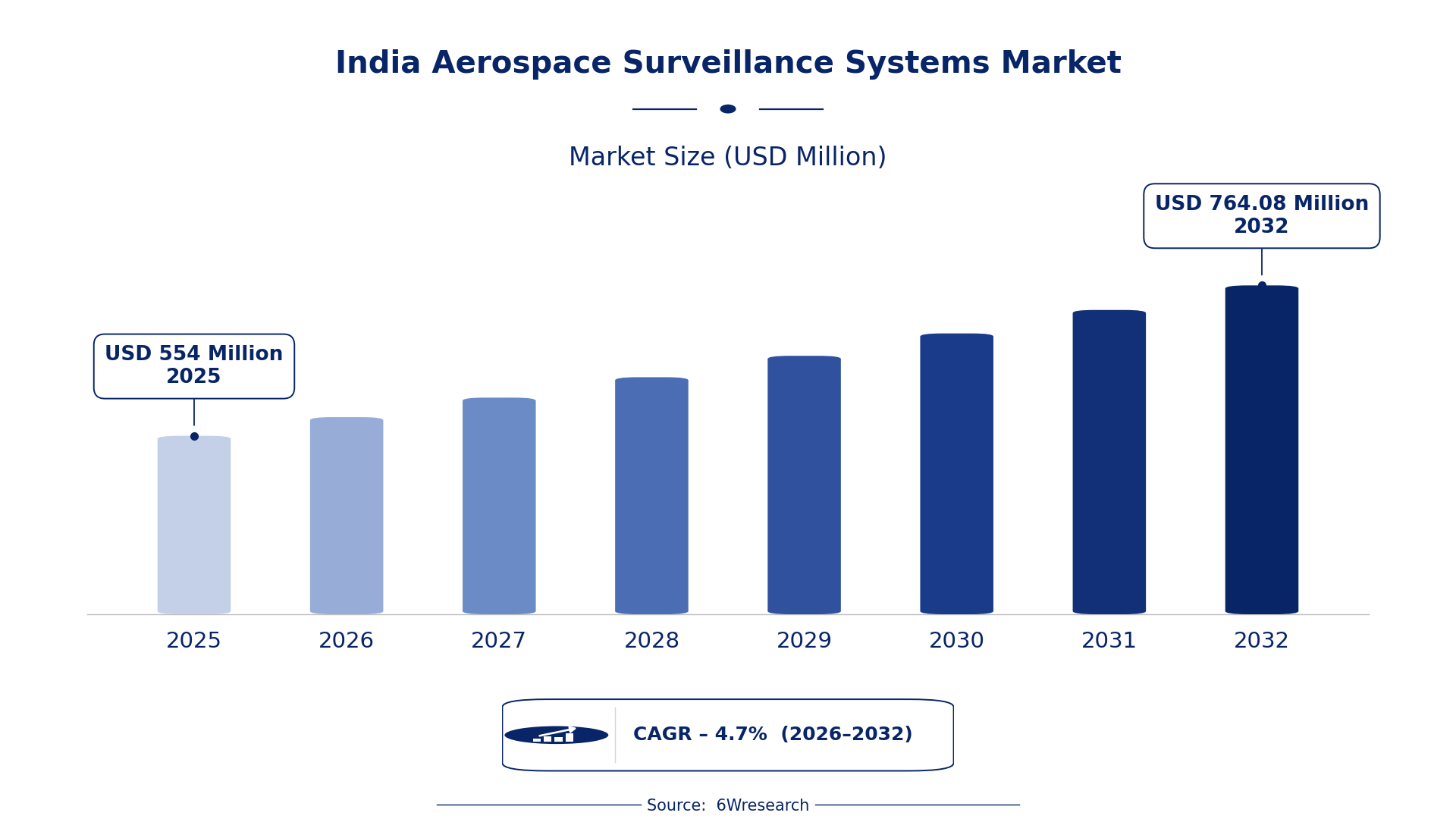
According to 6Wresearch internal database and industry insights, the India Aerospace Surveillance Systems Market was valued at USD 554.0 million in 2025 and is projected to reach USD 764.08 million by 2032, growing at a CAGR of approximately 4.7% during 2026–2032.
India Aerospace Surveillance Systems Market Highlights
| Report Metric | Details |
| Report Name | India Aerospace Surveillance Systems Market |
| Market Size 2025 | USD 554.0 million |
| Market Size 2032 | USD 764.08 million |
| Absolute Growth 2025–2032 | USD 210.08 million |
| CAGR 2026–2032 | 4.7% |
| Peak Annual Growth | 6.4% in 2032 |
| Forecast Period | 2026–2032 |
| Historical Data | 2022–2025 |
| Base Year | 2025 |
| Leading Surveillance Systems, 2025 | Radar Systems (45% share) |
| Leading System Type, 2025 | Ground-based (42% share) |
| Leading Technology Used, 2025 | Doppler (40% share) |
| Leading Distribution Channel, 2025 | Government Contracts (43% share) |
| Leading End User, 2025 | Air Traffic Control (42% share) |
| Fastest-Growing Surveillance Systems | AIS & ADS-B (6.9% CAGR) |
| Fastest-Growing System Type | Airborne (7.3% CAGR) |
| Fastest-Growing Technology Used | Infrared/Optical (6.1% CAGR) |
| Fastest-Growing End User | Civil Aviation (6.2% CAGR) |
| Growing Sector | Civil Aviation |
| Key End Users | Air Traffic Control, Military Surveillance, Civil Aviation, Defense Agencies |
India Aerospace Surveillance Systems Market Year-wise Growth Rate and Key Drivers (2022–2032)
This graph illustrates the annual growth rates of the market from 2022 to 2032, highlighting a steady upward trajectory and projected market expansion over the forecast period.
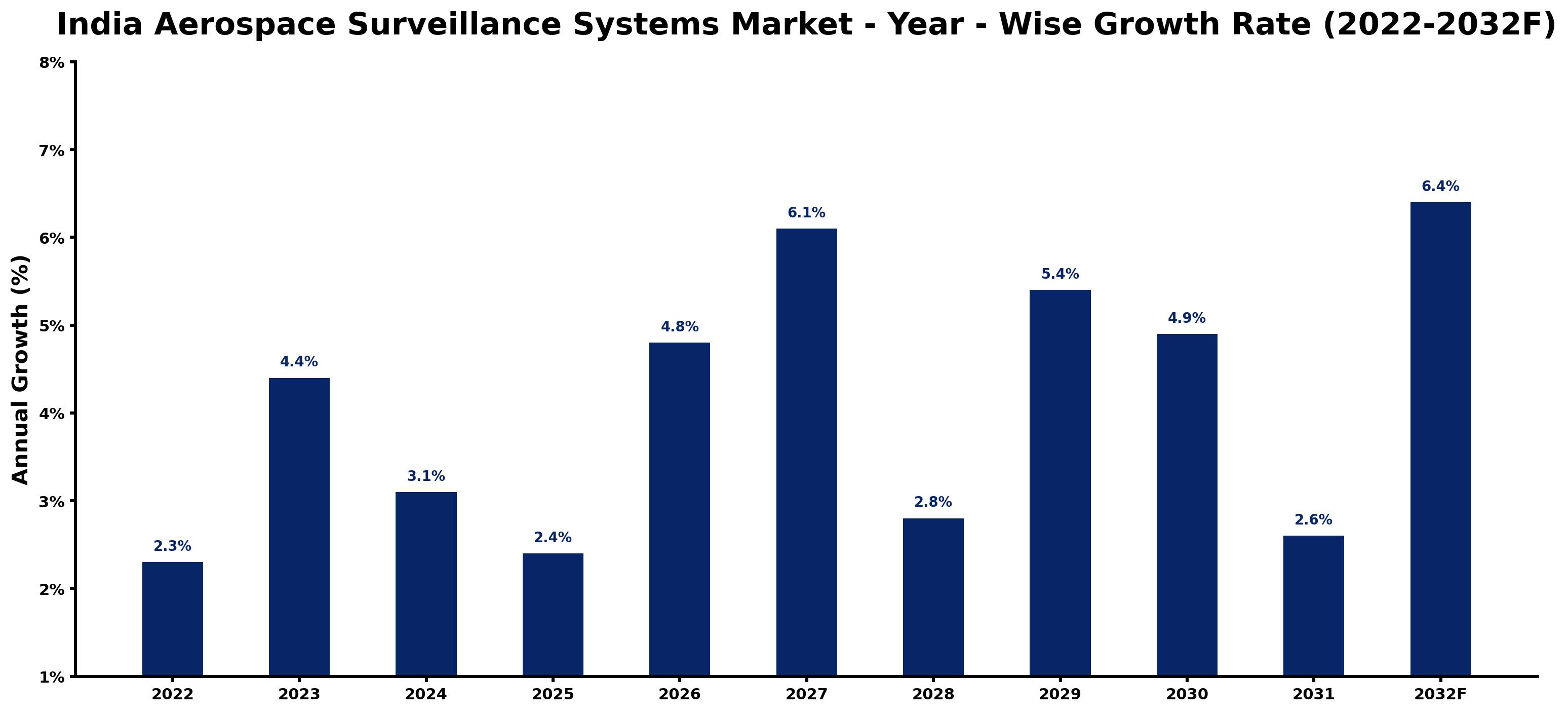
Year by year, the estimates below pair each growth rate with the development that shaped it.
| Year | Estimated Annual Growth (%) | Market Rationale |
| 2022 | 2.3 | The market experienced steady growth due to ongoing upgrades in air traffic management systems. |
| 2023 | 4.4 | Growth accelerated as the Indian Air Force improved its radar capabilities for surveillance. |
| 2024 | 3.1 | A slowdown occurred as investments in indigenous technologies faced temporary delays. |
| 2025 | 2.4 | Growth continued to slow as the market adjusted to new regulatory frameworks. |
| 2026 | 4.8 | Demand surged with the government's increased focus on indigenous surveillance production. |
| 2027 | 6.1 | Expansion of military surveillance needs contributed to strong growth. |
| 2028 | 2.8 | A slowdown was noted as the market faced challenges in technology integration. |
| 2029 | 5.4 | Demand rebounded as civil aviation requirements increased with passenger traffic. |
| 2030 | 4.9 | Growth slowed as the market adjusted to the completion of major projects. |
| 2031 | 2.6 | A further slowdown occurred as competition intensified among domestic suppliers. |
| 2032 | 6.4 | The market peaked with heightened investments in advanced surveillance technologies. |
Note: Market size estimations and growth projections presented in this report are based on 6Wresearch's proprietary forecasting methodology, utilizing the latest available industry data, government publications, and primary research inputs.
India Aerospace Surveillance Systems Market Synopsis
The India Aerospace Surveillance Systems Market encompasses technologies for monitoring airspace and tracking aircraft, utilising advanced engineering processes. Government initiatives, such as the National Aerospace Policy, are boosting local manufacturing capabilities and increasing investment in surveillance technologies. This growth is further supported by the expansion of air traffic management systems, which aim to improve safety and operational efficiency.
Market Dynamics Impact Analysis (2026–2032)
| Factor | Type | Impact | Primary Segment Affected |
| Increasing demand for air traffic management systems | Driver | High | Air Traffic Control |
| Growing military expenditure focusing on surveillance technologies | Driver | High | Military Surveillance |
| Investment in indigenous manufacturing of surveillance systems | Opportunity | High | Radar Systems |
| Expansion of civil aviation infrastructure and services | Opportunity | High | Civil Aviation |
| High costs associated with advanced technology integration | Restraint | Medium | EO/IR Systems |
| Limited availability of skilled workforce for advanced systems | Restraint | Medium | Ground-based |
| Challenges in meeting international standards for surveillance | Challenge | High | Satellite-based |
| Dependency on government contracts for revenue generation | Challenge | Medium | Government Contracts |
Evaluation of Drivers in India Aerospace Surveillance Systems Market (2026–2032)
The table below links each growth driver to the segment it affects and the evidence for it.
| Drivers | Primary Segment Affected | Why It Matters (Evidence) |
| Increased passenger traffic requiring efficient air traffic management | Air Traffic Control | India's civil aviation sector is projected to handle 1 billion passengers by 2030, prompting demand for advanced systems. |
| Rising military budgets focused on surveillance capabilities | Military Surveillance | India's military expenditure reached USD 76.6 billion in 2023, driving demand for advanced surveillance technologies. |
| Government initiatives promoting local manufacturing | Radar Systems | The 'Make in India' initiative aims to boost domestic production, increasing procurement from local manufacturers. |
| Modernisation of air traffic control systems | Civil Aviation | The Indian government allocated INR 1,500 crore for upgrading air traffic management systems in 2023, enhancing operational efficiency. |
| Growing need for real-time data in military operations | EO/IR Systems | The Indian Air Force operates advanced radar systems, necessitating improved surveillance capabilities for effective operations. |
Growth in the Aerospace Surveillance Systems market in India comes from rising passenger traffic, military investments, and government initiatives. The civil aviation sector is projected to handle 1 billion passengers by 2030, driving demand for advanced air traffic management systems. Military expenditure reached USD 76.6 billion in 2023, focusing on surveillance capabilities. The government allocated INR 1,500 crore for upgrading air traffic management systems in 2023, boosting procurement from local manufacturers. The 'Make in India' initiative encourages local production of surveillance technologies, further increasing demand from military and civil aviation sectors.
Evaluation of Restraints in India Aerospace Surveillance Systems Market
Below mentioned are some major restraints and their influence on market dynamics.
| Market Restraint | Primary Segment Affected | Why It Matters (Evidence) |
| High costs for advanced technology integration | EO/IR Systems | Investments in advanced technologies can deter smaller firms from entering the market, limiting competition. |
| Shortage of skilled workforce for advanced systems | Ground-based | The need for specialised training in surveillance technologies creates hiring challenges for manufacturers. |
| Challenges in meeting international surveillance standards | Satellite-based | Compliance with international regulations can delay product approvals and market entry, impacting timelines. |
| Dependency on government contracts for revenue | Government Contracts | A leading supplier on public sector procurement can lead to revenue fluctuations based on government budget allocations. |
| Limited market awareness of advanced systems | Radar Systems | Potential buyers may lack understanding of the benefits of modern surveillance technologies, hindering adoption. |
India Aerospace Surveillance Systems Market Challenges
The India Aerospace Surveillance Systems market still has to solve a few problems, with high costs being a primary concern for buyers. The average expenditure on advanced surveillance technologies can exceed INR 100 crore, making it difficult for smaller operators to afford necessary upgrades. Competition among suppliers often leads to aggressive pricing strategies, which can compromise quality and reliability of systems, ultimately affecting buyers' operational efficiency. Rapid technological advancements create a gap; many producers struggle to keep pace with innovations, causing delays in system updates and impacting service delivery. Regulatory compliance complicates matters; evolving standards from the Bureau of Civil Aviation Security can increase costs and extend approval times for new technologies.
Trends in the India Aerospace Surveillance Systems Market
Buyers and suppliers in the India Aerospace Surveillance Systems Market are adjusting to the following trends.
- Shift towards Indigenous Manufacturing: India is increasingly focusing on domestic production of aerospace surveillance systems. The 'Make in India' initiative, launched in 2021, aims to boost local manufacturing, with a budget of INR 10,000 crore allocated.
- Transition to Advanced Air Traffic Management Systems: The National Air Traffic Management Plan, approved in 2022, is modernising air traffic control systems. This initiative aims to improve safety and efficiency across India's 450 airports.
- Emergence of Civil Aviation as a Key End User: Civil aviation is becoming a major driver for surveillance systems, with a projected CAGR of 6.2% from 2026 to 2032. The growing passenger traffic necessitates improved safety measures and operational efficiency.
- Growing Military Surveillance Capabilities: The Indian Army is expanding its surveillance capabilities with new technologies in 2023. Military expenditure reached USD 76.6 billion, highlighting the focus on advanced surveillance systems.
Investment Opportunities in the India Aerospace Surveillance Systems Market
Below are the investment opportunities with the strongest case in the India Aerospace Surveillance Systems Market.
- Investment Gap in Advanced Surveillance Technologies: With India's military expenditure at USD 76.6 billion, there is a notable opportunity to invest in advanced surveillance technologies for military applications, particularly in indigenous systems.
- Supply of Ground-based Surveillance Systems: The need for efficient air traffic control systems presents an opportunity to supply ground-based surveillance systems. The Airports Authority of India manages 137 airports, requiring upgraded technologies for enhanced safety.
- Demand from Civil Aviation Sector: As the civil aviation sector is projected to handle 1 billion passengers by 2030, there is a pressing need for advanced surveillance systems. Collaborating with local manufacturers can facilitate market entry and growth.
- Expansion of Military Surveillance Capabilities: The Indian Army's focus on expanding surveillance technologies creates an opportunity for suppliers. Engaging with defense agencies can lead to fruitful partnerships and increased procurement.
Government Initiatives in the India Aerospace Surveillance Systems Market
The National Civil Aviation Policy 2020 aims to improve air traffic management and safety standards, overseen by the Ministry of Civil Aviation. This policy mandates upgrades to existing systems, ensuring compliance with international regulations. The Defense Acquisition Procedure 2020 encourages indigenous production of surveillance systems, promoting self-reliance in defense. This procedure requires that a certain percentage of contracts be awarded to local manufacturers, strengthening domestic capabilities. The Aerospace and Defense Manufacturing Policy 2021 promotes investment in surveillance technologies, targeting a 20% increase in local production by 2025, thus bolstering the local supply chain.
The Ministry of Defense supports various funding programs aimed at enhancing surveillance technologies, facilitating research and development initiatives. The Defense Research and Development Organization is involved in developing indigenous surveillance systems, ensuring that local manufacturers are equipped to meet market demands. The Indian Space Research Organisation is also contributing to satellite-based surveillance systems, which are vital for global tracking and communication. These measures collectively aim to boost the aerospace surveillance systems market in India.
Future Insight of the India Aerospace Surveillance Systems Market
The India Aerospace Surveillance Systems market is expected to evolve significantly by 2032, driven by several key factors. The government’s commitment to upgrading air traffic management systems, with an allocation of INR 1,500 crore in 2023, will enhance operational capabilities for buyers. Initiatives like the 'Make in India' programme will stimulate local manufacturing, reducing reliance on foreign imports. Collaborations between the Indian Air Force and the Defense Research and Development Organization will drive the development of advanced technologies, strengthening national security.
Market Segmentation Analysis
The report offers a comprehensive study of the following market segments and their leading categories in the market.
By Surveillance Systems – Radar Systems Dominated, AIS & ADS-B Expected to Grow Fastest
According to Ravi Bhandari, Research Head at 6Wresearch, with a 45% revenue share in 2025, Radar Systems was the largest surveillance systems category. Radar Systems hold the largest market share as they are fundamental for tracking and monitoring air traffic, essential for both civil and military applications. The Indian Air Force's deployment of advanced radar systems underscores their critical role in effective surveillance operations. AIS & ADS-B is projected to grow fastest, at a CAGR of 6.9% during 2026–2032. AIS & ADS-B is experiencing rapid growth due to its increasing necessity for aircraft identification and tracking, particularly as India's civil aviation sector is set to handle 1 billion passengers by 2030. This technology's integration into air traffic management systems is a key factor driving its expansion. Suppliers should focus on advancing AIS & ADS-B technologies to cater to the rising demand within the civil aviation market.
By System Type – Ground-based Dominated, Airborne Expected to Grow Fastest
Ground-based accounted for a 42% market share by system type in 2025. Ground-based systems hold the largest share as they are extensively used for air traffic control and military installations throughout India. The Airports Authority of India manages 137 airports, relying on these systems for efficient operations and safety. Over 2026–2032, Airborne is expected to post the fastest growth, at a CAGR of 7.3%. Airborne systems are experiencing swift growth, driven by their deployment in military and surveillance aircraft for real-time data collection. The Indian Army's ongoing expansion of surveillance capabilities in 2023 underscores this trend. Buyers will increasingly seek advanced airborne systems to improve operational effectiveness in surveillance.
By Technology Used – Doppler Dominated, Infrared/Optical Expected to Grow Fastest
Doppler held a 40% share of the India Aerospace Surveillance Systems Market by technology used in 2025. Doppler technology leads the market due to its critical role in accurately measuring the speed and direction of aircraft, which is vital for air traffic management and military operations. This technology is integral to the radar systems employed by the Indian Air Force. The quickest growth will come from Infrared/Optical, forecast to expand at a CAGR of 6.1% between 2026 and 2032. Infrared/Optical technology is rapidly growing, as it is essential for surveillance and target acquisition in military applications. The Indian government's investment in upgrading radar systems will likely drive further adoption of this technology. Suppliers should focus on developing advanced infrared/optical technologies to cater to the increasing military demand.
By Distribution Channel – Government Contracts Dominated and Is Expected to Record the Fastest Growth
The largest distribution channel category in 2025 was Government Contracts, with a 43% share of total revenue. Government Contracts dominate the distribution channel, representing a significant source of revenue for surveillance systems in India. The Indian government's considerable allocation of funds for upgrading air traffic management systems exemplifies this channel's importance. Its lead should widen, with a projected CAGR of 7.4% during 2026–2032, the highest in this split. Government Contracts are also the fastest-growing distribution channel, as ongoing defence initiatives and civil aviation improvements generate steady demand. The government's ongoing commitment to enhancing surveillance capabilities will further reinforce this channel's growth trajectory. Suppliers need to align their efforts to secure government contracts, which are vital for achieving success in the market.
By End User – Air Traffic Control Dominated, Civil Aviation Expected to Grow Fastest
In 2025, Air Traffic Control led the end user split with a 42% share. Air Traffic Control is the leading end user of surveillance systems, as it is essential for maintaining safety and efficiency in airspace management. With over 450 airports in India, the demand for effective air traffic control systems remains high. Civil Aviation is projected to grow fastest, at a CAGR of 6.2% during 2026–2032. Civil Aviation is the fastest-growing end user, driven by the projected increase in passenger numbers to 1 billion by 2030. This surge in air travel necessitates improved safety and operational efficiency measures. Buyers in civil aviation should prioritise investments in advanced surveillance systems to ensure safety and compliance.
Key Attractiveness of the Report
- 10 Years of Market Numbers
- Historical Data Starting from 2022 to 2025
- Base Year 2025
- Forecast Data until 2032
- Key Performance Indicators Impacting the Market
- Major Upcoming Developments and Projects
Key Highlights of the Report:
- India Aerospace Surveillance Systems Market Outlook
- Market Size of India Aerospace Surveillance Systems Market, 2025
- Forecast of India Aerospace Surveillance Systems Market, 2032
- Historical Data and Forecast of India Aerospace Surveillance Systems Revenues & Volume for the Period 2022 - 2032F
- India Aerospace Surveillance Systems Market Trend Evolution
- India Aerospace Surveillance Systems Market Drivers and Challenges
- India Aerospace Surveillance Systems Price Trends
- India Aerospace Surveillance Systems Porter's Five Forces
- India Aerospace Surveillance Systems Industry Life Cycle
- Historical Data and Forecast of India Aerospace Surveillance Systems Market Revenues & Volume By Surveillance Systems for the Period 2022 - 2032F
- Historical Data and Forecast of India Aerospace Surveillance Systems Market Revenues & Volume By Radar Systems for the Period 2022 - 2032F
- Historical Data and Forecast of India Aerospace Surveillance Systems Market Revenues & Volume By EO/IR Systems for the Period 2022 - 2032F
- Historical Data and Forecast of India Aerospace Surveillance Systems Market Revenues & Volume By AIS & ADS-B for the Period 2022 - 2032F
- Historical Data and Forecast of India Aerospace Surveillance Systems Market Revenues & Volume By Signal Intelligence for the Period 2022 - 2032F
- Historical Data and Forecast of India Aerospace Surveillance Systems Market Revenues & Volume By System Type for the Period 2022 - 2032F
- Historical Data and Forecast of India Aerospace Surveillance Systems Market Revenues & Volume By Ground-based for the Period 2022 - 2032F
- Historical Data and Forecast of India Aerospace Surveillance Systems Market Revenues & Volume By Airborne for the Period 2022 - 2032F
- Historical Data and Forecast of India Aerospace Surveillance Systems Market Revenues & Volume By Satellite-based for the Period 2022 - 2032F
- Historical Data and Forecast of India Aerospace Surveillance Systems Market Revenues & Volume By Tactical Systems for the Period 2022 - 2032F
- Historical Data and Forecast of India Aerospace Surveillance Systems Market Revenues & Volume By Technology Used for the Period 2022 - 2032F
- Historical Data and Forecast of India Aerospace Surveillance Systems Market Revenues & Volume By Doppler for the Period 2022 - 2032F
- Historical Data and Forecast of India Aerospace Surveillance Systems Market Revenues & Volume By Infrared/Optical for the Period 2022 - 2032F
- Historical Data and Forecast of India Aerospace Surveillance Systems Market Revenues & Volume By GPS & Beacon Tech for the Period 2022 - 2032F
- Historical Data and Forecast of India Aerospace Surveillance Systems Market Revenues & Volume By RF Capture for the Period 2022 - 2032F
- Historical Data and Forecast of India Aerospace Surveillance Systems Market Revenues & Volume By Distribution Channel for the Period 2022 - 2032F
- Historical Data and Forecast of India Aerospace Surveillance Systems Market Revenues & Volume By OEMs for the Period 2022 - 2032F
- Historical Data and Forecast of India Aerospace Surveillance Systems Market Revenues & Volume By Direct Sales for the Period 2022 - 2032F
- Historical Data and Forecast of India Aerospace Surveillance Systems Market Revenues & Volume By Online Platforms for the Period 2022 - 2032F
- Historical Data and Forecast of India Aerospace Surveillance Systems Market Revenues & Volume By Government Contracts for the Period 2022 - 2032F
- Historical Data and Forecast of India Aerospace Surveillance Systems Market Revenues & Volume By End User for the Period 2022 - 2032F
- Historical Data and Forecast of India Aerospace Surveillance Systems Market Revenues & Volume By Air Traffic Control for the Period 2022 - 2032F
- Historical Data and Forecast of India Aerospace Surveillance Systems Market Revenues & Volume By Military Surveillance for the Period 2022 - 2032F
- Historical Data and Forecast of India Aerospace Surveillance Systems Market Revenues & Volume By Civil Aviation for the Period 2022 - 2032F
- Historical Data and Forecast of India Aerospace Surveillance Systems Market Revenues & Volume By Defense Agencies for the Period 2022 - 2032F
- India Aerospace Surveillance Systems Import Export Trade Statistics
- Market Opportunity Assessment By Surveillance Systems
- Market Opportunity Assessment By System Type
- Market Opportunity Assessment By Technology Used
- Market Opportunity Assessment By Distribution Channel
- Market Opportunity Assessment By End User
- India Aerospace Surveillance Systems Top Companies Market Share
- India Aerospace Surveillance Systems Competitive Benchmarking By Technical and Operational Parameters
- India Aerospace Surveillance Systems Company Profiles
- India Aerospace Surveillance Systems Key Strategic Recommendations
Market Covered
This report examines the market across the segments below.
By Surveillance Systems
- Radar Systems
- EO/IR Systems
- AIS & ADS-B
- Signal Intelligence
By System Type
- Ground-based
- Airborne
- Satellite-based
- Tactical Systems
By Technology Used
- Doppler
- Infrared/Optical
- GPS & Beacon Tech
- RF Capture
By Distribution Channel
- OEMs
- Direct Sales
- Online Platforms
- Government Contracts
By End User
- Air Traffic Control
- Military Surveillance
- Civil Aviation
- Defense Agencies































