India Aerospace Vibration Control Market Size & Growth Rate
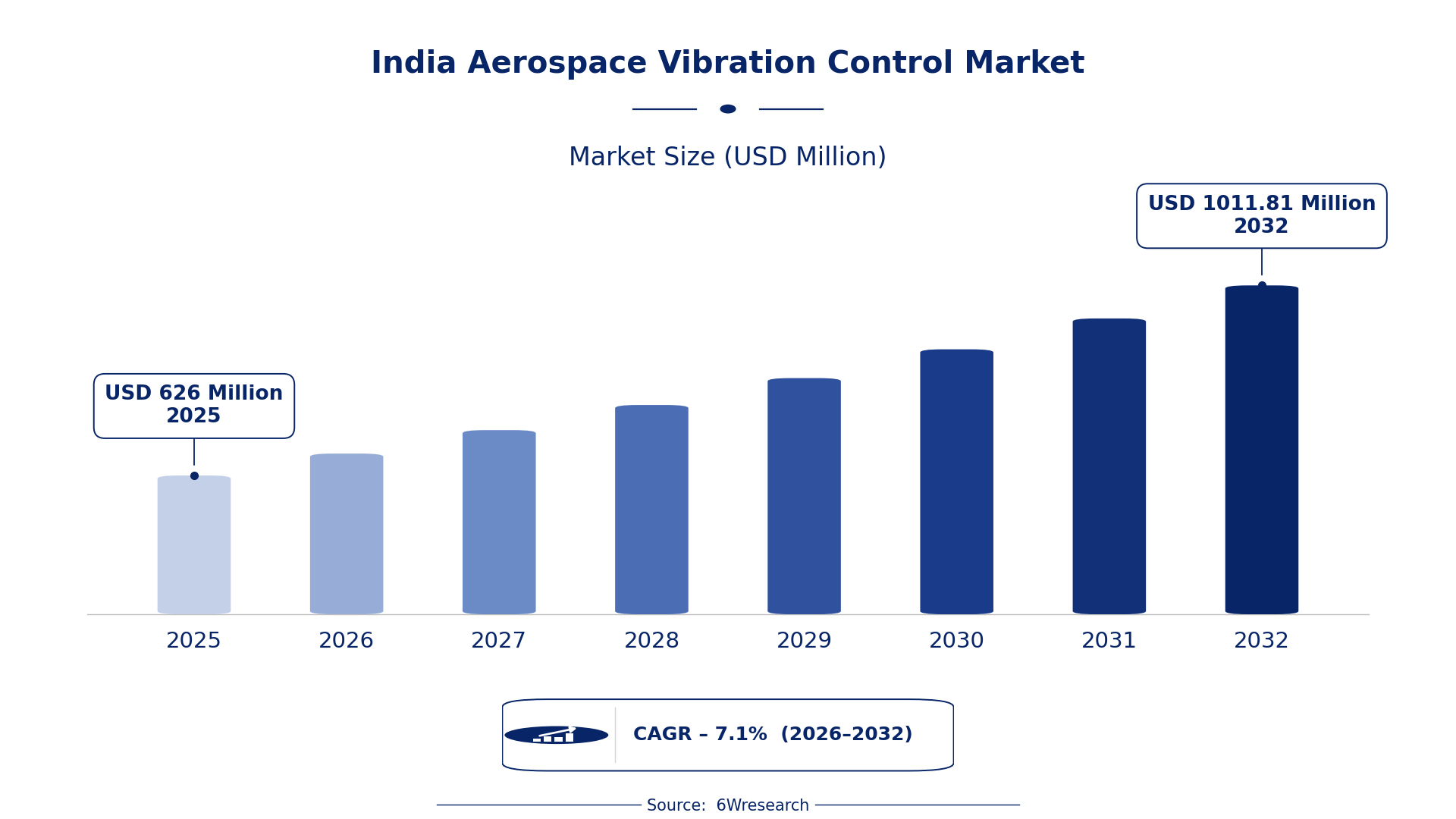
According to 6Wresearch internal database and industry insights, the India Aerospace Vibration Control Market was valued at USD 626.0 million in 2025 and is projected to reach USD 1,011.81 million by 2032, growing at a CAGR of approximately 7.1% during 2026–2032.
India Aerospace Vibration Control Market Highlights
| Report Metric | Details |
| Report Name | India Aerospace Vibration Control Market |
| Market Size 2025 | USD 626.0 million |
| Market Size 2032 | USD 1,011.81 million |
| Absolute Growth 2025–2032 | USD 385.81 million |
| CAGR 2026–2032 | 7.1% |
| Peak Annual Growth | 9.1% in 2032 |
| Forecast Period | 2026–2032 |
| Historical Data | 2022–2025 |
| Base Year | 2025 |
| Leading Vibration Control, 2025 | Dampers (39% share) |
| Leading Product Type, 2025 | Hydraulic (42% share) |
| Leading Technology, 2025 | Active Control (39% share) |
| Leading Distribution Channel, 2025 | Direct Sales (43% share) |
| Leading End User, 2025 | Aircraft Engines (51% share) |
| Fastest-Growing Vibration Control | Pads & Bushings (8.2% CAGR) |
| Fastest-Growing Product Type | Composite Materials (8.8% CAGR) |
| Fastest-Growing Distribution Channel | Online Platforms (9.7% CAGR) |
| Fastest-Growing End User | Spacecraft Components (9.1% CAGR) |
| Growing Sector | Spacecraft Components |
| Key End Users | Aircraft Engines, Defense Aircraft, Spacecraft Components, Rotorcraft |
India Aerospace Vibration Control Market Year-wise Growth Rate and Key Drivers (2022–2032)
This graph illustrates the annual growth rates of the market from 2022 to 2032, highlighting a steady upward trajectory and projected market expansion over the forecast period.
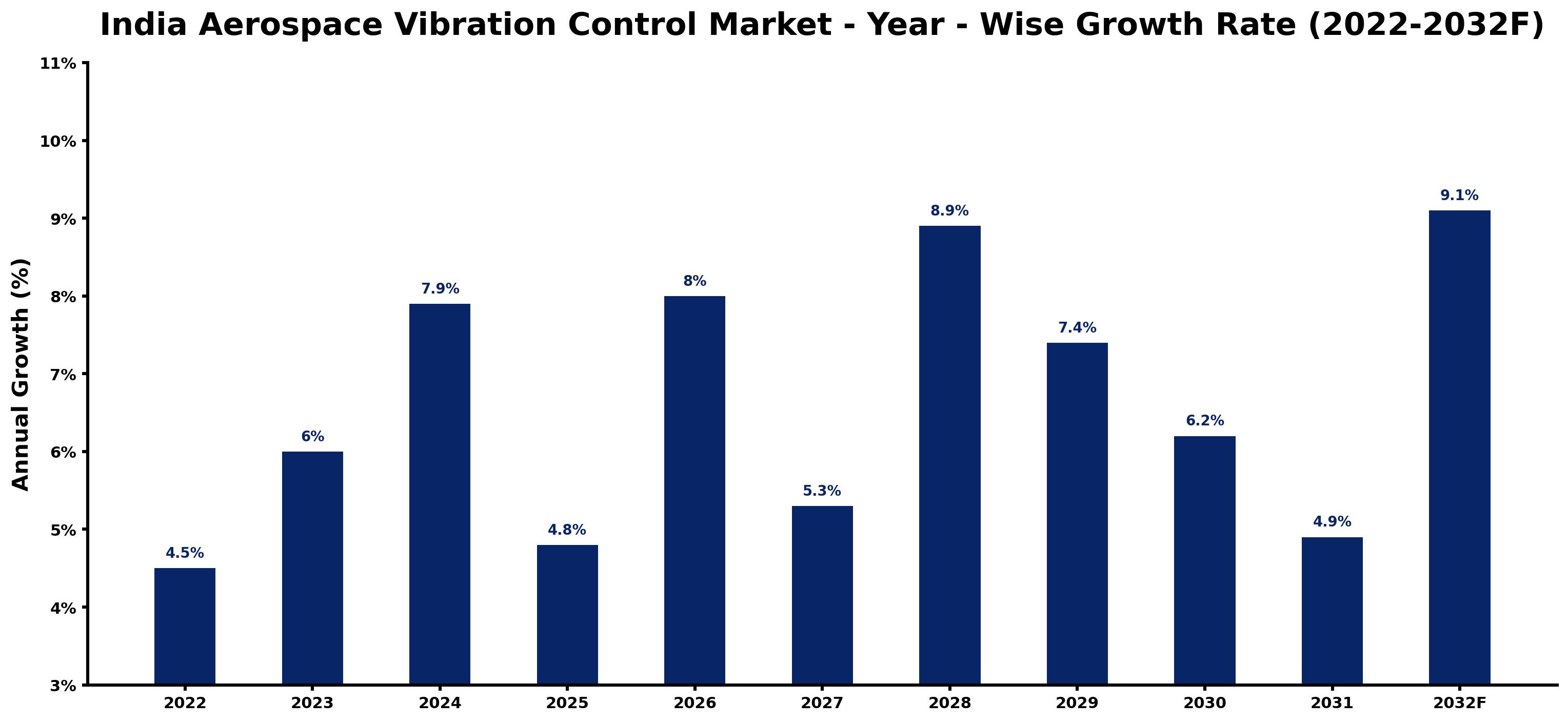
Annual growth estimates for each year appear below with the principal reason behind them, explaining the shifts that set the pace of the market.
| Year | Estimated Annual Growth (%) | Market Rationale |
| 2022 | 4.5 | The market experienced steady growth due to ongoing demand from domestic manufacturers. |
| 2023 | 6.0 | Increased investments in aerospace technology spurred growth beyond the previous year. |
| 2024 | 7.9 | The Indian Air Force's modernization efforts boosted demand for vibration control systems. |
| 2025 | 4.8 | Growth slowed as manufacturers adjusted to market conditions and demand fluctuations. |
| 2026 | 8.0 | Rising investments in aerospace research and development led to renewed growth. |
| 2027 | 5.3 | A temporary slowdown occurred as companies focused on optimizing production processes. |
| 2028 | 8.9 | The introduction of advanced vibration control technologies drove faster growth. |
| 2029 | 7.4 | Growth decelerated as the market began to stabilize after rapid expansions. |
| 2030 | 6.2 | Demand remained strong, but growth slowed due to market maturity. |
| 2031 | 4.9 | A further slowdown was noted as the market adjusted to new standards. |
| 2032 | 9.1 | The market peaked with increased investments in innovative vibration control solutions. |
Note: Market size estimations and growth projections presented in this report are based on 6Wresearch's proprietary forecasting methodology, utilizing the latest available industry data, government publications, and primary research inputs.
India Aerospace Vibration Control Market Synopsis
Aerospace Vibration Control in India focuses on technologies that reduce vibrations in aircraft and spacecraft systems. These systems utilise advanced composites, metals, and polymers to improve performance and safety in critical applications. The Aerospace Vibration Control Market is expanding due to increased domestic production capabilities and international partnerships. Noteworthy investments, including ₹1,000 crore allocated for aerospace technology development in 2022, are driving this growth. The Indian Air Force's fleet modernisation further stimulates demand, creating opportunities for local manufacturers and suppliers.
Market Dynamics Impact Analysis (2026–2032)
| Factor | Type | Impact | Primary Segment Affected |
| Increased domestic production capabilities | Driver | High | Dampers |
| Growing demand from defense aircraft modernization | Driver | High | Isolators |
| Rising investments in aerospace technology development | Opportunity | High | Hydraulic |
| Expansion of manufacturing hubs in key regions | Opportunity | Medium | Mounts |
| Limited availability of skilled workforce | Restraint | High | Pads & Bushings |
| High costs associated with advanced materials | Restraint | Medium | Composite Materials |
| Regulatory compliance challenges for manufacturers | Challenge | High | Active Control |
| Technological advancements requiring continuous investment | Challenge | Medium | Passive Vibration Tech |
Evaluation of Drivers in India Aerospace Vibration Control Market (2026–2032)
Key forces behind demand, with the segment each one moves most, are listed below.
| Drivers | Primary Segment Affected | Why It Matters (Evidence) |
| Rising domestic production capabilities | Dampers | The Aerospace and Defence Manufacturing Policy aims to increase domestic production capabilities by 2025, driving demand for vibration control products. |
| Modernization of defense aircraft | Isolators | The Indian Air Force's investment in fleet modernization is projected to increase demand for advanced vibration control systems. |
| Investment in aerospace technology development | Hydraulic | The Indian government allocated ₹1,000 crore for aerospace technology development, supporting research in vibration control. |
| Expansion of aerospace manufacturing hubs | Pads & Bushings | Maharashtra, Karnataka, and Tamil Nadu are key hubs contributing to increased demand for vibration control solutions. |
| Growing focus on innovation in aerospace technologies | Active Control | The National Aerospace and Defense Policy promotes innovation, driving demand for advanced vibration control technologies. |
Growth in the Aerospace Vibration Control market in India comes from rising domestic production capabilities, increased investments in defense aircraft modernization, and substantial funding for aerospace technology development. The Indian Air Force's modernization efforts are driving demand for advanced vibration control systems, while the allocation of ₹1,000 crore for aerospace technology development supports research in this area. Additionally, the expansion of aerospace manufacturing hubs in Maharashtra, Karnataka, and Tamil Nadu is contributing to the growth of vibration control solutions. Overall, the combination of these factors is expected to significantly boost market demand.
Evaluation of Restraints in India Aerospace Vibration Control Market
The key brakes on demand, and where they bite hardest, are shown below.
| Market Restraint | Primary Segment Affected | Why It Matters (Evidence) |
| Limited availability of skilled workforce | Pads & Bushings | The Aerospace and Defence Sector Skill Council is developing training programs, but a skilled workforce remains scarce, impacting production. |
| High costs associated with advanced materials | Composite Materials | The use of advanced composites increases production costs, limiting affordability for manufacturers. |
| Regulatory compliance challenges for manufacturers | Active Control | Manufacturers must adhere to stringent Bureau of Indian Standards, complicating the production process. |
| Technological advancements requiring continuous investment | Passive Vibration Tech | Rapid technological changes necessitate ongoing investment, which can strain smaller manufacturers. |
| Market fluctuations affecting demand consistency | Hydraulic | Economic uncertainties can lead to inconsistent demand for vibration control products. |
India Aerospace Vibration Control Market Challenges
Buyers in the India Aerospace Vibration Control Market face high costs due to inadequate domestic manufacturing, inflating prices by 20% compared to imports. Supply chain disruptions arise from reliance on foreign suppliers, which can delay project timelines by up to three months for manufacturers. Local firms struggle to compete against international companies with advanced technologies, forcing them to divert resources to R&D, which may hinder investment in other critical areas. A shortage of skilled professionals in vibration control technologies creates a talent gap, leading to further delays in project execution for producers.
Trends in the India Aerospace Vibration Control Market
Buyers and suppliers in the India Aerospace Vibration Control Market are adjusting to the following trends.
- Shift from Passive to Active Vibration Control: Since 2022, there has been a noticeable shift towards active vibration control technologies, driven by the need for improved performance. The adoption of Active Control systems is projected to grow, enhancing aircraft safety.
- Increase in Composite Material Usage: In 2023, the use of composite materials in vibration control systems rose by 8.8%, reflecting a trend towards lightweight and high-performance applications. This shift is important for manufacturers aiming to improve efficiency.
- Growth of Online Distribution Channels: The rise of online platforms as a distribution channel began in 2026, with a projected CAGR of 9.7%. This change allows manufacturers to reach a broader audience, increasing sales opportunities.
- Focus on Local Manufacturing Initiatives: The Make in India initiative, ongoing since 2014, has seen increased emphasis on local manufacturing of aerospace components. This has led to a surge in demand for vibration control systems, supporting domestic suppliers.
Investment Opportunities in the India Aerospace Vibration Control Market
Some of the investment opportunities in the India Aerospace Vibration Control Market are mentioned below.
- Gap in Skilled Workforce Development: With a projected need for skilled professionals in vibration control, there is an opportunity to invest in training programs. The Aerospace and Defence Sector Skill Council is actively developing these programs.
- Demand for Advanced Vibration Control Systems: The Indian Air Force's modernisation efforts present an opportunity to supply advanced vibration control systems. Local manufacturers can partner with the defence sector to meet this demand.
- Expansion of Aerospace Manufacturing Hubs: As manufacturing hubs grow, there is a need for vibration control solutions. Investing in facilities in Maharashtra and Karnataka can help meet this increasing demand.
- Rising Investment in Aerospace R&D: The ₹500 crore funding target for R&D in vibration control systems by 2022 presents an opportunity for suppliers to collaborate with research institutions and enhance product offerings.
Government Initiatives in the India Aerospace Vibration Control Market
The Aerospace and Defence Manufacturing Policy, enacted in 2021, aims to increase domestic production to 70% by 2030, impacting local capabilities in vibration control technologies. This policy encourages investment in manufacturing and innovation, directly influencing the aerospace sector. The National Aerospace Policy, introduced in 2022, focuses on promoting research and development in vibration control systems, with a target of ₹500 crore in funding. This initiative supports the development of advanced technologies and materials essential for the aerospace industry.
The Indian Air Force utilises the funding from the National Aerospace and Defense Policy to modernise its fleet, which includes advanced vibration control systems. Additionally, the Ministry of Defence oversees the implementation of various schemes that support local manufacturers in meeting the growing demand for these technologies. These efforts aim to enhance the capabilities and competitiveness of domestic suppliers in the aerospace sector.
Future Insight of the India Aerospace Vibration Control Market
By 2032, buyers and suppliers in the India Aerospace Vibration Control Market can expect a rise in domestic production capabilities, driven by the Aerospace and Defence Manufacturing Policy aiming for 70% local output. Increased government funding of ₹1,000 crore for aerospace technology development will spur advancements in vibration control systems. The 'Make in India' initiative will enhance local manufacturing, creating fresh opportunities for suppliers. Training programs from the Aerospace and Defence Sector Skill Council will ensure a skilled workforce is available to meet future industry demands.
Market Segmentation Analysis
The analysis below covers each segmentation, its leading category in 2025 and its fastest-growing category through 2032.
By Vibration Control – Dampers Dominated, Pads & Bushings Expected to Grow Fastest
According to Ravi Bhandari, Research Head at 6Wresearch, Dampers accounted for a 39% market share by vibration control in 2025. Dampers hold the largest share in the India Aerospace Vibration Control Market due to their essential role in managing vibrations in aircraft systems. This demand is particularly driven by the aerospace manufacturing hubs in Maharashtra and Karnataka, where many domestic manufacturers are located. Pads & Bushings are projected to grow fastest, at a CAGR of 8.2% during 2026–2032. Pads & Bushings are experiencing rapid growth as they effectively isolate vibrations between components, which is crucial for enhancing overall aircraft performance. The industry's increasing focus on lightweight designs is propelling this segment's expansion. Suppliers should prioritise the development of advanced pads and bushings to cater to the growing needs of the aerospace sector.
By Product Type – Hydraulic Dominated, Composite Materials Expected to Grow Fastest
With a 42% revenue share in 2025, Hydraulic was the largest product type category. Hydraulic systems dominate the market share as they are extensively used in applications that require precise vibration control, particularly in aircraft engines. Their reliability and effectiveness make them a preferred choice among aerospace manufacturers in India. The quickest growth will come from Composite Materials, forecast to expand at a CAGR of 8.8% between 2026 and 2032. Composite Materials are witnessing the fastest growth due to their lightweight and high-performance characteristics, which are increasingly vital for modern aerospace applications. The industry's push for fuel efficiency and enhanced performance is driving this trend. Buyers should consider integrating composite materials into their designs to improve performance and reduce weight in aerospace applications.
By Technology – Active Control Dominated and Is Expected to Record the Fastest Growth
Active Control held a 39% share of the India Aerospace Vibration Control Market by technology in 2025. Active Control technology leads the market share as it employs sensors and actuators to manage vibrations effectively, providing superior performance in aerospace applications. Its adoption is growing across military and commercial aircraft due to its advanced capabilities and benefits. Its lead should widen, with a projected CAGR of 8.7% during 2026–2032, the highest in this split. Active Control is also the fastest-growing segment, with ongoing advancements in its capabilities making it indispensable for modern aerospace systems. Continuous investments in research and development are expected to further solidify its market position. Suppliers must focus on enhancing active control systems to meet the increasing demand for sophisticated vibration management solutions.
By Distribution Channel – Direct Sales Dominated, Online Platforms Expected to Grow Fastest
Direct Sales took a 43% share of distribution channel in 2025, more than any other category. Direct Sales accounts for the largest share in the distribution of aerospace vibration control products, as it allows manufacturers to engage directly with suppliers. This channel is vital for ensuring that specific requirements are met promptly. Over 2026–2032, Online Platforms are expected to post the fastest growth, at a CAGR of 9.7%. Online Platforms are growing rapidly as a distribution channel, providing increased access to information and sales opportunities in the aerospace sector. The shift towards digitalisation is driving this change, especially among tech-savvy manufacturers. Suppliers should invest in online platforms to reach a broader audience and facilitate easier access to their products.
By End User – Aircraft Engines Dominated, Spacecraft Components Expected to Grow Fastest
The largest end user category in 2025 was Aircraft Engines, with a 51% share of total revenue. Aircraft Engines represent the largest share of the market for vibration control technologies, as they are a major application area where performance and reliability are critical. The ongoing modernization of fleets is boosting demand in this segment. Spacecraft Components are projected to grow fastest, at a CAGR of 9.1% during 2026–2032. Spacecraft Components are the fastest-growing end user segment, as they are critical for ensuring reliability and performance in space missions. The increasing number of space exploration initiatives is driving this growth. Buyers should focus on advanced vibration control solutions for spacecraft components to ensure mission success and reliability.
Key Attractiveness of the Report
- 10 Years of Market Numbers
- Historical Data Starting from 2022 to 2025
- Base Year 2025
- Forecast Data until 2032
- Key Performance Indicators Impacting the Market
- Major Upcoming Developments and Projects
Key Highlights of the Report:
- India Aerospace Vibration Control Market Outlook
- Market Size of India Aerospace Vibration Control Market, 2025
- Forecast of India Aerospace Vibration Control Market, 2032
- Historical Data and Forecast of India Aerospace Vibration Control Revenues & Volume for the Period 2022 - 2032F
- India Aerospace Vibration Control Market Trend Evolution
- India Aerospace Vibration Control Market Drivers and Challenges
- India Aerospace Vibration Control Price Trends
- India Aerospace Vibration Control Porter's Five Forces
- India Aerospace Vibration Control Industry Life Cycle
- Historical Data and Forecast of India Aerospace Vibration Control Market Revenues & Volume By Vibration Control for the Period 2022 - 2032F
- Historical Data and Forecast of India Aerospace Vibration Control Market Revenues & Volume By Dampers for the Period 2022 - 2032F
- Historical Data and Forecast of India Aerospace Vibration Control Market Revenues & Volume By Isolators for the Period 2022 - 2032F
- Historical Data and Forecast of India Aerospace Vibration Control Market Revenues & Volume By Mounts for the Period 2022 - 2032F
- Historical Data and Forecast of India Aerospace Vibration Control Market Revenues & Volume By Pads & Bushings for the Period 2022 - 2032F
- Historical Data and Forecast of India Aerospace Vibration Control Market Revenues & Volume By Product Type for the Period 2022 - 2032F
- Historical Data and Forecast of India Aerospace Vibration Control Market Revenues & Volume By Hydraulic for the Period 2022 - 2032F
- Historical Data and Forecast of India Aerospace Vibration Control Market Revenues & Volume By Rubber/Metallic for the Period 2022 - 2032F
- Historical Data and Forecast of India Aerospace Vibration Control Market Revenues & Volume By Composite Materials for the Period 2022 - 2032F
- Historical Data and Forecast of India Aerospace Vibration Control Market Revenues & Volume By Silicone/Polymer for the Period 2022 - 2032F
- Historical Data and Forecast of India Aerospace Vibration Control Market Revenues & Volume By Technology for the Period 2022 - 2032F
- Historical Data and Forecast of India Aerospace Vibration Control Market Revenues & Volume By Active Control for the Period 2022 - 2032F
- Historical Data and Forecast of India Aerospace Vibration Control Market Revenues & Volume By Passive Vibration Tech for the Period 2022 - 2032F
- Historical Data and Forecast of India Aerospace Vibration Control Market Revenues & Volume By Shock Absorbing for the Period 2022 - 2032F
- Historical Data and Forecast of India Aerospace Vibration Control Market Revenues & Volume By Noise & Vibration Reduction for the Period 2022 - 2032F
- Historical Data and Forecast of India Aerospace Vibration Control Market Revenues & Volume By Distribution Channel for the Period 2022 - 2032F
- Historical Data and Forecast of India Aerospace Vibration Control Market Revenues & Volume By Direct Sales for the Period 2022 - 2032F
- Historical Data and Forecast of India Aerospace Vibration Control Market Revenues & Volume By Online Platforms for the Period 2022 - 2032F
- Historical Data and Forecast of India Aerospace Vibration Control Market Revenues & Volume By Distributors for the Period 2022 - 2032F
- Historical Data and Forecast of India Aerospace Vibration Control Market Revenues & Volume By OEMs for the Period 2022 - 2032F
- Historical Data and Forecast of India Aerospace Vibration Control Market Revenues & Volume By End User for the Period 2022 - 2032F
- Historical Data and Forecast of India Aerospace Vibration Control Market Revenues & Volume By Aircraft Engines for the Period 2022 - 2032F
- Historical Data and Forecast of India Aerospace Vibration Control Market Revenues & Volume By Spacecraft Components for the Period 2022 - 2032F
- Historical Data and Forecast of India Aerospace Vibration Control Market Revenues & Volume By Defense Aircraft for the Period 2022 - 2032F
- Historical Data and Forecast of India Aerospace Vibration Control Market Revenues & Volume By Rotorcraft for the Period 2022 - 2032F
- India Aerospace Vibration Control Import Export Trade Statistics
- Market Opportunity Assessment By Vibration Control
- Market Opportunity Assessment By Product Type
- Market Opportunity Assessment By Technology
- Market Opportunity Assessment By Distribution Channel
- Market Opportunity Assessment By End User
- India Aerospace Vibration Control Top Companies Market Share
- India Aerospace Vibration Control Competitive Benchmarking By Technical and Operational Parameters
- India Aerospace Vibration Control Company Profiles
- India Aerospace Vibration Control Key Strategic Recommendations
Market Covered
The report offers an extensive study of the following market segments.
By Vibration Control
- Dampers
- Isolators
- Mounts
- Pads & Bushings
By Product Type
- Hydraulic
- Rubber/Metallic
- Composite Materials
- Silicone/Polymer
By Technology
- Active Control
- Passive Vibration Tech
- Shock Absorbing
- Noise & Vibration Reduction
By Distribution Channel
- Direct Sales
- Online Platforms
- Distributors
- OEMs
By End User
- Aircraft Engines
- Spacecraft Components
- Defense Aircraft
- Rotorcraft






































