China Aerospace Vibration Control Market Size & Growth Rate
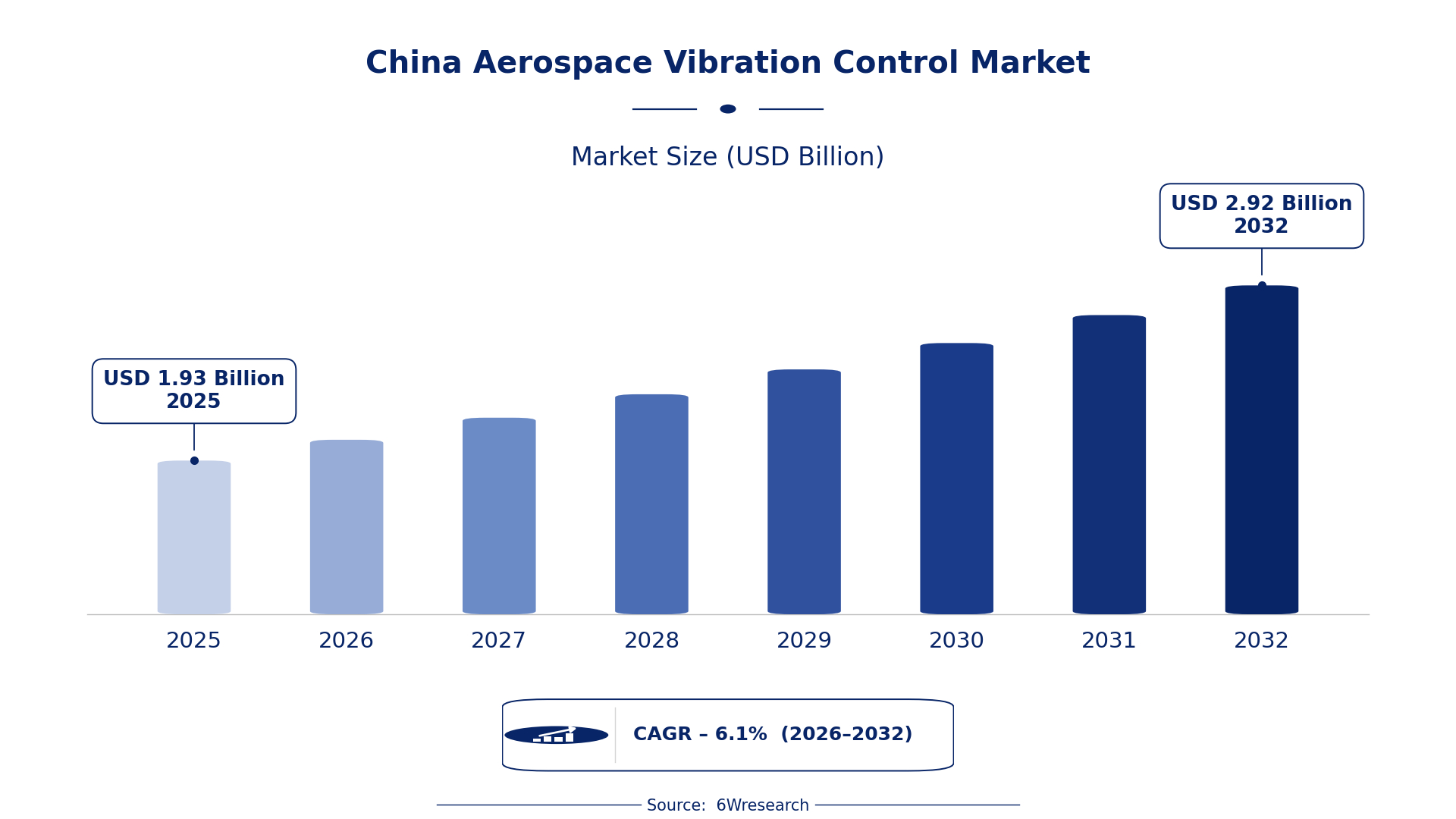
According to 6Wresearch internal database and industry insights, the China Aerospace Vibration Control Market was valued at USD 1.93 billion in 2025 and is projected to reach USD 2.92 billion by 2032, growing at a CAGR of approximately 6.1% during 2026–2032.
China Aerospace Vibration Control Market Highlights
| Report Metric | Details |
| Report Name | China Aerospace Vibration Control Market |
| Market Size 2025 | USD 1.93 billion |
| Market Size 2032 | USD 2.92 billion |
| Absolute Growth 2025–2032 | USD 0.99 billion |
| CAGR 2026–2032 | 6.1% |
| Peak Annual Growth | 8.5% in 2030 |
| Forecast Period | 2026–2032 |
| Historical Data | 2022–2025 |
| Base Year | 2025 |
| Leading Vibration Control, 2025 | Dampers (41% share) |
| Leading Product Type, 2025 | Hydraulic (37% share) |
| Leading Technology, 2025 | Active Control (40% share) |
| Leading Distribution Channel, 2025 | Direct Sales (46% share) |
| Leading End User, 2025 | Aircraft Engines (46% share) |
| Fastest-Growing Vibration Control | Isolators (7.3% CAGR) |
| Fastest-Growing Product Type | Composite Materials (8.5% CAGR) |
| Fastest-Growing Distribution Channel | Online Platforms (8.7% CAGR) |
| Fastest-Growing End User | Spacecraft Components (7.4% CAGR) |
| Growing Sector | Aerospace manufacturing |
| Key End Users | Aerospace manufacturers, defense contractors, spacecraft developers, aircraft engine producers |
China Aerospace Vibration Control Market Year-wise Growth Rate and Key Drivers (2022–2032)
This graph illustrates the annual growth rates of the market from 2022 to 2032, highlighting a steady upward trajectory and projected market expansion over the forecast period.
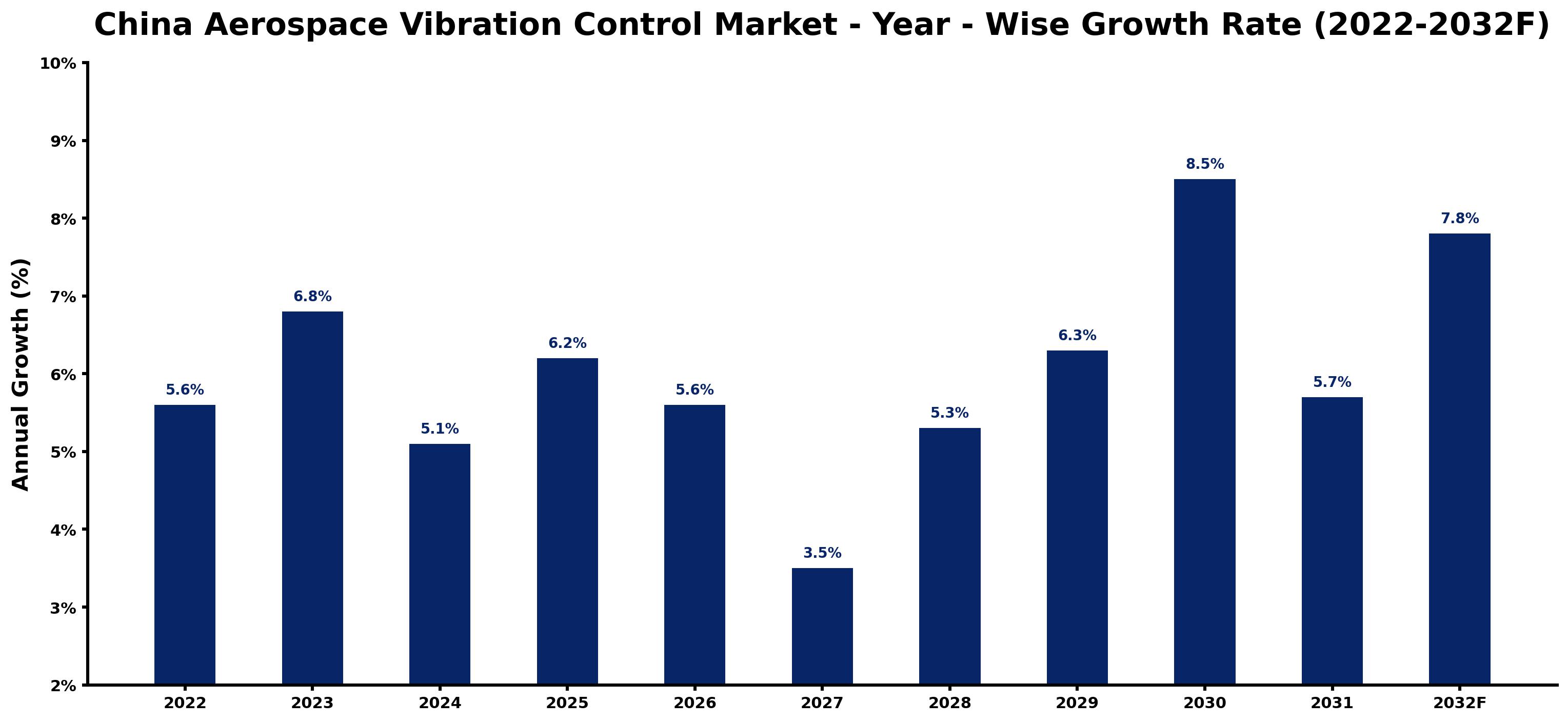
Annual growth estimates for each year appear below with the principal reason behind them, explaining the shifts that set the pace of the market.
| Year | Estimated Annual Growth (%) | Market Rationale |
| 2022 | 5.6 | The market experienced steady growth due to increasing domestic aerospace activities. |
| 2023 | 6.8 | Growth accelerated as the National Aerospace Industry Development Plan was implemented. |
| 2024 | 5.1 | A slowdown occurred as production adjustments were made within the aerospace sector. |
| 2025 | 6.2 | Growth resumed as demand for aircraft components increased ahead of the peak season. |
| 2026 | 5.6 | The market saw slower growth as manufacturers faced supply chain challenges. |
| 2027 | 3.5 | Growth decelerated due to increased competition and market saturation. |
| 2028 | 5.3 | A rebound in growth was driven by renewed investments in aerospace technology. |
| 2029 | 6.3 | Demand surged as international collaborations expanded in the aerospace sector. |
| 2030 | 8.5 | The market peaked due to heightened activity in China's space program. |
| 2031 | 5.7 | Growth slowed as the market stabilised after the peak demand year. |
| 2032 | 7.8 | A resurgence in growth is expected as new aerospace projects are initiated. |
Note: Market size estimations and growth projections presented in this report are based on 6Wresearch's proprietary forecasting methodology, utilizing the latest available industry data, government publications, and primary research inputs.
China Aerospace Vibration Control Market Synopsis
Aerospace Vibration Control in China includes technologies that reduce vibrations in aerospace applications. These technologies use advanced materials like composites and polymers, improving performance and safety in both aircraft and spacecraft. The China Aerospace Vibration Control Market is expanding due to strong domestic manufacturing and international partnerships. Demand is driven by over 60 active aerospace manufacturers, particularly in Beijing and Shanghai, along with the government's commitment to advancing aerospace technology. The National Aerospace Industry Development Plan aims to enhance domestic production capabilities by 2025, further propelling market growth.
Market Dynamics Impact Analysis (2026–2032)
| Factor | Type | Impact | Primary Segment Affected |
| Rising investments in aerospace technology and infrastructure development | Driver | High | Hydraulic |
| Increasing demand for aircraft and spacecraft components | Driver | High | Aircraft Engines |
| Growing opportunities in the space sector due to government initiatives | Opportunity | High | Spacecraft Components |
| Emerging demand for innovative vibration control solutions in defense applications | Opportunity | Medium | Defense Aircraft |
| Supply chain disruptions affecting material availability | Restraint | High | Dampers |
| High costs associated with advanced vibration control technologies | Restraint | Medium | Active Control |
| Challenges in meeting stringent regulatory standards for aerospace components | Challenge | High | Isolators |
| Limited access to advanced materials for smaller manufacturers | Challenge | Medium | Composite Materials |
Evaluation of Drivers in China Aerospace Vibration Control Market (2026–2032)
The factors lifting demand, and the evidence behind each, are summarised below.
| Drivers | Primary Segment Affected | Why It Matters (Evidence) |
| Increased government funding for aerospace technology advancements | Active Control | The government allocated 20 billion CNY in 2023 to support aerospace technology, driving demand for active control systems. |
| Expansion of domestic aerospace manufacturing capabilities | Hydraulic | Over 60 active aerospace manufacturers in China are boosting demand for hydraulic systems in vibration control. |
| Growing international collaborations in aerospace projects | Spacecraft Components | China's space program has launched numerous missions since 2020, increasing demand for vibration control technologies. |
| Rising production of aircraft engines | Aircraft Engines | The installed base of approximately 3,700 aircraft in 2022 drives demand for vibration control solutions. |
| Implementation of national standards for aerospace components | Dampers | The GB/T 20000 series standards ensure quality, increasing the need for compliant vibration control products. |
The growth of the Aerospace Vibration Control market in China is supported by increased funding, rising domestic manufacturing, and expanding international collaborations. More than 60 aerospace manufacturers are increasing the need for vibration control solutions, while the installed base of around 3,700 aircraft in 2022 drives the demand for these technologies. The launch of numerous space missions since 2020 has also heightened the need for vibration control technologies, ensuring operational integrity in spacecraft components. Compliance with GB/T 20000 series standards elevates the demand for quality vibration control products.
Evaluation of Restraints in China Aerospace Vibration Control Market
The following restraints limit how fast demand can grow.
| Market Restraint | Primary Segment Affected | Why It Matters (Evidence) |
| Supply chain disruptions affecting material availability | Dampers | Manufacturers face delays in sourcing materials due to ongoing global supply chain issues, impacting production timelines. |
| High costs associated with advanced vibration control technologies | Active Control | The investment required for advanced vibration control systems limits accessibility for smaller manufacturers, hindering market growth. |
| Challenges in meeting stringent regulatory standards for aerospace components | Isolators | Compliance with national standards increases production costs and complexity, affecting market entry for new players. |
| Limited access to advanced materials for smaller manufacturers | Composite Materials | Smaller firms struggle to procure high-quality materials, restricting their ability to compete in the aerospace sector. |
| Market saturation with existing vibration control solutions | Hydraulic | An oversupply of basic hydraulic systems limits growth opportunities for new products in the market. |
China Aerospace Vibration Control Market Challenges
Buyers and suppliers in the China Aerospace Vibration Control market are facing rising costs due to increased demand for advanced materials, inflating production expenses by as much as 15%. This demand surge originates from the rapid growth of China's aerospace sector, particularly in spacecraft production, which can delay project timelines for manufacturers. A skills gap is apparent, with only 30% of aerospace engineering graduates specialising in vibration control technologies, limiting the talent pool for producers. Compliance with regulations from the Ministry of Industry and Information Technology can extend project approval times by several months, complicating operations for manufacturers and increasing costs.
Trends in the China Aerospace Vibration Control Market
Buyers and suppliers in the China Aerospace Vibration Control Market are adjusting to the following trends.
- Shift towards Advanced Composite Materials: China's aerospace sector is increasingly adopting advanced composite materials for vibration control applications. This shift began in 2022, with a projected CAGR of 8.5% for composite materials by 2032, improving performance and reducing weight.
- Growing Emphasis on Active Control Technologies: Active control technologies are gaining traction in the aerospace industry, with a market share of 40% in 2025. This trend is driven by the need for real-time vibration management in aircraft and spacecraft.
- Increase in Direct Sales Channels: Direct sales channels are becoming more prominent in the Aerospace Vibration Control market, accounting for 46% in 2025. This shift is supported by manufacturers seeking closer relationships with customers.
- Expansion of Spacecraft Component Production: The production of spacecraft components is expanding rapidly, with a projected CAGR of 7.4% from 2026 to 2032. This growth is driven by China's ambitious space program and increased satellite launches.
Investment Opportunities in the China Aerospace Vibration Control Market
Some of the investment opportunities in the China Aerospace Vibration Control Market are mentioned below.
- Partnerships with Local Manufacturers: Collaborating with local aerospace manufacturers presents a significant opportunity, especially as the market is projected to grow to USD 2.92 billion by 2032. Engaging with manufacturers in Beijing and Shanghai can facilitate market entry.
- Investment in Innovative Vibration Control Solutions: Investing in advanced vibration control technologies is timely, given the demand for high-performance systems. The National Aerospace Industry Development Plan aims for a 15% increase in domestic production by 2025.
- Expansion into Online Sales Channels: With online platforms growing rapidly, entering this distribution channel is essential for reaching a broader customer base. Manufacturers should consider developing e-commerce strategies to tap into this trend.
- Focus on Defense Applications: The defense sector presents a lucrative opportunity, with rising demand for specialized vibration control solutions. The market for defense aircraft is expected to grow significantly, driven by government contracts.
Government Initiatives in the China Aerospace Vibration Control Market
The 'Aerospace Industry Development Plan' launched by the Ministry of Industry and Information Technology in 2021 aims for a 15% increase in domestic production by 2025. This initiative is crucial for enhancing local manufacturing capabilities and ensuring compliance with national standards. Additionally, the '2022-2025 Aerospace Technology Innovation Strategy' approved by the National Development and Reform Commission enhances research funding by 30% for vibration control technologies, benefiting manufacturers and researchers in the sector.
In 2023, the State Administration for Science, Technology and Industry for National Defense initiated the 'Aerospace Vibration Control Technology Promotion Program' to support startups in the sector. This program provides funding for innovation and development, enabling new entrants to enhance their capabilities in vibration control technologies. The Ministry of Science and Technology's updated 'National Key Research and Development Program' prioritises vibration control technologies, focusing on improving research and development capabilities.
Future Insight of the China Aerospace Vibration Control Market
Several forward-looking factors should support the China Aerospace Vibration Control market over the coming years. The National Aerospace Industry Development Plan aims to improve production capabilities by 2025, enhancing domestic supply. The government’s commitment to allocate 20 billion CNY for aerospace technology advancements will drive innovation in vibration control systems. The China National Space Administration's goal to expand its satellite network by 2025 will further increase demand for these technologies, creating new opportunities for both buyers and suppliers.
Market Segmentation Analysis
Each segment group is reviewed below, with the leader by share and the fastest grower by CAGR.
By Vibration Control – Dampers Dominated, Isolators Expected to Grow Fastest
According to Ravi Bhandari, Research Head at 6Wresearch, Dampers accounted for a 41% market share by vibration control in 2025. Dampers hold the largest share in the China Aerospace Vibration Control Market due to their essential role in managing vibrations in aircraft and spacecraft. With over 60 active aerospace manufacturers concentrated in key cities like Beijing and Shanghai, the demand for effective vibration management solutions is robust. Over 2026–2032, Isolators are expected to post the fastest growth, at a CAGR of 7.3%. Isolators are experiencing rapid growth as they are critical for isolating vibrations from sensitive equipment in advanced aerospace applications. The increase in China's space missions, which have surpassed 50 since 2020, significantly boosts the need for isolators in spacecraft. Suppliers should focus on developing advanced vibration control technologies to meet the rising demands of the aerospace sector.
By Product Type – Hydraulic Dominated, Composite Materials Expected to Grow Fastest
Hydraulic took a 37% share of product type in 2025, more than any other category. Hydraulic systems dominate the market share as they are widely used in active vibration control systems, which are vital for optimal performance in aircraft. The concentration of aerospace manufacturers in regions such as Beijing and Shanghai further drives the demand for hydraulic solutions. Composite Materials are projected to grow fastest, at a CAGR of 8.5% during 2026–2032. Composite materials are witnessing the fastest growth due to their lightweight and high-strength properties, which are essential for modern aerospace applications. The government's allocation of 20 billion CNY for aerospace technology advancements is likely to accelerate the adoption of composites. Buyers should consider investing in composite materials to enhance the performance and efficiency of their aerospace applications.
By Technology – Active Control Dominated and Is Expected to Record the Fastest Growth
In 2025, Active Control led the technology split with a 40% share. Active control technology leads the market share as it is crucial for real-time vibration management in aerospace applications. The focus on improving safety and performance within the aerospace sector reinforces the demand for active control systems. Its lead should widen, with a projected CAGR of 8.6% during 2026–2032, the highest in this split. Active control technology is also the fastest-growing segment, as its advantages in enhancing operational efficiency are increasingly recognised. Continuous advancements in aerospace technology ensure that active control remains a focal point in vibration management solutions. Suppliers must prioritise innovation in active control technologies to maintain competitiveness in the aerospace vibration control market.
By Distribution Channel – Direct Sales Dominated, Online Platforms Expected to Grow Fastest
With a 46% revenue share in 2025, Direct Sales was the largest distribution channel category. Direct sales channels capture the largest market share as they serve as the primary method for manufacturers to connect with customers in the aerospace sector. This direct engagement allows for tailored solutions that meet the specific needs of aerospace manufacturers. Online Platforms are set to record the highest CAGR in this split, 8.7% over 2026–2032. Online platforms are rapidly emerging as a growing distribution channel, enabling smaller suppliers to access a wider customer base. The increasing digitalisation of purchasing processes in the aerospace industry is driving this trend. Suppliers should enhance their online presence to capitalise on the growing trend of digital procurement in the aerospace market.
By End User – Aircraft Engines Dominated, Spacecraft Components Expected to Grow Fastest
The largest end user category in 2025 was Aircraft Engines, with a 46% share of total revenue. Aircraft engines represent the largest share of the market as they are a major application area for vibration control technologies, ensuring operational efficiency and safety. The substantial installed base of aircraft in China underscores the importance of effective vibration management in this segment. Over 2026–2032, Spacecraft Components are expected to post the fastest growth, at a CAGR of 7.4%. Spacecraft components are the fastest-growing end-user segment due to their critical role in ensuring operational integrity during missions. The ambitious goals of the China National Space Administration to expand its satellite network by 2025 are likely to drive demand for advanced vibration control solutions. Buyers in the aerospace sector should prioritise vibration control solutions for spacecraft components to ensure mission success and reliability.
Key Attractiveness of the Report
- 10 Years of Market Numbers
- Historical Data Starting from 2022 to 2025
- Base Year 2025
- Forecast Data until 2032
- Key Performance Indicators Impacting the Market
- Major Upcoming Developments and Projects
Key Highlights of the Report:
- China Aerospace Vibration Control Market Outlook
- Market Size of China Aerospace Vibration Control Market, 2025
- Forecast of China Aerospace Vibration Control Market, 2032
- Historical Data and Forecast of China Aerospace Vibration Control Revenues & Volume for the Period 2022 - 2032F
- China Aerospace Vibration Control Market Trend Evolution
- China Aerospace Vibration Control Market Drivers and Challenges
- China Aerospace Vibration Control Price Trends
- China Aerospace Vibration Control Porter's Five Forces
- China Aerospace Vibration Control Industry Life Cycle
- Historical Data and Forecast of China Aerospace Vibration Control Market Revenues & Volume By Vibration Control for the Period 2022 - 2032F
- Historical Data and Forecast of China Aerospace Vibration Control Market Revenues & Volume By Dampers for the Period 2022 - 2032F
- Historical Data and Forecast of China Aerospace Vibration Control Market Revenues & Volume By Isolators for the Period 2022 - 2032F
- Historical Data and Forecast of China Aerospace Vibration Control Market Revenues & Volume By Mounts for the Period 2022 - 2032F
- Historical Data and Forecast of China Aerospace Vibration Control Market Revenues & Volume By Pads & Bushings for the Period 2022 - 2032F
- Historical Data and Forecast of China Aerospace Vibration Control Market Revenues & Volume By Product Type for the Period 2022 - 2032F
- Historical Data and Forecast of China Aerospace Vibration Control Market Revenues & Volume By Hydraulic for the Period 2022 - 2032F
- Historical Data and Forecast of China Aerospace Vibration Control Market Revenues & Volume By Rubber/Metallic for the Period 2022 - 2032F
- Historical Data and Forecast of China Aerospace Vibration Control Market Revenues & Volume By Composite Materials for the Period 2022 - 2032F
- Historical Data and Forecast of China Aerospace Vibration Control Market Revenues & Volume By Silicone/Polymer for the Period 2022 - 2032F
- Historical Data and Forecast of China Aerospace Vibration Control Market Revenues & Volume By Technology for the Period 2022 - 2032F
- Historical Data and Forecast of China Aerospace Vibration Control Market Revenues & Volume By Active Control for the Period 2022 - 2032F
- Historical Data and Forecast of China Aerospace Vibration Control Market Revenues & Volume By Passive Vibration Tech for the Period 2022 - 2032F
- Historical Data and Forecast of China Aerospace Vibration Control Market Revenues & Volume By Shock Absorbing for the Period 2022 - 2032F
- Historical Data and Forecast of China Aerospace Vibration Control Market Revenues & Volume By Noise & Vibration Reduction for the Period 2022 - 2032F
- Historical Data and Forecast of China Aerospace Vibration Control Market Revenues & Volume By Distribution Channel for the Period 2022 - 2032F
- Historical Data and Forecast of China Aerospace Vibration Control Market Revenues & Volume By Direct Sales for the Period 2022 - 2032F
- Historical Data and Forecast of China Aerospace Vibration Control Market Revenues & Volume By Online Platforms for the Period 2022 - 2032F
- Historical Data and Forecast of China Aerospace Vibration Control Market Revenues & Volume By Distributors for the Period 2022 - 2032F
- Historical Data and Forecast of China Aerospace Vibration Control Market Revenues & Volume By OEMs for the Period 2022 - 2032F
- Historical Data and Forecast of China Aerospace Vibration Control Market Revenues & Volume By End User for the Period 2022 - 2032F
- Historical Data and Forecast of China Aerospace Vibration Control Market Revenues & Volume By Aircraft Engines for the Period 2022 - 2032F
- Historical Data and Forecast of China Aerospace Vibration Control Market Revenues & Volume By Spacecraft Components for the Period 2022 - 2032F
- Historical Data and Forecast of China Aerospace Vibration Control Market Revenues & Volume By Defense Aircraft for the Period 2022 - 2032F
- Historical Data and Forecast of China Aerospace Vibration Control Market Revenues & Volume By Rotorcraft for the Period 2022 - 2032F
- China Aerospace Vibration Control Import Export Trade Statistics
- Market Opportunity Assessment By Vibration Control
- Market Opportunity Assessment By Product Type
- Market Opportunity Assessment By Technology
- Market Opportunity Assessment By Distribution Channel
- Market Opportunity Assessment By End User
- China Aerospace Vibration Control Top Companies Market Share
- China Aerospace Vibration Control Competitive Benchmarking By Technical and Operational Parameters
- China Aerospace Vibration Control Company Profiles
- China Aerospace Vibration Control Key Strategic Recommendations
Market Covered
This report examines the market across the segments below.
By Vibration Control
- Dampers
- Isolators
- Mounts
- Pads & Bushings
By Product Type
- Hydraulic
- Rubber/Metallic
- Composite Materials
- Silicone/Polymer
By Technology
- Active Control
- Passive Vibration Tech
- Shock Absorbing
- Noise & Vibration Reduction
By Distribution Channel
- Direct Sales
- Online Platforms
- Distributors
- OEMs
By End User
- Aircraft Engines
- Spacecraft Components
- Defense Aircraft
- Rotorcraft






































