India AI-based Intrusion Detection Market Size & Growth Rate
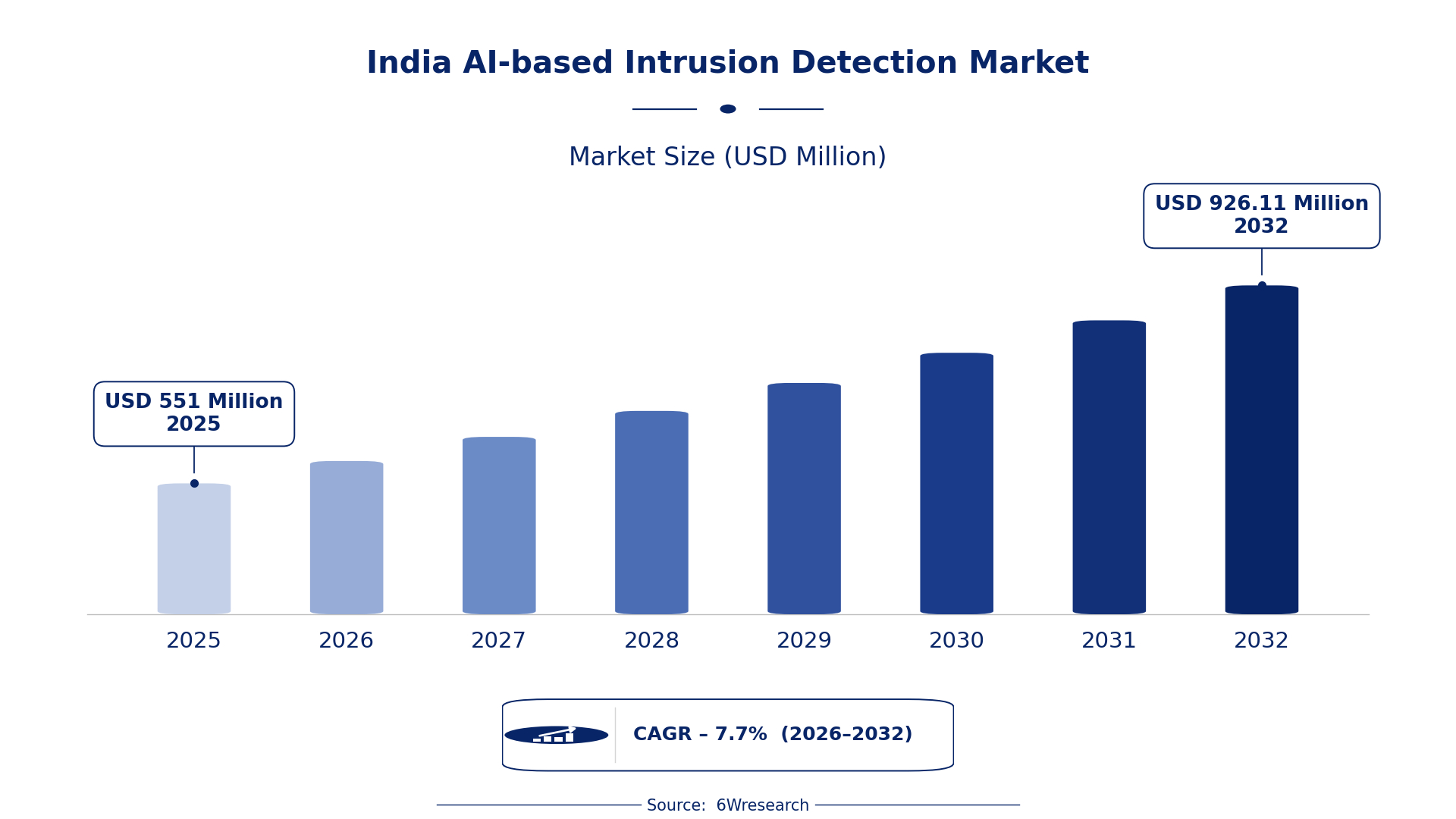
According to 6Wresearch internal database and industry insights, the India AI-based Intrusion Detection Market was valued at USD 551.0 million in 2025 and is projected to reach USD 926.11 million by 2032, growing at a CAGR of approximately 7.7% during 2026–2032.
India AI-based Intrusion Detection Market Highlights
| Report Metric | Details |
| Report Name | India AI-based Intrusion Detection Market |
| Market Size 2025 | USD 551.0 million |
| Market Size 2032 | USD 926.11 million |
| Absolute Growth 2025–2032 | USD 375.11 million |
| CAGR 2026–2032 | 7.7% |
| Peak Annual Growth | 9.2% in 2030 |
| Forecast Period | 2026–2032 |
| Historical Data | 2022–2025 |
| Base Year | 2025 |
| Leading Threat Type, 2025 | Network Intrusion (54% share) |
| Leading Detection Technique, 2025 | Behavior Analysis (49% share) |
| Leading Distribution Channel, 2025 | Cybersecurity Platforms (45% share) |
| Leading End User, 2025 | IT Security Teams (36% share) |
| Fastest-Growing Threat Type | Physical Intrusion (9.5% CAGR) |
| Fastest-Growing Detection Technique | Facial/Activity Recognition (10.5% CAGR) |
| Fastest-Growing Distribution Channel | Security Solution Providers (9.0% CAGR) |
| Fastest-Growing End User | Airports & Government Facilities (8.8% CAGR) |
| Growing Sector | Cybersecurity |
| Key End Users | IT Security Teams, Airports & Government Facilities, Financial Institutions |
India AI-based Intrusion Detection Market Year-wise Growth Rate and Key Drivers (2022–2032)
This graph illustrates the annual growth rates of the market from 2022 to 2032, highlighting a steady upward trajectory and projected market expansion over the forecast period.
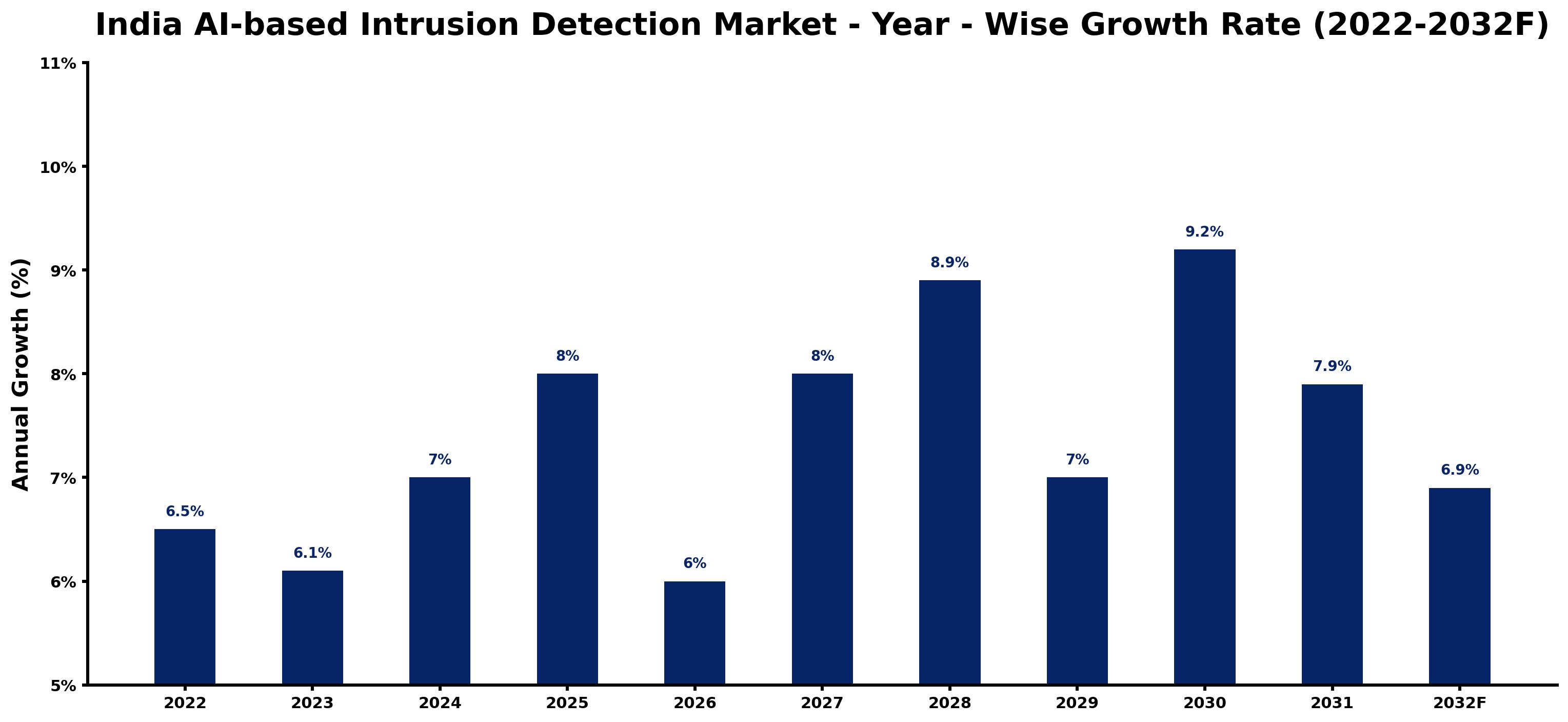
Annual growth estimates for each year appear below with the principal reason behind them, explaining the shifts that set the pace of the market.
| Year | Estimated Annual Growth (%) | Market Rationale |
| 2022 | 6.5 | The market experienced steady growth due to increasing cybersecurity needs across sectors. |
| 2023 | 6.1 | Growth slowed as enterprises adjusted to new security technologies and strategies. |
| 2024 | 7.0 | Demand increased as more organisations adopted AI-based solutions for security. |
| 2025 | 8.0 | The market peaked with significant investments in cybersecurity infrastructure and technology. |
| 2026 | 6.0 | Growth slowed as the market stabilised following the peak in investments. |
| 2027 | 8.0 | Demand surged as enterprises prioritised advanced intrusion detection systems for security. |
| 2028 | 8.9 | Growth continued as more sectors recognised the importance of AI in cybersecurity. |
| 2029 | 7.0 | The market experienced a slowdown as competition intensified among providers. |
| 2030 | 9.2 | Demand accelerated with the adoption of new AI technologies in intrusion detection. |
| 2031 | 7.9 | Growth slowed as the market matured and buyers became more selective. |
| 2032 | 6.9 | The market continued to grow as cybersecurity remains a priority for enterprises. |
Note: Market size estimations and growth projections presented in this report are based on 6Wresearch's proprietary forecasting methodology, utilizing the latest available industry data, government publications, and primary research inputs.
India AI-based Intrusion Detection Market Synopsis
AI-based Intrusion Detection systems in India utilise machine learning to identify security threats in real-time. These systems protect networks, physical premises, and cloud infrastructures from unauthorised access. The India AI-based Intrusion Detection Market is expanding due to the rising cybersecurity needs of enterprises and government facilities. Over 70% of Indian enterprises have integrated AI into their security measures, driven by initiatives like the Cyber Surakshit Bharat programme. The increasing frequency of cyber incidents, with over 1.5 million reported in 2022, further fuels this demand.
Market Dynamics Impact Analysis (2026–2032)
| Factor | Type | Impact | Primary Segment Affected |
| Growing cybersecurity incidents necessitate advanced protection measures. | Driver | High | Network Intrusion |
| Increased adoption of AI technologies enhances detection capabilities. | Driver | High | Behavior Analysis |
| Investment in smart city initiatives drives demand for urban security solutions. | Opportunity | High | Cloud Infrastructure |
| The need for compliance with cybersecurity regulations creates demand for solutions. | Opportunity | High | Cybersecurity Platforms |
| High costs associated with implementing advanced systems can deter adoption. | Restraint | Medium | IoT Intrusion |
| Limited awareness of AI capabilities among smaller enterprises restricts growth. | Restraint | Medium | Physical Intrusion |
| Buyers face challenges in integrating new systems with legacy infrastructure. | Challenge | High | Real-Time Monitoring |
| Suppliers struggle with the rapid pace of technological advancements in AI. | Challenge | Medium | Device Behavior Mapping |
Evaluation of Drivers in India AI-based Intrusion Detection Market (2026–2032)
The factors lifting demand, and the evidence behind each, are summarised below.
| Drivers | Primary Segment Affected | Why It Matters (Evidence) |
| Increased cyber threats lead to heightened demand for security solutions. | Network Intrusion | Over 1.5 million cyber incidents reported in 2022 prompted enterprises to invest in advanced intrusion detection. |
| Growing adoption of AI technologies improves security measures. | Behavior Analysis | Over 70% of Indian enterprises have adopted AI in security, increasing purchases of AI-based intrusion detection systems. |
| Investment in smart city projects boosts demand for security technologies. | Cloud Infrastructure | The Smart Cities Mission promotes advanced technologies, driving the need for effective intrusion detection solutions. |
| Compliance with cybersecurity regulations drives system adoption. | Cybersecurity Platforms | The IT Act 2000 mandates cybersecurity measures, encouraging enterprises to invest in intrusion detection systems. |
| Financial institutions increasingly require fraud prevention measures. | IoT Intrusion | AI-based intrusion detection is essential for securing connected devices, especially in the finance sector. |
Market growth in India for AI-based Intrusion Detection rests on rising investment in cybersecurity infrastructure, increased end-use demand from various sectors, and the adoption of advanced technologies. The surge in cyber incidents has prompted enterprises to significantly improve their security measures. A notable percentage of enterprises have integrated AI into their security protocols, leading to a marked increase in demand for AI-based solutions. Financial institutions are increasingly requiring intrusion detection to prevent fraud, creating additional demand for these systems.
Evaluation of Restraints in India AI-based Intrusion Detection Market
The main factors holding the market back are set out below.
| Market Restraint | Primary Segment Affected | Why It Matters (Evidence) |
| High implementation costs can limit accessibility for smaller enterprises. | IoT Intrusion | The need for substantial investment in AI technologies can deter smaller businesses from adopting these solutions. |
| Limited knowledge of AI capabilities restricts market growth. | Physical Intrusion | Many smaller enterprises lack awareness of how AI can improve their security measures, resulting in lower adoption rates. |
| Integration challenges with existing systems can hinder deployment. | Real-Time Monitoring | Buyers often face difficulties in integrating new AI systems with legacy infrastructure, delaying implementation. |
| Rapid technological advancements create uncertainty for suppliers. | Cybersecurity Platforms | Enterprises must navigate complex regulations, which can slow down decision-making and implementation. |
| Market fragmentation can complicate supplier selection. | Network Intrusion | With numerous providers in the market, buyers may struggle to identify the most effective solutions. |
India AI-based Intrusion Detection Market Challenges
Buyers in the India AI-based Intrusion Detection market struggle with a shortage of skilled professionals, which can delay system deployment and expose networks to threats. Competition from numerous local and international providers drives prices down, compelling buyers to settle for lower-quality security solutions that may not adequately protect their assets. Regulatory compliance with the IT Act 2000 introduces complexities, leading to potential penalties of up to ₹5 million for non-compliance, which can financially burden businesses. High import costs for advanced AI technologies limit smaller enterprises' ability to invest in robust security measures, restricting their operational capabilities and competitiveness.
Trends in the India AI-based Intrusion Detection Market
Buyers and suppliers in the India AI-based Intrusion Detection Market are adjusting to the following trends.
- Shift towards AI-Driven Security Solutions in Urban Areas: The Smart Cities Mission is driving the adoption of AI-based security solutions in urban environments, with a projected investment of USD 100 million by 2025. This shift improves security measures for urban infrastructure.
- Transition from Traditional to AI-Based Intrusion Detection: Since 2020, there has been a marked transition towards AI-based intrusion detection systems, with over 70% of enterprises adopting AI technologies. This trend indicates a move towards more efficient security measures.
- Emergence of Real-Time Monitoring Technologies: Real-time monitoring technologies have gained traction, particularly in financial institutions, which reported a 30% increase in AI adoption for fraud prevention in 2022. This trend indicates a growing focus on immediate threat detection.
- Increased Focus on Compliance with Cybersecurity Standards: The adoption of ISO/IEC 27001 has risen significantly, with over 60% of enterprises aiming for compliance by 2025. This trend underscores the importance of standardised security measures.
Investment Opportunities in the India AI-based Intrusion Detection Market
Investors looking at the India AI-based Intrusion Detection Market should consider the following areas.
- Investment in Smart City Security Initiatives: The Smart Cities Mission presents an opportunity for investment in AI-based security solutions, with a projected budget of USD 100 million by 2025. Local governments and urban planners are key buyers.
- Partnerships with Security Solution Providers: Now is the time to partner with security solution providers to strengthen market presence, as demand for integrated security solutions is rising. Collaborating with local firms can facilitate entry into the market.
- Expansion of AI Training Programs for Cybersecurity: The Cybersecurity Skill Development Scheme aims to improve skills in AI technologies, creating a demand for training providers. This initiative presents an opportunity for educational institutions and training centres.
- Growth in Financial Sector Security Solutions: With financial institutions increasingly adopting AI for fraud prevention, there is a market gap. Suppliers can enter this sector by offering tailored AI-based intrusion detection solutions.
Government Initiatives in the India AI-based Intrusion Detection Market
The National Cyber Security Policy, established in 2020, aims to improve cybersecurity infrastructure across sectors. This policy enhances previous regulations by providing a framework for strengthening security measures and encouraging the adoption of advanced technologies. It mandates regular assessments and updates to security protocols, ensuring that enterprises remain vigilant against evolving threats. The policy promotes collaboration between government and private sectors to bolster overall cybersecurity capabilities, benefiting AI-based Intrusion Detection buyers.
The Indian Computer Emergency Response Team (CERT-IN) oversees the implementation of various cybersecurity initiatives, including the Cyber Surakshit Bharat programme. This programme funds awareness campaigns and training for enterprises, improving their cybersecurity readiness. Additionally, the Ministry of Electronics and Information Technology plays a critical role in approving cybersecurity measures and providing guidance to organisations on best practices. Through these efforts, the government aims to create a more secure digital environment for all stakeholders.
Future Insight of the India AI-based Intrusion Detection Market
By 2032, buyers and suppliers in the India AI-based Intrusion Detection market can expect significant advancements, driven by the Cyber Surakshit Bharat initiative and the Digital India programme, which aim to enhance cybersecurity infrastructure. The adoption of ISO/IEC 27001 standards will become standard practice, promoting better information security management. The Cybersecurity Skill Development Scheme will address the skills gap, creating a more capable workforce. With over 1.5 million cyber incidents reported in 2022, the demand for sophisticated AI solutions will accelerate innovation in threat detection technologies.
Market Segmentation Analysis
Each segment group is reviewed below, with the leader by share and the fastest grower by CAGR.
By Threat Type – Network Intrusion Dominated, Physical Intrusion Expected to Grow Fastest
According to Shubham Padhi, Research Analyst at 6Wresearch, Network Intrusion accounted for a 54% market share by threat type in 2025. Network Intrusion captures the largest market share as it is crucial for safeguarding digital assets from cyber threats. The staggering figure of over 1.5 million cyber incidents reported in 2022 underscores the pressing need for robust network protection solutions. The quickest growth will come from Physical Intrusion, forecast to expand at a CAGR of 9.5% between 2026 and 2032. Physical Intrusion is experiencing rapid growth as security measures in high-risk environments, such as airports and government facilities, increasingly adopt advanced detection systems. This surge is propelled by the heightened focus on comprehensive security solutions that address both physical and digital threats. Suppliers should prioritise solutions that cater to both network and physical intrusion detection to effectively address the rising security demands.
By Detection Technique – Behavior Analysis Dominated, Facial/Activity Recognition Expected to Grow Fastest
With a 49% revenue share in 2025, Behavior Analysis was the largest detection technique category. Behavior Analysis leads the market as it is vital for identifying anomalies in user behaviour, which is essential for effective threat detection. Its widespread application across various sectors highlights its significance in maintaining robust security protocols. Facial/Activity Recognition is set to record the highest CAGR in this split, 10.5% over 2026–2032. Facial/Activity Recognition is witnessing swift growth due to its targeted applications in enhancing security at critical locations like airports. The increasing emphasis on advanced surveillance technologies is driving this segment's rapid expansion. Buyers are likely to gain substantial advantages by investing in advanced detection techniques that improve overall security effectiveness.
By Distribution Channel – Cybersecurity Platforms Dominated, Security Solution Providers Expected to Grow Fastest
Cybersecurity Platforms took a 45% share of distribution channel in 2025, more than any other category. Cybersecurity Platforms dominate the market as they serve as the primary means of delivering intrusion detection solutions across various sectors. Their comprehensive nature facilitates streamlined security management, making them indispensable for enterprises. Over 2026–2032, Security Solution Providers are expected to post the fastest growth, at a CAGR of 9.0%. Security Solution Providers are experiencing the fastest growth as they integrate a range of security services, including intrusion detection, to meet diverse client needs. The rising complexity of security threats necessitates a more holistic approach to security solutions. Suppliers should explore partnerships with security solution providers to broaden their market reach and enhance service offerings.
By End User – IT Security Teams Dominated, Airports & Government Facilities Expected to Grow Fastest
The largest end user category in 2025 was IT Security Teams, with a 36% share of total revenue. IT Security Teams represent the largest share of the market, as they are directly responsible for implementing and managing intrusion detection systems across organisations. Their expertise is crucial for maintaining effective cybersecurity measures. Airports & Government Facilities are projected to grow fastest, at a CAGR of 8.8% during 2026–2032. Airports & Government Facilities are the fastest-growing end users due to their high-security requirements that demand advanced intrusion detection systems. The focus on securing critical infrastructure drives this segment's rapid adoption of effective solutions. Suppliers should customise their products to meet the specific needs of high-security environments to capitalise on this growth opportunity.
Key Attractiveness of the Report
- 10 Years of Market Numbers
- Historical Data Starting from 2022 to 2025
- Base Year 2025
- Forecast Data until 2032
- Key Performance Indicators Impacting the Market
- Major Upcoming Developments and Projects
Key Highlights of the Report:
- India AI-based Intrusion Detection Market Outlook
- Market Size of India AI-based Intrusion Detection Market, 2025
- Forecast of India AI-based Intrusion Detection Market, 2032
- Historical Data and Forecast of India AI-based Intrusion Detection Revenues & Volume for the Period 2022 - 2032F
- India AI-based Intrusion Detection Market Trend Evolution
- India AI-based Intrusion Detection Market Drivers and Challenges
- India AI-based Intrusion Detection Price Trends
- India AI-based Intrusion Detection Porter's Five Forces
- India AI-based Intrusion Detection Industry Life Cycle
- Historical Data and Forecast of India AI-based Intrusion Detection Market Revenues & Volume By Threat Type for the Period 2022 - 2032F
- Historical Data and Forecast of India AI-based Intrusion Detection Market Revenues & Volume By Network Intrusion for the Period 2022 - 2032F
- Historical Data and Forecast of India AI-based Intrusion Detection Market Revenues & Volume By Physical Intrusion for the Period 2022 - 2032F
- Historical Data and Forecast of India AI-based Intrusion Detection Market Revenues & Volume By IoT Intrusion for the Period 2022 - 2032F
- Historical Data and Forecast of India AI-based Intrusion Detection Market Revenues & Volume By Cloud Infrastructure for the Period 2022 - 2032F
- Historical Data and Forecast of India AI-based Intrusion Detection Market Revenues & Volume By Detection Technique for the Period 2022 - 2032F
- Historical Data and Forecast of India AI-based Intrusion Detection Market Revenues & Volume By Behavior Analysis for the Period 2022 - 2032F
- Historical Data and Forecast of India AI-based Intrusion Detection Market Revenues & Volume By Facial/Activity Recognition for the Period 2022 - 2032F
- Historical Data and Forecast of India AI-based Intrusion Detection Market Revenues & Volume By Device Behavior Mapping for the Period 2022 - 2032F
- Historical Data and Forecast of India AI-based Intrusion Detection Market Revenues & Volume By Real-Time Monitoring for the Period 2022 - 2032F
- Historical Data and Forecast of India AI-based Intrusion Detection Market Revenues & Volume By Distribution Channel for the Period 2022 - 2032F
- Historical Data and Forecast of India AI-based Intrusion Detection Market Revenues & Volume By Cybersecurity Platforms for the Period 2022 - 2032F
- Historical Data and Forecast of India AI-based Intrusion Detection Market Revenues & Volume By Security Solution Providers for the Period 2022 - 2032F
- Historical Data and Forecast of India AI-based Intrusion Detection Market Revenues & Volume By IoT Security Vendors for the Period 2022 - 2032F
- Historical Data and Forecast of India AI-based Intrusion Detection Market Revenues & Volume By Cloud Security Suites for the Period 2022 - 2032F
- Historical Data and Forecast of India AI-based Intrusion Detection Market Revenues & Volume By End User for the Period 2022 - 2032F
- Historical Data and Forecast of India AI-based Intrusion Detection Market Revenues & Volume By IT Security Teams for the Period 2022 - 2032F
- Historical Data and Forecast of India AI-based Intrusion Detection Market Revenues & Volume By Airports & Government Facilities for the Period 2022 - 2032F
- Historical Data and Forecast of India AI-based Intrusion Detection Market Revenues & Volume By Smart Building Managers for the Period 2022 - 2032F
- Historical Data and Forecast of India AI-based Intrusion Detection Market Revenues & Volume By Enterprise Tech Teams for the Period 2022 - 2032F
- India AI-based Intrusion Detection Import Export Trade Statistics
- Market Opportunity Assessment By Threat Type
- Market Opportunity Assessment By Detection Technique
- Market Opportunity Assessment By Distribution Channel
- Market Opportunity Assessment By End User
- India AI-based Intrusion Detection Top Companies Market Share
- India AI-based Intrusion Detection Competitive Benchmarking By Technical and Operational Parameters
- India AI-based Intrusion Detection Company Profiles
- India AI-based Intrusion Detection Key Strategic Recommendations
Market Covered
The report offers an extensive study of the following market segments.
By Threat Type
- Network Intrusion
- Physical Intrusion
- IoT Intrusion
- Cloud Infrastructure
By Detection Technique
- Behavior Analysis
- Facial/Activity Recognition
- Device Behavior Mapping
- Real-Time Monitoring
By Distribution Channel
- Cybersecurity Platforms
- Security Solution Providers
- IoT Security Vendors
- Cloud Security Suites
By End User
- IT Security Teams
- Airports & Government Facilities
- Smart Building Managers
- Enterprise Tech Teams































