India AI-driven Quality Control Market Size & Growth Rate
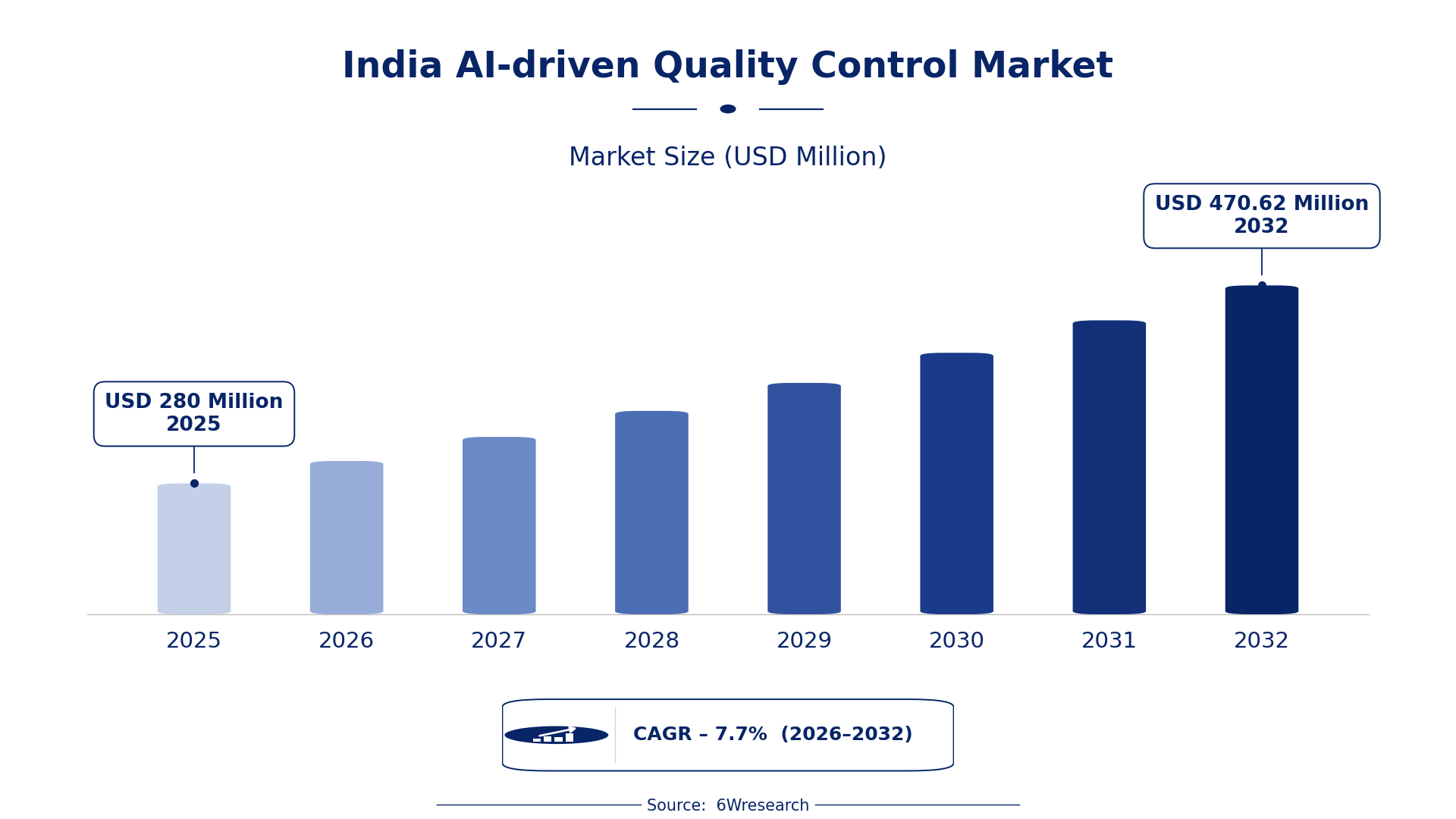
According to 6Wresearch internal database and industry insights, the India AI-driven Quality Control Market was valued at USD 280.0 million in 2025 and is projected to reach USD 470.62 million by 2032, growing at a CAGR of approximately 7.7% during 2026–2032.
India AI-driven Quality Control Market Highlights
| Report Metric | Details |
| Report Name | India AI-driven Quality Control Market |
| Market Size 2025 | USD 280.0 million |
| Market Size 2032 | USD 470.62 million |
| Absolute Growth 2025–2032 | USD 190.62 million |
| CAGR 2026–2032 | 7.7% |
| Peak Annual Growth | 10.1% in 2027 |
| Forecast Period | 2026–2032 |
| Historical Data | 2022–2025 |
| Base Year | 2025 |
| Leading Product Segment, 2025 | Electronics Assembly (43% share) |
| Leading AI Technology, 2025 | Defect Detection (47% share) |
| Leading Distribution Channel, 2025 | Inspection System Providers (42% share) |
| Leading End User, 2025 | PCB Manufacturers (37% share) |
| Fastest-Growing Product Segment | Food & Beverage (9.6% CAGR) |
| Fastest-Growing AI Technology | Vision-Based Inspection (9.5% CAGR) |
| Fastest-Growing Distribution Channel | Quality Automation Vendors (9.9% CAGR) |
| Fastest-Growing End User | FMCG Processing Units (9.9% CAGR) |
| Growing Sector | FMCG Processing Units |
| Key End Users | PCB Manufacturers, Car Manufacturers, FMCG Processing Units, Pharmaceutical Plants |
India AI-driven Quality Control Market Year-wise Growth Rate and Key Drivers (2022–2032)
This graph illustrates the annual growth rates of the market from 2022 to 2032, highlighting a steady upward trajectory and projected market expansion over the forecast period.
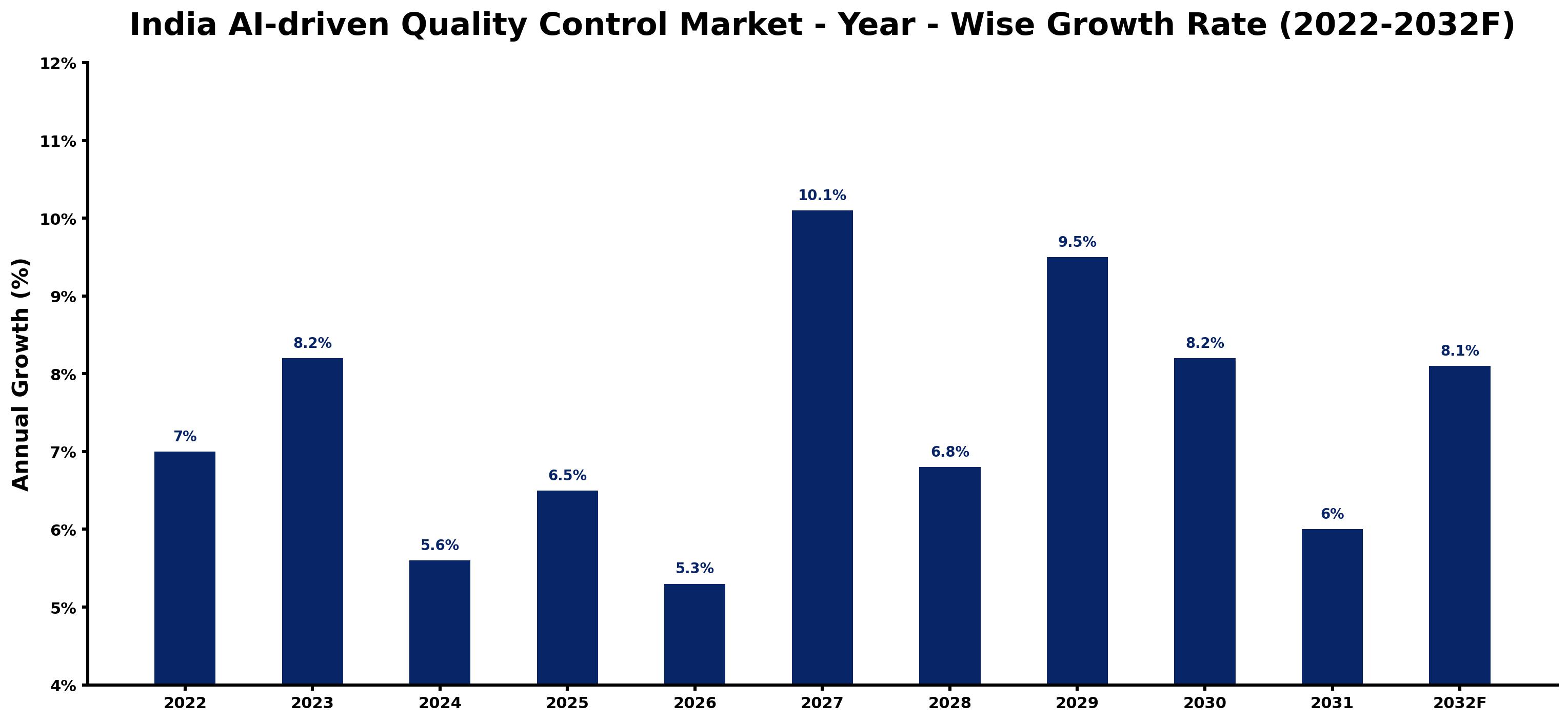
Below, each year's estimated growth is shown next to the factor that most influenced it.
| Year | Estimated Annual Growth (%) | Market Rationale |
| 2022 | 7.0 | The market saw steady demand from domestic manufacturers and exports. |
| 2023 | 8.2 | Quality control needs increased significantly due to automotive production targets. |
| 2024 | 5.6 | Growth slowed as manufacturers adjusted to new AI technologies. |
| 2025 | 6.5 | Demand rose again with the automotive sector producing 30 million vehicles. |
| 2026 | 5.3 | The market experienced a slowdown as companies faced integration challenges. |
| 2027 | 10.1 | A surge in AI adoption led to the highest growth rate in the forecast. |
| 2028 | 6.8 | Growth slowed again as companies consolidated their AI systems. |
| 2029 | 9.5 | Demand accelerated with more manufacturers adopting advanced quality checks. |
| 2030 | 8.2 | The market growth rate decreased as companies focused on efficiency. |
| 2031 | 6.0 | A slight slowdown occurred as the market matured and stabilised. |
| 2032 | 8.1 | Growth rebounded as new regulations encouraged AI in quality control. |
Note: Market size estimations and growth projections presented in this report are based on 6Wresearch's proprietary forecasting methodology, utilizing the latest available industry data, government publications, and primary research inputs.
India AI-driven Quality Control Market Synopsis
AI-driven Quality Control in India improves quality assurance processes through advanced algorithms and machine learning. It integrates AI technologies with existing systems for defect detection, process optimisation, and compliance assurance. The India AI-driven Quality Control Market is growing due to rising demand from the automotive and electronics sectors, supported by initiatives like 'Digital India' and regulatory backing from the Food Safety and Standards Authority. With the automotive industry expected to produce 30 million vehicles by 2026, the need for robust quality control systems is critical.
Market Dynamics Impact Analysis (2026–2032)
| Factor | Type | Impact | Primary Segment Affected |
| Rising production targets in the automotive sector drive demand for quality assurance systems. | Driver | High | Automotive Components |
| Increased adoption of AI technologies in food safety enhances quality control processes. | Driver | High | Food & Beverage |
| The growing need for compliance with safety standards creates opportunities for AI solutions. | Opportunity | High | Pharma Packaging |
| The expansion of PCB manufacturing facilities presents a chance for quality control suppliers. | Opportunity | High | Electronics Assembly |
| Integration challenges with existing systems can hinder AI adoption in manufacturing. | Restraint | High | Defect Detection |
| Limited awareness of AI benefits among smaller manufacturers restricts market growth. | Restraint | Medium | Vision-Based Inspection |
| Talent shortages in AI and machine learning limit the industry's growth potential. | Challenge | High | Quality Automation Vendors |
| High initial investment costs for AI-driven systems can deter smaller firms. | Challenge | Medium | Smart Sensors Suppliers |
Evaluation of Drivers in India AI-driven Quality Control Market (2026–2032)
The factors lifting demand, and the evidence behind each, are summarised below.
| Drivers | Primary Segment Affected | Why It Matters (Evidence) |
| Increased vehicle production necessitates advanced quality control systems. | Automotive Components | The automotive industry is expected to produce 30 million vehicles by 2026, driving demand for quality assurance. |
| Regulatory compliance drives demand for AI in food safety. | Food & Beverage | The Food Safety and Standards Authority of India promotes AI adoption for quality assurance in food processing. |
| Growing PCB manufacturing facilities increase the need for defect detection systems. | Electronics Assembly | AI-driven quality control systems are adopted in 60% of PCB manufacturing facilities in India. |
| Rising pharmaceutical market value increases demand for quality control. | Pharma Packaging | The pharmaceutical industry in India is valued at $42 billion, necessitating advanced quality control measures. |
| Integration of AI technologies in manufacturing processes boosts efficiency. | Vision-Based Inspection | The Bureau of Indian Standards has established guidelines for AI applications in manufacturing. |
The AI-driven Quality Control market in India is expanding as end-use demand from the automotive and electronics sectors increases. The automotive industry is projected to produce 30 million vehicles by 2026, driving the need for advanced quality control systems. The Food Safety and Standards Authority of India encourages AI adoption for quality assurance in food processing, further boosting demand. The pharmaceutical sector, valued at $42 billion, also requires stringent quality control measures, prompting manufacturers to integrate AI technologies for greater efficiency. The Bureau of Indian Standards has set guidelines that promote the use of AI in manufacturing processes, creating a favourable environment for growth.
Evaluation of Restraints in India AI-driven Quality Control Market
The key brakes on demand, and where they bite hardest, are shown below.
| Market Restraint | Primary Segment Affected | Why It Matters (Evidence) |
| Integration challenges with existing systems hinder AI adoption. | Defect Detection | Many manufacturers face difficulties in integrating AI technologies with traditional quality control processes. |
| Limited awareness of AI benefits restricts market growth. | Vision-Based Inspection | Smaller manufacturers often lack knowledge about the advantages of AI-driven quality control. |
| Talent shortages in AI and machine learning limit growth potential. | Quality Automation Vendors | The industry struggles to find skilled professionals to implement AI solutions effectively. |
| High initial investment costs deter smaller firms from adopting AI systems. | Smart Sensors Suppliers | Small and medium enterprises often cannot afford the upfront costs of AI-driven quality control. |
| Regulatory compliance can be complex and time-consuming. | Pharma Packaging | Manufacturers must navigate stringent regulations, which can delay AI implementation. |
India AI-driven Quality Control Market Challenges
The AI-driven Quality Control market in India still has to solve a few problems, and the first is the high cost of integration. Many buyers face initial investments that can consume up to 20% of their operational budget, which delays the adoption of essential quality assurance technologies. Suppliers encounter inconsistent demand, resulting in a 15% increase in lead times for AI system deliveries. Technology gaps remain, as only 60% of PCB manufacturing facilities currently utilise AI-driven systems, leaving many industries behind. Competition from traditional quality assurance methods persists, as buyers often favour established processes over new AI solutions.
Trends in the India AI-driven Quality Control Market
Below mentioned are some of the trends shaping the India AI-driven Quality Control Market growth.
- Shift towards AI Integration in Food Safety: The 'Pradhan Mantri Kisan Sampada Yojana' promotes AI in food quality assurance, aiming to improve processing efficiency. In 2023, this initiative is projected to drive increased demand for AI-driven solutions.
- Adoption of ISO 9001:2015 Standards: In India, 75% of manufacturers are adopting ISO 9001:2015 standards for quality management systems. This shift, driven by the need for compliance, encourages the integration of AI technologies in quality control.
- Growth of Vision-Based Inspection Technologies: The market for vision-based inspection technologies is expanding, with a CAGR of 9.5% projected. This trend is driven by the need for automated visual checks in production lines, particularly in electronics.
- Increased Investment in AI Research: In 2023, the Ministry of Electronics and Information Technology announced a $1 billion fund for AI research and development. This investment is expected to accelerate the adoption of AI technologies across various sectors.
Investment Opportunities in the India AI-driven Quality Control Market
Several openings in the India AI-driven Quality Control Market merit attention from investors.
- Supply of AI-Driven Quality Control Systems: With 60% of PCB manufacturing facilities adopting AI technologies, suppliers can meet growing demand. Collaborating with PCB manufacturers can facilitate entry into this expanding market.
- Investment in Food Quality Assurance Solutions: The food processing sector is increasingly adopting AI for quality control, presenting a $42 billion opportunity. Suppliers can engage with food manufacturers to provide tailored AI solutions.
- Development of Smart Sensors for Quality Control: As manufacturers seek to improve quality checks, the demand for smart sensors is rising. Investing in smart sensor technology can cater to automotive and electronics sectors, where precision is critical.
- Enhancement of Pharmaceutical Quality Standards: The pharmaceutical industry, valued at $42 billion, is focusing on AI integration for quality assurance. Suppliers can partner with pharmaceutical plants to provide AI-driven solutions for compliance and safety.
Government Initiatives in the India AI-driven Quality Control Market
In 2021, the Ministry of Electronics and Information Technology launched the 'AI for All' initiative, aiming to promote AI adoption in manufacturing with a budget of $500 million. This initiative encourages producers to integrate AI technologies into quality control processes, improving efficiency and compliance. The National Policy on Electronics 2019 further supports this by boosting the electronics manufacturing sector, promoting AI-driven quality control technologies across industries. Additionally, the Quality Council of India established a framework for implementing AI technologies in quality management systems since 2020, ensuring that manufacturers adhere to quality standards.
In 2023, the Ministry of Electronics and Information Technology announced a $1 billion fund for AI research and development. This funding aims to support projects that enhance AI integration in various sectors, promoting innovation and efficiency in quality control processes. The Bureau of Indian Standards also plays a role in establishing guidelines for AI applications in manufacturing, ensuring compliance with quality standards.
Future Insight of the India AI-driven Quality Control Market
The AI-driven Quality Control market in India is expected to develop significantly by 2032 due to several key factors. The automotive industry is projected to produce 30 million vehicles by 2026, driving a pressing need for advanced quality assurance measures. Government initiatives like the 'Digital India' programme will promote AI technologies across various sectors. The adoption of ISO 9001:2015 standards among 75% of manufacturers will enhance quality management systems, facilitating broader AI integration. Consequently, buyers and suppliers will experience improved efficiency and compliance in quality assurance processes.
Market Segmentation Analysis
The analysis below covers each segmentation, its leading category in 2025 and its fastest-growing category through 2032.
By Product Segment – Electronics Assembly Dominated, Food & Beverage Expected to Grow Fastest
According to Shubham Padhi, Research Analyst at 6Wresearch, Electronics Assembly held a 43% share of the India AI-driven Quality Control Market by product segment in 2025. Electronics Assembly commands the largest share due to its critical role in ensuring high standards for electronic components used in various applications. The robust growth of the electronics industry in India further fuels the demand for effective quality assurance solutions. Food & Beverage is projected to grow fastest, at a CAGR of 9.6% during 2026–2032. The Food & Beverage segment is experiencing rapid growth, spurred by regulations from the Food Safety and Standards Authority of India that promote stringent quality control measures. This segment's expansion underscores the increasing emphasis on product safety and compliance with health standards. Suppliers should focus on developing tailored solutions for the Food & Beverage sector to capitalise on emerging opportunities.
By AI Technology – Defect Detection Dominated, Vision-Based Inspection Expected to Grow Fastest
In 2025, Defect Detection led the ai technology split with a 47% share. Defect Detection leads the technology segment as it is crucial for identifying flaws in manufacturing processes, ensuring product quality across various industries. Its broad adoption is vital for maintaining high standards in production and fulfilling consumer expectations. The quickest growth will come from Vision-Based Inspection, forecast to expand at a CAGR of 9.5% between 2026 and 2032. Vision-Based Inspection is the fastest-growing technology, propelled by its effectiveness in automating visual checks during production. As manufacturers seek improved operational efficiency, the demand for vision-based solutions is anticipated to increase significantly. Buyers should consider investing in vision-based inspection technologies to enhance their quality control processes and maintain a competitive advantage.
By Distribution Channel – Inspection System Providers Dominated, Quality Automation Vendors Expected to Grow Fastest
With a 42% revenue share in 2025, Inspection System Providers was the largest distribution channel category. Inspection System Providers lead the distribution channel by supplying the necessary technology for AI-driven quality control systems. Their expertise and resources are vital for industries seeking reliable quality assurance solutions. Over 2026–2032, Quality Automation Vendors are expected to post the fastest growth, at a CAGR of 9.9%. Quality Automation Vendors are the fastest-growing channel, as they offer integrated AI solutions that streamline quality assurance processes. The shift towards automation in quality control is driving their rapid adoption. Suppliers should consider partnerships with quality automation vendors to expand their market reach and improve service delivery.
By End User – PCB Manufacturers Dominated, FMCG Processing Units Expected to Grow Fastest
The largest end user category in 2025 was PCB Manufacturers, with a 37% share of total revenue. PCB Manufacturers dominate the end-user segment, heavily relying on advanced quality control for printed circuit boards. Their significant investments in quality assurance highlight the importance of upholding high standards in electronics manufacturing. FMCG Processing Units are set to record the highest CAGR in this split, 9.9% over 2026–2032. FMCG Processing Units represent the fastest-growing end-user group, increasingly adopting technologies to ensure product consistency and safety in a competitive market. Their dedication to quality and compliance is driving rapid growth in this segment. Suppliers must tailor their offerings to meet the specific quality control needs of FMCG processing units to leverage this growth.
Key Attractiveness of the Report
- 10 Years of Market Numbers
- Historical Data Starting from 2022 to 2025
- Base Year 2025
- Forecast Data until 2032
- Key Performance Indicators Impacting the Market
- Major Upcoming Developments and Projects
Key Highlights of the Report:
- India AI-driven Quality Control Market Outlook
- Market Size of India AI-driven Quality Control Market, 2025
- Forecast of India AI-driven Quality Control Market, 2032
- Historical Data and Forecast of India AI-driven Quality Control Revenues & Volume for the Period 2022 - 2032F
- India AI-driven Quality Control Market Trend Evolution
- India AI-driven Quality Control Market Drivers and Challenges
- India AI-driven Quality Control Price Trends
- India AI-driven Quality Control Porter's Five Forces
- India AI-driven Quality Control Industry Life Cycle
- Historical Data and Forecast of India AI-driven Quality Control Market Revenues & Volume By Product Segment for the Period 2022 - 2032F
- Historical Data and Forecast of India AI-driven Quality Control Market Revenues & Volume By Electronics Assembly for the Period 2022 - 2032F
- Historical Data and Forecast of India AI-driven Quality Control Market Revenues & Volume By Automotive Components for the Period 2022 - 2032F
- Historical Data and Forecast of India AI-driven Quality Control Market Revenues & Volume By Food & Beverage for the Period 2022 - 2032F
- Historical Data and Forecast of India AI-driven Quality Control Market Revenues & Volume By Pharma Packaging for the Period 2022 - 2032F
- Historical Data and Forecast of India AI-driven Quality Control Market Revenues & Volume By AI Technology for the Period 2022 - 2032F
- Historical Data and Forecast of India AI-driven Quality Control Market Revenues & Volume By Defect Detection for the Period 2022 - 2032F
- Historical Data and Forecast of India AI-driven Quality Control Market Revenues & Volume By Vision-Based Inspection for the Period 2022 - 2032F
- Historical Data and Forecast of India AI-driven Quality Control Market Revenues & Volume By Contaminant Detection for the Period 2022 - 2032F
- Historical Data and Forecast of India AI-driven Quality Control Market Revenues & Volume By Anomaly Detection for the Period 2022 - 2032F
- Historical Data and Forecast of India AI-driven Quality Control Market Revenues & Volume By Distribution Channel for the Period 2022 - 2032F
- Historical Data and Forecast of India AI-driven Quality Control Market Revenues & Volume By Inspection System Providers for the Period 2022 - 2032F
- Historical Data and Forecast of India AI-driven Quality Control Market Revenues & Volume By Quality Automation Vendors for the Period 2022 - 2032F
- Historical Data and Forecast of India AI-driven Quality Control Market Revenues & Volume By Smart Sensors Suppliers for the Period 2022 - 2032F
- Historical Data and Forecast of India AI-driven Quality Control Market Revenues & Volume By Pharma Equipment Vendors for the Period 2022 - 2032F
- Historical Data and Forecast of India AI-driven Quality Control Market Revenues & Volume By End User for the Period 2022 - 2032F
- Historical Data and Forecast of India AI-driven Quality Control Market Revenues & Volume By PCB Manufacturers for the Period 2022 - 2032F
- Historical Data and Forecast of India AI-driven Quality Control Market Revenues & Volume By Car Manufacturers for the Period 2022 - 2032F
- Historical Data and Forecast of India AI-driven Quality Control Market Revenues & Volume By FMCG Processing Units for the Period 2022 - 2032F
- Historical Data and Forecast of India AI-driven Quality Control Market Revenues & Volume By Pharmaceutical Plants for the Period 2022 - 2032F
- India AI-driven Quality Control Import Export Trade Statistics
- Market Opportunity Assessment By Product Segment
- Market Opportunity Assessment By AI Technology
- Market Opportunity Assessment By Distribution Channel
- Market Opportunity Assessment By End User
- India AI-driven Quality Control Top Companies Market Share
- India AI-driven Quality Control Competitive Benchmarking By Technical and Operational Parameters
- India AI-driven Quality Control Company Profiles
- India AI-driven Quality Control Key Strategic Recommendations
Market Covered
This report examines the market across the segments below.
By Product Segment
- Electronics Assembly
- Automotive Components
- Food & Beverage
- Pharma Packaging
By AI Technology
- Defect Detection
- Vision-Based Inspection
- Contaminant Detection
- Anomaly Detection
By Distribution Channel
- Inspection System Providers
- Quality Automation Vendors
- Smart Sensors Suppliers
- Pharma Equipment Vendors
By End User
- PCB Manufacturers
- Car Manufacturers
- FMCG Processing Units
- Pharmaceutical Plants































