India AI-enabled Automotive Systems Market Size & Growth Rate
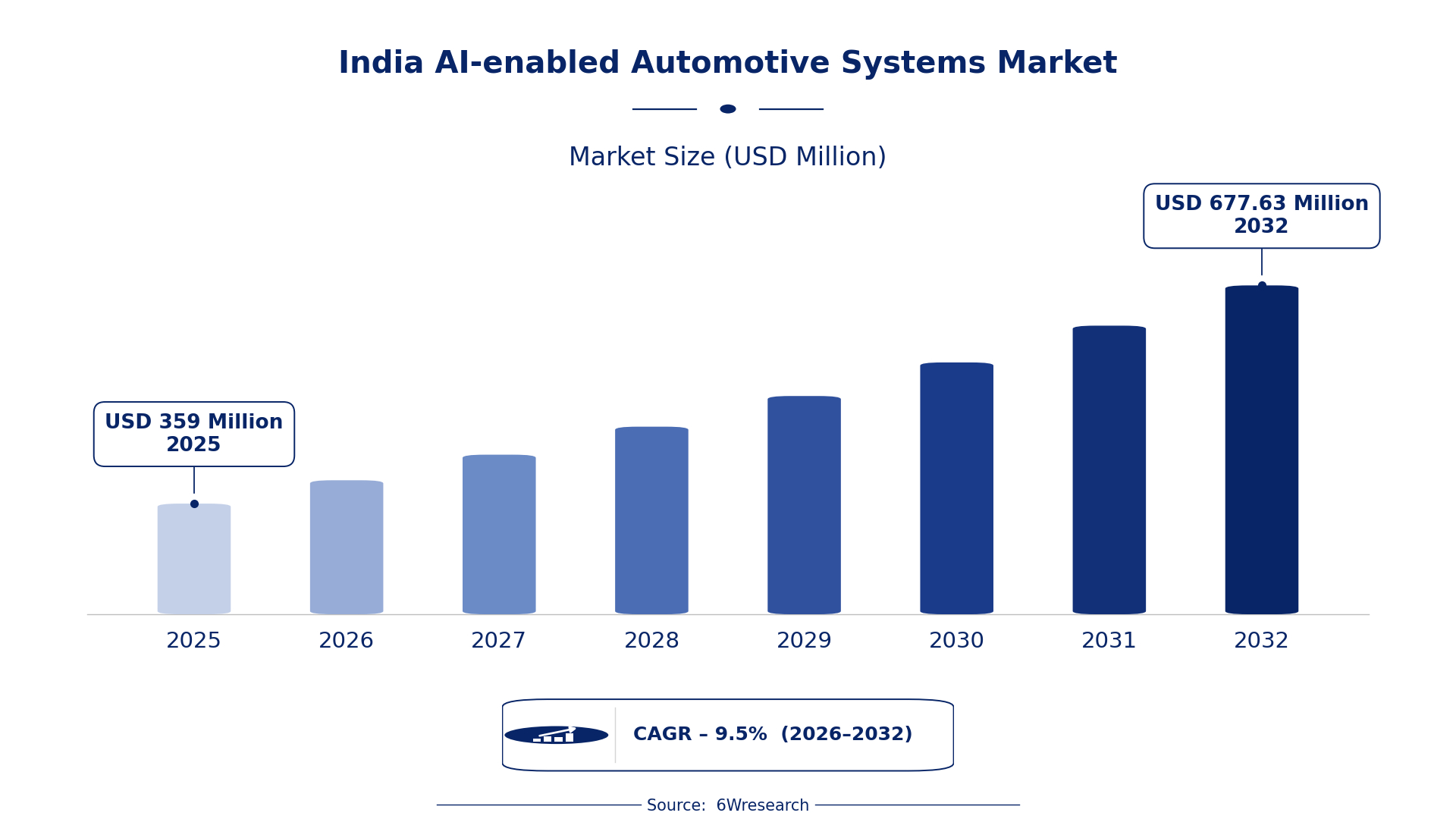
According to 6Wresearch internal database and industry insights, the India AI-enabled Automotive Systems Market was valued at USD 359.0 million in 2025 and is projected to reach USD 677.63 million by 2032, growing at a CAGR of approximately 9.5% during 2026–2032.
India AI-enabled Automotive Systems Market Highlights
| Report Metric | Details |
| Report Name | India AI-enabled Automotive Systems Market |
| Market Size 2025 | USD 359.0 million |
| Market Size 2032 | USD 677.63 million |
| Absolute Growth 2025–2032 | USD 318.63 million |
| CAGR 2026–2032 | 9.5% |
| Peak Annual Growth | 11.7% in 2026 |
| Forecast Period | 2026–2032 |
| Historical Data | 2022–2025 |
| Base Year | 2025 |
| Leading System Type, 2025 | ADAS (Driver Assist) (41% share) |
| Leading AI Functionality, 2025 | Object Detection (53% share) |
| Leading Distribution Channel, 2025 | Automotive OEMs (43% share) |
| Leading End User, 2025 | Car Manufacturers (46% share) |
| Fastest-Growing System Type | In-Vehicle Infotainment (11.7% CAGR) |
| Fastest-Growing AI Functionality | Voice/Touch AI Interface (11.3% CAGR) |
| Fastest-Growing Distribution Channel | Vehicle Software Vendors (11.7% CAGR) |
| Fastest-Growing End User | Connected Vehicle Developers (11.4% CAGR) |
| Growing Sector | automotive technology |
| Key End Users | car manufacturers, vehicle software vendors, fleet tech providers |
India AI-enabled Automotive Systems Market Year-wise Growth Rate and Key Drivers (2022–2032)
This graph illustrates the annual growth rates of the market from 2022 to 2032, highlighting a steady upward trajectory and projected market expansion over the forecast period.
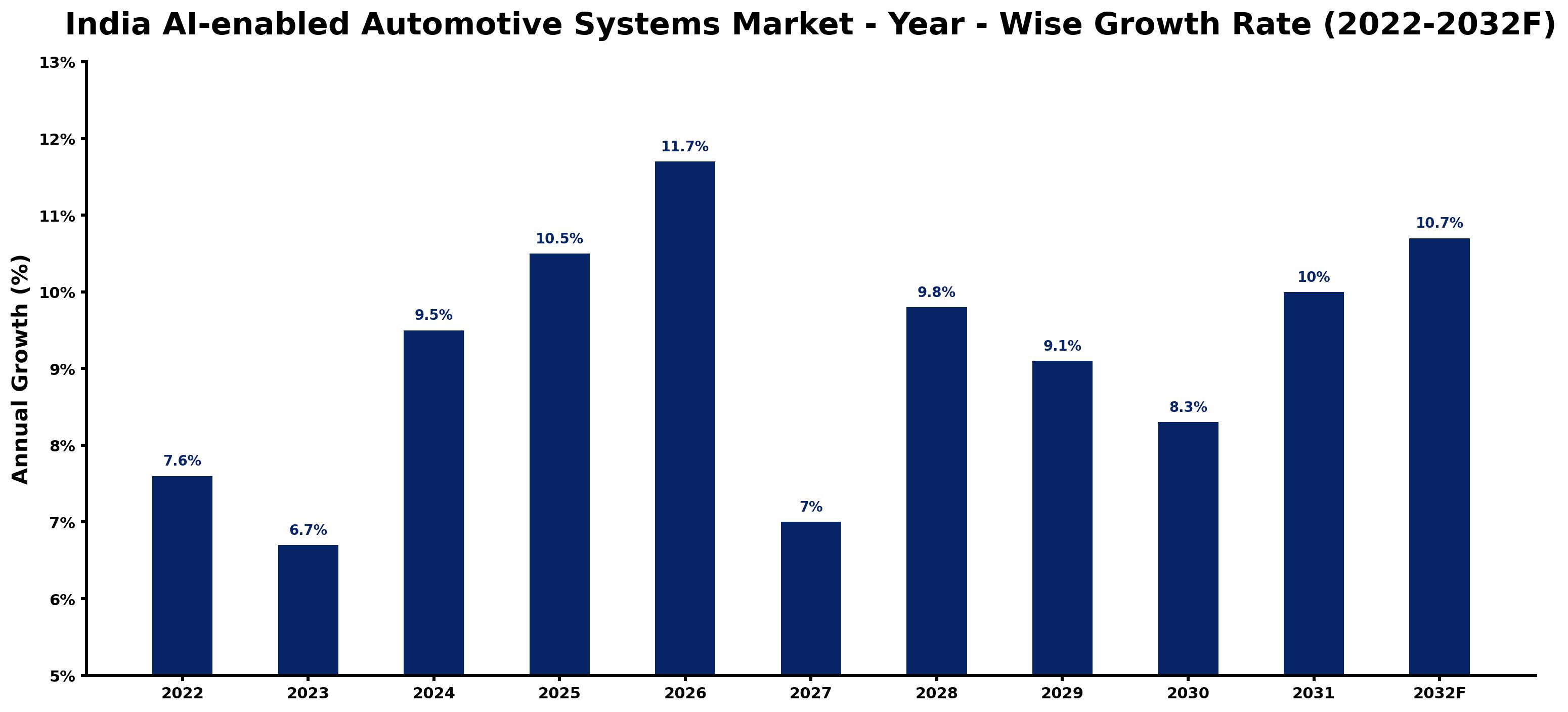
Annual growth estimates for each year appear below with the principal reason behind them, explaining the shifts that set the pace of the market.
| Year | Estimated Annual Growth (%) | Market Rationale |
| 2022 | 7.6 | The market experienced solid growth due to rising integration of AI technologies in vehicles. |
| 2023 | 6.7 | Growth slowed as manufacturers adjusted to fluctuating global supply chains affecting production. |
| 2024 | 9.5 | Demand surged as new AI-enabled models were launched, attracting consumer interest. |
| 2025 | 10.5 | The market reached a historical peak, driven by increased adoption of ADAS features in vehicles. |
| 2026 | 11.7 | Growth peaked as investment in AI technologies and safety features accelerated. |
| 2027 | 7.0 | A slowdown occurred as the market stabilised following rapid growth in previous years. |
| 2028 | 9.8 | Demand increased again as advancements in AI technologies improved system capabilities. |
| 2029 | 9.1 | Growth slowed due to market saturation in specific vehicle segments, particularly in urban areas. |
| 2030 | 8.3 | The market continued to grow, driven by ongoing technological enhancements in automotive systems. |
| 2031 | 10.0 | Demand rose as car manufacturers integrated more advanced AI functionalities into their offerings. |
| 2032 | 10.7 | The market is projected to grow further as connected vehicle technology becomes mainstream. |
Note: Market size estimations and growth projections presented in this report are based on 6Wresearch's proprietary forecasting methodology, utilizing the latest available industry data, government publications, and primary research inputs.
India AI-enabled Automotive Systems Market Synopsis
The India AI-enabled Automotive Systems Market encompasses advanced technologies that improve vehicle safety and efficiency. These systems integrate software algorithms and hardware components, providing functionalities like driver assistance and predictive maintenance. The market is expanding due to rising domestic demand from car manufacturers and technology developers, with over 4.4 million passenger vehicles produced in 2022. Government initiatives and standards support the integration of AI technologies, driving further adoption across the automotive sector.
Market Dynamics Impact Analysis (2026–2032)
| Factor | Type | Impact | Primary Segment Affected |
| Increasing integration of ADAS features in new vehicle models | Driver | High | ADAS (Driver Assist) |
| Rising demand for predictive maintenance solutions to reduce downtime | Driver | High | Predictive Maintenance |
| Growth in connected vehicle technology adoption | Opportunity | High | Connected Vehicle Developers |
| Expansion of AI functionalities in infotainment systems | Opportunity | Medium | In-Vehicle Infotainment |
| Challenges in aligning with ISO 26262 standards for safety | Restraint | High | AI ECU Systems |
| Fluctuations in global supply chains affecting production timelines | Restraint | Medium | Automotive OEMs |
| Limited skilled workforce to implement advanced AI technologies | Challenge | High | Car Manufacturers |
| High initial investment costs for AI system integration | Challenge | Medium | Vehicle Software Vendors |
Evaluation of Drivers in India AI-enabled Automotive Systems Market (2026–2032)
The main growth drivers and the segments they affect most are set out below.
| Drivers | Primary Segment Affected | Why It Matters (Evidence) |
| Rising integration of ADAS features | ADAS (Driver Assist) | This integration improves vehicle safety, with over 4.4 million passenger vehicles produced in 2022. |
| Growing demand for predictive maintenance solutions | Predictive Maintenance | AI-based predictive maintenance can reduce vehicle downtime by 30%. |
| Increased adoption of connected vehicle technologies | Connected Vehicle Developers | Connected vehicle technology adoption is expected to rise significantly by 2025. |
| Expansion of in-vehicle infotainment systems | In-Vehicle Infotainment | The demand for improved user experience drives growth in infotainment systems. |
| Government initiatives promoting electric vehicles | Automotive OEMs | These initiatives support the integration of AI technologies in automotive systems. |
Market growth for AI-enabled Automotive Systems in India is underpinned by rising integration of ADAS features, which improves vehicle safety. Over 4.4 million passenger vehicles were produced in 2022, driving demand for advanced safety technologies. The growing need for predictive maintenance solutions is notable, as AI-based systems can reduce vehicle downtime by 30%. Adoption of connected vehicle technologies is expected to increase by 2025, further boosting market growth.
Evaluation of Restraints in India AI-enabled Automotive Systems Market
The key brakes on demand, and where they bite hardest, are shown below.
| Market Restraint | Primary Segment Affected | Why It Matters (Evidence) |
| Challenges in aligning with ISO 26262 standards for safety | AI ECU Systems | Producers must ensure compliance with safety standards, which can delay product launches by several months. |
| Fluctuations in global supply chains affecting production timelines | Automotive OEMs | These fluctuations can lead to increased costs and delays in delivering vehicles by up to 15%. |
| Limited skilled workforce to implement advanced AI technologies | Car Manufacturers | A shortage of qualified professionals can hinder the adoption of new technologies and increase development costs by 20%. |
| High initial investment costs for AI system integration | Vehicle Software Vendors | These costs can deter smaller firms from entering the market, limiting competition. |
| Regulatory hurdles in deploying AI technologies | Connected Vehicle Developers | Compliance with evolving regulations can slow down innovation and deployment, affecting market entry. |
India AI-enabled Automotive Systems Market Challenges
The India AI-enabled Automotive Systems market still has to solve a few problems, starting with regulatory hurdles. The Ministry of Road Transport and Highways has set guidelines for AI in vehicles, causing delays in product launches for manufacturers by several months. A skills gap is another concern, as the rapid evolution of AI technologies outpaces the training of engineers, potentially increasing development costs for automotive firms by 20%. Supply chain disruptions also impede progress; for instance, delays in sourcing electronic components can extend production timelines by up to 15%. Technology integration issues arise as legacy systems struggle to incorporate new AI functionalities, complicating upgrades for producers and negatively affecting user experience.
Trends in the India AI-enabled Automotive Systems Market
Four trends stand out in the India AI-enabled Automotive Systems Market.
- Projected Growth of ADAS Integration: ADAS systems are increasingly being integrated into new vehicle models in India, with a projected growth rate of 11.7% by 2026. This shift improves safety and efficiency for consumers.
- Rise in AI-based Predictive Maintenance: The demand for AI-based predictive maintenance is increasing, with potential downtime reductions of 30%. This trend is particularly evident among fleet operators looking to optimise vehicle reliability.
- Surge in Connected Vehicle Technologies: Connected vehicle technology adoption is set to rise significantly by 2025, driven by government initiatives and consumer demand for enhanced connectivity features in vehicles.
- Growth of In-Vehicle Infotainment Systems: The integration of advanced infotainment systems is transforming user experiences in vehicles, with a projected growth rate of 11.7% for this segment by 2026.
Investment Opportunities in the India AI-enabled Automotive Systems Market
Investors looking at the India AI-enabled Automotive Systems Market should consider the following areas.
- Car Manufacturers Seeking Advanced AI Systems: Car manufacturers are increasingly looking for AI-enabled systems to improve vehicle features. Collaborating with local technology developers can facilitate entry into this growing market, projected to reach USD 359 million by 2025.
- Vehicle Software Vendors Focusing on AI Integration: Vehicle software vendors can supply AI solutions to meet the rising demand for advanced automotive systems. The automotive electronics market is projected to grow, creating investment opportunities for suppliers.
- Connected Vehicle Developers Aiming for Innovation: Connected vehicle developers are focusing on creating technologies that improve vehicle connectivity. The National Automotive Testing and R&D Infrastructure Project supports this innovation, encouraging partnerships for development.
- Fleet Tech Providers Needing Optimisation Solutions: Fleet tech providers require AI-enabled systems to enhance fleet management efficiency. The market's growth offers opportunities for suppliers to provide tailored solutions.
Government Initiatives in the India AI-enabled Automotive Systems Market
The National Electric Mobility Mission Plan 2020 promotes electric vehicles and associated technologies, enhancing AI integration in automotive systems. This initiative builds on previous policies by supporting manufacturers in meeting new standards, with a focus on innovation and investment in the automotive sector.
Funding from the National Automotive Testing and R&D Infrastructure Project supports automotive innovation, with the Automotive Research Association of India overseeing testing and certification. This collaboration ensures that new technologies meet safety and performance standards, enabling manufacturers to bring compliant products to market.
Future Insight of the India AI-enabled Automotive Systems Market
The India AI-enabled Automotive Systems market is expected to develop significantly by 2032, driven by several key factors. Connected vehicle technology adoption will rise, enhancing data exchange between vehicles and infrastructure. Government initiatives promoting electric vehicles will encourage deeper integration of AI systems, improving energy efficiency. The implementation of ISO 26262 standards for functional safety will become more widespread, ensuring safer automotive systems. By 2025, AI-based predictive maintenance can reduce vehicle downtime by up to 30%, benefiting both manufacturers and consumers.
Market Segmentation Analysis
Each segment group is reviewed below, with the leader by share and the fastest grower by CAGR.
By System Type – ADAS (Driver Assist) Dominated, In-Vehicle Infotainment Expected to Grow Fastest
According to Shubham Padhi, Research Analyst at 6Wresearch, ADAS (Driver Assist) held a 41% share of the India AI-enabled Automotive Systems Market by system type in 2025. ADAS systems hold the largest share as they provide essential safety features for vehicles, which aligns with India's increasing emphasis on road safety. Their integration into over 4.4 million passenger vehicles produced in 2022 highlights their critical importance in enhancing vehicle safety. The quickest growth will come from In-Vehicle Infotainment, forecast to expand at a CAGR of 11.7% between 2026 and 2032. In-Vehicle Infotainment is rapidly growing due to rising consumer demand for advanced entertainment and navigation features. As more new vehicle models incorporate these systems, the segment is set for significant expansion in the coming years. Suppliers should focus on developing innovative infotainment solutions to capture the growing market share.
By AI Functionality – Object Detection Dominated, Voice/Touch AI Interface Expected to Grow Fastest
Object Detection took a 53% share of ai functionality in 2025, more than any other category. Object Detection leads the market due to its vital role in safety systems for autonomous driving, making it a priority for vehicle manufacturers. The adherence to ISO 26262 standards for functional safety underscores the importance of this technology in ensuring safe vehicle operation. Voice/Touch AI Interface is set to record the highest CAGR in this split, 11.3% over 2026–2032. The Voice/Touch AI Interface is experiencing the fastest growth as it significantly enhances user interaction within vehicles. With consumer preferences shifting towards more intuitive interfaces, this segment is well-positioned for rapid expansion. Buyers should invest in advanced voice and touch interfaces to stay competitive in the automotive market.
By Distribution Channel – Automotive OEMs Dominated, Vehicle Software Vendors Expected to Grow Fastest
Automotive OEMs accounted for a 43% market share by distribution channel in 2025. Automotive OEMs command the largest market share as they are the primary developers and integrators of AI-enabled automotive systems, ensuring that safety and efficiency features are standard in new models. Their established relationships with manufacturers facilitate the widespread adoption of these technologies. Over 2026–2032, Vehicle Software Vendors are expected to post the fastest growth, at a CAGR of 11.7%. Vehicle Software Vendors are rapidly growing, driven by the increasing demand for essential software solutions that enhance vehicle systems. As the need for connected technologies rises, these vendors are set to capture a larger share of the market. Suppliers must strengthen partnerships with software vendors to leverage the growing demand for integrated vehicle systems.
By End User – Car Manufacturers Dominated, Connected Vehicle Developers Expected to Grow Fastest
In 2025, Car Manufacturers led the end user split with a 46% share. Car Manufacturers dominate the market as they integrate advanced systems into their vehicles, responding to the rising consumer demand for enhanced features. The production of over 4.4 million passenger vehicles in 2022 underscores the significant role of manufacturers in driving market growth. Connected Vehicle Developers are projected to grow fastest, at a CAGR of 11.4% during 2026–2032. Connected Vehicle Developers are experiencing the fastest growth, focusing on technologies that enable vehicle connectivity and communication. With government initiatives promoting intelligent transportation systems, this segment is poised for rapid advancement. Manufacturers should collaborate with connected vehicle developers to innovate and meet increasing consumer expectations.
Key Attractiveness of the Report
- 10 Years of Market Numbers
- Historical Data Starting from 2022 to 2025
- Base Year 2025
- Forecast Data until 2032
- Key Performance Indicators Impacting the Market
- Major Upcoming Developments and Projects
Key Highlights of the Report:
- India AI-enabled Automotive Systems Market Outlook
- Market Size of India AI-enabled Automotive Systems Market, 2025
- Forecast of India AI-enabled Automotive Systems Market, 2032
- Historical Data and Forecast of India AI-enabled Automotive Systems Revenues & Volume for the Period 2022 - 2032F
- India AI-enabled Automotive Systems Market Trend Evolution
- India AI-enabled Automotive Systems Market Drivers and Challenges
- India AI-enabled Automotive Systems Price Trends
- India AI-enabled Automotive Systems Porter's Five Forces
- India AI-enabled Automotive Systems Industry Life Cycle
- Historical Data and Forecast of India AI-enabled Automotive Systems Market Revenues & Volume By System Type for the Period 2022 - 2032F
- Historical Data and Forecast of India AI-enabled Automotive Systems Market Revenues & Volume By ADAS (Driver Assist) for the Period 2022 - 2032F
- Historical Data and Forecast of India AI-enabled Automotive Systems Market Revenues & Volume By In-Vehicle Infotainment for the Period 2022 - 2032F
- Historical Data and Forecast of India AI-enabled Automotive Systems Market Revenues & Volume By Predictive Maintenance for the Period 2022 - 2032F
- Historical Data and Forecast of India AI-enabled Automotive Systems Market Revenues & Volume By AI ECU Systems for the Period 2022 - 2032F
- Historical Data and Forecast of India AI-enabled Automotive Systems Market Revenues & Volume By AI Functionality for the Period 2022 - 2032F
- Historical Data and Forecast of India AI-enabled Automotive Systems Market Revenues & Volume By Object Detection for the Period 2022 - 2032F
- Historical Data and Forecast of India AI-enabled Automotive Systems Market Revenues & Volume By Voice/Touch AI Interface for the Period 2022 - 2032F
- Historical Data and Forecast of India AI-enabled Automotive Systems Market Revenues & Volume By Condition Monitoring for the Period 2022 - 2032F
- Historical Data and Forecast of India AI-enabled Automotive Systems Market Revenues & Volume By Behavior Optimization for the Period 2022 - 2032F
- Historical Data and Forecast of India AI-enabled Automotive Systems Market Revenues & Volume By Distribution Channel for the Period 2022 - 2032F
- Historical Data and Forecast of India AI-enabled Automotive Systems Market Revenues & Volume By Automotive OEMs for the Period 2022 - 2032F
- Historical Data and Forecast of India AI-enabled Automotive Systems Market Revenues & Volume By Vehicle Software Vendors for the Period 2022 - 2032F
- Historical Data and Forecast of India AI-enabled Automotive Systems Market Revenues & Volume By Fleet Tech Providers for the Period 2022 - 2032F
- Historical Data and Forecast of India AI-enabled Automotive Systems Market Revenues & Volume By Tier-1 Auto Suppliers for the Period 2022 - 2032F
- Historical Data and Forecast of India AI-enabled Automotive Systems Market Revenues & Volume By End User for the Period 2022 - 2032F
- Historical Data and Forecast of India AI-enabled Automotive Systems Market Revenues & Volume By Car Manufacturers for the Period 2022 - 2032F
- Historical Data and Forecast of India AI-enabled Automotive Systems Market Revenues & Volume By Connected Vehicle Developers for the Period 2022 - 2032F
- Historical Data and Forecast of India AI-enabled Automotive Systems Market Revenues & Volume By Vehicle Maintenance Teams for the Period 2022 - 2032F
- Historical Data and Forecast of India AI-enabled Automotive Systems Market Revenues & Volume By Automotive Electronics Firms for the Period 2022 - 2032F
- India AI-enabled Automotive Systems Import Export Trade Statistics
- Market Opportunity Assessment By System Type
- Market Opportunity Assessment By AI Functionality
- Market Opportunity Assessment By Distribution Channel
- Market Opportunity Assessment By End User
- India AI-enabled Automotive Systems Top Companies Market Share
- India AI-enabled Automotive Systems Competitive Benchmarking By Technical and Operational Parameters
- India AI-enabled Automotive Systems Company Profiles
- India AI-enabled Automotive Systems Key Strategic Recommendations
Market Covered
This report examines the market across the segments below.
By System Type
- ADAS (Driver Assist)
- In-Vehicle Infotainment
- Predictive Maintenance
- AI ECU Systems
By AI Functionality
- Object Detection
- Voice/Touch AI Interface
- Condition Monitoring
- Behavior Optimization
By Distribution Channel
- Automotive OEMs
- Vehicle Software Vendors
- Fleet Tech Providers
- Tier-1 Auto Suppliers
By End User
- Car Manufacturers
- Connected Vehicle Developers
- Vehicle Maintenance Teams
- Automotive Electronics Firms































