India AI-Enabled Vehicles Market Size & Growth Rate
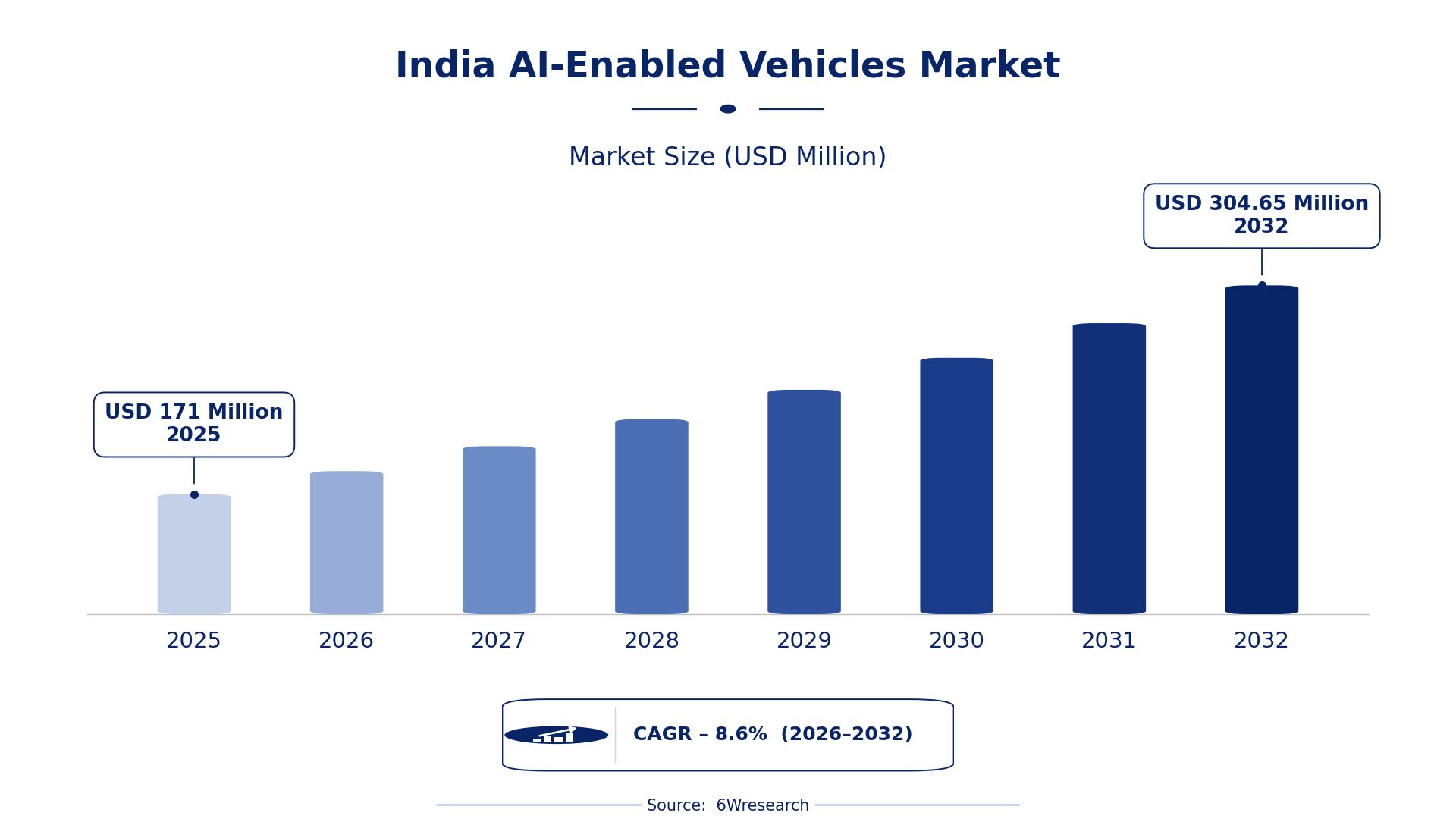
According to 6Wresearch internal database and industry insights, the India AI-Enabled Vehicles Market was valued at USD 171.0 million in 2025 and is projected to reach USD 304.65 million by 2032, growing at a CAGR of approximately 8.6% during 2026–2032.
India AI-Enabled Vehicles Market Highlights
| Report Metric | Details |
| Report Name | India AI-Enabled Vehicles Market |
| Market Size 2025 | USD 171.0 million |
| Market Size 2032 | USD 304.65 million |
| Absolute Growth 2025–2032 | USD 133.65 million |
| CAGR 2026–2032 | 8.6% |
| Peak Annual Growth | 11.0% in 2032 |
| Forecast Period | 2026–2032 |
| Historical Data | 2022–2025 |
| Base Year | 2025 |
| Leading Vehicle Type, 2025 | Passenger Vehicles (50% share) |
| Leading AI Capability, 2025 | Self-driving Features (47% share) |
| Leading Distribution Channel, 2025 | Automotive OEMs (43% share) |
| Leading End User, 2025 | Ride-sharing Services (36% share) |
| Fastest-Growing Vehicle Type | Public Buses (11.3% CAGR) |
| Fastest-Growing AI Capability | Predictive Routing (10.0% CAGR) |
| Fastest-Growing Distribution Channel | Smart Logistics Providers (10.7% CAGR) |
| Fastest-Growing End User | Fleet Management Companies (10.1% CAGR) |
| Growing Sector | Public Transport |
| Key End Users | Ride-sharing Services, Fleet Management Companies, Government Transport Agencies |
India AI-Enabled Vehicles Market Year-wise Growth Rate and Key Drivers (2022–2032)
This graph illustrates the annual growth rates of the market from 2022 to 2032, highlighting a steady upward trajectory and projected market expansion over the forecast period.
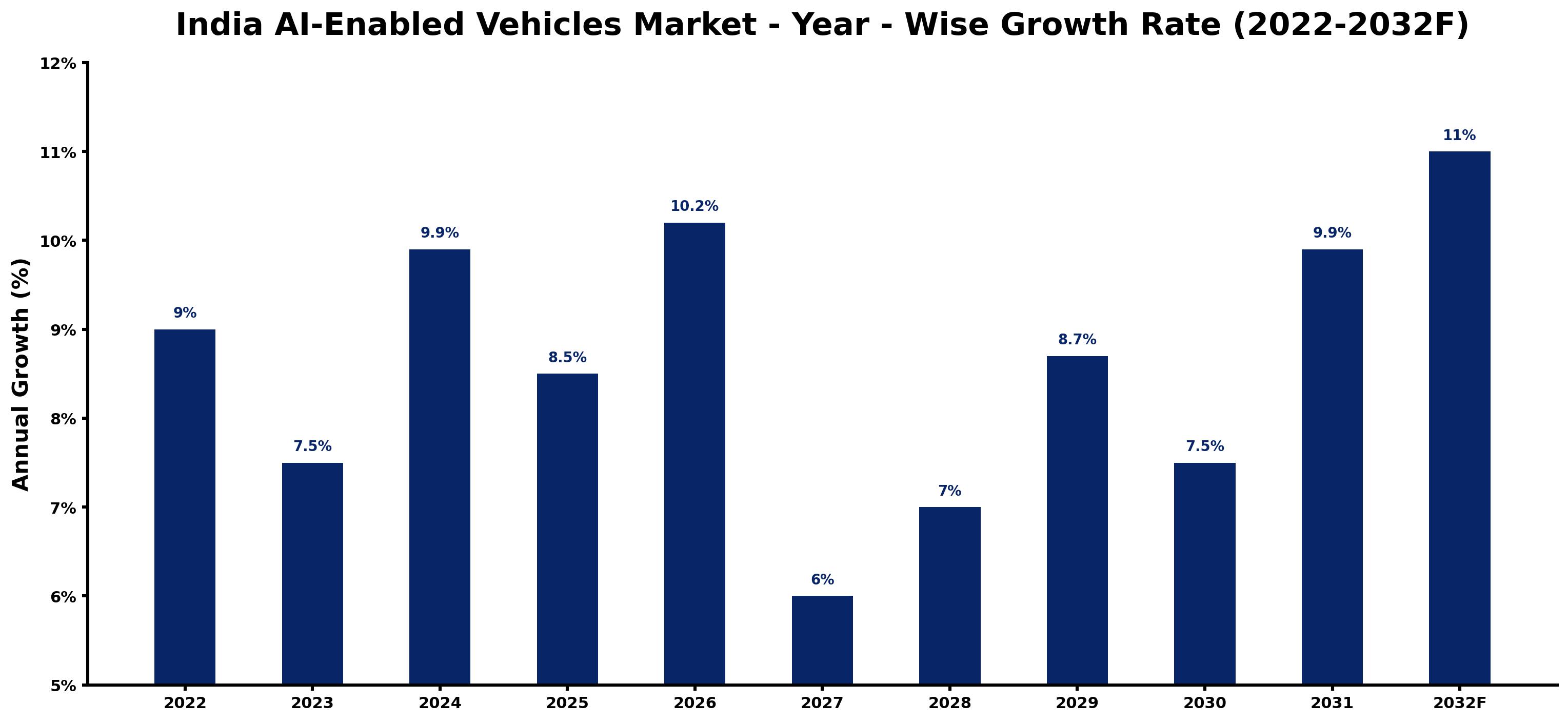
The following table presents the estimated annual growth rate for each year together with the principal factor influencing market performance.
| Year | Estimated Annual Growth (%) | Market Rationale |
| 2022 | 9.0 | The market experienced steady growth, driven by increased adoption of AI technologies in vehicles. |
| 2023 | 7.5 | Growth slowed due to challenges in integrating advanced AI systems across the automotive sector. |
| 2024 | 9.9 | Demand surged as more manufacturers began testing AI-enabled vehicles in urban environments. |
| 2025 | 8.5 | The market saw a slowdown as production faced delays in sourcing AI components. |
| 2026 | 10.2 | Growth accelerated with rising investments in smart city initiatives promoting AI technologies. |
| 2027 | 6.0 | A slowdown occurred as the market adjusted to new safety regulations for AI vehicles. |
| 2028 | 7.0 | Demand increased as public transport agencies began integrating AI for better efficiency. |
| 2029 | 8.7 | Growth picked up as fleet management companies adopted AI for improved operations. |
| 2030 | 7.5 | A slowdown was noted as the market faced challenges in meeting the 2030 EV penetration target. |
| 2031 | 9.9 | Demand surged again as the automotive sector adapted to new AI standards. |
| 2032 | 11.0 | The market peaked with significant investments in AI technologies for enhanced vehicle safety. |
Note: Market size estimations and growth projections presented in this report are based on 6Wresearch's proprietary forecasting methodology, utilizing the latest available industry data, government publications, and primary research inputs.
India AI-Enabled Vehicles Market Synopsis
AI-Enabled Vehicles in India represent a new generation of vehicles that leverage artificial intelligence to enhance driving safety and efficiency. These vehicles employ AI algorithms for features such as self-driving and predictive analytics. The India AI-Enabled Vehicles Market is experiencing growth driven by increasing domestic demand and substantial investments in AI capabilities. The automotive industry is anticipated to reach 30 million units by 2026, with a strong emphasis on smart city initiatives and government support for electric vehicle adoption.
Market Dynamics Impact Analysis (2026–2032)
| Factor | Type | Impact | Primary Segment Affected |
| Growing demand for self-driving features in personal and shared mobility solutions | Driver | High | Self-driving Features |
| Increasing adoption of AI technologies by fleet management companies | Driver | High | Fleet Management Companies |
| Investment opportunities in smart logistics for AI integration | Opportunity | High | Smart Logistics Providers |
| Expansion of public transport systems integrating AI technologies | Opportunity | Medium | Public Transport Vendors |
| Challenges in sourcing AI components affecting production timelines | Restraint | High | Passenger Vehicles |
| Regulatory hurdles in implementing AI standards across the automotive sector | Restraint | Medium | Commercial Trucks |
| High costs associated with developing AI technologies for vehicles | Challenge | High | Two-wheelers |
| Limited infrastructure for testing and deploying AI-enabled vehicles | Challenge | Medium | Public Buses |
Evaluation of Drivers in India AI-Enabled Vehicles Market (2026–2032)
Below mentioned are some major drivers and their influence on market dynamics.
| Drivers | Primary Segment Affected | Why It Matters (Evidence) |
| Increased consumer preference for self-driving features | Self-driving Features | The growing number of registered ride-sharing vehicles drives demand for advanced AI capabilities, with over 1.4 million vehicles in operation. |
| Growing investments in smart logistics solutions | Smart Logistics Providers | Over 60% of fleet management companies are adopting AI technologies by 2025, enhancing their operational capabilities. |
| Government initiatives promoting AI integration in public transport | Public Transport Vendors | The Intelligent Transport Systems initiative aims to improve urban mobility using AI technologies, with funding allocated for implementation. |
| Rising demand for predictive routing to improve traffic management | Predictive Routing | AI-powered traffic management systems are being implemented in major cities like Delhi and Mumbai, enhancing navigation efficiency. |
| Expanding market for AI-enabled passenger vehicles | Passenger Vehicles | India's automotive industry is expected to reach 30 million units by 2026, driving further demand for AI integration. |
The number of registered ride-sharing vehicles has reached over 1.4 million, driving demand for advanced AI capabilities. By 2025, more than 60% of fleet management companies are expected to adopt AI technologies, improving their operational efficiency. AI-powered traffic management systems are being implemented in major cities, improving navigation and traffic flow, which is critical for urban transport efficiency.
Evaluation of Restraints in India AI-Enabled Vehicles Market
The main factors holding the market back are set out below.
| Market Restraint | Primary Segment Affected | Why It Matters (Evidence) |
| High costs associated with developing AI technologies for vehicles | Two-wheelers | The average cost of integrating AI features can exceed ₹50,000 per unit, limiting adoption. |
| Regulatory hurdles in implementing AI standards across the automotive sector | Commercial Trucks | Compliance with the Automotive Industry Standard (AIS) 140 mandates costly modifications, impacting production timelines. |
| Challenges in sourcing AI components affecting production timelines | Passenger Vehicles | Supply chain disruptions have delayed AI component deliveries by up to six months, affecting availability for manufacturers. |
| Limited infrastructure for testing and deploying AI-enabled vehicles | Public Buses | Only 15% of public buses in major cities are expected to be AI-enabled by 2023, restricting operational efficiency. |
| Concerns over data privacy and security in AI systems | Fleet Management Companies | Data breaches can lead to financial penalties and loss of consumer trust, complicating AI adoption. |
India AI-Enabled Vehicles Market Challenges
The India AI-Enabled Vehicles market encounters several pressing challenges, starting with technology integration. Many manufacturers face difficulties in adopting advanced AI systems due to development costs that can account for 20% of total production expenses, resulting in delays for buyers. Regulatory compliance poses another challenge; the Automotive Industry Standard 140 requires safety features, which can extend testing periods by up to six months for manufacturers. Supply chain issues further complicate matters, as sourcing AI components may lead to delays, affecting fleet operators who rely on timely vehicle availability and efficient logistics.
Trends in the India AI-Enabled Vehicles Market
Several trends are reshaping the India AI-Enabled Vehicles Market; the most important are set out below.
- Shift from Traditional to AI-Enabled Public Transport: In India, public transport agencies are increasingly embracing AI technologies to improve operational efficiency. By 2023, 15% of public buses in major cities are expected to be AI-enabled, enhancing the passenger experience.
- Transition from Manual to Predictive Routing: The adoption of predictive routing in logistics began gaining traction in 2022, with smart logistics providers incorporating AI for improved traffic management. This transition is projected to enhance delivery times by 20%.
- Emergence of AI-Powered Traffic Management Systems: Cities like Delhi and Mumbai are rolling out AI-powered traffic management systems to optimise traffic flow. These systems are anticipated to reduce congestion by 30% in urban areas.
- Growth of AI Integration in Ride-sharing Services: Ride-sharing services in India have started utilising AI for operational efficiency since 2022. With over 1.4 million registered vehicles, this trend is transforming urban mobility.
Investment Opportunities in the India AI-Enabled Vehicles Market
Investors looking at the India AI-Enabled Vehicles Market should consider the following areas.
- Joint Ventures with Local Manufacturers: Local partnerships are essential for entering the AI-enabled vehicles market, especially in regions like Pune. With the automotive industry projected to reach 30 million units by 2026, collaboration can enhance market penetration.
- Investment in Smart City Initiatives: Smart city projects in Bengaluru are creating demand for AI-enabled public transport solutions. The government aims for 30% electric vehicle penetration by 2030, presenting a lucrative opportunity for suppliers.
- Expansion of AI Features in Two-wheelers: With India's two-wheeler market projected to grow to 25 million units by 2025, there is a significant gap for AI integration. Scooter manufacturers can capitalise on this trend by enhancing safety features.
- Focus on Fleet Management Solutions: Fleet management companies are increasingly adopting AI technologies for operational efficiency. With over 60% expected adoption by 2025, suppliers can target this growing segment.
Government Initiatives in the India AI-Enabled Vehicles Market
The National Electric Mobility Mission Plan 2020 seeks to promote electric and AI-enabled vehicles, aiming for 30% EV sales by 2030. This initiative strengthens the existing framework by offering incentives for manufacturers to develop AI capabilities in vehicles.
The Intelligent Transport Systems initiative, launched in 2021 by the Ministry of Road Transport and Highways, aims to enhance urban mobility through AI technologies. This programme funds the integration of AI in public transport systems, aiding the transition to smarter cities.
Future Insight of the India AI-Enabled Vehicles Market
By 2032, the India AI-Enabled Vehicles market will experience substantial changes, primarily driven by the government's initiative for 30% electric vehicle penetration by 2030. This push will stimulate advancements in AI technologies and their integration across various vehicle types. By 2025, more than 1.4 million ride-sharing vehicles are expected to adopt AI features, improving operational efficiency. The Bureau of Indian Standards is also developing regulations for AI in vehicles, which will ensure safer products for consumers and promote a more competitive automotive environment.
Market Segmentation Analysis
The analysis below covers each segmentation, its leading category in 2025 and its fastest-growing category through 2032.
By Vehicle Type – Passenger Vehicles Dominated, Public Buses Expected to Grow Fastest
According to Shubham Padhi, Research Analyst at 6Wresearch, the largest vehicle type category in 2025 was Passenger Vehicles, with a 50% share of total revenue. Passenger vehicles dominate the market share as they are widely adopted for personal and shared mobility solutions. The significant demand for these vehicles is reflected in India's automotive industry, projected to reach 30 million units by 2026. Public Buses are projected to grow fastest, at a CAGR of 11.3% during 2026–2032. Public buses are experiencing rapid growth due to their integration into smart city initiatives aimed at optimising public transport. The government's target of achieving 30% electric vehicle penetration by 2030 will further enhance the appeal of this segment. Suppliers should focus on developing features for passenger vehicles while also exploring opportunities in the public transport sector.
By AI Capability – Self-driving Features Dominated, Predictive Routing Expected to Grow Fastest
With a 47% revenue share in 2025, Self-driving Features was the largest ai capability category. Self-driving features lead the market as they are core to the development of autonomous vehicles, which are increasingly sought after by consumers. This capability is crucial for enhancing driving safety and efficiency, ensuring a strong market share. Predictive Routing is set to record the highest CAGR in this split, 10.0% over 2026–2032. Predictive routing is the fastest-growing capability, significantly improving navigation and traffic management for vehicles, particularly in urban settings. The implementation of traffic management systems in cities like Delhi and Mumbai is a key driver of this growth. Buyers should seek AI capabilities that improve navigation and safety, while suppliers need to invest in advancing self-driving technologies.
By Distribution Channel – Automotive OEMs Dominated, Smart Logistics Providers Expected to Grow Fastest
Automotive OEMs held a 43% share of the India AI-Enabled Vehicles Market by distribution channel in 2025. Automotive OEMs hold the largest share as they are the primary manufacturers of AI-enabled vehicles, meeting the growing demand in India's automotive sector. Their established networks and production capabilities ensure a steady supply of advanced vehicles. Over 2026–2032, Smart Logistics Providers are expected to post the fastest growth, at a CAGR of 10.7%. Smart logistics providers are the fastest-growing channel as they utilise AI for efficient fleet management, responding to the increasing need for optimisation in logistics. The rise of e-commerce and delivery services fuels this demand. Suppliers should strengthen partnerships with automotive OEMs while also targeting smart logistics providers to expand their market reach.
By End User – Ride-sharing Services Dominated, Fleet Management Companies Expected to Grow Fastest
Ride-sharing Services took a 36% share of end user in 2025, more than any other category. Ride-sharing services hold the largest market share as they leverage AI to enhance operational efficiency and user experience, essential in a competitive market. The presence of over 1.4 million registered ride-sharing vehicles in India underscores their significant impact. The quickest growth will come from Fleet Management Companies, forecast to expand at a CAGR of 10.1% between 2026 and 2032. Fleet management companies are the fastest-growing end-user group, utilising AI to optimise operations and reduce costs. The trend of over 60% of these companies adopting AI technologies by 2025 highlights their increasing reliance on such solutions. Suppliers should tailor their products to meet the needs of ride-sharing services while addressing the demands of fleet management companies.
Key Attractiveness of the Report
- 10 Years of Market Numbers
- Historical Data Starting from 2022 to 2025
- Base Year 2025
- Forecast Data until 2032
- Key Performance Indicators Impacting the Market
- Major Upcoming Developments and Projects
Key Highlights of the Report:
- India AI-Enabled Vehicles Market Outlook
- Market Size of India AI-Enabled Vehicles Market, 2025
- Forecast of India AI-Enabled Vehicles Market, 2032
- Historical Data and Forecast of India AI-Enabled Vehicles Revenues & Volume for the Period 2022 - 2032F
- India AI-Enabled Vehicles Market Trend Evolution
- India AI-Enabled Vehicles Market Drivers and Challenges
- India AI-Enabled Vehicles Price Trends
- India AI-Enabled Vehicles Porter's Five Forces
- India AI-Enabled Vehicles Industry Life Cycle
- Historical Data and Forecast of India AI-Enabled Vehicles Market Revenues & Volume By Vehicle Type for the Period 2022 - 2032F
- Historical Data and Forecast of India AI-Enabled Vehicles Market Revenues & Volume By Passenger Vehicles for the Period 2022 - 2032F
- Historical Data and Forecast of India AI-Enabled Vehicles Market Revenues & Volume By Commercial Trucks for the Period 2022 - 2032F
- Historical Data and Forecast of India AI-Enabled Vehicles Market Revenues & Volume By Two-wheelers for the Period 2022 - 2032F
- Historical Data and Forecast of India AI-Enabled Vehicles Market Revenues & Volume By Public Buses for the Period 2022 - 2032F
- Historical Data and Forecast of India AI-Enabled Vehicles Market Revenues & Volume By AI Capability for the Period 2022 - 2032F
- Historical Data and Forecast of India AI-Enabled Vehicles Market Revenues & Volume By Self-driving Features for the Period 2022 - 2032F
- Historical Data and Forecast of India AI-Enabled Vehicles Market Revenues & Volume By Predictive Routing for the Period 2022 - 2032F
- Historical Data and Forecast of India AI-Enabled Vehicles Market Revenues & Volume By AI-Powered Dash Systems for the Period 2022 - 2032F
- Historical Data and Forecast of India AI-Enabled Vehicles Market Revenues & Volume By Traffic Pattern AI for the Period 2022 - 2032F
- Historical Data and Forecast of India AI-Enabled Vehicles Market Revenues & Volume By Distribution Channel for the Period 2022 - 2032F
- Historical Data and Forecast of India AI-Enabled Vehicles Market Revenues & Volume By Automotive OEMs for the Period 2022 - 2032F
- Historical Data and Forecast of India AI-Enabled Vehicles Market Revenues & Volume By Smart Logistics Providers for the Period 2022 - 2032F
- Historical Data and Forecast of India AI-Enabled Vehicles Market Revenues & Volume By Vehicle Parts Distributors for the Period 2022 - 2032F
- Historical Data and Forecast of India AI-Enabled Vehicles Market Revenues & Volume By Public Transport Vendors for the Period 2022 - 2032F
- Historical Data and Forecast of India AI-Enabled Vehicles Market Revenues & Volume By End User for the Period 2022 - 2032F
- Historical Data and Forecast of India AI-Enabled Vehicles Market Revenues & Volume By Ride-sharing Services for the Period 2022 - 2032F
- Historical Data and Forecast of India AI-Enabled Vehicles Market Revenues & Volume By Fleet Management Companies for the Period 2022 - 2032F
- Historical Data and Forecast of India AI-Enabled Vehicles Market Revenues & Volume By Scooter/E-bike Manufacturers for the Period 2022 - 2032F
- Historical Data and Forecast of India AI-Enabled Vehicles Market Revenues & Volume By Government Transport Agencies for the Period 2022 - 2032F
- India AI-Enabled Vehicles Import Export Trade Statistics
- Market Opportunity Assessment By Vehicle Type
- Market Opportunity Assessment By AI Capability
- Market Opportunity Assessment By Distribution Channel
- Market Opportunity Assessment By End User
- India AI-Enabled Vehicles Top Companies Market Share
- India AI-Enabled Vehicles Competitive Benchmarking By Technical and Operational Parameters
- India AI-Enabled Vehicles Company Profiles
- India AI-Enabled Vehicles Key Strategic Recommendations
Market Covered
This report examines the market across the segments below.
By Vehicle Type
- Passenger Vehicles
- Commercial Trucks
- Two-wheelers
- Public Buses
By AI Capability
- Self-driving Features
- Predictive Routing
- AI-Powered Dash Systems
- Traffic Pattern AI
By Distribution Channel
- Automotive OEMs
- Smart Logistics Providers
- Vehicle Parts Distributors
- Public Transport Vendors
By End User
- Ride-sharing Services
- Fleet Management Companies
- Scooter/E-bike Manufacturers
- Government Transport Agencies































