India AI-Powered Merchandising Market Size & Growth Rate
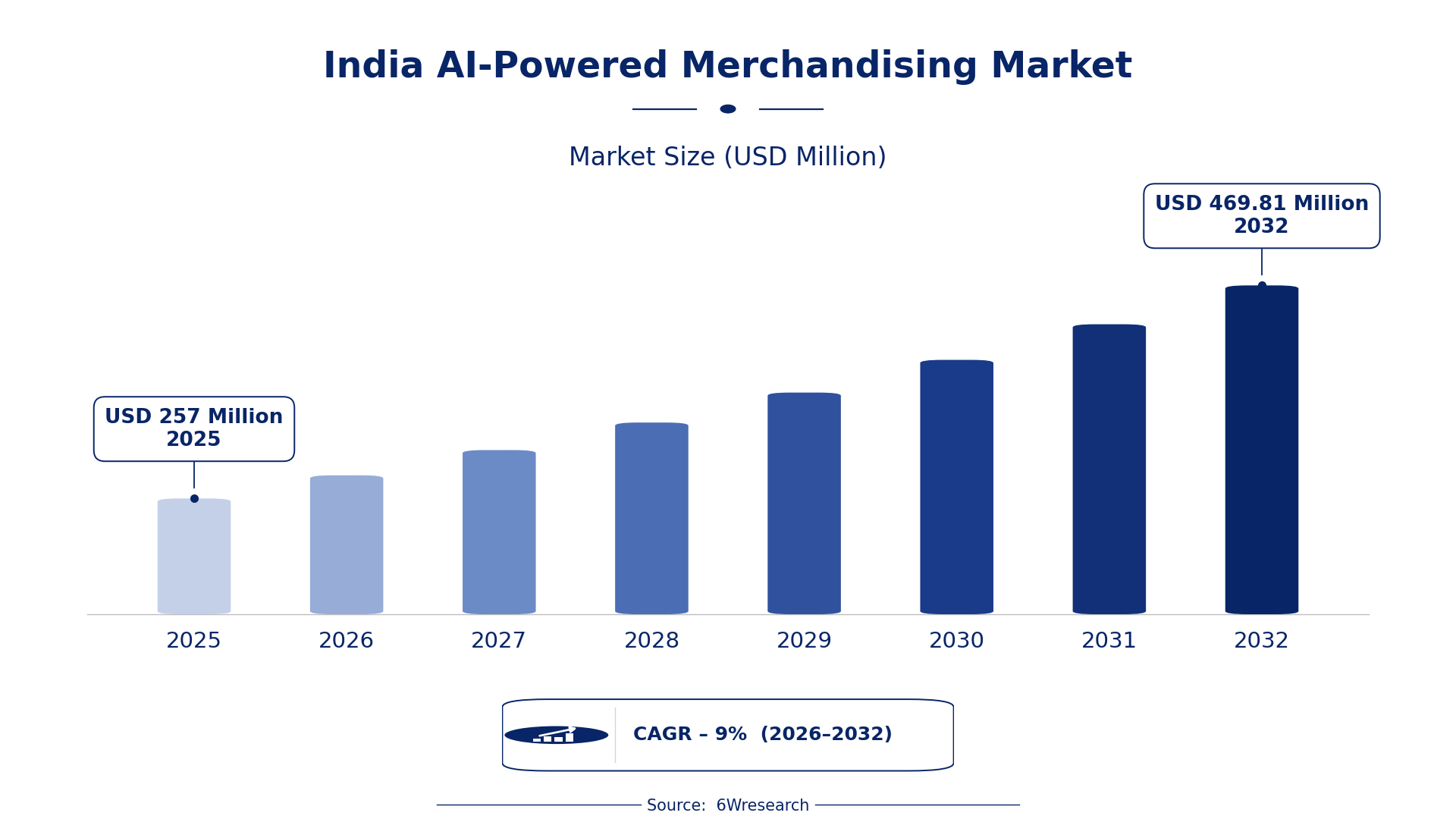
According to 6Wresearch internal database and industry insights, the India AI-Powered Merchandising Market was valued at USD 257.0 million in 2025 and is projected to reach USD 469.81 million by 2032, growing at a CAGR of approximately 9% during 2026–2032.
India AI-Powered Merchandising Market Highlights
| Report Metric | Details |
| Report Name | India AI-Powered Merchandising Market |
| Market Size 2025 | USD 257.0 million |
| Market Size 2032 | USD 469.81 million |
| Absolute Growth 2025–2032 | USD 212.81 million |
| CAGR 2026–2032 | 9% |
| Peak Annual Growth | 11.3% in 2028 |
| Forecast Period | 2026–2032 |
| Historical Data | 2022–2025 |
| Base Year | 2025 |
| Leading Retail Type, 2025 | E-Commerce (56% share) |
| Leading AI Capability, 2025 | Demand Forecasting AI (42% share) |
| Leading Distribution Channel, 2025 | Retail AI SaaS Providers (45% share) |
| Leading End User, 2025 | Apparel Brands (48% share) |
| Fastest-Growing AI Capability | Product Personalization (11.1% CAGR) |
| Fastest-Growing Distribution Channel | Online Merchandising Tools (11.2% CAGR) |
| Fastest-Growing End User | Online Marketplaces (11.8% CAGR) |
| Growing Sector | E-Commerce |
| Key End Users | Apparel Brands, Supermarkets, Online Marketplaces |
India AI-Powered Merchandising Market Year-wise Growth Rate and Key Drivers (2022–2032)
This graph illustrates the annual growth rates of the market from 2022 to 2032, highlighting a steady upward trajectory and projected market expansion over the forecast period.
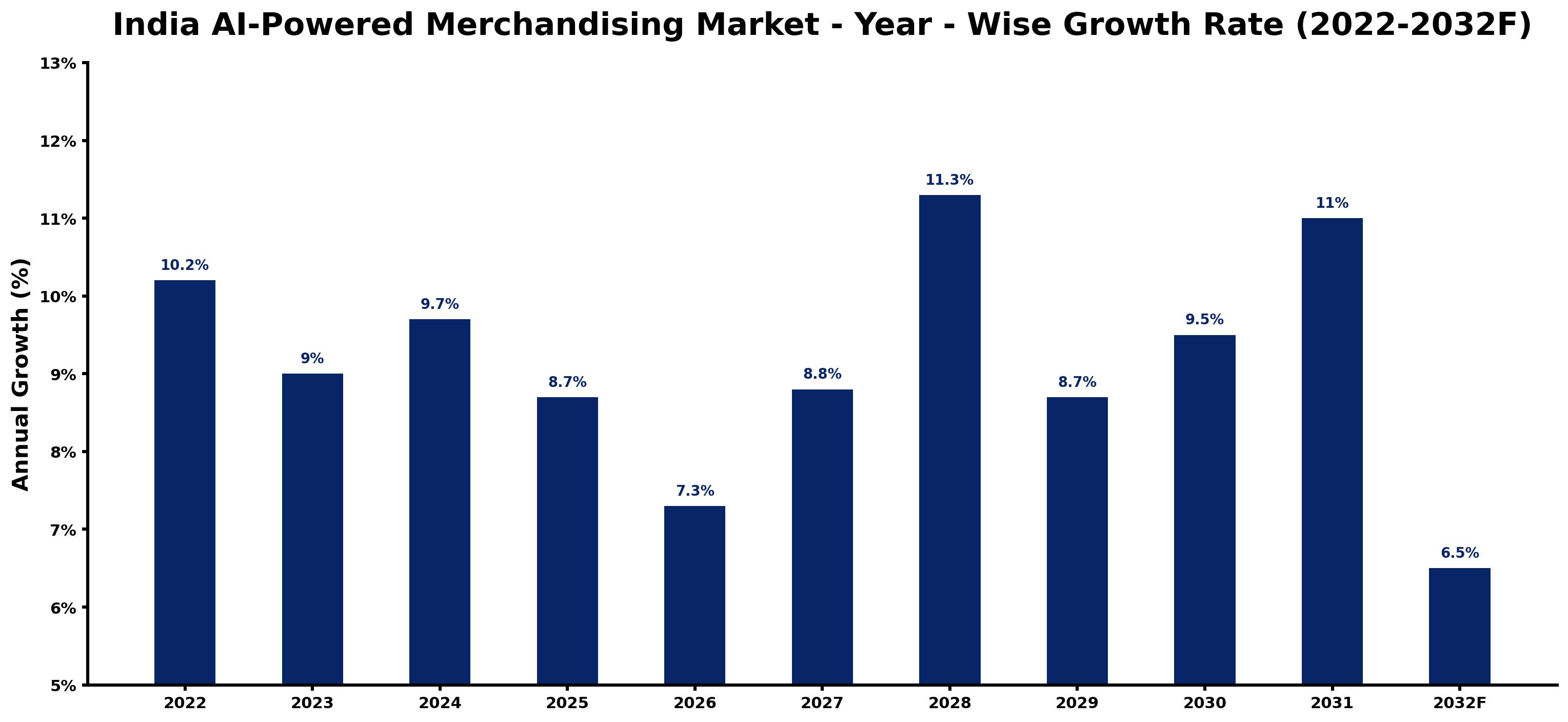
Each row of the following table gives one year's estimated growth and the event or demand shift that explains it.
| Year | Estimated Annual Growth (%) | Market Rationale |
| 2022 | 10.2 | The market experienced strong growth due to rising e-commerce sales and AI adoption. |
| 2023 | 9.0 | Growth slowed as the National Retail Policy began to promote technology adoption among retailers. |
| 2024 | 9.7 | Demand increased with the implementation of personalized marketing strategies in retail driven by AI. |
| 2025 | 8.7 | Growth slowed again as the market matured and faced challenges in technology integration. |
| 2026 | 7.3 | A slowdown is expected as companies focus on optimizing existing AI solutions under the Digital India initiative. |
| 2027 | 8.8 | Demand rose with advancements in AI capabilities and increased investment in retail technology. |
| 2028 | 11.3 | The market is projected to peak as dynamic pricing becomes widely adopted by major online retailers. |
| 2029 | 8.7 | Growth is expected to slow as the market stabilizes after rapid expansion. |
| 2030 | 9.5 | Demand will increase again as more retailers adopt AI-driven inventory management tools. |
| 2031 | 11.0 | Growth is projected to accelerate with the integration of AI in supply chain processes under the National Retail Policy. |
| 2032 | 6.5 | A slowdown is anticipated as the market matures and faces regulatory challenges. |
Note: Market size estimations and growth projections presented in this report are based on 6Wresearch's proprietary forecasting methodology, utilizing the latest available industry data, government publications, and primary research inputs.
India AI-Powered Merchandising Market Synopsis
AI-Powered Merchandising in India optimises retail operations through artificial intelligence, employing algorithms to analyse consumer data for demand forecasting and dynamic pricing. The India AI-Powered Merchandising Market is growing, driven by the booming e-commerce sector and rising demand for personalised shopping experiences. E-commerce sales are projected to reach $200 billion by 2026, prompting further investment in AI solutions. The National Retail Policy promotes technology adoption, creating a favourable environment for AI integration in retail, improving operational efficiency and customer satisfaction.
Market Dynamics Impact Analysis (2026–2032)
| Factor | Type | Impact | Primary Segment Affected |
| Growing e-commerce sales are driving demand for AI solutions to enhance customer engagement. | Driver | High | E-Commerce |
| The need for personalized marketing strategies is increasing among apparel brands. | Driver | High | Apparel Brands |
| The rise of online marketplaces is creating opportunities for AI-driven merchandising tools. | Opportunity | High | Online Marketplaces |
| The demand for AI-powered inventory prediction tools is increasing among supermarkets. | Opportunity | High | Supermarkets |
| Integration challenges with existing systems can hinder AI adoption in retail. | Restraint | High | Fashion Retail |
| Limited awareness about AI benefits may restrict its adoption among small retailers. | Restraint | Medium | Grocery Chains |
| The AI-Powered Merchandising market in India faces practical problems with technology integration. | Challenge | High | E-Commerce |
| Competition among AI service providers can lead to pricing pressures for retailers. | Challenge | Medium | Apparel Brands |
Evaluation of Drivers in India AI-Powered Merchandising Market (2026–2032)
The main growth drivers and the segments they affect most are set out below.
| Drivers | Primary Segment Affected | Why It Matters (Evidence) |
| Increasing e-commerce sales drive demand for AI solutions. | E-Commerce | E-commerce sales in India are estimated to reach $200 billion by 2026, prompting retailers to adopt AI for better customer engagement. |
| Demand for personalized marketing strategies is rising among apparel brands. | Apparel Brands | The fashion retail segment is projected to grow, with AI playing a key role in personalization. |
| AI-driven inventory prediction tools are gaining traction in supermarkets. | Supermarkets | AI-driven inventory prediction tools are being adopted by 40% of supermarkets in urban areas, improving stock management. |
| Dynamic pricing engines are increasingly utilized by online retailers. | Online Marketplaces | AI-powered dynamic pricing is used by over 60% of major online retailers in India, improving pricing strategies. |
| Retail AI SaaS providers are expanding their offerings. | Retail AI SaaS Providers | The rise in retail AI SaaS providers is meeting diverse retail needs, facilitating AI adoption. |
Growth in the AI-Powered Merchandising market in India comes from increasing e-commerce sales, rising demand for personalized marketing strategies, and the adoption of AI-driven inventory prediction tools. E-commerce sales are projected to reach $200 billion by 2026, prompting retailers to improve customer engagement through AI. The fashion retail segment is set to expand, with AI playing a key role in personalization. AI-driven inventory prediction tools are being adopted by 40% of supermarkets in urban areas, enhancing stock management. Dynamic pricing engines are increasingly utilized by major online retailers, improving pricing strategies and driving further demand.
Evaluation of Restraints in India AI-Powered Merchandising Market
The following restraints limit how fast demand can grow.
| Market Restraint | Primary Segment Affected | Why It Matters (Evidence) |
| Integration challenges with existing systems can hinder AI adoption in retail. | Fashion Retail | Many retailers face difficulties integrating AI with legacy systems, delaying implementation and increasing costs. |
| Limited awareness about AI benefits may restrict its adoption among small retailers. | Grocery Chains | Smaller retailers often lack knowledge about AI's advantages, resulting in slower adoption rates. |
| High initial investment costs can deter retailers from adopting AI solutions. | E-Commerce | The cost of implementing AI technologies can be prohibitive for smaller e-commerce platforms. |
| Data privacy concerns may limit the use of AI in merchandising. | Apparel Brands | Retailers must navigate complex data privacy regulations, which can restrict data usage for AI applications. |
| The fast pace of technological change can overwhelm retailers. | Supermarkets | Retailers may struggle to keep up with rapid advancements in AI technology, leading to missed opportunities. |
India AI-Powered Merchandising Market Challenges
The India AI-Powered Merchandising market faces a few practical problems, starting with skills shortages, as only 25% of retail staff are trained in AI technologies. This gap in expertise limits the effective implementation of AI solutions, causing delays in projects and increasing operational costs for retailers. Intense competition exists, with over 60% of major online retailers employing AI-powered dynamic pricing, which creates challenges for smaller players struggling to keep pace. High integration costs, exceeding 15% of total IT budgets, force many retailers to defer necessary upgrades. Lastly, technology adoption varies widely, with only 40% of supermarkets using AI-driven inventory prediction tools, hindering overall efficiency improvements in the sector.
Trends in the India AI-Powered Merchandising Market
Buyers and suppliers in the India AI-Powered Merchandising Market are adjusting to the following trends.
- Shift towards Personalised Shopping Experiences: Retailers are increasingly adopting AI to create personalised shopping experiences for consumers. For example, the fashion retail segment is expected to grow significantly, with AI playing a key role in personalisation, improving customer satisfaction.
- Adoption of Dynamic Pricing Strategies: Major online retailers are shifting towards dynamic pricing strategies powered by AI. Over 60% of these retailers in India are using AI-driven dynamic pricing, allowing them to adjust prices based on market demand.
- Growth in AI-Driven Inventory Management: Supermarkets are increasingly implementing AI-driven inventory management tools. Approximately 40% of supermarkets in urban areas are adopting these tools, improving operational efficiency and stock management.
- Expansion of Retail AI SaaS Providers: The market is seeing a rise in retail AI SaaS providers offering tailored solutions. By 2025, these providers are expected to capture a significant share of the market, enhancing the retail environment.
Investment Opportunities in the India AI-Powered Merchandising Market
Several openings in the India AI-Powered Merchandising Market merit attention from investors.
- E-Commerce Sector Expansion: The e-commerce sector in India is experiencing rapid growth, with sales projected to reach $200 billion by 2026. Retail AI SaaS providers can supply tailored AI solutions to online marketplaces, improving customer engagement.
- Integration of AI in Supermarkets: Supermarkets are increasingly adopting AI-driven inventory prediction tools, with 40% already implementing them. Suppliers can invest in developing advanced AI solutions to meet this growing demand.
- Focus on Apparel Brands: Apparel brands are seeking personalised marketing strategies to improve customer experiences. The growing demand for AI solutions in this sector creates opportunities for technology providers to offer advanced tools.
- Investment in AI Research and Development: The Indian government's budget of ₹10,000 crores for AI research and development in 2023 presents opportunities for technology firms. Collaborating with local partners can facilitate entry into the retail AI market.
Government Initiatives in the India AI-Powered Merchandising Market
The National Strategy for Artificial Intelligence, launched by the Ministry of Electronics and Information Technology in 2021, aims to promote AI across various sectors, including retail, targeting a $1 trillion digital economy by 2025. The Digital India initiative, initiated in 2015, focuses on enhancing digital infrastructure and aims to reach 1 billion internet users, facilitating AI technology adoption in retail. The National Retail Policy, introduced in 2022, streamlines regulations and encourages technology adoption, including AI applications, to improve competitiveness in the retail sector. These measures create a supportive environment for AI integration, enabling retailers to leverage technology for better operational efficiency and customer engagement.
In 2023, the Indian government allocated ₹10,000 crores for AI research and development, which includes projects aimed at improving retail efficiency. The Ministry of Commerce and Industry oversees the Atmanirbhar Bharat scheme, which boosts local manufacturing and technology adoption, including AI in retail sectors. This funding supports initiatives that drive innovation and improve the retail environment, ensuring that businesses can effectively integrate AI solutions. As a result, retailers are better positioned to enhance their operational capabilities and meet evolving consumer demands.
Future Insight of the India AI-Powered Merchandising Market
By 2032, the India AI-Powered Merchandising market will undergo notable transformations, driven by several key factors. The government's Digital India initiative will continue to promote AI integration, improving the retail environment. E-commerce sales are projected to grow substantially, reaching $200 billion by 2026, which will drive demand for AI solutions. The Bureau of Indian Standards is set to release guidelines for AI in retail by 2024, fostering compliance and confidence in these technologies. AI applications are expected to improve operational efficiency by 30% by 2025, enabling retailers to optimise processes and elevate customer experiences.
Market Segmentation Analysis
Each segment group is reviewed below, with the leader by share and the fastest grower by CAGR.
By Retail Type – E-Commerce Dominated and Is Expected to Record the Fastest Growth
According to Shubham Padhi, Research Analyst at 6Wresearch, E-Commerce accounted for a 56% market share by retail type in 2025. E-Commerce holds the largest share in India's AI-Powered Merchandising Market due to its vast customer base and the significant shift towards online shopping. The projected e-commerce sales of $200 billion by 2026 underscore the critical importance of technology in enhancing customer engagement and sales strategies. Its lead should widen, with a projected CAGR of 10.2% during 2026–2032, the highest in this split. E-Commerce is also the fastest-growing segment as it increasingly embraces advanced solutions to improve personalization and operational efficiency. The National Retail Policy's focus on technology adoption will further accelerate this growth trajectory, allowing e-commerce to maintain its lead. Suppliers should prioritise developing tailored solutions for e-commerce to capture the expanding market share.
By AI Capability – Demand Forecasting AI Dominated, Product Personalization Expected to Grow Fastest
With a 42% revenue share in 2025, Demand Forecasting AI was the largest ai capability category. Demand Forecasting AI leads the market share as it is vital for retailers to accurately predict consumer behaviour and manage stock levels effectively. This capability is essential for optimising inventory and ensuring product availability in India's diverse retail environment, making it a cornerstone of successful operations. The quickest growth will come from Product Personalization, forecast to expand at a CAGR of 11.1% between 2026 and 2032. Product Personalization is the fastest-growing capability, propelled by the increasing need for retailers to enhance customer satisfaction and loyalty. As businesses recognise the value of tailored shopping experiences, investment in this area is expected to surge, further solidifying the market's focus on personalised solutions. Buyers should seek solutions that offer robust forecasting and personalization features to maintain competitiveness.
By Distribution Channel – Retail AI SaaS Providers Dominated, Online Merchandising Tools Expected to Grow Fastest
Retail AI SaaS Providers took a 45% share of distribution channel in 2025, more than any other category. Retail AI SaaS Providers dominate the market share as they deliver essential software solutions that empower retailers to implement effective strategies. Their role is critical in facilitating the integration of technology into retail operations, ensuring seamless transitions and improved operational efficiency. Online Merchandising Tools are projected to grow fastest, at a CAGR of 11.2% during 2026–2032. Online Merchandising Tools are experiencing the fastest growth due to the rising demand for platforms that enable efficient strategy implementation. As digital retail expands, these tools will become indispensable for success, allowing retailers to adapt quickly to market changes. Suppliers must focus on enhancing their online tools to meet the increasing demand for effective technology integration.
By End User – Apparel Brands Dominated, Online Marketplaces Expected to Grow Fastest
In 2025, Apparel Brands led the end user split with a 48% share. Apparel Brands command the largest share as they utilise advanced solutions for trend analysis and inventory management, which are crucial in a competitive market. Their reliance on technology to optimise operations positions them as key players in the retail landscape, driving significant market activity. Over 2026–2032, Online Marketplaces are expected to post the fastest growth, at a CAGR of 11.8%. Online Marketplaces are the fastest-growing end user segment, heavily relying on advanced solutions to enhance user experience and optimise sales. The rapid growth of e-commerce platforms necessitates sophisticated technologies to cater to evolving consumer preferences, ensuring their continued expansion. Buyers in the apparel sector should invest in technologies that improve inventory management and customer engagement.
Key Attractiveness of the Report
- 10 Years of Market Numbers
- Historical Data Starting from 2022 to 2025
- Base Year 2025
- Forecast Data until 2032
- Key Performance Indicators Impacting the Market
- Major Upcoming Developments and Projects
Key Highlights of the Report:
- India AI-Powered Merchandising Market Outlook
- Market Size of India AI-Powered Merchandising Market, 2025
- Forecast of India AI-Powered Merchandising Market, 2032
- Historical Data and Forecast of India AI-Powered Merchandising Revenues & Volume for the Period 2022 - 2032F
- India AI-Powered Merchandising Market Trend Evolution
- India AI-Powered Merchandising Market Drivers and Challenges
- India AI-Powered Merchandising Price Trends
- India AI-Powered Merchandising Porter's Five Forces
- India AI-Powered Merchandising Industry Life Cycle
- Historical Data and Forecast of India AI-Powered Merchandising Market Revenues & Volume By Retail Type for the Period 2022 - 2032F
- Historical Data and Forecast of India AI-Powered Merchandising Market Revenues & Volume By Fashion Retail for the Period 2022 - 2032F
- Historical Data and Forecast of India AI-Powered Merchandising Market Revenues & Volume By Grocery Chains for the Period 2022 - 2032F
- Historical Data and Forecast of India AI-Powered Merchandising Market Revenues & Volume By E-Commerce for the Period 2022 - 2032F
- Historical Data and Forecast of India AI-Powered Merchandising Market Revenues & Volume By Convenience Stores for the Period 2022 - 2032F
- Historical Data and Forecast of India AI-Powered Merchandising Market Revenues & Volume By AI Capability for the Period 2022 - 2032F
- Historical Data and Forecast of India AI-Powered Merchandising Market Revenues & Volume By Demand Forecasting AI for the Period 2022 - 2032F
- Historical Data and Forecast of India AI-Powered Merchandising Market Revenues & Volume By Dynamic Pricing Engine for the Period 2022 - 2032F
- Historical Data and Forecast of India AI-Powered Merchandising Market Revenues & Volume By Product Personalization for the Period 2022 - 2032F
- Historical Data and Forecast of India AI-Powered Merchandising Market Revenues & Volume By Inventory Prediction for the Period 2022 - 2032F
- Historical Data and Forecast of India AI-Powered Merchandising Market Revenues & Volume By Distribution Channel for the Period 2022 - 2032F
- Historical Data and Forecast of India AI-Powered Merchandising Market Revenues & Volume By Retail AI SaaS Providers for the Period 2022 - 2032F
- Historical Data and Forecast of India AI-Powered Merchandising Market Revenues & Volume By Supply Chain Software Firms for the Period 2022 - 2032F
- Historical Data and Forecast of India AI-Powered Merchandising Market Revenues & Volume By Online Merchandising Tools for the Period 2022 - 2032F
- Historical Data and Forecast of India AI-Powered Merchandising Market Revenues & Volume By AI Retail Partners for the Period 2022 - 2032F
- Historical Data and Forecast of India AI-Powered Merchandising Market Revenues & Volume By End User for the Period 2022 - 2032F
- Historical Data and Forecast of India AI-Powered Merchandising Market Revenues & Volume By Apparel Brands for the Period 2022 - 2032F
- Historical Data and Forecast of India AI-Powered Merchandising Market Revenues & Volume By Supermarkets for the Period 2022 - 2032F
- Historical Data and Forecast of India AI-Powered Merchandising Market Revenues & Volume By Online Marketplaces for the Period 2022 - 2032F
- Historical Data and Forecast of India AI-Powered Merchandising Market Revenues & Volume By Quick-Service Retailers for the Period 2022 - 2032F
- India AI-Powered Merchandising Import Export Trade Statistics
- Market Opportunity Assessment By Retail Type
- Market Opportunity Assessment By AI Capability
- Market Opportunity Assessment By Distribution Channel
- Market Opportunity Assessment By End User
- India AI-Powered Merchandising Top Companies Market Share
- India AI-Powered Merchandising Competitive Benchmarking By Technical and Operational Parameters
- India AI-Powered Merchandising Company Profiles
- India AI-Powered Merchandising Key Strategic Recommendations
Market Covered
Segments analysed in this report are listed below.
By Retail Type
- Fashion Retail
- Grocery Chains
- E-Commerce
- Convenience Stores
By AI Capability
- Demand Forecasting AI
- Dynamic Pricing Engine
- Product Personalization
- Inventory Prediction
By Distribution Channel
- Retail AI SaaS Providers
- Supply Chain Software Firms
- Online Merchandising Tools
- AI Retail Partners
By End User
- Apparel Brands
- Supermarkets
- Online Marketplaces
- Quick-Service Retailers































