India AI Trading Market Size & Growth Rate
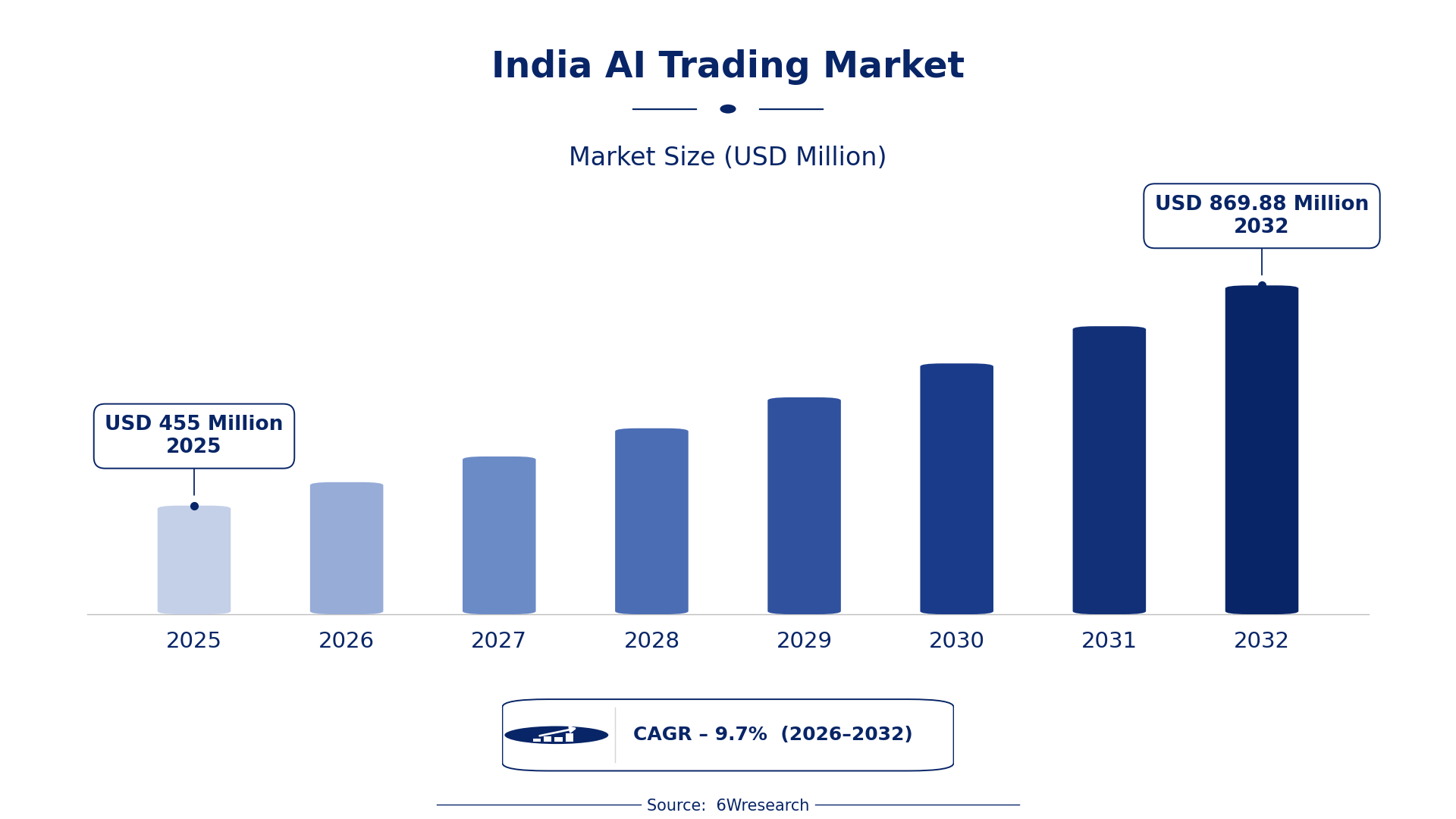
According to 6Wresearch internal database and industry insights, the India AI Trading Market was valued at USD 455.0 million in 2025 and is projected to reach USD 869.88 million by 2032, growing at a CAGR of approximately 9.7% during 2026–2032.
India AI Trading Market Highlights
| Report Metric | Details |
| Report Name | India AI Trading Market |
| Market Size 2025 | USD 455.0 million |
| Market Size 2032 | USD 869.88 million |
| Absolute Growth 2025–2032 | USD 414.88 million |
| CAGR 2026–2032 | 9.7% |
| Peak Annual Growth | 12.1% in 2030 |
| Forecast Period | 2026–2032 |
| Historical Data | 2022–2025 |
| Base Year | 2025 |
| Leading Trading Strategy, 2025 | Algorithmic Trading (41% share) |
| Leading AI Model Type, 2025 | Predictive Analytics (35% share) |
| Leading Distribution Channel, 2025 | Online Trading Platforms (53% share) |
| Leading End User, 2025 | Institutional Investors (44% share) |
| Fastest-Growing Trading Strategy | Crypto Trading (10.9% CAGR) |
| Fastest-Growing Distribution Channel | FinTech Marketplaces (12.0% CAGR) |
| Fastest-Growing End User | Individual Traders (12.1% CAGR) |
| Growing Sector | financial services |
| Key End Users | institutional investors, individual traders, hedge funds, investment banks |
India AI Trading Market Year-wise Growth Rate and Key Drivers (2022–2032)
This graph illustrates the annual growth rates of the market from 2022 to 2032, highlighting a steady upward trajectory and projected market expansion over the forecast period.
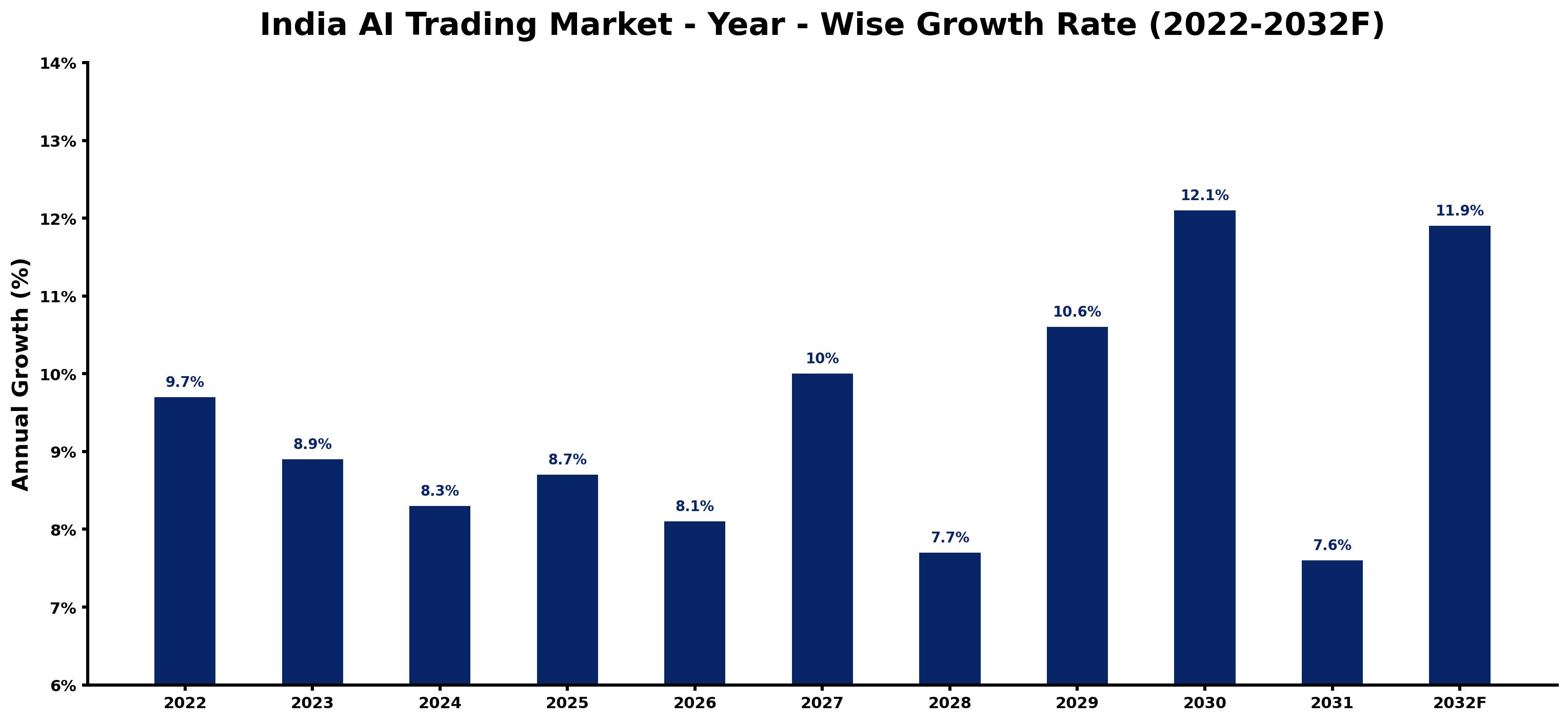
Below, each year's estimated growth is shown next to the factor that most influenced it.
| Year | Estimated Annual Growth (%) | Market Rationale |
| 2022 | 9.7 | The market exhibited strong performance due to increased algorithmic trading adoption. |
| 2023 | 8.9 | Growth slowed as regulatory updates were implemented, affecting trading strategies. |
| 2024 | 8.3 | Continued regulatory adjustments contributed to a further slowdown in growth. |
| 2025 | 8.7 | Demand picked up as institutional investors increased their AI trading activities. |
| 2026 | 8.1 | Growth decelerated due to compliance challenges from updated regulations. |
| 2027 | 10.0 | A resurgence in demand was driven by advancements in trading technologies. |
| 2028 | 7.7 | Growth slowed again as market conditions adjusted post-regulatory updates. |
| 2029 | 10.6 | Demand accelerated as individual traders increasingly adopted AI tools. |
| 2030 | 12.1 | The peak growth was driven by significant investments in AI technology. |
| 2031 | 7.6 | Growth slowed as the market began to stabilise after rapid expansion. |
| 2032 | 11.9 | Demand is expected to rise as new AI trading solutions are introduced. |
Note: Market size estimations and growth projections presented in this report are based on 6Wresearch's proprietary forecasting methodology, utilizing the latest available industry data, government publications, and primary research inputs.
India AI Trading Market Synopsis
AI Trading in India utilises artificial intelligence algorithms to analyse market data and execute trades, optimising investment strategies. The India AI Trading Market is experiencing rapid growth, fuelled by rising retail investor participation and advancements in algorithmic trading strategies. Approximately 40 million retail investors are now engaging with AI trading solutions. The Digital India initiative promotes tech adoption, creating a vibrant trading environment. This combination of factors keeps the market dynamic and relevant.
Market Dynamics Impact Analysis (2026–2032)
| Factor | Type | Impact | Primary Segment Affected |
| Growing retail investor participation | Driver | High | Algorithmic Trading |
| Advancements in AI technology | Driver | High | Predictive Analytics |
| Expansion of fintech startups | Opportunity | High | FinTech Marketplaces |
| Rising demand for automated trading solutions | Opportunity | High | Online Trading Platforms |
| Regulatory challenges in AI trading practices | Restraint | High | Algorithmic Trading |
| Limited awareness of AI trading benefits | Restraint | Medium | Individual Traders |
| AI Trading in India faces regulatory scrutiny | Challenge | High | High-Frequency Trading |
| Market volatility affecting trading strategies | Challenge | Medium | Quantitative Trading |
Evaluation of Drivers in India AI Trading Market (2026–2032)
The factors lifting demand, and the evidence behind each, are summarised below.
| Drivers | Primary Segment Affected | Why It Matters (Evidence) |
| Increased adoption of algorithmic trading | Algorithmic Trading | Over 60% of trades on Indian exchanges are executed through algorithmic trading, leading to higher demand for AI solutions. |
| Growing number of retail investors | Predictive Analytics | With approximately 40 million retail investors, the demand for predictive analytics tools is surging. |
| Investment in fintech innovations | FinTech Marketplaces | The rise of over 300 fintech startups is creating strong demand for advanced trading solutions. |
| Improved trading efficiency through AI | Online Trading Platforms | AI tools are optimising trading processes, attracting more users to online platforms. |
| Support from government initiatives | High-Frequency Trading | The Digital India initiative is promoting technology adoption, boosting AI trading practices. |
The AI Trading market in India is expanding as demand from retail investors, technological advancements, and increased algorithmic trading drive growth. Approximately 40 million retail investors are now engaging with AI trading solutions, boosting market activity. Over 60% of trades on exchanges are executed algorithmically, attracting new users. The rise of fintech startups is creating strong demand for advanced trading solutions.
Evaluation of Restraints in India AI Trading Market
Below mentioned are some major restraints and their influence on market dynamics.
| Market Restraint | Primary Segment Affected | Why It Matters (Evidence) |
| Regulatory scrutiny on AI trading practices | Algorithmic Trading | The Securities and Exchange Board of India regulates AI trading practices, creating compliance challenges for traders. |
| Limited understanding of AI benefits among users | Individual Traders | Many individual traders lack awareness of AI trading advantages, hindering market growth. |
| Complexity of AI technology integration | High-Frequency Trading | Integrating AI technology into existing trading systems can be challenging and costly. |
| Market volatility affecting trading confidence | Quantitative Trading | Fluctuating market conditions can deter traders from adopting AI-driven strategies. |
| High initial investment costs for AI tools | Predictive Analytics | The cost of implementing AI tools can be prohibitive for smaller investors. |
India AI Trading Market Challenges
Buyers in the India AI Trading market face intense competition, as over 300 fintech startups vie for market share, forcing them to lower prices and impacting their profitability. Rising operational costs create another challenge; advanced technology requirements can inflate expenses by 25%, which directly affects financial viability for these buyers. Retail investors, approximately 40 million strong, often find AI trading systems complex, leading to hesitance in adoption and potential financial losses. Supply chain delays also hinder progress; strict guidelines from the Securities and Exchange Board of India can postpone the introduction of new trading algorithms, limiting market responsiveness.
Trends in the India AI Trading Market
Several trends are reshaping the India AI Trading Market; the most important are set out below.
- Shift from Traditional to AI-Driven Trading: Since 2021, Indian traders have increasingly adopted AI-driven trading solutions, with over 60% of trades executed algorithmically. This shift is transforming trading strategies and improving efficiency.
- Rise in Retail Investor Engagement: In 2022, approximately 40 million retail investors began using AI trading tools, significantly increasing market participation. This trend indicates a growing acceptance of technology in personal finance.
- Growing Focus on FinTech Innovations: In 2023, the number of fintech startups in India surpassed 300, driving innovation in trading solutions. This growth highlights the increasing demand for advanced trading platforms.
- Increased Regulatory Support for AI Adoption: The 2021 launch of the Fintech Regulatory Sandbox by the Reserve Bank of India has encouraged innovation in AI trading. This support is vital for creating a healthy trading environment.
Investment Opportunities in the India AI Trading Market
Below are the investment opportunities with the strongest case in the India AI Trading Market.
- Timing for Investment in AI Solutions: With India's AI market expected to grow at a CAGR of 40% from 2023 to 2030, there is a strong opportunity to invest in AI trading technologies. Institutional investors are increasingly seeking effective solutions.
- Demand from Institutional Investors: Institutional investors are actively looking for AI trading solutions to enhance their strategies, presenting an opportunity for technology providers. Collaborating with financial institutions can facilitate market entry.
- Entry through Strategic Partnerships: Now is an ideal time to form joint ventures with fintech startups, as they are leading the charge in AI trading innovations. This collaboration can provide access to advanced technologies and market insights.
- Gap in Automated Trading Solutions: The market gap for automated trading solutions is evident, with a growing number of retail investors seeking such tools. Targeting this segment can yield substantial returns.
Government Initiatives in the India AI Trading Market
In 2021, the Reserve Bank of India launched the 'Fintech Regulatory Sandbox' to encourage innovation in financial technologies, including AI trading. This initiative allows startups to test their products in a controlled environment, promoting growth in the sector. Additionally, the Securities and Exchange Board of India updated its guidelines in 2022 to include provisions for algorithmic trading practices, ensuring that these technologies are regulated effectively. The National Digital Financial Inclusion Strategy, introduced in 2020, aims to enhance access to digital trading platforms, further supporting the growth of AI technologies in finance.
The Financial Stability and Development Council monitors AI impacts on the financial sector, providing oversight and guidance. This agency plays a significant role in approving projects that advance AI trading solutions. The Ministry of Electronics and Information Technology oversees the 'AI for All' program, initiated in 2023 to promote AI adoption across various sectors, including finance. This program aims to develop the skills of professionals in AI, ensuring that the workforce is equipped to handle emerging technologies.
Future Insight of the India AI Trading Market
The India AI Trading market is set to develop rapidly by 2032, driven by the Digital India initiative that encourages technology adoption. The Reserve Bank of India's guidelines for AI in finance will streamline processes and build investor confidence. With over 60% of trades executed through algorithmic trading, suppliers must innovate to keep pace with demand. Educational institutions like the Indian Institute of Technology will be vital in cultivating skilled professionals, ensuring a steady talent pipeline for the sector.
Market Segmentation Analysis
Each segment group is reviewed below, with the leader by share and the fastest grower by CAGR.
By Trading Strategy – Algorithmic Trading Dominated, Crypto Trading Expected to Grow Fastest
According to Shubham Padhi, Research Analyst at 6Wresearch, Algorithmic Trading held a 41% share of the India AI Trading Market by trading strategy in 2025. Algorithmic trading commands the largest market share in India due to its widespread adoption among various trader categories. This method is integral to trading efficiency, with over 60% of trades executed through it, showcasing its importance in the trading ecosystem. The quickest growth will come from Crypto Trading, forecast to expand at a CAGR of 10.9% between 2026 and 2032. Crypto trading is rapidly gaining traction as more retail investors engage with digital currencies. The increasing volume of transactions reflects a notable shift towards this modern trading approach, indicating strong future growth potential. Suppliers should focus on enhancing algorithmic trading solutions while also catering to the rising interest in crypto trading options.
By AI Model Type – Predictive Analytics Dominated and Is Expected to Record the Fastest Growth
With a 35% revenue share in 2025, Predictive Analytics was the largest ai model type category. Predictive analytics holds the largest market share as it is crucial for accurately forecasting market trends, making it indispensable for traders. Its capability to analyse extensive datasets allows for informed decision-making based on market predictions. Its lead should widen, with a projected CAGR of 11.5% during 2026–2032, the highest in this split. Predictive analytics is also the fastest-growing model type, with advancements in technology improving its accuracy and reliability. This growth solidifies its leading position as traders increasingly rely on precise forecasts for their strategies. Suppliers must prioritise the development of advanced predictive analytics tools to meet the escalating demand in the market.
By Distribution Channel – Online Trading Platforms Dominated, FinTech Marketplaces Expected to Grow Fastest
Online Trading Platforms accounted for a 53% market share by distribution channel in 2025. Online trading platforms dominate the market share, offering essential access for both retail and institutional traders to execute trades efficiently. Their user-friendly interfaces and comprehensive features make them the preferred choice for executing trades in India. FinTech Marketplaces are set to record the highest CAGR in this split, 12.0% over 2026–2032. FinTech marketplaces are experiencing rapid growth, providing customised trading solutions and services that cater to individual user preferences. This expansion is driven by the increasing number of fintech startups focused on enhancing the trading experience. Suppliers should explore partnerships with fintech marketplaces to expand their reach and improve service offerings.
By End User – Institutional Investors Dominated, Individual Traders Expected to Grow Fastest
Institutional Investors took a 44% share of end user in 2025, more than any other category. Institutional investors represent the largest market share, significantly influencing trading trends and strategies in India. Their substantial capital and expertise enable them to effectively utilise trading tools, shaping market dynamics. Individual Traders are projected to grow fastest, at a CAGR of 12.1% during 2026–2032. Individual traders are the fastest-growing segment as they increasingly adopt tools to refine their personal trading strategies. This trend highlights the broader accessibility of trading technology, empowering a larger audience. Suppliers should tailor their products to address the specific needs of individual traders while maintaining strong relationships with institutional investors.
Key Attractiveness of the Report
- 10 Years of Market Numbers
- Historical Data Starting from 2022 to 2025
- Base Year 2025
- Forecast Data until 2032
- Key Performance Indicators Impacting the Market
- Major Upcoming Developments and Projects
Key Highlights of the Report:
- India AI Trading Market Outlook
- Market Size of India AI Trading Market, 2025
- Forecast of India AI Trading Market, 2032
- Historical Data and Forecast of India AI Trading Revenues & Volume for the Period 2022 - 2032F
- India AI Trading Market Trend Evolution
- India AI Trading Market Drivers and Challenges
- India AI Trading Price Trends
- India AI Trading Porter's Five Forces
- India AI Trading Industry Life Cycle
- Historical Data and Forecast of India AI Trading Market Revenues & Volume By Trading Strategy for the Period 2022 - 2032F
- Historical Data and Forecast of India AI Trading Market Revenues & Volume By Algorithmic Trading for the Period 2022 - 2032F
- Historical Data and Forecast of India AI Trading Market Revenues & Volume By Quantitative Trading for the Period 2022 - 2032F
- Historical Data and Forecast of India AI Trading Market Revenues & Volume By High-Frequency Trading for the Period 2022 - 2032F
- Historical Data and Forecast of India AI Trading Market Revenues & Volume By Crypto Trading for the Period 2022 - 2032F
- Historical Data and Forecast of India AI Trading Market Revenues & Volume By AI Model Type for the Period 2022 - 2032F
- Historical Data and Forecast of India AI Trading Market Revenues & Volume By Predictive Analytics for the Period 2022 - 2032F
- Historical Data and Forecast of India AI Trading Market Revenues & Volume By Reinforcement Learning for the Period 2022 - 2032F
- Historical Data and Forecast of India AI Trading Market Revenues & Volume By Real-Time Signal Processing for the Period 2022 - 2032F
- Historical Data and Forecast of India AI Trading Market Revenues & Volume By Sentiment Analysis for the Period 2022 - 2032F
- Historical Data and Forecast of India AI Trading Market Revenues & Volume By Distribution Channel for the Period 2022 - 2032F
- Historical Data and Forecast of India AI Trading Market Revenues & Volume By Online Trading Platforms for the Period 2022 - 2032F
- Historical Data and Forecast of India AI Trading Market Revenues & Volume By FinTech Marketplaces for the Period 2022 - 2032F
- Historical Data and Forecast of India AI Trading Market Revenues & Volume By Direct API Access for the Period 2022 - 2032F
- Historical Data and Forecast of India AI Trading Market Revenues & Volume By Crypto Exchanges for the Period 2022 - 2032F
- Historical Data and Forecast of India AI Trading Market Revenues & Volume By End User for the Period 2022 - 2032F
- Historical Data and Forecast of India AI Trading Market Revenues & Volume By Institutional Investors for the Period 2022 - 2032F
- Historical Data and Forecast of India AI Trading Market Revenues & Volume By Hedge Funds for the Period 2022 - 2032F
- Historical Data and Forecast of India AI Trading Market Revenues & Volume By Investment Banks for the Period 2022 - 2032F
- Historical Data and Forecast of India AI Trading Market Revenues & Volume By Individual Traders for the Period 2022 - 2032F
- India AI Trading Import Export Trade Statistics
- Market Opportunity Assessment By Trading Strategy
- Market Opportunity Assessment By AI Model Type
- Market Opportunity Assessment By Distribution Channel
- Market Opportunity Assessment By End User
- India AI Trading Top Companies Market Share
- India AI Trading Competitive Benchmarking By Technical and Operational Parameters
- India AI Trading Company Profiles
- India AI Trading Key Strategic Recommendations
Market Covered
The report offers an extensive study of the following market segments.
By Trading Strategy
- Algorithmic Trading
- Quantitative Trading
- High-Frequency Trading
- Crypto Trading
By AI Model Type
- Predictive Analytics
- Reinforcement Learning
- Real-Time Signal Processing
- Sentiment Analysis
By Distribution Channel
- Online Trading Platforms
- FinTech Marketplaces
- Direct API Access
- Crypto Exchanges
By End User
- Institutional Investors
- Hedge Funds
- Investment Banks
- Individual Traders































