India AI Traffic Management Market Size & Growth Rate
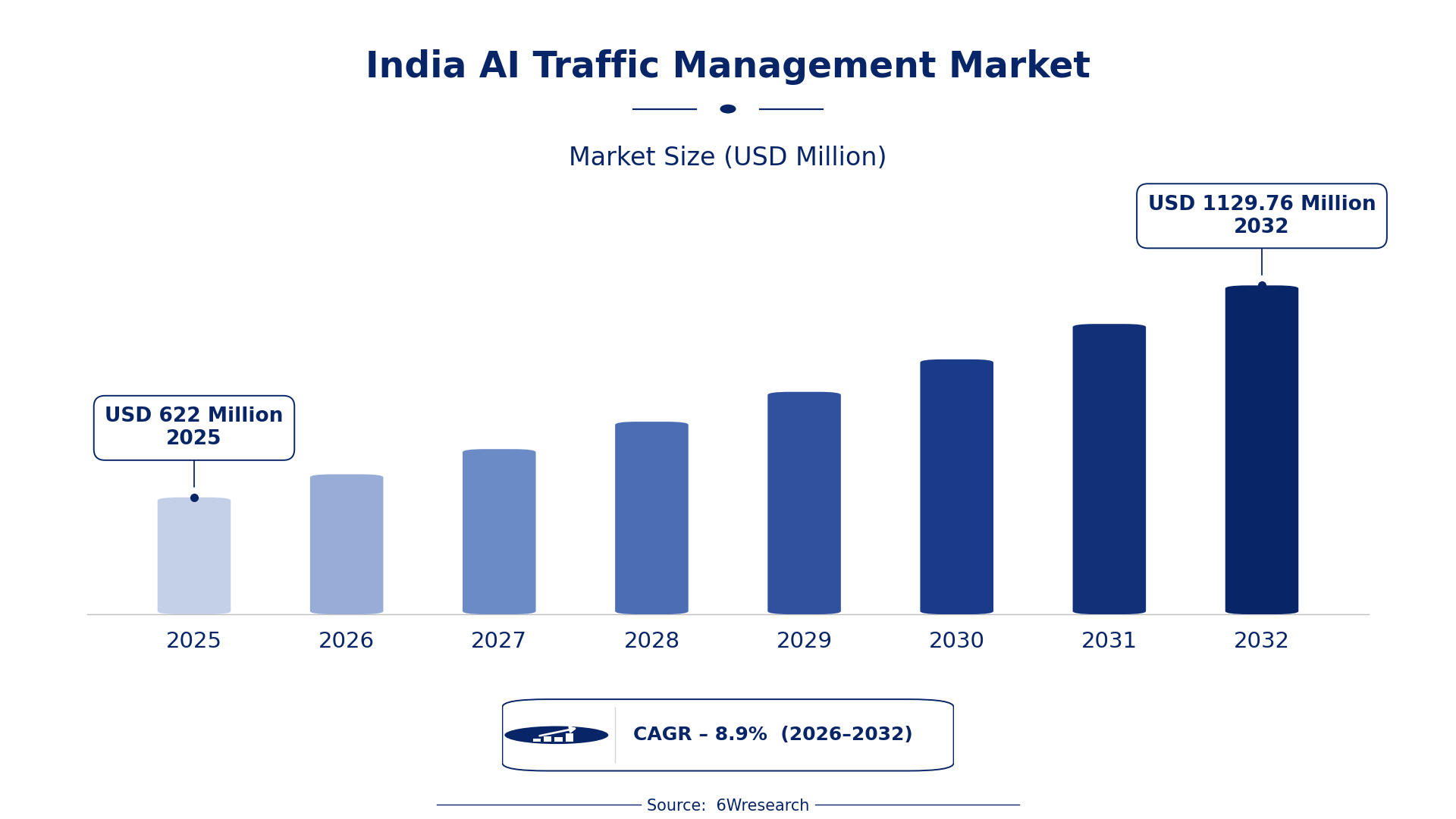
According to 6Wresearch internal database and industry insights, the India AI Traffic Management Market was valued at USD 622.0 million in 2025 and is projected to reach USD 1,129.76 million by 2032, growing at a CAGR of approximately 8.9% during 2026–2032.
India AI Traffic Management Market Highlights
| Report Metric | Details |
| Report Name | India AI Traffic Management Market |
| Market Size 2025 | USD 622.0 million |
| Market Size 2032 | USD 1,129.76 million |
| Absolute Growth 2025–2032 | USD 507.76 million |
| CAGR 2026–2032 | 8.9% |
| Peak Annual Growth | 10.5% in 2027 |
| Forecast Period | 2026–2032 |
| Historical Data | 2022–2025 |
| Base Year | 2025 |
| Leading Traffic Segment, 2025 | Urban Road Traffic (45% share) |
| Leading AI Application, 2025 | Real-Time Congestion Mapping (35% share) |
| Leading Distribution Channel, 2025 | Smart City Platforms (35% share) |
| Leading End User, 2025 | Municipal Authorities (51% share) |
| Fastest-Growing Traffic Segment | Public Transport Routing (10.0% CAGR) |
| Fastest-Growing AI Application | Predictive Flow Monitoring (10.8% CAGR) |
| Fastest-Growing End User | Metro & Bus Corporations (11.0% CAGR) |
| Growing Sector | Predictive Flow Monitoring |
| Key End Users | Real-Time Congestion Mapping, Predictive Flow Monitoring, AI-Driven Signal Optimization, Pattern Recognition |
India AI Traffic Management Market Year-wise Growth Rate and Key Drivers (2022–2032)
This graph illustrates the annual growth rates of the market from 2022 to 2032, highlighting a steady upward trajectory and projected market expansion over the forecast period.
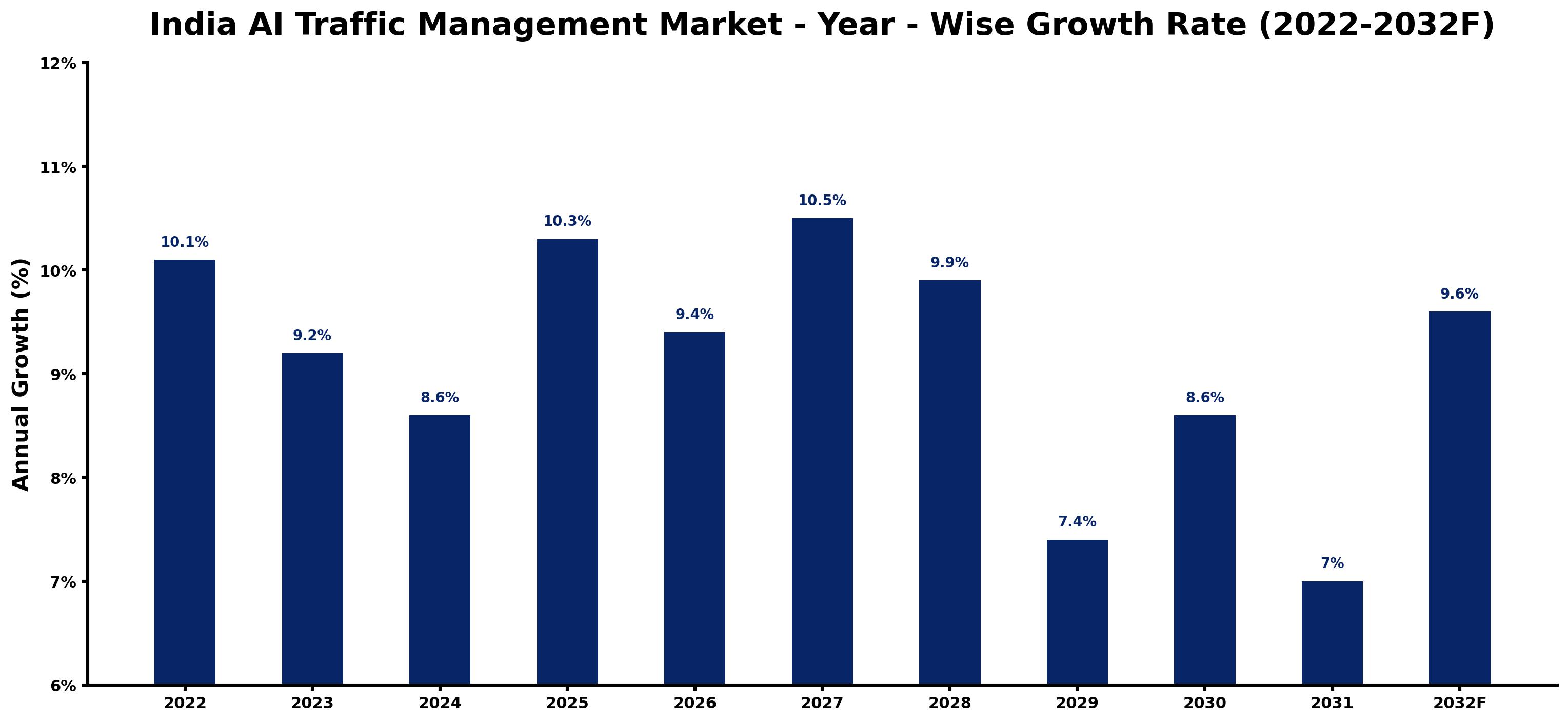
The table below sets out the estimated growth rate for each year and the main factor behind it.
| Year | Estimated Annual Growth (%) | Market Rationale |
| 2022 | 10.1 | The market showed strong growth due to rising urbanisation and traffic congestion. |
| 2023 | 9.2 | Demand slowed slightly as smart city projects faced implementation challenges. |
| 2024 | 8.6 | Growth continued to decelerate as municipalities adjusted their traffic management strategies. |
| 2025 | 10.3 | The market rebounded with increased funding for AI traffic solutions in urban areas. |
| 2026 | 9.4 | Growth slowed again as the integration of AI technologies faced technical hurdles. |
| 2027 | 10.5 | A surge in demand occurred as cities implemented AI-Driven Signal Optimization systems. |
| 2028 | 9.9 | Growth decelerated as cities focused on refining existing traffic management solutions. |
| 2029 | 7.4 | The market slowed further due to budget constraints in municipal authorities. |
| 2030 | 8.6 | Growth picked up as public transport agencies adopted AI for routing efficiency. |
| 2031 | 7.0 | The market slowed again as competition among technology providers intensified. |
| 2032 | 9.6 | A renewed focus on urban mobility will drive demand for advanced traffic management solutions. |
Note: Market size estimations and growth projections presented in this report are based on 6Wresearch's proprietary forecasting methodology, utilizing the latest available industry data, government publications, and primary research inputs.
India AI Traffic Management Market Synopsis
AI Traffic Management in India utilises advanced algorithms and machine learning to optimise traffic flow and reduce congestion. It draws on data from sensors, cameras, and IoT devices, primarily for real-time monitoring and predictive analytics. The India AI Traffic Management Market is expanding due to strong demand from urban municipalities and highway authorities focused on smart city initiatives. In 2023, the Smart Cities Mission allocated substantial funding for AI traffic solutions, further propelling market growth. Key regions such as Delhi and Mumbai lead the way in implementing these systems.
Market Dynamics Impact Analysis (2026–2032)
| Factor | Type | Impact | Primary Segment Affected |
| Increasing urbanisation is driving demand for effective traffic management solutions. | Driver | High | Urban Road Traffic |
| The integration of AI technologies is creating opportunities for enhanced traffic efficiency. | Opportunity | High | Smart City Platforms |
| High implementation costs can deter municipalities from adopting AI traffic solutions. | Restraint | High | Urban Road Traffic |
| Competition among suppliers can lead to price wars, affecting solution quality. | Challenge | High | Urban Road Traffic |
| Growing public transport needs are boosting demand for AI routing solutions. | Driver | Medium | Public Transport Routing |
| Limited technical expertise can hinder the deployment of AI traffic systems. | Restraint | Medium | Urban Road Traffic |
| Investment in smart city projects is creating opportunities for AI integration. | Opportunity | Medium | Smart City Platforms |
| Supply chain disruptions can delay the rollout of AI traffic management systems. | Challenge | Medium | Urban Road Traffic |
Evaluation of Drivers in India AI Traffic Management Market (2026–2032)
The main growth drivers and the segments they affect most are set out below.
| Drivers | Primary Segment Affected | Why It Matters (Evidence) |
| Rising urbanisation is increasing the need for effective traffic management solutions. | Urban Road Traffic | India's population exceeds 1.4 billion, leading to higher traffic congestion in urban areas. |
| Smart city initiatives are driving investment in AI traffic management technologies. | Smart City Platforms | The Smart Cities Mission allocated ₹48,000 crores for urban infrastructure improvements. |
| Public transport agencies are adopting AI for improved routing and scheduling. | Public Transport Routing | In 2023, agencies are increasingly integrating AI technologies to enhance efficiency. |
| Real-Time Congestion Mapping is essential for immediate traffic updates. | Real-Time Congestion Mapping | Major urban areas like Delhi utilise this technology to manage traffic flow effectively. |
| AI-Driven Signal Optimization is being tested for efficiency improvements. | AI-Driven Signal Optimization | Multiple Indian cities are implementing this technology to reduce wait times at signals. |
With a population exceeding 1.4 billion, India faces increasing traffic congestion, creating a pressing need for effective management solutions. The Smart Cities Mission allocated ₹48,000 crores for urban infrastructure improvements, driving demand for AI technologies. Major urban areas like Delhi are employing Real-Time Congestion Mapping to manage traffic flow effectively, while several cities are trialling AI-Driven Signal Optimization to minimise wait times at signals.
Evaluation of Restraints in India AI Traffic Management Market
The following restraints limit how fast demand can grow.
| Market Restraint | Primary Segment Affected | Why It Matters (Evidence) |
| High implementation costs can deter municipalities from adopting AI traffic solutions. | Urban Road Traffic | Implementation expenses often exceed 30% of initial budgets due to complex integration. |
| Limited technical expertise can hinder the deployment of AI traffic systems. | Urban Road Traffic | Skills shortages in data analytics and AI technologies affect suppliers' ability to meet demand. |
| Supply chain disruptions can delay the rollout of AI traffic management systems. | Urban Road Traffic | Challenges in sourcing advanced sensors and IoT devices impact project timelines. |
| Intense competition among suppliers can lead to price wars, affecting solution quality. | Urban Road Traffic | Price competition may compromise the quality of AI solutions for buyers. |
| Budget constraints in municipal authorities can limit investment in AI solutions. | Municipal Authorities | Financial limitations restrict the ability to implement advanced traffic management systems. |
India AI Traffic Management Market Challenges
India's urban municipalities face escalating costs for AI traffic management solutions, with implementation expenses often surpassing 30% of initial budgets due to the complexity of integrating new systems with existing infrastructure. Suppliers encounter a shortage of skilled professionals in data analytics, causing project delays that can extend timelines for city planners by several months. Intense competition among suppliers leads to price reductions, which may compromise the quality of AI solutions and result in subpar performance for buyers. Disruptions in the supply chain for essential sensors and IoT devices can further postpone project rollouts, obstructing urban authorities' efforts to enhance traffic flow.
Trends in the India AI Traffic Management Market
Four trends stand out in the India AI Traffic Management Market.
- Shift Towards Real-Time Traffic Monitoring: Since 2022, cities like Delhi have increasingly adopted Real-Time Congestion Mapping, improving traffic management. This shift is evident as urban authorities invest in AI technologies, which leads to better traffic flow and reduced congestion.
- Growth of AI-Driven Signal Optimization: In 2023, AI-Driven Signal Optimization systems are being tested in major cities, aiming to reduce wait times at intersections. This trend reflects a broader commitment to utilising technology for urban traffic efficiency.
- Integration of AI in Public Transport Routing: Public transport agencies are increasingly adopting AI for routing efficiency, with significant implementations in Mumbai. This trend supports the overall improvement of urban mobility and public transport systems.
- Expansion of Smart City Platforms: The Smart Cities Mission is driving the adoption of Smart City Platforms, focusing on AI integration. This initiative aims to modernise urban infrastructure, improving traffic management across major cities.
Investment Opportunities in the India AI Traffic Management Market
The following opportunities in the India AI Traffic Management Market pair current demand with a clear way in.
- Investment in Smart City Projects: With ₹48,000 crores allocated for urban infrastructure, there is a prime opportunity to supply AI traffic management solutions. Municipal authorities are actively seeking partnerships to upgrade their traffic systems.
- Demand for AI-Driven Signal Optimization: As cities implement AI-Driven Signal Optimization, suppliers can invest in this technology to address growing needs. Urban areas like Delhi are at the forefront of adopting these solutions.
- Public Transport Efficiency Improvements: Public transport agencies are increasingly prioritising AI for routing efficiency, creating opportunities for technology providers. This is particularly pertinent in regions with high commuter volumes.
- Real-Time Congestion Mapping Solutions: The demand for Real-Time Congestion Mapping is on the rise, presenting a chance for suppliers to deliver advanced solutions. Urban municipalities are focusing on immediate traffic updates to manage congestion effectively.
Government Initiatives in the India AI Traffic Management Market
The National Smart Transportation Policy, launched in 2023, aims to integrate AI into traffic management systems across major cities, promoting sustainability. This policy builds on the Smart Cities Mission, which has funded urban infrastructure improvements since 2020, with a budget of ₹48,000 crores over five years, enhancing the capabilities of AI Traffic Management systems.
The Ministry of Housing and Urban Affairs oversees the implementation of the Smart Cities Mission, which finances AI traffic management projects. Additionally, the National Institute of Urban Affairs supports research in urban traffic optimisation, ensuring municipalities have access to the latest technologies and methodologies. In 2023, the Ministry approved several projects aimed at modernising urban transport systems, facilitating the adoption of AI technologies.
Future Insight of the India AI Traffic Management Market
The AI traffic management market in India is poised for transformative growth by 2032, propelled by robust government backing for smart city initiatives and increased funding for AI solutions. Urban municipalities will increasingly implement predictive analytics to refine traffic flow and mitigate congestion. New regulations from the Bureau of Indian Standards will ensure quality and interoperability of AI systems. By 2025, public transport agencies are projected to leverage AI for improved routing, thereby boosting the efficiency of urban transportation systems.
Market Segmentation Analysis
The report offers a comprehensive study of the following market segments and their leading categories in the market.
By Traffic Segment – Urban Road Traffic Dominated, Public Transport Routing Expected to Grow Fastest
According to Shubham Padhi, Research Analyst at 6Wresearch, Urban Road Traffic held a 45% share of the India AI Traffic Management Market by traffic segment in 2025. Urban Road Traffic holds the largest share due to its essential role in managing congestion in densely populated cities like Delhi and Mumbai. These urban centres are actively implementing traffic management solutions to improve flow and reduce delays, making this segment crucial for urban mobility. The quickest growth will come from Public Transport Routing, forecast to expand at a CAGR of 10.0% between 2026 and 2032. Public Transport Routing is experiencing rapid growth as cities focus on enhancing public transport efficiency, with initiatives in major urban areas driving this demand. The increasing need for optimised routing solutions highlights the segment's importance in improving commuter experiences. Suppliers should prioritise solutions tailored for urban road traffic and public transport routing to capture the growing market share.
By AI Application – Real-Time Congestion Mapping Dominated, Predictive Flow Monitoring Expected to Grow Fastest
With a 35% revenue share in 2025, Real-Time Congestion Mapping was the largest ai application category. Real-Time Congestion Mapping is the leading application, necessary for providing immediate traffic updates in bustling urban environments. Its widespread adoption in cities like Delhi ensures that traffic management systems remain responsive to real-time conditions, solidifying its market position. Predictive Flow Monitoring is set to record the highest CAGR in this split, 10.8% over 2026–2032. Predictive Flow Monitoring is growing quickly as cities invest in forecasting tools to better manage traffic conditions, driven by the need for proactive solutions. This growth is supported by increasing funding for traffic management solutions under smart city initiatives. Buyers must consider applications that offer real-time and predictive capabilities to stay ahead in traffic management.
By Distribution Channel – Smart City Platforms Dominated and Is Expected to Record the Fastest Growth
Smart City Platforms took a 35% share of distribution channel in 2025, more than any other category. Smart City Platforms dominate the distribution channel as they are integral to the infrastructure of smart cities, facilitating the integration of various traffic management solutions. Their importance is underscored by significant investments in smart city projects across India, ensuring their leading position. The same category are also set to grow fastest, at a CAGR of 10.0% during 2026–2032. Smart City Platforms are also the fastest-growing channel, reflecting the increasing emphasis on smart city initiatives that incorporate advanced traffic management systems. This dual role solidifies their market position as cities expand their digital infrastructure. Suppliers should focus on developing solutions compatible with smart city platforms to maximise their market share.
By End User – Municipal Authorities Dominated, Metro & Bus Corporations Expected to Grow Fastest
Municipal Authorities accounted for a 51% market share by end user in 2025. Municipal Authorities lead the end user segment as they are the primary users of traffic management solutions, tasked with improving urban mobility in cities. Their direct involvement in implementing these systems ensures a steady demand for traffic management technologies. Metro & Bus Corporations are projected to grow fastest, at a CAGR of 11.0% during 2026–2032. Metro & Bus Corporations are the fastest-growing end user group, driven by the need to optimise public transport routes and schedules in urban areas. This growth indicates a broader trend towards enhancing public transport efficiency through advanced solutions. Suppliers should tailor their offerings to meet the specific needs of municipal authorities and public transport agencies to capture emerging opportunities.
Key Attractiveness of the Report
- 10 Years of Market Numbers
- Historical Data Starting from 2022 to 2025
- Base Year 2025
- Forecast Data until 2032
- Key Performance Indicators Impacting the Market
- Major Upcoming Developments and Projects
Key Highlights of the Report:
- India AI Traffic Management Market Outlook
- Market Size of India AI Traffic Management Market, 2025
- Forecast of India AI Traffic Management Market, 2032
- Historical Data and Forecast of India AI Traffic Management Revenues & Volume for the Period 2022 - 2032F
- India AI Traffic Management Market Trend Evolution
- India AI Traffic Management Market Drivers and Challenges
- India AI Traffic Management Price Trends
- India AI Traffic Management Porter's Five Forces
- India AI Traffic Management Industry Life Cycle
- Historical Data and Forecast of India AI Traffic Management Market Revenues & Volume By Traffic Segment for the Period 2022 - 2032F
- Historical Data and Forecast of India AI Traffic Management Market Revenues & Volume By Urban Road Traffic for the Period 2022 - 2032F
- Historical Data and Forecast of India AI Traffic Management Market Revenues & Volume By Highway Control for the Period 2022 - 2032F
- Historical Data and Forecast of India AI Traffic Management Market Revenues & Volume By Intersection Management for the Period 2022 - 2032F
- Historical Data and Forecast of India AI Traffic Management Market Revenues & Volume By Public Transport Routing for the Period 2022 - 2032F
- Historical Data and Forecast of India AI Traffic Management Market Revenues & Volume By AI Application for the Period 2022 - 2032F
- Historical Data and Forecast of India AI Traffic Management Market Revenues & Volume By Real-Time Congestion Mapping for the Period 2022 - 2032F
- Historical Data and Forecast of India AI Traffic Management Market Revenues & Volume By Predictive Flow Monitoring for the Period 2022 - 2032F
- Historical Data and Forecast of India AI Traffic Management Market Revenues & Volume By AI-Driven Signal Optimization for the Period 2022 - 2032F
- Historical Data and Forecast of India AI Traffic Management Market Revenues & Volume By Pattern Recognition for the Period 2022 - 2032F
- Historical Data and Forecast of India AI Traffic Management Market Revenues & Volume By Distribution Channel for the Period 2022 - 2032F
- Historical Data and Forecast of India AI Traffic Management Market Revenues & Volume By Smart City Platforms for the Period 2022 - 2032F
- Historical Data and Forecast of India AI Traffic Management Market Revenues & Volume By Transport Tech Integrators for the Period 2022 - 2032F
- Historical Data and Forecast of India AI Traffic Management Market Revenues & Volume By IoT Traffic Devices for the Period 2022 - 2032F
- Historical Data and Forecast of India AI Traffic Management Market Revenues & Volume By Mobility SaaS Solutions for the Period 2022 - 2032F
- Historical Data and Forecast of India AI Traffic Management Market Revenues & Volume By End User for the Period 2022 - 2032F
- Historical Data and Forecast of India AI Traffic Management Market Revenues & Volume By Municipal Authorities for the Period 2022 - 2032F
- Historical Data and Forecast of India AI Traffic Management Market Revenues & Volume By Highway Authorities for the Period 2022 - 2032F
- Historical Data and Forecast of India AI Traffic Management Market Revenues & Volume By Smart Infrastructure Agencies for the Period 2022 - 2032F
- Historical Data and Forecast of India AI Traffic Management Market Revenues & Volume By Metro & Bus Corporations for the Period 2022 - 2032F
- India AI Traffic Management Import Export Trade Statistics
- Market Opportunity Assessment By Traffic Segment
- Market Opportunity Assessment By AI Application
- Market Opportunity Assessment By Distribution Channel
- Market Opportunity Assessment By End User
- India AI Traffic Management Top Companies Market Share
- India AI Traffic Management Competitive Benchmarking By Technical and Operational Parameters
- India AI Traffic Management Company Profiles
- India AI Traffic Management Key Strategic Recommendations
Market Covered
This report examines the market across the segments below.
By Traffic Segment
- Urban Road Traffic
- Highway Control
- Intersection Management
- Public Transport Routing
By AI Application
- Real-Time Congestion Mapping
- Predictive Flow Monitoring
- AI-Driven Signal Optimization
- Pattern Recognition
By Distribution Channel
- Smart City Platforms
- Transport Tech Integrators
- IoT Traffic Devices
- Mobility SaaS Solutions
By End User
- Municipal Authorities
- Highway Authorities
- Smart Infrastructure Agencies
- Metro & Bus Corporations































