India Air Defense Sensor Market Size & Growth Rate
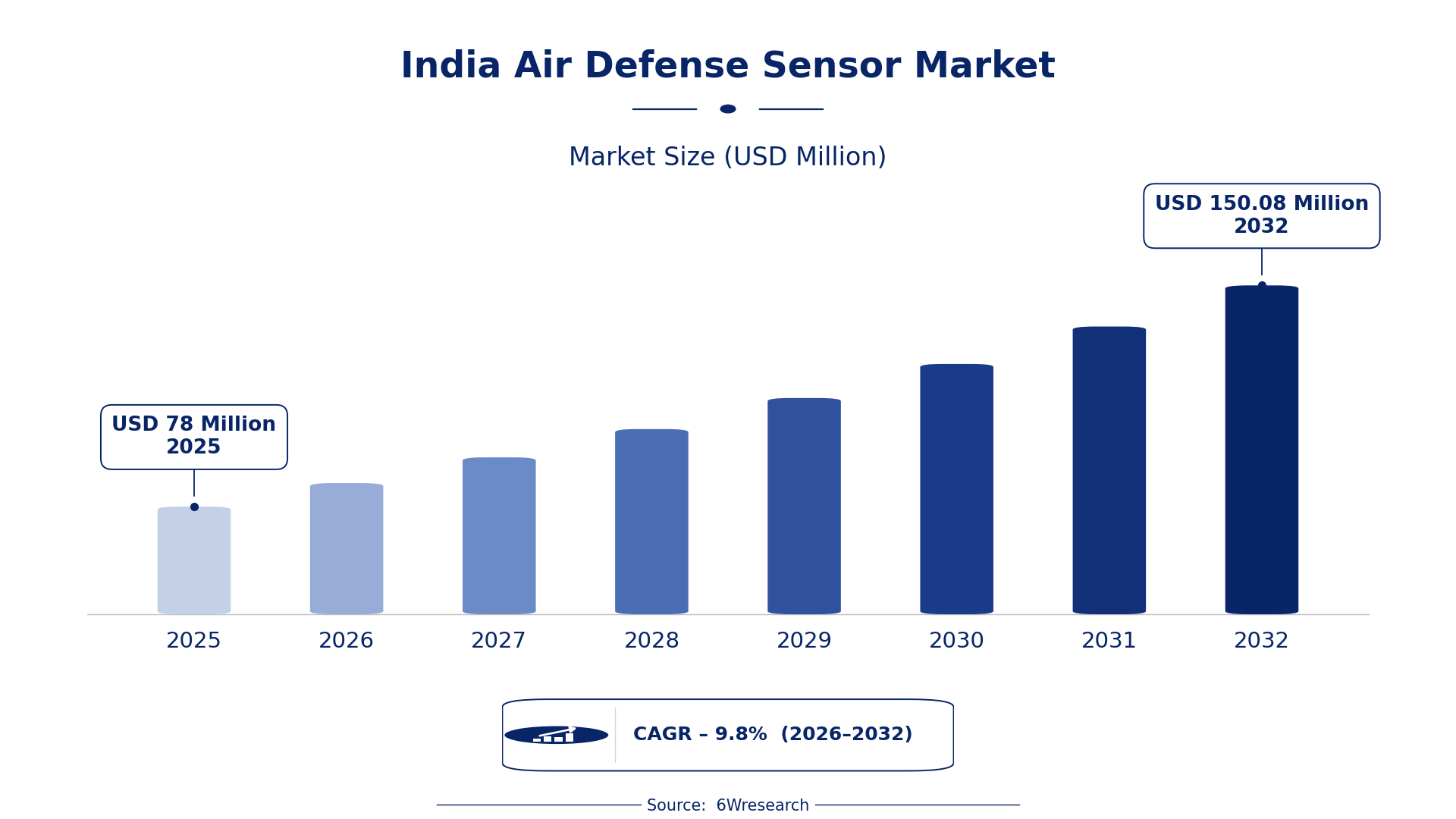
According to 6Wresearch internal database and industry insights, the India Air Defense Sensor Market was valued at USD 78.0 million in 2025 and is projected to reach USD 150.08 million by 2032, growing at a CAGR of approximately 9.8% during 2026–2032.
India Air Defense Sensor Market Highlights
| Report Metric | Details |
| Report Name | India Air Defense Sensor Market |
| Market Size 2025 | USD 78.0 million |
| Market Size 2032 | USD 150.08 million |
| Absolute Growth 2025–2032 | USD 72.08 million |
| CAGR 2026–2032 | 9.8% |
| Peak Annual Growth | 11.9% in 2026 |
| Forecast Period | 2026–2032 |
| Historical Data | 2022–2025 |
| Base Year | 2025 |
| Leading Sensor Type, 2025 | Radar Sensors (37% share) |
| Leading Detection Range, 2025 | Long-Range Targeting (42% share) |
| Leading Distribution Channel, 2025 | Defense OEMs (40% share) |
| Leading End User, 2025 | Air Force Units (38% share) |
| Fastest-Growing Sensor Type | Multi-Sensor Systems (11.4% CAGR) |
| Fastest-Growing Detection Range | AI Data Fusion (11.9% CAGR) |
| Fastest-Growing Distribution Channel | Government Contractors (12.2% CAGR) |
| Fastest-Growing End User | Missile Defense Systems (12.4% CAGR) |
| Growing Sector | Military Applications |
| Key End Users | Air Force Units, National Defense Agencies, Government Contractors |
India Air Defense Sensor Market Year-wise Growth Rate and Key Drivers (2022–2032)
This graph illustrates the annual growth rates of the market from 2022 to 2032, highlighting a steady upward trajectory and projected market expansion over the forecast period.
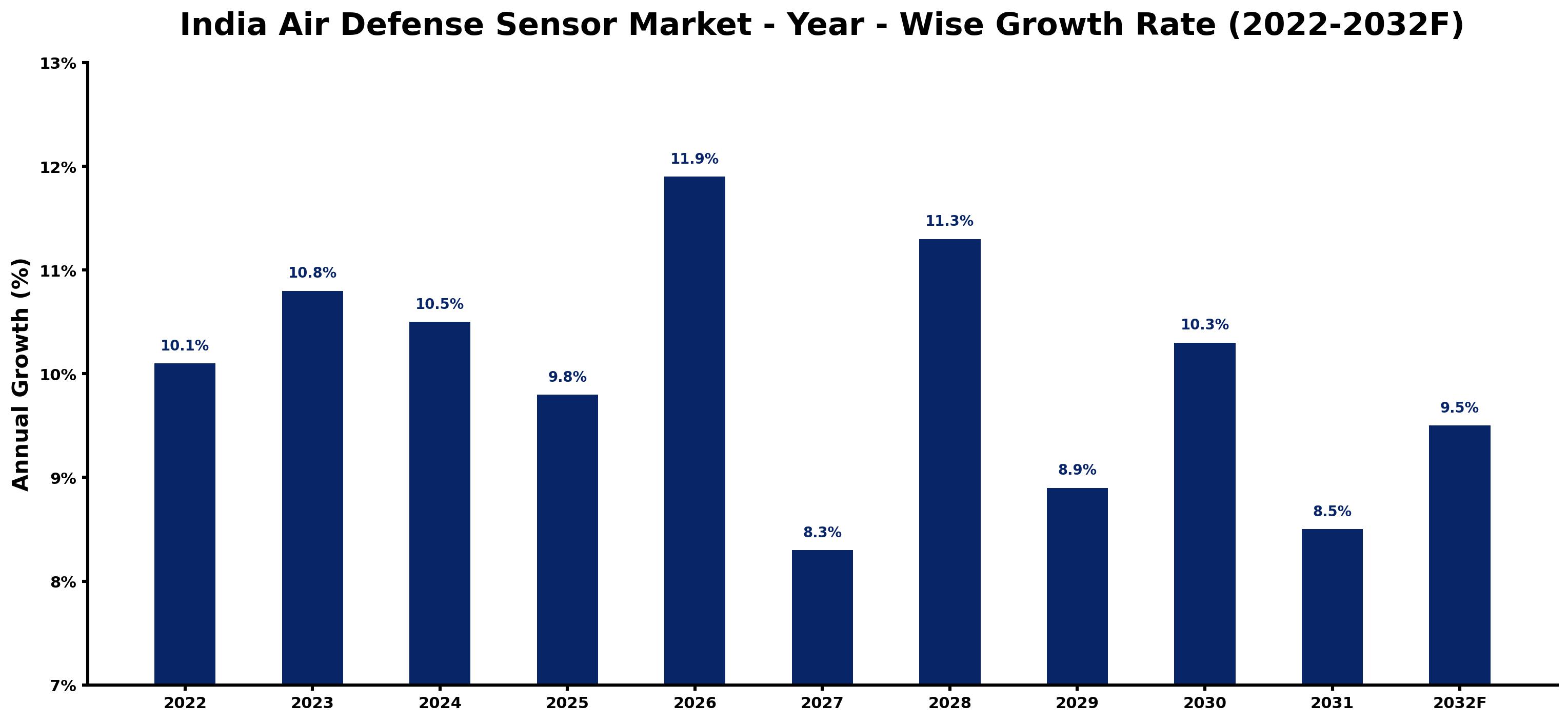
Annual growth estimates for each year appear below with the principal reason behind them, explaining the shifts that set the pace of the market.
| Year | Estimated Annual Growth (%) | Market Rationale |
| 2022 | 10.1 | The market exhibited steady growth, supported by ongoing military upgrades. |
| 2023 | 10.8 | Demand for air defense sensors increased due to new military contracts. |
| 2024 | 10.5 | Growth slowed as procurement processes faced delays in approvals. |
| 2025 | 9.8 | Market expansion continued, driven by the Make in India initiative. |
| 2026 | 11.9 | A surge in investment led to the highest growth rate in the forecast period. |
| 2027 | 8.3 | Growth slowed as the market adjusted to new technological standards. |
| 2028 | 11.3 | The introduction of advanced multi-sensor systems spurred demand. |
| 2029 | 8.9 | Market growth decelerated as competition intensified among suppliers. |
| 2030 | 10.3 | Increased funding for defense modernization revitalised purchasing activity. |
| 2031 | 8.5 | Growth slowed due to challenges in meeting production targets. |
| 2032 | 9.5 | Demand is expected to rise as air defense strategies evolve. |
Note: Market size estimations and growth projections presented in this report are based on 6Wresearch's proprietary forecasting methodology, utilizing the latest available industry data, government publications, and primary research inputs.
India Air Defense Sensor Market Synopsis
Air Defense Sensor Market in India includes sophisticated systems designed to detect and track aerial threats, employing technologies like radar and infrared. These sensors play a crucial role in military applications, such as airspace surveillance and missile defence systems. The market is expanding due to substantial investments in domestic development and government initiatives. The operational needs of the Indian Air Force and the emphasis on self-reliance in defence production drive this growth. With a budget of ₹20,000 crores allocated for modernization, the market is set for considerable expansion.
Market Dynamics Impact Analysis (2026–2032)
| Factor | Type | Impact | Primary Segment Affected |
| Increased investment in indigenous defense production | Driver | High | Radar Sensors |
| Growing military contracts from the Indian Air Force | Driver | High | Multi-Sensor Systems |
| Expanding market for advanced sensor technologies | Opportunity | High | IR Sensors |
| Rising demand for missile defense systems | Opportunity | High | Missile Defense Systems |
| Challenges in meeting production timelines | Restraint | Medium | Acoustic Sensors |
| Dependence on international technology for advanced systems | Restraint | Medium | Radar Sensors |
| Limited local expertise in advanced sensor technologies | Challenge | High | Multi-Sensor Systems |
| Regulatory hurdles in defense procurement processes | Challenge | Medium | IR Sensors |
Evaluation of Drivers in India Air Defense Sensor Market (2026–2032)
Below mentioned are some major drivers and their influence on market dynamics.
| Drivers | Primary Segment Affected | Why It Matters (Evidence) |
| Increased government funding for defense modernization | Multi-Sensor Systems | The Indian government allocated ₹20,000 crores in 2023, boosting procurement from military units. |
| Growing demand for indigenous defense capabilities | Radar Sensors | The establishment of new air defense units in northern regions drives sensor purchases. |
| Expansion of air defense units across regions | IR Sensors | New units in northern and western regions drive sensor purchases for enhanced coverage. |
| Collaboration with international defense agencies | Missile Defense Systems | Partnerships facilitate technology transfer, leading to increased investments in domestic production. |
| Focus on multi-sensor integration for enhanced capabilities | Multi-Sensor Systems | The need for comprehensive threat assessment drives demand for integrated sensor solutions. |
Market growth for Air Defense Sensor in India is underpinned by increased government funding, expanding military contracts, and rising demand for indigenous capabilities. The Indian government allocated ₹20,000 crores for defense modernization in 2023, boosting procurement activities significantly. The Make in India initiative encourages local production, resulting in higher orders for radar sensors from military units. The establishment of new air defense units across northern regions has led to increased purchases of IR sensors. Collaboration with international defense agencies facilitates technology transfer, further driving investments in missile defense systems.
Evaluation of Restraints in India Air Defense Sensor Market
Below mentioned are some major restraints and their influence on market dynamics.
| Market Restraint | Primary Segment Affected | Why It Matters (Evidence) |
| Challenges in meeting production timelines | Acoustic Sensors | Production delays affect the timely delivery of essential components, impacting military readiness. |
| Dependence on international technology for advanced systems | Radar Sensors | A leading supplier on foreign technology can delay the development of critical defense capabilities. |
| Limited local expertise in advanced sensor technologies | Multi-Sensor Systems | A shortage of skilled professionals hampers the growth of sophisticated sensor production. |
| Regulatory hurdles in defense procurement processes | IR Sensors | Complex approval processes slow down the acquisition of necessary equipment for defense units. |
| Budget constraints affecting procurement decisions | Missile Defense Systems | Limited funding can restrict the ability of military units to upgrade their systems. |
India Air Defense Sensor Market Challenges
The India Air Defense Sensor Market encounters several practical challenges, with a skills shortage being a primary concern. This issue arises from a lack of specialised training programs in advanced sensor technologies, causing delays in project timelines for military units. Buyers face inflated costs, as reliance on imported components can raise expenses by up to 30% compared to local alternatives. Competition remains intense, with international agencies often providing more advanced systems, making it challenging for local producers to secure government contracts. Compliance with ISO 9001 standards can lead to annual costs of ₹500 crores for manufacturers, affecting their pricing strategies.
Trends in the India Air Defense Sensor Market
Four trends stand out in the India Air Defense Sensor Market.
- Shift towards Multi-Sensor Integration: India is increasingly adopting multi-sensor systems to improve air defense capabilities. The market for these systems is projected to grow at a CAGR of 11.4% from 2026 to 2032.
- Transition from Traditional to Advanced Radar Systems: Since 2023, the Indian Air Force has been upgrading to advanced radar systems, which are essential for modern air defense. This shift is expected to enhance operational efficiency significantly.
- Emergence of Indigenous Production Standards: The Make in India initiative, launched in 2020, has led to the development of indigenous production standards, boosting local manufacturing capabilities in air defense technologies.
- Growing Focus on AI-Driven Solutions: The integration of AI in air defense systems is becoming a priority. The adoption of AI Data Fusion technologies is projected to grow at 11.9% CAGR, improving situational awareness.
Investment Opportunities in the India Air Defense Sensor Market
The following opportunities in the India Air Defense Sensor Market pair current demand with a clear way in.
- Entry through Joint Ventures: With a projected market size of ₹150.08 crores by 2032, opportunities exist for joint ventures with local manufacturers to supply advanced air defense sensors, particularly in northern regions.
- Investment in Indigenous Manufacturing: The Indian Army's push for self-reliance presents opportunities for suppliers to invest in local manufacturing facilities, especially for radar sensors, which are critical for national defense.
- Collaboration with Military Suppliers: The need for advanced missile defense systems creates opportunities for collaboration with military suppliers, particularly in western regions where demand is rising.
- Expansion into Multi-Sensor Technologies: With the market for multi-sensor systems growing, suppliers can focus on developing integrated solutions, tapping into the increasing demand from air force units.
Government Initiatives in the India Air Defense Sensor Market
The 'Defence Production Policy 2020' aims to achieve a turnover of ₹1.75 lakh crore in defense manufacturing by 2025, supporting local production capabilities. This policy ensures that domestic manufacturers meet the increasing demand from military units. The 'Make in India' initiative, launched by the Ministry of Defence in 2020, complements this by encouraging local manufacturing of defense equipment, including air defense technologies, further boosting the market.
The Defence Acquisition Procedure 2020 streamlines procurement processes for air defense systems, improving efficiency and reducing delays. The National Policy on Electronics 2019 promotes the development of electronic systems for defense applications, ensuring that local manufacturers can meet quality standards. The Ministry of Defence oversees the implementation of various programs that fund and approve defense projects, enabling producers to access necessary resources.
Future Insight of the India Air Defense Sensor Market
By 2032, buyers and suppliers in the India Air Defense Sensor Market can expect substantial advancements driven by the 'Make in India' initiative and the 'Aatmanirbhar Bharat' program. The Indian government's budget allocation of ₹20,000 crores for defense modernization will strengthen local production capabilities. Increased collaboration with international defense agencies will facilitate technology transfer, introducing new solutions. The growing demand for multi-sensor systems will encourage producers to develop more integrated and effective air defense solutions.
Market Segmentation Analysis
The report offers a comprehensive study of the following market segments and their leading categories in the market.
By Sensor Type – Radar Sensors Dominated, Multi-Sensor Systems Expected to Grow Fastest
According to Shubham Padhi, Research Analyst at 6Wresearch, Radar Sensors held a 37% share of the India Air Defense Sensor Market by sensor type in 2025. Radar Sensors dominate the market due to their critical role in tracking aerial threats, which is essential for national defense. With over 1,000 operational air defense systems in India, these sensors are vital for military applications and airspace security. Multi-Sensor Systems are set to record the highest CAGR in this split, 11.4% over 2026–2032. The rapid expansion of Multi-Sensor Systems is fuelled by the increasing demand for comprehensive air defense capabilities that integrate multiple detection methods. This trend aligns with India's focus on enhancing its air defense strategies through indigenous development initiatives. Suppliers should focus on developing Multi-Sensor Systems to meet the growing demand for integrated air defense solutions.
By Detection Range – Long-Range Targeting Dominated, AI Data Fusion Expected to Grow Fastest
With a 42% revenue share in 2025, Long-Range Targeting was the largest detection range category. Long-Range Targeting holds the largest market share as it is crucial for effectively engaging threats from significant distances, thereby enhancing airspace security. This capability is vital for India's strategic defense posture, particularly in northern and western regions. Over 2026–2032, AI Data Fusion is expected to post the fastest growth, at a CAGR of 11.9%. The swift growth of AI Data Fusion is driven by its capacity to enhance situational awareness through the integration of data from various sources, essential for modern air defense operations. The emphasis on modernising defense capabilities in India further accelerates this trend. Buyers will increasingly seek solutions that incorporate AI Data Fusion to improve their operational effectiveness in air defense.
By Distribution Channel – Defense OEMs Dominated, Government Contractors Expected to Grow Fastest
In 2025, Defense OEMs led the distribution channel split with a 40% share. Defense OEMs lead the market as they are the primary manufacturers of air defense systems, supplying essential technologies to the military. Their established relationships with the Indian government facilitate large-scale contracts and projects. Government Contractors are projected to grow fastest, at a CAGR of 12.2% during 2026–2032. Government Contractors are the fastest-growing segment, driven by increased defence budgets and a focus on local production under initiatives like 'Make in India'. This trend indicates a shift towards more collaborative defense procurement processes. Suppliers must align their strategies with government contractors to capture opportunities in the expanding air defense market.
By End User – Air Force Units Dominated, Missile Defense Systems Expected to Grow Fastest
The largest end user category in 2025 was Air Force Units, with a 38% share of total revenue. Air Force Units represent the largest share as they are the primary users of air defense sensors, responsible for ensuring air superiority and national security. Their operational requirements significantly drive the demand for advanced sensor technologies tailored to military applications. The quickest growth will come from Missile Defense Systems, forecast to expand at a CAGR of 12.4% between 2026 and 2032. Missile Defense Systems are rapidly gaining traction as they become more integrated with air defense sensors for effective threat neutralisation. This trend highlights India's commitment to enhancing its missile defense capabilities in response to evolving security challenges. Buyers will prioritise investments in integrated missile defense systems to strengthen their air defense infrastructure.
Key Attractiveness of the Report
- 10 Years of Market Numbers
- Historical Data Starting from 2022 to 2025
- Base Year 2025
- Forecast Data until 2032
- Key Performance Indicators Impacting the Market
- Major Upcoming Developments and Projects
Key Highlights of the Report:
- India Air Defense Sensor Market Outlook
- Market Size of India Air Defense Sensor Market, 2025
- Forecast of India Air Defense Sensor Market, 2032
- Historical Data and Forecast of India Air Defense Sensor Revenues & Volume for the Period 2022 - 2032F
- India Air Defense Sensor Market Trend Evolution
- India Air Defense Sensor Market Drivers and Challenges
- India Air Defense Sensor Price Trends
- India Air Defense Sensor Porter's Five Forces
- India Air Defense Sensor Industry Life Cycle
- Historical Data and Forecast of India Air Defense Sensor Market Revenues & Volume By Sensor Type for the Period 2022 - 2032F
- Historical Data and Forecast of India Air Defense Sensor Market Revenues & Volume By Radar Sensors for the Period 2022 - 2032F
- Historical Data and Forecast of India Air Defense Sensor Market Revenues & Volume By IR Sensors for the Period 2022 - 2032F
- Historical Data and Forecast of India Air Defense Sensor Market Revenues & Volume By Acoustic Sensors for the Period 2022 - 2032F
- Historical Data and Forecast of India Air Defense Sensor Market Revenues & Volume By Multi-Sensor Systems for the Period 2022 - 2032F
- Historical Data and Forecast of India Air Defense Sensor Market Revenues & Volume By Detection Range for the Period 2022 - 2032F
- Historical Data and Forecast of India Air Defense Sensor Market Revenues & Volume By Long-Range Targeting for the Period 2022 - 2032F
- Historical Data and Forecast of India Air Defense Sensor Market Revenues & Volume By Heat Signature Tracking for the Period 2022 - 2032F
- Historical Data and Forecast of India Air Defense Sensor Market Revenues & Volume By AI Sound Classification for the Period 2022 - 2032F
- Historical Data and Forecast of India Air Defense Sensor Market Revenues & Volume By AI Data Fusion for the Period 2022 - 2032F
- Historical Data and Forecast of India Air Defense Sensor Market Revenues & Volume By Distribution Channel for the Period 2022 - 2032F
- Historical Data and Forecast of India Air Defense Sensor Market Revenues & Volume By Defense OEMs for the Period 2022 - 2032F
- Historical Data and Forecast of India Air Defense Sensor Market Revenues & Volume By Military Suppliers for the Period 2022 - 2032F
- Historical Data and Forecast of India Air Defense Sensor Market Revenues & Volume By Tactical Gear Vendors for the Period 2022 - 2032F
- Historical Data and Forecast of India Air Defense Sensor Market Revenues & Volume By Government Contractors for the Period 2022 - 2032F
- Historical Data and Forecast of India Air Defense Sensor Market Revenues & Volume By End User for the Period 2022 - 2032F
- Historical Data and Forecast of India Air Defense Sensor Market Revenues & Volume By Air Force Units for the Period 2022 - 2032F
- Historical Data and Forecast of India Air Defense Sensor Market Revenues & Volume By Missile Defense Systems for the Period 2022 - 2032F
- Historical Data and Forecast of India Air Defense Sensor Market Revenues & Volume By Battlefield Surveillance Units for the Period 2022 - 2032F
- Historical Data and Forecast of India Air Defense Sensor Market Revenues & Volume By National Defense Agencies for the Period 2022 - 2032F
- India Air Defense Sensor Import Export Trade Statistics
- Market Opportunity Assessment By Sensor Type
- Market Opportunity Assessment By Detection Range
- Market Opportunity Assessment By Distribution Channel
- Market Opportunity Assessment By End User
- India Air Defense Sensor Top Companies Market Share
- India Air Defense Sensor Competitive Benchmarking By Technical and Operational Parameters
- India Air Defense Sensor Company Profiles
- India Air Defense Sensor Key Strategic Recommendations
Market Covered
The report offers an extensive study of the following market segments.
By Sensor Type
- Radar Sensors
- IR Sensors
- Acoustic Sensors
- Multi-Sensor Systems
By Detection Range
- Long-Range Targeting
- Heat Signature Tracking
- AI Sound Classification
- AI Data Fusion
By Distribution Channel
- Defense OEMs
- Military Suppliers
- Tactical Gear Vendors
- Government Contractors
By End User
- Air Force Units
- Missile Defense Systems
- Battlefield Surveillance Units
- National Defense Agencies































