India Air Purification Wearables Market Size & Growth Rate
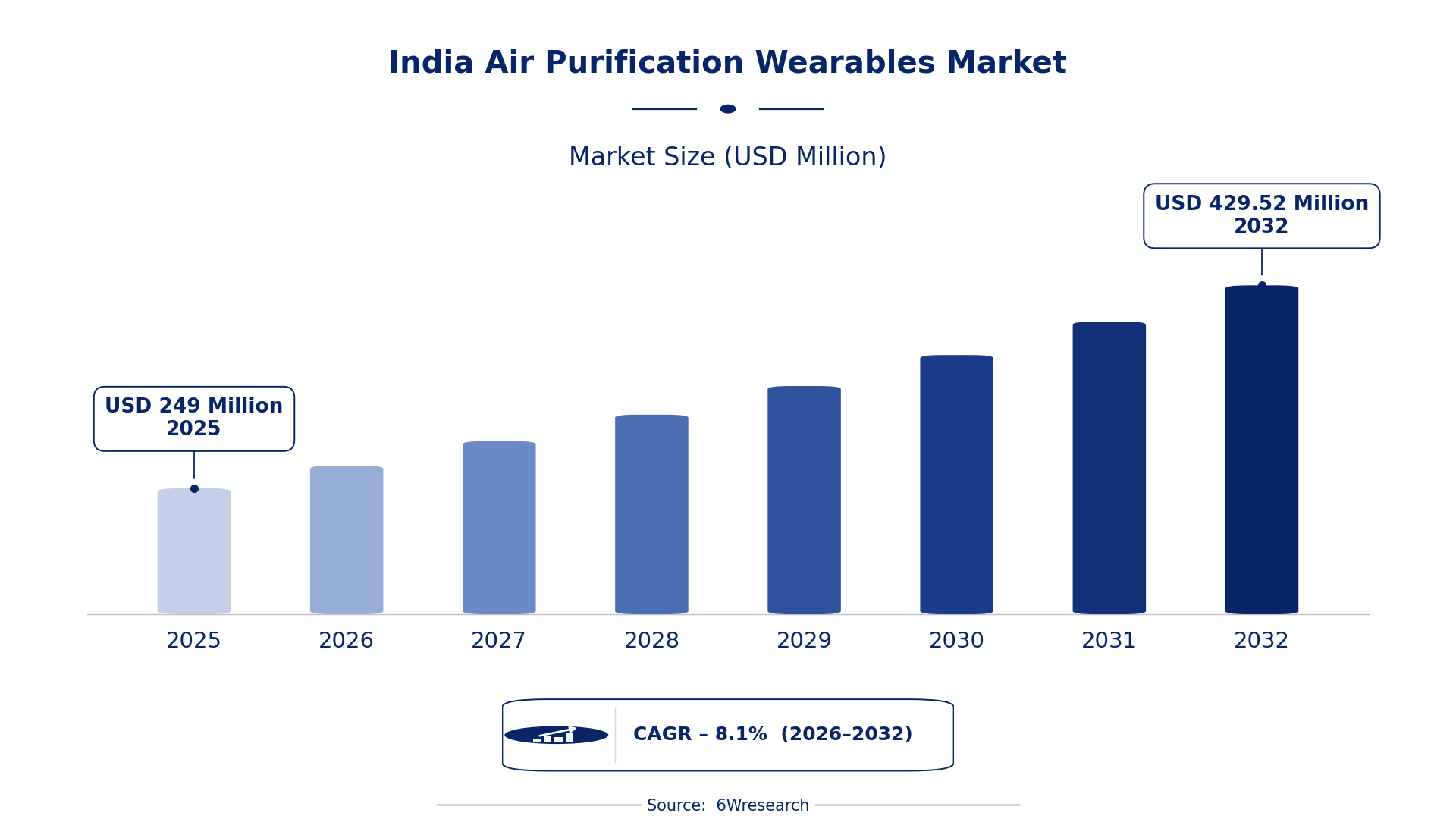
According to 6Wresearch internal database and industry insights, the India Air Purification Wearables Market was valued at USD 249.0 million in 2025 and is projected to reach USD 429.52 million by 2032, growing at a CAGR of approximately 8.1% during 2026–2032.
India Air Purification Wearables Market Highlights
| Report Metric | Details |
| Report Name | India Air Purification Wearables Market |
| Market Size 2025 | USD 249.0 million |
| Market Size 2032 | USD 429.52 million |
| Absolute Growth 2025–2032 | USD 180.52 million |
| CAGR 2026–2032 | 8.1% |
| Peak Annual Growth | 10.3% in 2030 |
| Forecast Period | 2026–2032 |
| Historical Data | 2022–2025 |
| Base Year | 2025 |
| Leading Wearable Type, 2025 | Mask Devices (49% share) |
| Leading Purification Method, 2025 | HEPA/Carbon Filters (35% share) |
| Leading Distribution Channel, 2025 | E-commerce Sites (45% share) |
| Leading End User, 2025 | Urban Commuters (40% share) |
| Fastest-Growing Wearable Type | AI-Controlled Devices (10.7% CAGR) |
| Fastest-Growing Purification Method | Ion-Based Air Flow (10.3% CAGR) |
| Fastest-Growing Distribution Channel | Wellness Tech Startups (10.5% CAGR) |
| Fastest-Growing End User | Outdoor Workers (9.9% CAGR) |
| Growing Sector | Health and wellness technology |
| Key End Users | Urban commuters, outdoor workers, health-conscious consumers, allergy-prone individuals |
India Air Purification Wearables Market Year-wise Growth Rate and Key Drivers (2022–2032)
This graph illustrates the annual growth rates of the market from 2022 to 2032, highlighting a steady upward trajectory and projected market expansion over the forecast period.
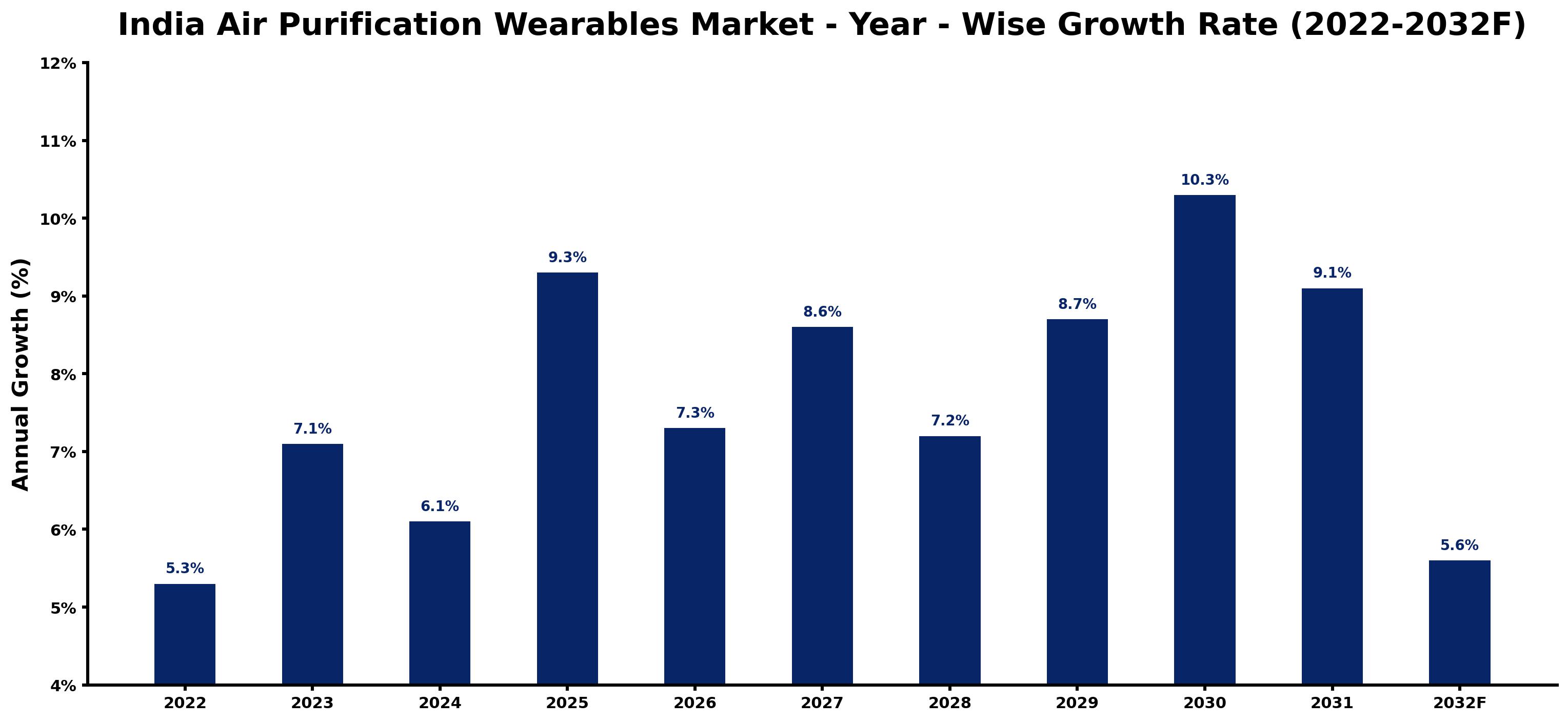
Annual growth estimates for each year appear below with the principal reason behind them, explaining the shifts that set the pace of the market.
| Year | Estimated Annual Growth (%) | Market Rationale |
| 2022 | 5.3 | Urban areas faced severe air quality issues, driving interest in personal air purification solutions. |
| 2023 | 7.1 | Increased awareness of health impacts from pollution spurred demand for wearable air purifiers, especially among urban commuters. |
| 2024 | 6.1 | Growth slowed as market saturation began to affect new consumer adoption rates for air purification wearables. |
| 2025 | 9.3 | The launch of health campaigns, including the 'Clean Air Programme', encouraged higher sales of air purification wearables. |
| 2026 | 7.3 | Consumer interest in AI-controlled devices is expected to contribute to a slowdown in growth rates. |
| 2027 | 8.6 | Demand surged as outdoor workers sought protection from rising pollution levels, particularly in urban areas. |
| 2028 | 7.2 | Market growth is projected to decelerate as competition intensifies among existing brands and products. |
| 2029 | 8.7 | Health-conscious consumers increasingly opted for portable air purification solutions, especially during high pollution periods. |
| 2030 | 10.3 | The introduction of innovative designs and features drove peak growth in this year, attracting more buyers. |
| 2031 | 9.1 | Consumer demand is expected to stabilise as the market matures and options expand for air purification wearables. |
| 2032 | 5.6 | Growth is projected to slow as the market reaches a more mature phase with established players dominating. |
Note: Market size estimations and growth projections presented in this report are based on 6Wresearch's proprietary forecasting methodology, utilizing the latest available industry data, government publications, and primary research inputs.
India Air Purification Wearables Market Synopsis
The Air Purification Wearables Market in India includes personal devices designed to filter and purify the surrounding air, utilising technologies such as HEPA filters. These wearables prioritise portability and efficiency, helping users minimise their exposure to urban pollutants. The market is growing due to escalating air pollution levels and increasing health awareness among consumers. Urban areas represented over 70% of sales in 2022, and initiatives like the Clean Air Programme are driving this expansion. With a population of 1.4 billion, the demand for health-related wearables is set to rise, especially among urban commuters and outdoor workers.
Market Dynamics Impact Analysis (2026–2032)
| Factor | Type | Impact | Primary Segment Affected |
| Increasing urban pollution levels drive demand for personal air filtration devices. | Driver | High | Neckband Purifiers |
| The rise of e-commerce platforms facilitates greater access to air purification wearables. | Driver | High | E-commerce Sites |
| Growing health consciousness presents opportunities for innovative wearable designs. | Opportunity | High | AI-Controlled Devices |
| The expanding market for health tech products encourages investment in air purification wearables. | Opportunity | High | Wellness Tech Startups |
| High production costs limit affordability for some consumer segments. | Restraint | Medium | Mask Devices |
| Limited awareness of product benefits among certain demographics constrains market growth. | Restraint | Medium | Clip-on Purifiers |
| The Air Purification Wearables market in India faces challenges from regulatory compliance costs. | Challenge | High | AI-Controlled Devices |
| Competition from traditional air purifiers may hinder market penetration of wearables. | Challenge | Medium | HEPA/Carbon Filters |
Evaluation of Drivers in India Air Purification Wearables Market (2026–2032)
The main growth drivers and the segments they affect most are set out below.
| Drivers | Primary Segment Affected | Why It Matters (Evidence) |
| Increasing urban air pollution levels | Neckband Purifiers | High pollution levels in cities, often exceeding 300 AQI, drive demand for portable air purification solutions among urban commuters. |
| Growth of e-commerce sales channels | E-commerce Sites | E-commerce sales of air purification wearables grew by 25% in 2023, enhancing accessibility for consumers and boosting overall market growth. |
| Health awareness campaigns | Mask Devices | Campaigns by the Ministry of Health and Family Welfare have raised awareness about air pollution impacts, increasing consumer interest in protective wearables. |
| Technological advancements in filtration | AI-Controlled Devices | The rise of AI-controlled wearables, which offer real-time air quality monitoring, attracts health-conscious consumers seeking effective solutions. |
| Local manufacturing initiatives | Clip-on Purifiers | The 'Atmanirbhar Bharat' initiative encourages local production of health tech, reducing costs and increasing the availability of affordable air purification wearables. |
Expansion of the Air Purification Wearables market in India is backed by rising air pollution levels, increased health awareness, and technological advancements. In urban areas, pollution often exceeds 300 AQI, prompting consumers to seek portable solutions. E-commerce sales grew by 25% in 2023, making wearables more accessible. The emergence of startups focusing on health technologies has driven innovation in this sector, attracting consumers looking for effective personal air purification devices.
Evaluation of Restraints in India Air Purification Wearables Market
Below mentioned are some major restraints and their influence on market dynamics.
| Market Restraint | Primary Segment Affected | Why It Matters (Evidence) |
| High production costs limit affordability for consumers, affecting market penetration. | Mask Devices | Production costs impact pricing, making wearables less accessible to budget-conscious buyers. |
| Limited awareness of air purification wearables among certain demographics constrains market growth. | Clip-on Purifiers | Some consumers remain unaware of the benefits of portable air purification solutions, hindering adoption. |
| Regulatory compliance costs can burden manufacturers, limiting their market competitiveness. | AI-Controlled Devices | Compliance with standards set by the Bureau of Indian Standards increases operational costs for producers. |
| Consumer preference for traditional air purifiers may hinder adoption of wearables. | HEPA/Carbon Filters | Many consumers still favour conventional devices over newer wearable technologies, affecting market growth. |
| Market saturation can slow growth as competition intensifies among existing products. | Neckband Purifiers | An influx of similar products may lead to reduced differentiation and consumer interest in wearables. |
India Air Purification Wearables Market Challenges
The India Air Purification Wearables Market faces intense competition, which restricts new producers from entering the space and limits choices for buyers. Regulatory hurdles result in lengthy approval processes for new devices, often delaying launches by up to six months, which frustrates manufacturers. The high costs associated with advanced filtration technologies, particularly HEPA filters, can elevate retail prices, making these products unaffordable for lower-income urban buyers. Supply chain disruptions frequently lead to product shortages, forcing retailers to maintain minimal stock levels, resulting in lost sales opportunities during peak pollution periods.
Trends in the India Air Purification Wearables Market
The trends below show where the India Air Purification Wearables Market is heading.
- Rise of AI-Controlled Wearables: The popularity of AI-controlled devices is growing among urban commuters, with a focus on real-time air quality monitoring. In 2023, the market for these wearables expanded by 10.7%, reflecting consumer interest in advanced technology.
- Shift Towards E-commerce Sales: E-commerce platforms are emerging as the primary sales channel for air purification wearables, with a 25% growth in 2023. This trend highlights a shift in consumer purchasing behaviour towards online shopping, enhancing accessibility.
- Growth of Health and Wellness Startups: The rise of wellness tech startups in India is driving innovation in air purification wearables. In 2023, this segment experienced a notable increase in new entrants focusing on health-related technologies, broadening market options.
- Increased Adoption Among Outdoor Workers: Outdoor workers, particularly in construction and agriculture, are increasingly adopting air purification wearables for health protection. This trend is evident as more individuals seek solutions to combat environmental pollutants.
Investment Opportunities in the India Air Purification Wearables Market
Several openings in the India Air Purification Wearables Market merit attention from investors.
- Invest in AI-Controlled Devices: AI-controlled wearables offer a promising investment opportunity, with a projected CAGR of 10.7%. Collaborating with wellness tech startups can enhance product offerings in urban markets, attracting health-conscious consumers.
- Expand E-commerce Presence: E-commerce sales are rapidly increasing, with a 25% rise in 2023. Establishing partnerships with online retailers can help reach a broader consumer base effectively, capitalising on changing shopping behaviours.
- Develop Products for Outdoor Workers: The demand for air purification wearables among outdoor workers is on the rise, particularly in urban areas with high pollution levels. Focusing on this segment can lead to increased sales and market penetration.
- Capitalize on Health Awareness Campaigns: Health campaigns initiated by the government create opportunities for market growth. Aligning product marketing with these campaigns can improve visibility and consumer trust in air purification wearables.
Government Initiatives in the India Air Purification Wearables Market
The 'National Clean Air Programme' was launched in 2019 to reduce air pollution levels across India, focusing on urban areas. This programme establishes the framework for various initiatives aimed at improving air quality, influencing consumer demand for air purification technologies. Additionally, the 'Swachh Bharat Mission', initiated in 2014, aims to improve public health and sanitation, indirectly promoting air purification solutions. These policies have created a supportive environment for manufacturers and consumers alike, encouraging growth in the air purification wearables market.
The 'Clean Air Programme' allocates funding for air quality monitoring stations and pollution control measures. The Ministry of Environment oversees this initiative, ensuring compliance and implementation of air quality standards. In 2021, the Ministry of Health and Family Welfare launched a campaign to raise awareness about air pollution, encouraging the use of protective devices. This campaign has increased consumer interest in air purification wearables, supporting market growth. The government aims to install 100 air quality monitoring stations in urban areas by 2025, further enhancing market opportunities.
Future Insight of the India Air Purification Wearables Market
By 2032, buyers and suppliers in the India Air Purification Wearables Market can expect transformative changes driven by advancements in filtration technology that will improve user experience. Rising health awareness among urban populations will boost demand for portable purification solutions, particularly benefiting outdoor workers and urban dwellers. Local manufacturing initiatives will facilitate the production of affordable wearables, while the growth of e-commerce will enhance accessibility for consumers across cities. Government efforts to improve air quality standards will further promote the adoption of air purification technologies.
Market Segmentation Analysis
The report offers a comprehensive study of the following market segments and their leading categories in the market.
By Wearable Type – Mask Devices Dominated, AI-Controlled Devices Expected to Grow Fastest
According to Shubham Padhi, Research Analyst at 6Wresearch, Mask Devices took a 49% share of wearable type in 2025, more than any other category. Mask devices command the largest market share as they are integrated with masks, providing essential air filtration for health-conscious users in polluted urban areas. In regions like Delhi, where air quality often exceeds 300 AQI, these wearables are vital for daily protection against harmful airborne particles. AI-Controlled Devices are projected to grow fastest, at a CAGR of 10.7% during 2026–2032. AI-controlled devices are experiencing rapid growth due to their capability to monitor air quality in real-time, attracting users who seek advanced solutions. This segment is particularly appealing to urban residents who are increasingly aware of the need for effective air purification methods. Suppliers should focus on enhancing mask device offerings while exploring advancements in AI technologies to meet the growing demand for effective air purification wearables.
By Purification Method – HEPA/Carbon Filters Dominated, Ion-Based Air Flow Expected to Grow Fastest
The largest purification method category in 2025 was HEPA/Carbon Filters, with a 35% share of total revenue. HEPA and carbon filters are the leading purification method in air purification wearables, known for their effective filtration capabilities. Their widespread use aligns with the National Ambient Air Quality Standards that influence consumer preferences for high-performance devices. The quickest growth will come from Ion-Based Air Flow, forecast to expand at a CAGR of 10.3% between 2026 and 2032. Ion-based air flow technology is gaining traction, particularly for its effectiveness in urban markets, where air quality concerns are paramount. This method appeals to consumers looking for alternatives to traditional filtration systems. Manufacturers should consider diversifying their product lines to include ion-based technologies to capture the emerging market segment.
By Distribution Channel – E-commerce Sites Dominated, Wellness Tech Startups Expected to Grow Fastest
With a 45% revenue share in 2025, E-commerce Sites was the largest distribution channel category. E-commerce sites lead the distribution channel, providing consumers with convenient access to air purification wearables and significantly boosting sales. This channel has gained importance as urban consumers increasingly prefer online shopping for health-related products. Wellness Tech Startups are set to record the highest CAGR in this split, 10.5% over 2026–2032. Wellness tech startups are quickly gaining momentum by introducing health tech innovations that resonate with a demographic increasingly concerned about air quality. Their emergence is reshaping the market and appealing to a younger, tech-savvy audience eager for new air purification solutions. Suppliers should refine their online marketing strategies and consider collaborations with emerging startups to effectively engage the evolving consumer base in the air purification wearables market.
By End User – Urban Commuters Dominated, Outdoor Workers Expected to Grow Fastest
Urban Commuters accounted for a 40% market share by end user in 2025. Urban commuters represent the largest user group, primarily due to their exposure to high pollution levels in metropolitan areas. This demographic's need for effective air purification solutions drives substantial market share. Over 2026–2032, Outdoor Workers are expected to post the fastest growth, at a CAGR of 9.9%. Outdoor workers are increasingly adopting air purification wearables to protect themselves from environmental pollutants, reflecting a growing awareness of health risks. This segment's rapid growth is indicative of a broader trend towards health protection in challenging work environments. Companies should tailor their marketing strategies to address the specific needs of outdoor workers, highlighting the protective benefits of air purification wearables.
Key Attractiveness of the Report
- 10 Years of Market Numbers
- Historical Data Starting from 2022 to 2025
- Base Year 2025
- Forecast Data until 2032
- Key Performance Indicators Impacting the Market
- Major Upcoming Developments and Projects
Key Highlights of the Report:
- India Air Purification Wearables Market Outlook
- Market Size of India Air Purification Wearables Market, 2025
- Forecast of India Air Purification Wearables Market, 2032
- Historical Data and Forecast of India Air Purification Wearables Revenues & Volume for the Period 2022 - 2032F
- India Air Purification Wearables Market Trend Evolution
- India Air Purification Wearables Market Drivers and Challenges
- India Air Purification Wearables Price Trends
- India Air Purification Wearables Porter's Five Forces
- India Air Purification Wearables Industry Life Cycle
- Historical Data and Forecast of India Air Purification Wearables Market Revenues & Volume By Wearable Type for the Period 2022 - 2032F
- Historical Data and Forecast of India Air Purification Wearables Market Revenues & Volume By Neckband Purifiers for the Period 2022 - 2032F
- Historical Data and Forecast of India Air Purification Wearables Market Revenues & Volume By Mask Devices for the Period 2022 - 2032F
- Historical Data and Forecast of India Air Purification Wearables Market Revenues & Volume By Clip-on Purifiers for the Period 2022 - 2032F
- Historical Data and Forecast of India Air Purification Wearables Market Revenues & Volume By AI-Controlled Devices for the Period 2022 - 2032F
- Historical Data and Forecast of India Air Purification Wearables Market Revenues & Volume By Purification Method for the Period 2022 - 2032F
- Historical Data and Forecast of India Air Purification Wearables Market Revenues & Volume By Ion-Based Air Flow for the Period 2022 - 2032F
- Historical Data and Forecast of India Air Purification Wearables Market Revenues & Volume By HEPA/Carbon Filters for the Period 2022 - 2032F
- Historical Data and Forecast of India Air Purification Wearables Market Revenues & Volume By Fan with UV-C for the Period 2022 - 2032F
- Historical Data and Forecast of India Air Purification Wearables Market Revenues & Volume By Air Quality Monitoring for the Period 2022 - 2032F
- Historical Data and Forecast of India Air Purification Wearables Market Revenues & Volume By Distribution Channel for the Period 2022 - 2032F
- Historical Data and Forecast of India Air Purification Wearables Market Revenues & Volume By E-commerce Sites for the Period 2022 - 2032F
- Historical Data and Forecast of India Air Purification Wearables Market Revenues & Volume By Health Product Retailers for the Period 2022 - 2032F
- Historical Data and Forecast of India Air Purification Wearables Market Revenues & Volume By Wellness Tech Startups for the Period 2022 - 2032F
- Historical Data and Forecast of India Air Purification Wearables Market Revenues & Volume By Smart Wearable Distributors for the Period 2022 - 2032F
- Historical Data and Forecast of India Air Purification Wearables Market Revenues & Volume By End User for the Period 2022 - 2032F
- Historical Data and Forecast of India Air Purification Wearables Market Revenues & Volume By Urban Commuters for the Period 2022 - 2032F
- Historical Data and Forecast of India Air Purification Wearables Market Revenues & Volume By Outdoor Workers for the Period 2022 - 2032F
- Historical Data and Forecast of India Air Purification Wearables Market Revenues & Volume By Allergy-Prone Individuals for the Period 2022 - 2032F
- Historical Data and Forecast of India Air Purification Wearables Market Revenues & Volume By Fitness & Travel Users for the Period 2022 - 2032F
- India Air Purification Wearables Import Export Trade Statistics
- Market Opportunity Assessment By Wearable Type
- Market Opportunity Assessment By Purification Method
- Market Opportunity Assessment By Distribution Channel
- Market Opportunity Assessment By End User
- India Air Purification Wearables Top Companies Market Share
- India Air Purification Wearables Competitive Benchmarking By Technical and Operational Parameters
- India Air Purification Wearables Company Profiles
- India Air Purification Wearables Key Strategic Recommendations
Market Covered
The report offers an extensive study of the following market segments.
By Wearable Type
- Neckband Purifiers
- Mask Devices
- Clip-on Purifiers
- AI-Controlled Devices
By Purification Method
- Ion-Based Air Flow
- HEPA/Carbon Filters
- Fan with UV-C
- Air Quality Monitoring
By Distribution Channel
- E-commerce Sites
- Health Product Retailers
- Wellness Tech Startups
- Smart Wearable Distributors
By End User
- Urban Commuters
- Outdoor Workers
- Allergy-Prone Individuals
- Fitness & Travel Users































