India Air Seeder Systems Market Size & Growth Rate
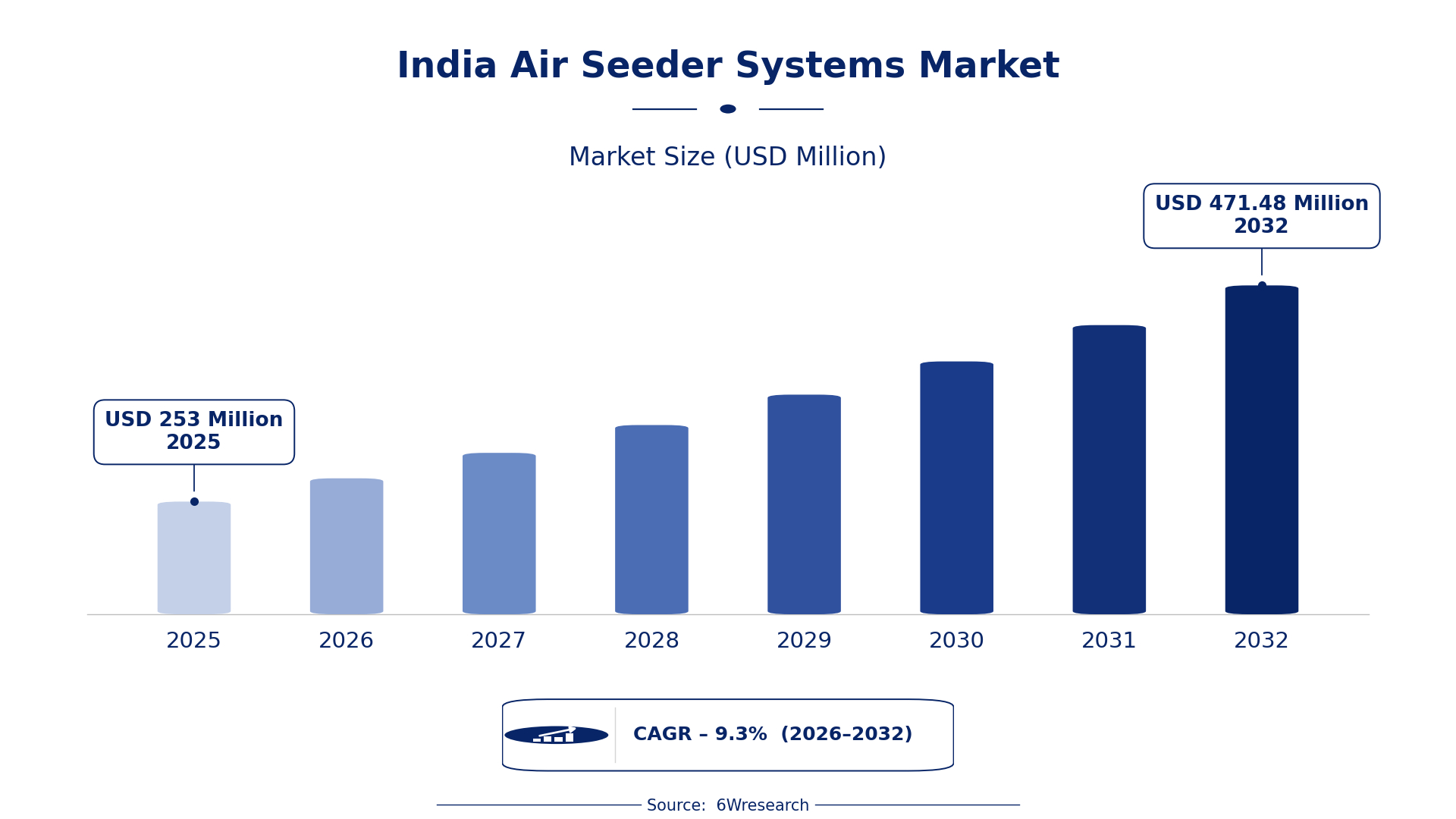
According to 6Wresearch internal database and industry insights, the India Air Seeder Systems Market was valued at USD 253.0 million in 2025 and is projected to reach USD 471.48 million by 2032, growing at a CAGR of approximately 9.3% during 2026–2032.
India Air Seeder Systems Market Highlights
| Report Metric | Details |
| Report Name | India Air Seeder Systems Market |
| Market Size 2025 | USD 253.0 million |
| Market Size 2032 | USD 471.48 million |
| Absolute Growth 2025–2032 | USD 218.48 million |
| CAGR 2026–2032 | 9.3% |
| Peak Annual Growth | 12.0% in 2032 |
| Forecast Period | 2026–2032 |
| Historical Data | 2022–2025 |
| Base Year | 2025 |
| Leading Product Type, 2025 | Central Air Seeders (35% share) |
| Leading Mechanism Type, 2025 | Pneumatic Delivery (40% share) |
| Leading Distribution Channel, 2025 | Agricultural Equipment Dealers (40% share) |
| Leading End User, 2025 | Commercial Agriculture Farms (37% share) |
| Fastest-Growing Product Type | Precision Air Seeders (11.6% CAGR) |
| Fastest-Growing Mechanism Type | Variable Rate Control (12.0% CAGR) |
| Fastest-Growing Distribution Channel | Online Platforms (12.0% CAGR) |
| Fastest-Growing End User | Modern Farming Enterprises (10.7% CAGR) |
| Growing Sector | Commercial Agriculture |
| Key End Users | Large-Scale Farms, Commercial Agriculture Farms, Cereal Crop Producers |
India Air Seeder Systems Market Year-wise Growth Rate and Key Drivers (2022–2032)
This graph illustrates the annual growth rates of the market from 2022 to 2032, highlighting a steady upward trajectory and projected market expansion over the forecast period.
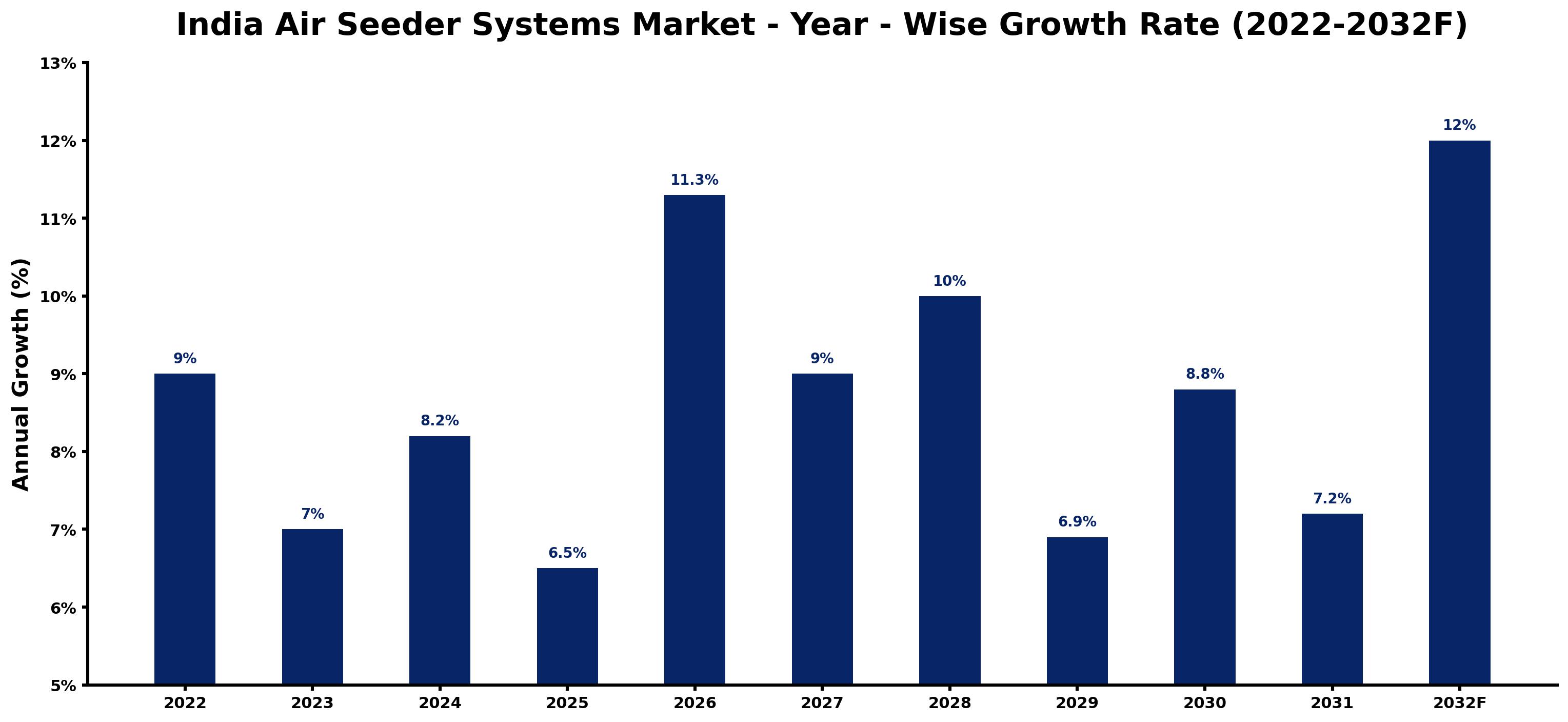
Year by year, the estimates below pair each growth rate with the development that shaped it.
| Year | Estimated Annual Growth (%) | Market Rationale |
| 2022 | 9.0 | The market experienced strong demand from large-scale farms adopting advanced planting technologies. |
| 2023 | 7.0 | Adoption rates slowed as farmers adjusted to new agricultural practices and equipment. |
| 2024 | 8.2 | Increased awareness of air seeders led to higher adoption in Punjab and Haryana regions. |
| 2025 | 6.5 | Demand growth slowed as the market matured and competition increased among suppliers. |
| 2026 | 11.3 | Investment in agricultural mechanization initiatives spurred renewed interest in air seeders. |
| 2027 | 9.0 | Market growth slowed as farmers evaluated the return on investment for new equipment. |
| 2028 | 10.0 | Technological advancements in air seeder design attracted more commercial agriculture farms. |
| 2029 | 6.9 | Demand growth slowed as the market reached a more stable adoption phase. |
| 2030 | 8.8 | Increased food grain production drove further interest in efficient planting solutions. |
| 2031 | 7.2 | The market experienced slower growth as farmers focused on optimizing existing equipment. |
| 2032 | 12.0 | A surge in demand is expected as mechanization rates increase towards national targets. |
Note: Market size estimations and growth projections presented in this report are based on 6Wresearch's proprietary forecasting methodology, utilizing the latest available industry data, government publications, and primary research inputs.
India Air Seeder Systems Market Synopsis
Air Seeder Systems in India are advanced agricultural tools designed for efficient seed planting using pneumatic technology. These systems improve planting efficiency and crop yield, making them crucial for large-scale farming operations. The India Air Seeder Systems Market is expanding due to strong demand from commercial agriculture and ongoing advancements in farming technology. In 2022, India produced 307 million tons of food grains, underscoring the need for efficient planting solutions. Government initiatives and funding further promote the adoption of air seeders across the agricultural sector.
Market Dynamics Impact Analysis (2026–2032)
| Factor | Type | Impact | Primary Segment Affected |
| Growing adoption of precision farming techniques | Driver | High | Precision Air Seeders |
| Increased investment in agricultural mechanization | Driver | High | Pneumatic Delivery |
| Expansion of online platforms for equipment sales | Opportunity | Medium | Online Platforms |
| Rising demand for high-efficiency planting solutions | Opportunity | High | Commercial Agriculture Farms |
| High initial investment costs for advanced equipment | Restraint | High | Central Air Seeders |
| Limited awareness among smallholder farmers | Restraint | Medium | Box Air Seeders |
| Dependence on favourable weather conditions for crop yield | Challenge | Medium | Central Air Seeders |
| Challenges in training farmers on new technologies | Challenge | High | Tow-Behind Models |
Evaluation of Drivers in India Air Seeder Systems Market (2026–2032)
The table below links each growth driver to the segment it affects and the evidence for it.
| Drivers | Primary Segment Affected | Why It Matters (Evidence) |
| Investment in agricultural mechanization initiatives | Pneumatic Delivery | The Indian government allocated ₹1,000 crores for agricultural mechanization, increasing demand for air seeders. |
| Growing food grain production | Precision Air Seeders | In 2022, India produced 310 million tons of food grains, driving demand for efficient planting solutions. |
| Support from agricultural bodies for modern equipment | Commercial Agriculture Farms | The Agricultural and Processed Food Products Export Development Authority promotes air seeders for export-quality crops. |
| Rising average farm sizes | Large-Scale Farms | The average farm size in India is approximately 1.08 hectares, influencing the need for efficient planting. |
| Technological advancements in air seeder design | Tow-Behind Models | Modern air seeders reduce seed wastage, improving overall crop yield. |
Market growth for Air Seeder Systems in India is underpinned by increased investment in agricultural mechanization, rising food grain production, and support from agricultural bodies. In 2022, India produced 310 million tons of food grains, highlighting the need for efficient planting solutions. The Agricultural and Processed Food Products Export Development Authority promotes air seeders for export-quality crops, further driving demand. The average farm size of approximately 1.08 hectares necessitates efficient planting methods, leading to increased purchases of air seeders.
Evaluation of Restraints in India Air Seeder Systems Market
The key brakes on demand, and where they bite hardest, are shown below.
| Market Restraint | Primary Segment Affected | Why It Matters (Evidence) |
| High initial investment costs for advanced equipment | Central Air Seeders | Many farmers find the upfront costs of air seeders prohibitive, limiting adoption rates. |
| Limited awareness among smallholder farmers | Box Air Seeders | Smallholder farmers often lack knowledge about the benefits of air seeders, hindering market growth. |
| Dependence on favourable weather conditions for crop yield | Central Air Seeders | Adverse weather can impact crop yields, affecting the perceived value of investing in air seeders. |
| Challenges in training farmers on new technologies | Tow-Behind Models | Farmers require training to effectively use advanced equipment, which can delay adoption. |
| Market saturation in certain regions | Pneumatic Delivery | In areas with high adoption rates, growth may slow as the market reaches saturation. |
India Air Seeder Systems Market Challenges
The India Air Seeder Systems market still has to address a few issues, starting with a shortage of skilled operators. Many farmers lack proper training to effectively use air seeders, resulting in inefficient planting and reduced crop yields. Buyers face inflated prices due to the inconsistent supply of quality air seeders, as local manufacturers struggle to meet the rising demand, causing planting delays. Traditional farming methods continue to dominate, as some farmers are reluctant to adopt new technology, which hampers market growth. Slow technology adoption further limits efficiency improvements, negatively affecting productivity for large-scale farms.
Trends in the India Air Seeder Systems Market
The trends below show where the India Air Seeder Systems Market is heading.
- Shift to Precision Farming in Punjab and Haryana: Punjab and Haryana are increasingly adopting precision farming techniques, with precision air seeders becoming popular. In 2023, the adoption rate of precision air seeders in these regions rose by 20%, enhancing crop yields.
- Transition from Traditional to Modern Equipment: The National Mission on Agricultural Extension and Technology has promoted modern farming techniques since 2020, leading to a rise in air seeder usage. In 2023, the adoption of air seeders increased by 20% among large-scale farms.
- Emergence of Online Sales Channels: Online platforms for agricultural equipment sales are gaining traction, improving accessibility for farmers. In 2023, online sales of air seeders grew by 15%, reflecting changing purchasing behaviours.
- Increased Focus on Sustainability: Farmers are prioritising sustainable farming practices, leading to higher demand for efficient planting solutions. The Agricultural Mechanization Policy aims to boost mechanization rates from 40% to 70% by 2025.
Investment Opportunities in the India Air Seeder Systems Market
Some of the investment opportunities in the India Air Seeder Systems Market are mentioned below.
- Commercial Agriculture Farms Seeking Efficiency: Commercial agriculture farms are increasingly looking for efficient planting solutions, with demand for air seeders expected to rise. In 2023, the market for air seeders is projected to grow by 15%.
- Growing Need for High-Efficiency Planting Solutions: With the Indian government aiming to increase mechanization rates, there is a significant opportunity to supply air seeders. The push for mechanization is expected to create a ₹500 crore market by 2025.
- Investment in Agricultural Technology: As the agricultural sector modernises, there is a growing need for advanced planting equipment. The National Agriculture Development Programme supports the adoption of air seeders, creating opportunities for suppliers.
- Expansion of Online Sales Channels: With online platforms gaining popularity, suppliers can tap into a growing market for air seeders. In 2023, online sales are expected to account for 20% of total air seeder sales.
Government Initiatives in the India Air Seeder Systems Market
The Agricultural Mechanization Policy, introduced in 2022, focuses on increasing the adoption of air seeders to improve productivity and sustainability in farming. This policy aims to raise mechanization rates in agriculture from 40% to 70% by 2025, benefiting producers by improving operational efficiency. The Pradhan Mantri Kisan Samman Nidhi Yojana, launched in 2020, provides financial support to farmers for purchasing modern agricultural equipment, including air seeders, facilitating access to advanced technology. Additionally, the National Agriculture Development Programme, updated in 2021, promotes the use of advanced farming technologies such as air seeders across India, encouraging wider adoption among farmers.
In 2023, the Indian government allocated ₹1,000 crores for agricultural mechanization initiatives, which are administered by the Ministry of Agriculture. This funding supports projects aimed at increasing the mechanization of farming practices, including the adoption of air seeders. The Soil Health Card Scheme encourages farmers to adopt precision farming techniques, including air seeder usage, since 2020, enhancing crop productivity. The Digital India Initiative also supports online platforms for agricultural equipment sales, improving accessibility for farmers.
Future Insight of the India Air Seeder Systems Market
By 2032, the India Air Seeder Systems market will undergo considerable changes, primarily driven by government initiatives to boost agricultural mechanization. The National Mission on Agricultural Extension and Technology will promote modern farming practices, increasing air seeder adoption across the country. The mechanization rate in agriculture is expected to rise to 70%, improving operational efficiency for buyers. Stricter quality specifications from the Bureau of Indian Standards will ensure that producers benefit from improved performance and reliability in air seeders.
Market Segmentation Analysis
Each segment group is reviewed below, with the leader by share and the fastest grower by CAGR.
By Product Type – Central Air Seeders Dominated, Precision Air Seeders Expected to Grow Fastest
According to Shubham Padhi, Research Analyst at 6Wresearch, with a 35% revenue share in 2025, Central Air Seeders was the largest product type category. Central air seeders lead the market share as they are crucial for high-volume seed planting across various terrains, making them indispensable for large-scale farming operations. Their widespread use in Maharashtra underscores their vital role in enhancing agricultural productivity in the region. Over 2026–2032, Precision Air Seeders are expected to post the fastest growth, at a CAGR of 11.6%. Precision air seeders are experiencing rapid growth due to their ability to facilitate accurate seed placement, significantly improving crop yields. The increasing adoption of these systems in Punjab and Haryana highlights their growing importance among farmers focused on planting efficiency. Suppliers should prioritise the availability of precision air seeders to meet the rising demand from modern agricultural practices.
By Mechanism Type – Pneumatic Delivery Dominated, Variable Rate Control Expected to Grow Fastest
In 2025, Pneumatic Delivery led the mechanism type split with a 40% share. Pneumatic delivery systems capture the largest market share as they employ air pressure for seed transport, ensuring uniform planting across fields. This mechanism is especially favoured by farmers seeking consistent crop yields and reliability in their planting operations. The quickest growth will come from Variable Rate Control, forecast to expand at a CAGR of 12.0% between 2026 and 2032. Variable rate control is the fastest-growing mechanism type, as it allows customised seed application rates based on field variability, which is essential for optimising resource use. This adaptability is increasingly vital as farmers strive to enhance productivity in diverse agricultural conditions. Buyers will benefit significantly by investing in variable rate control systems to improve planting efficiency and adapt to varying field conditions.
By Distribution Channel – Agricultural Equipment Dealers Dominated, Online Platforms Expected to Grow Fastest
The largest distribution channel category in 2025 was Agricultural Equipment Dealers, with a 40% share of total revenue. Agricultural equipment dealers hold the largest share of the distribution channel due to their established networks and expertise in selling air seeders. They serve as a crucial link between manufacturers and end-users, particularly in rural areas where access to advanced technology is essential. Online Platforms are set to record the highest CAGR in this split, 12.0% over 2026–2032. Online platforms are rapidly becoming the fastest-growing distribution channel, driven by the convenience they provide for direct purchases of agricultural equipment. This shift towards digital purchasing reflects changing consumer preferences within the agricultural sector. Suppliers should enhance their online presence to cater to the increasing number of buyers who prefer digital channels for acquiring air seeders.
By End User – Commercial Agriculture Farms Dominated, Modern Farming Enterprises Expected to Grow Fastest
Commercial Agriculture Farms accounted for a 37% market share by end user in 2025. Commercial agriculture farms represent the largest share of end users as they utilise air seeders to maximise productivity and profitability on a large scale. Their significant contribution to India's food production underscores their reliance on advanced planting technologies to meet growing demands. Modern Farming Enterprises are projected to grow fastest, at a CAGR of 10.7% during 2026–2032. Modern farming enterprises are the fastest-growing end user segment, adopting air seeders to implement advanced agricultural practices that enhance efficiency. Their focus on innovation and productivity is driving the demand for more sophisticated planting solutions. Suppliers must tailor their offerings to meet the specific needs of modern farming enterprises, which are increasingly prioritising advanced agricultural technologies.
Key Attractiveness of the Report
- 10 Years of Market Numbers
- Historical Data Starting from 2022 to 2025
- Base Year 2025
- Forecast Data until 2032
- Key Performance Indicators Impacting the Market
- Major Upcoming Developments and Projects
Key Highlights of the Report:
- India Air Seeder Systems Market Outlook
- Market Size of India Air Seeder Systems Market, 2025
- Forecast of India Air Seeder Systems Market, 2032
- Historical Data and Forecast of India Air Seeder Systems Revenues & Volume for the Period 2022 - 2032F
- India Air Seeder Systems Market Trend Evolution
- India Air Seeder Systems Market Drivers and Challenges
- India Air Seeder Systems Price Trends
- India Air Seeder Systems Porter's Five Forces
- India Air Seeder Systems Industry Life Cycle
- Historical Data and Forecast of India Air Seeder Systems Market Revenues & Volume By Product Type for the Period 2022 - 2032F
- Historical Data and Forecast of India Air Seeder Systems Market Revenues & Volume By Box Air Seeders for the Period 2022 - 2032F
- Historical Data and Forecast of India Air Seeder Systems Market Revenues & Volume By Central Air Seeders for the Period 2022 - 2032F
- Historical Data and Forecast of India Air Seeder Systems Market Revenues & Volume By Tow-Behind Models for the Period 2022 - 2032F
- Historical Data and Forecast of India Air Seeder Systems Market Revenues & Volume By Precision Air Seeders for the Period 2022 - 2032F
- Historical Data and Forecast of India Air Seeder Systems Market Revenues & Volume By Mechanism Type for the Period 2022 - 2032F
- Historical Data and Forecast of India Air Seeder Systems Market Revenues & Volume By Ground Drive for the Period 2022 - 2032F
- Historical Data and Forecast of India Air Seeder Systems Market Revenues & Volume By Pneumatic Delivery for the Period 2022 - 2032F
- Historical Data and Forecast of India Air Seeder Systems Market Revenues & Volume By Hydraulic Driven for the Period 2022 - 2032F
- Historical Data and Forecast of India Air Seeder Systems Market Revenues & Volume By Variable Rate Control for the Period 2022 - 2032F
- Historical Data and Forecast of India Air Seeder Systems Market Revenues & Volume By Distribution Channel for the Period 2022 - 2032F
- Historical Data and Forecast of India Air Seeder Systems Market Revenues & Volume By Agricultural Equipment Dealers for the Period 2022 - 2032F
- Historical Data and Forecast of India Air Seeder Systems Market Revenues & Volume By OEM Distributors for the Period 2022 - 2032F
- Historical Data and Forecast of India Air Seeder Systems Market Revenues & Volume By Tractor Showrooms for the Period 2022 - 2032F
- Historical Data and Forecast of India Air Seeder Systems Market Revenues & Volume By Online Platforms for the Period 2022 - 2032F
- Historical Data and Forecast of India Air Seeder Systems Market Revenues & Volume By End User for the Period 2022 - 2032F
- Historical Data and Forecast of India Air Seeder Systems Market Revenues & Volume By Large-Scale Farms for the Period 2022 - 2032F
- Historical Data and Forecast of India Air Seeder Systems Market Revenues & Volume By Commercial Agriculture Farms for the Period 2022 - 2032F
- Historical Data and Forecast of India Air Seeder Systems Market Revenues & Volume By Cereal Crop Producers for the Period 2022 - 2032F
- Historical Data and Forecast of India Air Seeder Systems Market Revenues & Volume By Modern Farming Enterprises for the Period 2022 - 2032F
- India Air Seeder Systems Import Export Trade Statistics
- Market Opportunity Assessment By Product Type
- Market Opportunity Assessment By Mechanism Type
- Market Opportunity Assessment By Distribution Channel
- Market Opportunity Assessment By End User
- India Air Seeder Systems Top Companies Market Share
- India Air Seeder Systems Competitive Benchmarking By Technical and Operational Parameters
- India Air Seeder Systems Company Profiles
- India Air Seeder Systems Key Strategic Recommendations
Market Covered
The report offers an extensive study of the following market segments.
By Product Type
- Box Air Seeders
- Central Air Seeders
- Tow-Behind Models
- Precision Air Seeders
By Mechanism Type
- Ground Drive
- Pneumatic Delivery
- Hydraulic Driven
- Variable Rate Control
By Distribution Channel
- Agricultural Equipment Dealers
- OEM Distributors
- Tractor Showrooms
- Online Platforms
By End User
- Large-Scale Farms
- Commercial Agriculture Farms
- Cereal Crop Producers
- Modern Farming Enterprises































