India Airbag Deployment Mechanisms Market Size & Growth Rate
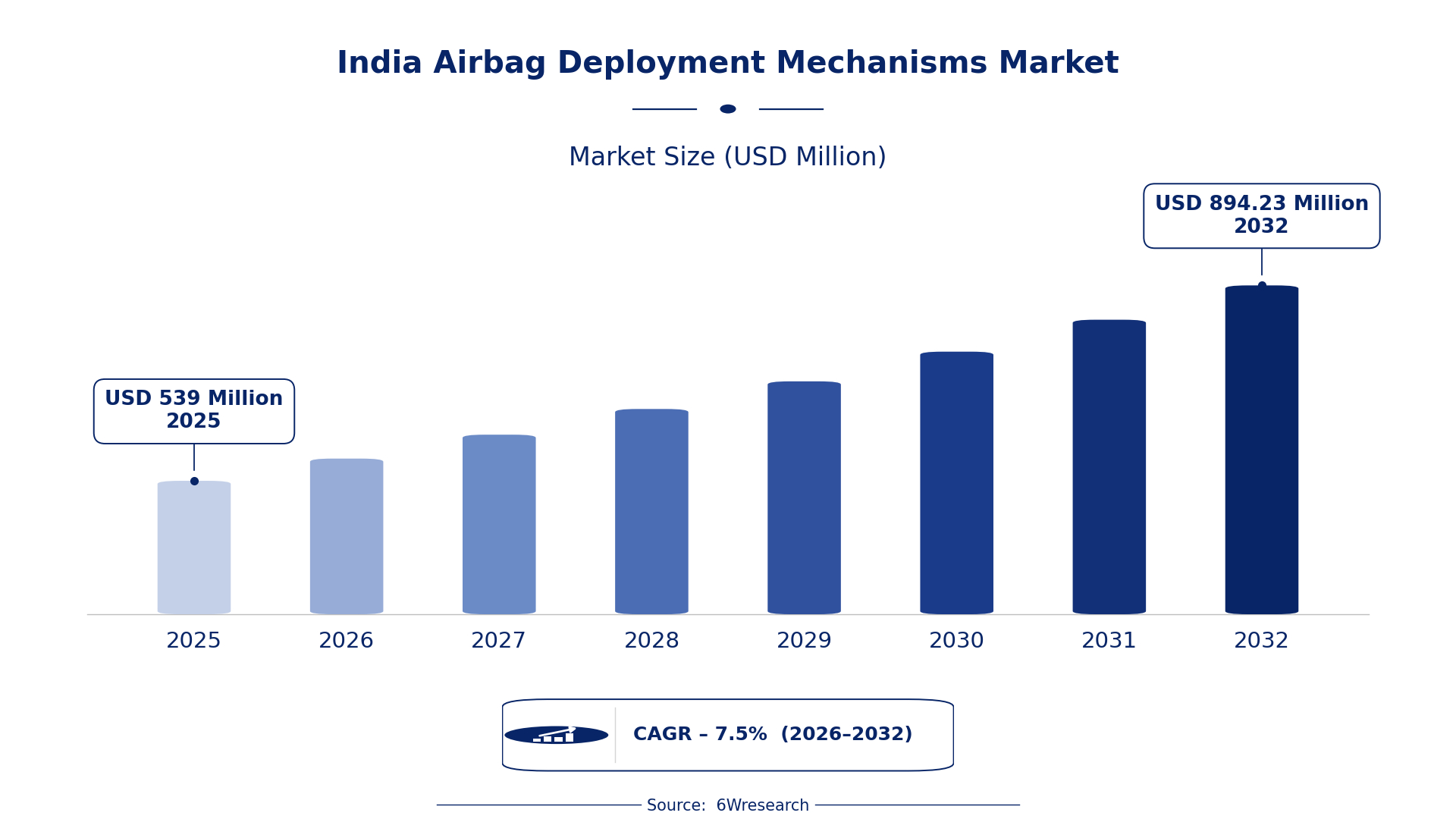
According to 6Wresearch internal database and industry insights, the India Airbag Deployment Mechanisms Market was valued at USD 539.0 million in 2025 and is projected to reach USD 894.23 million by 2032, growing at a CAGR of approximately 7.5% during 2026–2032.
India Airbag Deployment Mechanisms Market Highlights
| Report Metric | Details |
| Report Name | India Airbag Deployment Mechanisms Market |
| Market Size 2025 | USD 539.0 million |
| Market Size 2032 | USD 894.23 million |
| Absolute Growth 2025–2032 | USD 355.23 million |
| CAGR 2026–2032 | 7.5% |
| Peak Annual Growth | 9.7% in 2030 |
| Forecast Period | 2026–2032 |
| Historical Data | 2022–2025 |
| Base Year | 2025 |
| Leading Deployment Mechanism, 2025 | Pyrotechnic Inflators (34% share) |
| Leading Sensor Type, 2025 | Crash Detection Sensors (36% share) |
| Leading Distribution Channel, 2025 | Airbag Manufacturers (44% share) |
| Leading End User, 2025 | Passenger Vehicle OEMs (41% share) |
| Fastest-Growing Deployment Mechanism | Hybrid Inflators (9.4% CAGR) |
| Fastest-Growing Sensor Type | Gas Generator Units (8.6% CAGR) |
| Fastest-Growing Distribution Channel | Safety System Vendors (8.5% CAGR) |
| Fastest-Growing End User | Premium Automotive Brands (9.6% CAGR) |
| Growing Sector | Premium Automotive Brands |
| Key End Users | Passenger Vehicle OEMs, Premium Automotive Brands, Commercial Vehicle Makers, Electric Vehicle Manufacturers |
India Airbag Deployment Mechanisms Market Year-wise Growth Rate and Key Drivers (2022–2032)
This graph illustrates the annual growth rates of the market from 2022 to 2032, highlighting a steady upward trajectory and projected market expansion over the forecast period.
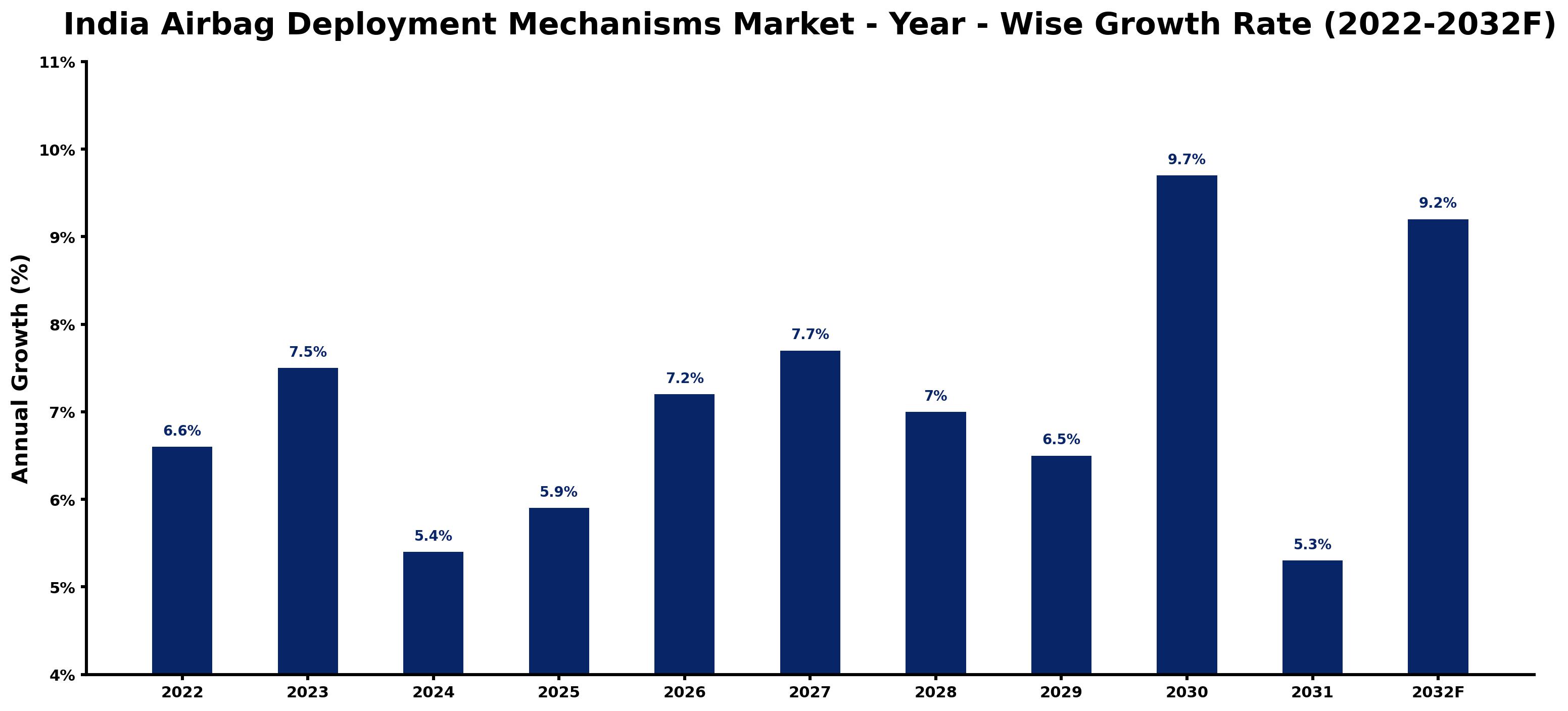
Year by year, the estimates below pair each growth rate with the development that shaped it.
| Year | Estimated Annual Growth (%) | Market Rationale |
| 2022 | 6.6 | The automotive sector produced over 4.4 million passenger vehicles, driving demand for airbag systems. |
| 2023 | 7.5 | The implementation of the Bharat New Vehicle Safety Assessment Program boosted safety standards and demand for airbags. |
| 2024 | 5.4 | Growth slowed as manufacturers adjusted to regulatory changes and market dynamics. |
| 2025 | 5.9 | Investments in safety technologies, including airbags, increased, supporting market expansion. |
| 2026 | 7.2 | The market experienced growth as dual airbags became mandatory in new passenger vehicles. |
| 2027 | 7.7 | Rising consumer awareness about vehicle safety further propelled demand for airbag systems. |
| 2028 | 7.0 | Growth slowed due to market saturation and increased competition among suppliers. |
| 2029 | 6.5 | The demand for advanced safety features continued to rise, sustaining market growth. |
| 2030 | 9.7 | Significant investments in hybrid inflators drove a surge in market demand. |
| 2031 | 5.3 | The market growth slowed as manufacturers faced challenges in meeting new safety standards. |
| 2032 | 9.2 | The continued emphasis on passenger safety is expected to drive further growth in airbag installations. |
Note: Market size estimations and growth projections presented in this report are based on 6Wresearch's proprietary forecasting methodology, utilizing the latest available industry data, government publications, and primary research inputs.
India Airbag Deployment Mechanisms Market Synopsis
Airbag Deployment Mechanisms in India serve as crucial safety devices that inflate airbags during collisions, primarily through chemical reactions or compressed gas. These mechanisms play a key role in passenger safety across vehicles, especially in passenger cars and commercial vehicles. The India Airbag Deployment Mechanisms Market is expanding, driven by the automotive sector's production of over 4.4 million vehicles in 2022 and growing investments in safety technologies. Stricter safety regulations and standards further stimulate demand, creating a robust market for airbag systems.
Market Dynamics Impact Analysis (2026–2032)
| Factor | Type | Impact | Primary Segment Affected |
| Increasing vehicle production and safety regulations drive demand for airbag deployment mechanisms. | Driver | High | Airbag Manufacturers |
| The rise in consumer awareness regarding vehicle safety features enhances market opportunities. | Driver | High | Passenger Vehicle OEMs |
| Growing investments in safety technologies create opportunities for advanced airbag systems. | Opportunity | High | Hybrid Inflators |
| The push for dual airbags in all new passenger vehicles opens avenues for suppliers. | Opportunity | High | Safety System Vendors |
| Compliance with stringent safety standards can increase production costs for manufacturers. | Restraint | High | Airbag Manufacturers |
| Limited awareness of advanced airbag technologies may hinder market penetration. | Restraint | Medium | Commercial Vehicle Makers |
| Supply chain disruptions can delay the availability of critical components for airbag systems. | Challenge | High | Tier-1 Automotive Suppliers |
| Technological advancements in safety systems require continuous investment and adaptation. | Challenge | Medium | Electric Vehicle Manufacturers |
Evaluation of Drivers in India Airbag Deployment Mechanisms Market (2026–2032)
Below mentioned are some major drivers and their influence on market dynamics.
| Drivers | Primary Segment Affected | Why It Matters (Evidence) |
| Increased vehicle production in India is driving demand for airbag systems. | Airbag Manufacturers | India's automotive sector produced over 4.4 million passenger vehicles in 2022, boosting demand for safety features. |
| The introduction of the Bharat New Vehicle Safety Assessment Program improves safety standards. | Passenger Vehicle OEMs | This program encourages manufacturers to invest in advanced airbag technologies. |
| Growing consumer awareness about vehicle safety features is propelling market demand. | Hybrid Inflators | As safety becomes a priority, consumers are more likely to choose vehicles equipped with advanced airbag systems. |
| Regulatory requirements mandating dual airbags in new vehicles drive production. | Safety System Vendors | The 2021 regulation by the Ministry of Road Transport and Highways has increased demand for airbag systems. |
| Investments in safety technologies are increasing across the automotive sector. | Commercial Vehicle Makers | In 2022, the Indian automotive industry invested approximately INR 74,000 crore in safety technologies, including airbags. |
Market growth in India for Airbag Deployment Mechanisms rests on increased vehicle production, regulatory compliance, and rising consumer awareness. The automotive sector produced over 4.4 million passenger vehicles in 2022, boosting demand for airbag systems. The introduction of the Bharat New Vehicle Safety Assessment Program in 2023 further improves safety standards, encouraging manufacturers to invest in advanced airbag technologies. The 2021 regulation mandating dual airbags in new vehicles has stimulated production and sales. As safety becomes a priority for consumers, the demand for vehicles equipped with advanced airbag systems continues to rise, driving market growth.
Evaluation of Restraints in India Airbag Deployment Mechanisms Market
The table below lists the restraints and the evidence behind each.
| Market Restraint | Primary Segment Affected | Why It Matters (Evidence) |
| Compliance with stringent safety standards increases production costs for manufacturers. | Airbag Manufacturers | The Bureau of Indian Standards mandates compliance with IS 14900, raising costs for producers. |
| Limited awareness of advanced airbag technologies may hinder market penetration. | Commercial Vehicle Makers | Many commercial vehicle makers are still adapting to new safety regulations and technologies. |
| Supply chain disruptions can delay the availability of critical components for airbag systems. | Tier-1 Automotive Suppliers | Recent global supply chain issues have impacted the timely delivery of essential parts. |
| Technological advancements in safety systems require continuous investment and adaptation. | Electric Vehicle Manufacturers | Investments in R&D for new technologies can strain budgets and affect production timelines. |
| Market saturation in the automotive sector may limit growth opportunities. | Passenger Vehicle OEMs | As more vehicles become equipped with airbags, the market may experience slower growth. |
India Airbag Deployment Mechanisms Market Challenges
The India airbag deployment mechanisms market still has to solve a few problems, starting with outdated technology that limits deployment efficiency. Many producers rely on traditional pyrotechnic inflators, which can delay inflation times, risking passenger safety in over 4.4 million vehicles produced in 2022. Supply chain disruptions affect manufacturers as sourcing materials like sodium azide becomes increasingly difficult, leading to production delays and higher costs for suppliers. Competition from alternative safety technologies pressures airbag producers to innovate, which can raise production costs for vehicle manufacturers and ultimately increase prices for buyers.
Trends in the India Airbag Deployment Mechanisms Market
Four trends stand out in the India Airbag Deployment Mechanisms Market.
- Shift towards Hybrid Inflators: Passenger Vehicle OEMs are increasingly adopting hybrid inflators due to their efficiency in airbag deployment. The Indian market is witnessing a rise in demand for hybrid inflators, projected to grow at a CAGR of 9.4% from 2026 to 2032.
- Emphasis on Vehicle Safety Standards: The shift in vehicle safety standards is marked by the implementation of the Bharat New Vehicle Safety Assessment Program. This program aims to enhance safety regulations, resulting in a projected 50% increase in airbag installations in commercial vehicles by 2023.
- Growth of Crash Detection Sensors: Crash Detection Sensors are becoming crucial in triggering airbag deployment, thereby increasing safety in vehicles. By 2025, this segment is projected to hold a market share of 36% in airbag deployment mechanisms.
- Rise in Demand for Dual-Stage Deployment: Dual-Stage Deployment mechanisms are gaining popularity as they adjust airbag deployment based on crash severity. This technology is important for improving passenger safety and is expected to see substantial adoption in the coming years.
Investment Opportunities in the India Airbag Deployment Mechanisms Market
Investors looking at the India Airbag Deployment Mechanisms Market should consider the following areas.
- Supply of Hybrid Inflators: The demand for hybrid inflators is rising, providing opportunities for suppliers to invest in this technology. With a projected CAGR of 9.4% from 2026 to 2032, partnerships with Tier-1 Automotive Suppliers can facilitate market entry.
- Investment in Safety Technologies: Investing in advanced safety technologies, such as dual-stage deployment systems, is essential. The Automotive Component Manufacturers Association of India promotes safety standards, creating opportunities for collaboration with local manufacturers.
- Expansion in Commercial Vehicle Segment: The commercial vehicle sector is increasingly adopting airbag systems, presenting a significant opportunity. Collaborating with commercial vehicle makers in regions like Maharashtra can enhance market presence.
- Certification for Airbag Systems: Obtaining BIS certification for airbag systems is essential for market entry. Engaging with the Bureau of Indian Standards can streamline the approval process for new products.
Government Initiatives in the India Airbag Deployment Mechanisms Market
The Bharat New Vehicle Safety Assessment Program (BNVSAP) launched in 2023 impacts airbag deployment mechanisms by improving vehicle safety standards. This program requires manufacturers to comply with updated regulations, ensuring higher safety levels. Additionally, the Motor Vehicles Act mandates dual airbags in all new passenger vehicles since 2021, promoting better safety compliance. The Automotive Research Association of India (ARAI) updated testing protocols for airbag systems in 2022 to align with global standards, further supporting safety compliance. These measures strengthen the market for airbag deployment mechanisms in India.
The Bureau of Indian Standards (BIS) regulates airbag systems, having revised IS 14900 to include new safety requirements in 2023. This revision ensures that manufacturers adhere to stringent safety standards, improving overall product quality. The National Automotive Testing and R&D Infrastructure Project (NATRiP) received INR 1,000 crore in funding to support advancements in automotive safety technologies, including airbags. The funding aims to enhance testing and certification processes, benefiting manufacturers and consumers alike. These initiatives help ensure that airbag systems meet the highest safety standards, fostering consumer confidence in vehicle safety.
Future Insight of the India Airbag Deployment Mechanisms Market
By 2032, the India airbag deployment mechanisms market will see significant changes, primarily driven by the Bharat New Vehicle Safety Assessment Program, which will improve compliance with safety standards. This initiative will push manufacturers to invest in advanced airbag technologies, increasing overall safety. The automotive sector expects a 50% increase in airbag installations in commercial vehicles, reflecting a stronger focus on passenger protection. The demand for more efficient inflators will also rise, benefiting both suppliers and vehicle manufacturers.
Market Segmentation Analysis
Each segment group is reviewed below, with the leader by share and the fastest grower by CAGR.
By Deployment Mechanism – Pyrotechnic Inflators Dominated, Hybrid Inflators Expected to Grow Fastest
According to Shubham Padhi, Research Analyst at 6Wresearch, Pyrotechnic Inflators took a 34% share of deployment mechanism in 2025, more than any other category. Pyrotechnic inflators lead the India airbag deployment mechanisms market due to their critical role in ensuring immediate airbag inflation during collisions. The production of over 4.4 million passenger vehicles in 2022 underscores their importance in meeting stringent safety regulations. Over 2026–2032, Hybrid Inflators are expected to post the fastest growth, at a CAGR of 9.4%. Hybrid inflators are witnessing rapid growth as they combine various technologies for enhanced airbag deployment efficiency. The automotive sector's goal of a 50% increase in airbag installations in commercial vehicles by 2023 is a key factor driving this segment's expansion. Suppliers should focus on advancing hybrid inflators to cater to the increasing demand for sophisticated safety solutions in the automotive market.
By Sensor Type – Crash Detection Sensors Dominated, Gas Generator Units Expected to Grow Fastest
Crash Detection Sensors accounted for a 36% market share by sensor type in 2025. Crash detection sensors dominate the market share as they are vital for triggering the deployment of airbags during an accident. Their importance is underscored by the Bureau of Indian Standards' regulations, which mandate compliance with safety standards for effective airbag systems. Gas Generator Units are projected to grow fastest, at a CAGR of 8.6% during 2026–2032. Gas generator units are the fastest-growing segment, as they are integral to the inflation process of airbags. The increasing emphasis on passenger safety and the implementation of new safety regulations are propelling the demand for these units. Buyers should prioritise sourcing advanced gas generator units to ensure compliance with evolving safety standards in the automotive sector.
By Distribution Channel – Airbag Manufacturers Dominated, Safety System Vendors Expected to Grow Fastest
The largest distribution channel category in 2025 was Airbag Manufacturers, with a 44% share of total revenue. Airbag manufacturers command the largest market share as they are the primary producers of airbag systems, directly influencing the supply chain. Their established presence and ongoing investments in safety technologies solidify their leading role in the market. Safety System Vendors are set to record the highest CAGR in this split, 8.5% over 2026–2032. Safety system vendors are experiencing the fastest growth as they offer comprehensive safety solutions that encompass airbag systems. The growing focus on integrated safety features in vehicles propels the expansion of this segment. Suppliers must enhance partnerships with safety system vendors to expand their market presence and meet the demand for integrated safety solutions.
By End User – Passenger Vehicle OEMs Dominated, Premium Automotive Brands Expected to Grow Fastest
With a 41% revenue share in 2025, Passenger Vehicle OEMs was the largest end user category. Passenger vehicle OEMs account for the largest market share as they are the primary consumers of airbag deployment mechanisms, driven by regulatory safety mandates. The requirement for dual airbags in all new passenger vehicles since 2021 has reinforced their dominant position in the market. The quickest growth will come from Premium Automotive Brands, forecast to expand at a CAGR of 9.6% between 2026 and 2032. Premium automotive brands are the fastest-growing segment, emphasising advanced safety features that include airbags. Their commitment to improving passenger safety aligns with increasing regulatory demands and consumer expectations for enhanced safety technologies. Manufacturers should target premium automotive brands to align with the growing demand for advanced safety features in the market.
Key Attractiveness of the Report
- 10 Years of Market Numbers
- Historical Data Starting from 2022 to 2025
- Base Year 2025
- Forecast Data until 2032
- Key Performance Indicators Impacting the Market
- Major Upcoming Developments and Projects
Key Highlights of the Report:
- India Airbag Deployment Mechanisms Market Outlook
- Market Size of India Airbag Deployment Mechanisms Market, 2025
- Forecast of India Airbag Deployment Mechanisms Market, 2032
- Historical Data and Forecast of India Airbag Deployment Mechanisms Revenues & Volume for the Period 2022 - 2032F
- India Airbag Deployment Mechanisms Market Trend Evolution
- India Airbag Deployment Mechanisms Market Drivers and Challenges
- India Airbag Deployment Mechanisms Price Trends
- India Airbag Deployment Mechanisms Porter's Five Forces
- India Airbag Deployment Mechanisms Industry Life Cycle
- Historical Data and Forecast of India Airbag Deployment Mechanisms Market Revenues & Volume By Deployment Mechanism for the Period 2022 - 2032F
- Historical Data and Forecast of India Airbag Deployment Mechanisms Market Revenues & Volume By Pyrotechnic Inflators for the Period 2022 - 2032F
- Historical Data and Forecast of India Airbag Deployment Mechanisms Market Revenues & Volume By Hybrid Inflators for the Period 2022 - 2032F
- Historical Data and Forecast of India Airbag Deployment Mechanisms Market Revenues & Volume By Compressed Gas Systems for the Period 2022 - 2032F
- Historical Data and Forecast of India Airbag Deployment Mechanisms Market Revenues & Volume By Dual-Stage Deployment for the Period 2022 - 2032F
- Historical Data and Forecast of India Airbag Deployment Mechanisms Market Revenues & Volume By Sensor Type for the Period 2022 - 2032F
- Historical Data and Forecast of India Airbag Deployment Mechanisms Market Revenues & Volume By Crash Detection Sensors for the Period 2022 - 2032F
- Historical Data and Forecast of India Airbag Deployment Mechanisms Market Revenues & Volume By Gas Generator Units for the Period 2022 - 2032F
- Historical Data and Forecast of India Airbag Deployment Mechanisms Market Revenues & Volume By Pressure Triggered for the Period 2022 - 2032F
- Historical Data and Forecast of India Airbag Deployment Mechanisms Market Revenues & Volume By AI-Based Impact Analysis for the Period 2022 - 2032F
- Historical Data and Forecast of India Airbag Deployment Mechanisms Market Revenues & Volume By Distribution Channel for the Period 2022 - 2032F
- Historical Data and Forecast of India Airbag Deployment Mechanisms Market Revenues & Volume By Airbag Manufacturers for the Period 2022 - 2032F
- Historical Data and Forecast of India Airbag Deployment Mechanisms Market Revenues & Volume By Safety System Vendors for the Period 2022 - 2032F
- Historical Data and Forecast of India Airbag Deployment Mechanisms Market Revenues & Volume By Industrial Distributors for the Period 2022 - 2032F
- Historical Data and Forecast of India Airbag Deployment Mechanisms Market Revenues & Volume By Tier-1 Automotive Suppliers for the Period 2022 - 2032F
- Historical Data and Forecast of India Airbag Deployment Mechanisms Market Revenues & Volume By End User for the Period 2022 - 2032F
- Historical Data and Forecast of India Airbag Deployment Mechanisms Market Revenues & Volume By Passenger Vehicle OEMs for the Period 2022 - 2032F
- Historical Data and Forecast of India Airbag Deployment Mechanisms Market Revenues & Volume By Premium Automotive Brands for the Period 2022 - 2032F
- Historical Data and Forecast of India Airbag Deployment Mechanisms Market Revenues & Volume By Commercial Vehicle Makers for the Period 2022 - 2032F
- Historical Data and Forecast of India Airbag Deployment Mechanisms Market Revenues & Volume By Electric Vehicle Manufacturers for the Period 2022 - 2032F
- India Airbag Deployment Mechanisms Import Export Trade Statistics
- Market Opportunity Assessment By Deployment Mechanism
- Market Opportunity Assessment By Sensor Type
- Market Opportunity Assessment By Distribution Channel
- Market Opportunity Assessment By End User
- India Airbag Deployment Mechanisms Top Companies Market Share
- India Airbag Deployment Mechanisms Competitive Benchmarking By Technical and Operational Parameters
- India Airbag Deployment Mechanisms Company Profiles
- India Airbag Deployment Mechanisms Key Strategic Recommendations
Market Covered
The report offers an extensive study of the following market segments.
By Deployment Mechanism
- Pyrotechnic Inflators
- Hybrid Inflators
- Compressed Gas Systems
- Dual-Stage Deployment
By Sensor Type
- Crash Detection Sensors
- Gas Generator Units
- Pressure Triggered
- AI-Based Impact Analysis
By Distribution Channel
- Airbag Manufacturers
- Safety System Vendors
- Industrial Distributors
- Tier-1 Automotive Suppliers
By End User
- Passenger Vehicle OEMs
- Premium Automotive Brands
- Commercial Vehicle Makers
- Electric Vehicle Manufacturers































