India Airborne Command & Control AI Market Size & Growth Rate
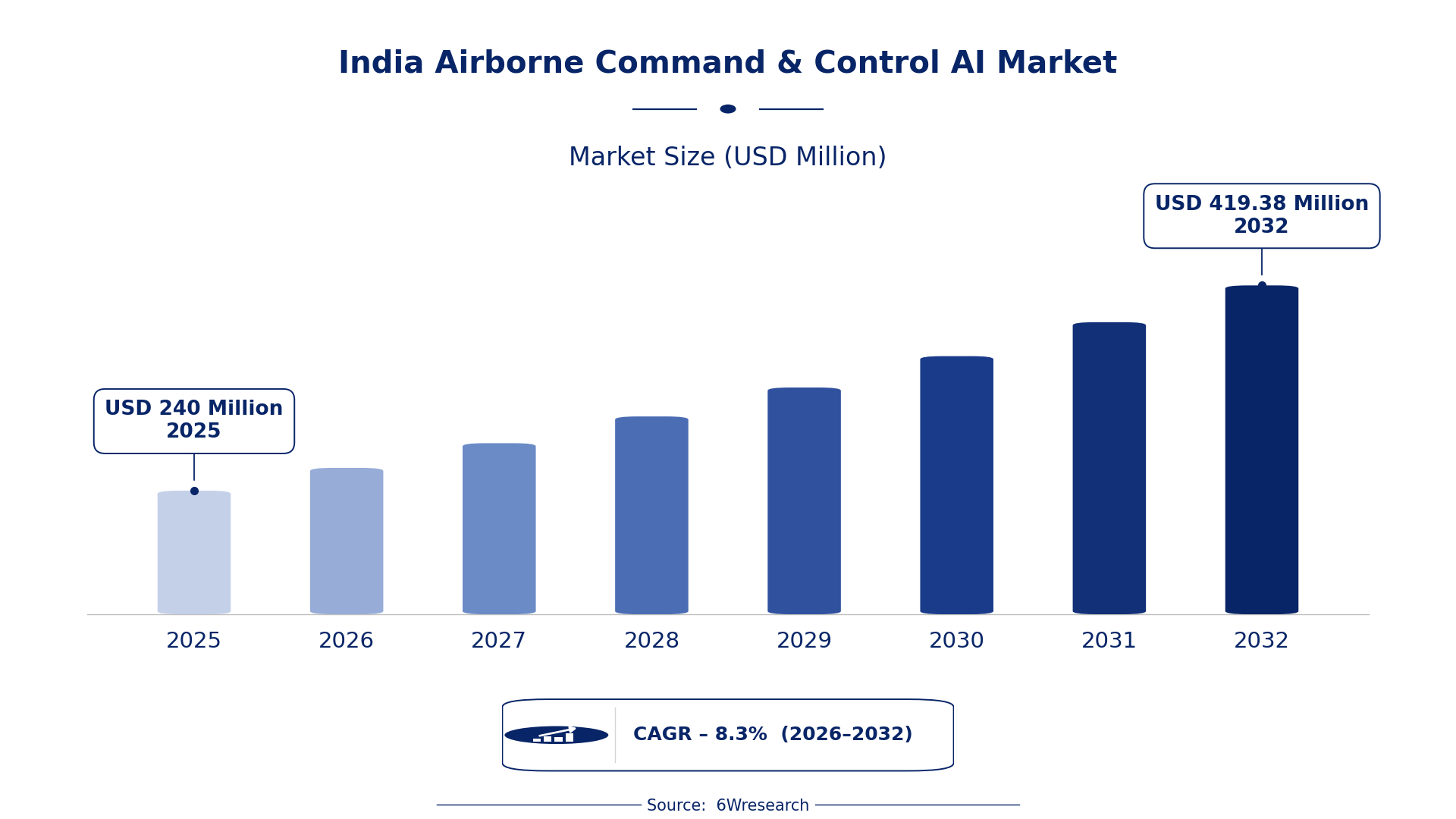
According to 6Wresearch internal database and industry insights, the India Airborne Command & Control AI Market was valued at USD 240.0 million in 2025 and is projected to reach USD 419.38 million by 2032, growing at a CAGR of approximately 8.3% during 2026–2032.
India Airborne Command & Control AI Market Highlights
| Report Metric | Details |
| Report Name | India Airborne Command & Control AI Market |
| Market Size 2025 | USD 240.0 million |
| Market Size 2032 | USD 419.38 million |
| Absolute Growth 2025–2032 | USD 179.38 million |
| CAGR 2026–2032 | 8.3% |
| Peak Annual Growth | 9.8% in 2028 |
| Forecast Period | 2026–2032 |
| Historical Data | 2022–2025 |
| Base Year | 2025 |
| Leading Platform Type, 2025 | Fixed-Wing Aircraft (39% share) |
| Leading AI Capability, 2025 | Real-Time Threat Analysis (46% share) |
| Leading Distribution Channel, 2025 | Defense Contractors (40% share) |
| Leading End User, 2025 | National Security Forces (50% share) |
| Fastest-Growing Platform Type | Drones/UAVs (9.5% CAGR) |
| Fastest-Growing AI Capability | Autonomous Coordination (10.5% CAGR) |
| Fastest-Growing Distribution Channel | Military OEM Integrators (10.4% CAGR) |
| Fastest-Growing End User | Tactical Combat Units (10.0% CAGR) |
| Growing Sector | defense technology |
| Key End Users | National Security Forces, Tactical Combat Units, Defense Intelligence Agencies |
India Airborne Command & Control AI Market Year-wise Growth Rate and Key Drivers (2022–2032)
This graph illustrates the annual growth rates of the market from 2022 to 2032, highlighting a steady upward trajectory and projected market expansion over the forecast period.
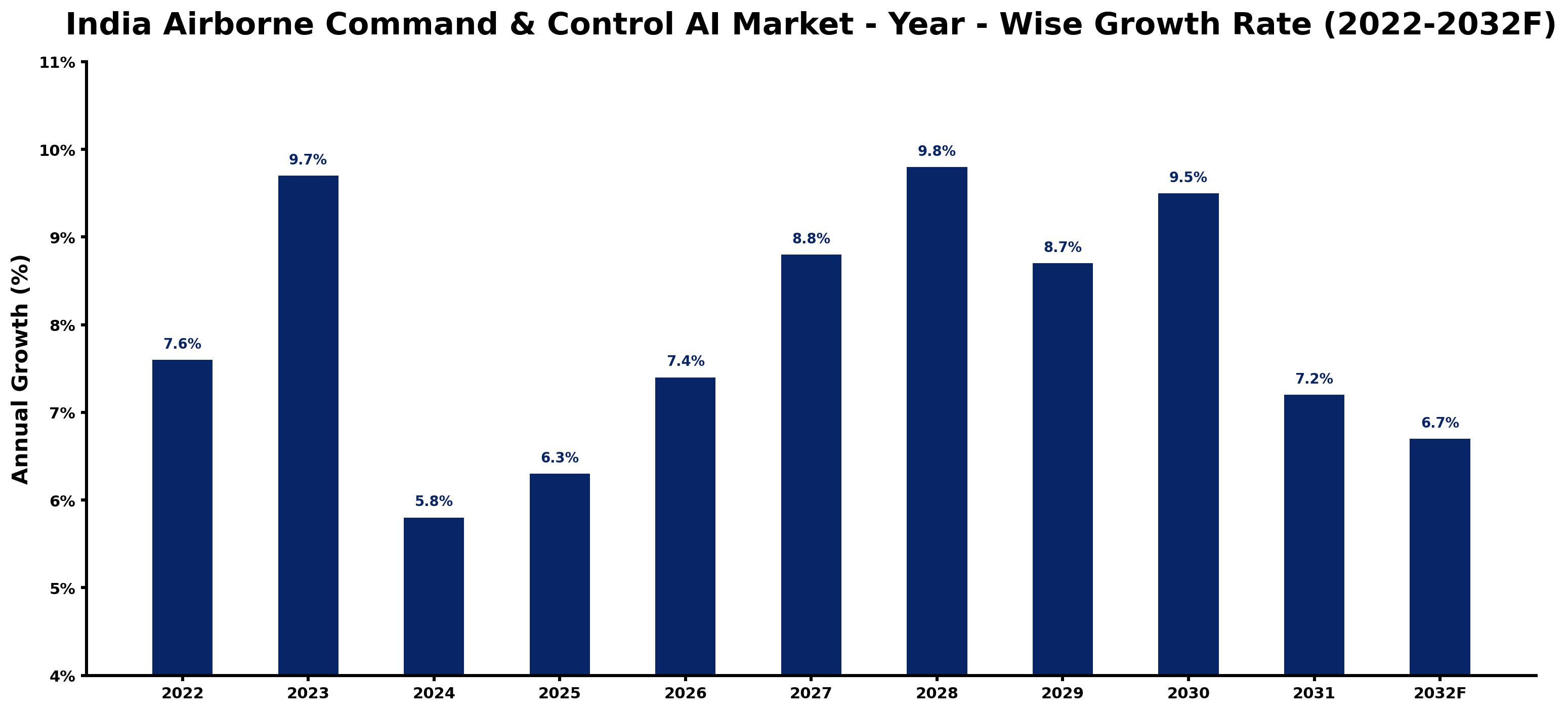
Year by year, the estimates below pair each growth rate with the development that shaped it.
| Year | Estimated Annual Growth (%) | Market Rationale |
| 2022 | 7.6 | The market experienced solid growth due to increased defense spending and procurement initiatives. |
| 2023 | 9.7 | Demand surged as the Indian Air Force enhanced its operational capabilities with advanced systems. |
| 2024 | 5.8 | Growth slowed as procurement processes faced delays in approvals and integration. |
| 2025 | 6.3 | The market rebounded with renewed focus on indigenous defense production initiatives. |
| 2026 | 7.4 | Investment in AI technologies gained momentum, boosting demand for advanced command systems. |
| 2027 | 8.8 | Growing operational needs from tactical units spurred demand for real-time analysis tools. |
| 2028 | 9.8 | The market peaked as the integration of AI in defense became a priority for national security. |
| 2029 | 8.7 | A slight slowdown occurred as budget reallocations impacted procurement timelines. |
| 2030 | 9.5 | Demand rose again as new defense strategies emphasized advanced command capabilities. |
| 2031 | 7.2 | Growth decelerated due to challenges in meeting indigenization targets in defense procurement. |
| 2032 | 6.7 | The market continues to grow, driven by ongoing modernization efforts in defense operations. |
Note: Market size estimations and growth projections presented in this report are based on 6Wresearch's proprietary forecasting methodology, utilizing the latest available industry data, government publications, and primary research inputs.
India Airborne Command & Control AI Market Synopsis
Airborne Command & Control AI in India refers to advanced technologies integrated into military platforms for enhanced situational awareness and decision-making. This technology is essential for real-time threat assessment, coordination of defense operations, and communication optimization. The Airborne Command & Control AI Market is projected to grow significantly, driven by India's defense budget of approximately ₹5.25 lakh crores and the emphasis on indigenous production through initiatives like 'Aatmanirbhar Bharat'. Demand is primarily sourced from national security forces and tactical combat units, reflecting the increasing need for advanced military capabilities.
Market Dynamics Impact Analysis (2026–2032)
| Factor | Type | Impact | Primary Segment Affected |
| Increased defense spending supports the adoption of advanced command systems. | Driver | High | Real-Time Threat Analysis |
| The push for indigenous production creates opportunities for local technology providers. | Opportunity | High | Drones/UAVs |
| Delays in procurement processes hinder timely acquisition of necessary technologies. | Restraint | High | Fixed-Wing Aircraft |
| Limited integration capabilities can slow down the deployment of new systems. | Challenge | Medium | Mobile Ground Terminals |
| Growing demand for enhanced situational awareness drives investment in AI technologies. | Driver | High | Autonomous Coordination |
| The focus on modernization of tactical units presents opportunities for suppliers. | Opportunity | Medium | Tactical Combat Units |
| Regulatory hurdles can complicate the procurement of advanced systems. | Restraint | Medium | Satellites |
| Competition from international suppliers poses challenges for local manufacturers. | Challenge | High | Defense Contractors |
Evaluation of Drivers in India Airborne Command & Control AI Market (2026–2032)
The main growth drivers and the segments they affect most are set out below.
| Drivers | Primary Segment Affected | Why It Matters (Evidence) |
| Increased defense budget allocation drives demand for advanced systems. | Real-Time Threat Analysis | India's defense budget for 2023 is approximately ₹5.25 lakh crores, enabling procurement of advanced AI systems. |
| Growing operational needs from tactical units boost demand for AI technologies. | Drones/UAVs | The establishment of Tactical Operations Centers enhances decision-making capabilities in military operations. |
| Emphasis on indigenization encourages local technology development. | Mobile Ground Terminals | A target of achieving 70% indigenization in defense procurement by 2025 promotes local manufacturing. |
| Integration of AI in defense strategies improves operational effectiveness. | Autonomous Coordination | The National Strategy for Artificial Intelligence focuses on AI applications in defense by 2025. |
| Strategic partnerships with defense contractors facilitate technology transfer. | Fixed-Wing Aircraft | The Indian Air Force collaborates with various defense contractors for AI integration. |
Growth in the Airborne Command & Control AI market in India comes from increased defense budget allocations, operational needs from tactical units, and a strong emphasis on indigenization. The establishment of Tactical Operations Centers enhances decision-making capabilities, driving demand for advanced command systems. The target of achieving 70% indigenization in defense procurement by 2025 promotes local technology development. Partnerships with defense contractors facilitate the integration of AI technologies into military platforms, improving operational effectiveness. With a defense budget of approximately ₹5.25 lakh crores, procurement of advanced AI systems is becoming more feasible, reflecting the increasing focus on modernising military capabilities.
Evaluation of Restraints in India Airborne Command & Control AI Market
The following restraints limit how fast demand can grow.
| Market Restraint | Primary Segment Affected | Why It Matters (Evidence) |
| Delays in procurement processes hinder timely acquisition of necessary technologies. | Fixed-Wing Aircraft | The Defence Acquisition Procedure approved in 2021 aims to streamline procurement but still faces implementation challenges. |
| Regulatory hurdles complicate the procurement of advanced systems. | Satellites | The Defence Production and Export Promotion Policy outlines a roadmap but can be slow to enact. |
| Limited integration capabilities can slow down the deployment of new systems. | Mobile Ground Terminals | Integrating AI systems into existing platforms requires substantial investment and time. |
| Budget reallocations can impact procurement timelines. | Drones/UAVs | Shifts in defense priorities may delay funding for new technology acquisitions. |
| Competition from international suppliers poses challenges for local manufacturers. | Defense Contractors | The global defense market is highly competitive, affecting local firms' market share. |
India Airborne Command & Control AI Market Challenges
India's defence sector encounters supply chain disruptions, as limited domestic production of Airborne Command & Control AI technologies hampers access for producers, affecting project timelines. This situation can postpone government procurement schedules, impacting operational readiness for national security forces. Importers face high costs, with technology development expenses potentially rising by 30% due to tariffs and logistical hurdles. Many military platforms still lack advanced AI capabilities, which restricts operational effectiveness for buyers, while a shortage of skilled personnel in AI and data analytics stifles innovation for producers, increasing dependence on foreign expertise.
Trends in the India Airborne Command & Control AI Market
Below mentioned are some of the trends shaping the India Airborne Command & Control AI Market growth.
- Shift Towards AI-Driven Decision Making: India is progressively embracing AI technologies to enhance decision-making in military operations. The National Strategy for Artificial Intelligence, released in 2021, outlines a commitment to AI applications in defence, targeting notable advancements by 2025.
- Transition from Traditional to Modern Platforms: The Indian Air Force is modernising its fleet, with over 200 fixed-wing aircraft now outfitted with advanced command and control systems. This modernisation aligns with the National Security Strategy's focus on integrating AI by 2025.
- Emergence of Tactical Operations Centers: Tactical Operations Centers have been established by the Indian Army to improve real-time decision-making capabilities. This initiative reflects the increasing need for operational efficiency in military engagements.
- Increased Focus on Indigenous Production: The 'Aatmanirbhar Bharat' initiative launched in 2022 aims to enhance indigenous defence production. This policy encourages local manufacturers to develop advanced military technologies, with a target of achieving 70% indigenisation by 2025.
Investment Opportunities in the India Airborne Command & Control AI Market
Investors looking at the India Airborne Command & Control AI Market should consider the following areas.
- Growing Demand for Real-Time Threat Analysis: With a projected market size of USD 240.0 million by 2025, there exists an opportunity for suppliers in real-time threat analysis technologies. National Security Forces are actively pursuing advanced solutions to boost operational capabilities.
- Investment in Drones for Tactical Operations: The Indian Army's focus on tactical operations presents an opportunity for drone manufacturers. The demand for enhanced reconnaissance capabilities is driving interest in UAVs, with over 100 operational drones currently deployed.
- Partnerships for AI Integration: The emphasis on indigenous production creates opportunities for collaborations with local firms. Partnering with defence contractors can facilitate technology transfer and integration of AI systems into military platforms.
- Expansion of Mobile Ground Terminals: The establishment of Tactical Operations Centers underscores the need for mobile ground terminals. Suppliers can capitalise on this demand by providing advanced command and control capabilities to enhance operational efficiency.
Government Initiatives in the India Airborne Command & Control AI Market
The 'Aatmanirbhar Bharat' initiative, launched in 2020, aims to boost self-reliance in defense manufacturing and technology development. This initiative encourages local production of advanced military technologies, including AI systems. The 'Defence Production and Export Promotion Policy' of 2020 outlines a roadmap for increasing defense exports and encouraging private sector participation, which is vital for fostering innovation in the sector. The 'National Strategy for Artificial Intelligence' published by NITI Aayog in 2021 focuses on AI applications in defense and security, aiming for significant advancements by 2025.
The Ministry of Defence plays a key role in approving and funding defense projects. The Defence Acquisition Procedure approved in 2021 streamlines procurement processes, promoting indigenization and collaboration with private sector firms. Additionally, the Ministry supports initiatives that improve local manufacturing capabilities, ensuring that buyers can access advanced technologies efficiently. The implementation of these policies is set to yield substantial benefits for national security forces and tactical combat units, driving demand for innovative solutions in the defense sector.
Future Insight of the India Airborne Command & Control AI Market
By 2032, buyers and suppliers in the Airborne Command & Control AI market can anticipate considerable changes driven by government initiatives like the 'Aatmanirbhar Bharat' programme, which aims to strengthen local production capabilities. The Ministry of Defence's target for 70% indigenisation will advance local technology development and decrease reliance on imports. The integration of AI in defence operations, as outlined in the National Security Strategy, will refine decision-making processes. With over 100 operational drones for military use, the demand for advanced technologies is expected to persist.
Market Segmentation Analysis
Each segment group is reviewed below, with the leader by share and the fastest grower by CAGR.
By Platform Type – Fixed-Wing Aircraft Dominated, Drones/UAVs Expected to Grow Fastest
According to Shubham Padhi, Research Analyst at 6Wresearch, in 2025, Fixed-Wing Aircraft led the platform type split with a 39% share. Fixed-Wing Aircraft dominate the market due to their extensive use in airborne operations and surveillance, with over 200 such aircraft currently in the Indian Air Force. This established installed base ensures a strong demand for advanced command and control AI technologies. The quickest growth will come from Drones/UAVs, forecast to expand at a CAGR of 9.5% between 2026 and 2032. Drones/UAVs are experiencing rapid growth as they are increasingly deployed for reconnaissance and tactical missions, aligning with the Indian government's push for indigenous defense production under the 'Aatmanirbhar Bharat' initiative. This trend is expected to accelerate as more operational drones are integrated into military strategies. Suppliers focusing on drone technology will find ample opportunities as demand from tactical units rises.
By AI Capability – Real-Time Threat Analysis Dominated, Autonomous Coordination Expected to Grow Fastest
Real-Time Threat Analysis took a 46% share of ai capability in 2025, more than any other category. Real-Time Threat Analysis holds the largest share as it is essential for immediate decision-making in combat scenarios, allowing national security forces to effectively respond to threats. This capability is crucial for maintaining operational readiness, especially in high-stakes environments where timely information is vital. Autonomous Coordination is set to record the highest CAGR in this split, 10.5% over 2026–2032. Autonomous Coordination is witnessing rapid growth due to its ability to enhance operational efficiency across multiple platforms, which is increasingly important for modern military operations. The ongoing emphasis on integrating advanced technologies into defense strategies further drives the expansion of this segment. Suppliers should focus on developing solutions that optimise coordination and response times in military operations.
By Distribution Channel – Defense Contractors Dominated, Military OEM Integrators Expected to Grow Fastest
With a 40% revenue share in 2025, Defense Contractors was the largest distribution channel category. Defense Contractors dominate the market because they are instrumental in developing and supplying airborne command and control systems, serving as the primary interface for military procurement. Their established connections with the Indian government facilitate the integration of advanced technologies into military platforms, ensuring a steady supply chain. Over 2026–2032, Military OEM Integrators are expected to post the fastest growth, at a CAGR of 10.4%. Military OEM Integrators are the fastest-growing channel, as they are essential for the integration of advanced systems into various military platforms, reflecting the increasing complexity of modern military requirements. Their collaboration with defense contractors drives the overall market forward. Suppliers need to build strong partnerships with military OEM integrators to capitalise on the rising demand for integrated solutions.
By End User – National Security Forces Dominated, Tactical Combat Units Expected to Grow Fastest
National Security Forces held a 50% share of the India Airborne Command & Control AI Market by end user in 2025. National Security Forces represent the largest user group for airborne command and control technologies, consistently requiring advanced capabilities to ensure national security. Their extensive operational demands significantly shape the market for sophisticated solutions tailored to their needs. Tactical Combat Units are projected to grow fastest, at a CAGR of 10.0% during 2026–2032. Tactical Combat Units are the fastest-growing end user segment, increasingly utilising advanced technologies to improve operational effectiveness in the field. This trend is supported by the establishment of Tactical Operations Centers within the Indian Army, which enhances decision-making capabilities. Suppliers should tailor their offerings to meet the specific requirements of tactical units, which are becoming more reliant on advanced technologies.
Key Attractiveness of the Report
- 10 Years of Market Numbers
- Historical Data Starting from 2022 to 2025
- Base Year 2025
- Forecast Data until 2032
- Key Performance Indicators Impacting the Market
- Major Upcoming Developments and Projects
Key Highlights of the Report:
- India Airborne Command & Control AI Market Outlook
- Market Size of India Airborne Command & Control AI Market, 2025
- Forecast of India Airborne Command & Control AI Market, 2032
- Historical Data and Forecast of India Airborne Command & Control AI Revenues & Volume for the Period 2022 - 2032F
- India Airborne Command & Control AI Market Trend Evolution
- India Airborne Command & Control AI Market Drivers and Challenges
- India Airborne Command & Control AI Price Trends
- India Airborne Command & Control AI Porter's Five Forces
- India Airborne Command & Control AI Industry Life Cycle
- Historical Data and Forecast of India Airborne Command & Control AI Market Revenues & Volume By Platform Type for the Period 2022 - 2032F
- Historical Data and Forecast of India Airborne Command & Control AI Market Revenues & Volume By Fixed-Wing Aircraft for the Period 2022 - 2032F
- Historical Data and Forecast of India Airborne Command & Control AI Market Revenues & Volume By Drones/UAVs for the Period 2022 - 2032F
- Historical Data and Forecast of India Airborne Command & Control AI Market Revenues & Volume By Satellites for the Period 2022 - 2032F
- Historical Data and Forecast of India Airborne Command & Control AI Market Revenues & Volume By Mobile Ground Terminals for the Period 2022 - 2032F
- Historical Data and Forecast of India Airborne Command & Control AI Market Revenues & Volume By AI Capability for the Period 2022 - 2032F
- Historical Data and Forecast of India Airborne Command & Control AI Market Revenues & Volume By Real-Time Threat Analysis for the Period 2022 - 2032F
- Historical Data and Forecast of India Airborne Command & Control AI Market Revenues & Volume By Autonomous Coordination for the Period 2022 - 2032F
- Historical Data and Forecast of India Airborne Command & Control AI Market Revenues & Volume By Satellite Communication for the Period 2022 - 2032F
- Historical Data and Forecast of India Airborne Command & Control AI Market Revenues & Volume By Command Link Optimization for the Period 2022 - 2032F
- Historical Data and Forecast of India Airborne Command & Control AI Market Revenues & Volume By Distribution Channel for the Period 2022 - 2032F
- Historical Data and Forecast of India Airborne Command & Control AI Market Revenues & Volume By Defense Contractors for the Period 2022 - 2032F
- Historical Data and Forecast of India Airborne Command & Control AI Market Revenues & Volume By Military OEM Integrators for the Period 2022 - 2032F
- Historical Data and Forecast of India Airborne Command & Control AI Market Revenues & Volume By Space Defense Partners for the Period 2022 - 2032F
- Historical Data and Forecast of India Airborne Command & Control AI Market Revenues & Volume By Government Procurement for the Period 2022 - 2032F
- Historical Data and Forecast of India Airborne Command & Control AI Market Revenues & Volume By End User for the Period 2022 - 2032F
- Historical Data and Forecast of India Airborne Command & Control AI Market Revenues & Volume By National Security Forces for the Period 2022 - 2032F
- Historical Data and Forecast of India Airborne Command & Control AI Market Revenues & Volume By Tactical Combat Units for the Period 2022 - 2032F
- Historical Data and Forecast of India Airborne Command & Control AI Market Revenues & Volume By Defense Intelligence Agencies for the Period 2022 - 2032F
- Historical Data and Forecast of India Airborne Command & Control AI Market Revenues & Volume By Strategic Operations Centers for the Period 2022 - 2032F
- India Airborne Command & Control AI Import Export Trade Statistics
- Market Opportunity Assessment By Platform Type
- Market Opportunity Assessment By AI Capability
- Market Opportunity Assessment By Distribution Channel
- Market Opportunity Assessment By End User
- India Airborne Command & Control AI Top Companies Market Share
- India Airborne Command & Control AI Competitive Benchmarking By Technical and Operational Parameters
- India Airborne Command & Control AI Company Profiles
- India Airborne Command & Control AI Key Strategic Recommendations
Market Covered
This report examines the market across the segments below.
By Platform Type
- Fixed-Wing Aircraft
- Drones/UAVs
- Satellites
- Mobile Ground Terminals
By AI Capability
- Real-Time Threat Analysis
- Autonomous Coordination
- Satellite Communication
- Command Link Optimization
By Distribution Channel
- Defense Contractors
- Military OEM Integrators
- Space Defense Partners
- Government Procurement
By End User
- National Security Forces
- Tactical Combat Units
- Defense Intelligence Agencies
- Strategic Operations Centers































