India Airborne Search Radar Market Size & Growth Rate
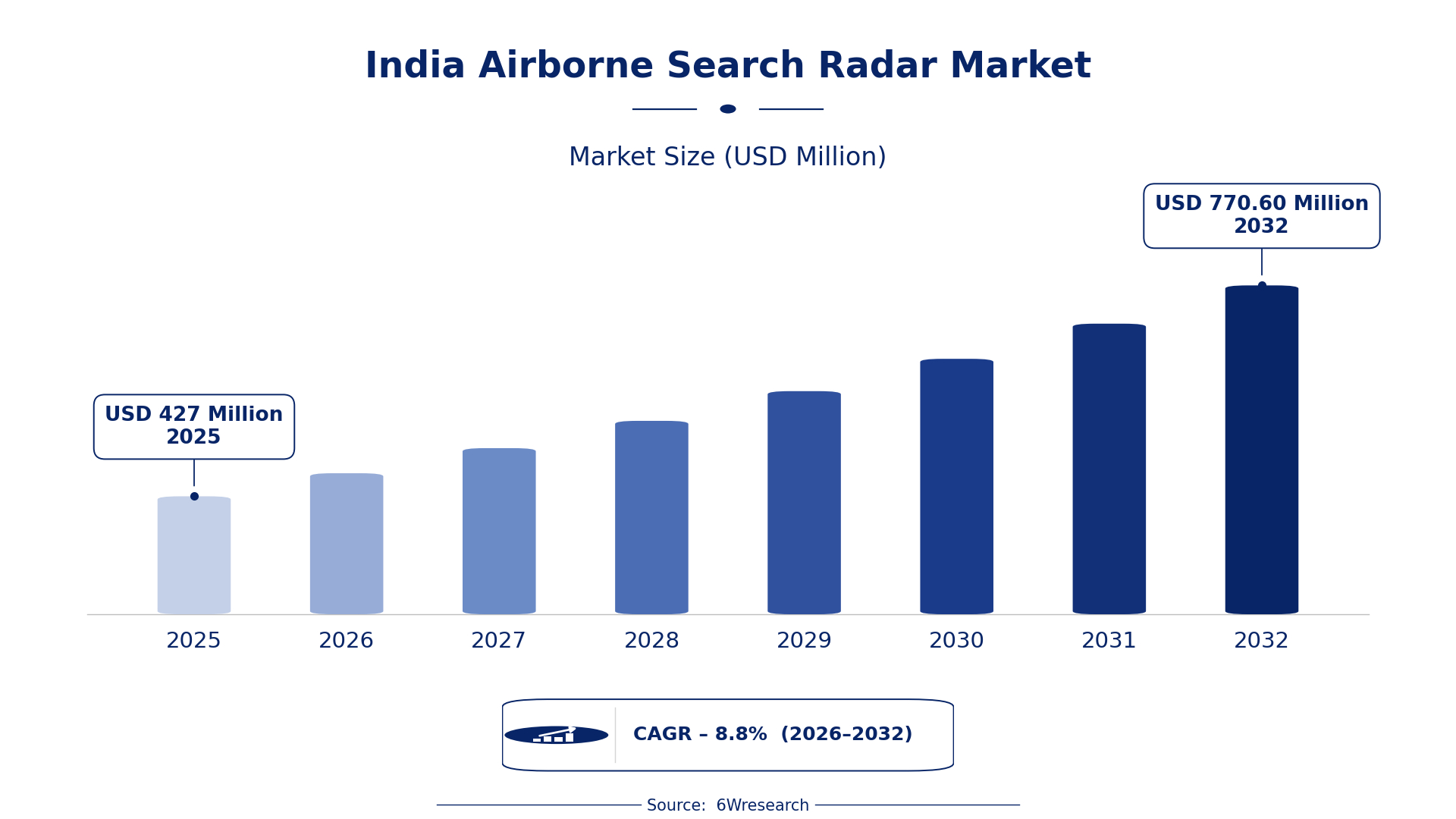
According to 6Wresearch internal database and industry insights, the India Airborne Search Radar Market was valued at USD 427.0 million in 2025 and is projected to reach USD 770.60 million by 2032, growing at a CAGR of approximately 8.8% during 2026–2032.
India Airborne Search Radar Market Highlights
| Report Metric | Details |
| Report Name | India Airborne Search Radar Market |
| Market Size 2025 | USD 427.0 million |
| Market Size 2032 | USD 770.60 million |
| Absolute Growth 2025–2032 | USD 343.60 million |
| CAGR 2026–2032 | 8.8% |
| Peak Annual Growth | 11.3% in 2028 |
| Forecast Period | 2026–2032 |
| Historical Data | 2022–2025 |
| Base Year | 2025 |
| Leading Radar Type, 2025 | AESA Radar (37% share) |
| Leading Range Capability, 2025 | Long-Range Targeting (38% share) |
| Leading Distribution Channel, 2025 | Direct Government Orders (38% share) |
| Leading End User, 2025 | Air Defense Units (43% share) |
| Fastest-Growing Range Capability | Active Electronically Scanned (10.5% CAGR) |
| Fastest-Growing Distribution Channel | Radar Equipment Integrators (10.6% CAGR) |
| Fastest-Growing End User | Naval Surveillance Commands (10.3% CAGR) |
| Growing Sector | Defense |
| Key End Users | Air Defense Units, Naval Surveillance Commands, Tactical Intelligence Teams, Defense Reconnaissance Aircraft |
India Airborne Search Radar Market Year-wise Growth Rate and Key Drivers (2022–2032)
This graph illustrates the annual growth rates of the market from 2022 to 2032, highlighting a steady upward trajectory and projected market expansion over the forecast period.
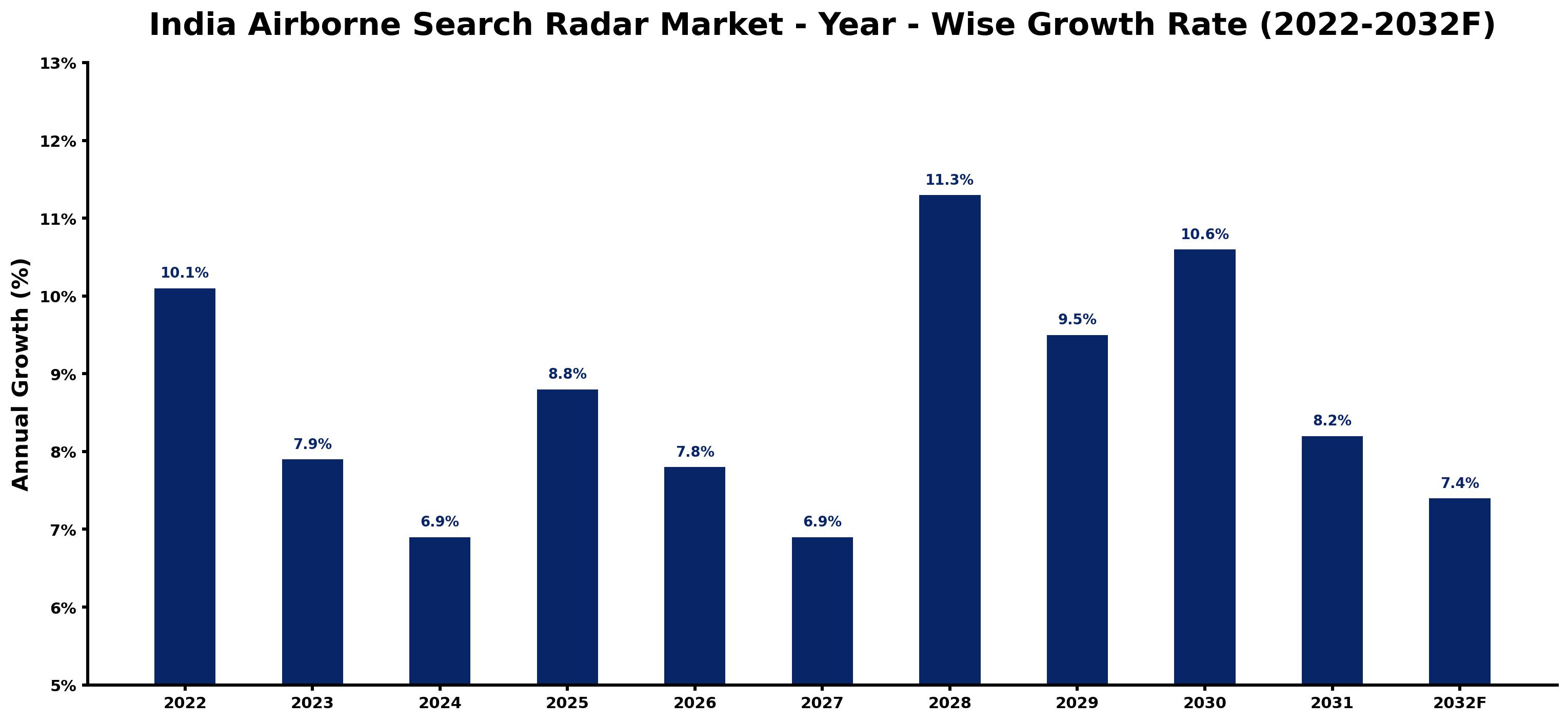
The following table presents the estimated annual growth rate for each year together with the principal factor influencing market performance.
| Year | Estimated Annual Growth (%) | Market Rationale |
| 2022 | 10.1 | The market showed strong demand due to increased military spending and modernization initiatives. |
| 2023 | 7.9 | Growth slowed as defense budget constraints impacted procurement activities in the sector. |
| 2024 | 6.9 | The market continued to slow due to reduced procurement activities linked to budget reallocations. |
| 2025 | 8.8 | Demand surged as the Indian Air Force aimed to significantly upgrade its radar capabilities. |
| 2026 | 7.8 | Growth is expected to slow again as procurement processes face delays and regulatory hurdles. |
| 2027 | 6.9 | The market is projected to maintain growth, driven by ongoing military modernization efforts. |
| 2028 | 11.3 | A peak in growth is anticipated as new radar systems are integrated into defense operations. |
| 2029 | 9.5 | Growth is expected to slow as budget reallocations affect defense spending priorities. |
| 2030 | 10.6 | Demand will increase again as new projects are initiated for radar system upgrades. |
| 2031 | 8.2 | Growth is projected to slow due to challenges in meeting production timelines and specifications. |
| 2032 | 7.4 | The market will continue to grow as the government pushes for self-reliance in defense technologies. |
Note: Market size estimations and growth projections presented in this report are based on 6Wresearch's proprietary forecasting methodology, utilizing the latest available industry data, government publications, and primary research inputs.
India Airborne Search Radar Market Synopsis
The India Airborne Search Radar Market encompasses advanced technology for detecting airborne objects, primarily used in military surveillance and air traffic control. This market is expanding due to significant defense budget allocations, with approximately ₹5.25 lakh crore earmarked for 2023. The Indian Air Force operates over 150 aircraft equipped with advanced radar technologies, and the 'Make in India' initiative is boosting local production. Demand is further supported by the Indian Army's focus on integrating radar systems with unmanned aerial vehicles, improving operational capabilities.
Market Dynamics Impact Analysis (2026–2032)
| Factor | Type | Impact | Primary Segment Affected |
| Increased defense budget allocations for radar systems | Driver | High | AESA Radar |
| Growing focus on indigenous production of defense technologies | Driver | High | 3D Search Radar |
| Expansion of radar capabilities in Air Defense Units | Opportunity | High | Air Defense Units |
| Integration of radar systems with unmanned aerial vehicles | Opportunity | Medium | Defense Reconnaissance Aircraft |
| Delays in procurement processes for defense equipment | Restraint | High | Pulse-Doppler Radar |
| Regulatory hurdles affecting radar system approvals | Restraint | Medium | AESA Radar |
| Challenges in meeting production timelines | Challenge | High | Radar Equipment Integrators |
| Competition from international radar manufacturers | Challenge | Medium | OEM Aircraft Suppliers |
Evaluation of Drivers in India Airborne Search Radar Market (2026–2032)
The main growth drivers and the segments they affect most are set out below.
| Drivers | Primary Segment Affected | Why It Matters (Evidence) |
| Increased military spending on advanced radar systems | AESA Radar | The Indian government allocated approximately ₹5.25 lakh crore for defense systems, boosting capabilities for the Air Force and Navy. |
| Focus on indigenous production through 'Make in India' | 3D Search Radar | This initiative promotes local manufacturing, leading to increased procurement of domestically produced radar systems. |
| Expansion of Air Defense Units' radar capabilities | Air Defense Units | With rising aerial threats, these units are investing in advanced radar technologies for better surveillance. |
| Integration of radar systems with unmanned aerial vehicles | Defense Reconnaissance Aircraft | This integration improves operational efficiency, driving demand for advanced radar systems. |
| Technological advancements in radar systems | Pulse-Doppler Radar | Innovations in radar technology are improving detection capabilities, prompting increased orders from defense forces. |
The Airborne Search Radar market in India is expanding as military spending increases, local production initiatives gain momentum, and technological advancements in radar systems are realised. The Indian government allocated approximately ₹5.25 lakh crore for defense in 2023, boosting radar procurement. The 'Make in India' initiative is driving local manufacturing, resulting in a surge in demand for domestically produced systems. The integration of radar with unmanned aerial vehicles is also driving demand, as the Indian Army seeks to improve reconnaissance capabilities. Advancements in radar technology are prompting increased orders from various defense forces, enhancing operational effectiveness.
Evaluation of Restraints in India Airborne Search Radar Market
Below mentioned are some major restraints and their influence on market dynamics.
| Market Restraint | Primary Segment Affected | Why It Matters (Evidence) |
| Delays in procurement processes for defense equipment | Pulse-Doppler Radar | The lengthy approval process for defense contracts can hinder timely acquisitions, impacting operational readiness. |
| Regulatory hurdles affecting radar system approvals | AESA Radar | Strict compliance requirements can slow down the introduction of new radar technologies into the market. |
| High costs associated with advanced radar systems | 3D Search Radar | The investment required for advanced radar technology can limit procurement by smaller defense units. |
| Limited availability of skilled workforce for radar integration | Radar Equipment Integrators | A shortage of trained professionals can delay system deployment and integration efforts. |
| Competition from international radar manufacturers | OEM Aircraft Suppliers | Global players may offer advanced technologies at competitive prices, challenging local manufacturers. |
India Airborne Search Radar Market Challenges
The India Airborne Search Radar market still has to solve a few problems, starting with high costs for buyers, which arise from the reliance on imported components that can inflate prices by up to 20%. Next, outdated technology hampers military forces, as many existing systems lack modern capabilities, delaying upgrades and affecting operational efficiency. Regulatory hurdles slow progress; compliance with evolving standards can take up to 18 months, hindering the introduction of new systems. Supply chain disruptions frequently occur, with delays in component delivery affecting production timelines for manufacturers and compromising military readiness.
Trends in the India Airborne Search Radar Market
The trends below show where the India Airborne Search Radar Market is heading.
- Integration of Radar Systems with UAVs: The Indian Army is increasingly integrating airborne search radars with unmanned aerial vehicles, improving real-time battlefield intelligence. This trend is evident as the Army focuses on modernizing its reconnaissance capabilities, with a projected increase in UAV deployments by 2025.
- Shift towards Indigenous Radar Production: The 'Make in India' initiative has spurred a shift towards local radar production, with the government aiming for a turnover of ₹1.75 lakh crore in defense manufacturing by 2025. This shift is expected to bolster self-reliance in defense technologies.
- Adoption of Advanced AESA Radar Technology: The Indian Air Force is adopting advanced AESA radar technology for its fighter jets, significantly improving combat capabilities. The DRDO has developed these systems, with plans for integration into the Tejas fighter jet by 2024.
- Expansion of Naval Radar Capabilities: The Indian Navy is enhancing its radar capabilities with the integration of 3D Search Radar on new vessels, vital for maritime security. This expansion is part of a broader strategy to strengthen coastal surveillance operations.
Investment Opportunities in the India Airborne Search Radar Market
Below are the investment opportunities with the strongest case in the India Airborne Search Radar Market.
- Supply of Advanced Radar Systems: There is a growing opportunity to supply advanced radar systems to the Indian Air Force, which aims to significantly upgrade its capabilities. With a budget of ₹5.25 lakh crore for 2023, suppliers can engage through partnerships with local manufacturers.
- Investment in Radar Technology Startups: Investing in radar technology startups presents a promising opportunity as the Indian government encourages innovation through the Defence Innovation Organisation. This initiative aims to support local tech firms, with funding expected to increase by 10% in 2023.
- Provision of Training for Radar Integration: With the increasing complexity of radar systems, there is a rising need for training services for personnel involved in radar integration. This is particularly relevant for the Indian Army, which is expanding its radar capabilities.
- Development of Indigenous Radar Components: The push for self-reliance in defence technologies creates opportunities for developing indigenous radar components. The 'Atmanirbhar Bharat' initiative supports local manufacturing, aiming to increase defence exports to $5 billion by 2025.
Government Initiatives in the India Airborne Search Radar Market
The Defence Procurement Procedure 2020, established by the Ministry of Defence, emphasises indigenization and streamlining procurement processes for radar systems. This policy aims to boost local production and reduce reliance on imports, ensuring that indigenous manufacturers can compete effectively. The 'Make in India' initiative, launched in 2020, further supports this goal by encouraging local manufacturing of defence equipment, including airborne radars. The initiative aims to enhance domestic capabilities and create jobs in the defence sector. The Defence Production Policy 2020 aims for a turnover of ₹1.75 lakh crore in defence manufacturing by 2025, promoting local production of radar systems and components. This policy supports various projects aimed at improving indigenous capabilities in radar technology.
The Defence Research and Development Organisation (DRDO) plays a significant role in approving and funding radar development projects. In 2023, the DRDO received a budget increase of 10% to support radar technologies. Additionally, the Ministry of Defence's 'Defence Production Policy 2020' aims for a turnover of ₹1.75 lakh crore in defence manufacturing by 2025, promoting local production of radar systems and components. This policy supports various projects aimed at improving indigenous capabilities in radar technology, enabling producers to innovate and compete effectively.
Future Insight of the India Airborne Search Radar Market
By 2032, the India Airborne Search Radar market will undergo substantial changes driven by the 'Make in India' initiative, which promotes local production capabilities. The Indian Air Force plans to acquire new systems by 2024, ensuring modernisation of its fleet. The government’s target to increase defence exports to $5 billion by 2025 will encourage innovation in radar technologies. Additionally, the Defence Innovation Organisation will support startups focused on radar advancements, fostering a more competitive environment.
Market Segmentation Analysis
The report offers a comprehensive study of the following market segments and their leading categories in the market.
By Radar Type – AESA Radar Dominated and Is Expected to Record the Fastest Growth
According to Shubham Padhi, Research Analyst at 6Wresearch, AESA Radar held a 37% share of the India Airborne Search Radar Market by radar type in 2025. AESA Radar holds the largest market share due to its advanced capabilities, essential for air-to-air and air-to-ground operations. The Indian Air Force's deployment of AESA radar across more than 150 aircraft illustrates its critical role in enhancing military effectiveness. Its lead should widen, with a projected CAGR of 10.7% during 2026–2032, the highest in this split. AESA Radar is set for rapid growth as the Indian Air Force continues to upgrade its radar systems to meet modern warfare requirements. This ongoing enhancement will further entrench AESA technology's dominant position in the Indian airborne search radar market. Suppliers must focus on advancing AESA technology to satisfy the growing demand from the Indian military.
By Range Capability – Long-Range Targeting Dominated, Active Electronically Scanned Expected to Grow Fastest
Long-Range Targeting took a 38% share of range capability in 2025, more than any other category. Long-Range Targeting commands the largest market share, as it is vital for effectively engaging distant threats in military operations. The Indian Army's emphasis on long-range capabilities underscores the importance of this radar type for strategic defence initiatives. The quickest growth will come from Active Electronically Scanned, forecast to expand at a CAGR of 10.5% between 2026 and 2032. Active Electronically Scanned radar is experiencing the fastest growth due to its ability to enable rapid target acquisition and tracking, which is crucial for contemporary combat scenarios. This aligns with the Indian Air Force's goals to improve operational efficiency. Buyers are likely to prioritise investments in long-range and active electronically scanned radar systems to enhance their operational readiness.
By Distribution Channel – Direct Government Orders Dominated, Radar Equipment Integrators Expected to Grow Fastest
The largest distribution channel category in 2025 was Direct Government Orders, with a 38% share of total revenue. Direct Government Orders represent the largest share, serving as the primary procurement method for defence radars in India. The substantial allocations within the defence budget for radar systems further solidify this channel's leading position. Radar Equipment Integrators are projected to grow fastest, at a CAGR of 10.6% during 2026–2032. Radar Equipment Integrators are witnessing the fastest growth as they play a pivotal role in system deployment and integration, becoming increasingly important with the rise of sophisticated radar technologies. Their involvement is crucial for ensuring effective operational capabilities. Suppliers should strengthen partnerships with radar equipment integrators to enhance market presence and streamline deployment processes.
By End User – Air Defense Units Dominated, Naval Surveillance Commands Expected to Grow Fastest
Air Defense Units accounted for a 43% market share by end user in 2025. Air Defense Units capture the largest market share due to their integration of radar systems for comprehensive airspace protection, which is vital for national security. The Indian government's commitment to bolstering air defense capabilities highlights the significance of this user group. Over 2026–2032, Naval Surveillance Commands are expected to post the fastest growth, at a CAGR of 10.3%. Naval Surveillance Commands are the fastest-growing segment as they increasingly utilise radar for maritime security operations, reflecting the growing importance of naval capabilities in India's defence strategy. This trend is expected to continue as maritime threats evolve. Suppliers should tailor their offerings to meet the specific needs of air defense units and naval surveillance commands to capitalise on this growth.
Key Attractiveness of the Report
- 10 Years of Market Numbers
- Historical Data Starting from 2022 to 2025
- Base Year 2025
- Forecast Data until 2032
- Key Performance Indicators Impacting the Market
- Major Upcoming Developments and Projects
Key Highlights of the Report:
- India Airborne Search Radar Market Outlook
- Market Size of India Airborne Search Radar Market, 2025
- Forecast of India Airborne Search Radar Market, 2032
- Historical Data and Forecast of India Airborne Search Radar Revenues & Volume for the Period 2022 - 2032F
- India Airborne Search Radar Market Trend Evolution
- India Airborne Search Radar Market Drivers and Challenges
- India Airborne Search Radar Price Trends
- India Airborne Search Radar Porter's Five Forces
- India Airborne Search Radar Industry Life Cycle
- Historical Data and Forecast of India Airborne Search Radar Market Revenues & Volume By Radar Type for the Period 2022 - 2032F
- Historical Data and Forecast of India Airborne Search Radar Market Revenues & Volume By Pulse-Doppler Radar for the Period 2022 - 2032F
- Historical Data and Forecast of India Airborne Search Radar Market Revenues & Volume By AESA Radar for the Period 2022 - 2032F
- Historical Data and Forecast of India Airborne Search Radar Market Revenues & Volume By Passive Radar for the Period 2022 - 2032F
- Historical Data and Forecast of India Airborne Search Radar Market Revenues & Volume By 3D Search Radar for the Period 2022 - 2032F
- Historical Data and Forecast of India Airborne Search Radar Market Revenues & Volume By Range Capability for the Period 2022 - 2032F
- Historical Data and Forecast of India Airborne Search Radar Market Revenues & Volume By Long-Range Targeting for the Period 2022 - 2032F
- Historical Data and Forecast of India Airborne Search Radar Market Revenues & Volume By Active Electronically Scanned for the Period 2022 - 2032F
- Historical Data and Forecast of India Airborne Search Radar Market Revenues & Volume By Stealth Signal Tracking for the Period 2022 - 2032F
- Historical Data and Forecast of India Airborne Search Radar Market Revenues & Volume By Vertical and Horizontal Detection for the Period 2022 - 2032F
- Historical Data and Forecast of India Airborne Search Radar Market Revenues & Volume By Distribution Channel for the Period 2022 - 2032F
- Historical Data and Forecast of India Airborne Search Radar Market Revenues & Volume By Radar Equipment Integrators for the Period 2022 - 2032F
- Historical Data and Forecast of India Airborne Search Radar Market Revenues & Volume By OEM Aircraft Suppliers for the Period 2022 - 2032F
- Historical Data and Forecast of India Airborne Search Radar Market Revenues & Volume By Intelligence Tech Firms for the Period 2022 - 2032F
- Historical Data and Forecast of India Airborne Search Radar Market Revenues & Volume By Direct Government Orders for the Period 2022 - 2032F
- Historical Data and Forecast of India Airborne Search Radar Market Revenues & Volume By End User for the Period 2022 - 2032F
- Historical Data and Forecast of India Airborne Search Radar Market Revenues & Volume By Naval Surveillance Commands for the Period 2022 - 2032F
- Historical Data and Forecast of India Airborne Search Radar Market Revenues & Volume By Defense Reconnaissance Aircraft for the Period 2022 - 2032F
- Historical Data and Forecast of India Airborne Search Radar Market Revenues & Volume By Tactical Intelligence Teams for the Period 2022 - 2032F
- Historical Data and Forecast of India Airborne Search Radar Market Revenues & Volume By Air Defense Units for the Period 2022 - 2032F
- India Airborne Search Radar Import Export Trade Statistics
- Market Opportunity Assessment By Radar Type
- Market Opportunity Assessment By Range Capability
- Market Opportunity Assessment By Distribution Channel
- Market Opportunity Assessment By End User
- India Airborne Search Radar Top Companies Market Share
- India Airborne Search Radar Competitive Benchmarking By Technical and Operational Parameters
- India Airborne Search Radar Company Profiles
- India Airborne Search Radar Key Strategic Recommendations
Market Covered
Segments analysed in this report are listed below.
By Radar Type
- Pulse-Doppler Radar
- AESA Radar
- Passive Radar
- 3D Search Radar
By Range Capability
- Long-Range Targeting
- Active Electronically Scanned
- Stealth Signal Tracking
- Vertical and Horizontal Detection
By Distribution Channel
- Radar Equipment Integrators
- OEM Aircraft Suppliers
- Intelligence Tech Firms
- Direct Government Orders
By End User
- Naval Surveillance Commands
- Defense Reconnaissance Aircraft
- Tactical Intelligence Teams
- Air Defense Units































