India Airborne Surveillance Sensor Market Size & Growth Rate
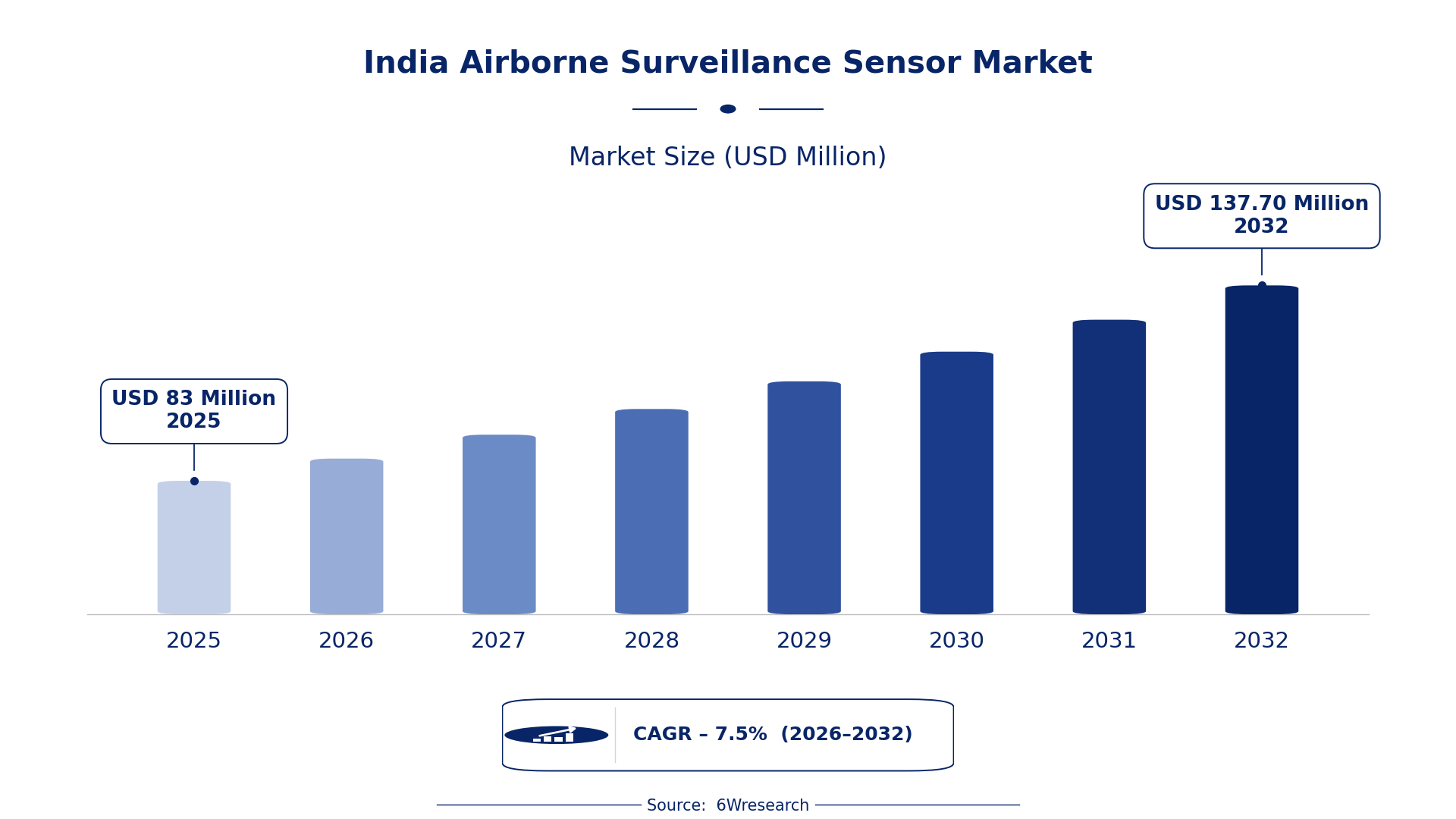
According to 6Wresearch internal database and industry insights, the India Airborne Surveillance Sensor Market was valued at USD 83.0 million in 2025 and is projected to reach USD 137.70 million by 2032, growing at a CAGR of approximately 7.5% during 2026–2032.
India Airborne Surveillance Sensor Market Highlights
| Report Metric | Details |
| Report Name | India Airborne Surveillance Sensor Market |
| Market Size 2025 | USD 83.0 million |
| Market Size 2032 | USD 137.70 million |
| Absolute Growth 2025–2032 | USD 54.70 million |
| CAGR 2026–2032 | 7.5% |
| Peak Annual Growth | 10.0% in 2026 |
| Forecast Period | 2026–2032 |
| Historical Data | 2022–2025 |
| Base Year | 2025 |
| Leading Sensor Type, 2025 | Optical Sensors (41% share) |
| Leading Monitoring Spectrum, 2025 | Day/Night Vision (45% share) |
| Leading Distribution Channel, 2025 | Sensor OEM Suppliers (46% share) |
| Leading End User, 2025 | Reconnaissance Aircraft Makers (43% share) |
| Fastest-Growing Sensor Type | Infrared Sensors (8.9% CAGR) |
| Fastest-Growing Monitoring Spectrum | Thermal Infrared Band (9.6% CAGR) |
| Fastest-Growing Distribution Channel | Military Contractors (9.7% CAGR) |
| Fastest-Growing End User | Anti-Terror Surveillance Units (10.2% CAGR) |
| Growing Sector | Anti-Terror Surveillance Units |
| Key End Users | Reconnaissance Aircraft Makers, Anti-Terror Surveillance Units, Topography Mapping Units, Strategic Military Operations |
India Airborne Surveillance Sensor Market Year-wise Growth Rate and Key Drivers (2022–2032)
This graph illustrates the annual growth rates of the market from 2022 to 2032, highlighting a steady upward trajectory and projected market expansion over the forecast period.
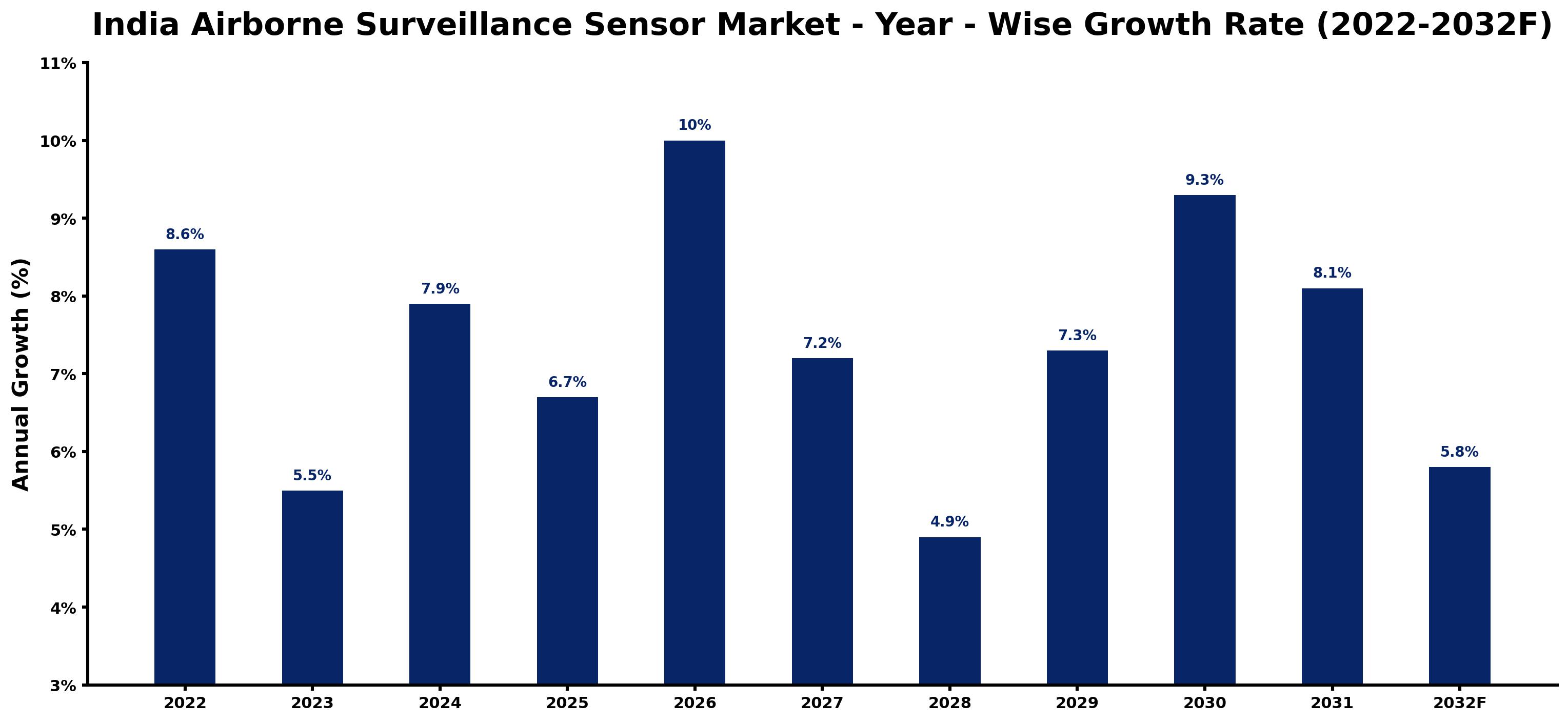
Below, each year's estimated growth is shown next to the factor that most influenced it.
| Year | Estimated Annual Growth (%) | Market Rationale |
| 2022 | 8.6 | The market experienced solid demand from military upgrades and modernization efforts. |
| 2023 | 5.5 | Growth slowed due to adjustments in procurement processes and budget allocations. |
| 2024 | 7.9 | Increased investments in indigenous technologies boosted market performance. |
| 2025 | 6.7 | Demand remained steady as the Indian Army continued its modernization programme. |
| 2026 | 10.0 | The market surged with the peak in military spending and new technology adoption. |
| 2027 | 7.2 | Growth moderated as procurement processes became more stringent and competitive. |
| 2028 | 4.9 | Demand slowed due to a focus on quality over quantity in sensor procurement. |
| 2029 | 7.3 | Increased military operations and surveillance needs drove demand higher again. |
| 2030 | 9.3 | The market expanded as new technologies improved operational capabilities. |
| 2031 | 8.1 | Demand increased as the 'Make in India' initiative spurred local production of sensors. |
| 2032 | 5.8 | Demand continues to grow, supported by ongoing military modernization initiatives. |
Note: Market size estimations and growth projections presented in this report are based on 6Wresearch's proprietary forecasting methodology, utilizing the latest available industry data, government publications, and primary research inputs.
India Airborne Surveillance Sensor Market Synopsis
Airborne Surveillance Sensors in India are advanced electronic devices used for monitoring and reconnaissance in military and civil applications. These sensors utilise sophisticated technologies, including optics and infrared components, to enhance surveillance capabilities. The India Airborne Surveillance Sensor Market is projected to grow, driven by India's defence budget of approximately ₹5.25 lakh crore and initiatives like 'Make in India' that promote local manufacturing. Demand is further supported by the Indian Air Force's operation of over 200 reconnaissance aircraft and the government's aim to boost defense exports to $5 billion by 2025.
Market Dynamics Impact Analysis (2026–2032)
| Factor | Type | Impact | Primary Segment Affected |
| Increased defence budget allocation for surveillance technologies | Driver | High | Optical Sensors |
| Growing demand for indigenous sensor technologies | Driver | High | Infrared Sensors |
| Investment in local manufacturing capabilities | Opportunity | High | LIDAR Sensors |
| Expansion of military operations requiring advanced surveillance | Opportunity | High | Synthetic Sensors |
| Challenges in meeting international quality standards | Restraint | Medium | Day/Night Vision |
| Limited access to advanced materials for sensor production | Restraint | Medium | Thermal Infrared Band |
| High initial investment costs for advanced sensor technologies | Challenge | High | Laser-Based Distance Sensing |
| Need for continuous upgrades to keep pace with technological advancements | Challenge | High | AI-Fused Sensor Arrays |
Evaluation of Drivers in India Airborne Surveillance Sensor Market (2026–2032)
The factors lifting demand, and the evidence behind each, are summarised below.
| Drivers | Primary Segment Affected | Why It Matters (Evidence) |
| Increased defence spending on surveillance technologies | Optical Sensors | India's defence budget allocation for 2023 is approximately ₹5.25 lakh crore, driving demand for advanced surveillance systems. |
| Focus on indigenous sensor development | Infrared Sensors | The 'Make in India' initiative encourages local production, boosting the market for infrared surveillance technologies. |
| Rising military operations requiring advanced reconnaissance | LIDAR Sensors | The Indian Army's modernization plan includes upgrading surveillance systems by 2025, increasing demand for LIDAR technologies. |
| Collaboration with technology integrators for sensor systems | Synthetic Sensors | The Indian Navy's partnerships with technology integrators improve sensor capabilities, boosting demand for synthetic solutions. |
| Growing exports of defense equipment | Day/Night Vision | India aims to increase defense exports to $5 billion by 2025, expanding the market for day/night vision sensors. |
Expansion of the Airborne Surveillance Sensor market in India is backed by increased defence spending, rising military operations, and a focus on indigenous technology development. The defence budget for 2023 is approximately ₹5.25 lakh crore, which drives demand for advanced surveillance systems. The Indian Army's modernization plan includes upgrading surveillance systems by 2025, which boosts demand for advanced sensor technologies. Collaborations with technology integrators improve sensor capabilities, enhancing market potential. India's aim to increase defense exports to $5 billion by 2025 is set to expand the market further.
Evaluation of Restraints in India Airborne Surveillance Sensor Market
The table below lists the restraints and the evidence behind each.
| Market Restraint | Primary Segment Affected | Why It Matters (Evidence) |
| Challenges in meeting international quality standards | Day/Night Vision | Manufacturers are adopting ISO 9001 standards to ensure quality, which can be costly and time-consuming. |
| Limited access to advanced materials for sensor production | Thermal Infrared Band | The reliance on imported materials can delay production timelines and increase costs. |
| High initial investment costs for advanced sensor technologies | Laser-Based Distance Sensing | The capital required for development can deter smaller manufacturers from entering the market. |
| Need for continuous upgrades to keep pace with technological advancements | AI-Fused Sensor Arrays | Staying competitive requires ongoing investment in R&D, which can strain resources. |
| Regulatory hurdles in defense procurement processes | Synthetic Sensors | The 'Defence Procurement Procedure 2020' can complicate and lengthen acquisition timelines. |
India Airborne Surveillance Sensor Market Challenges
Producers in the India Airborne Surveillance Sensor market face rising costs as advanced materials and components increase in price, inflating production expenses by up to 20%. Buyers in the military sector experience delays in procurement processes, which can extend project timelines by six months, hindering their operational readiness. Local suppliers struggle with competition from foreign manufacturers offering lower prices, forcing them to reduce margins by around 15% to remain viable. Technology gaps persist, as many producers lack access to modern innovations, limiting their capacity to meet critical defense requirements effectively.
Trends in the India Airborne Surveillance Sensor Market
Four trends stand out in the India Airborne Surveillance Sensor Market.
- Shift from Traditional to Advanced Surveillance Technologies: The Indian military is transitioning from traditional surveillance methods to advanced airborne sensors, driven by the need for improved reconnaissance capabilities. The 'Make in India' initiative supports this shift, with a projected market size of USD 83.0 million by 2025.
- Increased Integration of AI in Surveillance Systems: Military contractors are increasingly integrating AI technologies into airborne surveillance systems, improving data analysis and operational efficiency. This trend aligns with the Digital India program, which promotes advanced technologies in defense operations.
- Growing Demand for Indigenous Sensor Manufacturing: The Indian government is promoting local manufacturing of airborne surveillance sensors through initiatives like 'Atmanirbhar Bharat'. This effort aims to boost domestic production, with a target of increasing defense exports to $5 billion by 2025.
- Expansion of Surveillance Capabilities in the Indian Navy: The Indian Navy is enhancing its surveillance capabilities through collaborations with technology integrators for sensor systems. This trend is evident in the increased focus on advanced technologies following the establishment of the National Aerospace Laboratories.
Investment Opportunities in the India Airborne Surveillance Sensor Market
Several openings in the India Airborne Surveillance Sensor Market merit attention from investors.
- Partnerships with Local Manufacturers: Local manufacturers are seeking partnerships to improve production capabilities, with a projected gap of USD 54.7 million in sensor supply by 2025. Collaborating with military contractors can help meet this demand.
- Investment in Research and Development Facilities: The establishment of R&D facilities in aerospace hubs like Bengaluru offers opportunities to develop advanced sensor technologies. This region is key for innovation, supported by government initiatives.
- Expansion into Emerging Markets: The growing demand for surveillance sensors in Southeast Asia presents a significant opportunity, with an estimated market potential of USD 30 million. Targeting military contractors in these regions can facilitate entry.
- Focus on Quality Certification: Manufacturers are increasingly adopting ISO 9001 standards to improve product quality, creating opportunities for certification bodies. This trend is essential for meeting international market requirements.
Government Initiatives in the India Airborne Surveillance Sensor Market
The 'Defence Production and Export Promotion Policy' launched in 2022 aims to boost indigenous production of surveillance sensors. This policy encourages local manufacturers to invest in advanced technologies and streamline procurement processes. Additionally, the 'Make in India' initiative supports local manufacturing, targeting a significant increase in defense equipment production by 2025. These measures collectively improve the operational capabilities of the Indian military and promote self-reliance in defense manufacturing.
Various initiatives promote surveillance sensor technologies. The 'Defence Innovation Organisation' established in 2020 fosters innovation and funds projects aimed at developing advanced surveillance systems. Furthermore, the Defence Research and Development Organisation (DRDO) is actively involved in developing indigenous sensor technologies, ensuring that local manufacturers meet the required standards. These agencies play an important role in approving and funding projects that enhance India's surveillance capabilities.
Future Insight of the India Airborne Surveillance Sensor Market
By 2032, buyers and suppliers in the India Airborne Surveillance Sensor market can expect significant advancements driven by the 'Make in India' initiative, which will enhance local manufacturing capabilities. The Defence Research and Development Organisation's focus on indigenous sensor technologies will improve product offerings. With the Indian government targeting a defense export increase to $5 billion by 2025, demand for advanced sensors will rise. Collaborations between the Indian Space Research Organisation and defense agencies will further integrate satellite-based technologies into surveillance systems.
Market Segmentation Analysis
The report offers a comprehensive study of the following market segments and their leading categories in the market.
By Sensor Type – Optical Sensors Dominated, Infrared Sensors Expected to Grow Fastest
According to Shubham Padhi, Research Analyst at 6Wresearch, Optical Sensors accounted for a 41% market share by sensor type in 2025. Optical Sensors command the largest market share due to their widespread application in visual surveillance and reconnaissance, particularly within military contexts. Their essential role is exemplified by the Indian Air Force's operation of over 200 reconnaissance aircraft, which rely heavily on these sensors for effective monitoring. The quickest growth will come from Infrared Sensors, forecast to expand at a CAGR of 8.9% between 2026 and 2032. Infrared Sensors are experiencing rapid growth thanks to their ability to detect heat signatures, especially in low visibility conditions. This increase is driven by the Indian Army's modernization plan, which prioritises enhancements to surveillance systems by 2025, further solidifying the demand for these technologies. Suppliers should focus on advancing infrared sensor technology to meet the rising demands of India's defense sector.
By Monitoring Spectrum – Day/Night Vision Dominated, Thermal Infrared Band Expected to Grow Fastest
Day/Night Vision took a 45% share of monitoring spectrum in 2025, more than any other category. Day/Night Vision technology holds the largest market share as it is crucial for maintaining continuous surveillance capabilities across various operational scenarios. The Indian Navy's initiatives to enhance surveillance capabilities highlight the necessity for reliable day and night monitoring solutions. Over 2026–2032, Thermal Infrared Band is expected to post the fastest growth, at a CAGR of 9.6%. The Thermal Infrared Band is the fastest-growing segment, particularly important for operations in low visibility and night conditions. This growth is propelled by the increasing demand for advanced surveillance technologies, which is supported by the 'Digital India' programme. Investing in thermal infrared technologies will provide buyers with comprehensive surveillance capabilities across diverse environments.
By Distribution Channel – Sensor OEM Suppliers Dominated, Military Contractors Expected to Grow Fastest
With a 46% revenue share in 2025, Sensor OEM Suppliers was the largest distribution channel category. Sensor OEM Suppliers dominate the market as they provide essential components for airborne surveillance sensors, catering to a broad range of manufacturers. Their critical role sustains the supply chain for military applications in India, ensuring a steady flow of necessary technologies. Military Contractors are set to record the highest CAGR in this split, 9.7% over 2026–2032. Military Contractors are the fastest-growing distribution channel, as they directly integrate sensors into defense systems. Their rapid expansion aligns with the Indian government's focus on local manufacturing through the 'Atmanirbhar Bharat' initiative, enhancing their market presence. Suppliers should build strong partnerships with military contractors to enhance their market presence and address the growing demand for integrated sensor systems.
By End User – Reconnaissance Aircraft Makers Dominated, Anti-Terror Surveillance Units Expected to Grow Fastest
The largest end user category in 2025 was Reconnaissance Aircraft Makers, with a 43% share of total revenue. Reconnaissance Aircraft Makers hold the largest market share as they are the primary users of airborne surveillance sensors, which are vital for effective reconnaissance missions. The Indian Air Force's reliance on these aircraft underscores their significance in national defense operations. Anti-Terror Surveillance Units are projected to grow fastest, at a CAGR of 10.2% during 2026–2032. Anti-Terror Surveillance Units represent the fastest-growing end user, employing sensors to strengthen security operations against emerging threats. This growth correlates with the Indian government's commitment to enhancing defense exports and security measures. Manufacturers should tailor their products to meet the specific requirements of anti-terror units, ensuring competitiveness in a rapidly evolving market.
Key Attractiveness of the Report
- 10 Years of Market Numbers
- Historical Data Starting from 2022 to 2025
- Base Year 2025
- Forecast Data until 2032
- Key Performance Indicators Impacting the Market
- Major Upcoming Developments and Projects
Key Highlights of the Report:
- India Airborne Surveillance Sensor Market Outlook
- Market Size of India Airborne Surveillance Sensor Market, 2025
- Forecast of India Airborne Surveillance Sensor Market, 2032
- Historical Data and Forecast of India Airborne Surveillance Sensor Revenues & Volume for the Period 2022 - 2032F
- India Airborne Surveillance Sensor Market Trend Evolution
- India Airborne Surveillance Sensor Market Drivers and Challenges
- India Airborne Surveillance Sensor Price Trends
- India Airborne Surveillance Sensor Porter's Five Forces
- India Airborne Surveillance Sensor Industry Life Cycle
- Historical Data and Forecast of India Airborne Surveillance Sensor Market Revenues & Volume By Sensor Type for the Period 2022 - 2032F
- Historical Data and Forecast of India Airborne Surveillance Sensor Market Revenues & Volume By Optical Sensors for the Period 2022 - 2032F
- Historical Data and Forecast of India Airborne Surveillance Sensor Market Revenues & Volume By Infrared Sensors for the Period 2022 - 2032F
- Historical Data and Forecast of India Airborne Surveillance Sensor Market Revenues & Volume By LIDAR Sensors for the Period 2022 - 2032F
- Historical Data and Forecast of India Airborne Surveillance Sensor Market Revenues & Volume By Synthetic Sensors for the Period 2022 - 2032F
- Historical Data and Forecast of India Airborne Surveillance Sensor Market Revenues & Volume By Monitoring Spectrum for the Period 2022 - 2032F
- Historical Data and Forecast of India Airborne Surveillance Sensor Market Revenues & Volume By Day/Night Vision for the Period 2022 - 2032F
- Historical Data and Forecast of India Airborne Surveillance Sensor Market Revenues & Volume By Thermal Infrared Band for the Period 2022 - 2032F
- Historical Data and Forecast of India Airborne Surveillance Sensor Market Revenues & Volume By Laser-Based Distance Sensing for the Period 2022 - 2032F
- Historical Data and Forecast of India Airborne Surveillance Sensor Market Revenues & Volume By AI-Fused Sensor Arrays for the Period 2022 - 2032F
- Historical Data and Forecast of India Airborne Surveillance Sensor Market Revenues & Volume By Distribution Channel for the Period 2022 - 2032F
- Historical Data and Forecast of India Airborne Surveillance Sensor Market Revenues & Volume By Sensor OEM Suppliers for the Period 2022 - 2032F
- Historical Data and Forecast of India Airborne Surveillance Sensor Market Revenues & Volume By Military Contractors for the Period 2022 - 2032F
- Historical Data and Forecast of India Airborne Surveillance Sensor Market Revenues & Volume By Technology Integrators for the Period 2022 - 2032F
- Historical Data and Forecast of India Airborne Surveillance Sensor Market Revenues & Volume By Aerospace Tech Startups for the Period 2022 - 2032F
- Historical Data and Forecast of India Airborne Surveillance Sensor Market Revenues & Volume By End User for the Period 2022 - 2032F
- Historical Data and Forecast of India Airborne Surveillance Sensor Market Revenues & Volume By Reconnaissance Aircraft Makers for the Period 2022 - 2032F
- Historical Data and Forecast of India Airborne Surveillance Sensor Market Revenues & Volume By Anti-Terror Surveillance Units for the Period 2022 - 2032F
- Historical Data and Forecast of India Airborne Surveillance Sensor Market Revenues & Volume By Topography Mapping Units for the Period 2022 - 2032F
- Historical Data and Forecast of India Airborne Surveillance Sensor Market Revenues & Volume By Strategic Military Operations for the Period 2022 - 2032F
- India Airborne Surveillance Sensor Import Export Trade Statistics
- Market Opportunity Assessment By Sensor Type
- Market Opportunity Assessment By Monitoring Spectrum
- Market Opportunity Assessment By Distribution Channel
- Market Opportunity Assessment By End User
- India Airborne Surveillance Sensor Top Companies Market Share
- India Airborne Surveillance Sensor Competitive Benchmarking By Technical and Operational Parameters
- India Airborne Surveillance Sensor Company Profiles
- India Airborne Surveillance Sensor Key Strategic Recommendations
Market Covered
This report examines the market across the segments below.
By Sensor Type
- Optical Sensors
- Infrared Sensors
- LIDAR Sensors
- Synthetic Sensors
By Monitoring Spectrum
- Day/Night Vision
- Thermal Infrared Band
- Laser-Based Distance Sensing
- AI-Fused Sensor Arrays
By Distribution Channel
- Sensor OEM Suppliers
- Military Contractors
- Technology Integrators
- Aerospace Tech Startups
By End User
- Reconnaissance Aircraft Makers
- Anti-Terror Surveillance Units
- Topography Mapping Units
- Strategic Military Operations































