India Airborne Weapons System Market Size & Growth Rate
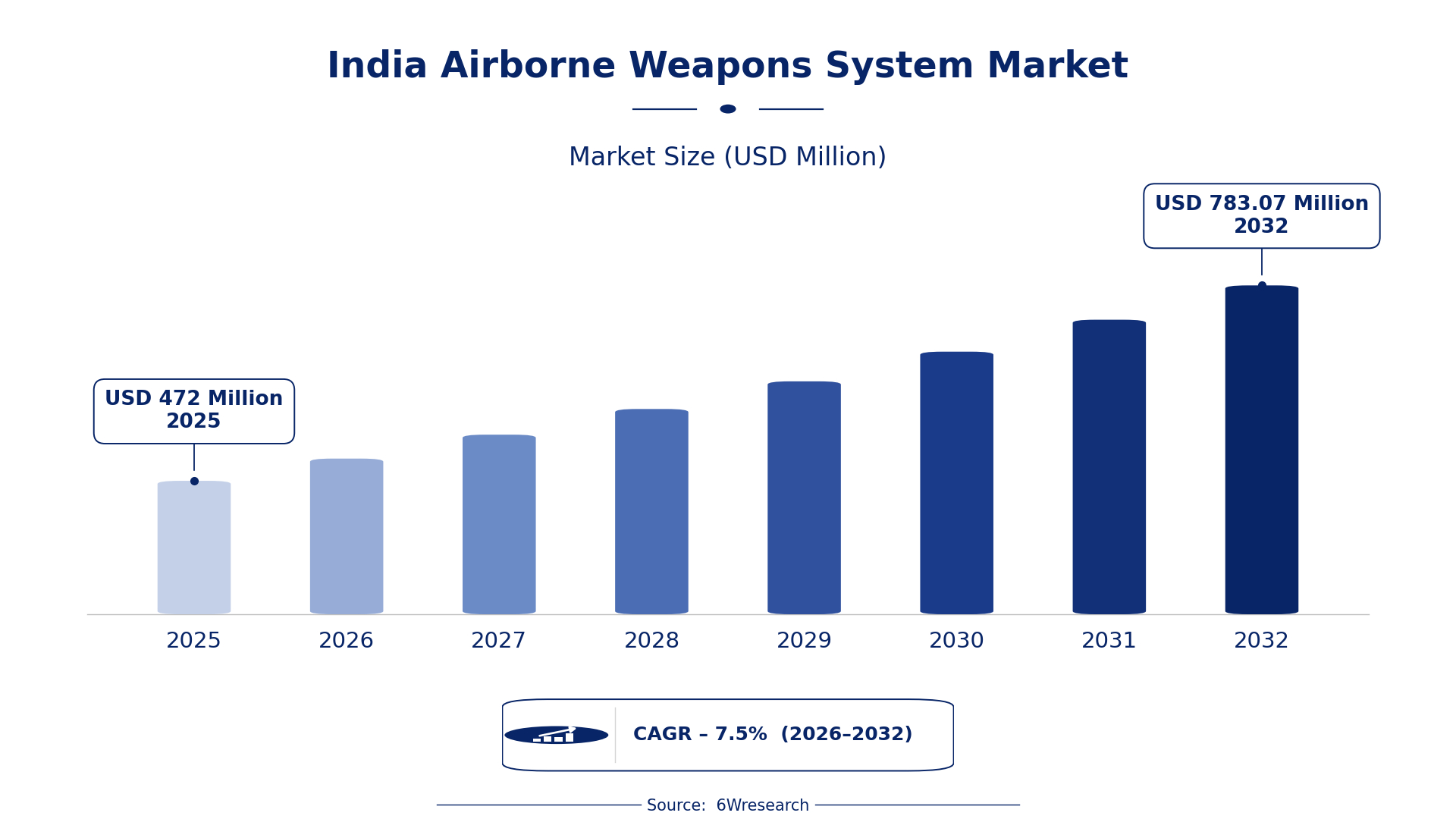
According to 6Wresearch internal database and industry insights, the India Airborne Weapons System Market was valued at USD 472.0 million in 2025 and is projected to reach USD 783.07 million by 2032, growing at a CAGR of approximately 7.5% during 2026–2032.
India Airborne Weapons System Market Highlights
| Report Metric | Details |
| Report Name | India Airborne Weapons System Market |
| Market Size 2025 | USD 472.0 million |
| Market Size 2032 | USD 783.07 million |
| Absolute Growth 2025–2032 | USD 311.07 million |
| CAGR 2026–2032 | 7.5% |
| Peak Annual Growth | 9.1% in 2030 |
| Forecast Period | 2026–2032 |
| Historical Data | 2022–2025 |
| Base Year | 2025 |
| Leading Weapon Type, 2025 | Air-to-Air Missiles (48% share) |
| Leading Platform Type, 2025 | Fighter Jets (55% share) |
| Leading Distribution Channel, 2025 | Defense Contractors (54% share) |
| Leading End User, 2025 | Air Force Units (51% share) |
| Fastest-Growing Weapon Type | Precision Guided Bombs (9.0% CAGR) |
| Fastest-Growing Platform Type | Unmanned Aircraft (10.0% CAGR) |
| Fastest-Growing Distribution Channel | Government Tenders (8.9% CAGR) |
| Fastest-Growing End User | Tactical Military Commands (9.5% CAGR) |
| Growing Sector | Military Technology |
| Key End Users | Air Force Units, Tactical Military Commands, Defense Contractors |
India Airborne Weapons System Market Year-wise Growth Rate and Key Drivers (2022–2032)
This graph illustrates the annual growth rates of the market from 2022 to 2032, highlighting a steady upward trajectory and projected market expansion over the forecast period.
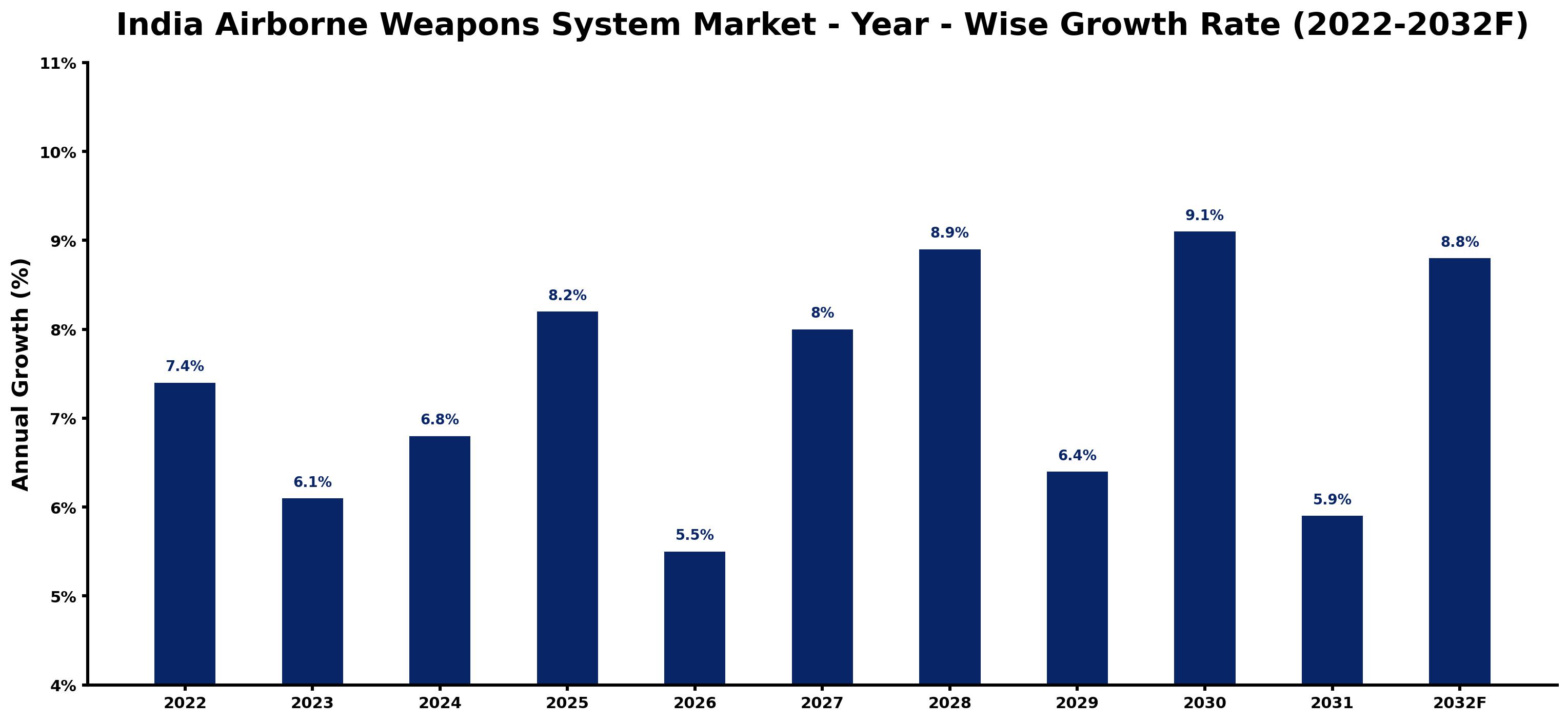
Each row of the following table gives one year's estimated growth and the event or demand shift that explains it.
| Year | Estimated Annual Growth (%) | Market Rationale |
| 2022 | 7.4 | The market showed solid growth due to ongoing modernization efforts in the Indian Air Force. |
| 2023 | 6.1 | Growth slowed as budget allocations focused on infrastructure rather than immediate procurement. |
| 2024 | 6.8 | Increased production of indigenous missile systems spurred demand for advanced airborne weapons. |
| 2025 | 8.2 | The market experienced a surge as the Air Force expanded its operational capabilities. |
| 2026 | 5.5 | Growth slowed as procurement processes faced challenges in streamlining and approvals. |
| 2027 | 8.0 | Demand rose again with significant investments in tactical military commands and their capabilities. |
| 2028 | 8.9 | The market grew as the adoption of unmanned aircraft technologies gained momentum. |
| 2029 | 6.4 | A slowdown occurred as focus shifted towards integrating advanced systems into existing platforms. |
| 2030 | 9.1 | Growth accelerated with the introduction of new UAV technologies and enhanced capabilities. |
| 2031 | 5.9 | Demand slowed as the market adjusted to procurement timelines and budget allocations. |
| 2032 | 8.8 | The market is expected to grow as modernization efforts continue and new technologies are adopted. |
Note: Market size estimations and growth projections presented in this report are based on 6Wresearch's proprietary forecasting methodology, utilizing the latest available industry data, government publications, and primary research inputs.
India Airborne Weapons System Market Synopsis
The Airborne Weapons System Market in India includes advanced military technologies designed for deployment from aircraft. These systems feature air-to-air missiles and precision-guided bombs, produced through precision engineering and state-of-the-art technology. The market is expanding due to substantial investments in domestic capabilities and modernisation efforts. With a defence budget allocation of ₹5.25 lakh crore in 2023, the Indian government is actively encouraging self-reliance in defence production. The 'Make in India' initiative further stimulates local manufacturing, generating strong demand for these systems.
Market Dynamics Impact Analysis (2026–2032)
| Factor | Type | Impact | Primary Segment Affected |
| Rising investments in indigenous capabilities | Driver | High | Air-to-Air Missiles |
| Increasing demand for advanced precision strikes | Driver | High | Precision Guided Bombs |
| Growing need for modern military capabilities | Opportunity | High | Fighter Jets |
| Expansion of defense procurement channels | Opportunity | Medium | Government Tenders |
| Challenges in procurement processes | Restraint | High | Air-to-Surface Missiles |
| Dependence on foreign technology for certain systems | Restraint | Medium | Anti-Ship Missiles |
| Delays in defense contract approvals | Challenge | High | Fighter Jets |
| High costs associated with advanced technology integration | Challenge | Medium | Unmanned Aircraft |
Evaluation of Drivers in India Airborne Weapons System Market (2026–2032)
The factors lifting demand, and the evidence behind each, are summarised below.
| Drivers | Primary Segment Affected | Why It Matters (Evidence) |
| Increased production of indigenous missile systems | Air-to-Air Missiles | The focus on developing indigenous capabilities has led to a rise in domestic production, increasing demand for air-to-air missiles. |
| Integration of Precision Guided Bombs into fleets | Precision Guided Bombs | The integration of precision-guided bombs into the Su-30MKI fleet improves strike capabilities, resulting in higher procurement by Air Force Units. |
| Expansion of Fighter Jet capabilities | Fighter Jets | With over 1,400 operational fighter jets, the Air Force is investing in advanced airborne weapons to enhance air superiority. |
| Government initiatives promoting self-reliance | Anti-Ship Missiles | The 'Atmanirbhar Bharat' initiative encourages local production of anti-ship missiles, boosting demand in the naval sector. |
| Growing tactical military commands | Unmanned Aircraft | The focus on tactical military commands is increasing the need for unmanned aircraft for surveillance and reconnaissance. |
Market growth for Airborne Weapons System in India is underpinned by rising investments in indigenous capabilities and a growing need for advanced precision strikes. The focus on developing indigenous missile systems has led to a rise in domestic production, increasing the need for air-to-air missiles. The integration of precision-guided bombs into the Su-30MKI fleet improves strike capabilities, resulting in higher procurement by Air Force Units. The Indian Air Force is investing in advanced airborne weapons to enhance air superiority, with a defense budget allocation of ₹5.25 lakh crore in 2023.
Evaluation of Restraints in India Airborne Weapons System Market
The table below lists the restraints and the evidence behind each.
| Market Restraint | Primary Segment Affected | Why It Matters (Evidence) |
| Challenges in procurement processes | Air-to-Surface Missiles | Delays in the procurement process hinder timely acquisition of air-to-surface missiles, affecting operational readiness. |
| Dependence on foreign technology for certain systems | Anti-Ship Missiles | A leading supplier on foreign technology for anti-ship missiles limits the speed of indigenous development and procurement. |
| High costs associated with advanced technology integration | Unmanned Aircraft | The integration of advanced technologies into unmanned aircraft increases costs, limiting budget allocations for procurement. |
| Delays in defense contract approvals | Fighter Jets | Lengthy approval processes for defense contracts slow down the acquisition of new fighter jets, impacting modernization efforts. |
| Limited availability of skilled workforce | Precision Guided Bombs | A shortage of skilled personnel in defense manufacturing affects the production capacity of precision-guided bombs. |
India Airborne Weapons System Market Challenges
The Airborne Weapons System market in India faces several challenges, starting with supply chain disruptions. These disruptions stem from reliance on foreign components, which can delay production timelines for suppliers by up to six months. Buyers encounter inflated costs due to fluctuating raw material prices, potentially raising project budgets by 15%. Intense competition among domestic manufacturers results in price wars, squeezing profit margins for suppliers and jeopardising quality. A shortage of skilled engineers in the defence sector hampers innovation, making it difficult for producers to keep pace with technological advancements.
Trends in the India Airborne Weapons System Market
Four trends stand out in the India Airborne Weapons System Market.
- Shift towards Indigenous Production: India is increasingly focusing on indigenous production of airborne weapons systems, driven by the 'Make in India' initiative. In 2023, the government allocated ₹5.25 lakh crore for defense, promoting local manufacturing.
- Rise of Unmanned Aircraft Technologies: The Indian Air Force is projected to adopt new UAV technologies by 2025, improving surveillance capabilities. This shift aligns with the growing demand for unmanned systems in military operations.
- Integration of Precision Guided Bombs: The integration of precision-guided bombs into the Su-30MKI fleet began in 2022, improving strike accuracy. This trend reflects the increasing emphasis on precision in military operations.
- Expansion of Tactical Military Commands: The Indian military is expanding its tactical military commands to improve operational efficiency. By 2025, this shift is expected to increase the demand for advanced airborne weapon systems.
Investment Opportunities in the India Airborne Weapons System Market
Investors looking at the India Airborne Weapons System Market should consider the following areas.
- Investment in Indigenous Missile Systems: Now is the time to invest in indigenous missile systems, as local production is a priority. With a target of ₹1.75 lakh crore in defense manufacturing by 2025, defense contractors can benefit from this initiative.
- Supply of Advanced UAV Technologies: The demand for advanced UAV technologies is rising, particularly by 2025. Tactical military commands are seeking solutions, presenting an opportunity for local firms to partner with defense contractors.
- Development of Precision Guided Bombs: The integration of precision-guided bombs into existing fleets creates a demand for suppliers. Air Force Units are looking for advanced technologies to improve their strike capabilities.
- Expansion of Government Tenders: With the growth of government tenders, there is an opportunity for suppliers to engage with the Indian military. The focus on self-reliance in defense production encourages partnerships with local manufacturers.
Government Initiatives in the India Airborne Weapons System Market
The 'Defense Production and Export Promotion Policy' was introduced by the Ministry of Defence in 2020 to strengthen domestic manufacturing capabilities. This policy builds on previous initiatives by promoting self-reliance in defence production and reducing imports. It encourages local firms to participate in the development and production of airborne weapons systems, thereby increasing indigenous capabilities.
In 2023, the Indian government allocated ₹5.25 lakh crore for defence, overseen by the Ministry of Defence. This funding supports various initiatives, including the 'Make in India' programme, which aims to achieve ₹1.75 lakh crore in defence manufacturing by 2025. The Technology Development Fund established in 2021 also supports R&D in defence technologies, enhancing the capabilities of local manufacturers.
Future Insight of the India Airborne Weapons System Market
The Airborne Weapons System market in India will experience significant changes by 2032, driven by advancements in indigenous manufacturing capabilities. The government's 'Make in India' initiative will strengthen local production, enabling suppliers to reduce import reliance. By 2025, the Indian Air Force is expected to adopt new UAV technologies, transforming operational strategies. The integration of indigenous missile systems will elevate strike capabilities, ultimately benefiting both buyers and suppliers in this evolving market.
Market Segmentation Analysis
The analysis below covers each segmentation, its leading category in 2025 and its fastest-growing category through 2032.
By Weapon Type – Air-to-Air Missiles Dominated, Precision Guided Bombs Expected to Grow Fastest
According to Shubham Padhi, Research Analyst at 6Wresearch, with a 48% revenue share in 2025, Air-to-Air Missiles was the largest weapon type category. Air-to-Air missiles hold the largest market share as they are vital for engaging enemy aircraft in aerial combat, with the Indian Air Force's over 1,400 operational fighter jets relying on them. The Astra missile programme exemplifies India's commitment to developing indigenous capabilities, reinforcing the importance of these systems in national defense. Precision Guided Bombs are projected to grow fastest, at a CAGR of 9.0% during 2026–2032. Precision Guided Bombs are rapidly gaining traction as they are integrated into the Su-30MKI fleet, significantly enhancing strike accuracy on ground targets. This growth is fuelled by the Indian government's focus on modernising its defense capabilities and improving operational effectiveness. Suppliers should prioritise the development of Precision Guided Bomb technologies to meet rising demand and align with government modernization efforts.
By Platform Type – Fighter Jets Dominated, Unmanned Aircraft Expected to Grow Fastest
Fighter Jets took a 55% share of platform type in 2025, more than any other category. Fighter Jets dominate the market as they serve as the primary platforms for deploying airborne weapons, with the Indian Air Force operating 36 squadrons that depend on these aircraft for various combat scenarios. Their versatility in air superiority missions underscores their critical role in India's military strategy. Unmanned Aircraft is set to record the highest CAGR in this split, 10.0% over 2026–2032. Unmanned Aircraft are witnessing the fastest growth, particularly as the Indian Air Force is set to adopt new UAV technologies by 2025, reflecting a shift towards modern warfare tactics. This trend is driven by the increasing need for enhanced surveillance and reconnaissance capabilities in military operations. Buyers should adapt their strategies to incorporate Unmanned Aircraft, ensuring they remain competitive in evolving military operations.
By Distribution Channel – Defense Contractors Dominated, Government Tenders Expected to Grow Fastest
In 2025, Defense Contractors led the distribution channel split with a 54% share. Defense Contractors lead the market as they are the primary suppliers of airborne weapon systems, facilitating the procurement process for the Indian military. Their established relationships with government entities ensure a consistent supply of advanced technologies essential for national defense. The quickest growth will come from Government Tenders, forecast to expand at a CAGR of 8.9% between 2026 and 2032. Government Tenders are experiencing rapid growth as the Indian government prioritises indigenization and self-reliance in defense procurement, supported by a budget allocation of ₹5.25 lakh crore for 2023. This emphasis on official procurement channels is reshaping market dynamics and supplier strategies. Suppliers must align their strategies with government procurement processes to capture emerging opportunities in the defense sector.
By End User – Air Force Units Dominated, Tactical Military Commands Expected to Grow Fastest
The largest end user category in 2025 was Air Force Units, with a 51% share of total revenue. Air Force Units account for the largest market share as they are the primary users of airborne weapons, directly employing these systems for national defense operations. Their operational requirements and strategic importance drive the demand for advanced weaponry in the market. Over 2026–2032, Tactical Military Commands are expected to post the fastest growth, at a CAGR of 9.5%. Tactical Military Commands are experiencing the fastest growth as they increasingly utilise airborne weapons for real-time operational effectiveness and flexibility. This trend indicates a broader shift towards agile military operations that require rapid response capabilities. Buyers should enhance their support for Tactical Military Commands to ensure operational readiness and effectiveness in dynamic military environments.
Key Attractiveness of the Report
- 10 Years of Market Numbers
- Historical Data Starting from 2022 to 2025
- Base Year 2025
- Forecast Data until 2032
- Key Performance Indicators Impacting the Market
- Major Upcoming Developments and Projects
Key Highlights of the Report:
- India Airborne Weapons System Market Outlook
- Market Size of India Airborne Weapons System Market, 2025
- Forecast of India Airborne Weapons System Market, 2032
- Historical Data and Forecast of India Airborne Weapons System Revenues & Volume for the Period 2022 - 2032F
- India Airborne Weapons System Market Trend Evolution
- India Airborne Weapons System Market Drivers and Challenges
- India Airborne Weapons System Price Trends
- India Airborne Weapons System Porter's Five Forces
- India Airborne Weapons System Industry Life Cycle
- Historical Data and Forecast of India Airborne Weapons System Market Revenues & Volume By Weapon Type for the Period 2022 - 2032F
- Historical Data and Forecast of India Airborne Weapons System Market Revenues & Volume By Air-to-Air Missiles for the Period 2022 - 2032F
- Historical Data and Forecast of India Airborne Weapons System Market Revenues & Volume By Precision Guided Bombs for the Period 2022 - 2032F
- Historical Data and Forecast of India Airborne Weapons System Market Revenues & Volume By Air-to-Surface Missiles for the Period 2022 - 2032F
- Historical Data and Forecast of India Airborne Weapons System Market Revenues & Volume By Anti-Ship Missiles for the Period 2022 - 2032F
- Historical Data and Forecast of India Airborne Weapons System Market Revenues & Volume By Platform Type for the Period 2022 - 2032F
- Historical Data and Forecast of India Airborne Weapons System Market Revenues & Volume By Fighter Jets for the Period 2022 - 2032F
- Historical Data and Forecast of India Airborne Weapons System Market Revenues & Volume By Unmanned Aircraft for the Period 2022 - 2032F
- Historical Data and Forecast of India Airborne Weapons System Market Revenues & Volume By Helicopters for the Period 2022 - 2032F
- Historical Data and Forecast of India Airborne Weapons System Market Revenues & Volume By Naval Aircraft for the Period 2022 - 2032F
- Historical Data and Forecast of India Airborne Weapons System Market Revenues & Volume By Distribution Channel for the Period 2022 - 2032F
- Historical Data and Forecast of India Airborne Weapons System Market Revenues & Volume By Defense Contractors for the Period 2022 - 2032F
- Historical Data and Forecast of India Airborne Weapons System Market Revenues & Volume By Government Tenders for the Period 2022 - 2032F
- Historical Data and Forecast of India Airborne Weapons System Market Revenues & Volume By OEM Weapon Integrators for the Period 2022 - 2032F
- Historical Data and Forecast of India Airborne Weapons System Market Revenues & Volume By Military Alliances for the Period 2022 - 2032F
- Historical Data and Forecast of India Airborne Weapons System Market Revenues & Volume By End User for the Period 2022 - 2032F
- Historical Data and Forecast of India Airborne Weapons System Market Revenues & Volume By Air Force Units for the Period 2022 - 2032F
- Historical Data and Forecast of India Airborne Weapons System Market Revenues & Volume By Tactical Military Commands for the Period 2022 - 2032F
- Historical Data and Forecast of India Airborne Weapons System Market Revenues & Volume By Special Ops Forces for the Period 2022 - 2032F
- Historical Data and Forecast of India Airborne Weapons System Market Revenues & Volume By Naval Strike Wings for the Period 2022 - 2032F
- India Airborne Weapons System Import Export Trade Statistics
- Market Opportunity Assessment By Weapon Type
- Market Opportunity Assessment By Platform Type
- Market Opportunity Assessment By Distribution Channel
- Market Opportunity Assessment By End User
- India Airborne Weapons System Top Companies Market Share
- India Airborne Weapons System Competitive Benchmarking By Technical and Operational Parameters
- India Airborne Weapons System Company Profiles
- India Airborne Weapons System Key Strategic Recommendations
Market Covered
This report examines the market across the segments below.
By Weapon Type
- Air-to-Air Missiles
- Precision Guided Bombs
- Air-to-Surface Missiles
- Anti-Ship Missiles
By Platform Type
- Fighter Jets
- Unmanned Aircraft
- Helicopters
- Naval Aircraft
By Distribution Channel
- Defense Contractors
- Government Tenders
- OEM Weapon Integrators
- Military Alliances
By End User
- Air Force Units
- Tactical Military Commands
- Special Ops Forces
- Naval Strike Wings































