India Airborne Weather Radar Market Size & Growth Rate
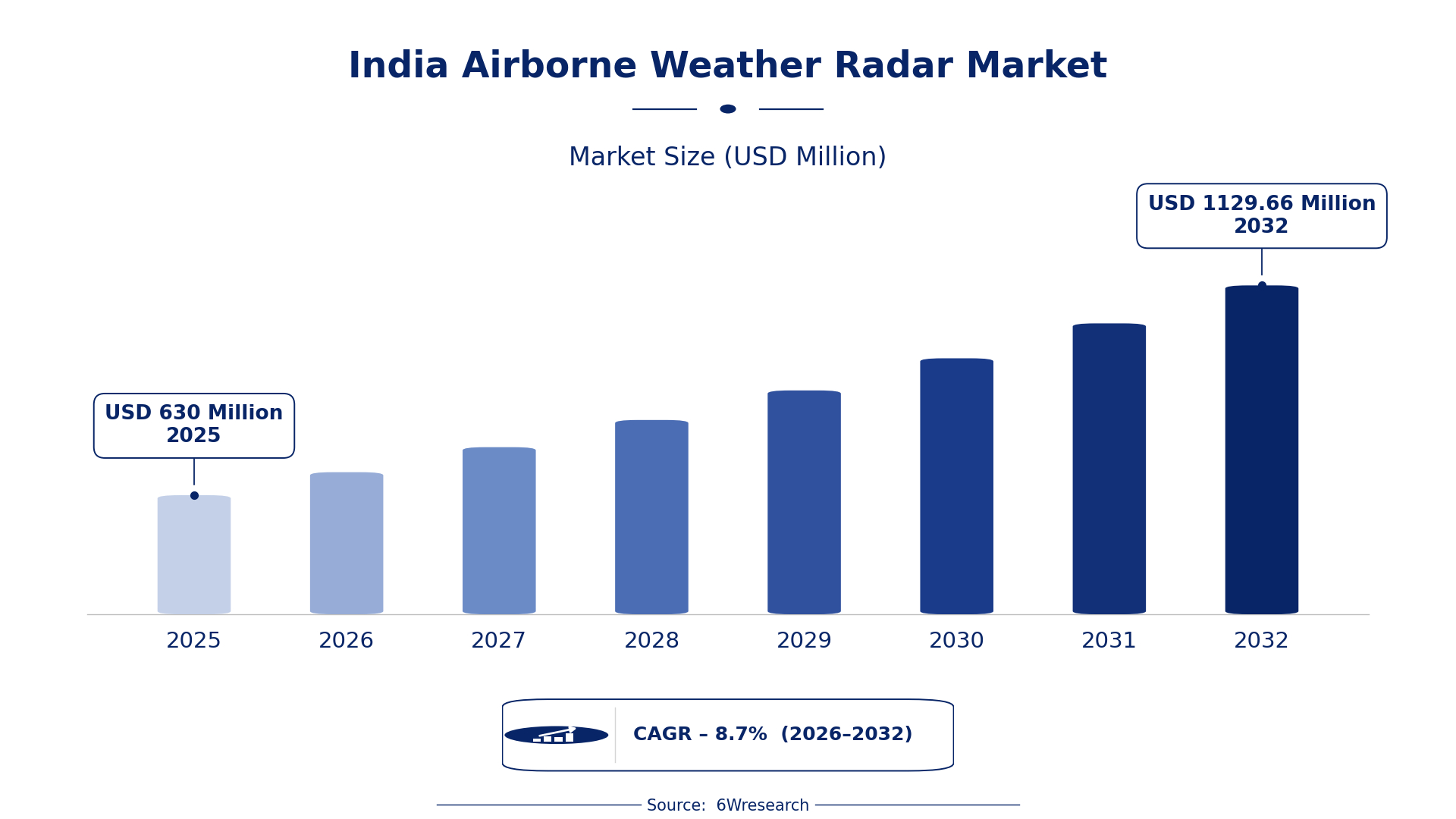
According to 6Wresearch internal database and industry insights, the India Airborne Weather Radar Market was valued at USD 630.0 million in 2025 and is projected to reach USD 1,129.66 million by 2032, growing at a CAGR of approximately 8.7% during 2026–2032.
India Airborne Weather Radar Market Highlights
| Report Metric | Details |
| Report Name | India Airborne Weather Radar Market |
| Market Size 2025 | USD 630.0 million |
| Market Size 2032 | USD 1,129.66 million |
| Absolute Growth 2025–2032 | USD 499.66 million |
| CAGR 2026–2032 | 8.7% |
| Peak Annual Growth | 11.2% in 2028 |
| Forecast Period | 2026–2032 |
| Historical Data | 2022–2025 |
| Base Year | 2025 |
| Leading Radar Type, 2025 | Pulse-Doppler Radar (35% share) |
| Leading Frequency Band, 2025 | C-band (50% share) |
| Leading Distribution Channel, 2025 | Aviation Equipment Vendors (37% share) |
| Leading End User, 2025 | Commercial Airlines (42% share) |
| Fastest-Growing Radar Type | Dual-Polarization Radar (10.5% CAGR) |
| Fastest-Growing Frequency Band | X-band (11.0% CAGR) |
| Fastest-Growing End User | Meteorological Agencies (11.0% CAGR) |
| Growing Sector | aviation |
| Key End Users | Commercial Airlines, Meteorological Agencies, Defense Aviation Units |
India Airborne Weather Radar Market Year-wise Growth Rate and Key Drivers (2022–2032)
This graph illustrates the annual growth rates of the market from 2022 to 2032, highlighting a steady upward trajectory and projected market expansion over the forecast period.
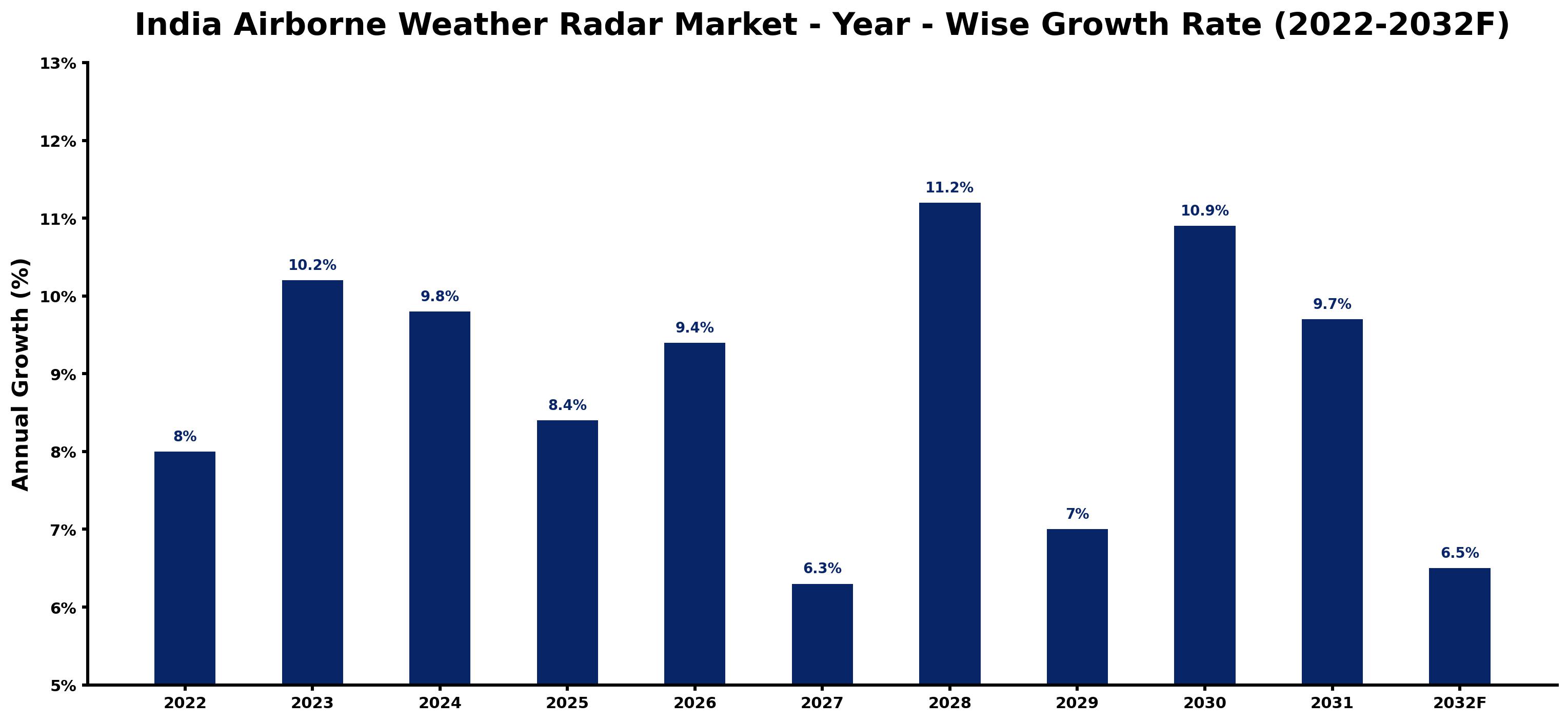
Annual growth estimates for each year appear below with the principal reason behind them, explaining the shifts that set the pace of the market.
| Year | Estimated Annual Growth (%) | Market Rationale |
| 2022 | 8.0 | The market saw steady growth due to increasing demand for aviation safety measures from commercial airlines. |
| 2023 | 10.2 | Growth accelerated as the Indian Meteorological Department expanded its radar network, enhancing forecasting capabilities. |
| 2024 | 9.8 | A slowdown occurred as infrastructure upgrades took longer than anticipated, affecting installation timelines. |
| 2025 | 8.4 | Demand remained stable as the Aviation Safety Enhancement Program was implemented, improving radar technology standards. |
| 2026 | 9.4 | Demand is expected to increase as the Defense Ministry's Indigenous Defense Production Policy gains traction, boosting local manufacturing. |
| 2027 | 6.3 | A slowdown is projected as the market adjusts to new supply chain challenges affecting component availability. |
| 2028 | 11.2 | Growth is expected to surge as advanced radar technologies are adopted across the aviation sector, improving safety measures. |
| 2029 | 7.0 | A slowdown is anticipated as the market stabilises after rapid expansion, with ongoing infrastructure developments. |
| 2030 | 10.9 | Growth is projected to pick up again as commercial airlines upgrade their radar systems to meet new standards. |
| 2031 | 9.7 | A slowdown is expected as the market faces integration challenges with new technologies and existing systems. |
| 2032 | 6.5 | Growth will continue but at a slower pace as the market matures, with a focus on efficiency and reliability. |
Note: Market size estimations and growth projections presented in this report are based on 6Wresearch's proprietary forecasting methodology, utilizing the latest available industry data, government publications, and primary research inputs.
India Airborne Weather Radar Market Synopsis
The Airborne Weather Radar Market in India involves technology used to detect and analyse weather patterns from aircraft. This technology is essential for flight safety, supporting meteorological research, and improving forecasting accuracy. The market is growing due to rising demand from commercial airlines and defence applications, with over 450 commercial aircraft equipped with advanced radar systems. Government initiatives, such as the Aviation Safety Enhancement Program, are driving demand for these systems, ensuring improved operational readiness and safety standards.
Market Dynamics Impact Analysis (2026–2032)
| Factor | Type | Impact | Primary Segment Affected |
| Increasing demand for aviation safety measures drives the need for advanced radar systems. | Driver | High | Pulse-Doppler Radar |
| Expansion of radar networks by meteorological agencies creates new opportunities for suppliers. | Driver | High | Meteorological Agencies |
| The growing need for accurate weather forecasting presents a significant opportunity for radar manufacturers. | Opportunity | High | Pulse-Doppler Radar |
| Investment in upgrading meteorological infrastructure opens new avenues for radar technology. | Opportunity | High | Pulse-Doppler Radar |
| High costs associated with advanced radar systems can limit market access for smaller operators. | Restraint | High | Pulse-Doppler Radar |
| Integration challenges with existing systems can delay the adoption of new technologies. | Restraint | Medium | Pulse-Doppler Radar |
| Supply chain disruptions affect timely delivery of radar components, impacting operational readiness. | Challenge | High | Pulse-Doppler Radar |
| Regulatory compliance can complicate the procurement process for radar systems. | Challenge | Medium | Pulse-Doppler Radar |
Evaluation of Drivers in India Airborne Weather Radar Market (2026–2032)
Below mentioned are some major drivers and their influence on market dynamics.
| Drivers | Primary Segment Affected | Why It Matters (Evidence) |
| Growing commercial airline fleet size increases demand for advanced radar systems. | Pulse-Doppler Radar | India has over 450 commercial aircraft equipped with advanced airborne weather radar systems. |
| Government initiatives to improve aviation safety drive radar technology adoption. | Pulse-Doppler Radar | In 2022, the Ministry of Civil Aviation launched a program to improve aviation safety using advanced radar systems. |
| The need for accurate weather forecasting boosts demand from meteorological agencies. | Meteorological Agencies | The Indian Meteorological Department operates several radar stations across the country. |
| Defense applications for operational readiness increase the market for airborne radar. | Pulse-Doppler Radar | The Indian Air Force utilises airborne weather radar for operational readiness and safety. |
| Local manufacturing initiatives support the growth of radar technology in the country. | Pulse-Doppler Radar | The Defense Ministry's Indigenous Defense Production Policy encourages local manufacturing of radar systems since 2020. |
Growth in the Airborne Weather Radar market in India comes from rising end-use demand from commercial airlines and defense applications. The Indian Meteorological Department operates several radar stations, enhancing forecasting capabilities. Additionally, defense applications necessitate reliable weather data for operational readiness, further propelling market growth.
Evaluation of Restraints in India Airborne Weather Radar Market
The following restraints limit how fast demand can grow.
| Market Restraint | Primary Segment Affected | Why It Matters (Evidence) |
| High costs of advanced radar systems limit access for smaller operators. | Pulse-Doppler Radar | The investment required for advanced radar technology can be prohibitive for smaller airlines. |
| Integration challenges with existing systems can delay new technology adoption. | Pulse-Doppler Radar | Many operators face difficulties in integrating new radar systems with legacy equipment, extending timelines. |
| Supply chain disruptions affect timely delivery of radar components. | Pulse-Doppler Radar | Recent global supply chain issues have led to delays in acquiring necessary radar components, impacting operational readiness. |
| Regulatory compliance complicates the procurement process for radar systems. | Pulse-Doppler Radar | Strict regulations require thorough testing and certification, extending procurement timelines for radar systems. |
| Limited awareness of advanced radar benefits slows market penetration. | Pulse-Doppler Radar | Some smaller airlines may not fully understand the advantages of upgrading radar systems, hindering adoption. |
India Airborne Weather Radar Market Challenges
The India Airborne Weather Radar market encounters several practical challenges, starting with a skills shortage that limits the availability of trained personnel in radar technology. This gap arises from a lack of educational programs in advanced radar systems, which delays project timelines for aviation and meteorological agencies. Local manufacturers face stiff competition from international suppliers, resulting in a 15% loss of market share as they struggle to match advanced features. Supply chain issues stem from reliance on imported components, causing delays in equipment delivery for defence applications, which can extend timelines by up to six months. Rising raw material costs have increased production expenses by 20%, pushing prices higher for buyers in the aviation sector.
Trends in the India Airborne Weather Radar Market
The trends below show where the India Airborne Weather Radar Market is heading.
- Shift from Traditional to Advanced Radar Systems: India is moving from traditional radar systems to advanced technologies, enhancing weather detection capabilities. The Indian Meteorological Department's Modernization of Meteorological Services program aims to improve radar capabilities by 2025, with substantial upgrades planned.
- Increased Adoption of Dual-Polarization Radar: Meteorological agencies are increasingly adopting Dual-Polarization Radar for detailed precipitation analysis. This shift is driven by the need for accurate weather forecasting, with a projected growth rate of 10.5% for this technology from 2026 to 2032.
- Expansion of Radar Infrastructure in Urban Areas: Urban areas in India are experiencing an expansion of radar infrastructure, particularly X-band radars for short-range monitoring. The Indian Meteorological Department has deployed several X-band radars in cities to improve local forecasting capabilities.
- Focus on Indigenous Radar Manufacturing: The Indian government is prioritising indigenous radar manufacturing to reduce dependency on imports. The Indigenous Defense Production Policy encourages local production, aiming for a substantial increase in domestic radar system manufacturing by 2025.
Investment Opportunities in the India Airborne Weather Radar Market
The following opportunities in the India Airborne Weather Radar Market pair current demand with a clear way in.
- Investment in Meteorological Infrastructure: The Indian Meteorological Department's modernization efforts present investment opportunities in radar technology. With a budget of USD 100 million allocated for upgrades by 2025, suppliers can engage in partnerships with government agencies.
- Supply of Dual-Polarization Radar Systems: Meteorological agencies are actively seeking advanced radar systems, particularly Dual-Polarization technology. This segment is projected to grow significantly, offering suppliers a chance to meet increasing demand.
- Collaboration with Defense Aviation Units: Defense Aviation Units are looking to enhance their weather data capabilities. Suppliers can explore partnerships with these units to provide advanced radar systems, utilising the Indigenous Defense Production Policy.
- Expansion of Aviation Equipment Vendors: Aviation Equipment Vendors are broadening their offerings to include advanced radar systems. This segment presents opportunities for suppliers to enter the market as demand rises.
Government Initiatives in the India Airborne Weather Radar Market
The 'Aviation Safety Enhancement Program' initiated by the Ministry of Civil Aviation in 2021 aims to improve radar technology across the aviation sector. This program enhances safety and reliability standards for radar systems used in commercial aviation, encouraging investment in advanced technologies. Additionally, the 'Modernization of Meteorological Services' program by the Indian Meteorological Department, with a budget of USD 100 million, aims to improve radar capabilities by 2025. This initiative is overseen by the Ministry of Earth Sciences, responsible for approving funding and ensuring integration of advanced radar systems into national weather forecasting frameworks.
The Bureau of Civil Aviation Security has set standards for radar equipment in aviation security, ensuring compliance with safety regulations. This agency plays a vital role in approving radar systems for operational use, enhancing overall safety in the aviation sector. The Indian Space Research Organization collaborates with meteorological agencies to integrate satellite data with radar information, improving forecasting accuracy. These measures collectively enhance the operational capabilities of Airborne Weather Radar systems, benefiting both producers and buyers in the market.
Future Insight of the India Airborne Weather Radar Market
The India Airborne Weather Radar market is set for significant advancements by 2032, driven by key developments in technology and infrastructure. The Ministry of Civil Aviation's recent program to improve aviation safety will lead to increased investments in radar technologies. The Indian government's commitment to upgrading meteorological infrastructure will improve forecasting capabilities. Collaboration between the Indian Space Research Organization and meteorological agencies will enhance data integration, improving weather analysis. As a result, buyers will benefit from more accurate weather predictions, while suppliers will see expanded opportunities in the aviation sector.
Market Segmentation Analysis
Each segment group is reviewed below, with the leader by share and the fastest grower by CAGR.
By Radar Type – Pulse-Doppler Radar Dominated, Dual-Polarization Radar Expected to Grow Fastest
According to Shubham Padhi, Research Analyst at 6Wresearch, in 2025, Pulse-Doppler Radar led the radar type split with a 35% share. Pulse-Doppler Radar holds the largest market share due to its ability to provide precise velocity measurements crucial for both aviation safety and meteorological applications. Its widespread adoption in sectors such as commercial aviation and defense, including usage by the Indian Air Force, highlights its importance in operational readiness. Dual-Polarization Radar is set to record the highest CAGR in this split, 10.5% over 2026–2032. Dual-Polarization Radar is experiencing rapid growth as it delivers detailed insights into precipitation types and intensity, increasingly required for accurate weather forecasting. The heightened focus on advanced weather analysis tools, especially in urban environments, is driving this segment's expansion. Suppliers should enhance Dual-Polarization technology to meet the rising demands of meteorological agencies.
By Frequency Band – C-band Dominated, X-band Expected to Grow Fastest
With a 50% revenue share in 2025, C-band was the largest frequency band category. C-band radar systems dominate the market share due to their effectiveness in long-range weather surveillance, making them essential for comprehensive monitoring across vast areas. Their deployment in various states for long-range forecasting underscores their critical role in the meteorological sector. X-band is projected to grow fastest, at a CAGR of 11.0% during 2026–2032. X-band radar is the fastest-growing segment, primarily because of its suitability for short-range weather observations, which are increasingly important in urban settings. The growing number of commercial aircraft equipped with X-band systems significantly fuels this growth. Buyers should invest in X-band technology to enhance short-range weather monitoring capabilities.
By Distribution Channel – Aviation Equipment Vendors Dominated and Is Expected to Record the Fastest Growth
Aviation Equipment Vendors accounted for a 37% market share by distribution channel in 2025. Aviation Equipment Vendors lead the market share as they are the primary suppliers of radar technology to airlines and operators, providing access to the latest systems that improve flight safety. Their established relationships within the aviation sector further reinforce their dominant position. Aviation Equipment Vendors are also forecast to expand faster than any other category, at a CAGR of 11.3% over 2026–2032. Aviation Equipment Vendors are also the fastest-growing segment, responding to the increasing demand for advanced radar systems in aviation. Their ability to offer comprehensive solutions positions them well for continued growth. Suppliers must strengthen partnerships with Aviation Equipment Vendors to capitalise on emerging market opportunities.
By End User – Commercial Airlines Dominated, Meteorological Agencies Expected to Grow Fastest
The largest end user category in 2025 was Commercial Airlines, with a 42% share of total revenue. Commercial Airlines capture the largest market share as they rely heavily on radar technology for ensuring flight safety and operational efficiency, which are vital in the competitive aviation industry. Their significant investments in advanced radar systems demonstrate their commitment to maintaining high safety standards. Over 2026–2032, Meteorological Agencies are expected to post the fastest growth, at a CAGR of 11.0%. Meteorological Agencies are the fastest-growing segment, driven by the rising need for accurate weather forecasting to support a growing population and infrastructure demands. Their dependence on advanced radar systems for precise weather data is a key factor in this growth. Suppliers should tailor their offerings to meet the specific needs of Meteorological Agencies to leverage this growth.
Key Attractiveness of the Report
- 10 Years of Market Numbers
- Historical Data Starting from 2022 to 2025
- Base Year 2025
- Forecast Data until 2032
- Key Performance Indicators Impacting the Market
- Major Upcoming Developments and Projects
Key Highlights of the Report:
- India Airborne Weather Radar Market Outlook
- Market Size of India Airborne Weather Radar Market, 2025
- Forecast of India Airborne Weather Radar Market, 2032
- Historical Data and Forecast of India Airborne Weather Radar Revenues & Volume for the Period 2022 - 2032F
- India Airborne Weather Radar Market Trend Evolution
- India Airborne Weather Radar Market Drivers and Challenges
- India Airborne Weather Radar Price Trends
- India Airborne Weather Radar Porter's Five Forces
- India Airborne Weather Radar Industry Life Cycle
- Historical Data and Forecast of India Airborne Weather Radar Market Revenues & Volume By Radar Type for the Period 2022 - 2032F
- Historical Data and Forecast of India Airborne Weather Radar Market Revenues & Volume By Pulse-Doppler Radar for the Period 2022 - 2032F
- Historical Data and Forecast of India Airborne Weather Radar Market Revenues & Volume By Dual-Polarization Radar for the Period 2022 - 2032F
- Historical Data and Forecast of India Airborne Weather Radar Market Revenues & Volume By Phased Array Radar for the Period 2022 - 2032F
- Historical Data and Forecast of India Airborne Weather Radar Market Revenues & Volume By Solid-State Radar for the Period 2022 - 2032F
- Historical Data and Forecast of India Airborne Weather Radar Market Revenues & Volume By Frequency Band for the Period 2022 - 2032F
- Historical Data and Forecast of India Airborne Weather Radar Market Revenues & Volume By X-band for the Period 2022 - 2032F
- Historical Data and Forecast of India Airborne Weather Radar Market Revenues & Volume By C-band for the Period 2022 - 2032F
- Historical Data and Forecast of India Airborne Weather Radar Market Revenues & Volume By S-band for the Period 2022 - 2032F
- Historical Data and Forecast of India Airborne Weather Radar Market Revenues & Volume By L-band for the Period 2022 - 2032F
- Historical Data and Forecast of India Airborne Weather Radar Market Revenues & Volume By Distribution Channel for the Period 2022 - 2032F
- Historical Data and Forecast of India Airborne Weather Radar Market Revenues & Volume By Radar OEMs for the Period 2022 - 2032F
- Historical Data and Forecast of India Airborne Weather Radar Market Revenues & Volume By Aviation Equipment Vendors for the Period 2022 - 2032F
- Historical Data and Forecast of India Airborne Weather Radar Market Revenues & Volume By Aerospace Integrators for the Period 2022 - 2032F
- Historical Data and Forecast of India Airborne Weather Radar Market Revenues & Volume By Online Aviation Suppliers for the Period 2022 - 2032F
- Historical Data and Forecast of India Airborne Weather Radar Market Revenues & Volume By End User for the Period 2022 - 2032F
- Historical Data and Forecast of India Airborne Weather Radar Market Revenues & Volume By Commercial Airlines for the Period 2022 - 2032F
- Historical Data and Forecast of India Airborne Weather Radar Market Revenues & Volume By Meteorological Agencies for the Period 2022 - 2032F
- Historical Data and Forecast of India Airborne Weather Radar Market Revenues & Volume By Defense Aviation Units for the Period 2022 - 2032F
- Historical Data and Forecast of India Airborne Weather Radar Market Revenues & Volume By Helicopter Operators for the Period 2022 - 2032F
- India Airborne Weather Radar Import Export Trade Statistics
- Market Opportunity Assessment By Radar Type
- Market Opportunity Assessment By Frequency Band
- Market Opportunity Assessment By Distribution Channel
- Market Opportunity Assessment By End User
- India Airborne Weather Radar Top Companies Market Share
- India Airborne Weather Radar Competitive Benchmarking By Technical and Operational Parameters
- India Airborne Weather Radar Company Profiles
- India Airborne Weather Radar Key Strategic Recommendations
Market Covered
Segments analysed in this report are listed below.
By Radar Type
- Pulse-Doppler Radar
- Dual-Polarization Radar
- Phased Array Radar
- Solid-State Radar
By Frequency Band
- X-band
- C-band
- S-band
- L-band
By Distribution Channel
- Radar OEMs
- Aviation Equipment Vendors
- Aerospace Integrators
- Online Aviation Suppliers
By End User
- Commercial Airlines
- Meteorological Agencies
- Defense Aviation Units
- Helicopter Operators































