India Aircraft Assembly Automation Market Size & Growth Rate
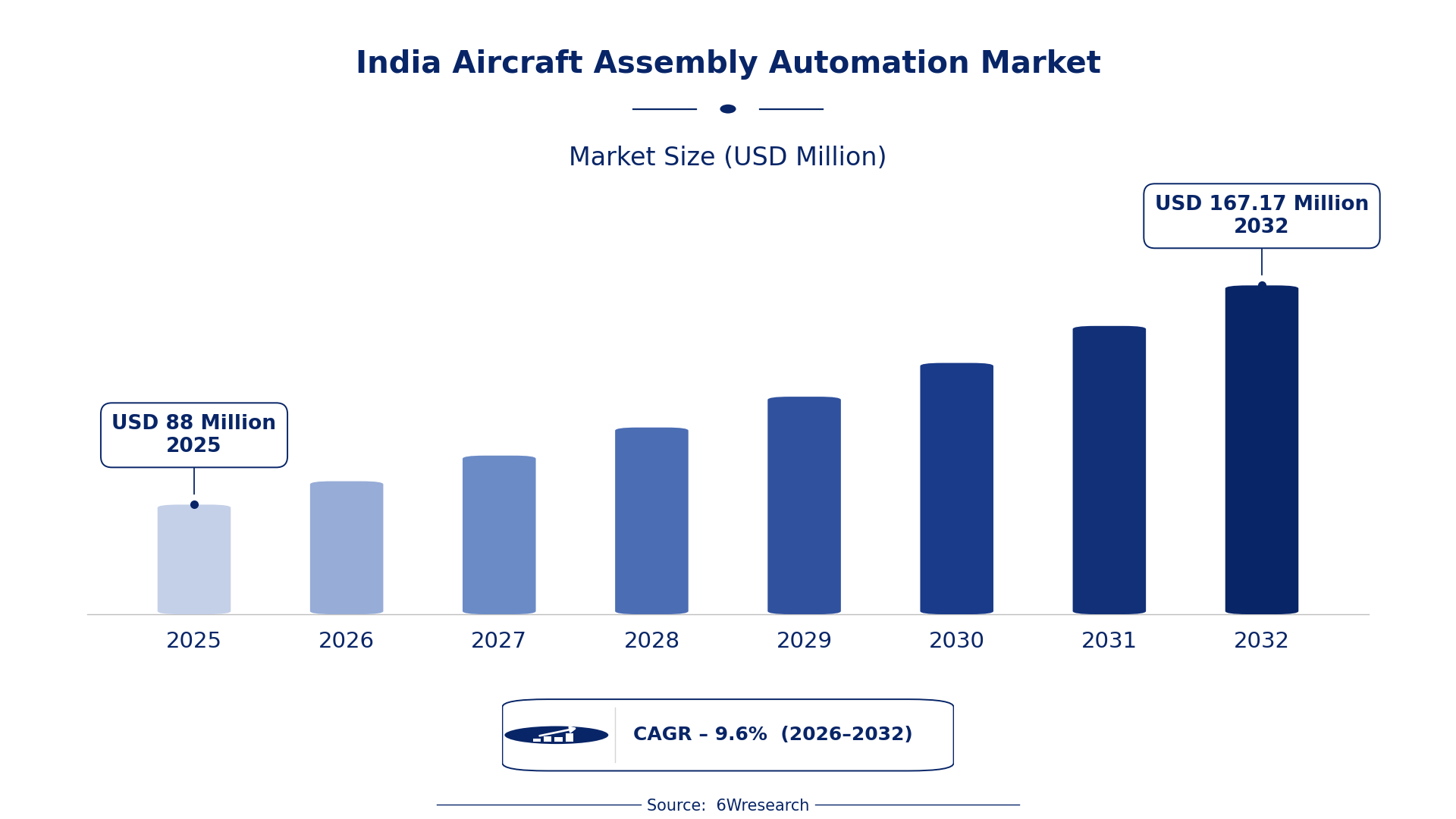
According to 6Wresearch internal database and industry insights, the India Aircraft Assembly Automation Market was valued at USD 88.0 million in 2025 and is projected to reach USD 167.17 million by 2032, growing at a CAGR of approximately 9.6% during 2026–2032.
India Aircraft Assembly Automation Market Highlights
| Report Metric | Details |
| Report Name | India Aircraft Assembly Automation Market |
| Market Size 2025 | USD 88.0 million |
| Market Size 2032 | USD 167.17 million |
| Absolute Growth 2025–2032 | USD 79.17 million |
| CAGR 2026–2032 | 9.6% |
| Peak Annual Growth | 12.1% in 2029 |
| Forecast Period | 2026–2032 |
| Historical Data | 2022–2025 |
| Base Year | 2025 |
| Leading Automation Type, 2025 | Robotic Drilling Systems (38% share) |
| Leading Technology Used, 2025 | AI-Powered Robots (44% share) |
| Leading Distribution Channel, 2025 | Aerospace Automation Firms (44% share) |
| Leading End User, 2025 | Commercial Aircraft OEMs (47% share) |
| Fastest-Growing Automation Type | Robotic Painting Arms (10.8% CAGR) |
| Fastest-Growing Distribution Channel | Aircraft Tool Integrators (12.3% CAGR) |
| Fastest-Growing End User | Military Aircraft Manufacturers (10.8% CAGR) |
| Growing Sector | Military Aircraft Manufacturers |
| Key End Users | Commercial Aircraft OEMs, Military Aircraft Manufacturers, Helicopter Manufacturing Plants, Quality Assurance Units |
India Aircraft Assembly Automation Market Year-wise Growth Rate and Key Drivers (2022–2032)
This graph illustrates the annual growth rates of the market from 2022 to 2032, highlighting a steady upward trajectory and projected market expansion over the forecast period.
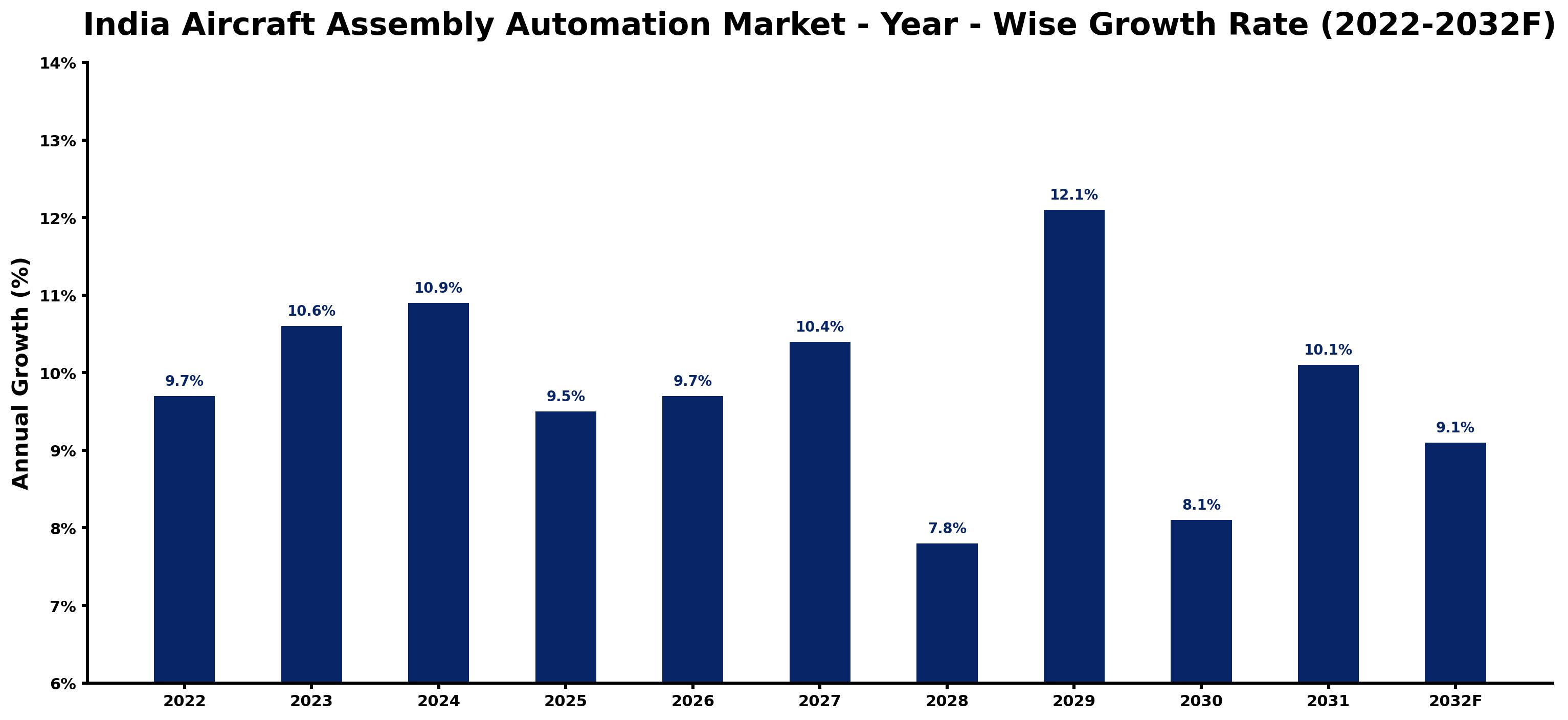
The table below sets out the estimated growth rate for each year and the main factor behind it.
| Year | Estimated Annual Growth (%) | Market Rationale |
| 2022 | 9.7 | The market experienced steady growth due to ongoing demand from domestic manufacturers. |
| 2023 | 10.6 | Investment in aerospace automation technologies increased, driving higher growth rates. |
| 2024 | 10.9 | The market saw heightened activity as manufacturers upgraded their assembly processes. |
| 2025 | 9.5 | Growth slowed slightly as companies adjusted to new production standards. |
| 2026 | 9.7 | Increased foreign direct investment supported a rebound in automation adoption. |
| 2027 | 10.4 | Demand from military aircraft manufacturers rose, boosting overall market growth. |
| 2028 | 7.8 | Growth slowed again as the market began to stabilise after rapid expansion. |
| 2029 | 12.1 | A surge in demand for commercial aircraft spurred significant growth in automation. |
| 2030 | 8.1 | The market experienced a slowdown as companies consolidated their operations. |
| 2031 | 10.1 | Investment in new technologies revitalised growth, particularly in robotics. |
| 2032 | 9.1 | Growth moderated as the market adjusted to evolving industry standards. |
Note: Market size estimations and growth projections presented in this report are based on 6Wresearch's proprietary forecasting methodology, utilizing the latest available industry data, government publications, and primary research inputs.
India Aircraft Assembly Automation Market Synopsis
Aircraft Assembly Automation Market in India includes cutting-edge technologies that optimise aircraft manufacturing processes. This involves the use of robotic arms and CNC machines, which improve precision and safety. The market is expanding due to increasing demand from domestic manufacturers and a growing export market. Initiatives such as 'Make in India' and the 'Aerospace and Defence Manufacturing Policy' are enhancing local production capabilities. With over 400 certified aerospace companies, the sector is set for substantial growth in the years ahead.
Market Dynamics Impact Analysis (2026–2032)
| Factor | Type | Impact | Primary Segment Affected |
| Increased foreign direct investment in the aerospace sector | Driver | High | Aerospace Automation Firms |
| Growing domestic demand for commercial aircraft | Driver | High | Commercial Aircraft OEMs |
| Expansion of aerospace manufacturing capabilities in Tamil Nadu | Opportunity | High | Helicopter Manufacturing Plants |
| Rising demand for high-quality surface finishing | Opportunity | Medium | Robotic Painting Arms |
| High initial investment costs for automation technologies | Restraint | High | Robotic Drilling Systems |
| Limited skilled workforce in aerospace automation | Restraint | Medium | Quality Assurance Units |
| Challenges in integrating new technologies into existing systems | Challenge | High | CNC Technology |
| Regulatory compliance issues delaying project approvals | Challenge | Medium | Automated Inspection Tools |
Evaluation of Drivers in India Aircraft Assembly Automation Market (2026–2032)
Key forces behind demand, with the segment each one moves most, are listed below.
| Drivers | Primary Segment Affected | Why It Matters (Evidence) |
| Investment in advanced robotics and automation technologies | AI-Powered Robots | This investment is projected to reach $1.5 billion by 2022, increasing adoption among manufacturers in the aerospace sector. |
| Growing domestic aerospace production capabilities | Aerospace Automation Firms | With over 400 certified aerospace companies, demand for automation solutions is rising as manufacturers expand their operations. |
| Increasing export opportunities for Indian aircraft | Military Aircraft Manufacturers | The Indian Air Force's fleet of over 1,500 aircraft drives demand for assembly automation, improving production efficiency. |
| Support from government initiatives like 'Make in India' | Commercial Aircraft OEMs | This initiative aims to create a $100 billion aerospace industry by 2025, boosting local manufacturing and technology adoption. |
| Technological advancements in automation systems | Robotic Painting Arms | These advancements are expected to improve production efficiency, leading to higher demand for automation technologies. |
Growth across the Aircraft Assembly Automation market in India is anchored in increased foreign direct investment, rising domestic demand for commercial aircraft, and advancements in automation technology. With a growing number of certified aerospace companies, demand for automation solutions is rising. The Indian Air Force's extensive fleet creates substantial demand for assembly automation technologies.
Evaluation of Restraints in India Aircraft Assembly Automation Market
Below mentioned are some major restraints and their influence on market dynamics.
| Market Restraint | Primary Segment Affected | Why It Matters (Evidence) |
| High initial investment costs for automation technologies | Robotic Drilling Systems | These costs can exceed $500,000, limiting adoption among smaller manufacturers. |
| Limited skilled workforce in aerospace automation | Quality Assurance Units | The 'Skill India' initiative aims to train over 1 million individuals by 2025, yet gaps remain in skilled labour availability. |
| Challenges in integrating new technologies into existing systems | CNC Technology | Integration delays can extend project timelines by up to 6 months, affecting production schedules. |
| Regulatory compliance issues delaying project approvals | Automated Inspection Tools | Compliance with BIS standards can take several months, hindering timely implementation of automation technologies. |
| Market volatility due to fluctuating demand from global markets | Aerospace Automation Firms | Global economic uncertainties can impact export orders, affecting local production capabilities. |
India Aircraft Assembly Automation Market Challenges
The India Aircraft Assembly Automation market still has to solve a few problems, starting with supply chain disruptions that hinder production timelines for local manufacturers. These disruptions arise from reliance on imported components, causing lead times to increase by 20%. Competition from international suppliers presents another hurdle, as foreign firms often offer advanced automation technologies at lower prices, challenging local players' market share. Buyers face difficulties due to a shortage of skilled labour; while the aerospace workforce is set to grow to 1 million by 2025, training programs are insufficient, potentially resulting in a 30% shortfall in qualified personnel.
Trends in the India Aircraft Assembly Automation Market
The trends below show where the India Aircraft Assembly Automation Market is heading.
- Shift towards Automation in Military Aircraft Manufacturing: Military Aircraft Manufacturers are increasingly adopting automation technologies to boost production efficiency. This trend began in 2021, with a projected growth rate of 10.8% for automation solutions in this sector.
- Transition from Manual to Automated Assembly Processes: The aerospace sector is transitioning from manual assembly to automated processes, enhancing precision and safety. This shift gained momentum in 2020, with government initiatives promoting automation.
- Emergence of AI-Powered Robotics in Assembly: AI-Powered Robots are becoming essential to the assembly process, improving efficiency and minimising errors. This trend started in 2022, with a 44% market share anticipated for these technologies by 2025.
- Prioritisation of Quality Assurance in Aerospace Manufacturing: Quality Assurance Units are increasingly utilising automated inspection tools to ensure compliance with standards. This trend has been apparent since 2020, with significant investments in quality assurance technologies.
Investment Opportunities in the India Aircraft Assembly Automation Market
Below are the investment opportunities with the strongest case in the India Aircraft Assembly Automation Market.
- Commercial Aircraft OEMs Seeking Automation Solutions: With the market projected to reach USD 88.0 million by 2025, there is a considerable opportunity to provide advanced automation technologies. Collaborating with Commercial Aircraft OEMs can strengthen local production capabilities.
- Investment in Robotic Systems for Assembly: The demand for robotic systems is anticipated to rise, driven by the need for precision in manufacturing. Targeting aerospace automation firms can facilitate entry into this growing market.
- Expansion of Aerospace Parks in Tamil Nadu: The creation of dedicated aerospace parks is expected to enhance collaboration among manufacturers. Investing in these facilities can generate opportunities for automation technology suppliers.
- Growth in Military Aircraft Manufacturing: With military aircraft manufacturers expected to ramp up production, there is a demand for advanced automation solutions. Engaging with these manufacturers can present substantial opportunities.
Government Initiatives in the India Aircraft Assembly Automation Market
The 'Aerospace and Defence Manufacturing Policy', launched by the Ministry of Defence in 2020, aims to strengthen indigenous production capabilities and decrease reliance on imports. This policy encourages local manufacturers to embrace advanced automation technologies, thereby increasing efficiency and competitiveness. In 2021, the Ministry of Civil Aviation introduced the 'National Civil Aviation Policy' to stimulate growth in the aerospace sector, focusing on enhancing infrastructure and regulatory frameworks. The updated 'National Policy on Electronics' in 2022 further supports the integration of automation in manufacturing processes, aligning with global standards. These measures aim to create a conducive environment for the growth of the Aircraft Assembly Automation market in India.
The Ministry of Defence oversees the implementation of various initiatives that fund and approve projects in the aerospace sector. The 'Aerospace and Defence Sector Skill Council' is dedicated to skill development, aiming to train over 1 million individuals in aerospace and defence skills by 2025. Additionally, the Indian government allocated $1.5 billion for aerospace research and development in 2022, supporting innovation and technological advancements. The National Aerospace Laboratories (NAL) plays a crucial role in approving research projects that enhance automation capabilities in aircraft assembly. These efforts are key to meeting the growing demands of the aerospace industry in India.
Future Insight of the India Aircraft Assembly Automation Market
Several forward-looking factors should support the India Aircraft Assembly Automation market in the coming years. The government's 'Make in India' initiative aims to create a $100 billion aerospace and defence industry by 2025, promoting local production. The Indian Defence Ministry's approval of 74% FDI in the defence sector will attract foreign investments, improving technological capabilities. The establishment of dedicated aerospace parks, such as the one in Tamil Nadu, will facilitate collaboration among manufacturers and research institutions. The 'Digital India' initiative will encourage the adoption of advanced technologies, enhancing assembly efficiency.
Market Segmentation Analysis
The report offers a comprehensive study of the following market segments and their leading categories in the market.
By Automation Type – Robotic Drilling Systems Dominated, Robotic Painting Arms Expected to Grow Fastest
According to Shubham Padhi, Research Analyst at 6Wresearch, with a 38% revenue share in 2025, Robotic Drilling Systems was the largest automation type category. Robotic Drilling Systems hold the largest share due to their essential role in ensuring precise drilling during aircraft assembly. Their widespread use among manufacturers, especially in aerospace facilities located in Maharashtra, highlights their critical importance in the industry. Robotic Painting Arms are projected to grow fastest, at a CAGR of 10.8% during 2026–2032. Robotic Painting Arms are witnessing rapid growth as manufacturers increasingly focus on achieving high-quality surface finishes for aircraft. This trend aligns with government initiatives like 'Make in India', driving the adoption of these advanced systems. Suppliers should enhance their offerings in robotic painting technologies to meet the growing demand for quality in aircraft assembly.
By Technology Used – AI-Powered Robots Dominated and Is Expected to Record the Fastest Growth
AI-Powered Robots accounted for a 44% market share by technology used in 2025. AI-Powered Robots dominate the market share as they significantly improve operational efficiency in aircraft assembly. Their integration into various processes, supported by initiatives like 'Digital India', underscores their vital role in contemporary manufacturing. Its lead should widen, with a projected CAGR of 11.7% during 2026–2032, the highest in this split. The growth of AI-Powered Robots is accelerating due to their widespread adoption across multiple assembly lines, solidifying their position as a leading technology. Their capability to streamline operations suggests that their market share will likely expand further as demand rises. Suppliers must invest in advanced technologies to remain competitive and address the evolving requirements of the aerospace sector.
By Distribution Channel – Aerospace Automation Firms Dominated, Aircraft Tool Integrators Expected to Grow Fastest
Aerospace Automation Firms took a 44% share of distribution channel in 2025, more than any other category. Aerospace Automation Firms lead the market share by specialising in comprehensive automation solutions tailored for aircraft assembly. Their established connections with manufacturers ensure a consistent demand for their services, particularly in key regions like Tamil Nadu. The quickest growth will come from Aircraft Tool Integrators, forecast to expand at a CAGR of 12.3% between 2026 and 2032. Aircraft Tool Integrators are experiencing rapid growth as they provide essential tools that enhance assembly processes, reflecting the industry's increasing focus on operational efficiency. As manufacturers strive to optimise their operations, reliance on these integrators is expected to grow. This suggests that suppliers should strengthen partnerships with tool integrators to better cater to the needs of aircraft manufacturers.
By End User – Commercial Aircraft OEMs Dominated, Military Aircraft Manufacturers Expected to Grow Fastest
The largest end user category in 2025 was Commercial Aircraft OEMs, with a 47% share of total revenue. Commercial Aircraft OEMs command the largest market share as they are the primary users of assembly automation technologies, driven by the need for high production rates. Their substantial investments in automation reflect the rising demand for commercial aircraft in India. Military Aircraft Manufacturers are set to record the highest CAGR in this split, 10.8% over 2026–2032. Military Aircraft Manufacturers are experiencing the fastest growth due to heightened government spending on defence and the necessity for advanced aircraft. This surge in demand for military aircraft production is likely to continue driving automation adoption in this segment. Suppliers should focus on customising their products to meet the specific needs of military manufacturers to capitalise on this growth opportunity.
Key Attractiveness of the Report
- 10 Years of Market Numbers
- Historical Data Starting from 2022 to 2025
- Base Year 2025
- Forecast Data until 2032
- Key Performance Indicators Impacting the Market
- Major Upcoming Developments and Projects
Key Highlights of the Report:
- India Aircraft Assembly Automation Market Outlook
- Market Size of India Aircraft Assembly Automation Market, 2025
- Forecast of India Aircraft Assembly Automation Market, 2032
- Historical Data and Forecast of India Aircraft Assembly Automation Revenues & Volume for the Period 2022 - 2032F
- India Aircraft Assembly Automation Market Trend Evolution
- India Aircraft Assembly Automation Market Drivers and Challenges
- India Aircraft Assembly Automation Price Trends
- India Aircraft Assembly Automation Porter's Five Forces
- India Aircraft Assembly Automation Industry Life Cycle
- Historical Data and Forecast of India Aircraft Assembly Automation Market Revenues & Volume By Automation Type for the Period 2022 - 2032F
- Historical Data and Forecast of India Aircraft Assembly Automation Market Revenues & Volume By Robotic Drilling Systems for the Period 2022 - 2032F
- Historical Data and Forecast of India Aircraft Assembly Automation Market Revenues & Volume By Riveting Machines for the Period 2022 - 2032F
- Historical Data and Forecast of India Aircraft Assembly Automation Market Revenues & Volume By Robotic Painting Arms for the Period 2022 - 2032F
- Historical Data and Forecast of India Aircraft Assembly Automation Market Revenues & Volume By Automated Inspection Tools for the Period 2022 - 2032F
- Historical Data and Forecast of India Aircraft Assembly Automation Market Revenues & Volume By Technology Used for the Period 2022 - 2032F
- Historical Data and Forecast of India Aircraft Assembly Automation Market Revenues & Volume By AI-Powered Robots for the Period 2022 - 2032F
- Historical Data and Forecast of India Aircraft Assembly Automation Market Revenues & Volume By CNC Technology for the Period 2022 - 2032F
- Historical Data and Forecast of India Aircraft Assembly Automation Market Revenues & Volume By Vision Systems for the Period 2022 - 2032F
- Historical Data and Forecast of India Aircraft Assembly Automation Market Revenues & Volume By ML/AI Based for the Period 2022 - 2032F
- Historical Data and Forecast of India Aircraft Assembly Automation Market Revenues & Volume By Distribution Channel for the Period 2022 - 2032F
- Historical Data and Forecast of India Aircraft Assembly Automation Market Revenues & Volume By Aircraft Tool Integrators for the Period 2022 - 2032F
- Historical Data and Forecast of India Aircraft Assembly Automation Market Revenues & Volume By Industrial Equipment Dealers for the Period 2022 - 2032F
- Historical Data and Forecast of India Aircraft Assembly Automation Market Revenues & Volume By Aerospace Automation Firms for the Period 2022 - 2032F
- Historical Data and Forecast of India Aircraft Assembly Automation Market Revenues & Volume By Online Automation Vendors for the Period 2022 - 2032F
- Historical Data and Forecast of India Aircraft Assembly Automation Market Revenues & Volume By End User for the Period 2022 - 2032F
- Historical Data and Forecast of India Aircraft Assembly Automation Market Revenues & Volume By Commercial Aircraft OEMs for the Period 2022 - 2032F
- Historical Data and Forecast of India Aircraft Assembly Automation Market Revenues & Volume By Military Aircraft Manufacturers for the Period 2022 - 2032F
- Historical Data and Forecast of India Aircraft Assembly Automation Market Revenues & Volume By Helicopter Manufacturing Plants for the Period 2022 - 2032F
- Historical Data and Forecast of India Aircraft Assembly Automation Market Revenues & Volume By Quality Assurance Units for the Period 2022 - 2032F
- India Aircraft Assembly Automation Import Export Trade Statistics
- Market Opportunity Assessment By Automation Type
- Market Opportunity Assessment By Technology Used
- Market Opportunity Assessment By Distribution Channel
- Market Opportunity Assessment By End User
- India Aircraft Assembly Automation Top Companies Market Share
- India Aircraft Assembly Automation Competitive Benchmarking By Technical and Operational Parameters
- India Aircraft Assembly Automation Company Profiles
- India Aircraft Assembly Automation Key Strategic Recommendations
Market Covered
This report examines the market across the segments below.
By Automation Type
- Robotic Drilling Systems
- Riveting Machines
- Robotic Painting Arms
- Automated Inspection Tools
By Technology Used
- AI-Powered Robots
- CNC Technology
- Vision Systems
- ML/AI Based
By Distribution Channel
- Aircraft Tool Integrators
- Industrial Equipment Dealers
- Aerospace Automation Firms
- Online Automation Vendors
By End User
- Commercial Aircraft OEMs
- Military Aircraft Manufacturers
- Helicopter Manufacturing Plants
- Quality Assurance Units































