India Aircraft Cabin Interior Hardware Market Size & Growth Rate
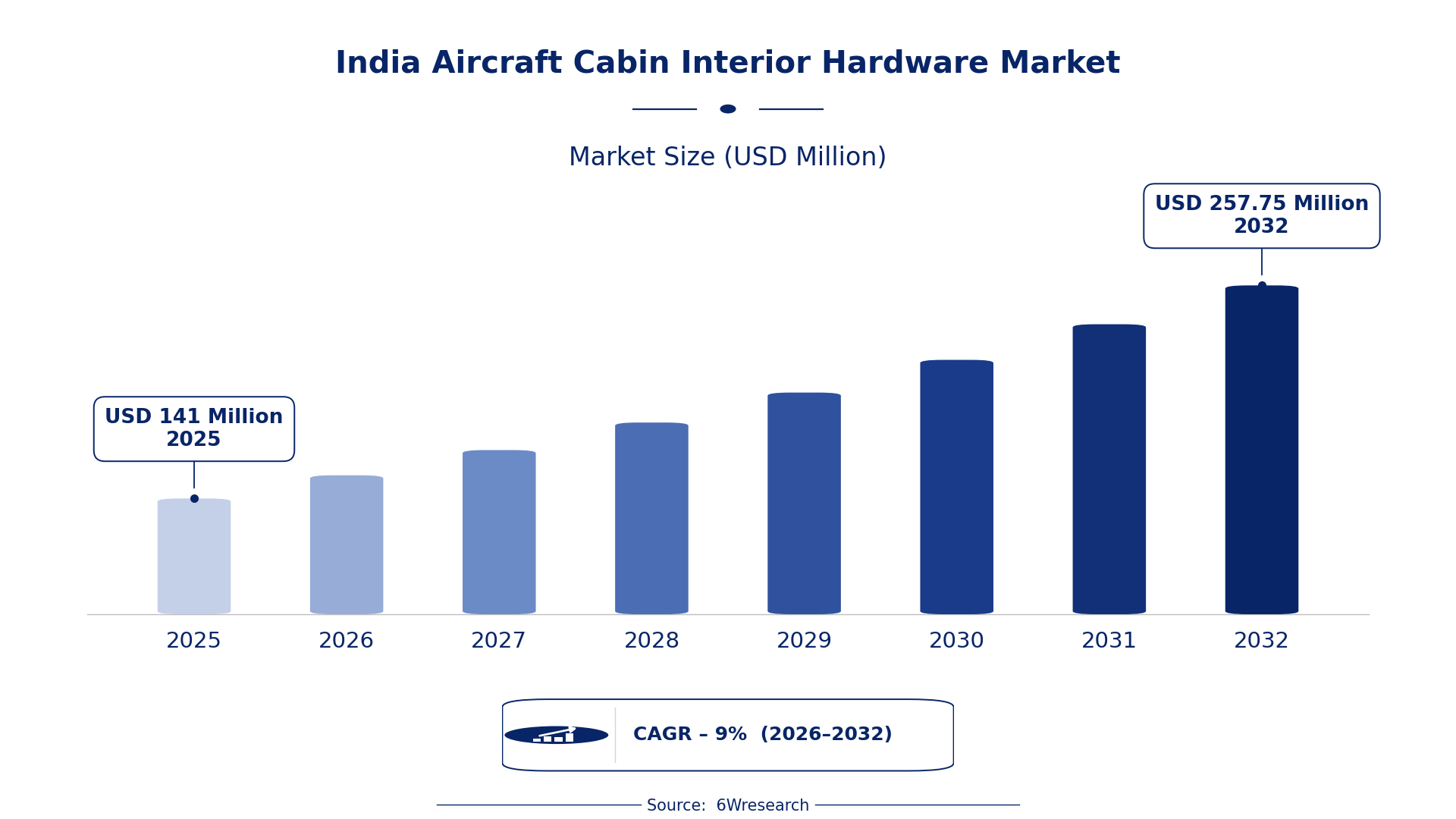
According to 6Wresearch internal database and industry insights, the India Aircraft Cabin Interior Hardware Market was valued at USD 141.0 million in 2025 and is projected to reach USD 257.75 million by 2032, growing at a CAGR of approximately 9% during 2026–2032.
India Aircraft Cabin Interior Hardware Market Highlights
| Report Metric | Details |
| Report Name | India Aircraft Cabin Interior Hardware Market |
| Market Size 2025 | USD 141.0 million |
| Market Size 2032 | USD 257.75 million |
| Absolute Growth 2025–2032 | USD 116.75 million |
| CAGR 2026–2032 | 9% |
| Peak Annual Growth | 11.6% in 2032 |
| Forecast Period | 2026–2032 |
| Historical Data | 2022–2025 |
| Base Year | 2025 |
| Leading Hardware Type, 2025 | Seat Mechanisms (42% share) |
| Leading Material Type, 2025 | Aluminum Alloy (41% share) |
| Leading Distribution Channel, 2025 | OEM Hardware Vendors (44% share) |
| Leading End User, 2025 | Commercial Airlines (45% share) |
| Fastest-Growing Hardware Type | Overhead Compartments (10.9% CAGR) |
| Fastest-Growing Material Type | Polycarbonate (11.2% CAGR) |
| Fastest-Growing Distribution Channel | Cabin Component Dealers (11.0% CAGR) |
| Fastest-Growing End User | Aircraft Interior Firms (11.0% CAGR) |
| Growing Sector | Commercial Airlines |
| Key End Users | Commercial Airlines, Private Jet Assemblers, Aircraft Interior Firms, OEM Hardware Vendors |
India Aircraft Cabin Interior Hardware Market Year-wise Growth Rate and Key Drivers (2022–2032)
This graph illustrates the annual growth rates of the market from 2022 to 2032, highlighting a steady upward trajectory and projected market expansion over the forecast period.
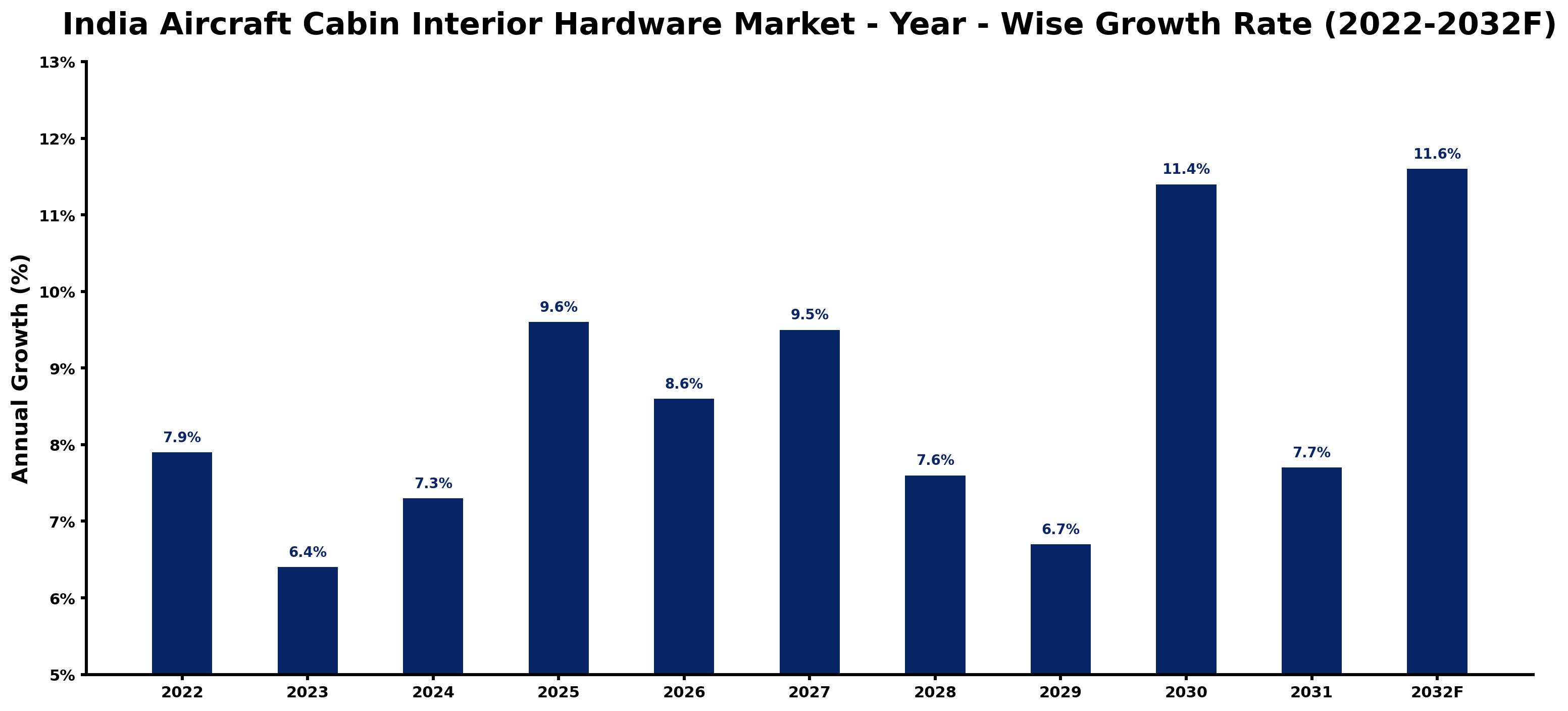
Annual growth estimates for each year appear below with the principal reason behind them, explaining the shifts that set the pace of the market.
| Year | Estimated Annual Growth (%) | Market Rationale |
| 2022 | 7.9 | The market experienced steady demand from commercial airlines and private jet manufacturers. |
| 2023 | 6.4 | Growth slowed due to supply chain disruptions affecting component availability. |
| 2024 | 7.3 | Increased demand from private jet assemblers spurred a faster growth rate. |
| 2025 | 9.6 | A surge in commercial airline operations led to significant hardware purchases. |
| 2026 | 8.6 | Growth slowed as manufacturers faced challenges in meeting rising demand. |
| 2027 | 9.5 | Demand from aircraft interior firms increased, driving faster growth. |
| 2028 | 7.6 | A slowdown occurred as market adjustments took place after rapid growth. |
| 2029 | 6.7 | Continued demand from commercial airlines kept the market growing, albeit slower. |
| 2030 | 11.4 | A resurgence in private jet orders contributed to a faster growth rate. |
| 2031 | 7.7 | Growth slowed as manufacturers adjusted to market conditions and demand. |
| 2032 | 11.6 | A peak in demand from commercial airlines and private jets drove growth. |
Note: Market size estimations and growth projections presented in this report are based on 6Wresearch's proprietary forecasting methodology, utilizing the latest available industry data, government publications, and primary research inputs.
India Aircraft Cabin Interior Hardware Market Synopsis
Aircraft Cabin Interior Hardware Market in India includes components such as seat mechanisms and overhead compartments, primarily crafted from aluminium alloy and polycarbonate. These components improve passenger comfort and safety in both commercial and private aircraft. The market is expanding due to increasing demand from domestic airlines and private jet manufacturers, bolstered by initiatives like the 'Make in India' programme that promotes local production.
Market Dynamics Impact Analysis (2026–2032)
| Factor | Type | Impact | Primary Segment Affected |
| Rising demand from commercial airlines drives the need for cabin interior hardware. | Driver | High | Commercial Airlines |
| The growing number of private jet assemblers creates opportunities for hardware suppliers. | Opportunity | High | Private Jet Assemblers |
| Supply chain disruptions can delay the availability of essential components. | Restraint | High | Cabin Component Dealers |
| Increasing competition among manufacturers may limit profit margins. | Challenge | Medium | OEM Hardware Vendors |
| The adoption of advanced materials like thermoplastics is enhancing product offerings. | Driver | Medium | Polycarbonate |
| The UDAN Scheme is increasing regional air connectivity, boosting demand. | Opportunity | High | Commercial Airlines |
| Regulatory compliance costs can burden manufacturers and slow production. | Restraint | Medium | Interior Fitment Suppliers |
| Technological advancements require continuous investment, straining budgets. | Challenge | Medium | Aircraft Interior Firms |
Evaluation of Drivers in India Aircraft Cabin Interior Hardware Market (2026–2032)
Below mentioned are some major drivers and their influence on market dynamics.
| Drivers | Primary Segment Affected | Why It Matters (Evidence) |
| Rising passenger traffic increases demand for cabin interior upgrades. | Commercial Airlines | The growing number of passengers necessitates more hardware from over 10 major operators. |
| The 'Make in India' initiative promotes local manufacturing of aircraft components. | OEM Hardware Vendors | This initiative encourages investments in domestic production, increasing hardware availability. |
| The increasing number of private jet owners boosts demand for customized interiors. | Private Jet Assemblers | The affluent class in India is driving demand for luxury private jets. |
| The adoption of lightweight materials improves fuel efficiency in aircraft. | Polycarbonate | Advanced materials are increasingly used in cabin interiors to meet efficiency standards. |
| The UDAN Scheme increases regional air travel, boosting hardware demand. | Commercial Airlines | More regional flights lead to higher requirements for cabin interior components. |
Market growth in India for Aircraft Cabin Interior Hardware rests on rising passenger traffic, increasing private jet ownership, and the push for local manufacturing. The ongoing expansion of commercial airlines is expected to raise demand for cabin interior upgrades, with over 10 major operators expanding their fleets. The affluent class is driving demand for customized interiors in private jets, while the adoption of lightweight materials like polycarbonate is improving fuel efficiency. The UDAN Scheme is projected to increase regional air travel, leading to higher requirements for cabin interior components.
Evaluation of Restraints in India Aircraft Cabin Interior Hardware Market
The main factors holding the market back are set out below.
| Market Restraint | Primary Segment Affected | Why It Matters (Evidence) |
| Supply chain disruptions can delay component availability. | Cabin Component Dealers | Manufacturers faced delays in sourcing materials, impacting production schedules. |
| Regulatory compliance costs burden manufacturers and slow production. | Interior Fitment Suppliers | Compliance with safety standards increases operational costs for suppliers. |
| Technological advancements require continuous investment, straining budgets. | Aircraft Interior Firms | Investing in new technologies can divert funds from other essential areas. |
| Increasing competition among manufacturers may limit profit margins. | OEM Hardware Vendors | Price wars can reduce profitability, affecting long-term sustainability. |
| Market fluctuations can lead to unpredictable demand patterns. | Commercial Airlines | Economic uncertainties may impact airline operations and hardware purchases. |
India Aircraft Cabin Interior Hardware Market Challenges
The India Aircraft Cabin Interior Hardware market encounters a notable technology gap, as many manufacturers find it challenging to adopt advanced materials like thermoplastics, causing product development delays of up to six months for suppliers. Heightened competition from international firms compels local producers to reduce prices, potentially shrinking profit margins by 15% for manufacturers. A shortage of skilled workers affects production efficiency, with training delays resulting in a 20% loss in output annually. Rising raw material costs, particularly for aluminium alloys, have surged by 10% this year, straining budgets and extending project timelines.
Trends in the India Aircraft Cabin Interior Hardware Market
Buyers and suppliers in the India Aircraft Cabin Interior Hardware Market are adjusting to the following trends.
- Shift from Traditional to Advanced Materials: Aircraft interior firms in India are increasingly turning to advanced materials like thermoplastics for lightweight solutions. In 2022, this transition was driven by the demand for improved fuel efficiency, with a projected increase of 11.2% in polycarbonate usage.
- Growing Demand for Customized Interiors: Private jet manufacturers are concentrating on bespoke cabin designs to meet the needs of affluent clients. The market for customised interiors is anticipated to grow by 10.9% from 2026 to 2032.
- Increased Focus on Safety Standards: The 'Safety Oversight Programme', launched in 2021, ensures compliance with international safety standards. This initiative is crucial for maintaining high safety levels in cabin interiors.
- Expansion of Regional Air Connectivity: The UDAN Scheme, initiated in 2016, aims to enhance regional air connectivity, resulting in increased demand for cabin interior hardware. The scheme has already significantly boosted regional flights, raising hardware requirements.
Investment Opportunities in the India Aircraft Cabin Interior Hardware Market
Some of the investment opportunities in the India Aircraft Cabin Interior Hardware Market are mentioned below.
- Growing Market for Lightweight Solutions: The Indian market for lightweight cabin interior components is on the rise, with a projected growth of 11.2%. Manufacturers can invest in advanced materials like thermoplastics to satisfy this demand, especially among commercial airlines.
- Increased Local Manufacturing Opportunities: The 'Make in India' initiative provides incentives for local production of aircraft components, encouraging investments. Suppliers can collaborate with local manufacturers to fulfil the demand for cabin interiors.
- Rising Demand from Private Jet Market: The growing number of private jet owners presents a chance for customised cabin interiors. Suppliers can target affluent buyers in urban areas to seize this expanding market.
- Expansion of Regional Airports: With the UDAN Scheme improving regional connectivity, there is a supply gap for cabin interiors. Suppliers can enter this market by partnering with regional airlines and local manufacturers.
Government Initiatives in the India Aircraft Cabin Interior Hardware Market
The 'National Civil Aviation Policy', updated by the Ministry of Civil Aviation in 2022, aims to improve infrastructure and promote local manufacturing of aircraft components. This policy encourages investment in domestic production, ensuring a steady supply of cabin interior hardware. Additionally, the 'Make in India' initiative, launched in 2014, continues to support domestic production with various incentives for manufacturers. This initiative has boosted local manufacturing capabilities in the aviation sector.
The Directorate General of Civil Aviation oversees safety and regulatory standards for aircraft interiors, ensuring compliance with international norms. The agency's 'Safety Oversight Programme', launched in 2021, focuses on maintaining high safety standards in cabin interiors. Furthermore, the UDAN Scheme, initiated in 2016, aims to increase regional air connectivity, which directly impacts the demand for cabin interior hardware. This scheme has led to the establishment of new regional airports, further boosting the market.
Future Insight of the India Aircraft Cabin Interior Hardware Market
Several forward-looking factors are set to support the India Aircraft Cabin Interior Hardware market in the coming years. The 'Make in India' initiative will promote local manufacturing, enhancing supply chain resilience. The shift towards advanced materials will improve product performance and reduce weight, benefiting both buyers and suppliers. The number of private jet manufacturers is projected to increase by 25%, expanding the market for cabin interior components. The updated National Aerospace and Defence Policy will stimulate investment in domestic manufacturing capabilities.
Market Segmentation Analysis
Each segment group is reviewed below, with the leader by share and the fastest grower by CAGR.
By Hardware Type – Seat Mechanisms Dominated, Overhead Compartments Expected to Grow Fastest
According to Shubham Padhi, Research Analyst at 6Wresearch, the largest hardware type category in 2025 was Seat Mechanisms, with a 42% share of total revenue. Seat mechanisms dominate the Indian aircraft cabin interior hardware market because they are essential for passenger seating adjustments, directly impacting comfort and safety. The presence of over 10 major commercial airlines in India ensures a consistent and high demand for these vital components. Overhead Compartments are set to record the highest CAGR in this split, 10.9% over 2026–2032. Overhead compartments are experiencing rapid growth due to their critical function in storing passenger luggage, particularly as airlines expand their fleets. The increase in domestic flights and rising passenger traffic are significant factors propelling this segment's demand. Suppliers should prioritise the development of innovative overhead compartment solutions to leverage this expanding market opportunity.
By Material Type – Aluminum Alloy Dominated, Polycarbonate Expected to Grow Fastest
In 2025, Aluminum Alloy led the material type split with a 41% share. Aluminum alloy commands the largest share in the aircraft cabin interior hardware market owing to its lightweight properties, making it the material of choice for manufacturers. Its extensive use across various components ensures a steady demand from both commercial and private aircraft sectors. Over 2026–2032, Polycarbonate is expected to post the fastest growth, at a CAGR of 11.2%. Polycarbonate is rapidly gaining traction as it is increasingly favoured for its durability and transparency, appealing to manufacturers focused on lightweight solutions. The industry shift towards advanced materials for aircraft interiors is a notable factor driving this growth. Manufacturers should invest in polycarbonate technologies to align with the rising demand for lightweight and durable cabin components.
By Distribution Channel – OEM Hardware Vendors Dominated, Cabin Component Dealers Expected to Grow Fastest
OEM Hardware Vendors took a 44% share of distribution channel in 2025, more than any other category. OEM hardware vendors lead the market share by providing original equipment for new aircraft, ensuring adherence to safety and regulatory standards. Their established relationships with major airlines and manufacturers solidify their strong position in the market. Cabin Component Dealers are projected to grow fastest, at a CAGR of 11.0% during 2026–2032. Cabin component dealers are experiencing rapid growth as they supply essential hardware to manufacturers, particularly in light of increasing aircraft production rates. This trend is bolstered by initiatives like the 'Make in India' programme, which promotes local sourcing of components. Suppliers must strengthen partnerships with cabin component dealers to effectively reach manufacturers and meet the growing demand.
By End User – Commercial Airlines Dominated, Aircraft Interior Firms Expected to Grow Fastest
With a 45% revenue share in 2025, Commercial Airlines was the largest end user category. Commercial airlines represent the largest end-user of cabin hardware, driven by the need for passenger comfort and safety on domestic and international flights. Their substantial fleet sizes necessitate a continuous supply of various cabin components. The quickest growth will come from Aircraft Interior Firms, forecast to expand at a CAGR of 11.0% between 2026 and 2032. Aircraft interior firms are experiencing the fastest growth as they design and fit hardware in aircraft, responding to the increasing demand for customised interiors. The expansion of the aviation sector in India fuels this trend. Suppliers should focus on building relationships with aircraft interior firms to tap into the growing demand for tailored cabin solutions.
Key Attractiveness of the Report
- 10 Years of Market Numbers
- Historical Data Starting from 2022 to 2025
- Base Year 2025
- Forecast Data until 2032
- Key Performance Indicators Impacting the Market
- Major Upcoming Developments and Projects
Key Highlights of the Report:
- India Aircraft Cabin Interior Hardware Market Outlook
- Market Size of India Aircraft Cabin Interior Hardware Market, 2025
- Forecast of India Aircraft Cabin Interior Hardware Market, 2032
- Historical Data and Forecast of India Aircraft Cabin Interior Hardware Revenues & Volume for the Period 2022 - 2032F
- India Aircraft Cabin Interior Hardware Market Trend Evolution
- India Aircraft Cabin Interior Hardware Market Drivers and Challenges
- India Aircraft Cabin Interior Hardware Price Trends
- India Aircraft Cabin Interior Hardware Porter's Five Forces
- India Aircraft Cabin Interior Hardware Industry Life Cycle
- Historical Data and Forecast of India Aircraft Cabin Interior Hardware Market Revenues & Volume By Hardware Type for the Period 2022 - 2032F
- Historical Data and Forecast of India Aircraft Cabin Interior Hardware Market Revenues & Volume By Seat Mechanisms for the Period 2022 - 2032F
- Historical Data and Forecast of India Aircraft Cabin Interior Hardware Market Revenues & Volume By Overhead Compartments for the Period 2022 - 2032F
- Historical Data and Forecast of India Aircraft Cabin Interior Hardware Market Revenues & Volume By Window Shades for the Period 2022 - 2032F
- Historical Data and Forecast of India Aircraft Cabin Interior Hardware Market Revenues & Volume By Door Handles & Locks for the Period 2022 - 2032F
- Historical Data and Forecast of India Aircraft Cabin Interior Hardware Market Revenues & Volume By Material Type for the Period 2022 - 2032F
- Historical Data and Forecast of India Aircraft Cabin Interior Hardware Market Revenues & Volume By Aluminum Alloy for the Period 2022 - 2032F
- Historical Data and Forecast of India Aircraft Cabin Interior Hardware Market Revenues & Volume By Polycarbonate for the Period 2022 - 2032F
- Historical Data and Forecast of India Aircraft Cabin Interior Hardware Market Revenues & Volume By Thermoplastic for the Period 2022 - 2032F
- Historical Data and Forecast of India Aircraft Cabin Interior Hardware Market Revenues & Volume By Stainless Steel for the Period 2022 - 2032F
- Historical Data and Forecast of India Aircraft Cabin Interior Hardware Market Revenues & Volume By Distribution Channel for the Period 2022 - 2032F
- Historical Data and Forecast of India Aircraft Cabin Interior Hardware Market Revenues & Volume By Cabin Component Dealers for the Period 2022 - 2032F
- Historical Data and Forecast of India Aircraft Cabin Interior Hardware Market Revenues & Volume By Interior Fitment Suppliers for the Period 2022 - 2032F
- Historical Data and Forecast of India Aircraft Cabin Interior Hardware Market Revenues & Volume By Aircraft Hardware Retailers for the Period 2022 - 2032F
- Historical Data and Forecast of India Aircraft Cabin Interior Hardware Market Revenues & Volume By OEM Hardware Vendors for the Period 2022 - 2032F
- Historical Data and Forecast of India Aircraft Cabin Interior Hardware Market Revenues & Volume By End User for the Period 2022 - 2032F
- Historical Data and Forecast of India Aircraft Cabin Interior Hardware Market Revenues & Volume By Commercial Airlines for the Period 2022 - 2032F
- Historical Data and Forecast of India Aircraft Cabin Interior Hardware Market Revenues & Volume By Aircraft Interior Firms for the Period 2022 - 2032F
- Historical Data and Forecast of India Aircraft Cabin Interior Hardware Market Revenues & Volume By Business Jet Designers for the Period 2022 - 2032F
- Historical Data and Forecast of India Aircraft Cabin Interior Hardware Market Revenues & Volume By Private Jet Assemblers for the Period 2022 - 2032F
- India Aircraft Cabin Interior Hardware Import Export Trade Statistics
- Market Opportunity Assessment By Hardware Type
- Market Opportunity Assessment By Material Type
- Market Opportunity Assessment By Distribution Channel
- Market Opportunity Assessment By End User
- India Aircraft Cabin Interior Hardware Top Companies Market Share
- India Aircraft Cabin Interior Hardware Competitive Benchmarking By Technical and Operational Parameters
- India Aircraft Cabin Interior Hardware Company Profiles
- India Aircraft Cabin Interior Hardware Key Strategic Recommendations
Market Covered
Segments analysed in this report are listed below.
By Hardware Type
- Seat Mechanisms
- Overhead Compartments
- Window Shades
- Door Handles & Locks
By Material Type
- Aluminum Alloy
- Polycarbonate
- Thermoplastic
- Stainless Steel
By Distribution Channel
- Cabin Component Dealers
- Interior Fitment Suppliers
- Aircraft Hardware Retailers
- OEM Hardware Vendors
By End User
- Commercial Airlines
- Aircraft Interior Firms
- Business Jet Designers
- Private Jet Assemblers































