India Aircraft Fuselage Structures Market Size & Growth Rate
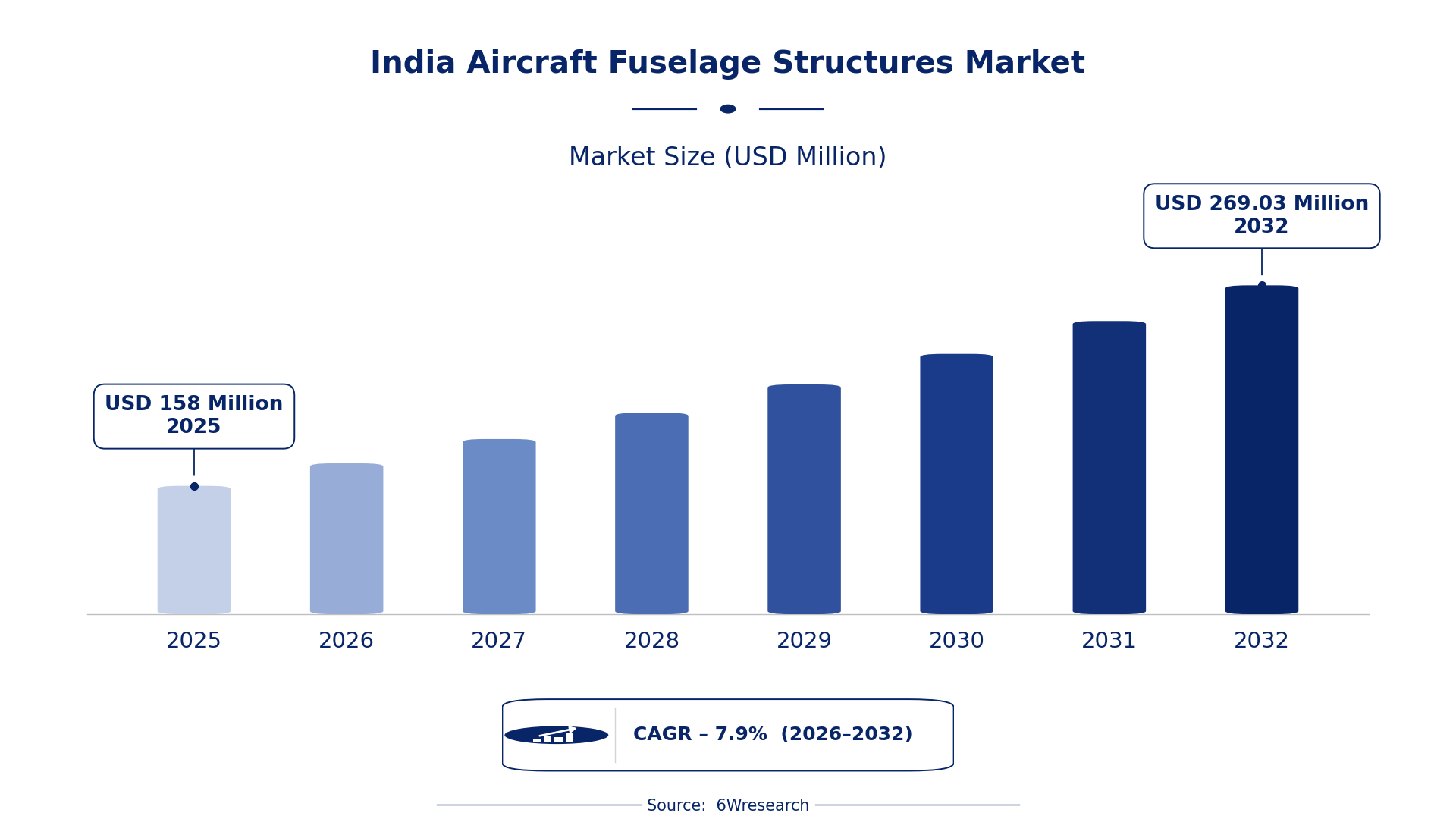
According to 6Wresearch internal database and industry insights, the India Aircraft Fuselage Structures Market was valued at USD 158.0 million in 2025 and is projected to reach USD 269.03 million by 2032, growing at a CAGR of approximately 7.9% during 2026–2032.
India Aircraft Fuselage Structures Market Highlights
| Report Metric | Details |
| Report Name | India Aircraft Fuselage Structures Market |
| Market Size 2025 | USD 158.0 million |
| Market Size 2032 | USD 269.03 million |
| Absolute Growth 2025–2032 | USD 111.03 million |
| CAGR 2026–2032 | 7.9% |
| Peak Annual Growth | 10.5% in 2029 |
| Forecast Period | 2026–2032 |
| Historical Data | 2022–2025 |
| Base Year | 2025 |
| Leading Structure Type, 2025 | Mid-Fuselage Assemblies (49% share) |
| Leading Material Composition, 2025 | Composite Materials (39% share) |
| Leading Distribution Channel, 2025 | Direct OEM Supply (50% share) |
| Leading End User, 2025 | Aircraft Integrators (40% share) |
| Fastest-Growing Structure Type | Bulkheads and Frames (9.8% CAGR) |
| Fastest-Growing Distribution Channel | Structural Component Vendors (9.9% CAGR) |
| Fastest-Growing End User | Military Contractors (9.8% CAGR) |
| Growing Sector | Aerospace Manufacturing |
| Key End Users | Aircraft Integrators, Military Contractors, Charter Jet Builders, Regional Aircraft Makers |
India Aircraft Fuselage Structures Market Year-wise Growth Rate and Key Drivers (2022–2032)
This graph illustrates the annual growth rates of the market from 2022 to 2032, highlighting a steady upward trajectory and projected market expansion over the forecast period.
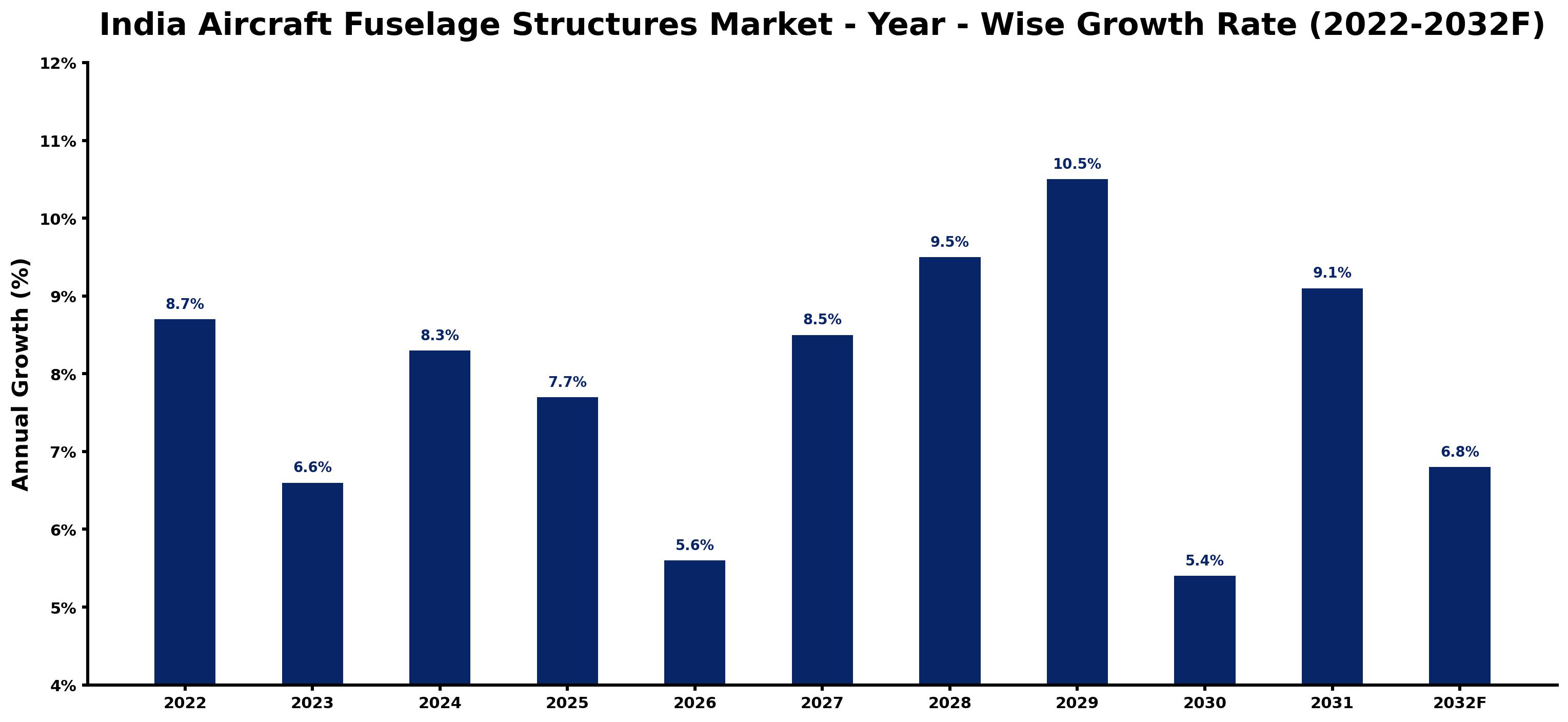
Annual growth estimates for each year appear below with the principal reason behind them, explaining the shifts that set the pace of the market.
| Year | Estimated Annual Growth (%) | Market Rationale |
| 2022 | 8.7 | The market experienced strong demand driven by military contracts and local production initiatives. |
| 2023 | 6.6 | Growth slowed due to supply chain challenges affecting component availability for manufacturers. |
| 2024 | 8.3 | Demand increased as local manufacturers ramped up production capabilities and efficiency. |
| 2025 | 7.7 | Growth slowed again as the market adjusted to previous high levels of activity. |
| 2026 | 5.6 | A further slowdown occurred as manufacturers faced regulatory hurdles in approvals for new projects. |
| 2027 | 8.5 | Demand rebounded with increased military spending and new aircraft acquisitions. |
| 2028 | 9.5 | Growth accelerated due to rising orders for regional aircraft and modernization efforts. |
| 2029 | 10.5 | The market peaked with substantial contracts for military aircraft boosting demand for fuselage structures. |
| 2030 | 5.4 | Growth slowed as the Indian Air Force's acquisition plans for new fighter jets were finalised. |
| 2031 | 9.1 | Demand increased again with the Indian Air Force's plans for new fighter jets. |
| 2032 | 6.8 | Growth slowed as the Indian Air Force's acquisition plans for new fighter jets are finalised. |
Note: Market size estimations and growth projections presented in this report are based on 6Wresearch's proprietary forecasting methodology, utilizing the latest available industry data, government publications, and primary research inputs.
India Aircraft Fuselage Structures Market Synopsis
The India Aircraft Fuselage Structures Market encompasses critical components of aircraft bodies, primarily made from aluminum, titanium, and composites. These structures provide essential structural integrity and aerodynamic efficiency. The market is expanding due to military contracts and the 'Make in India' initiative, with over 1,000 aircraft expected to be in service by 2030. Demand is further supported by advancements in composite materials, projected to grow at 15% annually, improving performance and reducing weight. Key buyers include military contractors and aircraft integrators, driving further growth in the sector.
Market Dynamics Impact Analysis (2026–2032)
| Factor | Type | Impact | Primary Segment Affected |
| Increased military contracts drive demand for fuselage structures. | Driver | High | Mid-Fuselage Assemblies |
| Rising demand for regional aircraft boosts orders for fuselage components. | Driver | High | Tail Sections |
| Growing aerospace workforce presents opportunities for skilled labour supply. | Opportunity | Medium | Aircraft Integrators |
| Investment in local manufacturing capabilities creates new supply channels. | Opportunity | Medium | Composite Materials |
| Regulatory hurdles delay approvals for new aircraft projects. | Restraint | High | Nose Sections |
| Supply chain disruptions impact the availability of key materials. | Restraint | High | Bulkheads and Frames |
| High costs of advanced materials challenge budget constraints for manufacturers. | Challenge | Medium | CFRP & GFRP |
| Technology adoption lagging behind global standards affects competitiveness. | Challenge | Medium | Aluminum/Titanium |
Evaluation of Drivers in India Aircraft Fuselage Structures Market (2026–2032)
The table below links each growth driver to the segment it affects and the evidence for it.
| Drivers | Primary Segment Affected | Why It Matters (Evidence) |
| Increased military spending on modernization of aircraft. | Mid-Fuselage Assemblies | India's defense budget for 2023 includes $12 billion for military aircraft upgrades, driving demand for fuselage structures. |
| Growing orders for regional aircraft from domestic manufacturers. | Tail Sections | The establishment of 15 major aerospace clusters supports increased production capacity. |
| Rising use of composite materials for weight reduction. | Composite Materials | Projected growth rate of 15% annually for composite materials leads to higher demand for lightweight fuselage structures. |
| Expansion of the aerospace workforce boosts production capabilities. | Aircraft Integrators | India's aerospace workforce is estimated to grow to 500,000 skilled professionals by 2025, supporting increased manufacturing. |
| Support from government initiatives boosts local production. | Bulkheads and Frames | The 'Make in India' initiative aims to increase domestic manufacturing in aerospace by 2025. |
Growth across the Aircraft Fuselage Structures market in India is anchored in increased military spending, rising orders for regional aircraft, and the adoption of advanced materials. The defense budget for 2023 allocates $12 billion for modernization, stimulating demand for components. The establishment of 15 aerospace clusters supports increased production capacity, particularly in Bengaluru and Hyderabad. The workforce is projected to reach 500,000 skilled professionals by 2025, further supporting manufacturing growth. The increasing demand for composite materials, which are expected to grow at 15% annually, enhances the performance of aircraft structures.
Evaluation of Restraints in India Aircraft Fuselage Structures Market
The key brakes on demand, and where they bite hardest, are shown below.
| Market Restraint | Primary Segment Affected | Why It Matters (Evidence) |
| Regulatory hurdles delay project approvals for new aircraft. | Nose Sections | Manufacturers face lengthy approval processes under the Directorate General of Civil Aviation, impacting project timelines. |
| Supply chain disruptions hinder material availability. | Bulkheads and Frames | Global supply chain issues have led to shortages of key materials, affecting production schedules. |
| High costs of advanced materials strain budgets for manufacturers. | CFRP & GFRP | The rising prices of composite materials limit the ability of manufacturers to adopt new technologies. |
| Limited access to financing for small manufacturers affects growth. | Aluminum/Titanium | Small manufacturers struggle to secure funding for expansion, impacting their ability to compete. |
| Competition from international suppliers challenges local producers. | Composite Materials | International suppliers often offer lower prices, making it difficult for local manufacturers to secure contracts. |
India Aircraft Fuselage Structures Market Challenges
The India Aircraft Fuselage Structures market confronts critical technological challenges, particularly in the integration of advanced composite materials, which can delay production schedules by up to six months for local manufacturers. Supply chain disruptions stem from reliance on imported components, leading to cost increases of around 20% for buyers requiring specialized parts. A shortage of skilled professionals hinders progress, as current training initiatives do not adequately prepare the workforce for the anticipated demand from the aerospace sector. Additionally, competition from foreign manufacturers pressures local producers, risking a potential 10% decline in market share if they do not innovate effectively.
Trends in the India Aircraft Fuselage Structures Market
Buyers and suppliers in the India Aircraft Fuselage Structures Market are adjusting to the following trends.
- Shift towards Composite Materials in Aircraft Manufacturing: India is increasingly adopting composite materials for aircraft fuselage structures, reflecting a projected growth rate of 15% annually, which improves performance and fuel efficiency.
- Expansion of Aerospace Clusters in India: Bengaluru and Hyderabad are leading the development of aerospace clusters, with 15 major clusters set to boost local production capabilities by enhancing collaboration among manufacturers.
- Increase in Military Aircraft Orders: The Indian Air Force's plan to acquire 83 Tejas fighter jets is driving demand for fuselage structures, significantly enhancing national defense capabilities with an estimated $12 billion investment.
- Rising Demand for Regional Aircraft: The growing need for regional connectivity is increasing orders for smaller aircraft, supported by government initiatives like the UDAN Scheme, aimed at improving air transport accessibility.
Investment Opportunities in the India Aircraft Fuselage Structures Market
Several openings in the India Aircraft Fuselage Structures Market merit attention from investors.
- Investment in Local Manufacturing: With the 'Make in India' initiative, there is a strong push for local manufacturing in aerospace. This presents an opportunity to invest in production facilities, especially in regions like Bengaluru, where demand is high, with an expected market size of $158 million by 2025.
- Supply of Advanced Composite Materials: The increasing use of composite materials creates a need for suppliers to provide these products. With a projected growth rate of 15%, manufacturers in the aerospace sector are looking for reliable sources to meet their production needs.
- Partnerships with Aerospace Integrators: Now is the time to form partnerships with aircraft integrators to supply fuselage components. Collaborating with local firms can facilitate market entry and expand reach in the growing aerospace sector, particularly among military contractors.
- Expansion into Military Contracts: The rise in military aircraft orders presents an opportunity for suppliers to engage with military contractors. With $12 billion allocated for modernization, there is potential for new contracts that can significantly boost local production.
Government Initiatives in the India Aircraft Fuselage Structures Market
The 'Aerospace and Defence Manufacturing Policy' launched by the Ministry of Defence in 2020 aims to boost indigenous production capabilities. This policy encourages local manufacturers to invest in advanced technologies and improve production efficiency. The 'Production-Linked Incentive Scheme' introduced in 2021 provides $1.5 billion to incentivize local manufacturing in the aerospace sector, further promoting growth and innovation in the industry. Additionally, the 'National Civil Aviation Policy' updated in 2022 aims to enhance regional connectivity and expand the aviation market, impacting the production of fuselage structures.
The Ministry of Civil Aviation oversees the implementation of various schemes, including the 'UDAN Scheme', which improves regional air transport. This initiative, active since 2017, aims to enhance connectivity and expand the aviation market. The National Aerospace Laboratories (NAL) plays a crucial role in research and development, supporting local manufacturers in adopting new technologies. The Bureau of Indian Standards (BIS) establishes quality standards for aerospace components, ensuring compliance and safety for producers and buyers alike.
Future Insight of the India Aircraft Fuselage Structures Market
The India Aircraft Fuselage Structures market will undergo transformative changes by 2032, driven by the 'Make in India' initiative that aims to boost local production capabilities. The Indian government's commitment to modernizing military aircraft, with a $12 billion defense budget, will significantly increase demand for fuselage structures. The anticipated growth of the aerospace workforce will support this expansion, enabling suppliers to meet rising needs. Enhanced standards established by the Bureau of Indian Standards will ensure quality and reliability, fostering greater trust among buyers and suppliers.
Market Segmentation Analysis
The analysis below covers each segmentation, its leading category in 2025 and its fastest-growing category through 2032.
By Structure Type – Mid-Fuselage Assemblies Dominated, Bulkheads and Frames Expected to Grow Fastest
According to Shubham Padhi, Research Analyst at 6Wresearch, Mid-Fuselage Assemblies held a 49% share of the India Aircraft Fuselage Structures Market by structure type in 2025. Mid-Fuselage Assemblies hold the largest share in the Indian Aircraft Fuselage Structures Market due to their critical function in ensuring aircraft integrity and passenger safety. With a projected operational fleet of over 1,000 aircraft by 2030, the demand for these assemblies is expected to increase significantly. Bulkheads and Frames are set to record the highest CAGR in this split, 9.8% over 2026–2032. Bulkheads and Frames are experiencing the fastest growth as they are essential for providing structural support and compartmentalization in aircraft. The increased focus on safety and efficiency in aviation is propelling this segment's rapid expansion. Suppliers should focus on enhancing their offerings in Bulkheads and Frames to effectively meet the rising demand.
By Material Composition – Composite Materials Dominated and Is Expected to Record the Fastest Growth
With a 39% revenue share in 2025, Composite Materials was the largest material composition category. Composite Materials dominate the market share as they are increasingly preferred for their benefits in weight reduction and improved performance in aircraft designs. This trend aligns with initiatives to boost domestic manufacturing capabilities in aerospace, particularly under government policies. The same category are also set to grow fastest, at a CAGR of 10.0% during 2026–2032. Composite Materials are also the fastest-growing segment, driven by their advantages in reducing aircraft weight and enhancing fuel efficiency. As the aerospace sector expands, the reliance on these materials will further solidify their market position. Buyers should prioritise sourcing Composite Materials to fully capitalise on their performance benefits in aircraft production.
By Distribution Channel – Direct OEM Supply Dominated, Structural Component Vendors Expected to Grow Fastest
The largest distribution channel category in 2025 was Direct OEM Supply, with a 50% share of total revenue. Direct OEM Supply leads the market share as it serves as the primary channel for delivering fuselage structures directly to manufacturers. This channel ensures quality control and timely delivery, which are crucial for maintaining production schedules. Structural Component Vendors are projected to grow fastest, at a CAGR of 9.9% during 2026–2032. Structural Component Vendors are the fastest-growing distribution channel, as they play a vital role in sourcing specialised parts and assemblies tailored to specific aircraft needs. The increasing complexity of aircraft designs is driving growth in this segment. Suppliers must build strong relationships with Structural Component Vendors to enhance their market presence.
By End User – Aircraft Integrators Dominated, Military Contractors Expected to Grow Fastest
In 2025, Aircraft Integrators led the end user split with a 40% share. Aircraft Integrators hold the largest share in the end-user segment, as they are the main users responsible for assembling complete aircraft. The growing number of aircraft in service significantly amplifies the demand from this group. The quickest growth will come from Military Contractors, forecast to expand at a CAGR of 9.8% between 2026 and 2032. Military Contractors represent the fastest-growing end-user segment, driven by substantial demand for defence-related aircraft, including new acquisitions of fighter jets. This trend is likely to continue as defence budgets rise. Suppliers should tailor their offerings to meet the specific needs of Military Contractors to capture this expanding market.
Key Attractiveness of the Report
- 10 Years of Market Numbers
- Historical Data Starting from 2022 to 2025
- Base Year 2025
- Forecast Data until 2032
- Key Performance Indicators Impacting the Market
- Major Upcoming Developments and Projects
Key Highlights of the Report:
- India Aircraft Fuselage Structures Market Outlook
- Market Size of India Aircraft Fuselage Structures Market, 2025
- Forecast of India Aircraft Fuselage Structures Market, 2032
- Historical Data and Forecast of India Aircraft Fuselage Structures Revenues & Volume for the Period 2022 - 2032F
- India Aircraft Fuselage Structures Market Trend Evolution
- India Aircraft Fuselage Structures Market Drivers and Challenges
- India Aircraft Fuselage Structures Price Trends
- India Aircraft Fuselage Structures Porter's Five Forces
- India Aircraft Fuselage Structures Industry Life Cycle
- Historical Data and Forecast of India Aircraft Fuselage Structures Market Revenues & Volume By Structure Type for the Period 2022 - 2032F
- Historical Data and Forecast of India Aircraft Fuselage Structures Market Revenues & Volume By Nose Sections for the Period 2022 - 2032F
- Historical Data and Forecast of India Aircraft Fuselage Structures Market Revenues & Volume By Mid-Fuselage Assemblies for the Period 2022 - 2032F
- Historical Data and Forecast of India Aircraft Fuselage Structures Market Revenues & Volume By Tail Sections for the Period 2022 - 2032F
- Historical Data and Forecast of India Aircraft Fuselage Structures Market Revenues & Volume By Bulkheads and Frames for the Period 2022 - 2032F
- Historical Data and Forecast of India Aircraft Fuselage Structures Market Revenues & Volume By Material Composition for the Period 2022 - 2032F
- Historical Data and Forecast of India Aircraft Fuselage Structures Market Revenues & Volume By Aluminum/Titanium for the Period 2022 - 2032F
- Historical Data and Forecast of India Aircraft Fuselage Structures Market Revenues & Volume By Composite Materials for the Period 2022 - 2032F
- Historical Data and Forecast of India Aircraft Fuselage Structures Market Revenues & Volume By CFRP & GFRP for the Period 2022 - 2032F
- Historical Data and Forecast of India Aircraft Fuselage Structures Market Revenues & Volume By Forged Metal for the Period 2022 - 2032F
- Historical Data and Forecast of India Aircraft Fuselage Structures Market Revenues & Volume By Distribution Channel for the Period 2022 - 2032F
- Historical Data and Forecast of India Aircraft Fuselage Structures Market Revenues & Volume By Direct OEM Supply for the Period 2022 - 2032F
- Historical Data and Forecast of India Aircraft Fuselage Structures Market Revenues & Volume By Structural Component Vendors for the Period 2022 - 2032F
- Historical Data and Forecast of India Aircraft Fuselage Structures Market Revenues & Volume By Online Aerospace Stores for the Period 2022 - 2032F
- Historical Data and Forecast of India Aircraft Fuselage Structures Market Revenues & Volume By Industrial Distributors for the Period 2022 - 2032F
- Historical Data and Forecast of India Aircraft Fuselage Structures Market Revenues & Volume By End User for the Period 2022 - 2032F
- Historical Data and Forecast of India Aircraft Fuselage Structures Market Revenues & Volume By Aircraft Integrators for the Period 2022 - 2032F
- Historical Data and Forecast of India Aircraft Fuselage Structures Market Revenues & Volume By Military Contractors for the Period 2022 - 2032F
- Historical Data and Forecast of India Aircraft Fuselage Structures Market Revenues & Volume By Charter Jet Builders for the Period 2022 - 2032F
- Historical Data and Forecast of India Aircraft Fuselage Structures Market Revenues & Volume By Regional Aircraft Makers for the Period 2022 - 2032F
- India Aircraft Fuselage Structures Import Export Trade Statistics
- Market Opportunity Assessment By Structure Type
- Market Opportunity Assessment By Material Composition
- Market Opportunity Assessment By Distribution Channel
- Market Opportunity Assessment By End User
- India Aircraft Fuselage Structures Top Companies Market Share
- India Aircraft Fuselage Structures Competitive Benchmarking By Technical and Operational Parameters
- India Aircraft Fuselage Structures Company Profiles
- India Aircraft Fuselage Structures Key Strategic Recommendations
Market Covered
The report offers an extensive study of the following market segments.
By Structure Type
- Nose Sections
- Mid-Fuselage Assemblies
- Tail Sections
- Bulkheads and Frames
By Material Composition
- Aluminum/Titanium
- Composite Materials
- CFRP & GFRP
- Forged Metal
By Distribution Channel
- Direct OEM Supply
- Structural Component Vendors
- Online Aerospace Stores
- Industrial Distributors
By End User
- Aircraft Integrators
- Military Contractors
- Charter Jet Builders
- Regional Aircraft Makers































