India Business Intelligence and Analytics Software Market Size & Growth Rate (2026-2032)
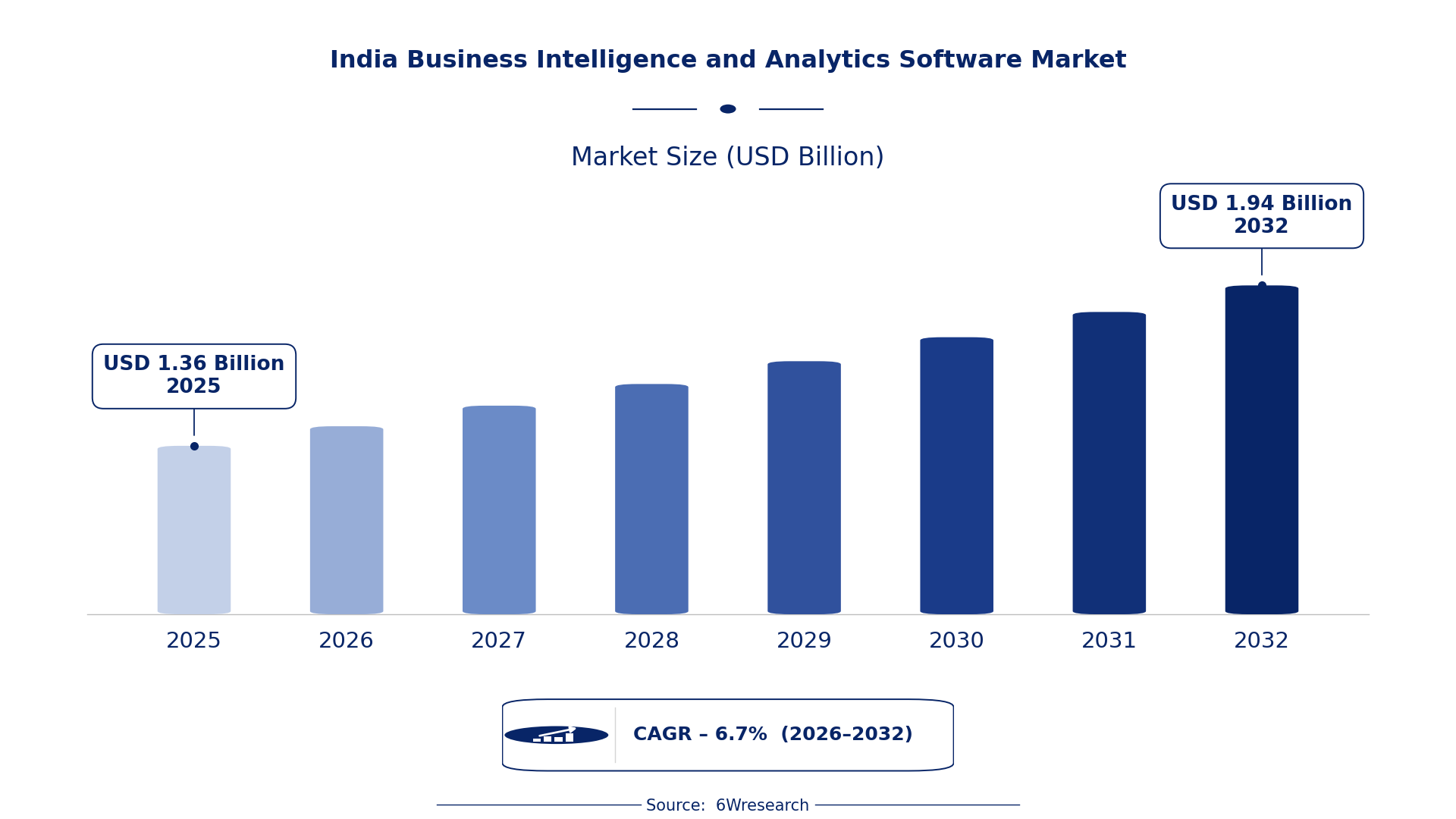
The India Business Intelligence and Analytics Software Market was estimated at USD 1358 Million in 2025 and is projected to reach USD 1940 Million by 2032, growing at a CAGR of 6.7% from 2026 to 2032.
India Business Intelligence and Analytics Software Market Synopsis
The primary force driving the India Business Intelligence and Analytics Software Market is the escalating demand for data-driven decision-making. Organizations are increasingly recognizing the need to analyze vast amounts of data to remain competitive and responsive to market changes.
As businesses in India look to optimize their operations, the software's advanced capabilities for real-time data access and predictive analytics are becoming indispensable. The integration of artificial intelligence and machine learning into analytics tools further enhances their value, allowing firms to extract actionable insights with unprecedented accuracy.
India Business Intelligence and Analytics Software Market Year-wise Growth Rate and Key Drivers
This graph illustrates the annual growth rates of the India Business Intelligence and Analytics Software Market from 2021 to 2032, highlighting a steady upward trajectory and projected expansion over the forecast period.
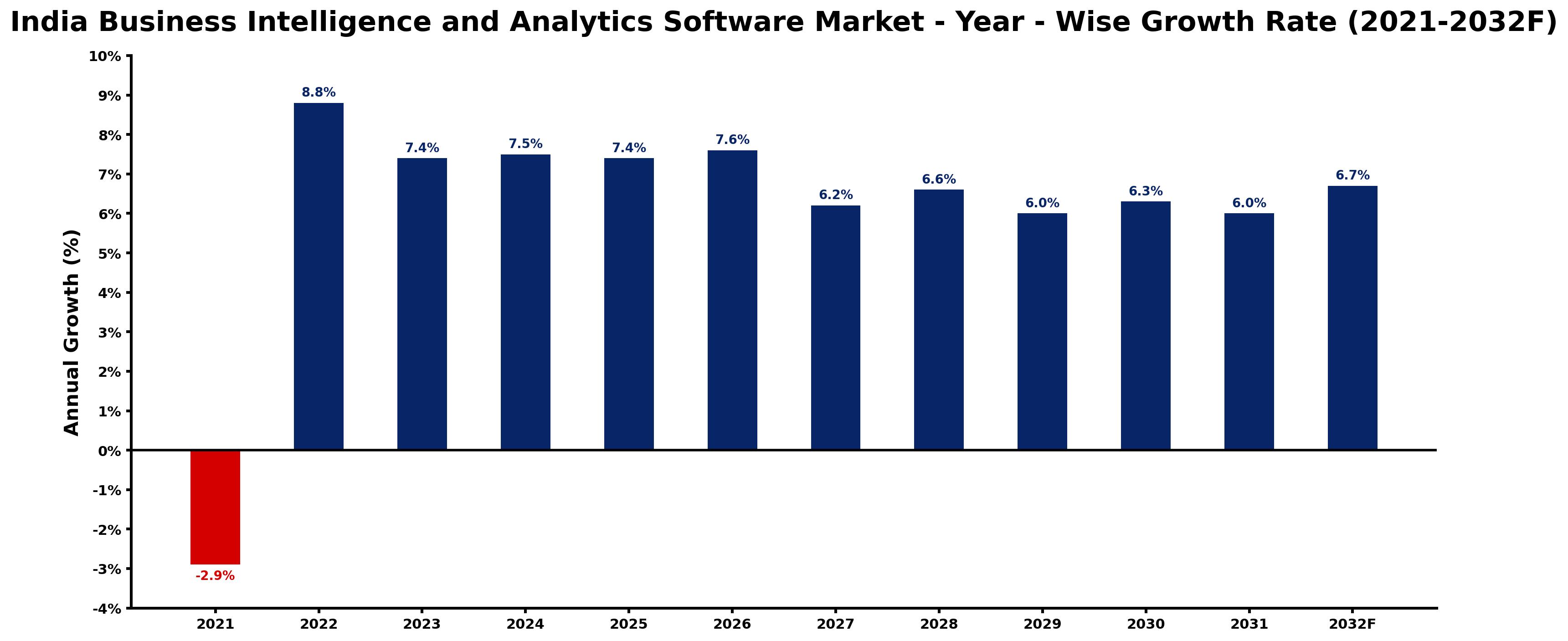
The table below presents the year‑wise growth rates along with the key drivers influencing the market
| Year | Growth Rate | Major Drivers |
| 2021 | -2.9% | Delayed adoption due to inadequate data infrastructure initiatives. |
| 2022 | 8.8% | Increased adoption of AI technologies across industries. |
| 2023 | 7.4% | Government's Digital India initiative boosting analytics investments. |
| 2024 | 7.5% | Rising number of startups leveraging big data solutions. |
| 2025 | 7.4% | Corporate tax incentives for technology-based innovations. |
| 2026 | 7.6% | Expanding internet penetration enhancing data accessibility. |
| 2027 | 6.2% | Upsurge in remote working requiring advanced analytics tools. |
| 2028 | 6.6% | Growing e-commerce demand driving BI tool adoption. |
| 2029 | 6.0% | Focus on smart manufacturing improving data utilization. |
| 2030 | 6.3% | Increased regulatory requirements for business data compliance. |
| 2031 | 6.0% | Strong investment in educational programs for data literacy. |
| 2032 | 6.7% | Emergence of cloud services enhancing BI software availability. |
Note: Market size estimations and growth projections presented in this report are based on 6Wresearch's proprietary forecasting methodology, utilizing the latest available industry data, government publications, and primary research inputs.
India Business Intelligence and Analytics Software Market Key Takeaways
Below are some of the specific key takeaways from the market, including:
- The market is experiencing steady growth as organizations prioritize data analysis for informed decision-making.
- Real-time access to data and predictive analytics are critical drivers of software adoption.
- Data quality and integration remain significant challenges for many businesses.
- Investments in training and development for skilled professionals are essential for maximizing software potential.
- The COVID-19 pandemic has accelerated the shift toward data-driven insights across sectors.
Evaluation of Restraints in India Business Intelligence and Analytics Software Market
Despite the promising growth trajectory, the market faces several restraints that hinder its potential. Data quality and integration issues are common, as many organizations struggle with siloed data sources. This fragmentation complicates the process of deriving meaningful insights from available data. on top of that, concerns around data privacy and security are increasingly pressing, particularly as businesses strive to comply with stringent regulations. The shortage of skilled professionals proficient in analytics tools exacerbates these challenges, necessitating significant investment in workforce training and development.
India Business Intelligence and Analytics Software Market Trends
A notable trend in the India Business Intelligence and Analytics Software Market is the growing emphasis on self-service analytics. Organizations are empowering end-users to generate insights without relying solely on IT departments, which accelerates decision-making processes. on top of that, the integration of artificial intelligence is transforming analytics capabilities, enabling predictive and prescriptive analytics that drive proactive business strategies. Cloud-based solutions are also gaining traction, offering flexibility and scalability that on-premises systems often lack.
India Business Intelligence and Analytics Software Market Opportunities
The future holds substantial growth and investment opportunities in the India Business Intelligence and Analytics Software Market. As more organizations recognize the importance of data-driven strategies, there is a clear push towards adopting advanced analytics solutions. Industries such as retail, healthcare, and finance are particularly ripe for innovation, as they seek to enhance customer experiences and streamline operations through analytics. Additionally, the ongoing digital transformation initiatives in India present avenues for software vendors to introduce tailored solutions that meet specific industry needs.
Government Initiatives in the India Business Intelligence and Analytics Software Market
Government initiatives are playing an essential role in shaping the India Business Intelligence and Analytics Software Market. With a focus on enhancing digital infrastructure and promoting data-driven governance, public policy is becoming increasingly supportive of analytics adoption. The government aims to facilitate the growth of this sector through strategic investments and regulatory frameworks that foster innovation and data security.
- A national digital infrastructure upgrade programme was launched to improve data accessibility and analytics capabilities across sectors.
- A current initiative is underway to develop a comprehensive data privacy framework that ensures compliance while encouraging data sharing for analytics purposes.
- Plans are in place for a public-private partnership expected to enhance analytics capabilities in government services by 2027.
- Ongoing workshops and training programs are being conducted to equip professionals with the necessary analytics skills.
Future Insights of the India Business Intelligence and Analytics Software Market
Looking ahead to 2026-2032, the India Business Intelligence and Analytics Software Market is set to evolve significantly. The increasing adoption of artificial intelligence and machine learning will drive more sophisticated analytics capabilities, enabling businesses to anticipate market trends and consumer behavior with greater accuracy. As organizations continue to harness data for strategic advantages, the demand for innovative software solutions will escalate. on top of that, the regulatory landscape will likely evolve, necessitating adaptable solutions that address emerging compliance requirements.
India Business Intelligence and Analytics Software Market Latest Developments
In the past year, the India Business Intelligence and Analytics Software Market has seen considerable activity as organizations accelerate their digital transformation efforts. Companies are increasingly investing in advanced analytics tools to improve operational efficiency and enhance customer interactions. The competitive environment is driving innovation, with several players introducing new features and capabilities to meet diverse business needs.
- A major technology vendor rolled out a new analytics platform designed to integrate seamlessly with existing enterprise systems in Q1 2025.
- An initiative to enhance data visualization capabilities is currently ongoing, providing users with more intuitive tools for analysis.
- A leading regional operator is expanding its analytics offerings, with a planned launch of new predictive analytics features set for late 2026.
- In early 2025, a collaborative project between tech firms and academic institutions was initiated to foster innovation in analytics education.
India Business Intelligence and Analytics Software Market - Key Attractiveness of the Report
- 10 Years of Market Numbers
- Historical Data Starting from 2022 to 2025
- Base Year: 2025
- Forecast Data until 2032
- Key Performance Indicators Impacting the Market
- Major Upcoming Developments and Projects
Key Highlights of the Report:
- India Business Intelligence and Analytics Software Market Outlook
- Market Size of India Business Intelligence and Analytics Software Market, 2025
- Forecast of India Business Intelligence and Analytics Software Market, 2032
- Historical Data and Forecast of India Business Intelligence and Analytics Software Revenues & Volume for the Period 2022-2032F
- India Business Intelligence and Analytics Software Market Trend Evolution
- India Business Intelligence and Analytics Software Market Drivers and Challenges
- India Business Intelligence and Analytics Software Price Trends
- India Business Intelligence and Analytics Software Porter's Five Forces
- India Business Intelligence and Analytics Software Industry Life Cycle
- Historical Data and Forecast of India Business Intelligence and Analytics Software Market Revenues & Volume By Segment for the Period 2022-2032F
- Historical Data and Forecast of India Business Intelligence and Analytics Software Market Revenues & Volume By Business Intelligence (BI) Platforms for the Period 2022-2032F
- Historical Data and Forecast of India Business Intelligence and Analytics Software Market Revenues & Volume By Corporate Performance Management (CPM) Suite for the Period 2022-2032F
- Historical Data and Forecast of India Business Intelligence and Analytics Software Market Revenues & Volume By Advanced and Predictive Analytics for the Period 2022-2032F
- Historical Data and Forecast of India Business Intelligence and Analytics Software Market Revenues & Volume By Content Analytics for the Period 2022-2032F
- Historical Data and Forecast of India Business Intelligence and Analytics Software Market Revenues & Volume By Analytics Application for the Period 2022-2032F
- Historical Data and Forecast of India Business Intelligence and Analytics Software Market Revenues & Volume By Deployment Modes for the Period 2022-2032F
- Historical Data and Forecast of India Business Intelligence and Analytics Software Market Revenues & Volume By On-premise for the Period 2022-2032F
- Historical Data and Forecast of India Business Intelligence and Analytics Software Market Revenues & Volume By Cloud for the Period 2022-2032F
- Historical Data and Forecast of India Business Intelligence and Analytics Software Market Revenues & Volume By Organization Size for the Period 2022-2032F
- Historical Data and Forecast of India Business Intelligence and Analytics Software Market Revenues & Volume By Small Medium Business (SMB??s) for the Period 2022-2032F
- Historical Data and Forecast of India Business Intelligence and Analytics Software Market Revenues & Volume By Large enterprises for the Period 2022-2032F
- Historical Data and Forecast of India Business Intelligence and Analytics Software Market Revenues & Volume By Deployment Mode for the Period 2022-2032F
- Historical Data and Forecast of India Business Intelligence and Analytics Software Market Revenues & Volume By On-premise for the Period 2022-2032F
- Historical Data and Forecast of India Business Intelligence and Analytics Software Market Revenues & Volume By Cloud for the Period 2022-2032F
- Historical Data and Forecast of India Business Intelligence and Analytics Software Market Revenues & Volume By Verticals for the Period 2022-2032F
- Historical Data and Forecast of India Business Intelligence and Analytics Software Market Revenues & Volume By Banking, Financial Services, and Insurance (BFSI) for the Period 2022-2032F
- Historical Data and Forecast of India Business Intelligence and Analytics Software Market Revenues & Volume By Healthcare for the Period 2022-2032F
- Historical Data and Forecast of India Business Intelligence and Analytics Software Market Revenues & Volume By IT & Telecom for the Period 2022-2032F
- Historical Data and Forecast of India Business Intelligence and Analytics Software Market Revenues & Volume By Retail for the Period 2022-2032F
- Historical Data and Forecast of India Business Intelligence and Analytics Software Market Revenues & Volume By Manufacturing for the Period 2022-2032F
- Historical Data and Forecast of India Business Intelligence and Analytics Software Market Revenues & Volume By Education for the Period 2022-2032F
- Historical Data and Forecast of India Business Intelligence and Analytics Software Market Revenues & Volume By Government for the Period 2022-2032F
- Historical Data and Forecast of India Business Intelligence and Analytics Software Market Revenues & Volume By Energy and Power for the Period 2022-2032F
- India Business Intelligence and Analytics Software Import Export Trade Statistics
- Market Opportunity Assessment By Segment
- Market Opportunity Assessment By Deployment Modes
- Market Opportunity Assessment By Organization Size
- Market Opportunity Assessment By Deployment Mode
- Market Opportunity Assessment By Verticals
- India Business Intelligence and Analytics Software Top Companies Market Share
- India Business Intelligence and Analytics Software Competitive Benchmarking By Technical and Operational Parameters
- India Business Intelligence and Analytics Software Company Profiles
- India Business Intelligence and Analytics Software Key Strategic Recommendations






































