India Dishwasher Market Size & Growth Rate
According to 6Wresearch internal database and industry insights, the India Dishwasher Market was valued at USD 90 Million in 2025 and is projected to reach USD 164.52 Million by 2032, growing at a CAGR of approximately 9% during 2026–2032.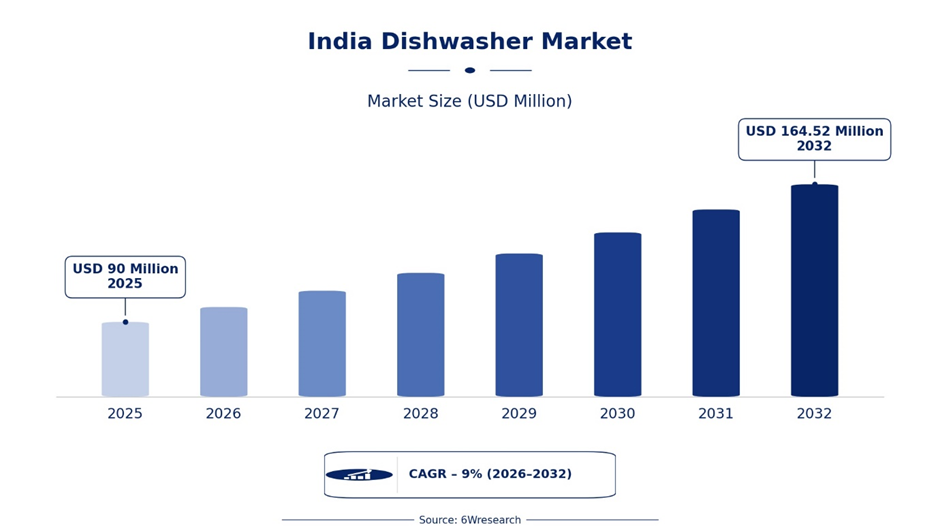
India Dishwasher Market Highlights
|
Report Metric |
Details |
|
Report Name |
India Dishwasher Market |
|
Market Size 2025 |
USD 90 Million |
|
Market Size 2032 |
USD 164.52 Million |
|
Absolute Growth 2025–2032 |
USD 74.52 Million |
|
CAGR 2026–2032 |
9% |
|
Peak Annual Growth |
10.1% in 2029 |
|
Forecast Period |
2026–2032 |
|
Historical Data |
2022–2025 |
|
Base Year |
2025 |
|
Leading Type, 2025 |
Freestanding dishwasher (64% share) |
|
Fastest-Growing Type |
Built-in dishwasher (12.1% CAGR) |
|
Leading Application, 2025 |
Residential (83% share) |
|
Fastest-Growing Application |
Industrial (11.2% CAGR) |
|
Leading Distribution Channel, 2025 |
Offline (72% share) |
|
Fastest-Growing Distribution Channel |
Online (12.6% CAGR) |
|
Growing Sector |
Premium urban kitchens and commercial food service |
|
Key End Users |
Urban households, hotels and restaurants, cloud kitchens, hospitals and institutional canteens |
India Dishwasher Market Year-wise Growth Rate and Key Drivers (2022–2032)
This graph illustrates the annual growth rates of the market from 2022 to 2032, highlighting a steady upward trajectory and projected market expansion over the forecast period.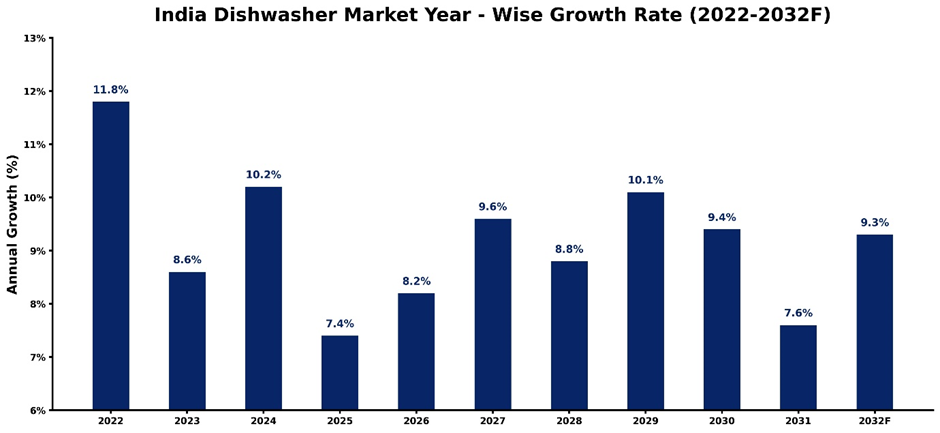 The following table presents the estimated annual growth rate for each year together with the principal factor influencing market performance.
|
Year |
Estimated Annual Growth (%) |
Market Rationale |
|
2022 |
11.8% |
Easing of COVID-19 restrictions in early 2022 released pent-up demand for premium kitchen appliances among urban households. |
|
2023 |
8.6% |
Elevated inflation and higher interest rates through 2023 moderated discretionary spending on high-ticket household appliances. |
|
2024 |
10.2% |
Strong festive-season demand and heavy promotional activity by appliance brands lifted unit sales during 2024. |
|
2025 |
7.4% |
A high base from strong 2024 sales and uneven urban consumption normalised growth during 2025. |
|
2026 |
8.2% |
Lower borrowing costs following policy rate reductions in 2025 are expected to improve affordability of high-ticket household durables. |
|
2027 |
9.6% |
Rising handovers of premium apartments with modular kitchens are expected to raise installations in major metropolitan regions. |
|
2028 |
8.8% |
Growth is expected to ease as demand from early adopters in the largest metropolitan cities begins to mature. |
|
2029 |
10.1% |
Wider distribution by leading brands is expected to extend reach into tier-2 cities and improve price accessibility. |
|
2030 |
9.4% |
Expansion beyond metropolitan cities is expected to slow modestly as the first wave of tier-2 purchases stabilises. |
|
2031 |
7.6% |
Intensifying price competition among global and domestic brands is expected to compress margins and slow value growth. |
|
2032 |
9.3% |
Replacement demand from the early installed base and premium upgrades to larger-capacity models are expected to lift growth. |
Note: Market size estimations and growth projections presented in this report are based on 6Wresearch’s proprietary forecasting methodology, utilizing the latest available industry data, government publications, and primary research inputs.
India Dishwasher Market Synopsis
The India Dishwasher Market comprises freestanding and built-in dishwashers sold to residential and industrial users through offline and online channels. A dishwasher is an automated appliance that cleans, rinses and dries utensils using heated water, detergent and pressurised jets. Growth is supported by rising urban household incomes, growing apartment-based living, increasing awareness of water-efficient cleaning and wider distribution by leading appliance brands. However, high purchase prices, low-cost domestic help and hard water continue to limit household adoption.
Market Dynamics Impact Analysis (2026–2032)
|
Factor |
Type |
Impact |
Primary Segment Affected |
|
Rising dual-income urban households |
Driver |
High |
Residential |
|
Water conservation awareness |
Driver |
Medium |
Freestanding dishwasher |
|
Modular kitchen integration in premium housing |
Opportunity |
High |
Built-in dishwasher |
|
Marketplace expansion into tier-2 and tier-3 cities |
Opportunity |
High |
Online |
|
High purchase price relative to domestic help |
Restraint |
High |
Residential |
|
Compact kitchens and cookware compatibility |
Restraint |
Medium |
Freestanding dishwasher |
|
Hard water and service network gaps |
Challenge |
High |
Offline |
|
Running costs of consumables and utilities |
Challenge |
Medium |
Industrial |
Evaluation of Drivers in India Dishwasher Market (2026–2032)
Below mentioned are some major drivers and their influence on market dynamics.
|
Drivers |
Primary Segment Affected |
Why It Matters (Evidence) |
|
Rising participation of women in the workforce and growth of dual-income households |
Residential |
Households with limited time seek to automate utensil cleaning, which converts a daily chore into a purchase decision. The female labour force participation rate for those aged 15 and above rose to about 41.7 per cent in 2023-24. |
|
Water stress and conservation awareness |
Freestanding dishwasher |
Efficient machines use a fraction of the water consumed in manual washing, which appeals to buyers in water-scarce cities. NITI Aayog’s 2018 water index reported that about 600 million Indians face high to extreme water stress. |
|
Reduction of GST on dishwashers |
Offline |
Lower taxation reduces shelf prices and improves conversion in retail stores where buyers compare models. The GST Council cut the rate from 28 per cent to 18 per cent, effective 22 September 2025. |
|
Growth of modular kitchens in new apartments |
Built-in dishwasher |
Developers and kitchen designers include dishwasher bays in new layouts, which creates demand for cabinet-compatible units. Built-in models follow a standard 60 cm width that fits organised modular kitchen systems. |
|
Hygiene compliance in commercial food service |
Industrial |
Hotels, cloud kitchens and canteens require high-temperature sanitisation of utensils to meet audit requirements, which supports commercial machine adoption. Schedule 4 of the Food Safety and Standards (Licensing and Registration of Food Businesses) Regulations, 2011 sets sanitary requirements for food businesses. |
The India Dishwasher Market is supported by rising household purchasing power, as an expanding middle class increasingly shifts from basic to premium kitchen appliances. Furthermore, urbanisation is concentrating households in apartment-based housing, where compact living arrangements encourage the adoption of automated solutions for daily chores, with urban areas accounting for approximately 36 per cent of the national population. Expanding organised appliance retail is also making high-ticket durables more accessible to first-time buyers through wider product displays and financing options. In addition, local assembly by international and domestic brands is reducing delivery times, while brand-operated service centres are strengthening consumer confidence across metropolitan regions.
Evaluation of Restraints in India Dishwasher Market
Below mentioned are some major restraints and their influence on market dynamics.
|
Market Restraint |
Primary Segment Affected |
Why It Matters (Evidence) |
|
High upfront cost compared with domestic help |
Residential |
Entry-level units are priced from roughly INR 25,000 to INR 30,000, whereas part-time domestic help costs a few thousand rupees a month, which delays purchase decisions. |
|
Mismatch with Indian cooking and utensils |
Freestanding dishwasher |
Oil-rich dishes and large steel vessels, pressure cookers and griddles often need manual pre-rinsing and do not fit standard racks, which reduces perceived convenience. Standard baskets are designed for 12 to 14 Western-style place settings. |
|
Low awareness and limited trust in cleaning performance |
Offline |
Many buyers doubt that machines can clean heavily soiled utensils, which limits first-time conversion. Dishwasher ownership remains below 1 per cent of Indian households. |
|
Space and installation limitations in compact kitchens |
Built-in dishwasher |
Built-in units need cabinet cut-outs and dedicated water inlet, drainage and power points, which restricts retrofits in existing flats. Many urban apartments of 800 to 1,000 square feet have kitchens too small for a 60 cm unit. |
|
Dependence on imported premium models and currency movement |
Built-in dishwasher |
Premium brands import finished units from Europe and Asia, which raises landed costs when the rupee depreciates. Basic customs duty applies to imported finished household appliances. |
India Dishwasher Market Challenges
The India Dishwasher Industry faces several operational challenges. Groundwater in parts of north-western and western India often exceeds 500 mg per litre of dissolved solids, leading to scale build-up in heating elements and increasing the need for water-softening accessories. Furthermore, many apartment buildings constructed before 2010 lack dedicated water inlets and drainage points, thereby increasing installation costs and complexity. A limited pool of trained technicians outside major cities also extends repair times and weakens brand reputation. Additionally, recurring expenditure on detergent, salt and rinse aid, estimated at INR 8 to 12 per cycle, further discourages frequent usage among cost-conscious households.
Trends in the India Dishwasher Market
Below mentioned are some of the trends shaping the India Dishwasher Market growth.
- Shift from Full-Size to Compact Slimline Formats: Urban apartment kitchens are driving demand for 45 cm slimline and compact models that fit limited counter and floor space. Leading brands have widened compact ranges for small families. The shift favours suppliers able to deliver full cleaning performance in a reduced footprint.
- Water and Energy Efficiency Prioritised over Capacity Alone: Buyers in water-stressed cities increasingly compare litres per cycle and energy use before choosing a model, and leading units now operate on about 10 litres per cycle. Suppliers that certify and communicate resource savings can differentiate their offers in a price-sensitive market, while those with older platforms face pressure to upgrade.
- Shift from Showroom Discovery to Digital Research and Purchase: Buyers increasingly research dishwashers through video demonstrations, ratings and marketplace listings before visiting a store, and brands now allow installation booking and EMI selection at checkout. Online listings also reach cities without brand showrooms. The shift favours suppliers with strong digital content, transparent pricing and reliable doorstep installation partners.
Investment Opportunities in the India Dishwasher Market
Some of the investment opportunities in the India Dishwasher Market are mentioned below.
- Local Assembly and Component Manufacturing: Import dependence on pumps, heating elements and control boards leaves room for domestic production. Investors can set up assembly lines or component units in appliance clusters such as Greater Noida, Pune and Sri City, with entry through joint ventures with established appliance makers or contract manufacturing agreements. Local production would shorten supply chains and enable competitive pricing.
- Appliance Rental and Subscription Services: High purchase prices and uncertain usage deter first-time buyers, creating scope for rental and subscription offers that include installation and maintenance. Investors can build asset-backed leasing platforms or partner with existing rental companies and brand dealers in major cities. Recurring revenue and consumer trial would support later conversion to ownership.
- After-Sales Service and Water-Treatment Networks: Hard water and thin technician coverage outside large cities create recurring demand for installation, descaling and servicing. Investors can establish multi-brand franchise service networks, water softener supply and spare parts distribution that reduce repair downtime for owners. Entry is practical through tie-ups with appliance dealers and home-service platforms in tier-2 cities.
Leading Players in India Dishwasher Market
Stated below are some of the leading companies contributing significantly to the India Dishwasher Market share.
1. BSH Hausgeräte (Bosch and Siemens)
| Company Name | BSH Hausgeräte (Bosch and Siemens) |
|---|---|
| Established Year | 1967 |
| Headquarters | Munich, Germany |
| Official Website | Click Here |
BSH Hausgeräte is a leading manufacturer of home appliances and supplies Bosch and Siemens dishwashers in India. The company holds a strong position in the premium and built-in categories through its dealer and service network.
2. IFB Industries
| Company Name | IFB Industries |
|---|---|
| Established Year | 1974 |
| Headquarters | Kolkata, India |
| Official Website | Click Here |
IFB Industries is an Indian home appliances company that offers dishwashers alongside laundry and kitchen products. It is a prominent domestic participant with a wide service network across the country.
3. Voltas Limited
| Company Name | Voltas Limited |
|---|---|
| Established Year | 1954 |
| Headquarters | Mumbai, India |
| Official Website | Click Here |
Voltas Limited is an Indian engineering and appliances company that markets dishwashers through its partnership with Beko. It contributes to the market through broad retail reach and an established after-sales network.
4. Miele
| Company Name | Miele |
|---|---|
| Established Year | 1899 |
| Headquarters | Gütersloh, Germany |
| Official Website | Click Here |
Miele is a premium appliance manufacturer that supplies residential and professional dishwashing equipment in India. The company serves the luxury and commercial kitchen segments through selected experience centres and specialist dealers.
Government Initiatives in the India Dishwasher Market
The policy framework is shaped by the GST Council’s decision to reduce the tax rate on dishwashers from 28 per cent to 18 per cent with effect from 22 September 2025, which lowers retail prices for buyers. The Make in India initiative, launched in 2014 and covering 25 sectors, further encourages local assembly of household appliances through investment facilitation and a stable manufacturing policy environment.
Implementation is led by the Ministry of Housing and Urban Affairs, which has run the Smart Cities Mission across 100 cities since 2015 and sanctioned more than 1 crore houses under the Pradhan Mantri Awas Yojana-Urban, expanding formal urban housing stock. The Bureau of Indian Standards complements these efforts by administering safety standards for household electrical appliances, which supports quality assurance for imported and locally assembled units.
Future Insight of the India Dishwasher Market
The India Dishwasher Market is expected to benefit from the expansion of broadband and mobile network coverage, which will enable remote monitoring and software updates in connected appliances. Furthermore, the development of a domestic electronics component ecosystem will improve supply reliability and support competitive pricing. The Electronics Component Manufacturing Scheme, approved in 2025, carries an outlay of INR 22,919 crore, while the Viksit Bharat vision targets developed-nation status by 2047. Additionally, the continued expansion of planned townships and premium housing projects will increase the base of modern kitchens, while stricter water and energy efficiency requirements will favour advanced dishwasher models.
Market Segmentation Analysis
The report offers a comprehensive study of the market across its key segments. The chart below highlights the leading segment by market share in 2025 and the fastest-growing segment by CAGR over 2026–2032, followed by a detailed analysis of each segment.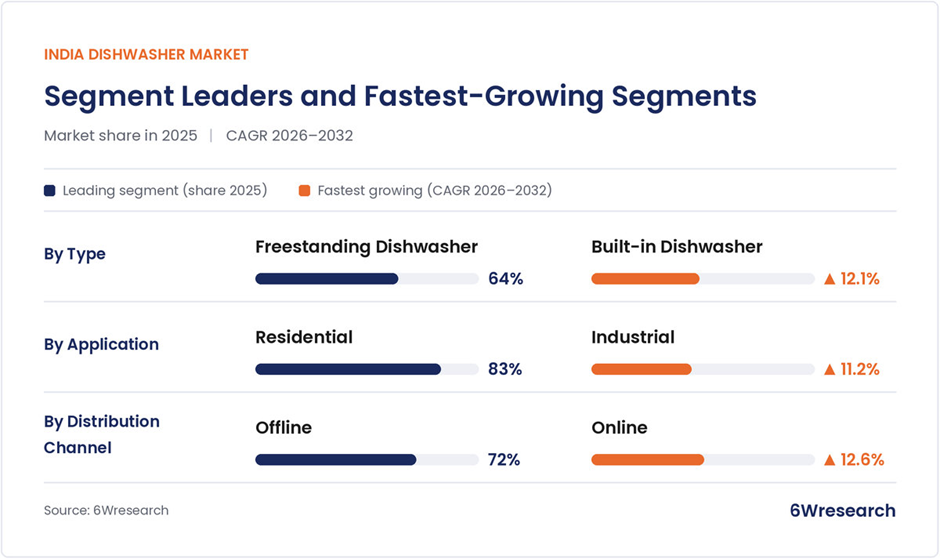
By Type – Freestanding Dishwasher Led, Built-in Dishwasher Expected to Grow Fastest
According to Ravi Bhandari, Research Head at 6Wresearch, freestanding dishwashers lead the market with a 64% share in 2025, as they require no cabinetry modifications and are suitable for rented and compact homes in Delhi NCR, Mumbai and Bengaluru. Meanwhile, built-in dishwashers are expected to record the fastest growth at a CAGR of 12.1% during 2026 to 2032, supported by premium apartment projects that incorporate dishwasher spaces into modular kitchen layouts.
By Application – Residential Led, Industrial Expected to Grow Fastest
Residential users account for the largest share of 83% in 2025, driven by urban households in the National Capital Region and Mumbai Metropolitan Region that are increasingly automating daily utensil cleaning. In contrast, the industrial category is projected to record the fastest CAGR of 11.2% during 2026 to 2032, as hotels, cloud kitchens and institutional canteens in metropolitan areas increasingly adopt machine washing to meet hygiene standards.
By Distribution Channel – Offline Leads, Online Expected to Grow Fastest
Offline channels hold a 72% share in 2025, as buyers prefer in-store demonstrations and assured installation services offered by appliance retailers and brand stores in major cities. Meanwhile, online sales are projected to expand at the fastest CAGR of 12.6% during 2026 to 2032, supported by marketplace reach across smaller cities and attractive festive-season promotions.
Key Attractiveness of the Report
- 10 Years of Market Numbers
- Historical Data Starting from 2022 to 2025
- Base Year 2025
- Forecast Data until 2032
- Key Performance Indicators Impacting the Market
- Major Upcoming Developments and Projects
Key Highlights of the Report:
- India Dishwasher Market Outlook
- Market Size of India Dishwasher Market, 2025
- Forecast of India Dishwasher Market, 2032
- Historical Data and Forecast of India Dishwasher Revenues & Volume for the Period 2022-2032
- India Dishwasher Market Trend Evolution
- India Dishwasher Market Drivers and Challenges
- India Dishwasher Price Trends
- India Dishwasher Porter's Five Forces
- India Dishwasher Industry Life Cycle
- Historical Data and Forecast of India Dishwasher Market Revenues & Volume By Type for the Period 2022-2032
- Historical Data and Forecast of India Dishwasher Market Revenues & Volume By Freestanding dishwasher for the Period 2022-2032
- Historical Data and Forecast of India Dishwasher Market Revenues & Volume By Built-in dishwasher for the Period 2022-2032
- Historical Data and Forecast of India Dishwasher Market Revenues & Volume By Application for the Period 2022-2032
- Historical Data and Forecast of India Dishwasher Market Revenues & Volume By Industrial for the Period 2022-2032
- Historical Data and Forecast of India Dishwasher Market Revenues & Volume By Residential for the Period 2022-2032
- Historical Data and Forecast of India Dishwasher Market Revenues & Volume By Distribution Channel for the Period 2022-2032
- Historical Data and Forecast of India Dishwasher Market Revenues & Volume By Offline for the Period 2022-2032
- Historical Data and Forecast of India Dishwasher Market Revenues & Volume By Online for the Period 2022-2032
- India Dishwasher Import Export Trade Statistics
- Market Opportunity Assessment By Type
- Market Opportunity Assessment By Application
- Market Opportunity Assessment By Distribution Channel
- India Dishwasher Top Companies Market Share
- India Dishwasher Competitive Benchmarking By Technical and Operational Parameters
- India Dishwasher Company Profiles
- India Dishwasher Key Strategic Recommendations
Market Covered
The report offers an extensive study of the following market segments.
By Type
- Freestanding dishwasher
- Built-in dishwasher
By Application
- Industrial
- Residential
By Distribution Channel
- Offline
- Online































