India Distilled Water Market Size, Share & Growth Rate
The India Distilled Water Market was estimated at USD 799 Million in 2025 and is projected to reach USD 1142 Million by 2032, growing at a CAGR of 5.2% from 2026 to 2032. This impressive growth trajectory can be attributed to several factors, including the rising demand from the food and beverage sector, which is increasingly utilizing distilled water in production processes. Additionally, the healthcare industry's expanding requirements for purified water further drive the market's evolution, fueled by a growing consumer awareness of the importance of health and safety.
India Distilled Water Market Growth Rate Analysis (2021-2032)
The Indian distilled water market has experienced varying growth rates over recent years, reflecting shifts in consumer behavior and technological advancements. After a contraction of -3.5% in 2021, the market rebounded with impressive growth of 9.0% in 2022, fueled by rising health awareness and an increase in demand from sectors like pharmaceuticals and food processing. As we progress into 2023, growth remains robust at 8.0%, and forecasts suggest a steady decline in growth rates, stabilizing around 6.5% to 6.2% by 2028. This normalization is attributed to evolving industrial needs, improved water purification technologies, and ongoing investments in infrastructure, ensuring a sustainable supply chain amid India's pressing energy transition and urbanization trends.
India Distilled Water Market Year-wise Growth Rate and Key Drivers
This graph highlights how the India Distilled Water Market has steadily grown over the past five years, supported by major growth factors.
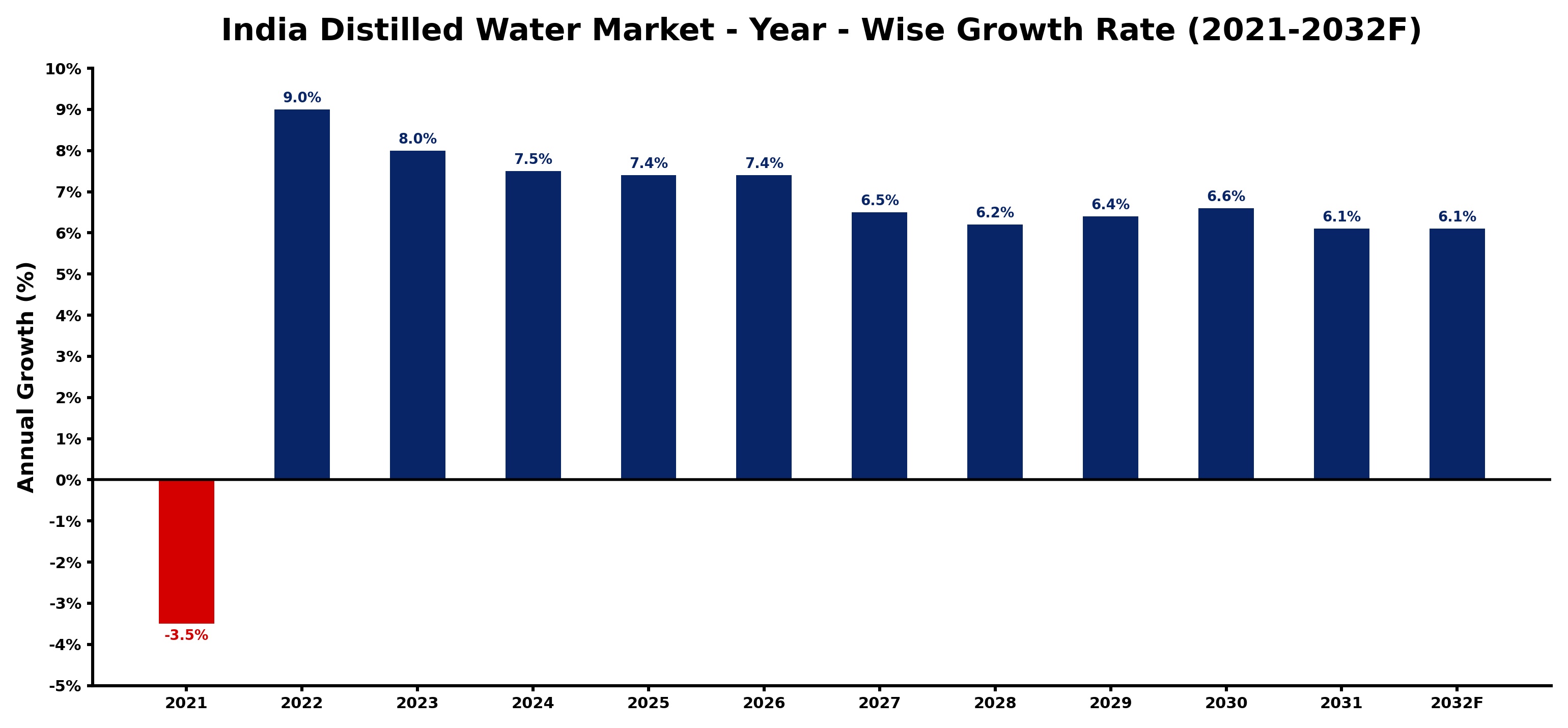
The table below presents the year‑wise growth rates along with the key drivers influencing the market
| Year | Growth Rate | Major Drivers |
| 2021 | -3.5% | Pandemic reduced consumer demand |
| 2022 | 9.0% | Health awareness drove product adoption |
| 2023 | 8.0% | Industrial applications expanded significantly |
| 2024 | 7.5% | Increased urbanization boosted consumption |
| 2025 | 7.4% | Technological advancements improved production |
| 2026 | 7.4% | Rising disposable incomes fueled demand |
| 2027 | 6.5% | Sustainability trends enhanced market growth |
| 2028 | 6.2% | E-commerce platforms increased accessibility |
| 2029 | 6.4% | Product innovation attracted new customers |
| 2030 | 6.6% | Government initiatives supported industry growth |
| 2031 | 6.1% | Export opportunities expanded market reach |
| 2032 | 6.1% | Consumer preferences shifted positively |
Note - Market size estimations and growth projections presented in this report are based on 6Wresearch’s advanced forecasting approach, validated with industry datasets as of June 2026.
India Distilled Water Market Synopsis
In India, the demand for distilled water is notably influenced by the increasing adoption in laboratories, hospitals, and the pharmaceutical industry, where the need for contamination-free water is critical. Furthermore, the trend towards packaged and processed foods has heightened the necessity for distilled water, which ensures product safety and quality.
Urbanization and rising living standards are leading to greater consumption of packaged products, consequently driving the distilled water market. With health-conscious consumers seeking purity and quality in drinking water, the industry is set to witness sustained demand growth across various applications.
India Distilled Water Market Key Takeaways
- The India Distilled Water Market is projected to grow significantly, reaching USD 1142 Million by 2032.
- Awareness regarding health and safety is significantly boosting demand for distilled water across multiple sectors.
- Regulatory frameworks enforcing stringent quality standards are propelling investments in the distilled water segment.
- Urbanization trends are facilitating improved access to distilled water, enhancing market potential.
- The increasing use of distilled water in laboratories and healthcare is further driving market growth.
Evaluation of Restraints in India Distilled Water Market
While the India Distilled Water Market demonstrates robust potential, several factors could hinder its growth. The high capital investment required for advanced purification technology creates barriers to entry for smaller companies. Additionally, operational costs associated with energy consumption can affect profitability. The prevalence of alternative purification methods, such as reverse osmosis, which offer similar benefits at a lower cost, poses a competitive threat to distilled water products. These factors combined necessitate strategic planning for stakeholders to navigate market challenges effectively.
India Distilled Water Market Trends
The market is currently witnessing several key trends that are shaping demand and technology. Increasing environmental consciousness is prompting manufacturers to invest in sustainable production practices, while innovations in purification technology are enhancing the efficiency and quality of distilled water. Furthermore, a growing trend towards online purchasing is making distilled water more accessible to consumers, particularly in urban areas where lifestyle changes are promoting convenience and quality.
India Distilled Water Market Opportunities
There are significant growth opportunities within the India Distilled Water Market, particularly in expanding product availability in rural areas and through e-commerce platforms. Investment in advanced purification technologies can enhance product offerings, while partnerships with health and wellness brands could boost market visibility. Additionally, as the pharmaceutical and biotech sectors expand, the demand for distilled water in production and research processes presents lucrative avenues for growth.
Government Initiatives in the India Distilled Water Market
The Indian government has implemented various initiatives aimed at ensuring water quality and safety across the country. This includes stringent regulations and quality assurance measures that mandate the purity of drinking water sources. Public health campaigns emphasizing the importance of safe drinking water have also been reinforced, contributing to heightened consumer awareness and demand for distilled water products. Furthermore, there are incentives for companies investing in sustainable water purification technologies to support environmental sustainability.
Future Insights of the India Distilled Water Market
Looking ahead to the period of 2026-2032, the India Distilled Water Market is expected to continue its upward trajectory. The convergence of health awareness and technological advancement will likely redefine consumer preferences, making distilled water a staple in households and industries alike. The ongoing urbanization and rising disposable incomes will drive further demand, ensuring that distilled water remains integral to various sectors, particularly food and beverages and healthcare.
India Distilled Water Market Latest Developments (May 2025 - June 2026)
In the recent months, the industry has seen a focus on enhancing distribution networks to improve access to distilled water across diverse regions. Companies are exploring collaborations with e-commerce platforms to cater to the growing trend of online grocery shopping, making distilled water more readily available. Additionally, innovations in purification technologies are making headlines, with several firms launching advanced systems aimed at increasing efficiency and reducing operational costs.
India Distilled Water Market - Key Attractiveness of the Report
- 10 Years of Market Numbers
- Historical Data Starting from 2022 to 2025
- Base Year: 2025
- Forecast Data until 2032
- Key Performance Indicators Impacting the Market
- Major Upcoming Developments and Projects
Key Highlights of the Report:
- India Distilled Water Market Outlook
- Market Size of India Distilled Water Market, 2025
- Forecast of India Distilled Water Market, 2032
- Historical Data and Forecast of India Distilled Water Revenues & Volume for the Period 2022-2032F
- India Distilled Water Market Trend Evolution
- India Distilled Water Market Drivers and Challenges
- India Distilled Water Price Trends
- India Distilled Water Porter's Five Forces
- India Distilled Water Industry Life Cycle
- Historical Data and Forecast of India Distilled Water Market Revenues & Volume By Types for the Period 2022-2032F
- Historical Data and Forecast of India Distilled Water Market Revenues & Volume By Pharmaceutical Grade for the Period 2022-2032F
- Historical Data and Forecast of India Distilled Water Market Revenues & Volume By Industrial Grade for the Period 2022-2032F
- Historical Data and Forecast of India Distilled Water Market Revenues & Volume By Applications for the Period 2022-2032F
- Historical Data and Forecast of India Distilled Water Market Revenues & Volume By Drinking for the Period 2022-2032F
- Historical Data and Forecast of India Distilled Water Market Revenues & Volume By Chemical and Biological Laboratories for the Period 2022-2032F
- Historical Data and Forecast of India Distilled Water Market Revenues & Volume By Automotive Cooling Systems and Batteries for the Period 2022-2032F
- Historical Data and Forecast of India Distilled Water Market Revenues & Volume By Medical for the Period 2022-2032F
- Historical Data and Forecast of India Distilled Water Market Revenues & Volume By Others for the Period 2022-2032F
- India Distilled Water Import Export Trade Statistics
- Market Opportunity Assessment By Types
- Market Opportunity Assessment By Applications
- India Distilled Water Top Companies Market Share
- India Distilled Water Competitive Benchmarking By Technical and Operational Parameters
- India Distilled Water Company Profiles
- India Distilled Water Key Strategic Recommendations






































