India Groceries Market Summary
The india groceries market was estimated at USD 992 Million in 2025 and is projected to reach USD 1421 Million by 2032, growing at a CAGR of 8.1% from 2026 to 2032.
India Groceries Market Year-wise Growth Rate and Key Drivers
This graph highlights how the India Groceries Market has steadily grown over the past five years, supported by major growth factors.
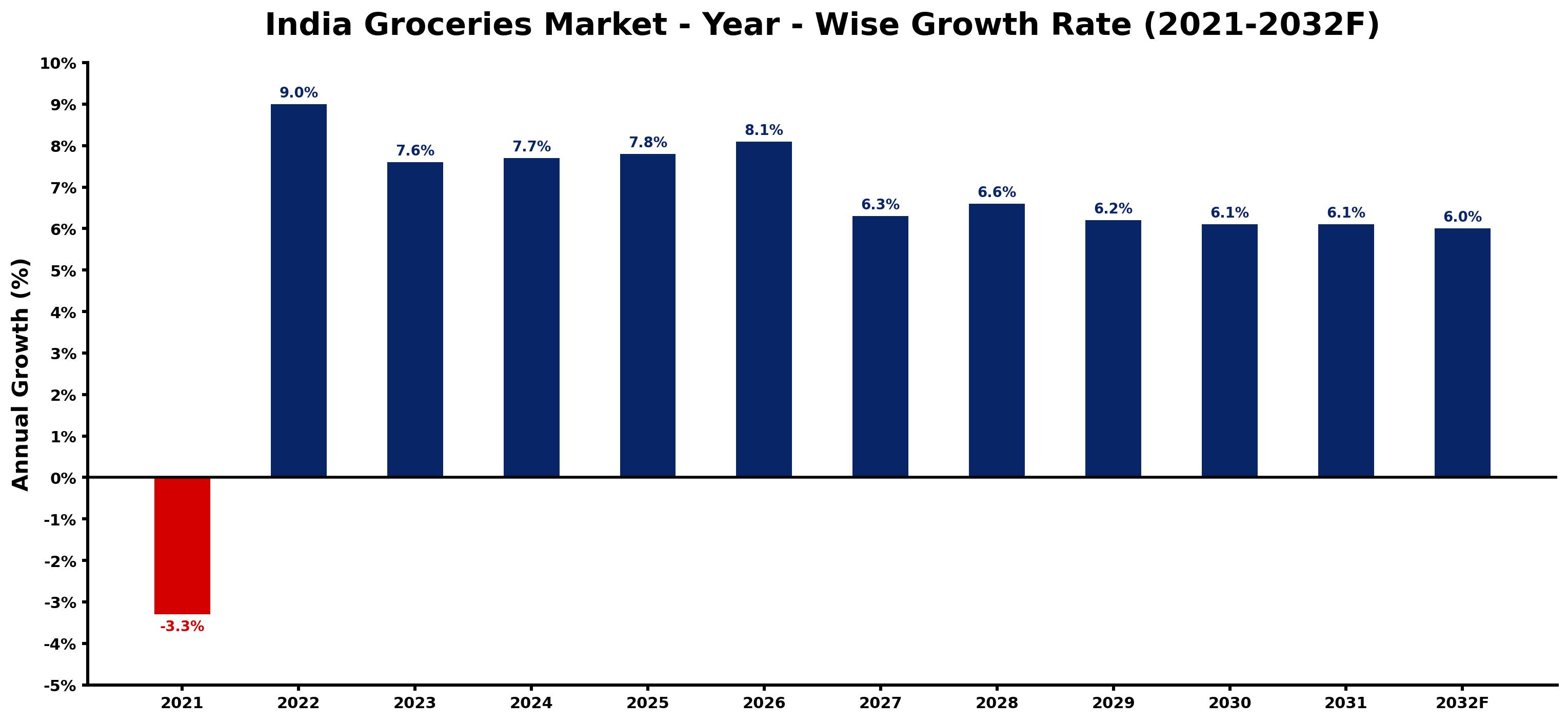
The table below presents the year wise growth rates along with the key drivers influencing the market
| Year | Growth Rate | Major Drivers |
| 2021 | -3.3% | Pandemicinduced supply chain disruptions led to product shortages, ultimately diminishing consumer purchasing power for groceries. |
| 2022 | 9.0% | Emergence of local brands fosters competition, encouraging innovative product offerings in groceries. |
| 2023 | 7.6% | Increased urbanization leads to demand for organized retail formats and modern grocery stores. |
| 2024 | 7.7% | Consumer awareness about health drives interest in organic and natural grocery products. |
| 2025 | 7.8% | E-commerce platforms expand grocery offerings, making shopping more accessible for consumers. |
| 2026 | 8.1% | Technological integrations in supply chains enhance efficiency and reduce operational costs. |
| 2027 | 6.3% | Rural areas experience better connectivity, increasing access to grocery products and services. |
| 2028 | 6.6% | Shifts in consumer spending patterns prioritize convenience foods and ready-to-cook meal options. |
| 2029 | 6.2% | Sustainability trends influence grocery brands towards eco-friendly packaging and sourcing practices. |
| 2030 | 6.1% | Investment in cold chain logistics supports the delivery of perishable items nationwide. |
| 2031 | 6.1% | Health crises prompt heightened focus on hygiene and safety in grocery shopping environments. |
| 2032 | 6.0% | Collaboration between local farmers and grocery retailers strengthens fresh produce supply chains. |
Note - Market size estimations and growth projections presented in this report are based on 6Wresearch's advanced forecasting approach, validated with industry datasets as of June 2026.
India Groceries Market Synopsis
The India Groceries Market is projected to reach 8.1% and witness significant growth during the forecast period (2026-2032). The market is driven by several factors, including increasing urbanization, a shift towards organized retail formats, and growing consumer awareness regarding health and nutrition. As lifestyles evolve, the demand for convenient shopping experiences and healthier food options continues to rise, making it an opportune time for stakeholders in this sector.
India Groceries Market Growth Drivers
Key drivers of the India Groceries Market are reshaping the grocery landscape and contributing to its robust growth:
- Shift Towards Organized Retail Formats: The emergence of modern retail formats, including convenience stores, has facilitated easier access to groceries, allowing consumers to shop quickly and efficiently.
- Increasing Urbanization: The growing urban population has led to a surge in the consumption of packaged foods and groceries, with supermarkets and online grocery stores becoming popular destinations for urban dwellers.
- Rising Awareness About Health & Nutrition: Consumers are increasingly prioritizing healthy eating habits, which has resulted in heightened demand for organic products and dietary supplements, fostering a shift in product offerings.
- Convenience Shopping Trends: Working-class individuals are gravitating towards shopping options that save time, driving the popularity of convenience stores and home delivery services.
- Technological Advancements: Innovations in e-commerce and supply chain management have enhanced the efficiency of grocery delivery systems, making it easier for consumers to access a variety of grocery items.
India Groceries Market Challenges and Restraints
While the India Groceries Market is poised for growth, it faces certain challenges:
- High Price Sensitivity of Consumers: Indian consumers tend to be highly price-sensitive, which influences their purchasing decisions and limits the sales potential of premium grocery items.
- Limited Reach of Online Grocery Stores: Although online grocery shopping is on the rise, tier 2 cities often lack sufficient access to e-commerce platforms, presenting a barrier to market expansion for companies.
- Infrastructure Constraints: Inadequate supply chain infrastructure and logistical challenges can hinder the timely delivery of grocery products, impacting customer satisfaction.
- Competition from Local Kirana Stores: Traditional mom-and-pop stores continue to dominate the grocery market due to their accessibility and established customer relationships, posing a challenge for organized retail formats.
- Regulatory Hurdles: Compliance with various government regulations regarding food safety and quality can be cumbersome for retailers and suppliers, affecting their operational efficiency.
India Groceries Market Trends and Opportunities
Emerging trends in the India Groceries Market are creating new opportunities for growth:
- Increase in Demand for Organic Food Products: As consumers become more health-conscious, the market for organic food is expanding, prompting retailers to increase their organic product offerings.
- Growth of Home Delivery Services: The rise of technology-driven home delivery services offers convenience to consumers, allowing them to receive groceries at their doorstep swiftly.
- Enhanced Use of Technology by Retailers: Retailers are leveraging technologies such as AI and IoT to improve customer experience, streamline inventory management, and optimize delivery processes.
- Focus on Sustainable Practices: There is an increasing emphasis on sustainable sourcing and eco-friendly packaging, reflecting a shift towards environmentally responsible grocery shopping.
- Collaboration Among Stakeholders: Partnerships between local suppliers and retailers are becoming more common, enabling a wider range of products to reach consumers effectively.
India Groceries Market Government Investment and Initiatives
The government of India has been actively promoting initiatives to bolster the grocery sector, recognizing its potential for economic growth and employment generation. Various policies have been introduced to facilitate the growth of organized retail, including:
- Investment in Infrastructure: The government is investing in improving logistics and supply chain infrastructure to enhance the distribution of grocery items across urban and rural areas.
- Encouragement of E-commerce: Provisions have been made to support the growth of online grocery platforms, creating a conducive environment for digital retailing.
- Promotion of Organic Farming: Incentives for organic farming and the establishment of regulatory frameworks help stimulate the organic grocery segment.
- Support for Small and Medium Enterprises (SMEs): Policies aimed at empowering local suppliers and SMEs are fostering a diverse range of grocery offerings in the market.
- Consumer Awareness Programs: The government is implementing public awareness campaigns to educate consumers about health and nutrition, thereby driving demand for healthier grocery options.
India Groceries Market Latest Developments (May 2025 - June 2026)
Recent developments in the India Groceries Market indicate significant industry shifts and trends:
- Innovations in Home Delivery: Several grocery retailers have enhanced their home delivery services, leveraging technology to ensure faster and more reliable delivery times for customers.
- Expansion of Online Platforms: The number of online grocery platforms continues to grow, expanding their reach to underserved areas, particularly in tier 2 and tier 3 cities.
- Increase in Private Label Products: Retailers are increasingly introducing their own private label products, providing consumers with affordable options while enhancing brand loyalty.
- Adoption of Digital Payment Solutions: The use of digital payment methods for grocery purchases is on the rise, driven by consumer preference for cashless transactions.
- Emergence of Health-Focused Brands: New brands focused on health and wellness are entering the market, offering products that cater to the evolving consumption patterns of health-conscious consumers.
India Groceries Market - Key Attractiveness of the Report
- 10 Years of Market Numbers
- Historical Data Starting from 2022 to 2025
- Base Year: 2025
- Forecast Data until 2032
- Key Performance Indicators Impacting the Market
- Major Upcoming Developments and Projects
Key Highlights of the Report:
- India Groceries Market Outlook
- Market Size of India Groceries Market, 2025
- Forecast of India Groceries Market, 2032
- Historical Data and Forecast of India Groceries Revenues & Volume for the Period 2022-2032F
- India Groceries Market Trend Evolution
- India Groceries Market Drivers and Challenges
- India Groceries Price Trends
- India Groceries Porter's Five Forces
- India Groceries Industry Life Cycle
- Historical Data and Forecast of India Groceries Market Revenues & Volume By Product Types for the Period 2022-2032F
- Historical Data and Forecast of India Groceries Market Revenues & Volume By Packaged Food for the Period 2022-2032F
- Historical Data and Forecast of India Groceries Market Revenues & Volume By Unpackaged Food for the Period 2022-2032F
- Historical Data and Forecast of India Groceries Market Revenues & Volume By Drinks for the Period 2022-2032F
- Historical Data and Forecast of India Groceries Market Revenues & Volume By Tobacco for the Period 2022-2032F
- Historical Data and Forecast of India Groceries Market Revenues & Volume By Household Products for the Period 2022-2032F
- Historical Data and Forecast of India Groceries Market Revenues & Volume By Others for the Period 2022-2032F
- Historical Data and Forecast of India Groceries Market Revenues & Volume By Distribution Channel for the Period 2022-2032F
- Historical Data and Forecast of India Groceries Market Revenues & Volume By Supermarkets & Hypermarkets for the Period 2022-2032F
- Historical Data and Forecast of India Groceries Market Revenues & Volume By Convenience Store for the Period 2022-2032F
- Historical Data and Forecast of India Groceries Market Revenues & Volume By Online for the Period 2022-2032F
- India Groceries Import Export Trade Statistics
- Market Opportunity Assessment By Product Types
- Market Opportunity Assessment By Distribution Channel
- India Groceries Top Companies Market Share
- India Groceries Competitive Benchmarking By Technical and Operational Parameters
- India Groceries Company Profiles
- India Groceries Key Strategic Recommendations






































