India Immunocompromised Infection Market Size & Growth Rate
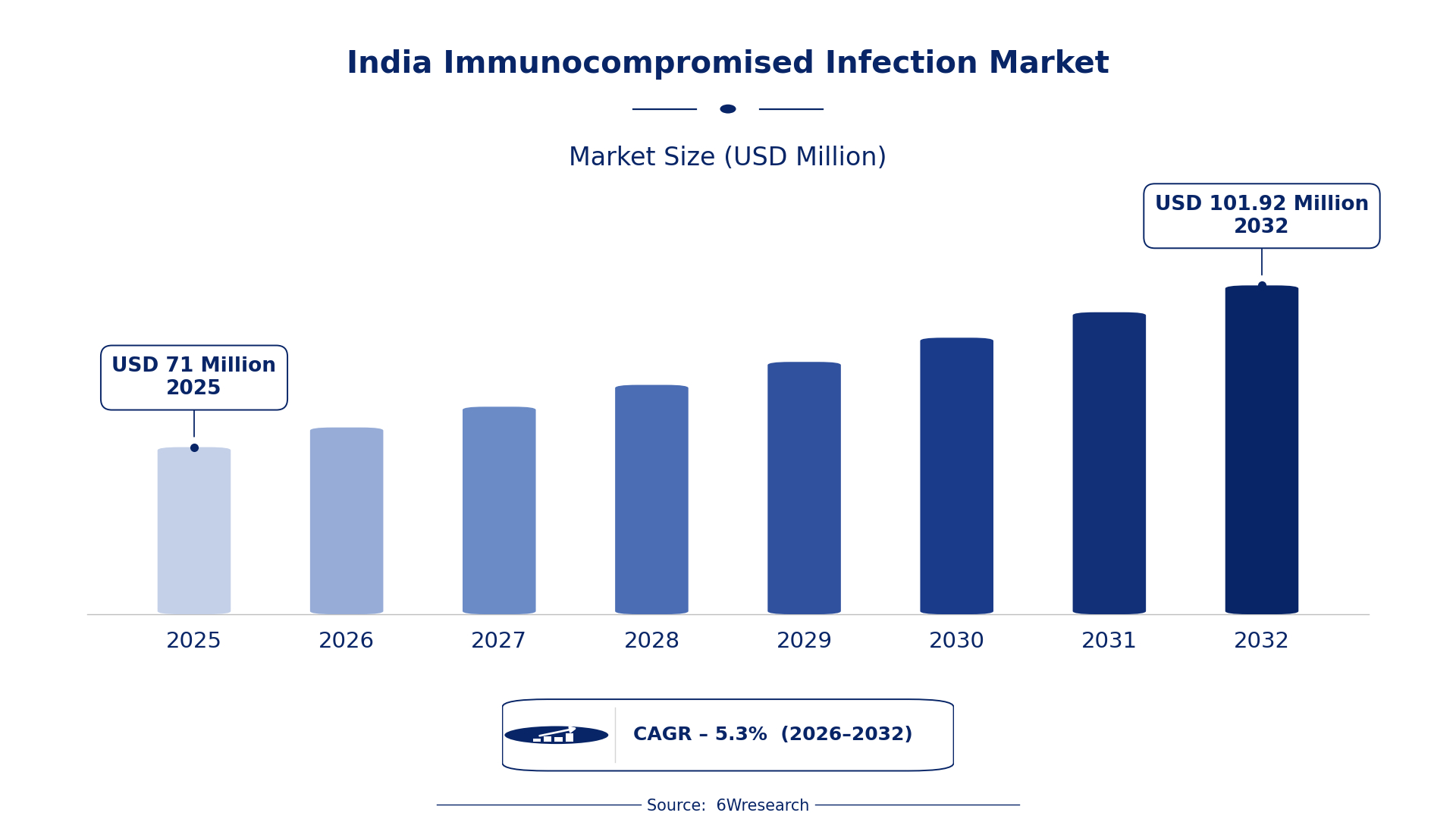
According to 6Wresearch internal database and industry insights, the India Immunocompromised Infection Market was valued at USD 71.0 million in 2025 and is projected to reach USD 101.92 million by 2032, growing at a CAGR of approximately 5.3% during 2026–2032.
India Immunocompromised Infection Market Highlights
| Report Metric | Details |
| Report Name | India Immunocompromised Infection Market |
| Market Size 2025 | USD 71.0 million |
| Market Size 2032 | USD 101.92 million |
| Absolute Growth 2025–2032 | USD 30.92 million |
| CAGR 2026–2032 | 5.3% |
| Peak Annual Growth | 7.8% in 2030 |
| Forecast Period | 2026–2032 |
| Historical Data | 2022–2025 |
| Base Year | 2025 |
| Leading Infection Type, 2025 | Opportunistic Infections (52% share) |
| Leading Patient Type, 2025 | Cancer Patients (32% share) |
| Leading Treatment Type, 2025 | Antiviral/Antifungal (37% share) |
| Leading End User, 2025 | Specialty Hospitals (40% share) |
| Fastest-Growing Infection Type | Fungal Infections (7.1% CAGR) |
| Fastest-Growing Patient Type | Transplant Recipients (7.3% CAGR) |
| Fastest-Growing Treatment Type | Combination Therapies (7.5% CAGR) |
| Fastest-Growing End User | Immunology Clinics (6.6% CAGR) |
| Growing Sector | Specialty Hospitals |
| Key End Users | Hospitals, Immunology Clinics, Critical Care Units, Specialty Hospitals |
India Immunocompromised Infection Market Year-wise Growth Rate and Key Drivers (2022–2032)
This graph illustrates the annual growth rates of the market from 2022 to 2032, highlighting a steady upward trajectory and projected market expansion over the forecast period.
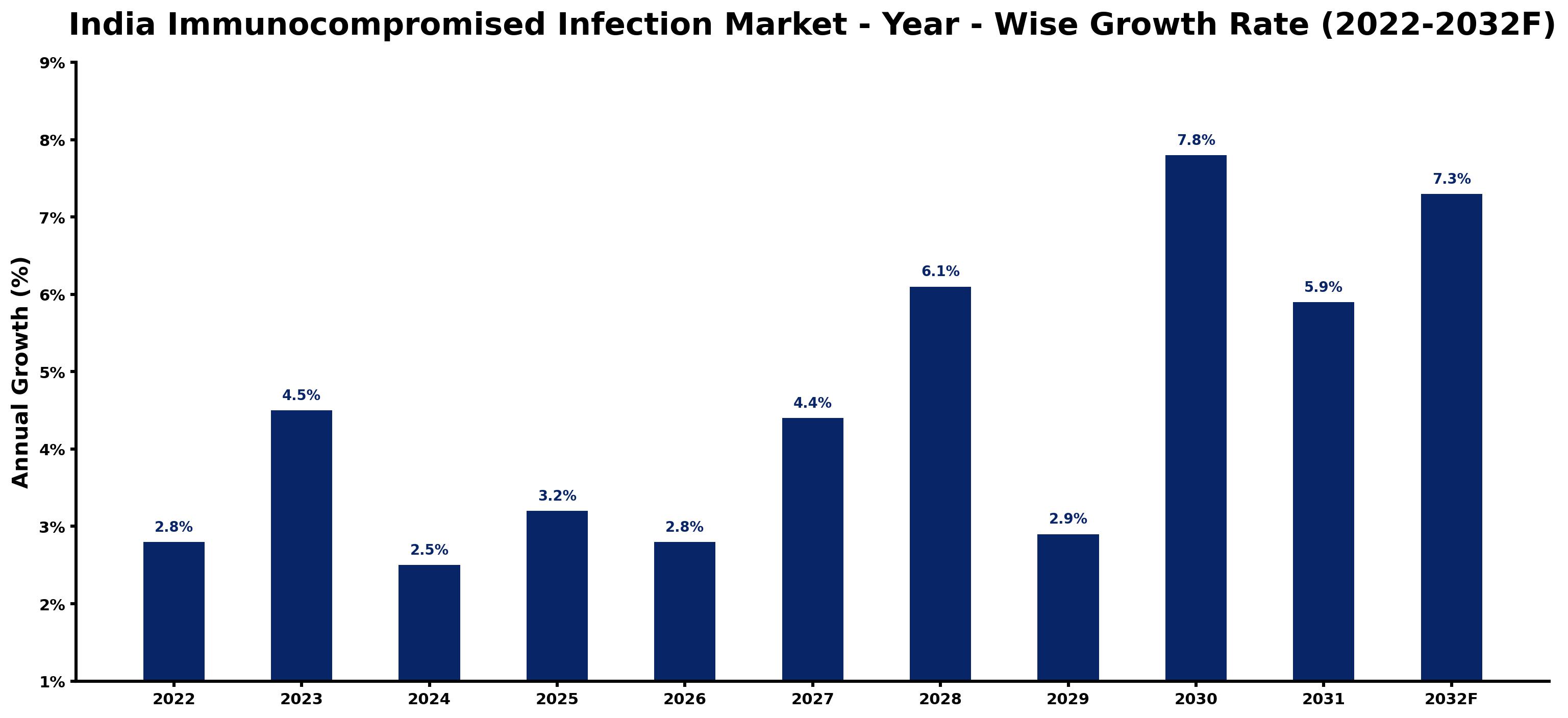
The following table presents the estimated annual growth rate for each year together with the principal factor influencing market performance.
| Year | Estimated Annual Growth (%) | Market Rationale |
| 2022 | 2.8 | The market saw steady growth as healthcare facilities expanded their services for immunocompromised patients. |
| 2023 | 4.5 | Increased awareness of opportunistic infections contributed to a faster growth rate than the previous year. |
| 2024 | 2.5 | A slowdown occurred as hospitals faced challenges in resource allocation for immunocompromised care. |
| 2025 | 3.2 | Growth accelerated again due to rising cancer cases and improved treatment access for patients. |
| 2026 | 2.8 | The market experienced a slowdown as healthcare providers adjusted to new treatment protocols. |
| 2027 | 4.4 | Demand surged as transplant recipients required more specialized care and treatment options. |
| 2028 | 6.1 | Growth continued to rise as immunology clinics expanded their services to meet patient needs. |
| 2029 | 2.9 | A slowdown was noted as healthcare facilities faced staffing challenges in critical care units. |
| 2030 | 7.8 | The market peaked due to heightened investments in healthcare infrastructure and treatment advancements. |
| 2031 | 5.9 | Growth slowed as healthcare providers focused on managing costs while maintaining service quality. |
| 2032 | 7.3 | A resurgence in growth is expected as new treatment options and facilities become available. |
Note: Market size estimations and growth projections presented in this report are based on 6Wresearch's proprietary forecasting methodology, utilizing the latest available industry data, government publications, and primary research inputs.
India Immunocompromised Infection Market Synopsis
The Immunocompromised Infection Market in India addresses infections that affect patients with weakened immune systems, such as those with HIV or cancer. These infections are treated with antiviral, antifungal, and antibiotic therapies. Growth in this market is driven by rising cancer cases, expected to reach 1.57 million by 2025, and the implementation of the 'Ayushman Bharat' scheme, which improves healthcare access for low-income families. Specialty hospitals in metropolitan areas play a crucial role in this expansion, focusing on complex infection management.
Market Dynamics Impact Analysis (2026–2032)
| Factor | Type | Impact | Primary Segment Affected |
| Increasing cancer cases drive demand for specialized treatments and care. | Driver | High | Cancer Patients |
| Expansion of immunology clinics enhances patient access to treatment. | Driver | High | Immunology Clinics |
| Growing need for advanced therapies presents opportunities for suppliers. | Opportunity | High | Combination Therapies |
| Healthcare access improvements create demand for new facilities. | Opportunity | High | Specialty Hospitals |
| Antifungal resistance limits treatment options for patients. | Restraint | High | Fungal Infections |
| Resource allocation issues in hospitals can delay treatment. | Restraint | Medium | Critical Care Units |
| High treatment costs can deter patients from seeking care. | Challenge | High | Transplant Recipients |
| Supply chain disruptions affect the availability of critical medications. | Challenge | Medium | Antiviral/Antifungal |
Evaluation of Drivers in India Immunocompromised Infection Market (2026–2032)
Below mentioned are some major drivers and their influence on market dynamics.
| Drivers | Primary Segment Affected | Why It Matters (Evidence) |
| Rising cancer cases increase the demand for immunocompromised infection treatments. | Cancer Patients | Projected cancer cases in India are expected to reach 1.57 million by 2025, prompting hospitals to invest in specialized care. |
| Expansion of immunology clinics improves patient access to treatment. | Immunology Clinics | The growth of immunology clinics in metropolitan areas provides more treatment options for patients with compromised immunity. |
| Increased funding for healthcare initiatives boosts treatment availability. | Specialty Hospitals | The 'Ayushman Bharat' scheme, updated in 2023, expands healthcare coverage for chronic disease patients, increasing treatment access. |
| Growing awareness of opportunistic infections drives demand for effective therapies. | Opportunistic Infections | Awareness campaigns by health organizations lead to more patients seeking treatment for infections, improving health outcomes. |
| Investment in healthcare infrastructure supports market growth. | Critical Care Units | Government initiatives are improving the capacity of critical care units to manage severe infections, enhancing patient care. |
The anticipated rise in cancer cases to 1.57 million by 2025 compels hospitals to invest in specialised care. The expansion of immunology clinics in urban centres enhances patient access to effective therapies, enabling timely treatment. Awareness campaigns encourage more patients to seek treatment, further driving demand for effective therapies.
Evaluation of Restraints in India Immunocompromised Infection Market
The table below lists the restraints and the evidence behind each.
| Market Restraint | Primary Segment Affected | Why It Matters (Evidence) |
| Antifungal resistance limits treatment options for patients. | Fungal Infections | Antifungal resistance is a growing concern in Indian healthcare facilities, complicating treatment protocols and leading to increased costs. |
| Resource allocation issues in hospitals can delay treatment. | Critical Care Units | Limited resources can hinder timely treatment for immunocompromised patients, affecting care quality and patient outcomes. |
| High treatment costs can deter patients from seeking care. | Transplant Recipients | The financial burden of treatments can prevent patients from accessing necessary healthcare services, impacting their recovery. |
| Supply chain disruptions affect the availability of critical medications. | Antiviral/Antifungal | Disruptions in the supply chain can lead to shortages of essential medications for immunocompromised patients, delaying treatment. |
| Limited awareness of opportunistic infections may hinder early diagnosis. | Opportunistic Infections | Despite increased awareness, many patients still lack knowledge about the risks associated with opportunistic infections, delaying treatment. |
India Immunocompromised Infection Market Challenges
Hospitals in the India immunocompromised infection market encounter delays due to outdated treatment technologies, which can prolong recovery times and inflate costs for healthcare providers. Regulatory hurdles impede the approval of new therapies, creating a backlog that delays access to essential medications for clinics. The growing number of immunocompromised individuals, particularly over 2.1 million living with HIV, strains the supply chain, resulting in shortages that disrupt treatment plans for patients. Rising antifungal resistance complicates treatment strategies, forcing hospitals to resort to more expensive alternatives, which impacts overall healthcare expenditure.
Trends in the India Immunocompromised Infection Market
The trends below show where the India Immunocompromised Infection Market is heading.
- Shift towards Combination Therapies: The use of combination therapies for treating immunocompromised infections is increasing, with a projected CAGR of 7.5% from 2026 to 2032. This trend is driven by the need for more effective treatment options in critical care settings.
- Growth in Specialty Hospitals: In 2023, the number of specialty hospitals focusing on immunocompromised infections is growing, particularly in metropolitan areas like Delhi and Mumbai. This growth is vital for improving patient outcomes and access to care.
- Increased Focus on Antimicrobial Resistance: The National Antimicrobial Resistance Action Plan, approved in 2021, aims to combat drug resistance in infections. This initiative is essential for ensuring effective treatment options for immunocompromised patients.
- Expansion of Immunology Clinics: The number of immunology clinics is increasing, with a focus on providing specialized care for patients with compromised immune systems. This expansion is important for improving treatment access and outcomes.
Investment Opportunities in the India Immunocompromised Infection Market
Some of the investment opportunities in the India Immunocompromised Infection Market are mentioned below.
- Investment in Advanced Treatment Options: With the projected growth of the market, there is an opportunity to invest in advanced treatment options for immunocompromised infections. Hospitals and clinics are actively seeking new therapies to improve patient outcomes.
- Supply of Antiviral and Antifungal Medications: The growing need for antiviral and antifungal medications presents a valuable opportunity for suppliers. Hospitals, particularly in metropolitan areas, are looking for reliable sources to meet treatment needs.
- Development of Specialty Hospitals: The increasing demand for comprehensive care for immunocompromised patients highlights the opportunity to develop new specialty hospitals. Regions with high cancer and HIV prevalence are ideal for such investments.
- Expansion of Healthcare Coverage: The 'Ayushman Bharat' scheme's expansion creates opportunities for healthcare providers to offer services to low-income families. This initiative is set to increase patient access to necessary treatments.
Government Initiatives in the India Immunocompromised Infection Market
The Ministry of Health and Family Welfare implements various healthcare initiatives, including the 'Ayushman Bharat' scheme, which expands healthcare coverage for chronic diseases. This scheme provides financial support for low-income families, enabling them to access necessary treatments. The National Health Mission (NHM) funds projects aimed at improving healthcare services for immunocompromised patients, ensuring better access to care. Additionally, the ICMR conducts research on opportunistic infections, informing treatment guidelines and practices for healthcare providers.
The National Health Mission (NHM) launched in 2020 aims to improve healthcare services for immunocompromised patients across India. The Ministry of Health and Family Welfare approved the 'National Antimicrobial Resistance Action Plan' in 2021 to combat drug resistance in infections, enhancing treatment protocols. In 2022, the ICMR initiated a research program focusing on opportunistic infections in immunocompromised patients, which is crucial for developing effective therapies. The 'Ayushman Bharat' scheme, updated in 2023, expands healthcare coverage for patients with chronic diseases including cancer and HIV, facilitating better access to necessary treatments.
Future Insight of the India Immunocompromised Infection Market
Several forward-looking factors should support the immunocompromised infection market in India over the coming years. The 'Ayushman Bharat' scheme will broaden healthcare access, allowing more individuals to receive timely treatment. Initiatives from the National Health Mission will strengthen support for immunocompromised individuals, increasing demand for advanced therapies. By 2025, cancer cases are projected to reach 1.57 million, prompting hospitals to enhance their treatment facilities. Research by the Indian Council of Medical Research will improve infection management, benefiting both healthcare providers and patients.
Market Segmentation Analysis
The analysis below covers each segmentation, its leading category in 2025 and its fastest-growing category through 2032.
By Infection Type – Opportunistic Infections Dominated, Fungal Infections Expected to Grow Fastest
According to Sachin Kumar Rai, Senior Research Analyst at 6Wresearch, in 2025, Opportunistic Infections led the infection type split with a 52% share. Opportunistic infections hold the largest share in the India immunocompromised infection market due to their widespread occurrence among patients with weakened immune systems, particularly those suffering from HIV and cancer. The National AIDS Control Organization's initiatives highlight the critical need for effective management of these infections in healthcare settings. Fungal Infections are set to record the highest CAGR in this split, 7.1% over 2026–2032. Fungal infections are experiencing rapid growth, primarily due to the increasing prevalence of antifungal resistance in healthcare facilities. This trend necessitates urgent attention to develop effective treatment protocols, as evidenced by the rising cases reported in hospitals across India. This indicates that suppliers must prioritise the development of effective treatments for both opportunistic and fungal infections to address the growing healthcare challenges.
By Patient Type – Cancer Patients Dominated, Transplant Recipients Expected to Grow Fastest
With a 32% revenue share in 2025, Cancer Patients was the largest patient type category. Cancer patients represent the largest share of the market as they are particularly vulnerable to infections due to their compromised immune systems. The projected increase in cancer cases in India, expected to reach 1.57 million by 2025, further underscores the critical need for targeted infection management. Transplant Recipients are projected to grow fastest, at a CAGR of 7.3% during 2026–2032. Transplant recipients are the fastest-growing segment due to their heightened susceptibility to infections following surgery. The increasing number of transplant procedures in India necessitates specialised care and treatment options tailored to this patient group. This suggests that suppliers should tailor their offerings to meet the unique needs of cancer patients and transplant recipients, ensuring effective infection management.
By Treatment Type – Antiviral/Antifungal Dominated, Combination Therapies Expected to Grow Fastest
The largest treatment type category in 2025 was Antiviral/Antifungal, with a 37% share of total revenue. Antiviral and antifungal treatments hold the largest market share due to their critical role in managing infections among immunocompromised patients. The high prevalence of conditions like HIV and cancer in India necessitates these therapies, particularly in specialty hospitals located in metropolitan areas. The quickest growth will come from Combination Therapies, forecast to expand at a CAGR of 7.5% between 2026 and 2032. Combination therapies are experiencing the fastest growth as they are increasingly recognised for their effectiveness in treating complex infections. The rising incidence of opportunistic infections, especially in patients with multiple health challenges, drives this trend. This indicates a need for suppliers to focus on developing effective combination therapies that can cater to the intricate treatment requirements of immunocompromised patients.
By End User – Specialty Hospitals Dominated, Immunology Clinics Expected to Grow Fastest
Specialty Hospitals took a 40% share of end user in 2025, more than any other category. Specialty hospitals capture the largest share of the market as they focus on treating complex infections prevalent among immunocompromised patients. These facilities, particularly in metropolitan areas, are equipped with the necessary resources and expertise to manage such critical cases effectively. Over 2026–2032, Immunology Clinics are expected to post the fastest growth, at a CAGR of 6.6%. Immunology clinics are the fastest-growing segment due to their specialised focus on managing immunocompromised patients. The increasing awareness and demand for tailored care in these settings are driving their rapid expansion across the country. This signals to suppliers the need to strengthen partnerships with specialty hospitals and immunology clinics to ensure their products meet the specific requirements of these end users.
Key Attractiveness of the Report
- 10 Years of Market Numbers
- Historical Data Starting from 2022 to 2025
- Base Year 2025
- Forecast Data until 2032
- Key Performance Indicators Impacting the Market
- Major Upcoming Developments and Projects
Key Highlights of the Report:
- India Immunocompromised Infection Market Outlook
- Market Size of India Immunocompromised Infection Market, 2025
- Forecast of India Immunocompromised Infection Market, 2032
- Historical Data and Forecast of India Immunocompromised Infection Revenues & Volume for the Period 2022 - 2032F
- India Immunocompromised Infection Market Trend Evolution
- India Immunocompromised Infection Market Drivers and Challenges
- India Immunocompromised Infection Price Trends
- India Immunocompromised Infection Porter's Five Forces
- India Immunocompromised Infection Industry Life Cycle
- Historical Data and Forecast of India Immunocompromised Infection Market Revenues & Volume By Infection Type for the Period 2022 - 2032F
- Historical Data and Forecast of India Immunocompromised Infection Market Revenues & Volume By Opportunistic Infections for the Period 2022 - 2032F
- Historical Data and Forecast of India Immunocompromised Infection Market Revenues & Volume By Fungal Infections for the Period 2022 - 2032F
- Historical Data and Forecast of India Immunocompromised Infection Market Revenues & Volume By Bacterial Infections for the Period 2022 - 2032F
- Historical Data and Forecast of India Immunocompromised Infection Market Revenues & Volume By Viral Infections for the Period 2022 - 2032F
- Historical Data and Forecast of India Immunocompromised Infection Market Revenues & Volume By Patient Type for the Period 2022 - 2032F
- Historical Data and Forecast of India Immunocompromised Infection Market Revenues & Volume By HIV, Cancer Patients for the Period 2022 - 2032F
- Historical Data and Forecast of India Immunocompromised Infection Market Revenues & Volume By Transplant Recipients for the Period 2022 - 2032F
- Historical Data and Forecast of India Immunocompromised Infection Market Revenues & Volume By Immunodeficient Adults for the Period 2022 - 2032F
- Historical Data and Forecast of India Immunocompromised Infection Market Revenues & Volume By Pediatric Cases for the Period 2022 - 2032F
- Historical Data and Forecast of India Immunocompromised Infection Market Revenues & Volume By Treatment Type for the Period 2022 - 2032F
- Historical Data and Forecast of India Immunocompromised Infection Market Revenues & Volume By Antiviral/Antifungal for the Period 2022 - 2032F
- Historical Data and Forecast of India Immunocompromised Infection Market Revenues & Volume By Systemic Antifungals for the Period 2022 - 2032F
- Historical Data and Forecast of India Immunocompromised Infection Market Revenues & Volume By IV Antibiotic Therapy for the Period 2022 - 2032F
- Historical Data and Forecast of India Immunocompromised Infection Market Revenues & Volume By Combination Therapies for the Period 2022 - 2032F
- Historical Data and Forecast of India Immunocompromised Infection Market Revenues & Volume By End User for the Period 2022 - 2032F
- Historical Data and Forecast of India Immunocompromised Infection Market Revenues & Volume By Specialty Hospitals for the Period 2022 - 2032F
- Historical Data and Forecast of India Immunocompromised Infection Market Revenues & Volume By Immunology Clinics for the Period 2022 - 2032F
- Historical Data and Forecast of India Immunocompromised Infection Market Revenues & Volume By Critical Care Units for the Period 2022 - 2032F
- Historical Data and Forecast of India Immunocompromised Infection Market Revenues & Volume By Pediatric ICUs for the Period 2022 - 2032F
- India Immunocompromised Infection Import Export Trade Statistics
- Market Opportunity Assessment By Infection Type
- Market Opportunity Assessment By Patient Type
- Market Opportunity Assessment By Treatment Type
- Market Opportunity Assessment By End User
- India Immunocompromised Infection Top Companies Market Share
- India Immunocompromised Infection Competitive Benchmarking By Technical and Operational Parameters
- India Immunocompromised Infection Company Profiles
- India Immunocompromised Infection Key Strategic Recommendations
Market Covered
Segments analysed in this report are listed below.
By Infection Type
- Opportunistic Infections
- Fungal Infections
- Bacterial Infections
- Viral Infections
By Patient Type
- HIV
- Cancer Patients
- Transplant Recipients
- Immunodeficient Adults
- Pediatric Cases
By Treatment Type
- Antiviral/Antifungal
- Systemic Antifungals
- IV Antibiotic Therapy
- Combination Therapies
By End User
- Specialty Hospitals
- Immunology Clinics
- Critical Care Units
- Pediatric ICUs































