India In-Cabin Monitoring Sensor Market Size & Growth Rate
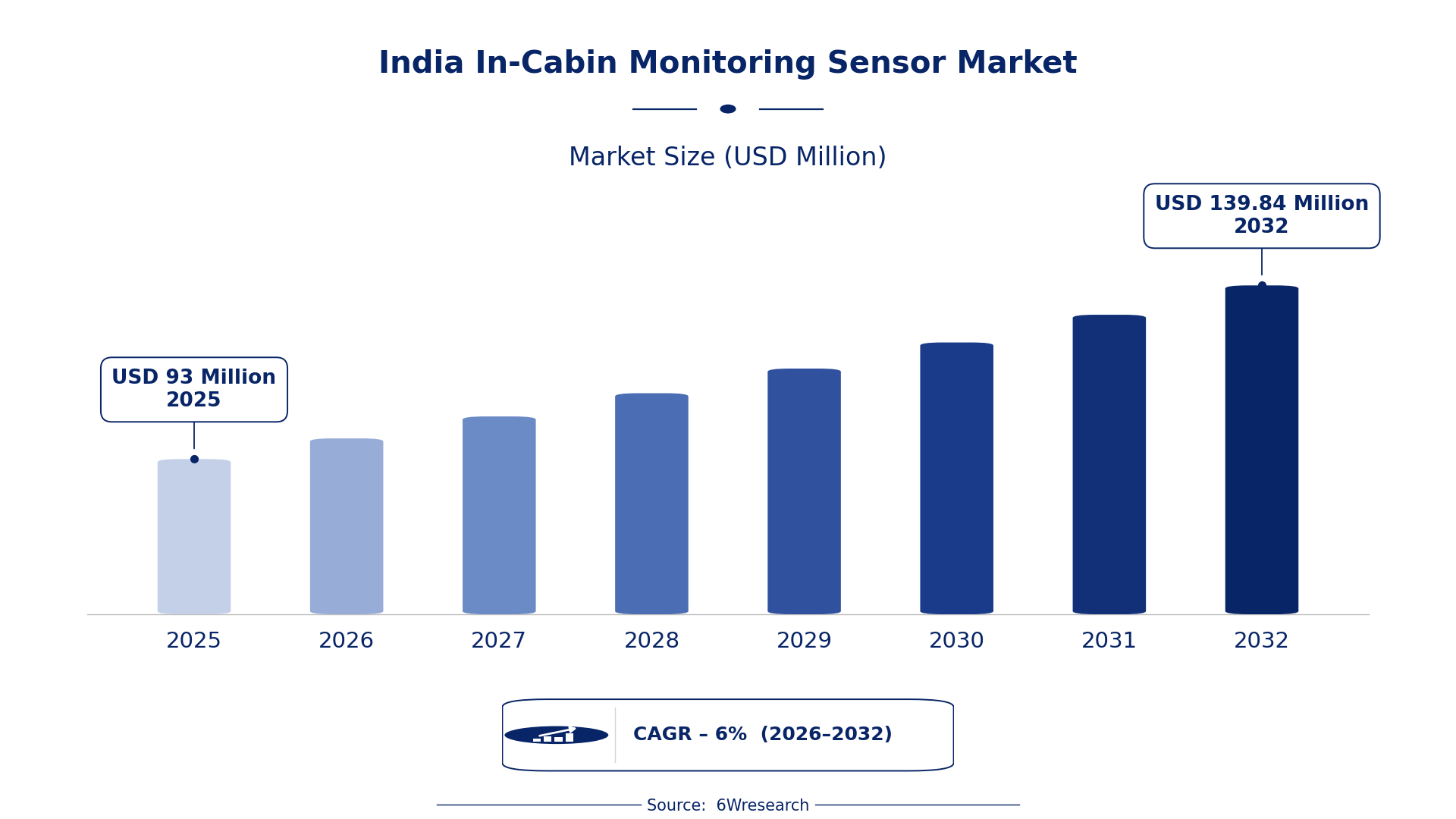
According to 6Wresearch internal database and industry insights, the India In-Cabin Monitoring Sensor Market was valued at USD 93.0 million in 2025 and is projected to reach USD 139.84 million by 2032, growing at a CAGR of approximately 6% during 2026–2032.
India In-Cabin Monitoring Sensor Market Highlights
| Report Metric | Details |
| Report Name | India In-Cabin Monitoring Sensor Market |
| Market Size 2025 | USD 93.0 million |
| Market Size 2032 | USD 139.84 million |
| Absolute Growth 2025–2032 | USD 46.84 million |
| CAGR 2026–2032 | 6% |
| Peak Annual Growth | 8.6% in 2032 |
| Forecast Period | 2026–2032 |
| Historical Data | 2022–2025 |
| Base Year | 2025 |
| Leading Monitoring Type, 2025 | Driver Monitoring (35% share) |
| Leading Sensor Technology, 2025 | Camera + Infrared (31% share) |
| Leading Application Area, 2025 | Drowsiness (48% share) |
| Leading End User, 2025 | ADAS Developers (46% share) |
| Fastest-Growing Monitoring Type | Occupant Detection (7.6% CAGR) |
| Fastest-Growing Sensor Technology | Ultrasonic + Pressure (8.8% CAGR) |
| Fastest-Growing Application Area | Distraction (8.0% CAGR) |
| Fastest-Growing End User | Automotive OEMs (7.7% CAGR) |
| Growing Sector | automotive safety technology |
| Key End Users | ADAS Developers, Automotive OEMs, Autonomous Vehicle Makers, Interior System Integrators |
India In-Cabin Monitoring Sensor Market Year-wise Growth Rate and Key Drivers (2022–2032)
This graph illustrates the annual growth rates of the market from 2022 to 2032, highlighting a steady upward trajectory and projected market expansion over the forecast period.
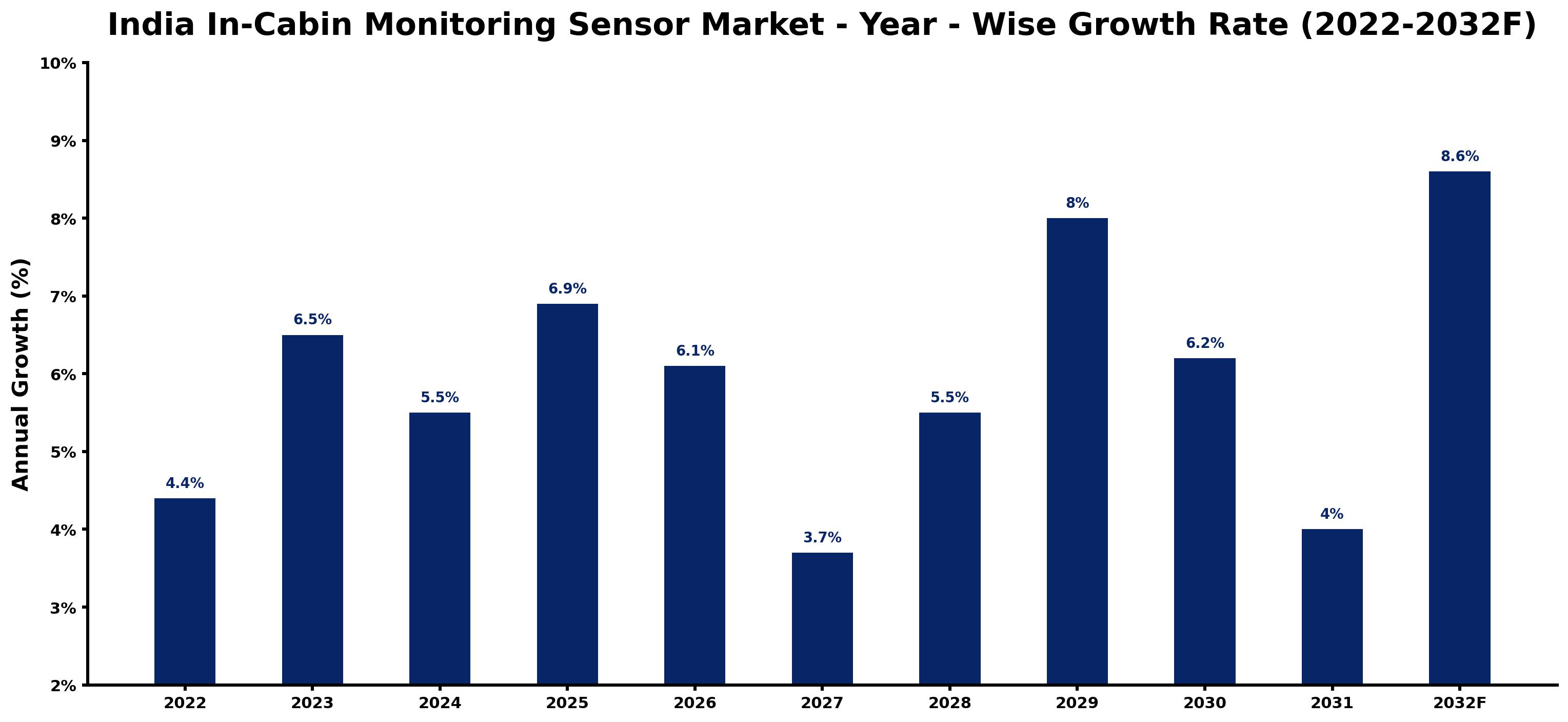
Each row of the following table gives one year's estimated growth and the event or demand shift that explains it.
| Year | Estimated Annual Growth (%) | Market Rationale |
| 2022 | 4.4 | The market experienced steady growth, driven by increasing vehicle production and safety awareness. |
| 2023 | 6.5 | Demand accelerated due to rising safety regulations and the introduction of new monitoring technologies. |
| 2024 | 5.5 | Growth slowed as manufacturers adjusted to regulatory changes and market conditions. |
| 2025 | 6.9 | The market saw a resurgence in growth, supported by advancements in driver monitoring systems. |
| 2026 | 6.1 | A slight slowdown occurred as manufacturers focused on compliance with emerging standards. |
| 2027 | 3.7 | Growth continued to decelerate as the market adjusted to new safety requirements. |
| 2028 | 5.5 | Demand increased again, driven by a rise in consumer awareness of vehicle safety technologies. |
| 2029 | 8.0 | The market rebounded with strong growth, influenced by the push for advanced safety features. |
| 2030 | 6.2 | Growth slowed as manufacturers faced challenges in integrating new technologies into existing models. |
| 2031 | 4.0 | Demand continued to slow as the market stabilised around established safety standards. |
| 2032 | 8.6 | Growth peaked as new regulations mandated driver monitoring systems in all new vehicles. |
Note: Market size estimations and growth projections presented in this report are based on 6Wresearch's proprietary forecasting methodology, utilizing the latest available industry data, government publications, and primary research inputs.
India In-Cabin Monitoring Sensor Market Synopsis
The In-Cabin Monitoring Sensor Market in India covers advanced technologies designed to monitor driver and passenger behaviour within vehicles. These sensors utilise cameras and infrared technologies to detect drowsiness and ensure child presence. The market is expanding due to rising vehicle production and stringent safety regulations. With approximately 4.4 million passenger vehicles produced in 2022, the demand for these sensors is driven by automotive manufacturers and technology developers. The push for improved safety standards by the Ministry of Road Transport and Highways further fuels market growth.
Market Dynamics Impact Analysis (2026–2032)
| Factor | Type | Impact | Primary Segment Affected |
| Increasing vehicle production and safety regulations drive demand for monitoring sensors. | Driver | High | Driver Monitoring |
| Growing awareness of passenger safety enhances the need for in-cabin monitoring. | Driver | High | Occupant Detection |
| The rise in electric vehicle adoption creates opportunities for advanced sensor integration. | Opportunity | High | ADAS Developers |
| The push for compliance with new safety standards opens avenues for sensor manufacturers. | Opportunity | Medium | Automotive OEMs |
| High development costs can limit the entry of new players into the market. | Restraint | High | Vital Sign Monitoring |
| Limited consumer awareness regarding the benefits of in-cabin monitoring systems restrains growth. | Restraint | Medium | Gesture Recognition |
| Integration challenges with existing vehicle systems can delay market adoption. | Challenge | High | Camera + Infrared |
| Competition among sensor manufacturers can lead to pricing pressures in the market. | Challenge | Medium | Ultrasonic + Pressure |
Evaluation of Drivers in India In-Cabin Monitoring Sensor Market (2026–2032)
Key forces behind demand, with the segment each one moves most, are listed below.
| Drivers | Primary Segment Affected | Why It Matters (Evidence) |
| Increased vehicle production in India drives demand for monitoring sensors. | Driver Monitoring | In 2022, India produced approximately 4.4 million passenger vehicles, increasing the need for safety technologies. |
| Rising safety regulations mandate the integration of monitoring systems in vehicles. | Occupant Detection | The Ministry of Road Transport and Highways aims to improve vehicle safety standards by 2025. |
| Technological advancements in sensor capabilities boost market growth. | Camera + Infrared | The Automotive Research Association of India is developing standards for in-cabin monitoring systems. |
| Consumer demand for improved safety features influences purchasing decisions. | Drowsiness | The average age of vehicles in India is around 10 years, necessitating modern safety upgrades. |
| The growth of electric vehicles creates new opportunities for sensor integration. | ADAS Developers | The Union Ministry of Heavy Industries launched the 'FAME India Scheme' to promote electric vehicles. |
In 2022, India produced approximately 4.4 million passenger vehicles, creating a strong need for safety technologies. With the average vehicle age at around 10 years, there is a pressing need for modern safety upgrades, leading to increased purchases of monitoring sensors. The ongoing development of standards by the Automotive Research Association of India encourages manufacturers to adopt these technologies, ensuring compliance and reliability.
Evaluation of Restraints in India In-Cabin Monitoring Sensor Market
The key brakes on demand, and where they bite hardest, are shown below.
| Market Restraint | Primary Segment Affected | Why It Matters (Evidence) |
| High development costs limit market entry for new companies. | Vital Sign Monitoring | Developing advanced monitoring systems requires substantial investment, which can deter new entrants. |
| Limited consumer awareness hampers the adoption of in-cabin monitoring systems. | Gesture Recognition | Many consumers are unaware of the benefits these technologies offer, slowing market growth. |
| Integration challenges with existing vehicle systems can delay market adoption. | Camera + Infrared | Existing vehicles may require extensive modifications to accommodate new monitoring technologies. |
| Regulatory compliance can increase operational costs for manufacturers. | Occupant Detection | Meeting new safety standards may require additional investments in technology and training. |
| Market competition can lead to pricing pressures, affecting profitability. | Driver Monitoring | As more players enter the market, price wars may reduce profit margins for manufacturers. |
India In-Cabin Monitoring Sensor Market Challenges
The India In-Cabin Monitoring Sensor market still has to solve a few problems, and the first is intense competition among automotive OEMs. This competition drives prices down, making it difficult for suppliers to maintain margins and invest in new technologies. Buyers face high costs as integrating in-cabin monitoring systems can increase vehicle prices by up to 15%. The slow pace of technology adoption is another hurdle, as many vehicles on the road are over ten years old and lack modern safety features. Supply chain disruptions further complicate matters, delaying essential components and impacting production schedules for manufacturers reliant on timely deliveries.
Trends in the India In-Cabin Monitoring Sensor Market
Buyers and suppliers in the India In-Cabin Monitoring Sensor Market are adjusting to the following trends.
- Shift towards Advanced Driver Assistance Systems (ADAS): The Indian automotive industry is increasingly embracing Advanced Driver Assistance Systems, spurred by safety regulations. The Ministry of Road Transport and Highways has set a target to improve vehicle safety standards by 2025, leading to a projected rise in sensor demand.
- Transition from Traditional to Smart Monitoring Systems: The emergence of smart in-cabin monitoring systems is clear as technology progresses. In 2022, the Automotive Research Association of India began developing standards for these systems, signalling a shift towards more sophisticated safety technologies.
- Emergence of Electric Vehicles and Associated Technologies: The drive for electric vehicles is reshaping the automotive sector in India. In 2023, the Indian government announced a $1.4 billion investment in electric vehicle infrastructure, promoting the integration of advanced monitoring sensors.
- Increase in Regulatory Standards for Vehicle Safety: The introduction of new regulations is boosting the demand for in-cabin monitoring sensors. The 'Automotive Industry Standards' initiative launched in 2021 aims to improve vehicle safety, influencing sensor technology adoption.
Investment Opportunities in the India In-Cabin Monitoring Sensor Market
Some of the investment opportunities in the India In-Cabin Monitoring Sensor Market are mentioned below.
- In-Cabin Monitoring Sensors for Electric Vehicles: The expanding electric vehicle market presents an opportunity for in-cabin monitoring sensors. By 2032, the market is projected to reach USD 139.84 million, as automotive OEMs seek advanced safety solutions for their vehicles.
- Investment in Advanced Safety Technologies: There is an urgent need for advanced safety technologies in the Indian automotive sector. With over 300 million registered vehicles in 2023, automotive manufacturers are looking to invest in innovative monitoring solutions.
- Development of Indigenous Automotive Technologies: The push for local manufacturing of automotive components creates opportunities for sensor suppliers. The 'Production Linked Incentive Scheme' approved in 2022 aims to boost local production, encouraging partnerships with local manufacturers.
- Growing Demand from ADAS Developers: ADAS developers are increasingly seeking advanced monitoring solutions to improve vehicle safety. With a 46% share in 2025, they represent a key buyer group for in-cabin monitoring sensors.
Government Initiatives in the India In-Cabin Monitoring Sensor Market
In 2022, the government approved the 'Production Linked Incentive Scheme' to boost local manufacturing of automotive components, including sensors. This initiative aims to strengthen domestic production capabilities, reducing reliance on imports and supporting the growth of the in-cabin monitoring sensor market. Additionally, the 'National Policy on Electronics 2019' encourages the development of indigenous automotive technologies, impacting sensor production and integration.
The 'National Electric Mobility Mission Plan 2020' aims to promote electric vehicle adoption, influencing sensor technology demand. The Ministry of Heavy Industries oversees this initiative, which allocates funding for infrastructure development and technology integration. Furthermore, the 'Automotive Mission Plan 2026' outlines strategies for improving safety technologies in vehicles, including in-cabin monitoring systems, ensuring that manufacturers align with evolving safety standards.
Future Insight of the India In-Cabin Monitoring Sensor Market
By 2032, the India In-Cabin Monitoring Sensor market will undergo transformative changes driven by mandatory driver monitoring systems in new vehicles. This regulatory shift will compel automotive manufacturers to adopt advanced safety technologies in their designs. The Automotive Research Association of India is developing standards that will improve compliance and product reliability. With over 300 million registered vehicles, demand for in-cabin monitoring sensors is expected to rise sharply, supported by a $1.4 billion investment in electric vehicle infrastructure.
Market Segmentation Analysis
Each segment group is reviewed below, with the leader by share and the fastest grower by CAGR.
By Monitoring Type – Driver Monitoring Dominated, Occupant Detection Expected to Grow Fastest
According to Sachin Kumar Rai, Senior Research Analyst at 6Wresearch, Driver Monitoring held a 35% share of the India In-Cabin Monitoring Sensor Market by monitoring type in 2025. Driver Monitoring commands the largest market share due to its critical role in ensuring driver safety and preventing accidents. With over 300 million registered vehicles in India, the demand for effective monitoring systems is substantial. Occupant Detection is projected to grow fastest, at a CAGR of 7.6% during 2026–2032. Occupant Detection is rapidly growing as it addresses the increasing emphasis on child safety and passenger monitoring. The anticipated regulations mandating driver monitoring systems by 2025 will further amplify the need for comprehensive occupant detection solutions. This trend indicates that suppliers should prioritise the development of advanced occupant detection technologies to meet forthcoming regulatory requirements.
By Sensor Technology – Camera + Infrared Dominated, Ultrasonic + Pressure Expected to Grow Fastest
In 2025, Camera + Infrared led the sensor technology split with a 31% share. Camera + Infrared technology leads the market as it is widely used for monitoring and detection purposes in vehicles. Its effectiveness in various applications has made it a preferred choice among automotive manufacturers. The quickest growth will come from Ultrasonic + Pressure, forecast to expand at a CAGR of 8.8% between 2026 and 2032. Ultrasonic + Pressure sensors are growing quickly due to their specific applications, such as in parking assistance systems. As the automotive industry continues to innovate, the integration of these sensors will likely expand. Suppliers should consider diversifying their offerings to include Ultrasonic + Pressure sensors to capture emerging market opportunities.
By Application Area – Drowsiness Dominated, Distraction Expected to Grow Fastest
Drowsiness accounted for a 48% market share by application area in 2025. Drowsiness monitoring leads the application area as it is essential for preventing accidents linked to driver fatigue. The production of around 4.4 million passenger vehicles in 2022 illustrates the significant demand for drowsiness detection systems. Over 2026–2032, Distraction is expected to post the fastest growth, at a CAGR of 8.0%. Distraction monitoring is experiencing swift growth because it is vital for enhancing driver focus. The rising awareness regarding the risks associated with distracted driving is likely to escalate the demand for these systems. This growth suggests that suppliers should invest in creating distraction monitoring technologies to comply with evolving safety standards.
By End User – ADAS Developers Dominated, Automotive OEMs Expected to Grow Fastest
The largest end user category in 2025 was ADAS Developers, with a 46% share of total revenue. ADAS Developers hold the largest share as they are the primary users of in-cabin monitoring sensors for advanced driver assistance systems. Their need for reliable and effective monitoring solutions significantly shapes this segment. Automotive OEMs are set to record the highest CAGR in this split, 7.7% over 2026–2032. Automotive OEMs are witnessing the fastest growth as they integrate these technologies into new vehicle models. The presence of over 50 automotive OEMs in India intensifies competition to improve vehicle safety, driving this growth. This signifies that suppliers should strengthen collaborations with automotive OEMs to ensure their technologies are incorporated into future vehicle designs.
Key Attractiveness of the Report
- 10 Years of Market Numbers
- Historical Data Starting from 2022 to 2025
- Base Year 2025
- Forecast Data until 2032
- Key Performance Indicators Impacting the Market
- Major Upcoming Developments and Projects
Key Highlights of the Report:
- India In-Cabin Monitoring Sensor Market Outlook
- Market Size of India In-Cabin Monitoring Sensor Market, 2025
- Forecast of India In-Cabin Monitoring Sensor Market, 2032
- Historical Data and Forecast of India In-Cabin Monitoring Sensor Revenues & Volume for the Period 2022 - 2032F
- India In-Cabin Monitoring Sensor Market Trend Evolution
- India In-Cabin Monitoring Sensor Market Drivers and Challenges
- India In-Cabin Monitoring Sensor Price Trends
- India In-Cabin Monitoring Sensor Porter's Five Forces
- India In-Cabin Monitoring Sensor Industry Life Cycle
- Historical Data and Forecast of India In-Cabin Monitoring Sensor Market Revenues & Volume By Monitoring Type for the Period 2022 - 2032F
- Historical Data and Forecast of India In-Cabin Monitoring Sensor Market Revenues & Volume By Driver Monitoring for the Period 2022 - 2032F
- Historical Data and Forecast of India In-Cabin Monitoring Sensor Market Revenues & Volume By Occupant Detection for the Period 2022 - 2032F
- Historical Data and Forecast of India In-Cabin Monitoring Sensor Market Revenues & Volume By Vital Sign Monitoring for the Period 2022 - 2032F
- Historical Data and Forecast of India In-Cabin Monitoring Sensor Market Revenues & Volume By Gesture Recognition for the Period 2022 - 2032F
- Historical Data and Forecast of India In-Cabin Monitoring Sensor Market Revenues & Volume By Sensor Technology for the Period 2022 - 2032F
- Historical Data and Forecast of India In-Cabin Monitoring Sensor Market Revenues & Volume By Camera + Infrared for the Period 2022 - 2032F
- Historical Data and Forecast of India In-Cabin Monitoring Sensor Market Revenues & Volume By Ultrasonic + Pressure for the Period 2022 - 2032F
- Historical Data and Forecast of India In-Cabin Monitoring Sensor Market Revenues & Volume By Radar, Thermal Sensors for the Period 2022 - 2032F
- Historical Data and Forecast of India In-Cabin Monitoring Sensor Market Revenues & Volume By 3D Cameras/ToF for the Period 2022 - 2032F
- Historical Data and Forecast of India In-Cabin Monitoring Sensor Market Revenues & Volume By Application Area for the Period 2022 - 2032F
- Historical Data and Forecast of India In-Cabin Monitoring Sensor Market Revenues & Volume By Drowsiness, Distraction for the Period 2022 - 2032F
- Historical Data and Forecast of India In-Cabin Monitoring Sensor Market Revenues & Volume By Child Presence, Safety for the Period 2022 - 2032F
- Historical Data and Forecast of India In-Cabin Monitoring Sensor Market Revenues & Volume By Heart/Respiratory Rate for the Period 2022 - 2032F
- Historical Data and Forecast of India In-Cabin Monitoring Sensor Market Revenues & Volume By Infotainment Interaction for the Period 2022 - 2032F
- Historical Data and Forecast of India In-Cabin Monitoring Sensor Market Revenues & Volume By End User for the Period 2022 - 2032F
- Historical Data and Forecast of India In-Cabin Monitoring Sensor Market Revenues & Volume By ADAS Developers for the Period 2022 - 2032F
- Historical Data and Forecast of India In-Cabin Monitoring Sensor Market Revenues & Volume By Automotive OEMs for the Period 2022 - 2032F
- Historical Data and Forecast of India In-Cabin Monitoring Sensor Market Revenues & Volume By Autonomous Vehicle Makers for the Period 2022 - 2032F
- Historical Data and Forecast of India In-Cabin Monitoring Sensor Market Revenues & Volume By Interior System Integrators for the Period 2022 - 2032F
- India In-Cabin Monitoring Sensor Import Export Trade Statistics
- Market Opportunity Assessment By Monitoring Type
- Market Opportunity Assessment By Sensor Technology
- Market Opportunity Assessment By Application Area
- Market Opportunity Assessment By End User
- India In-Cabin Monitoring Sensor Top Companies Market Share
- India In-Cabin Monitoring Sensor Competitive Benchmarking By Technical and Operational Parameters
- India In-Cabin Monitoring Sensor Company Profiles
- India In-Cabin Monitoring Sensor Key Strategic Recommendations
Market Covered
Segments analysed in this report are listed below.
By Monitoring Type
- Driver Monitoring
- Occupant Detection
- Vital Sign Monitoring
- Gesture Recognition
By Sensor Technology
- Camera + Infrared
- Ultrasonic + Pressure
- Radar
- Thermal Sensors
- 3D Cameras/ToF
By Application Area
- Drowsiness
- Distraction
- Child Presence
- Safety
- Heart/Respiratory Rate
- Infotainment Interaction
By End User
- ADAS Developers
- Automotive OEMs
- Autonomous Vehicle Makers
- Interior System Integrators































