India In-Dash Monitor Market Size & Growth Rate
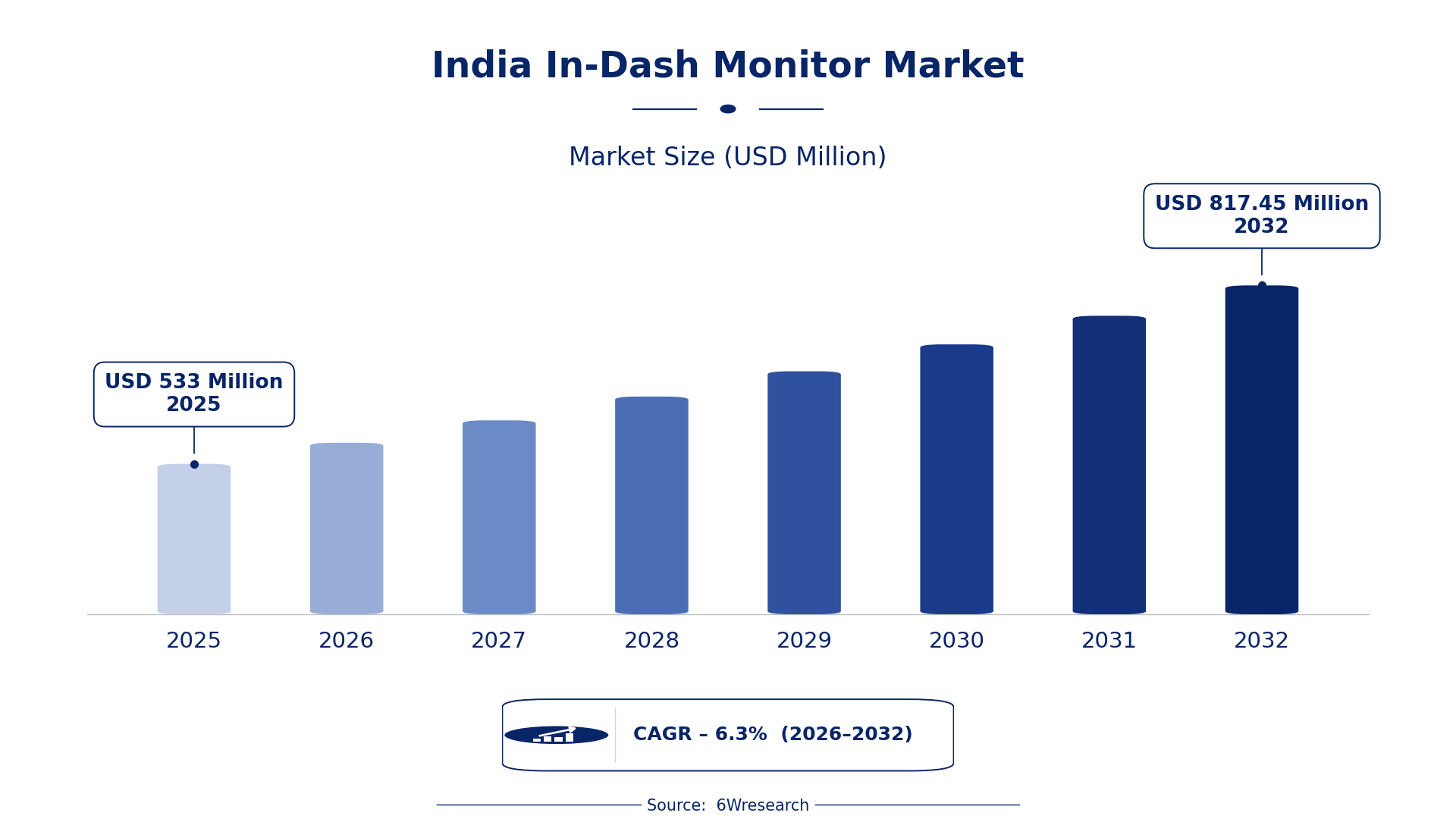
According to 6Wresearch internal database and industry insights, the India In-Dash Monitor Market was valued at USD 533.0 million in 2025 and is projected to reach USD 817.45 million by 2032, growing at a CAGR of approximately 6.3% during 2026–2032.
India In-Dash Monitor Market Highlights
| Report Metric | Details |
| Report Name | India In-Dash Monitor Market |
| Market Size 2025 | USD 533.0 million |
| Market Size 2032 | USD 817.45 million |
| Absolute Growth 2025–2032 | USD 284.45 million |
| CAGR 2026–2032 | 6.3% |
| Peak Annual Growth | 8.7% in 2028 |
| Forecast Period | 2026–2032 |
| Historical Data | 2022–2025 |
| Base Year | 2025 |
| Leading Monitor Type, 2025 | Single-Screen Display (40% share) |
| Leading Screen Size, 2025 | 7–10 inches (50% share) |
| Leading Integration Type, 2025 | Analog/Digital Clusters (36% share) |
| Leading End User, 2025 | Sedan OEMs (41% share) |
| Fastest-Growing Monitor Type | Dual-Screen Setup (7.3% CAGR) |
| Fastest-Growing Integration Type | Full-Dash Integration (7.8% CAGR) |
| Fastest-Growing End User | Premium EV Developers (8.9% CAGR) |
| Growing Sector | Automotive |
| Key End Users | Sedan OEMs, High-End Vehicle Makers, Premium EV Developers, ADAS Tier-1 Suppliers |
India In-Dash Monitor Market Year-wise Growth Rate and Key Drivers (2022–2032)
This graph illustrates the annual growth rates of the market from 2022 to 2032, highlighting a steady upward trajectory and projected market expansion over the forecast period.
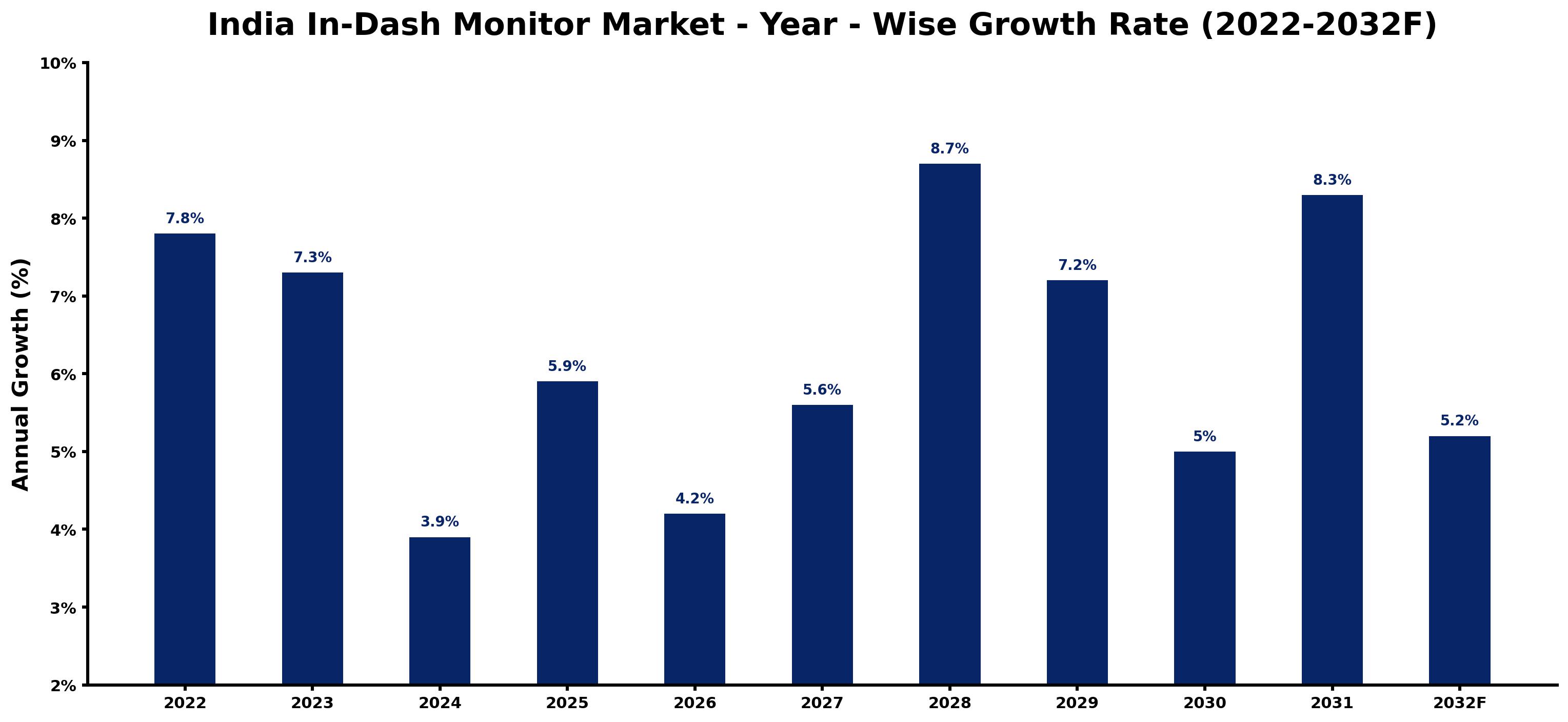
The following table presents the estimated annual growth rate for each year together with the principal factor influencing market performance.
| Year | Estimated Annual Growth (%) | Market Rationale |
| 2022 | 7.8 | The market experienced strong growth due to a rise in vehicle production, with a reported increase of 25%. |
| 2023 | 7.3 | Demand growth slowed as the market adjusted to the previous year's high production levels and consumer expectations. |
| 2024 | 3.9 | The market continued to grow, albeit at a slower pace, driven by the introduction of advanced display technologies. |
| 2025 | 5.9 | Increased vehicle production and consumer preferences for advanced displays drove demand for in-dash monitors. |
| 2026 | 4.2 | Growth is expected to moderate as manufacturers face challenges in meeting rising consumer expectations for technology integration. |
| 2027 | 5.6 | Renewed interest in advanced driver-assistance systems and integrated displays is projected to boost the market. |
| 2028 | 8.7 | A surge in demand for high-tech dashboards is expected to propel the market to its peak growth rate. |
| 2029 | 7.2 | Growth is anticipated to slow as market maturity sets in and competition intensifies among manufacturers. |
| 2030 | 5.0 | Demand is projected to decelerate as the market stabilises after rapid growth phases and consumer preferences evolve. |
| 2031 | 8.3 | A resurgence in electric vehicle adoption is expected to revitalise interest in advanced in-dash systems and their functionalities. |
| 2032 | 5.2 | Growth is projected to slow again as the market reaches a more stable phase of development, reflecting changing consumer needs. |
Note: Market size estimations and growth projections presented in this report are based on 6Wresearch's proprietary forecasting methodology, utilizing the latest available industry data, government publications, and primary research inputs.
India In-Dash Monitor Market Synopsis
In-Dash Monitors in India are advanced display systems integrated into vehicle dashboards, primarily utilising LCD or OLED technology for navigation, entertainment, and diagnostics. The market is expanding due to increased vehicle production, which rose by 25% in 2022. Additionally, the growing number of registered electric vehicles, now exceeding 1.4 million, is driving demand for sophisticated dashboards. Government initiatives like the National Electric Mobility Mission Plan 2020 further stimulate this market's expansion, improving the integration of advanced technologies.
Market Dynamics Impact Analysis (2026–2032)
| Factor | Type | Impact | Primary Segment Affected |
| Rising vehicle production rates | Driver | High | Single-Screen Display |
| Increased adoption of electric vehicles | Driver | High | Dual-Screen Setup |
| Growing demand for advanced driver-assistance systems | Opportunity | High | ADAS Tier-1 Suppliers |
| Expansion of the automotive sector | Opportunity | Medium | Sedan OEMs |
| High costs of advanced display technologies | Restraint | High | Rearview Display |
| Limited consumer awareness about features | Restraint | Medium | Analog/Digital Clusters |
| The In-Dash Monitor Market in India faces high production costs | Challenge | High | Dual-Screen Setup |
| Competition from alternative technologies | Challenge | Medium | Curved Wide Display |
Evaluation of Drivers in India In-Dash Monitor Market (2026–2032)
The factors lifting demand, and the evidence behind each, are summarised below.
| Drivers | Primary Segment Affected | Why It Matters (Evidence) |
| Increased vehicle production | Single-Screen Display | In 2022, vehicle production rose by 25%, leading to higher demand for in-dash monitors. |
| Growth in electric vehicle registrations | Dual-Screen Setup | With over 1.4 million electric vehicles in 2023, demand for advanced displays surged. |
| Government initiatives promoting smart technologies | ADAS Tier-1 Suppliers | The National Electric Mobility Mission Plan 2020 supports the adoption of advanced systems. |
| Consumer preference for advanced driver experiences | Rearview Display | The average price range of INR 15,000 to INR 50,000 makes these systems accessible. |
| Technological advancements in display integration | Analog/Digital Clusters | The introduction of IS 15885 standards in 2020 improved safety benchmarks for displays. |
Market growth in India for In-Dash Monitor rests on rising vehicle production, increasing electric vehicle registrations, and support for smart technologies. In 2022, vehicle production surged by 25%, boosting demand for advanced in-dash monitors. The presence of over 1.4 million registered electric vehicles as of 2023 has intensified the need for sophisticated display systems. The Automotive Mission Plan 2026 promotes the integration of advanced technologies, improving overall consumer experience. The average price range of INR 15,000 to INR 50,000 ensures accessibility for a wider market segment.
Evaluation of Restraints in India In-Dash Monitor Market
The main factors holding the market back are set out below.
| Market Restraint | Primary Segment Affected | Why It Matters (Evidence) |
| High costs of advanced display technologies | Rearview Display | The average price range of INR 15,000 to INR 50,000 can deter budget-conscious consumers. |
| Limited consumer awareness about features | Analog/Digital Clusters | Many consumers remain unaware of the benefits of advanced in-dash systems, affecting adoption rates. |
| Supply chain disruptions impacting production | Dual-Screen Setup | Ongoing supply chain issues have delayed the availability of components, hindering growth in this segment. |
| Regulatory compliance costs for manufacturers | Single-Screen Display | Meeting the Bureau of Indian Standards can increase production costs for manufacturers, affecting pricing strategies. |
| Competition from emerging technologies | Curved Wide Display | New technologies may divert consumer interest away from traditional in-dash monitors, impacting sales. |
India In-Dash Monitor Market Challenges
In the India In-Dash Monitor market, regulatory compliance presents a major hurdle, as the Bureau of Indian Standards mandates strict safety standards for automotive electronics, causing delays of up to six months for producers launching new products. Producers also face skills shortages in advanced display technology, limiting their ability to innovate and resulting in outdated systems that frustrate buyers seeking modern features. Buyers are experiencing rising costs, with average prices for in-dash monitors ranging from INR 15,000 to INR 50,000, which restricts access for many consumers. Rapid technological advancements pressure importers to adapt quickly, often leading to increased import costs that disrupt supply chains and affect availability for retailers.
Trends in the India In-Dash Monitor Market
The trends below show where the India In-Dash Monitor Market is heading.
- Shift towards Integrated Display Systems: Since 2022, the trend has moved towards integrated display systems that combine multiple functionalities. The introduction of Full-Dash Integration systems is gaining traction in the market, improving user experience.
- Transition from Analog to Digital Displays: In 2023, the Automotive Industry Standards Committee introduced new guidelines for in-vehicle displays, promoting digital technologies. This shift is crucial for manufacturers aiming to meet evolving consumer preferences.
- Emergence of Smart Mirror Monitors: Smart mirror monitors are becoming increasingly popular as an alternative display solution. The growing interest in safety features and connectivity is driving this trend in the market.
- Focus on Enhanced Driver Assistance Features: The demand for advanced driver-assistance systems has surged since 2023, as safety becomes a priority for consumers. This trend is supported by government initiatives promoting smart technologies.
Investment Opportunities in the India In-Dash Monitor Market
The following opportunities in the India In-Dash Monitor Market pair current demand with a clear way in.
- Automotive Manufacturing Hubs: With India's automotive sector contributing approximately 7% to GDP, investment in manufacturing hubs is timely. Targeting Sedan OEMs can lead to fruitful partnerships and increased production capabilities.
- Growing Electric Vehicle Market: The rise in electric vehicle registrations, now over 1.4 million, presents a prime opportunity. Focusing on Premium EV Developers will facilitate entry into this expanding segment.
- Investment in Advanced Display Technologies: The introduction of new display technologies offers a chance for suppliers to innovate. Collaborating with ADAS Tier-1 Suppliers can improve product offerings and market reach.
- Partnerships for Compliance and Standards: Aligning with local manufacturers to meet BIS standards can streamline market entry. This approach is vital for navigating regulatory requirements effectively.
Government Initiatives in the India In-Dash Monitor Market
The Bureau of Indian Standards established IS 15885 for automotive displays in 2020, outlining safety and performance benchmarks for in-dash monitors. Additionally, the National Policy on Electronics 2019 aims to increase domestic manufacturing of electronic components, including in-dash monitors, by 2025. The Automotive Mission Plan 2026 focuses on making India a global hub for automotive manufacturing while promoting smart technologies. These measures collectively improve production capabilities for in-dash monitors and ensure compliance with safety standards.
The Ministry of Heavy Industries oversees the implementation of the National Electric Mobility Mission Plan 2020, which promotes electric vehicle adoption and associated technologies. This initiative supports manufacturers in developing advanced in-dash systems tailored for electric vehicles. Furthermore, the Automotive Industry Standards Committee approves new guidelines for in-vehicle displays, ensuring that products meet safety and performance standards. These agencies facilitate the growth of the in-dash monitor market by encouraging innovation and compliance.
Future Insight of the India In-Dash Monitor Market
By 2032, buyers and suppliers in the India In-Dash Monitor market can anticipate a surge in demand, driven by the government's goal to achieve a 30% adoption rate for electric vehicles. The introduction of new guidelines for in-vehicle displays will stimulate innovation, resulting in advanced features that enhance user experience. The automotive sector's contribution of approximately 7% to GDP will attract increased investments in technology and infrastructure. Initiatives like the Faster Adoption and Manufacturing of Hybrid and Electric Vehicles scheme will further support the growth of high-tech dashboards.
Market Segmentation Analysis
The report offers a comprehensive study of the following market segments and their leading categories in the market.
By Monitor Type – Single-Screen Display Dominated, Dual-Screen Setup Expected to Grow Fastest
According to Sachin Kumar Rai, Senior Research Analyst at 6Wresearch, Single-Screen Display held a 40% share of the India In-Dash Monitor Market by monitor type in 2025. The Single-Screen Display segment captures the largest market share as it is predominantly used in vehicles for essential navigation and entertainment functions. Its straightforward design is particularly appealing to manufacturers of standard vehicle models, ensuring widespread adoption across the industry. The quickest growth will come from Dual-Screen Setup, forecast to expand at a CAGR of 7.3% between 2026 and 2032. The Dual-Screen Setup is experiencing rapid growth due to its capability to enhance functionality for both drivers and passengers, meeting the increasing demand for sophisticated in-vehicle technology. This segment's expansion is expected to continue as consumers increasingly seek interactive and multifunctional displays. Suppliers should focus on developing dual-screen solutions to meet the rising expectations of consumers for advanced in-dash technology.
By Screen Size – 7–10 inches Dominated and Is Expected to Record the Fastest Growth
7–10 inches took a 50% share of screen size in 2025, more than any other category. The 7–10 inches screen size segment holds the largest market share as it is the standard size for most vehicles, providing an optimal balance between visibility and dashboard space. This size is preferred by manufacturers for enhancing user experience while maintaining a sleek design aesthetic. 7–10 inches are also forecast to expand faster than any other category, at a CAGR of 7.8% over 2026–2032. As the 7–10 inches segment is also the fastest growing, its popularity reflects a trend towards integrating advanced features within compact dimensions. This growth is likely to persist as vehicle designs evolve to incorporate more technology without increasing overall size. Manufacturers must ensure their in-dash monitors are designed within this preferred size range while incorporating advanced functionalities.
By Integration Type – Analog/Digital Clusters Dominated, Full-Dash Integration Expected to Grow Fastest
With a 36% revenue share in 2025, Analog/Digital Clusters was the largest integration type category. Analog/Digital Clusters dominate the market share because they are essential for displaying critical vehicle metrics and diagnostics, making them indispensable for manufacturers. Their established role in the automotive sector ensures consistent demand from vehicle producers across various models. Over 2026–2032, Full-Dash Integration is expected to post the fastest growth, at a CAGR of 7.8%. Full-Dash Integration is rapidly gaining traction as it combines multiple systems into a single interface, appealing to modern consumers who desire streamlined technology. As vehicles become more technologically advanced, this integration type is set for significant growth. Suppliers should concentrate on developing full-dash integration solutions to align with the automotive industry's shift towards comprehensive digital interfaces.
By End User – Sedan OEMs Dominated, Premium EV Developers Expected to Grow Fastest
Sedan OEMs accounted for a 41% market share by end user in 2025. Sedan OEMs represent the largest market share as they are the primary users of in-dash monitors for standard vehicle models, driving consistent demand in the market. Their established production lines ensure a steady flow of in-dash monitor installations. Premium EV Developers are projected to grow fastest, at a CAGR of 8.9% during 2026–2032. Premium EV Developers are the fastest growing segment, driven by the surge in electric vehicle adoption and the need for advanced in-dash systems. This segment's growth reflects the industry's shift towards high-tech solutions in response to consumer preferences. Suppliers should tailor their offerings to meet the specific needs of premium EV developers to capitalise on this rapidly expanding market.
Key Attractiveness of the Report
- 10 Years of Market Numbers
- Historical Data Starting from 2022 to 2025
- Base Year 2025
- Forecast Data until 2032
- Key Performance Indicators Impacting the Market
- Major Upcoming Developments and Projects
Key Highlights of the Report:
- India In-Dash Monitor Market Outlook
- Market Size of India In-Dash Monitor Market, 2025
- Forecast of India In-Dash Monitor Market, 2032
- Historical Data and Forecast of India In-Dash Monitor Revenues & Volume for the Period 2022 - 2032F
- India In-Dash Monitor Market Trend Evolution
- India In-Dash Monitor Market Drivers and Challenges
- India In-Dash Monitor Price Trends
- India In-Dash Monitor Porter's Five Forces
- India In-Dash Monitor Industry Life Cycle
- Historical Data and Forecast of India In-Dash Monitor Market Revenues & Volume By Monitor Type for the Period 2022 - 2032F
- Historical Data and Forecast of India In-Dash Monitor Market Revenues & Volume By Single-Screen Display for the Period 2022 - 2032F
- Historical Data and Forecast of India In-Dash Monitor Market Revenues & Volume By Dual-Screen Setup for the Period 2022 - 2032F
- Historical Data and Forecast of India In-Dash Monitor Market Revenues & Volume By Curved Wide Display for the Period 2022 - 2032F
- Historical Data and Forecast of India In-Dash Monitor Market Revenues & Volume By Rearview Display for the Period 2022 - 2032F
- Historical Data and Forecast of India In-Dash Monitor Market Revenues & Volume By Screen Size for the Period 2022 - 2032F
- Historical Data and Forecast of India In-Dash Monitor Market Revenues & Volume By 7 10 inches for the Period 2022 - 2032F
- Historical Data and Forecast of India In-Dash Monitor Market Revenues & Volume By 12 inches for the Period 2022 - 2032F
- Historical Data and Forecast of India In-Dash Monitor Market Revenues & Volume By OLED/QLED for the Period 2022 - 2032F
- Historical Data and Forecast of India In-Dash Monitor Market Revenues & Volume By Smart Mirror Monitors for the Period 2022 - 2032F
- Historical Data and Forecast of India In-Dash Monitor Market Revenues & Volume By Integration Type for the Period 2022 - 2032F
- Historical Data and Forecast of India In-Dash Monitor Market Revenues & Volume By Analog/Digital Clusters for the Period 2022 - 2032F
- Historical Data and Forecast of India In-Dash Monitor Market Revenues & Volume By Dashboard Passenger View for the Period 2022 - 2032F
- Historical Data and Forecast of India In-Dash Monitor Market Revenues & Volume By Full-Dash Integration for the Period 2022 - 2032F
- Historical Data and Forecast of India In-Dash Monitor Market Revenues & Volume By Camera Integration for the Period 2022 - 2032F
- Historical Data and Forecast of India In-Dash Monitor Market Revenues & Volume By End User for the Period 2022 - 2032F
- Historical Data and Forecast of India In-Dash Monitor Market Revenues & Volume By Sedan OEMs for the Period 2022 - 2032F
- Historical Data and Forecast of India In-Dash Monitor Market Revenues & Volume By High-End Vehicle Makers for the Period 2022 - 2032F
- Historical Data and Forecast of India In-Dash Monitor Market Revenues & Volume By Premium EV Developers for the Period 2022 - 2032F
- Historical Data and Forecast of India In-Dash Monitor Market Revenues & Volume By ADAS Tier-1 Suppliers for the Period 2022 - 2032F
- India In-Dash Monitor Import Export Trade Statistics
- Market Opportunity Assessment By Monitor Type
- Market Opportunity Assessment By Screen Size
- Market Opportunity Assessment By Integration Type
- Market Opportunity Assessment By End User
- India In-Dash Monitor Top Companies Market Share
- India In-Dash Monitor Competitive Benchmarking By Technical and Operational Parameters
- India In-Dash Monitor Company Profiles
- India In-Dash Monitor Key Strategic Recommendations
Market Covered
Segments analysed in this report are listed below.
By Monitor Type
- Single-Screen Display
- Dual-Screen Setup
- Curved Wide Display
- Rearview Display
By Screen Size
- 7–10 inches
- >12 inches
- OLED/QLED
- Smart Mirror Monitors
By Integration Type
- Analog/Digital Clusters
- Dashboard + Passenger View
- Full-Dash Integration
- Camera Integration
By End User
- Sedan OEMs
- High-End Vehicle Makers
- Premium EV Developers
- ADAS Tier-1 Suppliers































