India Industrial Antimicrobial Coatings Market Size & Growth Rate
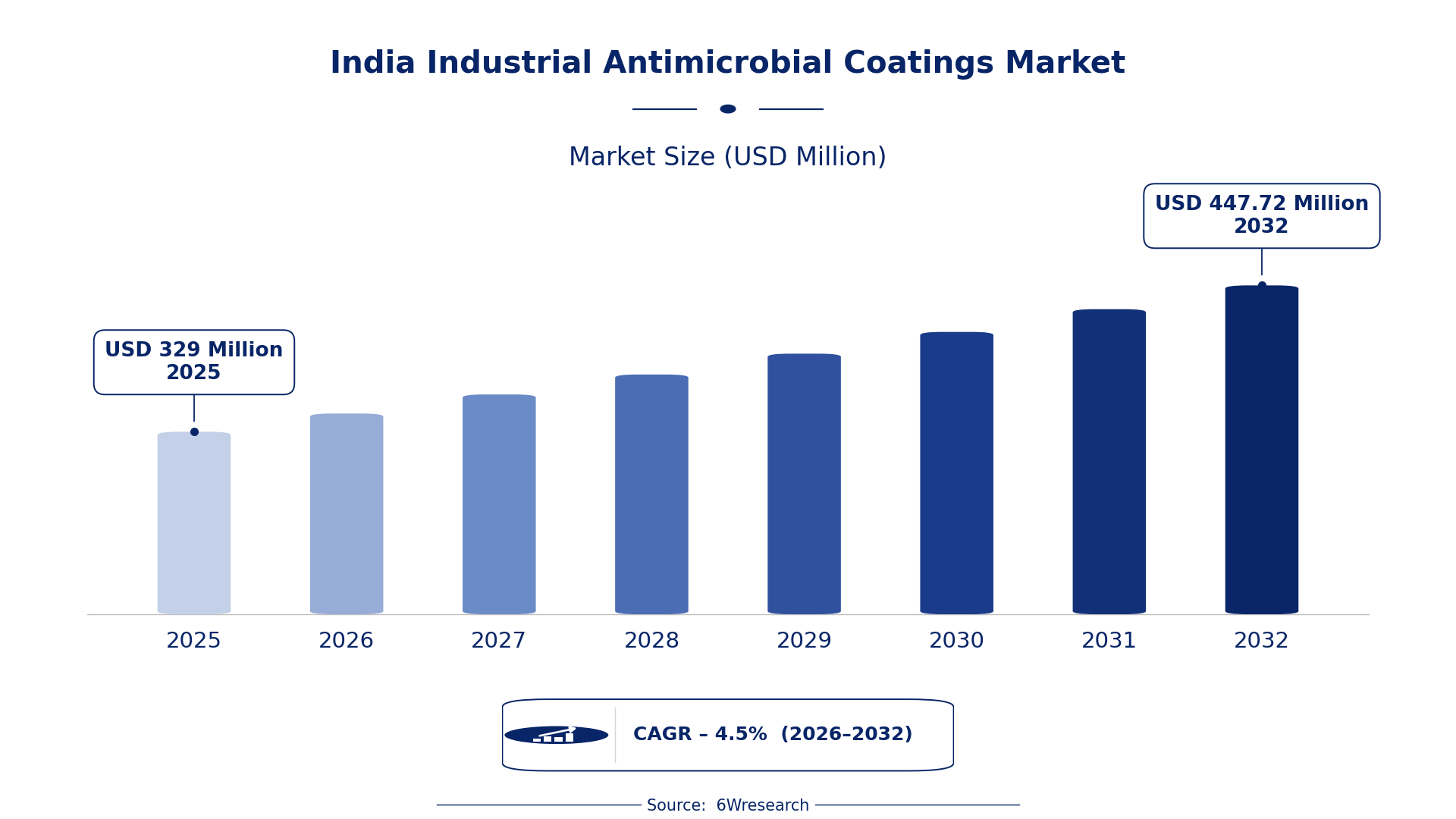
According to 6Wresearch internal database and industry insights, the India Industrial Antimicrobial Coatings Market was valued at USD 329.0 million in 2025 and is projected to reach USD 447.72 million by 2032, growing at a CAGR of approximately 4.5% during 2026–2032.
India Industrial Antimicrobial Coatings Market Highlights
| Report Metric | Details |
| Report Name | India Industrial Antimicrobial Coatings Market |
| Market Size 2025 | USD 329.0 million |
| Market Size 2032 | USD 447.72 million |
| Absolute Growth 2025–2032 | USD 118.72 million |
| CAGR 2026–2032 | 4.5% |
| Peak Annual Growth | 6.6% in 2031 |
| Forecast Period | 2026–2032 |
| Historical Data | 2022–2025 |
| Base Year | 2025 |
| Leading Coating Type, 2025 | Silver-Based Coatings (45% share) |
| Leading Active Agent, 2025 | Silver Ions (41% share) |
| Leading Substrate Compatibility, 2025 | Metals (45% share) |
| Leading End User, 2025 | Medical Device Makers (48% share) |
| Fastest-Growing Coating Type | Hybrid Coatings (6.3% CAGR) |
| Fastest-Growing Active Agent | Nanoparticle Infused (6.6% CAGR) |
| Fastest-Growing Substrate Compatibility | HVAC Surfaces (7.0% CAGR) |
| Fastest-Growing End User | Food Processing Units (6.1% CAGR) |
| Growing Sector | Healthcare |
| Key End Users | Medical Device Makers, Food Processing Units, Public Infrastructure |
India Industrial Antimicrobial Coatings Market Year-wise Growth Rate and Key Drivers (2022–2032)
This graph illustrates the annual growth rates of the market from 2022 to 2032, highlighting a steady upward trajectory and projected market expansion over the forecast period.
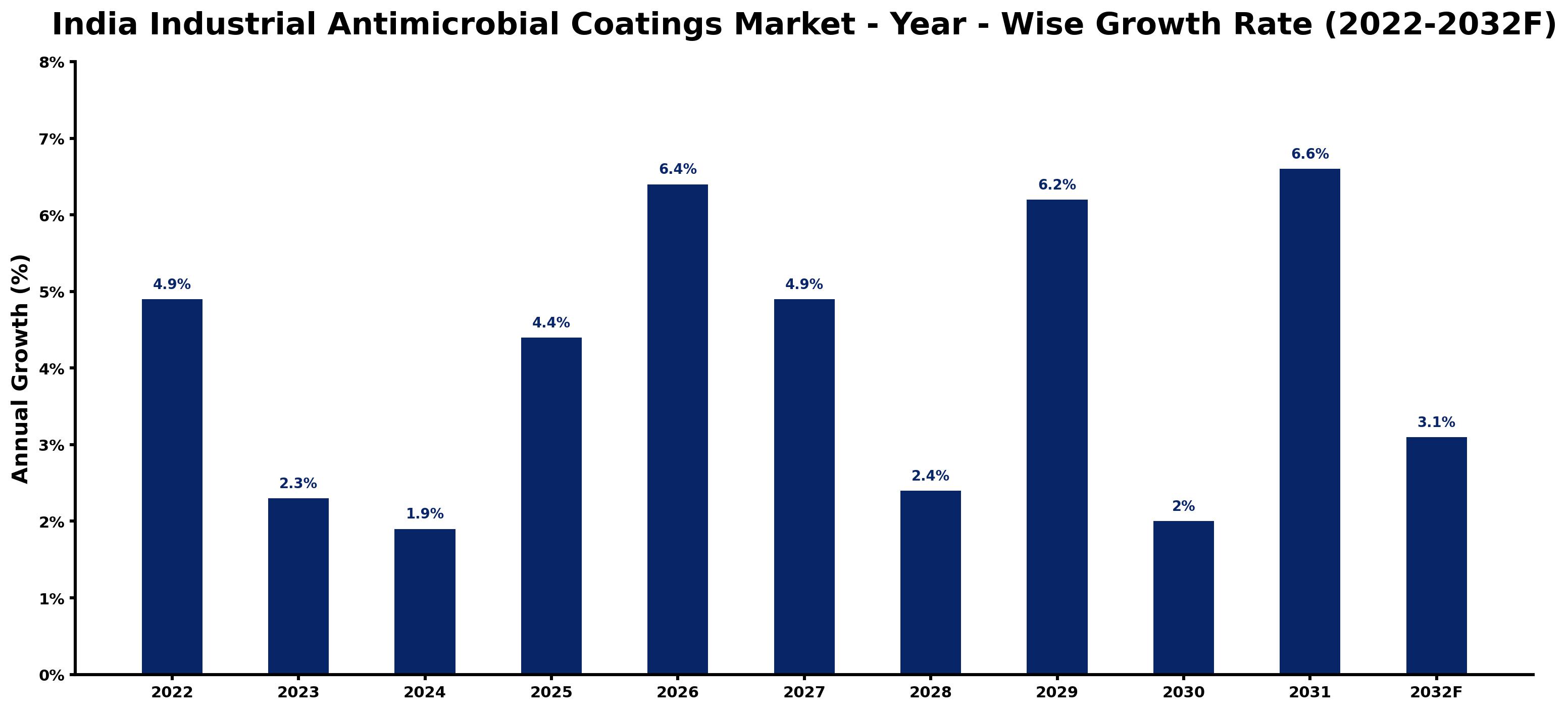
Year by year, the estimates below pair each growth rate with the development that shaped it.
| Year | Estimated Annual Growth (%) | Market Rationale |
| 2022 | 4.9 | The market experienced strong demand due to heightened healthcare needs and food safety regulations. |
| 2023 | 2.3 | Growth slowed as the market adjusted to previous peaks in demand from healthcare sectors. |
| 2024 | 1.9 | Continued slow growth reflected ongoing adjustments in production and application practices. |
| 2025 | 4.4 | An increase in public infrastructure projects boosted demand for antimicrobial coatings. |
| 2026 | 6.4 | Growth is expected to accelerate as healthcare spending targets increase, driving higher coating requirements. |
| 2027 | 4.9 | Demand growth is projected to slow as market conditions stabilise after a period of rapid expansion. |
| 2028 | 2.4 | The market is expected to experience slower growth due to adjustments in production capacities and demand. |
| 2029 | 6.2 | A resurgence in public health initiatives is likely to lead to renewed interest in antimicrobial applications. |
| 2030 | 2.0 | Growth is expected to slow as market dynamics stabilise after several years of fluctuating demand. |
| 2031 | 6.6 | The market is projected to peak with strong demand from healthcare and public infrastructure sectors. |
| 2032 | 3.1 | Growth is expected to decelerate as the market stabilises after reaching peak levels. |
Note: Market size estimations and growth projections presented in this report are based on 6Wresearch's proprietary forecasting methodology, utilizing the latest available industry data, government publications, and primary research inputs.
India Industrial Antimicrobial Coatings Market Synopsis
The India Industrial Antimicrobial Coatings Market encompasses specialized coatings that prevent microorganism growth on surfaces. These coatings, formulated with active agents like silver ions, are primarily used in healthcare, food processing, and public infrastructure. The market is growing due to increasing healthcare spending, regulatory support, and a focus on hygiene. In particular, the healthcare sector drives demand, with silver-based coatings used in over 60% of medical devices. Ongoing industrial activities and public health initiatives further support this growth.
Market Dynamics Impact Analysis (2026–2032)
| Factor | Type | Impact | Primary Segment Affected |
| Increasing healthcare spending and regulations | Driver | High | Medical Device Makers |
| Public infrastructure projects focusing on hygiene | Driver | High | Public Infrastructure |
| Investment in food processing units | Opportunity | High | Food Processing Units |
| Emerging demand for hybrid coatings | Opportunity | Medium | Hybrid Coatings |
| Regulatory scrutiny on certain antimicrobial agents | Restraint | High | Organic Antimicrobials |
| Market adjustments in production capacities | Restraint | Medium | Copper-Based Coatings |
| Limited awareness among smaller manufacturers | Challenge | High | Hybrid Coatings |
| Competition from alternative antimicrobial solutions | Challenge | Medium | Silver-Based Coatings |
Evaluation of Drivers in India Industrial Antimicrobial Coatings Market (2026–2032)
Key forces behind demand, with the segment each one moves most, are listed below.
| Drivers | Primary Segment Affected | Why It Matters (Evidence) |
| Rising healthcare spending | Medical Device Makers | India aims to increase healthcare spending to 2.5% of GDP by 2025, boosting demand for coatings in medical devices. |
| Public health initiatives | Public Infrastructure | The National Health Mission promotes antimicrobial materials in healthcare, increasing coating applications and enhancing safety standards. |
| Food safety regulations | Food Processing Units | The FSSAI regulates food processing standards, requiring the use of antimicrobial coatings to ensure safety in food packaging. |
| Growing construction projects | Public Infrastructure | The Indian government allocated ₹1.5 trillion for infrastructure development, impacting the demand for antimicrobial coatings in public spaces. |
| Technological advancements in coatings | Hybrid Coatings | Emerging hybrid coatings are gaining traction for their effectiveness in various applications, appealing to diverse industries. |
India aims to boost healthcare spending to 2.5% of GDP by 2025, which will drive demand for coatings in medical devices. The FSSAI regulates food processing standards, requiring the use of antimicrobial coatings to ensure safety in food packaging. Technological advancements are leading to the emergence of hybrid coatings, which are gaining traction for their effectiveness in various applications.
Evaluation of Restraints in India Industrial Antimicrobial Coatings Market
The main factors holding the market back are set out below.
| Market Restraint | Primary Segment Affected | Why It Matters (Evidence) |
| Regulatory scrutiny on certain antimicrobial agents | Organic Antimicrobials | Regulations on agents like Triclosan limit their use, affecting market growth and compliance costs. |
| Market adjustments in production capacities | Copper-Based Coatings | Manufacturers face challenges in scaling production to meet rising demand, leading to potential supply shortages. |
| Limited awareness among smaller manufacturers | Hybrid Coatings | Smaller players struggle to adopt advanced technologies, hindering market penetration and innovation efforts. |
| Competition from alternative antimicrobial solutions | Silver-Based Coatings | Alternative solutions may attract buyers seeking cost-effective options, impacting market share for traditional coatings. |
| Supply chain disruptions | Medical Device Makers | Global supply chain issues have delayed the availability of key raw materials, affecting production timelines. |
India Industrial Antimicrobial Coatings Market Challenges
Producers in the India Industrial Antimicrobial Coatings market encounter skills shortages, as a lack of trained professionals hinders production efficiency and increases costs by approximately 20%. Rising raw material prices, especially for silver-based compounds, place additional burdens on manufacturers, leading to price hikes of around 15% for buyers. Adhering to regulations set by the Food Safety and Standards Authority of India (FSSAI) complicates manufacturing processes, resulting in prolonged approval times that may delay product launches by up to six months. The slow uptake of advanced coating technologies limits suppliers' capacity to innovate, making it difficult to meet the changing demands of buyers.
Trends in the India Industrial Antimicrobial Coatings Market
Below mentioned are some of the trends shaping the India Industrial Antimicrobial Coatings Market growth.
- Rise in Antimicrobial Coatings for Food Packaging: The Food Safety and Standards (Packaging) Regulations 2018 encourage the use of antimicrobial coatings in food packaging to ensure safety. This trend is expected to improve hygiene standards across the food processing industry.
- Growth in HVAC Applications: HVAC surfaces are increasingly being coated with antimicrobial materials to prevent microbial growth. This trend is driven by rising awareness of indoor air quality and is projected to grow at a CAGR of 7.0%.
- Expansion of Public Infrastructure Projects: Public infrastructure projects are increasingly incorporating antimicrobial coatings to improve hygiene and safety. The Indian government's focus on sanitation through the Swachh Bharat Mission 2020 supports this trend.
- Shift towards Hybrid Coatings: Hybrid coatings are gaining popularity in India, particularly in healthcare applications, with a projected CAGR of 6.3% from 2026 to 2032. This shift reflects a growing preference for versatile solutions that combine multiple benefits.
Investment Opportunities in the India Industrial Antimicrobial Coatings Market
Several openings in the India Industrial Antimicrobial Coatings Market merit attention from investors.
- Supply of Antimicrobial Coatings for Medical Devices: The healthcare sector is on the rise, presenting a strong opportunity for suppliers of antimicrobial coatings. With over 60% of medical devices employing these coatings, collaborations with medical device manufacturers can yield substantial returns.
- Investment in Food Processing Units: Valued at $150 billion, the food processing sector offers a promising opportunity for antimicrobial coatings. Suppliers can target food processing units to improve hygiene and safety standards, ensuring compliance with regulations.
- Development of Hybrid Coatings: The growing demand for hybrid coatings presents a timely investment opportunity. Suppliers can focus on creating effective solutions for various applications, particularly in healthcare and public infrastructure, to address increasing needs.
- Entry into Public Infrastructure Projects: With the Indian government investing ₹1.5 trillion in infrastructure, there is a clear opportunity for suppliers. Partnering with local entities can facilitate entry into this expanding market and improve project outcomes.
Government Initiatives in the India Industrial Antimicrobial Coatings Market
The National Health Policy 2017 advocates for infection control in healthcare settings, promoting the use of antimicrobial coatings to enhance patient safety. This policy builds on earlier regulations and underscores the necessity for effective infection prevention measures in hospitals and healthcare facilities. The FSSAI's Food Safety and Standards (Packaging) Regulations 2018 further endorse the use of antimicrobial coatings in food packaging, ensuring safety and hygiene in food processing. These measures collectively stimulate demand for antimicrobial coatings in India.
The Indian government allocated ₹1.5 trillion for infrastructure development in 2021, with the Ministry of Housing and Urban Affairs overseeing projects that incorporate antimicrobial coatings. This funding bolsters initiatives aimed at improving hygiene and safety in public spaces. The Bureau of Indian Standards (BIS) has also established standards for antimicrobial coatings, ensuring quality and safety for producers and buyers alike. These standards facilitate compliance and boost market confidence in antimicrobial products.
Future Insight of the India Industrial Antimicrobial Coatings Market
Several forward-looking factors should support the India Industrial Antimicrobial Coatings market in the coming years. The government's 'Make in India' initiative will strengthen local manufacturing capabilities, enhancing supply chain efficiency. By 2025, healthcare spending is expected to rise to 2.5% of GDP, driving increased demand for medical coatings. Infrastructure projects, backed by a ₹1.5 trillion investment, will create new applications for antimicrobial coatings in public spaces. The National Building Code's guidelines will further encourage the adoption of antimicrobial surfaces in construction.
Market Segmentation Analysis
The analysis below covers each segmentation, its leading category in 2025 and its fastest-growing category through 2032.
By Coating Type – Silver-Based Coatings Dominated, Hybrid Coatings Expected to Grow Fastest
According to Sachin Kumar Rai, Senior Research Analyst at 6Wresearch, with a 45% revenue share in 2025, Silver-Based Coatings was the largest coating type category. Silver-based coatings dominate the market as they are highly effective in preventing microbial growth, especially in medical devices where they account for over 60% of usage. This established presence in the healthcare sector solidifies their leading position among manufacturers prioritising reliable antimicrobial solutions. Hybrid Coatings are projected to grow fastest, at a CAGR of 6.3% during 2026–2032. Hybrid coatings are experiencing rapid growth due to their ability to offer enhanced properties for various applications, particularly in industries that require versatility. As manufacturers seek innovative options, the demand for hybrid formulations is expected to rise significantly. Suppliers should prioritise the development of hybrid coatings to meet the growing interest in versatile antimicrobial solutions.
By Active Agent – Silver Ions Dominated, Nanoparticle Infused Expected to Grow Fastest
Silver Ions took a 41% share of active agent in 2025, more than any other category. Silver ions are the predominant active agent in antimicrobial coatings, celebrated for their effectiveness across various applications, especially in healthcare and food safety. Their established reputation and regulatory support solidify their commanding market share. The quickest growth will come from Nanoparticle Infused, forecast to expand at a CAGR of 6.6% between 2026 and 2032. Nanoparticle infused coatings are on the rise due to their superior antimicrobial properties, attracting industries that seek advanced solutions. As understanding of their advantages spreads, this segment is set for rapid growth in the near future. Buyers should explore nanoparticle infused options for superior performance in antimicrobial applications.
By Substrate Compatibility – Metals Dominated, HVAC Surfaces Expected to Grow Fastest
Metals held a 45% share of the India Industrial Antimicrobial Coatings Market by substrate compatibility in 2025. Metals are the primary substrates for antimicrobial coatings, widely used in industrial applications due to their durability and effectiveness in preventing microbial growth. Their extensive use in sectors like healthcare and food processing reinforces their leading market share. HVAC Surfaces are set to record the highest CAGR in this split, 7.0% over 2026–2032. HVAC surfaces are becoming the fastest-growing segment as the need for hygienic air handling systems rises, particularly in public health-focused environments. This trend is driven by increased awareness of indoor air quality and safety standards. Suppliers should target HVAC applications to capitalise on the growing demand for antimicrobial solutions in air handling systems.
By End User – Medical Device Makers Dominated, Food Processing Units Expected to Grow Fastest
In 2025, Medical Device Makers led the end user split with a 48% share. Medical device makers represent the largest end-user segment for antimicrobial coatings, relying on these products to ensure safety and adhere to health regulations. Their substantial market share is further supported by the anticipated increase in healthcare spending in India, projected to reach 2.5% of GDP by 2025. Over 2026–2032, Food Processing Units are expected to post the fastest growth, at a CAGR of 6.1%. Food processing units are the fastest-growing end-user segment, propelled by stringent hygiene regulations and safety standards that heighten the need for antimicrobial coatings. The essential nature of cleanliness in food production environments is driving this growth trajectory. Manufacturers should concentrate on food processing applications to effectively respond to the increasing demand for hygiene-focused coatings.
Key Attractiveness of the Report
- 10 Years of Market Numbers
- Historical Data Starting from 2022 to 2025
- Base Year 2025
- Forecast Data until 2032
- Key Performance Indicators Impacting the Market
- Major Upcoming Developments and Projects
Key Highlights of the Report:
- India Industrial Antimicrobial Coatings Market Outlook
- Market Size of India Industrial Antimicrobial Coatings Market, 2025
- Forecast of India Industrial Antimicrobial Coatings Market, 2032
- Historical Data and Forecast of India Industrial Antimicrobial Coatings Revenues & Volume for the Period 2022 - 2032F
- India Industrial Antimicrobial Coatings Market Trend Evolution
- India Industrial Antimicrobial Coatings Market Drivers and Challenges
- India Industrial Antimicrobial Coatings Price Trends
- India Industrial Antimicrobial Coatings Porter's Five Forces
- India Industrial Antimicrobial Coatings Industry Life Cycle
- Historical Data and Forecast of India Industrial Antimicrobial Coatings Market Revenues & Volume By Coating Type for the Period 2022 - 2032F
- Historical Data and Forecast of India Industrial Antimicrobial Coatings Market Revenues & Volume By Silver-Based Coatings for the Period 2022 - 2032F
- Historical Data and Forecast of India Industrial Antimicrobial Coatings Market Revenues & Volume By Copper-Based Coatings for the Period 2022 - 2032F
- Historical Data and Forecast of India Industrial Antimicrobial Coatings Market Revenues & Volume By Organic Antimicrobials for the Period 2022 - 2032F
- Historical Data and Forecast of India Industrial Antimicrobial Coatings Market Revenues & Volume By Hybrid Coatings for the Period 2022 - 2032F
- Historical Data and Forecast of India Industrial Antimicrobial Coatings Market Revenues & Volume By Active Agent for the Period 2022 - 2032F
- Historical Data and Forecast of India Industrial Antimicrobial Coatings Market Revenues & Volume By Silver Ions for the Period 2022 - 2032F
- Historical Data and Forecast of India Industrial Antimicrobial Coatings Market Revenues & Volume By Cuprous Oxide for the Period 2022 - 2032F
- Historical Data and Forecast of India Industrial Antimicrobial Coatings Market Revenues & Volume By Triclosan, QACs for the Period 2022 - 2032F
- Historical Data and Forecast of India Industrial Antimicrobial Coatings Market Revenues & Volume By Nanoparticle Infused for the Period 2022 - 2032F
- Historical Data and Forecast of India Industrial Antimicrobial Coatings Market Revenues & Volume By Substrate Compatibility for the Period 2022 - 2032F
- Historical Data and Forecast of India Industrial Antimicrobial Coatings Market Revenues & Volume By Metals, Plastics for the Period 2022 - 2032F
- Historical Data and Forecast of India Industrial Antimicrobial Coatings Market Revenues & Volume By HVAC Surfaces for the Period 2022 - 2032F
- Historical Data and Forecast of India Industrial Antimicrobial Coatings Market Revenues & Volume By Textiles, Wood for the Period 2022 - 2032F
- Historical Data and Forecast of India Industrial Antimicrobial Coatings Market Revenues & Volume By Multi-Surface for the Period 2022 - 2032F
- Historical Data and Forecast of India Industrial Antimicrobial Coatings Market Revenues & Volume By End User for the Period 2022 - 2032F
- Historical Data and Forecast of India Industrial Antimicrobial Coatings Market Revenues & Volume By Medical Device Makers for the Period 2022 - 2032F
- Historical Data and Forecast of India Industrial Antimicrobial Coatings Market Revenues & Volume By Public Infrastructure for the Period 2022 - 2032F
- Historical Data and Forecast of India Industrial Antimicrobial Coatings Market Revenues & Volume By Furniture & Interiors for the Period 2022 - 2032F
- Historical Data and Forecast of India Industrial Antimicrobial Coatings Market Revenues & Volume By Food Processing Units for the Period 2022 - 2032F
- India Industrial Antimicrobial Coatings Import Export Trade Statistics
- Market Opportunity Assessment By Coating Type
- Market Opportunity Assessment By Active Agent
- Market Opportunity Assessment By Substrate Compatibility
- Market Opportunity Assessment By End User
- India Industrial Antimicrobial Coatings Top Companies Market Share
- India Industrial Antimicrobial Coatings Competitive Benchmarking By Technical and Operational Parameters
- India Industrial Antimicrobial Coatings Company Profiles
- India Industrial Antimicrobial Coatings Key Strategic Recommendations
Market Covered
Segments analysed in this report are listed below.
By Coating Type
- Silver-Based Coatings
- Copper-Based Coatings
- Organic Antimicrobials
- Hybrid Coatings
By Active Agent
- Silver Ions
- Cuprous Oxide
- Triclosan
- QACs
- Nanoparticle Infused
By Substrate Compatibility
- Metals
- Plastics
- HVAC Surfaces
- Textiles
- Wood
- Multi-Surface
By End User
- Medical Device Makers
- Public Infrastructure
- Furniture & Interiors
- Food Processing Units































