India industrial automation control equipment Market Size & Growth Rate
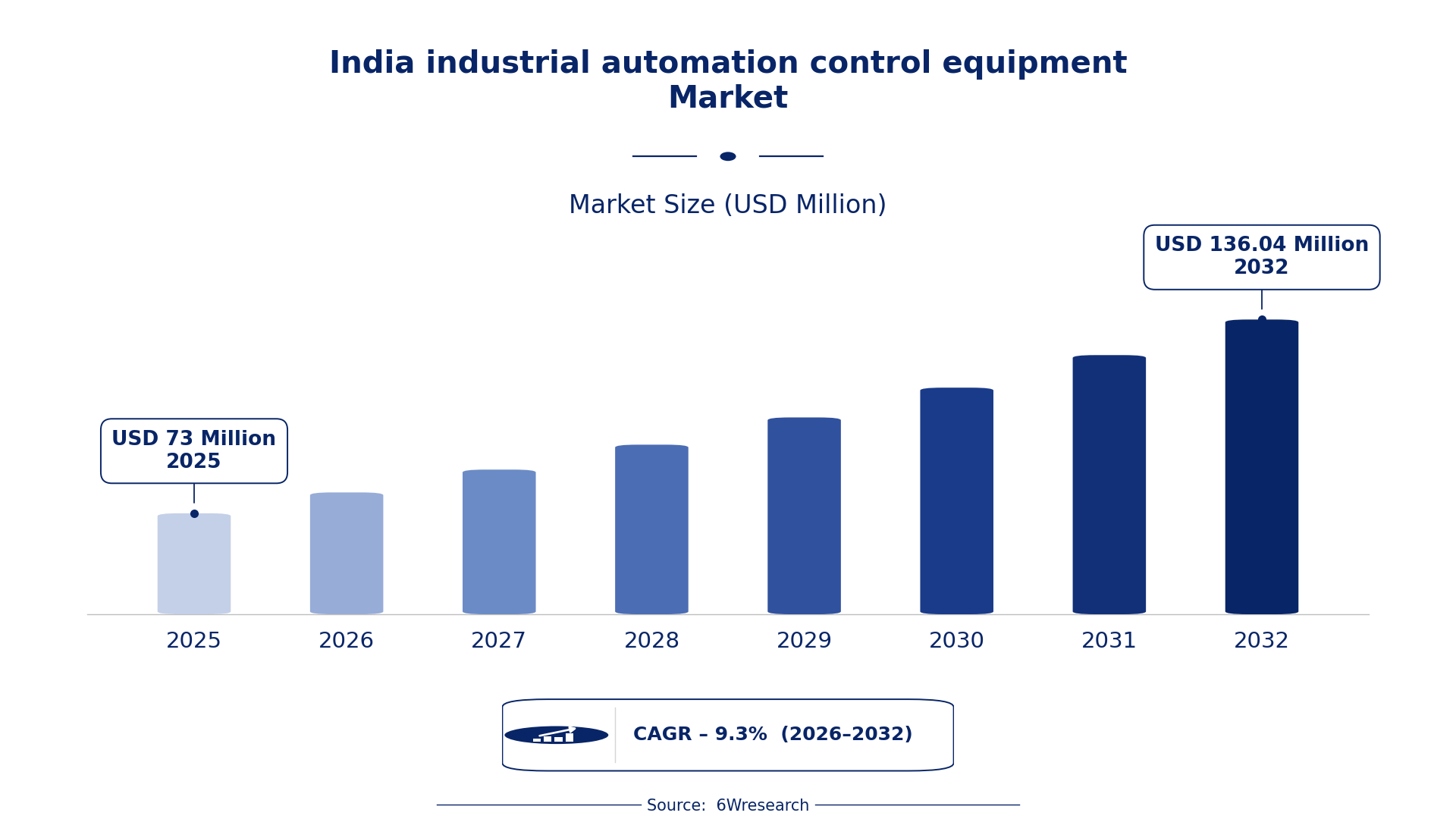
According to 6Wresearch internal database and industry insights, the India industrial automation control equipment Market was valued at USD 73.0 million in 2025 and is projected to reach USD 136.04 million by 2032, growing at a CAGR of approximately 9.3% during 2026–2032.
India industrial automation control equipment Market Highlights
| Report Metric | Details |
| Report Name | India industrial automation control equipment Market |
| Market Size 2025 | USD 73.0 million |
| Market Size 2032 | USD 136.04 million |
| Absolute Growth 2025–2032 | USD 63.04 million |
| CAGR 2026–2032 | 9.3% |
| Peak Annual Growth | 11.4% in 2032 |
| Forecast Period | 2026–2032 |
| Historical Data | 2022–2025 |
| Base Year | 2025 |
| Leading Equipment Type, 2025 | Programmable Controllers (41% share) |
| Leading Control Mechanism, 2025 | Real-Time Automation (46% share) |
| Leading Operation Level, 2025 | Process Automation (47% share) |
| Leading End User, 2025 | Automotive Plants (50% share) |
| Fastest-Growing Equipment Type | SCADA Systems (11.9% CAGR) |
| Fastest-Growing Operation Level | Remote Monitoring (11.9% CAGR) |
| Fastest-Growing End User | Utility Networks (11.7% CAGR) |
| Growing Sector | Automotive |
| Key End Users | Automotive Plants, Chemical Plants, Utility Networks, Packaging Industry |
India industrial automation control equipment Market Year-wise Growth Rate and Key Drivers (2022–2032)
This graph illustrates the annual growth rates of the market from 2022 to 2032, highlighting a steady upward trajectory and projected market expansion over the forecast period.
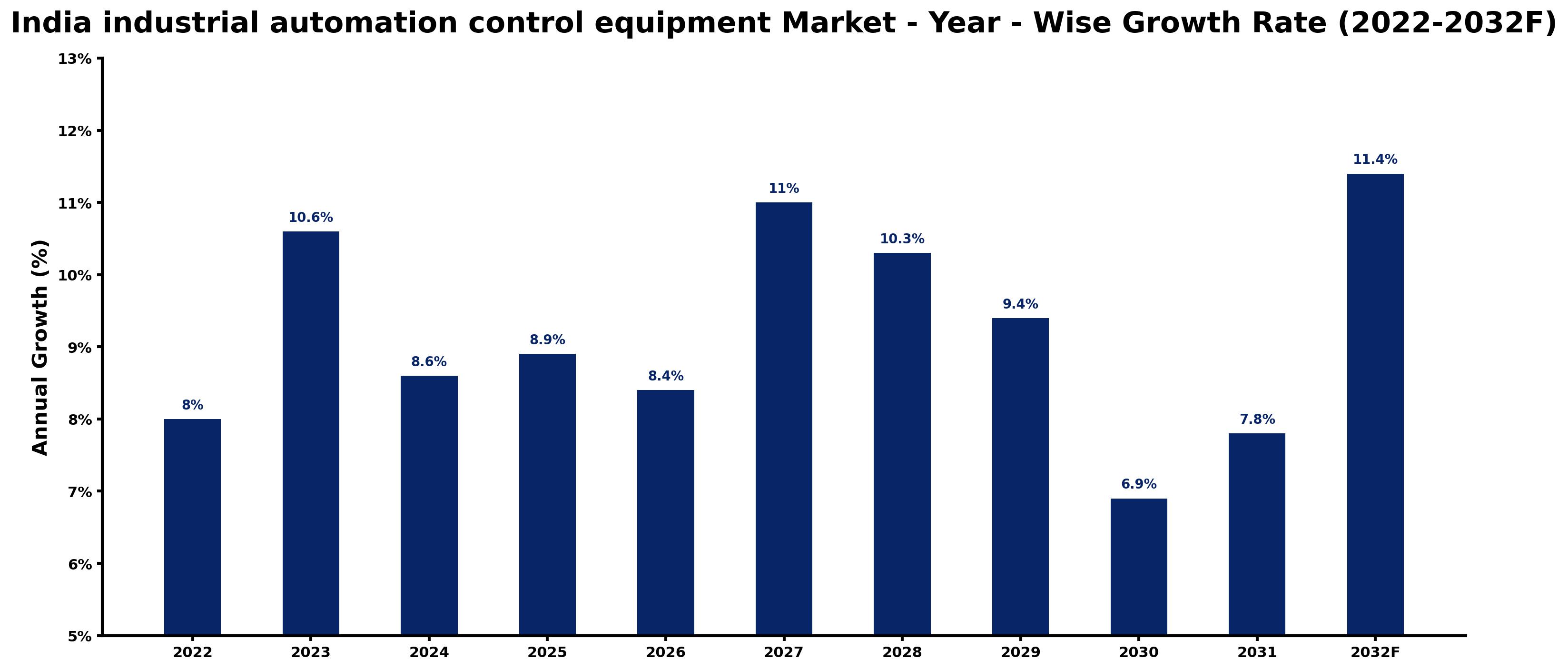
Year by year, the estimates below pair each growth rate with the development that shaped it.
| Year | Estimated Annual Growth (%) | Market Rationale |
| 2022 | 8.0 | The market experienced steady growth, driven by increasing automation in manufacturing sectors. |
| 2023 | 10.6 | Demand surged due to heightened investments in smart manufacturing technologies and automation. |
| 2024 | 8.6 | A slowdown occurred as the market adjusted to previous rapid growth rates and demand stabilised. |
| 2025 | 8.9 | Growth resumed as the automotive sector expanded, boosting automation needs. |
| 2026 | 8.4 | The market is expected to grow at a slower pace due to normalised conditions after previous peaks in investment. |
| 2027 | 11.0 | Demand is projected to rise, particularly from utility networks adopting automation. |
| 2028 | 10.3 | The market will continue to grow, albeit at a slower pace, influenced by advancements in process automation. |
| 2029 | 9.4 | Demand growth is expected to decelerate further as the market stabilises after rapid expansions in prior years. |
| 2030 | 6.9 | The market is projected to experience a slowdown as investments in automation begin to plateau. |
| 2031 | 7.8 | An uptick in growth is anticipated as the automotive sector continues to drive demand for automation. |
| 2032 | 11.4 | The market is expected to peak with growth driven by advancements in smart manufacturing technologies. |
Note: Market size estimations and growth projections presented in this report are based on 6Wresearch's proprietary forecasting methodology, utilizing the latest available industry data, government publications, and primary research inputs.
India industrial automation control equipment Market Synopsis
Industrial automation control equipment in India includes systems that manage industrial processes, improving efficiency and safety. This sector is essential for reducing labor costs and enhancing operational performance across various industries. The India industrial automation control equipment Market is expanding due to rising demand from the automotive sector and initiatives like 'Make in India'. With the automotive industry projected to reach 300 billion USD by 2026, the need for automation solutions continues to grow, supported by government investments in smart manufacturing technologies.
Market Dynamics Impact Analysis (2026–2032)
| Factor | Type | Impact | Primary Segment Affected |
| Increasing demand for automation in the automotive sector boosts equipment sales. | Driver | High | Programmable Controllers |
| The push for smart manufacturing technologies drives investment in automation solutions. | Driver | High | SCADA Systems |
| The automotive industry is projected to reach 300 billion USD by 2026, creating opportunities for automation providers. | Opportunity | High | Automotive Plants |
| The Packaging Industry is expected to reach 73 billion USD by 2024, increasing demand for automation. | Opportunity | High | Packaging Industry |
| Limited skilled workforce in automation technologies hampers market growth. | Restraint | High | Real-Time Automation |
| High initial investment costs for automation equipment restrict adoption among smaller manufacturers. | Restraint | Medium | Industrial Panels |
| Competition from imported automation solutions affects local manufacturers' market share. | Challenge | High | Distributed Control Systems |
| Rapid technological changes require constant updates, posing challenges for existing providers. | Challenge | Medium | Programmable Controllers |
Evaluation of Drivers in India industrial automation control equipment Market (2026–2032)
Below mentioned are some major drivers and their influence on market dynamics.
| Drivers | Primary Segment Affected | Why It Matters (Evidence) |
| Investment in smart manufacturing technologies is increasing demand for automation solutions. | SCADA Systems | The Indian government announced a 500 million USD investment in smart manufacturing technologies, leading to higher automation adoption among utility networks. |
| The automotive sector's growth is driving demand for automation solutions. | Programmable Controllers | With the automotive industry projected to reach 300 billion USD by 2026, manufacturers are investing heavily in automation to improve production efficiency. |
| The 'Make in India' initiative encourages domestic manufacturing and automation adoption. | Industrial Panels | This programme supports local production, increasing the need for efficient automation solutions across various industries. |
| The growing need for real-time data acquisition is boosting SCADA system demand. | SCADA Systems | Utility networks are increasingly adopting SCADA systems for efficient management, driving demand for automation solutions. |
| The 'Digital India' initiative promotes automation across various sectors. | Real-Time Automation | This programme aims to transform India into a digitally empowered society, increasing the demand for automation technologies. |
The automotive industry is set to reach 300 billion USD by 2026, prompting manufacturers to adopt automation solutions to improve production efficiency. Utility networks are increasingly adopting SCADA systems for efficient management, which boosts the market for industrial automation control equipment in India.
Evaluation of Restraints in India industrial automation control equipment Market
The table below lists the restraints and the evidence behind each.
| Market Restraint | Primary Segment Affected | Why It Matters (Evidence) |
| Limited skilled workforce in automation technologies hampers market growth. | Real-Time Automation | The shortage of trained professionals affects the implementation and maintenance of automation solutions, resulting in delays and increased costs. |
| High initial investment costs for automation equipment restrict adoption among smaller manufacturers. | Industrial Panels | Smaller manufacturers often struggle to afford the upfront costs associated with automation, limiting their competitiveness. |
| Competition from imported automation solutions affects local manufacturers' market share. | Distributed Control Systems | Imported products often provide lower prices, challenging local manufacturers' ability to compete effectively. |
| Rapid technological changes require constant updates, posing challenges for existing providers. | Programmable Controllers | Providers must continuously innovate to keep pace with evolving technology, straining their resources and budgets. |
| Regulatory compliance can be complex and costly for manufacturers. | SCADA Systems | Navigating the regulatory requirements necessitates significant investment in compliance measures, impacting operational budgets. |
India industrial automation control equipment Market Challenges
The India industrial automation control equipment market faces several practical challenges, beginning with technology adoption. Many manufacturers find it difficult to implement advanced automation systems due to a lack of skilled workers, which delays projects and increases training costs for producers. Supply chain disruptions also create obstacles, as over 200 chemical plants depend on imported components, resulting in extended lead times that can disrupt production. Competition is intense, with local firms often unable to compete with the pricing of international suppliers, forcing buyers to opt for lower-quality alternatives. Rising raw material costs further inflate prices, straining budgets for manufacturers and increasing expenses for end-users.
Trends in the India industrial automation control equipment Market
Buyers and suppliers in the India industrial automation control equipment Market are adjusting to the following trends.
- Shift from Traditional to Smart Manufacturing: Since 2021, India has seen a transition towards smart manufacturing practices, driven by the 'Digital India' initiative. This shift is reflected in a 500 million USD investment in smart technologies, enabling manufacturers to improve efficiency and productivity.
- Rise of Real-Time Automation: In 2022, the demand for real-time automation surged, particularly in utility networks. This trend is highlighted by the growing adoption of SCADA systems, which are projected to expand significantly in the coming years.
- Increased Focus on Quality Standards: Since 2023, manufacturers have prioritised quality assurance with the updated IS 9000 standard. This focus on quality is essential for meeting international standards and improving competitiveness in the automation market.
- Expansion of Automation in the Packaging Industry: By 2024, the Packaging Industry is expected to reach 73 billion USD, driving automation adoption. This growth underscores the need for efficient automation solutions to streamline packaging processes.
Investment Opportunities in the India industrial automation control equipment Market
Below are the investment opportunities with the strongest case in the India industrial automation control equipment Market.
- Investment in Smart Manufacturing: With a 500 million USD investment in smart manufacturing, there is a notable opportunity for automation providers. Targeting automotive manufacturers can yield high returns as they seek to improve production efficiency.
- Growing Demand in Utility Networks: The utility sector's increasing need for automation presents a lucrative opportunity. Suppliers can enter this market by partnering with local utilities to provide tailored automation solutions.
- Automation in Chemical Plants: With over 200 chemical plants in India, there is a pressing need for automation solutions. Investing in technologies that improve safety and efficiency can capture this growing market.
- Focus on Training and Skill Development: The 'Skill India Mission 2.0' aims to train 1 million individuals in automation skills by 2025. This initiative creates opportunities for training providers and automation companies to collaborate.
Government Initiatives in the India industrial automation control equipment Market
The 'National Policy on Electronics' launched in 2021 aims to promote domestic manufacturing of automation equipment, targeting a 25 billion USD electronics market by 2025. This policy supports local production and innovation in automation technologies, benefiting both manufacturers and buyers. The 'Atmanirbhar Bharat' initiative, introduced in 2020, seeks to enhance self-reliance in manufacturing, including automation technologies, creating a favourable environment for growth.
In 2023, the Bureau of Indian Standards updated the IS 9000 standard to incorporate guidelines for automation equipment quality assurance. This update is intended to ensure that automation products meet high-quality standards, boosting buyer confidence and market competitiveness. The Ministry of Skill Development and Entrepreneurship launched the 'Skill India Mission 2.0' to train youth in automation skills, aiming for 1 million trained individuals by 2025, which will support the industry's growth.
Future Insight of the India industrial automation control equipment Market
Several forward-looking factors should support growth in the India industrial automation control equipment market over the coming years. The 'Digital India' initiative will promote automation across various sectors, while the 'Make in India' program aims to strengthen domestic manufacturing capabilities. Additionally, the government's 500 million USD investment in smart manufacturing technologies will improve operational efficiency, presenting valuable opportunities for both buyers and suppliers.
Market Segmentation Analysis
The report offers a comprehensive study of the following market segments and their leading categories in the market.
By Equipment Type – Programmable Controllers Dominated, SCADA Systems Expected to Grow Fastest
According to Sachin Kumar Rai, Senior Research Analyst at 6Wresearch, with a 41% revenue share in 2025, Programmable Controllers was the largest equipment type category. Programmable Controllers hold the largest share in India's industrial automation control equipment market due to their extensive use in automating machinery across various sectors. They are integral to the operations of over 200 chemical plants, ensuring efficient process management. SCADA Systems are set to record the highest CAGR in this split, 11.9% over 2026–2032. SCADA Systems are experiencing rapid growth as they are essential for real-time data acquisition and control, especially in utility networks. With increasing investments in smart manufacturing technologies, SCADA Systems are set to become even more critical in the coming years. This trend indicates that suppliers should focus on enhancing their SCADA offerings to meet the growing demand for real-time control solutions.
By Control Mechanism – Real-Time Automation Dominated and Is Expected to Record the Fastest Growth
The largest control mechanism category in 2025 was Real-Time Automation, with a 46% share of total revenue. Real-Time Automation leads the market due to its crucial role in enabling immediate adjustments in industrial processes, which is vital for maintaining efficiency. Its widespread adoption across various industries highlights its importance in operational success. The same category is also set to grow fastest, at a CAGR of 11.2% during 2026–2032. Real-Time Automation is also the fastest-growing segment as industries increasingly recognise the need for immediate process adjustments to stay competitive. This dual role of leadership and growth suggests that its market share will continue to expand significantly. Suppliers should prioritise innovations in Real-Time Automation to capitalise on its growing importance in industrial applications.
By Operation Level – Process Automation Dominated, Remote Monitoring Expected to Grow Fastest
Process Automation held a 47% share of the India industrial automation control equipment Market by operation level in 2025. Process Automation commands the largest share because it is essential for continuous production processes across multiple industries, ensuring efficiency and reliability. Its widespread implementation in manufacturing facilities underscores its significance in the industrial landscape. Remote Monitoring is projected to grow fastest, at a CAGR of 11.9% during 2026–2032. Remote Monitoring is the fastest-growing segment as it becomes increasingly vital for off-site management, particularly in industries where real-time oversight is necessary. The push for greater operational efficiency is driving this growth, indicating a shift towards more flexible management solutions. This shift suggests that suppliers should enhance their Remote Monitoring capabilities to meet the rising demand for off-site management solutions.
By End User – Automotive Plants Dominated, Utility Networks Expected to Grow Fastest
Automotive Plants accounted for a 50% market share by end user in 2025. Automotive Plants dominate the market due to their extensive use of automation for assembly line processes, reflecting the sector's significant investment in technology. The automotive industry, projected to reach 300 billion USD by 2026, is a key driver of this trend. The quickest growth will come from Utility Networks, forecast to expand at a CAGR of 11.7% between 2026 and 2032. Utility Networks are the fastest-growing end user segment as they are critical for managing energy and water distribution, with increasing investments in smart technologies. This growth indicates a rising focus on efficiency and sustainability in utility management. Suppliers should tailor their solutions to meet the specific needs of Utility Networks to capture the opportunities presented by this growing sector.
Key Attractiveness of the Report
- 10 Years of Market Numbers
- Historical Data Starting from 2022 to 2025
- Base Year 2025
- Forecast Data until 2032
- Key Performance Indicators Impacting the Market
- Major Upcoming Developments and Projects
Key Highlights of the Report:
- India industrial automation control equipment Market Outlook
- Market Size of India industrial automation control equipment Market, 2025
- Forecast of India industrial automation control equipment Market, 2032
- Historical Data and Forecast of India industrial automation control equipment Revenues & Volume for the Period 2022 - 2032F
- India industrial automation control equipment Market Trend Evolution
- India industrial automation control equipment Market Drivers and Challenges
- India industrial automation control equipment Price Trends
- India industrial automation control equipment Porter's Five Forces
- India industrial automation control equipment Industry Life Cycle
- Historical Data and Forecast of India industrial automation control equipment Market Revenues & Volume By Equipment Type for the Period 2022 - 2032F
- Historical Data and Forecast of India industrial automation control equipment Market Revenues & Volume By Distributed Control Systems for the Period 2022 - 2032F
- Historical Data and Forecast of India industrial automation control equipment Market Revenues & Volume By SCADA Systems for the Period 2022 - 2032F
- Historical Data and Forecast of India industrial automation control equipment Market Revenues & Volume By Programmable Controllers for the Period 2022 - 2032F
- Historical Data and Forecast of India industrial automation control equipment Market Revenues & Volume By Industrial Panels for the Period 2022 - 2032F
- Historical Data and Forecast of India industrial automation control equipment Market Revenues & Volume By Control Mechanism for the Period 2022 - 2032F
- Historical Data and Forecast of India industrial automation control equipment Market Revenues & Volume By Real-Time Automation for the Period 2022 - 2032F
- Historical Data and Forecast of India industrial automation control equipment Market Revenues & Volume By Supervisory Control for the Period 2022 - 2032F
- Historical Data and Forecast of India industrial automation control equipment Market Revenues & Volume By Logic-Based for the Period 2022 - 2032F
- Historical Data and Forecast of India industrial automation control equipment Market Revenues & Volume By Touch/Keypad for the Period 2022 - 2032F
- Historical Data and Forecast of India industrial automation control equipment Market Revenues & Volume By Operation Level for the Period 2022 - 2032F
- Historical Data and Forecast of India industrial automation control equipment Market Revenues & Volume By Process Automation for the Period 2022 - 2032F
- Historical Data and Forecast of India industrial automation control equipment Market Revenues & Volume By Remote Monitoring for the Period 2022 - 2032F
- Historical Data and Forecast of India industrial automation control equipment Market Revenues & Volume By Discrete Automation for the Period 2022 - 2032F
- Historical Data and Forecast of India industrial automation control equipment Market Revenues & Volume By Operator Interface for the Period 2022 - 2032F
- Historical Data and Forecast of India industrial automation control equipment Market Revenues & Volume By End User for the Period 2022 - 2032F
- Historical Data and Forecast of India industrial automation control equipment Market Revenues & Volume By Chemical Plants for the Period 2022 - 2032F
- Historical Data and Forecast of India industrial automation control equipment Market Revenues & Volume By Utility Networks for the Period 2022 - 2032F
- Historical Data and Forecast of India industrial automation control equipment Market Revenues & Volume By Packaging Industry for the Period 2022 - 2032F
- Historical Data and Forecast of India industrial automation control equipment Market Revenues & Volume By Automotive Plants for the Period 2022 - 2032F
- India industrial automation control equipment Import Export Trade Statistics
- Market Opportunity Assessment By Equipment Type
- Market Opportunity Assessment By Control Mechanism
- Market Opportunity Assessment By Operation Level
- Market Opportunity Assessment By End User
- India industrial automation control equipment Top Companies Market Share
- India industrial automation control equipment Competitive Benchmarking By Technical and Operational Parameters
- India industrial automation control equipment Company Profiles
- India industrial automation control equipment Key Strategic Recommendations
Market Covered
The report offers an extensive study of the following market segments.
By Equipment Type
- Distributed Control Systems
- SCADA Systems
- Programmable Controllers
- Industrial Panels
By Control Mechanism
- Real-Time Automation
- Supervisory Control
- Logic-Based
- Touch/Keypad
By Operation Level
- Process Automation
- Remote Monitoring
- Discrete Automation
- Operator Interface
By End User
- Chemical Plants
- Utility Networks
- Packaging Industry
- Automotive Plants































