India Industrial Belt Systems Market Size & Growth Rate
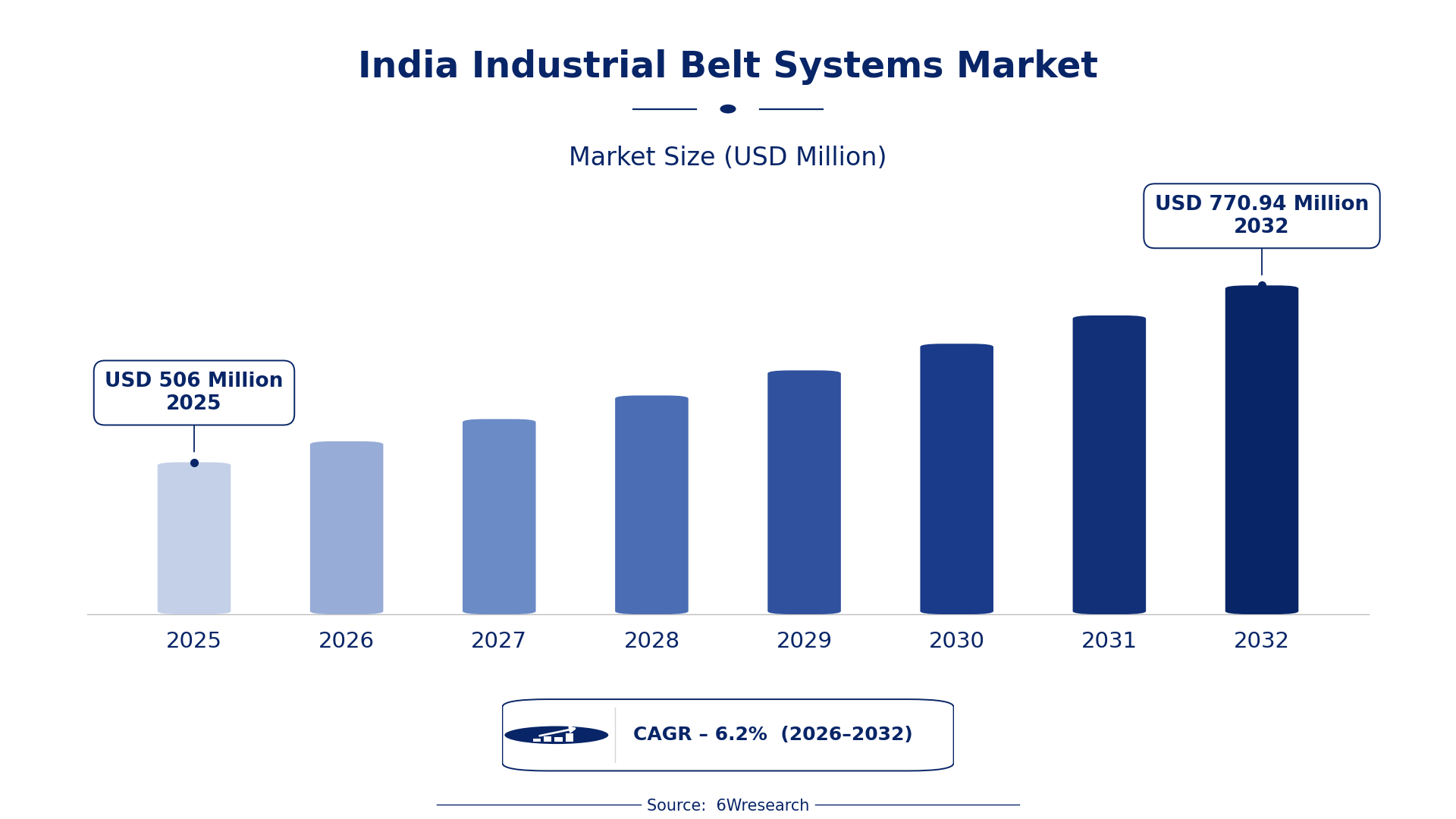
According to 6Wresearch internal database and industry insights, the India Industrial Belt Systems Market was valued at USD 506.0 million in 2025 and is projected to reach USD 770.94 million by 2032, growing at a CAGR of approximately 6.2% during 2026–2032.
India Industrial Belt Systems Market Highlights
| Report Metric | Details |
| Report Name | India Industrial Belt Systems Market |
| Market Size 2025 | USD 506.0 million |
| Market Size 2032 | USD 770.94 million |
| Absolute Growth 2025–2032 | USD 264.94 million |
| CAGR 2026–2032 | 6.2% |
| Peak Annual Growth | 8.5% in 2027 |
| Forecast Period | 2026–2032 |
| Historical Data | 2022–2025 |
| Base Year | 2025 |
| Leading Belt Type, 2025 | Conveyor Belts (50% share) |
| Leading Material Type, 2025 | Rubber (42% share) |
| Leading Usage Mode, 2025 | Power Transmission (39% share) |
| Leading End User, 2025 | Automotive Industry (43% share) |
| Fastest-Growing Belt Type | Timing Belts (8.9% CAGR) |
| Fastest-Growing Material Type | PVC (8.8% CAGR) |
| Fastest-Growing Usage Mode | Synchronous Transmission (7.3% CAGR) |
| Fastest-Growing End User | Mining & Quarry Plants (7.3% CAGR) |
| Growing Sector | Automotive Industry |
| Key End Users | Automotive Industry, Mining & Quarry Plants, Agricultural Equipment, Textile & Packaging Units |
India Industrial Belt Systems Market Year-wise Growth Rate and Key Drivers (2022–2032)
This graph illustrates the annual growth rates of the market from 2022 to 2032, highlighting a steady upward trajectory and projected market expansion over the forecast period.
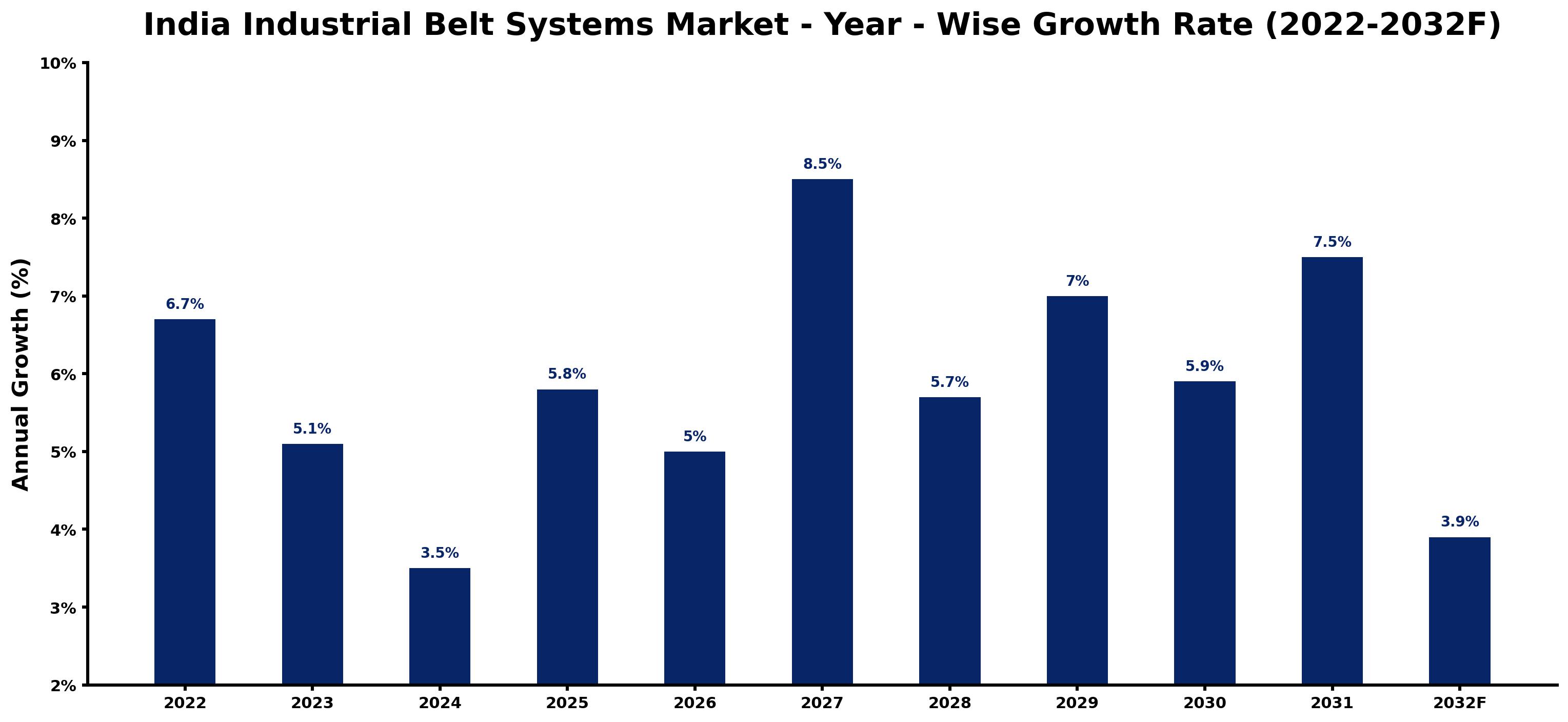
Annual growth estimates for each year appear below with the principal reason behind them, explaining the shifts that set the pace of the market.
| Year | Estimated Annual Growth (%) | Market Rationale |
| 2022 | 6.7 | The market experienced steady demand from various industrial sectors, particularly automotive and mining, driven by the need for efficient material handling systems. |
| 2023 | 5.1 | Growth slowed as manufacturers faced challenges in sourcing raw materials and meeting production targets, particularly in the automotive sector. |
| 2024 | 3.5 | Demand continued to decelerate due to ongoing supply chain disruptions affecting key industries like mining and agriculture. |
| 2025 | 5.8 | A rebound occurred as the automotive sector increased its reliance on timing belts for new vehicle models, boosting production. |
| 2026 | 5.0 | Growth is expected to slow again as manufacturers adjust to changing market conditions and consumer preferences in the industrial sector. |
| 2027 | 8.5 | A surge in demand is projected, driven by increased investments in mining and agricultural equipment, enhancing production capabilities. |
| 2028 | 5.7 | Growth is expected to decelerate as market saturation begins to affect new orders and production rates in the automotive industry. |
| 2029 | 7.0 | An uptick in demand is projected as mining operations expand, requiring more conveyor belts for efficient material handling. |
| 2030 | 5.9 | Growth is expected to slow as manufacturers face challenges in maintaining quality standards amid rising competition from imports. |
| 2031 | 7.5 | A resurgence in demand is anticipated, driven by new projects in the automotive and agricultural sectors, boosting local production. |
| 2032 | 3.9 | Growth is projected to slow as the market stabilises, reflecting a maturing industry with established players and competitive dynamics. |
Note: Market size estimations and growth projections presented in this report are based on 6Wresearch's proprietary forecasting methodology, utilizing the latest available industry data, government publications, and primary research inputs.
India Industrial Belt Systems Market Synopsis
Industrial Belt Systems in India encompass various types such as conveyor belts, timing belts, and V-belts, essential for material handling in sectors like automotive and mining. The India Industrial Belt Systems Market is expanding due to increasing domestic manufacturing and the 'Make in India' initiative aimed at boosting local production. The automotive industry accounts for a large portion of demand, with 30% attributed to timing belts. As the population continues to grow, the need for efficient industrial systems is expected to rise further, supported by investments in local manufacturing and infrastructure development.
Market Dynamics Impact Analysis (2026–2032)
| Factor | Type | Impact | Primary Segment Affected |
| Increased domestic manufacturing capabilities | Driver | High | Conveyor Belts |
| Growing automotive production and demand for components | Driver | High | Timing Belts |
| Investment in advanced manufacturing technologies | Opportunity | High | V-Belts |
| Expansion of mining operations requiring heavy-duty equipment | Opportunity | Medium | Conveyor Belts |
| Supply chain disruptions affecting raw material availability | Restraint | High | V-Belts |
| Quality control challenges in local manufacturing | Restraint | Medium | Timing Belts |
| Competition from international suppliers offering lower prices | Challenge | High | Conveyor Belts |
| Technological advancements requiring constant upgrades | Challenge | Medium | V-Belts |
Evaluation of Drivers in India Industrial Belt Systems Market (2026–2032)
Below mentioned are some major drivers and their influence on market dynamics.
| Drivers | Primary Segment Affected | Why It Matters (Evidence) |
| Rising automotive production | Timing Belts | The automotive industry accounts for 30% of demand, driving manufacturers to increase production of timing belts to meet market needs. |
| Expansion of mining operations | Conveyor Belts | The installed base of conveyor belts in mining exceeds 1,000 kilometers, necessitating further investments in production and supply. |
| Government initiatives promoting local manufacturing | V-Belts | The 'Make in India' initiative encourages domestic production, increasing demand for locally manufactured belts and supporting local economies. |
| Growing agricultural sector | V-Belts | With 58% of the population employed in agriculture, demand for agricultural equipment belts is rising, prompting manufacturers to expand their offerings. |
| Technological advancements in manufacturing processes | Conveyor Belts | Investments in advanced technologies improve production efficiency, leading to increased output and better quality of industrial belts. |
The automotive sector's demand for timing belts is substantial, prompting manufacturers to ramp up production to meet this need. Mining operations require extensive conveyor systems, with over 1,000 kilometres already installed, leading to further investments in production capacity. Additionally, the agricultural sector's dependence on equipment belts is on the rise, as agriculture employs a significant portion of the workforce.
Evaluation of Restraints in India Industrial Belt Systems Market
The following restraints limit how fast demand can grow.
| Market Restraint | Primary Segment Affected | Why It Matters (Evidence) |
| Supply chain disruptions affecting raw material availability | V-Belts | Manufacturers have reported delays in sourcing rubber and PVC, impacting production timelines and leading to increased costs. |
| Quality control challenges in local manufacturing | Timing Belts | Some manufacturers struggle to meet the Bureau of Indian Standards, resulting in product recalls and affecting market reputation. |
| Technological gaps in production processes | V-Belts | Some local producers lack access to advanced manufacturing technologies, limiting their competitiveness and production efficiency. |
| Regulatory compliance costs | Timing Belts | Adhering to BIS standards increases operational costs for local manufacturers, affecting pricing strategies. |
| Pressure from imported systems | Conveyor Belts | Local manufacturers face competition from cheaper imports, affecting their market share and profit margins. |
India Industrial Belt Systems Market Challenges
Buyers and suppliers in the India Industrial Belt Systems market are contending with rising raw material costs, potentially increasing production expenses by 15%. This challenge stems from global supply chain disruptions that hinder access to essential materials like rubber and PVC. Manufacturers also face technological hurdles, as investments in modern machinery could raise capital costs by 20%. Competition from imported systems forces local producers to lower prices, risking profit margins by up to 10%. A skills gap among workers further complicates the implementation of advanced production techniques, delaying product development timelines for buyers.
Trends in the India Industrial Belt Systems Market
Four trends stand out in the India Industrial Belt Systems Market.
- Shift towards Advanced Manufacturing Technologies: Manufacturers are increasingly adopting advanced technologies to boost production efficiency, with the Ministry of Heavy Industries promoting automation in industrial belt production, impacting local manufacturing capabilities and output.
- Growing Demand for Sustainable Materials: The trend towards eco-friendly manufacturing practices is clear, with the Ministry of Heavy Industries advocating for the use of indigenous materials in industrial belt production, affecting local sourcing strategies and production costs, aiming for a 20% increase in local material use.
- Increased Automation in Production Processes: Automation is becoming more common in industrial belt manufacturing, with many facilities upgrading to automated systems to enhance productivity, supported by government initiatives aimed at improving operational efficiency, targeting a 30% increase in automated processes.
- Expansion of Mining Operations: Mining companies are investing in new equipment, leading to a surge in demand for conveyor belts, with over 1,000 kilometres of installed base already in India, necessitating further supply and production capabilities.
Investment Opportunities in the India Industrial Belt Systems Market
The following opportunities in the India Industrial Belt Systems Market pair current demand with a clear way in.
- Investment in Local Manufacturing: Now is an ideal time to invest in local manufacturing due to the 'Make in India' initiative, which aims to boost domestic production, targeting a 25% contribution to GDP by 2025 and increasing local market share.
- Expansion into Agricultural Equipment Market: With a significant portion of the population employed in agriculture, there is a rising need for agricultural equipment belts, presenting a valuable opportunity for manufacturers to capture market share, estimated at a 15% growth rate.
- Partnerships with Local Producers: Forming joint ventures with local manufacturers can facilitate market entry and compliance with BIS standards, enhancing production capabilities and ensuring quality, potentially increasing output by 20%.
- Development of Advanced Belt Technologies: Investing in advanced manufacturing technologies is timely, as the government announced a subsidy program in 2023 to support SMEs in this area, enabling innovation and efficiency, with funding up to USD 5 million.
Government Initiatives in the India Industrial Belt Systems Market
The National Manufacturing Policy, updated in 2021, targets a 25% contribution of manufacturing to GDP by 2025, impacting demand for industrial belts by promoting local production and reducing import reliance. The Bureau of Indian Standards (BIS) established standards for rubber conveyor belts under IS 1891 in 2020, ensuring quality and safety in production, which benefits manufacturers by enhancing product credibility. Additionally, the 'Make in India' initiative, launched in 2014, aims to boost manufacturing capabilities, driving local production and innovation in the industrial belt sector.
The Ministry of Heavy Industries' subsidy program for SMEs investing in advanced manufacturing technologies, announced in 2023, supports the development of innovative industrial belts. This program ensures that manufacturers can meet the evolving demands of the automotive sector while promoting the use of indigenous materials, which enhances local production capabilities and reduces costs for buyers. The scheme is expected to fund up to 500 projects, enabling manufacturers to innovate and improve efficiency.
Future Insight of the India Industrial Belt Systems Market
The India Industrial Belt Systems market is set to evolve by 2032, driven by the 'Make in India' initiative that aims to boost local manufacturing. The introduction of advanced belt technologies, supported by recent government subsidies, will improve production efficiency and reduce operational costs for suppliers. By 2025, the National Manufacturing Policy is expected to raise manufacturing's contribution to GDP to 25%, positively impacting demand for industrial belts. The agricultural sector, which employs around 58% of the population, will continue to stimulate growth as it increasingly adopts efficient belt systems.
Market Segmentation Analysis
The analysis below covers each segmentation, its leading category in 2025 and its fastest-growing category through 2032.
By Belt Type – Conveyor Belts Dominated, Timing Belts Expected to Grow Fastest
According to Sachin Kumar Rai, Senior Research Analyst at 6Wresearch, Conveyor Belts took a 50% share of belt type in 2025, more than any other category. Conveyor belts hold the largest market share due to their extensive application in material handling across various industries, including mining and automotive. The installed base of over 1,000 kilometers of conveyor belts in mining operations exemplifies their critical importance in facilitating efficient processes. Over 2026–2032, Timing Belts are expected to post the fastest growth, at a CAGR of 8.9%. Timing belts are experiencing rapid growth as they are essential for synchronous transmission in machinery, particularly in the automotive industry, which accounts for 30% of demand. The automotive sector's ongoing expansion will further drive the need for timing belts, allowing conveyor belts to maintain their lead. Suppliers must focus on enhancing their conveyor belt offerings while also investing in timing belt technologies to meet the rising demand.
By Material Type – Rubber Dominated, PVC Expected to Grow Fastest
With a 42% revenue share in 2025, Rubber was the largest material type category. Rubber is the primary material type in the industrial belt systems market, valued for its durability and flexibility, which are vital for various applications. This material is predominantly used in conveyor belts, making it essential for industries such as mining and automotive. The quickest growth will come from PVC, forecast to expand at a CAGR of 8.8% between 2026 and 2032. PVC is the fastest-growing material type due to its application in lightweight and corrosion-resistant solutions, particularly in settings where traditional materials may not perform well. This trend suggests a shift towards more efficient materials, which could strengthen rubber's market position over time. Manufacturers should consider diversifying their material offerings to include PVC, addressing the rising demand for lightweight solutions.
By Usage Mode – Power Transmission Dominated, Synchronous Transmission Expected to Grow Fastest
Power Transmission held a 39% share of the India Industrial Belt Systems Market by usage mode in 2025. Power transmission is the dominant usage mode in the market, primarily due to its key function in V-belts used in engines across various sectors. This widespread application ensures that power transmission systems maintain a strong market share. Synchronous Transmission is projected to grow fastest, at a CAGR of 7.3% during 2026–2032. Synchronous transmission is the fastest-growing usage mode, driven by the increasing demand for timing belts in machinery, particularly within the automotive industry. As this sector continues to expand, the need for synchronous transmission will further accelerate, reinforcing the position of power transmission. Suppliers must adapt their product lines to meet the rising demand for synchronous transmission solutions while maintaining strong power transmission capabilities.
By End User – Automotive Industry Dominated, Mining & Quarry Plants Expected to Grow Fastest
In 2025, Automotive Industry led the end user split with a 43% share. The automotive industry is the leading end user of industrial belt systems, primarily due to its substantial consumption of timing belts. This sector's significant market share reflects its reliance on these components for operational efficiency. Mining & Quarry Plants are set to record the highest CAGR in this split, 7.3% over 2026–2032. Mining and quarry plants represent the fastest-growing end user segment, driven by their increasing demand for heavy-duty conveyor belts for material handling. As mining operations expand, the need for these systems will rise, reinforcing the automotive industry's dominant position. Manufacturers should prioritise developing tailored solutions for both the automotive and mining sectors to leverage their growth opportunities.
Key Attractiveness of the Report
- 10 Years of Market Numbers
- Historical Data Starting from 2022 to 2025
- Base Year 2025
- Forecast Data until 2032
- Key Performance Indicators Impacting the Market
- Major Upcoming Developments and Projects
Key Highlights of the Report:
- India Industrial Belt Systems Market Outlook
- Market Size of India Industrial Belt Systems Market, 2025
- Forecast of India Industrial Belt Systems Market, 2032
- Historical Data and Forecast of India Industrial Belt Systems Revenues & Volume for the Period 2022 - 2032F
- India Industrial Belt Systems Market Trend Evolution
- India Industrial Belt Systems Market Drivers and Challenges
- India Industrial Belt Systems Price Trends
- India Industrial Belt Systems Porter's Five Forces
- India Industrial Belt Systems Industry Life Cycle
- Historical Data and Forecast of India Industrial Belt Systems Market Revenues & Volume By Belt Type for the Period 2022 - 2032F
- Historical Data and Forecast of India Industrial Belt Systems Market Revenues & Volume By Conveyor Belts for the Period 2022 - 2032F
- Historical Data and Forecast of India Industrial Belt Systems Market Revenues & Volume By Timing Belts for the Period 2022 - 2032F
- Historical Data and Forecast of India Industrial Belt Systems Market Revenues & Volume By V-Belts for the Period 2022 - 2032F
- Historical Data and Forecast of India Industrial Belt Systems Market Revenues & Volume By Flat Belts for the Period 2022 - 2032F
- Historical Data and Forecast of India Industrial Belt Systems Market Revenues & Volume By Material Type for the Period 2022 - 2032F
- Historical Data and Forecast of India Industrial Belt Systems Market Revenues & Volume By Rubber, PVC for the Period 2022 - 2032F
- Historical Data and Forecast of India Industrial Belt Systems Market Revenues & Volume By Polyurethane + Steel Cord for the Period 2022 - 2032F
- Historical Data and Forecast of India Industrial Belt Systems Market Revenues & Volume By Neoprene/Fabric for the Period 2022 - 2032F
- Historical Data and Forecast of India Industrial Belt Systems Market Revenues & Volume By Leather, Fabric for the Period 2022 - 2032F
- Historical Data and Forecast of India Industrial Belt Systems Market Revenues & Volume By Usage Mode for the Period 2022 - 2032F
- Historical Data and Forecast of India Industrial Belt Systems Market Revenues & Volume By Continuous Motion for the Period 2022 - 2032F
- Historical Data and Forecast of India Industrial Belt Systems Market Revenues & Volume By Synchronous Transmission for the Period 2022 - 2032F
- Historical Data and Forecast of India Industrial Belt Systems Market Revenues & Volume By Power Transmission for the Period 2022 - 2032F
- Historical Data and Forecast of India Industrial Belt Systems Market Revenues & Volume By Low-Torque Drives for the Period 2022 - 2032F
- Historical Data and Forecast of India Industrial Belt Systems Market Revenues & Volume By End User for the Period 2022 - 2032F
- Historical Data and Forecast of India Industrial Belt Systems Market Revenues & Volume By Mining & Quarry Plants for the Period 2022 - 2032F
- Historical Data and Forecast of India Industrial Belt Systems Market Revenues & Volume By Automotive Industry for the Period 2022 - 2032F
- Historical Data and Forecast of India Industrial Belt Systems Market Revenues & Volume By Agricultural Equipment for the Period 2022 - 2032F
- Historical Data and Forecast of India Industrial Belt Systems Market Revenues & Volume By Textile & Packaging Units for the Period 2022 - 2032F
- India Industrial Belt Systems Import Export Trade Statistics
- Market Opportunity Assessment By Belt Type
- Market Opportunity Assessment By Material Type
- Market Opportunity Assessment By Usage Mode
- Market Opportunity Assessment By End User
- India Industrial Belt Systems Top Companies Market Share
- India Industrial Belt Systems Competitive Benchmarking By Technical and Operational Parameters
- India Industrial Belt Systems Company Profiles
- India Industrial Belt Systems Key Strategic Recommendations
Market Covered
The report offers an extensive study of the following market segments.
By Belt Type
- Conveyor Belts
- Timing Belts
- V-Belts
- Flat Belts
By Material Type
- Rubber
- PVC
- Polyurethane + Steel Cord
- Neoprene/Fabric
- Leather
- Fabric
By Usage Mode
- Continuous Motion
- Synchronous Transmission
- Power Transmission
- Low-Torque Drives
By End User
- Mining & Quarry Plants
- Automotive Industry
- Agricultural Equipment
- Textile & Packaging Units































