India Industrial IoT Sensor Market Size & Growth Rate
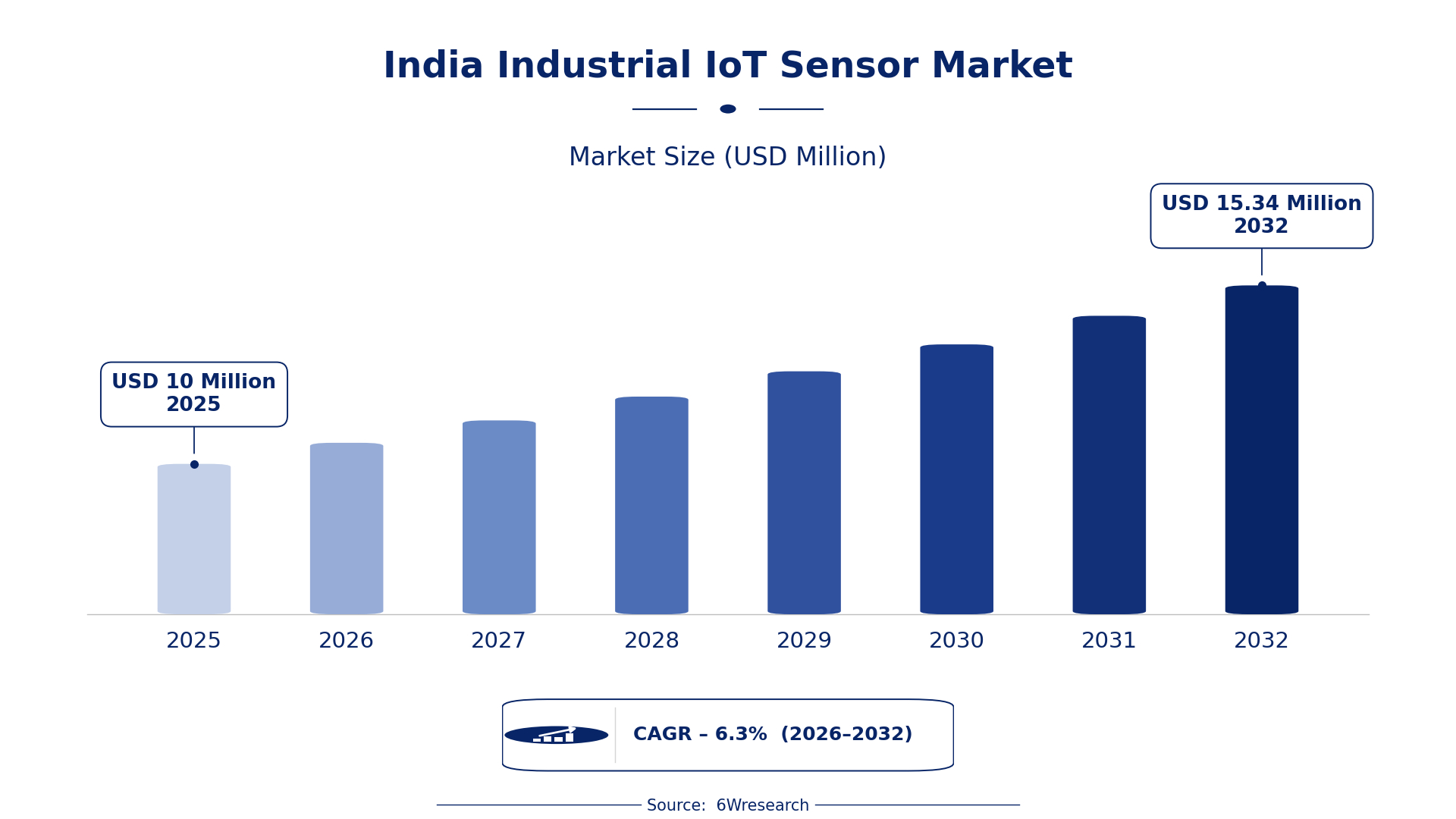
According to 6Wresearch internal database and industry insights, the India Industrial IoT Sensor Market was valued at USD 10.0 million in 2025 and is projected to reach USD 15.34 million by 2032, growing at a CAGR of approximately 6.3% during 2026–2032.
India Industrial IoT Sensor Market Highlights
| Report Metric | Details |
| Report Name | India Industrial IoT Sensor Market |
| Market Size 2025 | USD 10.0 million |
| Market Size 2032 | USD 15.34 million |
| Absolute Growth 2025–2032 | USD 5.34 million |
| CAGR 2026–2032 | 6.3% |
| Peak Annual Growth | 8.4% in 2026 |
| Forecast Period | 2026–2032 |
| Historical Data | 2022–2025 |
| Base Year | 2025 |
| Leading Sensor Type, 2025 | Temperature Sensors (43% share) |
| Leading Signal Output, 2025 | Analog/Digital (54% share) |
| Leading Connectivity, 2025 | Wired/Wireless (42% share) |
| Leading End User, 2025 | Food Processing (47% share) |
| Fastest-Growing Sensor Type | Humidity Sensors (8.0% CAGR) |
| Fastest-Growing Connectivity | CANbus/Modbus (8.8% CAGR) |
| Fastest-Growing End User | Chemical Plants (8.9% CAGR) |
| Growing Sector | Food Processing |
| Key End Users | Manufacturers, Food Processors, Chemical Plants, HVAC Systems |
India Industrial IoT Sensor Market Year-wise Growth Rate and Key Drivers (2022–2032)
This graph illustrates the annual growth rates of the market from 2022 to 2032, highlighting a steady upward trajectory and projected market expansion over the forecast period.
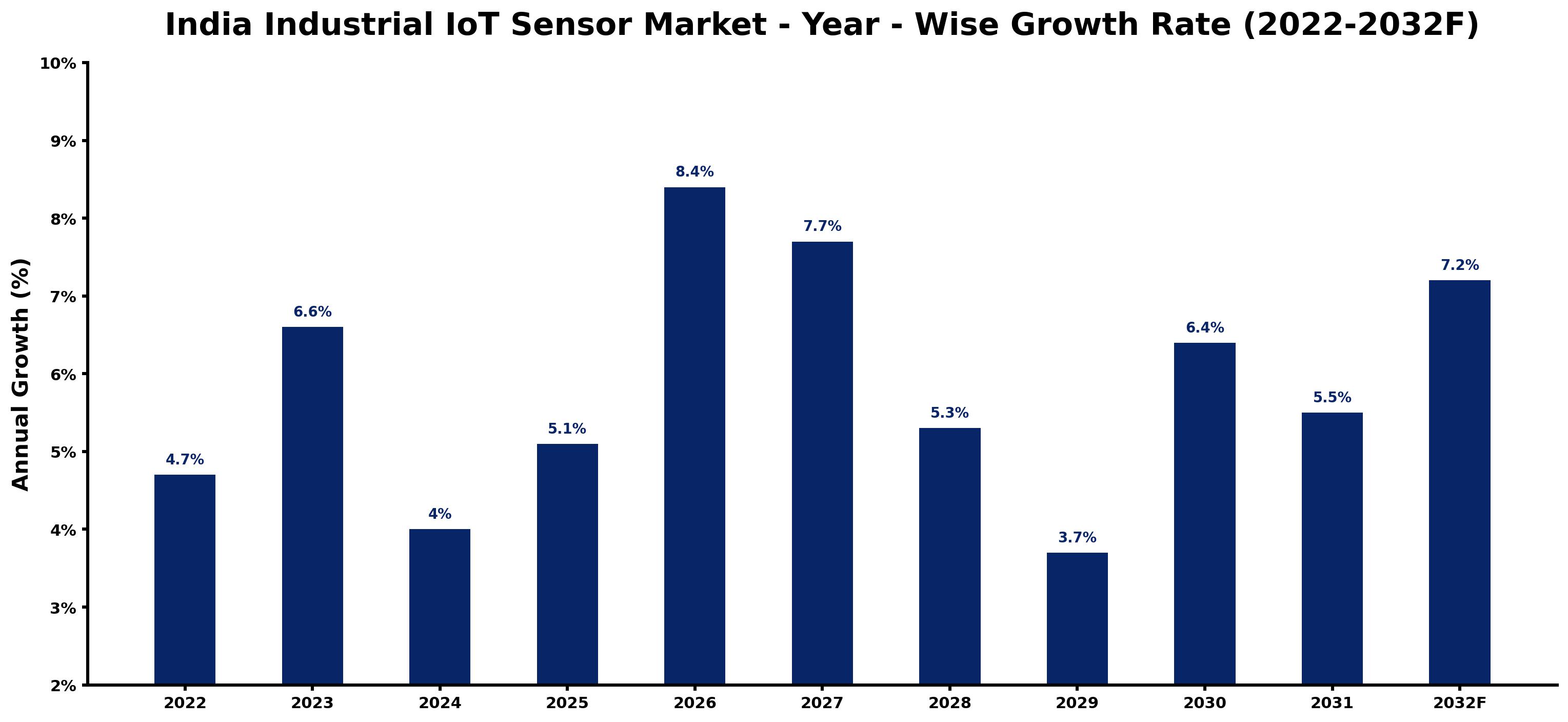
The following table presents the estimated annual growth rate for each year together with the principal factor influencing market performance.
| Year | Estimated Annual Growth (%) | Market Rationale |
| 2022 | 4.7 | The market showed steady growth, supported by the Smart Manufacturing Mission enhancing IoT adoption. |
| 2023 | 6.6 | Growth accelerated due to increased adoption of IoT technologies in manufacturing processes. |
| 2024 | 4.0 | A slowdown occurred as companies adjusted to previous investments in IoT infrastructure. |
| 2025 | 5.1 | Demand picked up as more food processing units integrated IoT sensors for quality monitoring. |
| 2026 | 8.4 | The peak growth year is expected to be driven by the Smart Manufacturing Mission promoting IoT adoption. |
| 2027 | 7.7 | A slowdown is projected as market players focus on optimising existing IoT systems. |
| 2028 | 5.3 | Further slowdown is anticipated as companies consolidate their IoT investments and strategies. |
| 2029 | 3.7 | Growth is expected to continue decelerating as the market matures and competition intensifies. |
| 2030 | 6.4 | An uptick in growth is projected as the HVAC industry expands, increasing sensor demand. |
| 2031 | 5.5 | Growth is expected to slow again as market players face challenges in scaling up production. |
| 2032 | 7.2 | A rebound in growth is anticipated as new IoT applications emerge in various sectors. |
Note: Market size estimations and growth projections presented in this report are based on 6Wresearch's proprietary forecasting methodology, utilizing the latest available industry data, government publications, and primary research inputs.
India Industrial IoT Sensor Market Synopsis
Industrial IoT Sensors in India are devices that collect and transmit data from industrial equipment to improve operational efficiency. The India Industrial IoT Sensor Market is growing due to the Smart Manufacturing Mission and the increasing number of food processing units that rely on IoT sensors for quality assurance. With over 1,200 food processing units in operation, demand is expected to rise sharply, reflecting the broader trend towards digital transformation in manufacturing.
Market Dynamics Impact Analysis (2026–2032)
| Factor | Type | Impact | Primary Segment Affected |
| Increasing adoption of IoT technologies in manufacturing processes | Driver | High | Temperature Sensors |
| Expansion of the food processing sector requiring real-time monitoring | Driver | High | Food Processing |
| Growing demand for efficient industrial processes | Opportunity | High | Humidity Sensors |
| Rising investments in smart manufacturing initiatives | Opportunity | High | Chemical Plants |
| Challenges in scaling up production capacity | Restraint | Medium | Pressure Sensors |
| Regulatory compliance costs for IoT devices | Restraint | Medium | Analog/Digital |
| High initial investment for IoT infrastructure | Challenge | High | Wired/Wireless |
| Limited skilled workforce in IoT technologies | Challenge | Medium | Proximity Sensors |
Evaluation of Drivers in India Industrial IoT Sensor Market (2026–2032)
The main growth drivers and the segments they affect most are set out below.
| Drivers | Primary Segment Affected | Why It Matters (Evidence) |
| Adoption of Smart Manufacturing Mission promoting IoT integration | Temperature Sensors | This initiative aims to modernise manufacturing, resulting in increased demand for temperature monitoring solutions. |
| Expansion of the food processing industry | Food Processing | With over 1,200 units, this sector drives the need for sensors to ensure quality and safety. |
| Growth in HVAC industry requiring real-time monitoring | Humidity Sensors | The HVAC sector's projected growth of 10% boosts demand for sensors that maintain optimal environmental conditions. |
| Investment in Digital India programme promoting IoT | Analog/Digital | The ₹10,000 crore allocated supports the development and deployment of IoT technologies. |
| Increasing focus on predictive maintenance in industries | Pressure Sensors | This trend necessitates the use of pressure sensors to prevent equipment failures and optimise operations. |
Market growth in India for Industrial IoT Sensor hinges on the rising adoption of IoT technologies, expanding industrial sectors, and increasing investments in smart manufacturing. The food processing sector, with over 1,200 units, fuels demand for sensors to ensure quality and safety. The HVAC industry is projected to grow by 10%, increasing the need for humidity sensors. These factors stimulate the purchasing activity of manufacturers aiming to optimise their operations.
Evaluation of Restraints in India Industrial IoT Sensor Market
Below mentioned are some major restraints and their influence on market dynamics.
| Market Restraint | Primary Segment Affected | Why It Matters (Evidence) |
| High costs associated with IoT infrastructure implementation | Pressure Sensors | The initial investment can deter smaller manufacturers from adopting necessary sensor technologies. |
| Regulatory compliance costs for sensor standards | Analog/Digital | Adhering to BIS guidelines increases operational costs for manufacturers. |
| Limited availability of skilled professionals in IoT | Wired/Wireless | A shortage of trained personnel can hinder the deployment of IoT solutions. |
| Challenges in scaling production capacity | Temperature Sensors | Manufacturers may struggle to meet the growing demand without adequate production facilities. |
| Market competition leading to price pressures | Humidity Sensors | Intense competition may reduce profit margins for sensor manufacturers. |
India Industrial IoT Sensor Market Challenges
The India Industrial IoT Sensor Market faces challenges that hinder growth for producers. Many manufacturing units still rely on outdated technology, inflating operational costs by up to 20% for buyers. Inconsistent supply chains lead to procurement delays, extending lead times by over three weeks and disrupting production schedules. Compliance with the Bureau of Indian Standards complicates matters, as strict guidelines can delay product approvals for up to six months, affecting suppliers' time-to-market. A skills gap persists, with only 30% of the workforce trained in IoT technologies, limiting companies' ability to effectively implement these sensors.
Trends in the India Industrial IoT Sensor Market
The trends below show where the India Industrial IoT Sensor Market is heading.
- Shift Towards Smart Manufacturing: The Smart Manufacturing Mission, initiated in 2021, promotes the adoption of IoT in manufacturing, aiming for a more efficient production process. This initiative is set to increase sensor demand significantly.
- Increased Focus on Predictive Maintenance: Since 2021, industries have increasingly adopted predictive maintenance strategies, driving demand for sensors that monitor equipment health. This trend is vital for reducing downtime and operational costs, particularly in the food processing sector.
- Growing Demand for Real-Time Monitoring: The food processing sector is increasingly prioritising real-time monitoring solutions, which has led to a surge in sensor adoption. With over 1,200 processing units in India, this demand is projected to rise.
- Expansion of the HVAC Sector: The HVAC industry is experiencing rapid growth, necessitating advanced sensor technologies for maintaining optimal conditions. This sector's expansion is expected to increase the demand for humidity sensors.
Investment Opportunities in the India Industrial IoT Sensor Market
Several openings in the India Industrial IoT Sensor Market merit attention from investors.
- Increased Need for Efficient Industrial Processes: With India's population exceeding 1.4 billion, the demand for efficient industrial processes is paramount. Investing in IoT sensors for food processing units can address this need, particularly in regions with high industrial activity.
- Timing for Smart Manufacturing Initiatives: Now is an opportune moment to supply advanced IoT sensors, especially as the Smart Manufacturing Mission gains momentum. Collaborating with food processing units can facilitate market entry and improve sensor deployment.
- Growing Chemical Industry Needs: The chemical industry, a significant consumer of IoT sensors, presents substantial opportunities for suppliers. Focusing on sensor technologies that improve safety and efficiency can yield high returns.
- Partnerships for Local Manufacturing: The Make in India initiative encourages local manufacturing of IoT devices. Partnering with local firms can streamline entry into the market and align with government objectives.
Government Initiatives in the India Industrial IoT Sensor Market
The National Policy on Electronics 2019, established by the Ministry of Electronics and Information Technology, aims to boost IoT manufacturing in India, targeting a $400 billion electronics market by 2025. This policy encourages local production of IoT devices, positively impacting the industrial IoT sensor market. Additionally, the Digital India programme, launched in 2020, allocates ₹10,000 crore to promote digital technologies, including IoT, thus supporting sensor adoption across sectors.
The Ministry of Electronics and Information Technology oversees the Digital India programme, which funds initiatives aimed at advancing IoT technologies. Furthermore, the Atal Innovation Mission, launched in 2020, supports startups in developing IoT solutions, with a budget of ₹1,000 crore over five years, facilitating innovation in the sensor market.
Future Insight of the India Industrial IoT Sensor Market
By 2032, the India Industrial IoT Sensor Market will experience transformative changes driven by key initiatives. The Smart Manufacturing Mission will significantly boost IoT adoption, streamlining processes across various sectors. The chemical industry is set to increase its consumption of industrial IoT sensors by 25%, raising overall demand. The Digital India programme will further advance IoT technologies, supporting local manufacturing and innovation. As a result, buyers will benefit from improved sensor availability, while suppliers will tap into a broader market.
Market Segmentation Analysis
The report offers a comprehensive study of the following market segments and their leading categories in the market.
By Sensor Type – Temperature Sensors Dominated, Humidity Sensors Expected to Grow Fastest
According to Sachin Kumar Rai, Senior Research Analyst at 6Wresearch, in 2025, Temperature Sensors led the sensor type split with a 43% share. Temperature Sensors hold the largest share as they are vital for monitoring temperature in various applications, especially in food processing and manufacturing. Their use in over 1,200 food processing units in India highlights their critical role in ensuring product quality and safety. Humidity Sensors are set to record the highest CAGR in this split, 8.0% over 2026–2032. Humidity Sensors are rapidly growing due to their importance in maintaining optimal conditions in production environments, particularly in food processing. The heightened focus on quality control in this sector is propelling the demand for these sensors, ensuring their market share continues to expand. Suppliers should prioritise improving the reliability and accuracy of humidity sensors to cater to the increasing demands of the food processing industry.
By Signal Output – Analog/Digital Dominated and Is Expected to Record the Fastest Growth
With a 54% revenue share in 2025, Analog/Digital was the largest signal output category. Analog/Digital signal output holds the largest market share as it is fundamental for sensor data transmission and processing across various industrial applications. The versatility of this technology makes it a preferred choice among manufacturers, ensuring its dominance in the market. Analog/Digital is also forecast to expand faster than any other category, at a CAGR of 8.1% over 2026–2032. The Analog/Digital segment is also the fastest-growing due to its critical role in facilitating efficient data communication in IoT systems. As industries increasingly adopt IoT solutions, the demand for reliable signal output methods like Analog/Digital will continue to expand, reinforcing its market leadership. Manufacturers should prioritise advancements in Analog/Digital technologies to cater to the increasing adoption of IoT in industrial applications.
By Connectivity – Wired/Wireless Dominated, CANbus/Modbus Expected to Grow Fastest
The largest connectivity category in 2025 was Wired/Wireless, with a 42% share of total revenue. Wired/Wireless connectivity holds the largest share in the India Industrial IoT Sensor Market due to its crucial role in enabling seamless data transmission across diverse industrial sectors. This connectivity is vital for real-time monitoring and control, particularly in large facilities like manufacturing plants. The quickest growth will come from CANbus/Modbus, forecast to expand at a CAGR of 8.8% between 2026 and 2032. The CANbus/Modbus segment is experiencing rapid growth because of its specific application in industrial communication protocols, particularly in automation systems. As industries increasingly adopt these protocols for efficient operations, the demand for CANbus/Modbus connectivity will continue to surge, while Wired/Wireless maintains its lead due to broader applications. Suppliers should focus on enhancing their offerings in CANbus/Modbus technologies to cater to the growing demand for specialised industrial communication solutions.
By End User – Food Processing Dominated, Chemical Plants Expected to Grow Fastest
Food Processing accounted for a 47% market share by end user in 2025. Food Processing is the dominant end user of industrial IoT sensors, extensively utilising them for monitoring quality and safety across over 1,200 processing units in India. The strict regulatory requirements in this sector drive the high demand for sensors to ensure compliance and maintain product integrity. Chemical Plants are projected to grow fastest, at a CAGR of 8.9% during 2026–2032. Chemical Plants represent the fastest-growing end user segment, primarily due to their essential need for effective process control and safety management. As the chemical industry expands, the reliance on advanced monitoring solutions will increase, further elevating the market share of sensors in this area. Suppliers should tailor their products to meet the specific needs of chemical plants, which are increasingly adopting advanced sensor technologies for enhanced operational efficiency.
Key Attractiveness of the Report
- 10 Years of Market Numbers
- Historical Data Starting from 2022 to 2025
- Base Year 2025
- Forecast Data until 2032
- Key Performance Indicators Impacting the Market
- Major Upcoming Developments and Projects
Key Highlights of the Report:
- India Industrial IoT Sensor Market Outlook
- Market Size of India Industrial IoT Sensor Market, 2025
- Forecast of India Industrial IoT Sensor Market, 2032
- Historical Data and Forecast of India Industrial IoT Sensor Revenues & Volume for the Period 2022 - 2032F
- India Industrial IoT Sensor Market Trend Evolution
- India Industrial IoT Sensor Market Drivers and Challenges
- India Industrial IoT Sensor Price Trends
- India Industrial IoT Sensor Porter's Five Forces
- India Industrial IoT Sensor Industry Life Cycle
- Historical Data and Forecast of India Industrial IoT Sensor Market Revenues & Volume By Sensor Type for the Period 2022 - 2032F
- Historical Data and Forecast of India Industrial IoT Sensor Market Revenues & Volume By Temperature Sensors for the Period 2022 - 2032F
- Historical Data and Forecast of India Industrial IoT Sensor Market Revenues & Volume By Pressure Sensors for the Period 2022 - 2032F
- Historical Data and Forecast of India Industrial IoT Sensor Market Revenues & Volume By Humidity Sensors for the Period 2022 - 2032F
- Historical Data and Forecast of India Industrial IoT Sensor Market Revenues & Volume By Proximity Sensors for the Period 2022 - 2032F
- Historical Data and Forecast of India Industrial IoT Sensor Market Revenues & Volume By Signal Output for the Period 2022 - 2032F
- Historical Data and Forecast of India Industrial IoT Sensor Market Revenues & Volume By Analog/Digital for the Period 2022 - 2032F
- Historical Data and Forecast of India Industrial IoT Sensor Market Revenues & Volume By Piezoresistive/Capacitive for the Period 2022 - 2032F
- Historical Data and Forecast of India Industrial IoT Sensor Market Revenues & Volume By Resistive/Capacitive for the Period 2022 - 2032F
- Historical Data and Forecast of India Industrial IoT Sensor Market Revenues & Volume By Inductive/Capacitive for the Period 2022 - 2032F
- Historical Data and Forecast of India Industrial IoT Sensor Market Revenues & Volume By Connectivity for the Period 2022 - 2032F
- Historical Data and Forecast of India Industrial IoT Sensor Market Revenues & Volume By Wired/Wireless for the Period 2022 - 2032F
- Historical Data and Forecast of India Industrial IoT Sensor Market Revenues & Volume By CANbus/Modbus for the Period 2022 - 2032F
- Historical Data and Forecast of India Industrial IoT Sensor Market Revenues & Volume By Bluetooth/LoRaWAN for the Period 2022 - 2032F
- Historical Data and Forecast of India Industrial IoT Sensor Market Revenues & Volume By PLC Interface for the Period 2022 - 2032F
- Historical Data and Forecast of India Industrial IoT Sensor Market Revenues & Volume By End User for the Period 2022 - 2032F
- Historical Data and Forecast of India Industrial IoT Sensor Market Revenues & Volume By Food Processing for the Period 2022 - 2032F
- Historical Data and Forecast of India Industrial IoT Sensor Market Revenues & Volume By Chemical Plants for the Period 2022 - 2032F
- Historical Data and Forecast of India Industrial IoT Sensor Market Revenues & Volume By HVAC Systems for the Period 2022 - 2032F
- Historical Data and Forecast of India Industrial IoT Sensor Market Revenues & Volume By Robotics & Conveyor Lines for the Period 2022 - 2032F
- India Industrial IoT Sensor Import Export Trade Statistics
- Market Opportunity Assessment By Sensor Type
- Market Opportunity Assessment By Signal Output
- Market Opportunity Assessment By Connectivity
- Market Opportunity Assessment By End User
- India Industrial IoT Sensor Top Companies Market Share
- India Industrial IoT Sensor Competitive Benchmarking By Technical and Operational Parameters
- India Industrial IoT Sensor Company Profiles
- India Industrial IoT Sensor Key Strategic Recommendations
Market Covered
Segments analysed in this report are listed below.
By Sensor Type
- Temperature Sensors
- Pressure Sensors
- Humidity Sensors
- Proximity Sensors
By Signal Output
- Analog/Digital
- Piezoresistive/Capacitive
- Resistive/Capacitive
- Inductive/Capacitive
By Connectivity
- Wired/Wireless
- CANbus/Modbus
- Bluetooth/LoRaWAN
- PLC Interface
By End User
- Food Processing
- Chemical Plants
- HVAC Systems
- Robotics & Conveyor Lines































