China Industrial IoT Sensor Market Size & Growth Rate
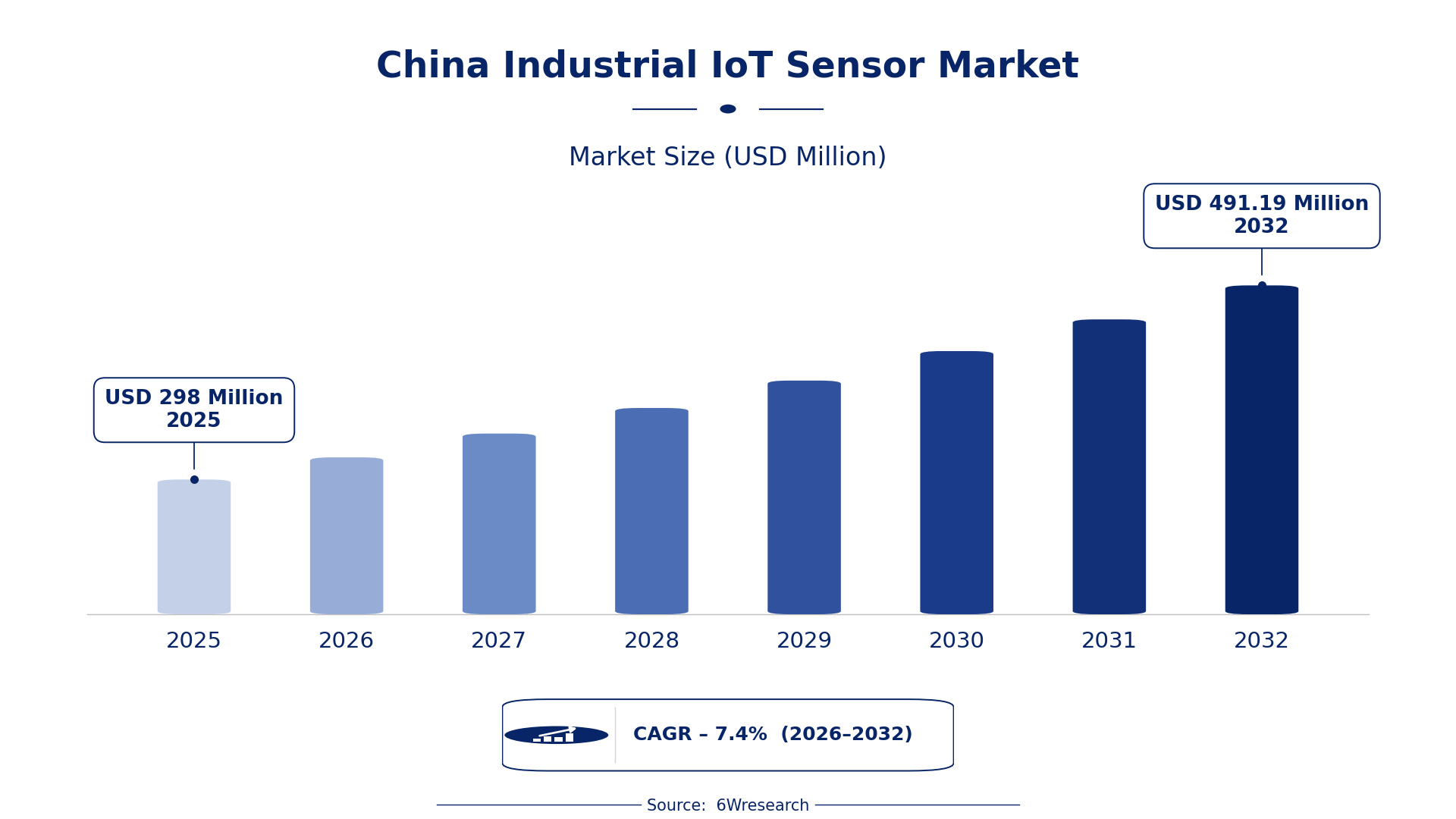
According to 6Wresearch internal database and industry insights, the China Industrial IoT Sensor Market was valued at USD 298.0 million in 2025 and is projected to reach USD 491.19 million by 2032, growing at a CAGR of approximately 7.4% during 2026–2032.
China Industrial IoT Sensor Market Highlights
| Report Metric | Details |
| Report Name | China Industrial IoT Sensor Market |
| Market Size 2025 | USD 298.0 million |
| Market Size 2032 | USD 491.19 million |
| Absolute Growth 2025–2032 | USD 193.19 million |
| CAGR 2026–2032 | 7.4% |
| Peak Annual Growth | 9.0% in 2031 |
| Forecast Period | 2026–2032 |
| Historical Data | 2022–2025 |
| Base Year | 2025 |
| Leading Sensor Type, 2025 | Temperature Sensors (48% share) |
| Leading Signal Output, 2025 | Analog/Digital (43% share) |
| Leading Connectivity, 2025 | Wired/Wireless (46% share) |
| Leading End User, 2025 | Food Processing (49% share) |
| Fastest-Growing Sensor Type | Humidity Sensors (9.4% CAGR) |
| Fastest-Growing Connectivity | Bluetooth/LoRaWAN (8.4% CAGR) |
| Fastest-Growing End User | Robotics & Conveyor Lines (8.6% CAGR) |
| Growing Sector | Robotics & Conveyor Lines |
| Key End Users | Food Processing, Chemical Plants, HVAC Systems, Robotics & Conveyor Lines |
China Industrial IoT Sensor Market Year-wise Growth Rate and Key Drivers (2022–2032)
This graph illustrates the annual growth rates of the market from 2022 to 2032, highlighting a steady upward trajectory and projected market expansion over the forecast period.
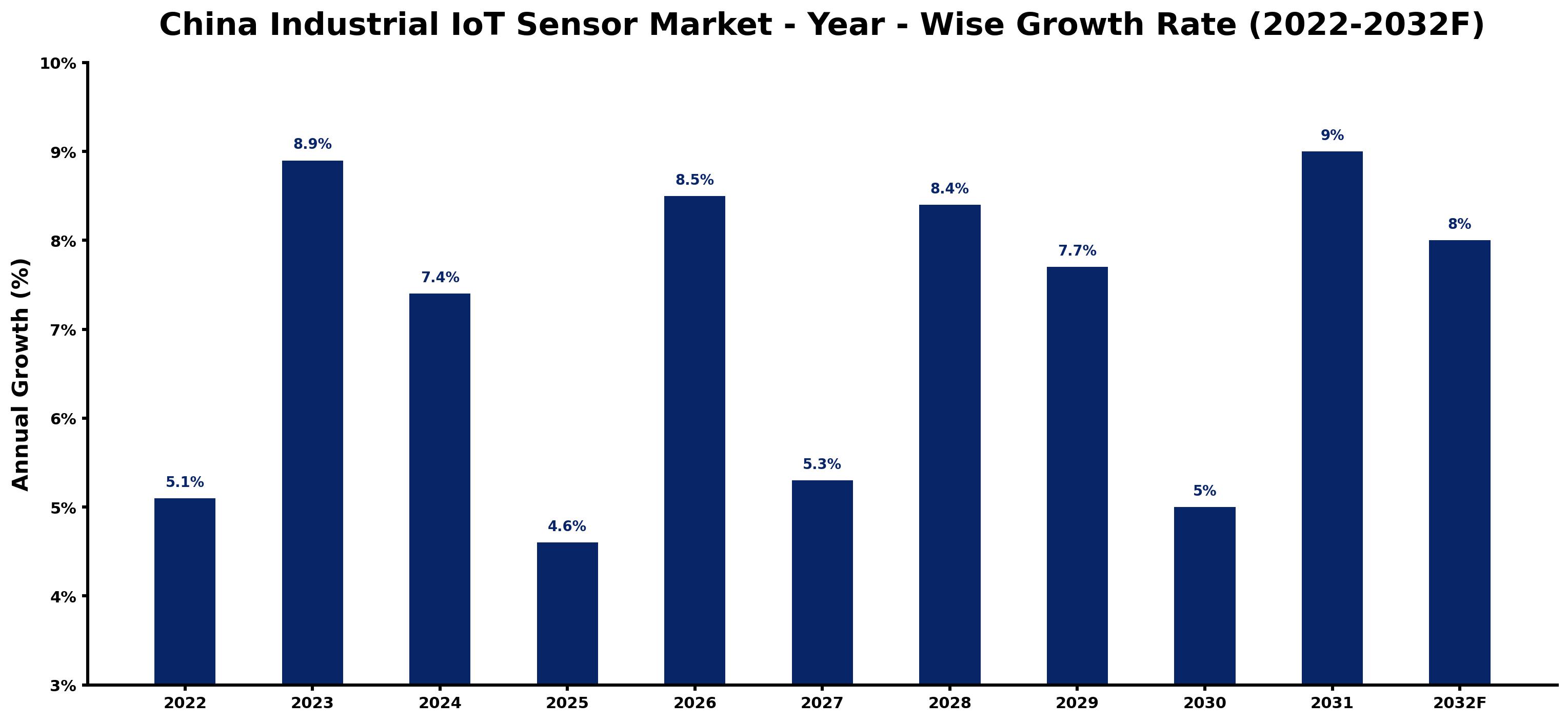
Below, each year's estimated growth is shown next to the factor that most influenced it.
| Year | Estimated Annual Growth (%) | Market Rationale |
| 2022 | 5.1 | The market experienced steady growth due to ongoing industrial activities and investments in sensor technologies. |
| 2023 | 8.9 | Growth accelerated as the Smart Manufacturing 2025 initiative gained traction among food processing manufacturers. |
| 2024 | 7.4 | Demand growth slowed as companies adjusted to the previous year's rapid expansion in sensor adoption. |
| 2025 | 4.6 | Industries focused on optimising existing sensor technologies, driving continued demand for various sensor types. |
| 2026 | 8.5 | Demand is expected to increase as businesses embrace advanced connectivity solutions for IoT integration in manufacturing. |
| 2027 | 5.3 | Growth is projected to moderate as companies face challenges in scaling up sensor deployments effectively in automation. |
| 2028 | 8.4 | Demand will surge as Robotics & Conveyor Lines expand, driving sensor integration in automation processes. |
| 2029 | 7.7 | Growth is anticipated to slow as market players focus on refining existing technologies and applications in various sectors. |
| 2030 | 5.0 | The market will continue to grow, albeit at a slower rate, as industries mature in sensor use and integration. |
| 2031 | 9.0 | A peak in growth is expected as IoT adoption reaches critical mass in manufacturing and logistics sectors. |
| 2032 | 8.0 | The market growth rate will slow as the sector stabilises, reflecting increased maturity in sensor applications. |
Note: Market size estimations and growth projections presented in this report are based on 6Wresearch's proprietary forecasting methodology, utilizing the latest available industry data, government publications, and primary research inputs.
China Industrial IoT Sensor Market Synopsis
Industrial IoT Sensors in China are devices that collect and transmit data to improve operational efficiency across various sectors. These sensors monitor equipment performance, ensure safety, and optimise processes in industries like food processing and logistics. The China Industrial IoT Sensor Market is expanding due to rising demand from these sectors, driven by initiatives such as Smart Manufacturing 2025. With an installed base exceeding 500 million units, substantial investment in IoT infrastructure supports this growth.
Market Dynamics Impact Analysis (2026–2032)
| Factor | Type | Impact | Primary Segment Affected |
| Increased adoption of Smart Manufacturing 2025 initiative | Driver | High | Temperature Sensors |
| Growing demand for automation in manufacturing processes | Driver | High | Proximity Sensors |
| Rising investment in smart city projects | Opportunity | High | Temperature Sensors |
| Expansion of the food processing sector requiring quality control | Opportunity | High | Humidity Sensors |
| Regulatory compliance challenges in sensor performance standards | Restraint | High | Pressure Sensors |
| High competition among sensor manufacturers leading to price wars | Restraint | Medium | Analog/Digital |
| Limited integration capabilities with legacy systems | Challenge | High | Wired/Wireless |
| Shortage of skilled workforce for IoT implementation | Challenge | Medium | Robotics & Conveyor Lines |
Evaluation of Drivers in China Industrial IoT Sensor Market (2026–2032)
Key forces behind demand, with the segment each one moves most, are listed below.
| Drivers | Primary Segment Affected | Why It Matters (Evidence) |
| Adoption of Smart Manufacturing 2025 initiative | Temperature Sensors | This initiative aims for a 30% increase in sensor adoption by 2025, driving demand for temperature sensors in food processing. |
| Investment in IoT infrastructure | Humidity Sensors | A 1 billion yuan investment in IoT infrastructure supports the growth of wireless sensors in logistics and supply chain management. |
| Expansion of food processing sector | Humidity Sensors | The food processing industry, accounting for 49% of end-users, drives demand for humidity sensors to ensure product quality. |
| Development of smart city projects | Bluetooth/LoRaWAN | LoRaWAN technology is being adopted in smart city projects, increasing the need for advanced connectivity solutions. |
| Automation in manufacturing processes | Proximity Sensors | As industries seek efficiency, proximity sensors are increasingly integrated into robotics and conveyor lines, improving operational safety. |
The Industrial IoT Sensor market in China is expanding as demand from food processing, automation in manufacturing, and smart city projects rises. In 2023, the installed base of industrial sensors reached over 500 million units, indicating active market engagement. Demand is expected to increase as businesses embrace advanced connectivity solutions for IoT integration. A 1 billion yuan investment in IoT infrastructure supports the growth of wireless sensors in logistics. The expansion of automation in manufacturing processes drives further integration of sensors, improving operational efficiency across sectors.
Evaluation of Restraints in China Industrial IoT Sensor Market
The main factors holding the market back are set out below.
| Market Restraint | Primary Segment Affected | Why It Matters (Evidence) |
| Regulatory compliance challenges in sensor performance standards | Pressure Sensors | The National Standard GB/T 32960-2016 imposes strict performance requirements, complicating compliance for manufacturers. |
| High competition among sensor manufacturers leading to price wars | Analog/Digital | Intense competition in the analog/digital segment pressures prices, affecting profit margins for manufacturers. |
| Limited integration capabilities with legacy systems | Wired/Wireless | Many existing industrial systems struggle to incorporate new wired/wireless sensors, hindering market growth. |
| Shortage of skilled workforce for IoT implementation | Robotics & Conveyor Lines | The lack of qualified personnel delays the adoption of advanced sensor technologies in automation. |
| Market saturation in certain segments | Humidity Sensors | As the market matures, growth in humidity sensors slows due to increased competition and product availability. |
China Industrial IoT Sensor Market Challenges
Producers in the China Industrial IoT Sensor Market encounter regulatory hurdles due to the National Standard GB/T 32960-2016, which complicates compliance and can delay product launches by up to six months. Technology adoption lags in traditional manufacturing sectors, preventing producers from integrating advanced sensors and causing them to lose competitive ground. Rising production costs, driven by semiconductor shortages, have increased sensor prices by approximately 15%, which forces buyers to reassess their budgets. The lack of interoperability among different sensor technologies results in inefficiencies, raising operational costs for buyers by about 10%.
Trends in the China Industrial IoT Sensor Market
Below mentioned are some of the trends shaping the China Industrial IoT Sensor Market growth.
- Shift towards Smart Manufacturing in Guangdong: Guangdong province is leading the shift towards smart manufacturing, focusing on IoT sensor integration. In 2023, the Shanghai International Industrial Fair showcased advancements in sensor technology, reflecting industry trends.
- Rise of LoRaWAN in Smart City Projects: The adoption of LoRaWAN technology is increasing in smart city projects across China, enhancing connectivity. In 2023, several cities reported a 20% increase in sensor deployments using this technology.
- Food Processing Sector Embracing IoT Sensors: Food processing is increasingly utilising IoT sensors for quality control and safety. In 2023, this sector accounted for 49% of the industrial sensor market, highlighting its importance.
- Robotics & Conveyor Lines Leading Automation: Robotics and conveyor lines are increasingly adopting proximity sensors for automation. The sector is projected to grow at 8.6% CAGR from 2026 to 2032, indicating strong demand.
Investment Opportunities in the China Industrial IoT Sensor Market
Below are the investment opportunities with the strongest case in the China Industrial IoT Sensor Market.
- Food Processing Sector's Need for Quality Control: The food processing sector is seeking advanced sensors to improve quality control, with a projected market growth of 491.19 million yuan by 2032. Collaborating with food manufacturers can facilitate market entry.
- Investment in Smart City Infrastructure: With a 1 billion yuan investment in IoT infrastructure, opportunities exist for suppliers of wireless sensors. Engaging with local governments can provide access to upcoming projects.
- Growing Demand for Automation in Manufacturing: As automation becomes a priority, manufacturers are looking for advanced sensors. The Robotics & Conveyor Lines sector presents a significant opportunity for suppliers to meet this demand.
- Expansion of IoT Integration in Chemical Plants: Chemical plants are increasingly integrating IoT sensors for monitoring and safety. Targeting this sector can yield substantial returns, especially with the current focus on process efficiency.
Government Initiatives in the China Industrial IoT Sensor Market
In 2023, the National Standardization Administration published the 'Guidelines for IoT Sensor Standardization', improving quality and interoperability across the industry. This measure builds on previous regulations, such as the 'IoT Innovation Development Action Plan' from 2021, which aimed to boost sensor adoption and performance standards. These changes support manufacturers in meeting compliance requirements and improving product quality.
The China Electronics Technology Group is responsible for promoting sensor technology standards and approving new sensor technologies. Their initiatives support funding for research and development projects, ensuring that manufacturers meet the latest performance benchmarks. The group has allocated 500 million yuan to support IoT sensor integration in key industries, enabling producers to enhance their technological capabilities.
Future Insight of the China Industrial IoT Sensor Market
The China Industrial IoT Sensor Market is poised for substantial evolution by 2032, driven by the Smart Manufacturing 2025 initiative that aims to integrate IoT into 50% of manufacturing processes. The National IoT Development Strategy will facilitate improved operational efficiency for producers across various sectors. An investment of 1 billion yuan in IoT infrastructure will expand sensor capabilities and enhance accessibility for buyers. Advancements in wireless technology will support more effective data collection and analysis, particularly in logistics and supply chain management.
Market Segmentation Analysis
The analysis below covers each segmentation, its leading category in 2025 and its fastest-growing category through 2032.
By Sensor Type – Temperature Sensors Dominated, Humidity Sensors Expected to Grow Fastest
According to Sachin Kumar Rai, Senior Research Analyst at 6Wresearch, in 2025, Temperature Sensors led the sensor type split with a 48% share. Temperature sensors hold the largest market share in China due to their critical role in monitoring equipment conditions, especially in food processing where safety and quality are paramount. Their compliance with the National Standard GB/T 32960-2016 further solidifies their widespread adoption among manufacturers. Humidity Sensors are projected to grow fastest, at a CAGR of 9.4% during 2026–2032. Humidity sensors are experiencing rapid growth as industries prioritise optimal environmental conditions, particularly in food processing and HVAC systems. The increasing focus on air quality and process efficiency is driving this surge in demand. Suppliers must enhance their offerings in humidity sensors to cater to the growing requirements across various industrial applications.
By Signal Output – Analog/Digital Dominated and Is Expected to Record the Fastest Growth
Analog/Digital took a 43% share of signal output in 2025, more than any other category. The Analog/Digital segment commands the largest share in the market as it is fundamental for the effective transmission and processing of data from industrial sensors. This technology is essential for ensuring accurate data collection and analysis in various applications. Its lead should widen, with a projected CAGR of 9.6% during 2026–2032, the highest in this split. As the leader in this segment, Analog/Digital is also the fastest-growing due to its versatility and applicability across numerous IoT solutions. The increasing integration of smart technologies in industries will further widen its market share. Suppliers must prioritise advancements in Analog/Digital technology to maintain competitiveness in a rapidly evolving market.
By Connectivity – Wired/Wireless Dominated, Bluetooth/LoRaWAN Expected to Grow Fastest
With a 46% revenue share in 2025, Wired/Wireless was the largest connectivity category. Wired/Wireless connectivity leads the market share as it is essential for establishing reliable connections within IoT setups across multiple industries, including manufacturing and logistics. Its versatility allows for seamless integration of sensors, making it a preferred choice among users. Bluetooth/LoRaWAN is set to record the highest CAGR in this split, 8.4% over 2026–2032. Bluetooth/LoRaWAN is the fastest-growing segment, particularly relevant in smart city projects and specific IoT applications. The trend towards wireless solutions for real-time data transmission is significantly contributing to its rapid expansion. Buyers should consider investing in Bluetooth/LoRaWAN technologies to enhance their IoT capabilities and improve operational efficiency.
By End User – Food Processing Dominated, Robotics & Conveyor Lines Expected to Grow Fastest
Food Processing held a 49% share of the China Industrial IoT Sensor Market by end user in 2025. Food processing dominates the end-user segment with the largest market share, largely due to its heavy reliance on sensors for ensuring quality control and compliance with safety regulations. The installed base of sensors in this sector underscores its importance in maintaining product integrity. The quickest growth will come from Robotics & Conveyor Lines, forecast to expand at a CAGR of 8.6% between 2026 and 2032. Robotics and conveyor lines are witnessing the fastest growth as automation becomes increasingly vital in manufacturing processes. The rising demand for efficiency and precision in production is driving this segment's rapid expansion. Suppliers should target the robotics and automation sectors to capitalise on the growing demand for advanced sensor solutions.
Key Attractiveness of the Report
- 10 Years of Market Numbers
- Historical Data Starting from 2022 to 2025
- Base Year 2025
- Forecast Data until 2032
- Key Performance Indicators Impacting the Market
- Major Upcoming Developments and Projects
Key Highlights of the Report:
- China Industrial IoT Sensor Market Outlook
- Market Size of China Industrial IoT Sensor Market, 2025
- Forecast of China Industrial IoT Sensor Market, 2032
- Historical Data and Forecast of China Industrial IoT Sensor Revenues & Volume for the Period 2022 - 2032F
- China Industrial IoT Sensor Market Trend Evolution
- China Industrial IoT Sensor Market Drivers and Challenges
- China Industrial IoT Sensor Price Trends
- China Industrial IoT Sensor Porter's Five Forces
- China Industrial IoT Sensor Industry Life Cycle
- Historical Data and Forecast of China Industrial IoT Sensor Market Revenues & Volume By Sensor Type for the Period 2022 - 2032F
- Historical Data and Forecast of China Industrial IoT Sensor Market Revenues & Volume By Temperature Sensors for the Period 2022 - 2032F
- Historical Data and Forecast of China Industrial IoT Sensor Market Revenues & Volume By Pressure Sensors for the Period 2022 - 2032F
- Historical Data and Forecast of China Industrial IoT Sensor Market Revenues & Volume By Humidity Sensors for the Period 2022 - 2032F
- Historical Data and Forecast of China Industrial IoT Sensor Market Revenues & Volume By Proximity Sensors for the Period 2022 - 2032F
- Historical Data and Forecast of China Industrial IoT Sensor Market Revenues & Volume By Signal Output for the Period 2022 - 2032F
- Historical Data and Forecast of China Industrial IoT Sensor Market Revenues & Volume By Analog/Digital for the Period 2022 - 2032F
- Historical Data and Forecast of China Industrial IoT Sensor Market Revenues & Volume By Piezoresistive/Capacitive for the Period 2022 - 2032F
- Historical Data and Forecast of China Industrial IoT Sensor Market Revenues & Volume By Resistive/Capacitive for the Period 2022 - 2032F
- Historical Data and Forecast of China Industrial IoT Sensor Market Revenues & Volume By Inductive/Capacitive for the Period 2022 - 2032F
- Historical Data and Forecast of China Industrial IoT Sensor Market Revenues & Volume By Connectivity for the Period 2022 - 2032F
- Historical Data and Forecast of China Industrial IoT Sensor Market Revenues & Volume By Wired/Wireless for the Period 2022 - 2032F
- Historical Data and Forecast of China Industrial IoT Sensor Market Revenues & Volume By CANbus/Modbus for the Period 2022 - 2032F
- Historical Data and Forecast of China Industrial IoT Sensor Market Revenues & Volume By Bluetooth/LoRaWAN for the Period 2022 - 2032F
- Historical Data and Forecast of China Industrial IoT Sensor Market Revenues & Volume By PLC Interface for the Period 2022 - 2032F
- Historical Data and Forecast of China Industrial IoT Sensor Market Revenues & Volume By End User for the Period 2022 - 2032F
- Historical Data and Forecast of China Industrial IoT Sensor Market Revenues & Volume By Food Processing for the Period 2022 - 2032F
- Historical Data and Forecast of China Industrial IoT Sensor Market Revenues & Volume By Chemical Plants for the Period 2022 - 2032F
- Historical Data and Forecast of China Industrial IoT Sensor Market Revenues & Volume By HVAC Systems for the Period 2022 - 2032F
- Historical Data and Forecast of China Industrial IoT Sensor Market Revenues & Volume By Robotics & Conveyor Lines for the Period 2022 - 2032F
- China Industrial IoT Sensor Import Export Trade Statistics
- Market Opportunity Assessment By Sensor Type
- Market Opportunity Assessment By Signal Output
- Market Opportunity Assessment By Connectivity
- Market Opportunity Assessment By End User
- China Industrial IoT Sensor Top Companies Market Share
- China Industrial IoT Sensor Competitive Benchmarking By Technical and Operational Parameters
- China Industrial IoT Sensor Company Profiles
- China Industrial IoT Sensor Key Strategic Recommendations
Market Covered
The report offers an extensive study of the following market segments.
By Sensor Type
- Temperature Sensors
- Pressure Sensors
- Humidity Sensors
- Proximity Sensors
By Signal Output
- Analog/Digital
- Piezoresistive/Capacitive
- Resistive/Capacitive
- Inductive/Capacitive
By Connectivity
- Wired/Wireless
- CANbus/Modbus
- Bluetooth/LoRaWAN
- PLC Interface
By End User
- Food Processing
- Chemical Plants
- HVAC Systems
- Robotics & Conveyor Lines































