India Industrial Motion Sensor Market Size & Growth Rate
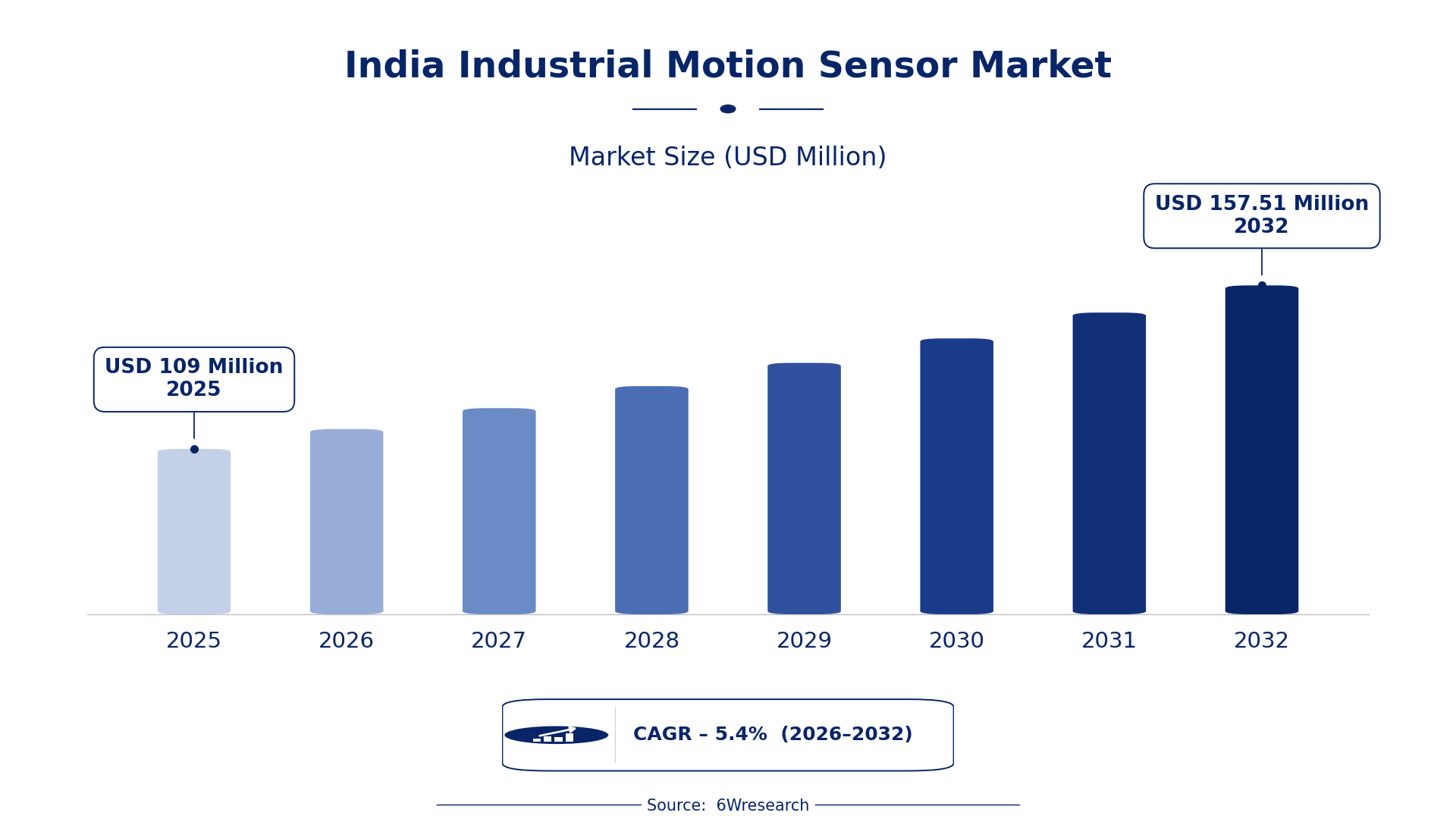
According to 6Wresearch internal database and industry insights, the India Industrial Motion Sensor Market was valued at USD 109.0 million in 2025 and is projected to reach USD 157.51 million by 2032, growing at a CAGR of approximately 5.4% during 2026–2032.
India Industrial Motion Sensor Market Highlights
| Report Metric | Details |
| Report Name | India Industrial Motion Sensor Market |
| Market Size 2025 | USD 109.0 million |
| Market Size 2032 | USD 157.51 million |
| Absolute Growth 2025–2032 | USD 48.51 million |
| CAGR 2026–2032 | 5.4% |
| Peak Annual Growth | 7.9% in 2028 |
| Forecast Period | 2026–2032 |
| Historical Data | 2022–2025 |
| Base Year | 2025 |
| Leading Sensor Type, 2025 | Accelerometers (51% share) |
| Leading Technology, 2025 | MEMS (38% share) |
| Leading Output Signal, 2025 | Digital (45% share) |
| Leading Application, 2025 | Vibration Monitoring (43% share) |
| Leading End User Industry, 2025 | Automotive (41% share) |
| Fastest-Growing Sensor Type | Ultrasonic Sensors (8.2% CAGR) |
| Fastest-Growing Output Signal | Analog (6.6% CAGR) |
| Fastest-Growing Application | Robotics (6.5% CAGR) |
| Fastest-Growing End User Industry | Industrial Automation (7.6% CAGR) |
| Growing Sector | Automotive |
| Key End Users | Automotive, Industrial Automation, Robotics, Aerospace and Defense |
India Industrial Motion Sensor Market Year-wise Growth Rate and Key Drivers (2022–2032)
This graph illustrates the annual growth rates of the market from 2022 to 2032, highlighting a steady upward trajectory and projected market expansion over the forecast period.
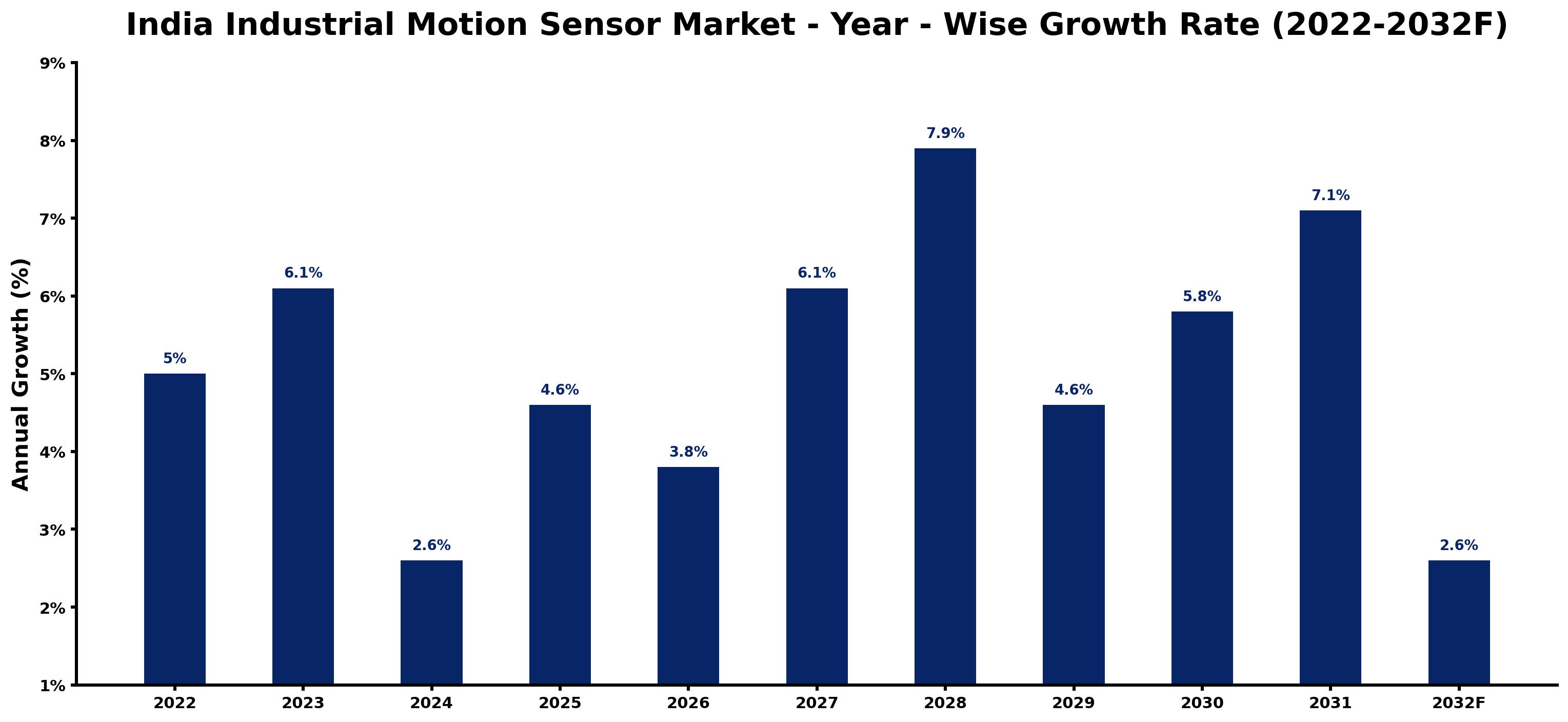
The following table presents the estimated annual growth rate for each year together with the principal factor influencing market performance.
| Year | Estimated Annual Growth (%) | Market Rationale |
| 2022 | 5.0 | The market experienced solid demand from the automotive sector, reflecting ongoing production needs. |
| 2023 | 6.1 | Growth accelerated due to increased vehicle production, with over 4.4 million vehicles manufactured. |
| 2024 | 2.6 | A slowdown occurred as demand stabilised following the previous year's surge in automotive production. |
| 2025 | 4.6 | Demand rose again, driven by the industrial automation sector's growth and investment in technology. |
| 2026 | 3.8 | Growth is expected to slow as the market adjusts to new manufacturing standards and quality requirements. |
| 2027 | 6.1 | Renewed interest in robotics applications will boost sensor demand, enhancing market activity. |
| 2028 | 7.9 | Peak growth is projected as the automotive sector expands significantly, increasing sensor purchases. |
| 2029 | 4.6 | A slowdown will follow as the market begins to stabilise after rapid growth phases. |
| 2030 | 5.8 | Demand is expected to increase again as new technologies in automation begin to take hold, encouraging purchases. |
| 2031 | 7.1 | Growth will accelerate with rising investments in smart manufacturing technologies and R&D initiatives. |
| 2032 | 2.6 | The market is projected to stabilise as demand from robotics and automotive sectors normalises. |
Note: Market size estimations and growth projections presented in this report are based on 6Wresearch's proprietary forecasting methodology, utilizing the latest available industry data, government publications, and primary research inputs.
India Industrial Motion Sensor Market Synopsis
Industrial motion sensors in India are devices that detect and measure motion or changes in position. These sensors utilise technologies such as MEMS and ultrasonic waves, primarily employed in applications like vibration monitoring and robotics. The India Industrial Motion Sensor Market is growing due to strong demand from the automotive and industrial automation sectors.
Market Dynamics Impact Analysis (2026–2032)
| Factor | Type | Impact | Primary Segment Affected |
| Increased production of vehicles in the automotive sector | Driver | High | Automotive |
| Growing investments in industrial automation technologies | Driver | High | Industrial Automation |
| Rising demand for advanced manufacturing technologies | Opportunity | High | Accelerometers |
| Expansion of the robotics market in India | Opportunity | High | Robotics |
| Challenges in meeting stringent quality standards | Restraint | High | Accelerometers |
| Limited awareness of advanced sensor technologies | Restraint | Medium | MEMS |
| High costs associated with advanced manufacturing technologies | Challenge | High | Accelerometers |
| Slow adoption of new technologies in traditional industries | Challenge | Medium | Industrial Automation |
Evaluation of Drivers in India Industrial Motion Sensor Market (2026–2032)
Key forces behind demand, with the segment each one moves most, are listed below.
| Drivers | Primary Segment Affected | Why It Matters (Evidence) |
| Increased vehicle production drives demand for motion sensors in automotive applications. | Automotive | The automotive industry produced over 4.4 million vehicles in 2022, increasing sensor purchases. |
| Growing automation in manufacturing processes boosts sensor adoption. | Industrial Automation | The sector is projected to reach $25 billion by 2025, prompting higher sensor demand. |
| Rising investments in robotics create a greater need for motion sensors. | Robotics | The Indian robotics market is projected to grow to $4 billion by 2025, driving purchases. |
| The MEMS technology segment is gaining traction due to its compactness. | MEMS | MEMS accounted for 30% of the market in 2023, leading to more applications. |
| Demand for safety systems in various industries is increasing. | Safety Systems | The Bureau of Indian Standards set ISO 9001, prompting manufacturers to improve safety features. |
Market growth in India for Industrial Motion Sensor rests on rising production in the automotive sector, advancements in industrial automation, and increased investments in robotics. The automotive industry produced over 4.4 million vehicles in 2022, which raised sensor demand. The industrial automation sector is set to grow substantially, with a projected value of $25 billion by 2025, leading to heightened sensor purchases. The Indian robotics market is anticipated to reach $4 billion by 2025, driving further sensor demand. MEMS technology accounted for 30% of the market in 2023, indicating strong demand for compact motion sensing applications.
Evaluation of Restraints in India Industrial Motion Sensor Market
The table below lists the restraints and the evidence behind each.
| Market Restraint | Primary Segment Affected | Why It Matters (Evidence) |
| Challenges in meeting stringent quality standards limit market growth. | Accelerometers | The Bureau of Indian Standards requires compliance with ISO 9001, increasing production costs. |
| Limited awareness of advanced sensor technologies restricts adoption. | MEMS | Many manufacturers are still reliant on traditional technologies, hindering market expansion. |
| High costs associated with advanced manufacturing technologies deter investment. | Accelerometers | The initial investment for smart technologies can be prohibitive for smaller manufacturers. |
| Slow adoption of new technologies in traditional industries hampers growth. | Industrial Automation | Many sectors are hesitant to shift from established practices, limiting sensor integration. |
| Inconsistent supply chain issues affect production timelines. | Accelerometers | Disruptions in the supply chain can delay sensor availability, impacting project timelines. |
India Industrial Motion Sensor Market Challenges
The India Industrial Motion Sensor Market still has to solve a few problems, starting with high production costs. Compliance with ISO 9001, mandated by the Bureau of Indian Standards, raises manufacturing expenses for suppliers, which in turn increases prices for buyers. Supply chain disruptions present another challenge, as the automotive sector, producing over 4.4 million vehicles in 2022, relies on timely sensor deliveries, causing delays in production. Skills shortages in sensor technology hinder production efficiency, resulting in longer lead times for manufacturers and affecting overall market competitiveness. Lastly, inconsistent demand from buyers complicates inventory management, forcing suppliers to maintain higher stock levels than necessary.
Trends in the India Industrial Motion Sensor Market
Below mentioned are some of the trends shaping the India Industrial Motion Sensor Market growth.
- Shift from Traditional to Smart Manufacturing: India is transitioning from traditional manufacturing methods to smart manufacturing technologies, driven by the 'Make in India' initiative. This shift is increasing the demand for motion sensors, with the industrial automation sector projected to grow to $25 billion by 2025.
- Growth in Robotics Applications: The robotics sector is rapidly expanding, with the Indian market anticipated to reach $4 billion by 2025. This growth is driving demand for motion sensors, particularly in automation and control systems.
- Increased Focus on Quality Standards: Manufacturers are prioritising compliance with ISO 9001 standards to improve product quality. This focus is evident as the Bureau of Indian Standards enforces these standards, positively impacting sensor production.
- Rise of MEMS Technology: MEMS technology is becoming increasingly popular in motion sensors due to its compact size and efficiency. It accounted for 30% of the market in 2023, reflecting its growing importance.
Investment Opportunities in the India Industrial Motion Sensor Market
Below are the investment opportunities with the strongest case in the India Industrial Motion Sensor Market.
- Investment in Smart Manufacturing Facilities: Smart manufacturing facilities in India are set to grow, with the industrial automation sector projected to reach $25 billion by 2025. Investing in motion sensors for these facilities presents a clear opportunity for suppliers.
- Expansion in the Automotive Sector: The automotive sector is projected to grow at a CAGR of 10% from 2023 to 2028, creating demand for motion sensors. Suppliers can enter this market by partnering with automotive manufacturers.
- Development of Robotics Technologies: With the Indian robotics market projected to reach $4 billion by 2025, there is a clear opportunity for motion sensor suppliers. Collaborating with robotics developers can facilitate market entry.
- Focus on Quality Compliance: As manufacturers aim to meet ISO 9001 standards, there is a growing need for high-quality motion sensors. Suppliers can target this need by ensuring their products meet these standards.
Government Initiatives in the India Industrial Motion Sensor Market
The 'Production Linked Incentive' scheme launched in 2021 by the Ministry of Electronics and Information Technology aims to boost local manufacturing of electronic components, including motion sensors. This initiative strengthens domestic production capabilities and reduces reliance on imports. The 'National Policy on Electronics 2019' seeks to increase the domestic production of electronic goods, including sensors, to $300 billion by 2025, positively impacting the motion sensor market. The 'Atmanirbhar Bharat' initiative, introduced in 2020, encourages self-reliance in manufacturing, further supporting the motion sensor industry.
In 2023, the Department of Science and Technology initiated a program to promote research and development in sensor technologies, with a budget of $200 million. This funding supports innovation and development in the motion sensor sector. The Ministry of Heavy Industries also announced a $500 million fund in 2022 to support advanced manufacturing technologies, including motion sensors. These initiatives are expected to facilitate the growth of the motion sensor market by providing necessary resources and support for research and development efforts.
Future Insight of the India Industrial Motion Sensor Market
The India Industrial Motion Sensor Market will see notable transformations by 2032, primarily driven by advancements in smart manufacturing technologies. The 'Make in India' initiative will strengthen local production capabilities, reducing reliance on imports. The robotics market is projected to grow to $4 billion by 2025, further stimulating demand for motion sensors. With the Indian government allocating $1 billion for technology development, suppliers will likely improve their manufacturing processes, creating a more streamlined environment for both buyers and producers.
Market Segmentation Analysis
Each segment group is reviewed below, with the leader by share and the fastest grower by CAGR.
By Sensor Type – Accelerometers Dominated, Ultrasonic Sensors Expected to Grow Fastest
According to Sachin Kumar Rai, Senior Research Analyst at 6Wresearch, in 2025, Accelerometers led the sensor type split with a 51% share. Accelerometers hold the largest share in the India Industrial Motion Sensor Market because they are crucial for measuring acceleration in various applications, especially within the automotive industry. Their integration into systems that produced over 4.4 million vehicles in 2022 underscores their vital role in enhancing vehicle performance and safety. Ultrasonic Sensors are set to record the highest CAGR in this split, 8.2% over 2026–2032. Ultrasonic sensors are experiencing the fastest growth as they are increasingly adopted for distance measurement and object detection in robotics applications. The projected growth of the Indian robotics market to $4 billion by 2025 significantly contributes to the rising demand for these sensors. Suppliers should focus on developing advanced ultrasonic sensors to capitalise on the growing robotics market.
By Technology – MEMS Dominated and Is Expected to Record the Fastest Growth
MEMS accounted for a 38% market share by technology in 2025. MEMS technology commands the largest market share due to its extensive use in compact motion sensing applications across various industries. Its widespread integration into systems, particularly in the automotive sector, which produced over 4.4 million vehicles in 2022, highlights its essential role in modern technology. MEMS is also forecast to expand faster than any other category, at a CAGR of 6.7% over 2026–2032. MEMS technology is also the fastest-growing segment, driven by its versatility and efficiency in contemporary motion sensing applications. As the automotive sector expands at a CAGR of 10% from 2023 to 2028, MEMS technology's dominance is set to strengthen further. Buyers should prioritise investments in MEMS technology to maintain a competitive edge in the industrial motion sensor market.
By Output Signal – Digital Dominated, Analog Expected to Grow Fastest
With a 45% revenue share in 2025, Digital was the largest output signal category. Digital output signals lead the market as they ensure accurate data transmission, which is vital for contemporary motion sensors. Their widespread use in advanced automotive systems reinforces their dominant position. Over 2026–2032, Analog is expected to post the fastest growth, at a CAGR of 6.6%. Analog signals are experiencing growth as they remain in use in older systems, but their replacement by digital outputs is on the horizon. As industries shift towards smarter technologies, the demand for digital outputs will continue to increase. Suppliers must focus on developing digital output technologies to satisfy the needs of modern applications.
By Application – Vibration Monitoring Dominated, Robotics Expected to Grow Fastest
The largest application category in 2025 was Vibration Monitoring, with a 43% share of total revenue. Vibration monitoring captures the largest market share due to its critical role in predictive maintenance, ensuring equipment reliability in industrial settings. The substantial investment in smart manufacturing technologies, with $1 billion allocated in 2023, drives this demand. The quickest growth will come from Robotics, forecast to expand at a CAGR of 6.5% between 2026 and 2032. Robotics is the fastest-growing application area, propelled by the increasing incorporation of motion sensors in robotic systems for movement and control. The projected growth of the robotics market to $4 billion by 2025 strongly indicates this trend. Buyers should invest in advanced motion sensors designed for robotics to capitalise on the automation growth.
By End User Industry – Automotive Dominated, Industrial Automation Expected to Grow Fastest
Automotive held a 41% share of the India Industrial Motion Sensor Market by end user industry in 2025. The automotive industry leads the market due to its substantial demand for motion sensors in vehicle systems, supported by the production of over 4.4 million vehicles in 2022. This sector's ongoing growth reinforces its dominant position. Industrial Automation is set to record the highest CAGR in this split, 7.6% over 2026–2032. Industrial automation is the fastest-growing end-user industry as it increasingly adopts motion sensors for manufacturing processes. The projected growth of the industrial automation sector to $25 billion by 2025 highlights its expanding role. Suppliers should target the industrial automation sector to align with its rapid growth and increasing sensor requirements.
Key Attractiveness of the Report
- 10 Years of Market Numbers
- Historical Data Starting from 2022 to 2025
- Base Year 2025
- Forecast Data until 2032
- Key Performance Indicators Impacting the Market
- Major Upcoming Developments and Projects
Key Highlights of the Report:
- India Industrial Motion Sensor Market Outlook
- Market Size of India Industrial Motion Sensor Market, 2025
- Forecast of India Industrial Motion Sensor Market, 2032
- Historical Data and Forecast of India Industrial Motion Sensor Revenues & Volume for the Period 2022 - 2032F
- India Industrial Motion Sensor Market Trend Evolution
- India Industrial Motion Sensor Market Drivers and Challenges
- India Industrial Motion Sensor Price Trends
- India Industrial Motion Sensor Porter's Five Forces
- India Industrial Motion Sensor Industry Life Cycle
- Historical Data and Forecast of India Industrial Motion Sensor Market Revenues & Volume By Sensor Type for the Period 2022 - 2032F
- Historical Data and Forecast of India Industrial Motion Sensor Market Revenues & Volume By Accelerometers for the Period 2022 - 2032F
- Historical Data and Forecast of India Industrial Motion Sensor Market Revenues & Volume By Gyroscopes for the Period 2022 - 2032F
- Historical Data and Forecast of India Industrial Motion Sensor Market Revenues & Volume By Ultrasonic Sensors for the Period 2022 - 2032F
- Historical Data and Forecast of India Industrial Motion Sensor Market Revenues & Volume By Infrared Sensors for the Period 2022 - 2032F
- Historical Data and Forecast of India Industrial Motion Sensor Market Revenues & Volume By Technology for the Period 2022 - 2032F
- Historical Data and Forecast of India Industrial Motion Sensor Market Revenues & Volume By MEMS for the Period 2022 - 2032F
- Historical Data and Forecast of India Industrial Motion Sensor Market Revenues & Volume By Fiber Optic for the Period 2022 - 2032F
- Historical Data and Forecast of India Industrial Motion Sensor Market Revenues & Volume By Ultrasonic Waves for the Period 2022 - 2032F
- Historical Data and Forecast of India Industrial Motion Sensor Market Revenues & Volume By Infrared Light for the Period 2022 - 2032F
- Historical Data and Forecast of India Industrial Motion Sensor Market Revenues & Volume By Output Signal for the Period 2022 - 2032F
- Historical Data and Forecast of India Industrial Motion Sensor Market Revenues & Volume By Analog for the Period 2022 - 2032F
- Historical Data and Forecast of India Industrial Motion Sensor Market Revenues & Volume By Digital for the Period 2022 - 2032F
- Historical Data and Forecast of India Industrial Motion Sensor Market Revenues & Volume By PWM for the Period 2022 - 2032F
- Historical Data and Forecast of India Industrial Motion Sensor Market Revenues & Volume By Voltage Signal for the Period 2022 - 2032F
- Historical Data and Forecast of India Industrial Motion Sensor Market Revenues & Volume By Application for the Period 2022 - 2032F
- Historical Data and Forecast of India Industrial Motion Sensor Market Revenues & Volume By Vibration Monitoring for the Period 2022 - 2032F
- Historical Data and Forecast of India Industrial Motion Sensor Market Revenues & Volume By Robotics for the Period 2022 - 2032F
- Historical Data and Forecast of India Industrial Motion Sensor Market Revenues & Volume By Position Tracking for the Period 2022 - 2032F
- Historical Data and Forecast of India Industrial Motion Sensor Market Revenues & Volume By Safety Systems for the Period 2022 - 2032F
- Historical Data and Forecast of India Industrial Motion Sensor Market Revenues & Volume By End User Industry for the Period 2022 - 2032F
- Historical Data and Forecast of India Industrial Motion Sensor Market Revenues & Volume By Automotive for the Period 2022 - 2032F
- Historical Data and Forecast of India Industrial Motion Sensor Market Revenues & Volume By Aerospace and Defense for the Period 2022 - 2032F
- Historical Data and Forecast of India Industrial Motion Sensor Market Revenues & Volume By Consumer Electronics for the Period 2022 - 2032F
- Historical Data and Forecast of India Industrial Motion Sensor Market Revenues & Volume By Industrial Automation for the Period 2022 - 2032F
- India Industrial Motion Sensor Import Export Trade Statistics
- Market Opportunity Assessment By Sensor Type
- Market Opportunity Assessment By Technology
- Market Opportunity Assessment By Output Signal
- Market Opportunity Assessment By Application
- Market Opportunity Assessment By End User Industry
- India Industrial Motion Sensor Top Companies Market Share
- India Industrial Motion Sensor Competitive Benchmarking By Technical and Operational Parameters
- India Industrial Motion Sensor Company Profiles
- India Industrial Motion Sensor Key Strategic Recommendations
Market Covered
The report offers an extensive study of the following market segments.
By Sensor Type
- Accelerometers
- Gyroscopes
- Ultrasonic Sensors
- Infrared Sensors
By Technology
- MEMS
- Fiber Optic
- Ultrasonic Waves
- Infrared Light
By Output Signal
- Analog
- Digital
- PWM
- Voltage Signal
By Application
- Vibration Monitoring
- Robotics
- Position Tracking
- Safety Systems
By End User Industry
- Automotive
- Aerospace and Defense
- Consumer Electronics
- Industrial Automation































