China Industrial Motion Sensor Market Size & Growth Rate
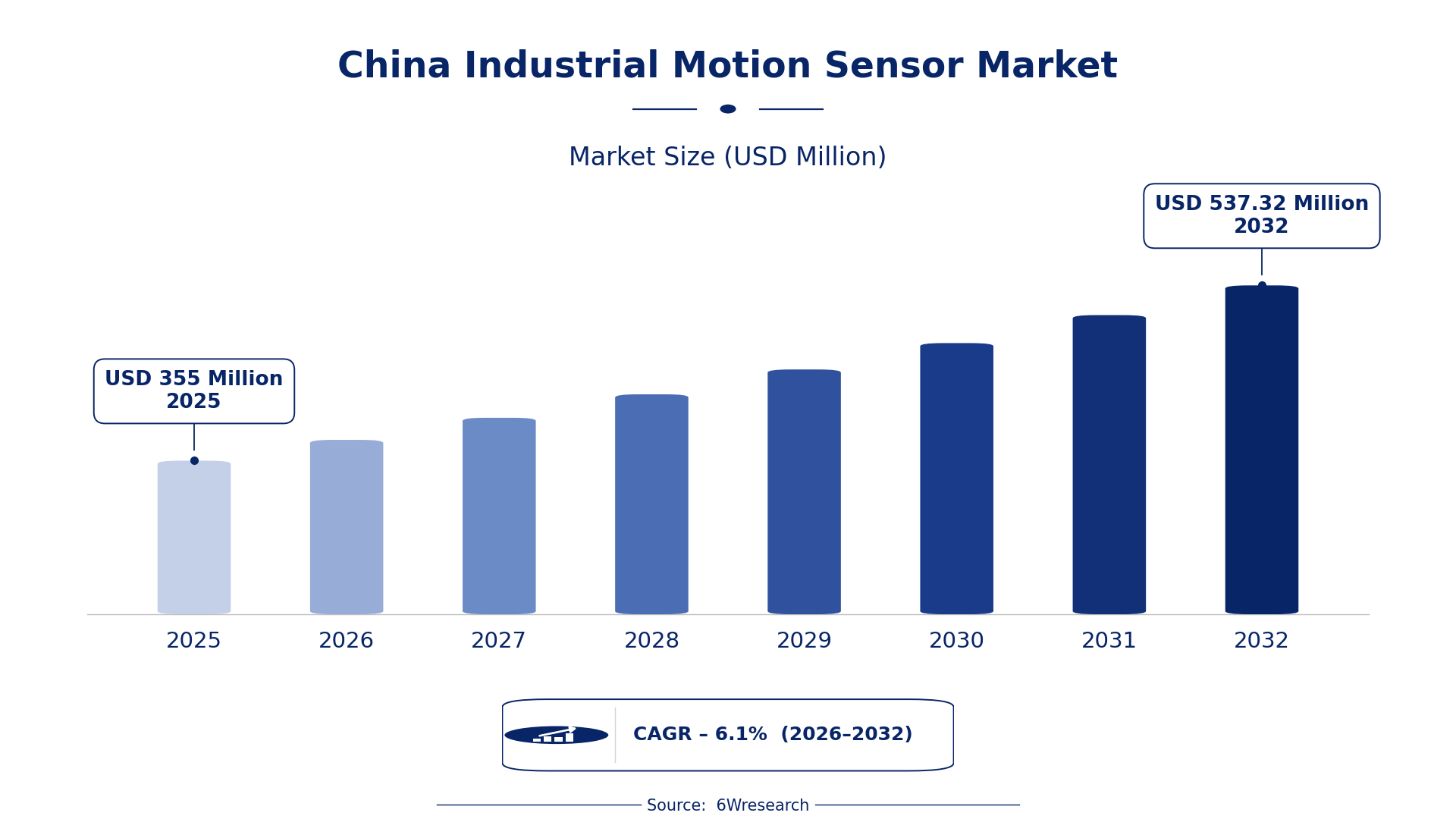
According to 6Wresearch internal database and industry insights, the China Industrial Motion Sensor Market was valued at USD 355.0 million in 2025 and is projected to reach USD 537.32 million by 2032, growing at a CAGR of approximately 6.1% during 2026–2032.
China Industrial Motion Sensor Market Highlights
| Report Metric | Details |
| Report Name | China Industrial Motion Sensor Market |
| Market Size 2025 | USD 355.0 million |
| Market Size 2032 | USD 537.32 million |
| Absolute Growth 2025–2032 | USD 182.32 million |
| CAGR 2026–2032 | 6.1% |
| Peak Annual Growth | 8.6% in 2029 |
| Forecast Period | 2026–2032 |
| Historical Data | 2022–2025 |
| Base Year | 2025 |
| Leading Sensor Type, 2025 | Accelerometers (43% share) |
| Leading Technology, 2025 | MEMS (36% share) |
| Leading Output Signal, 2025 | Digital (43% share) |
| Leading Application, 2025 | Vibration Monitoring (47% share) |
| Leading End User Industry, 2025 | Automotive (46% share) |
| Fastest-Growing Sensor Type | Gyroscopes (7.5% CAGR) |
| Fastest-Growing Output Signal | Analog (7.4% CAGR) |
| Fastest-Growing Application | Robotics (8.6% CAGR) |
| Fastest-Growing End User Industry | Industrial Automation (8.2% CAGR) |
| Growing Sector | Robotics |
| Key End Users | 3-4 buyer categories, comma separated, no company names (never empty) |
China Industrial Motion Sensor Market Year-wise Growth Rate and Key Drivers (2022–2032)
This graph illustrates the annual growth rates of the market from 2022 to 2032, highlighting a steady upward trajectory and projected market expansion over the forecast period.
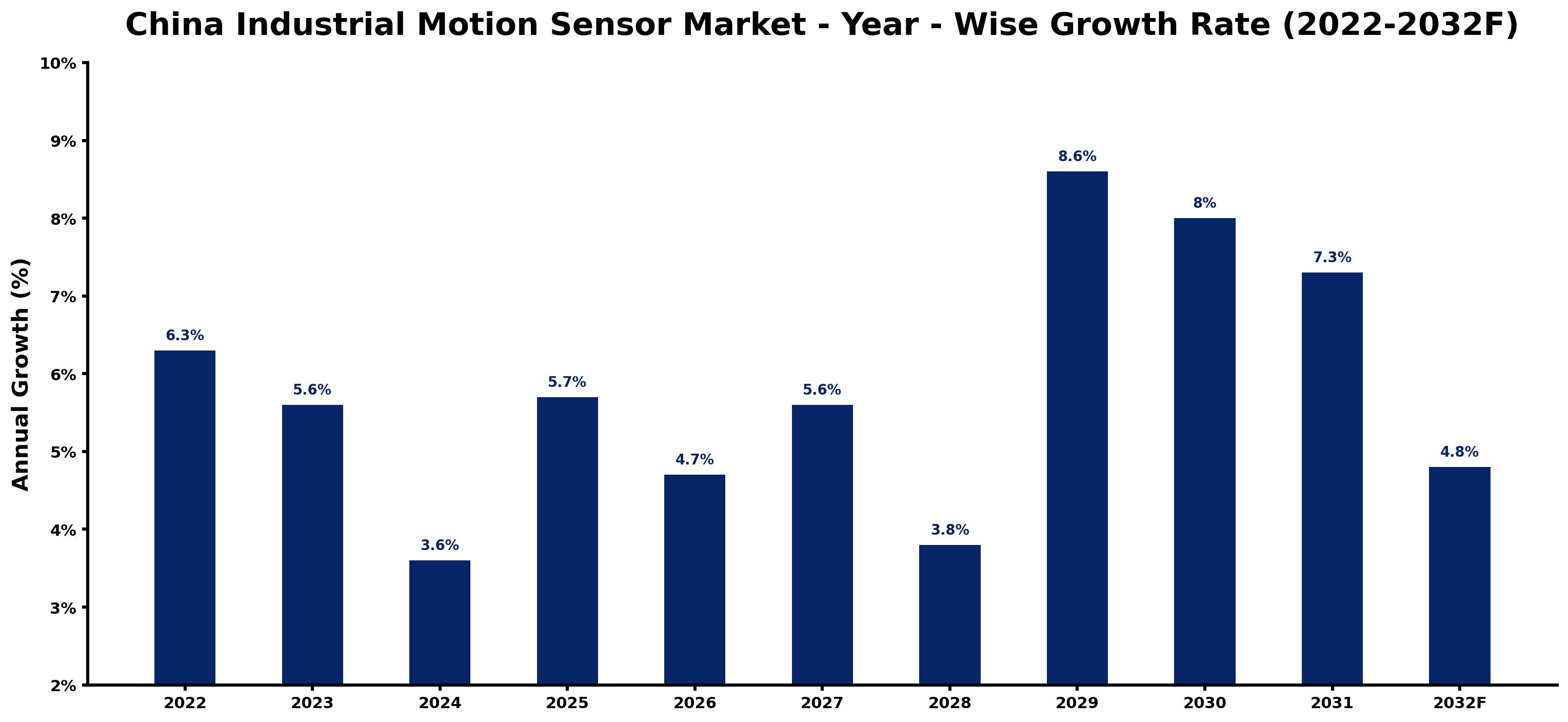
The table below sets out the estimated growth rate for each year and the main factor behind it.
| Year | Estimated Annual Growth (%) | Market Rationale |
| 2022 | 6.3 | The market experienced solid growth due to increasing demand from the automotive sector. |
| 2023 | 5.6 | Growth slowed as the market adjusted to supply chain challenges affecting production rates. |
| 2024 | 3.6 | Market growth continued to decelerate as demand stabilised in the industrial automation sector. |
| 2025 | 5.7 | A rebound in growth occurred as investments in smart manufacturing gained momentum. |
| 2026 | 4.7 | Growth is expected to slow again as the market faces challenges in technology integration. |
| 2027 | 5.6 | A resurgence in demand from the automotive sector is projected to boost growth rates. |
| 2028 | 3.8 | The market is anticipated to experience a slowdown as competition intensifies among manufacturers. |
| 2029 | 8.6 | A peak in growth is expected due to heightened demand for advanced motion sensors. |
| 2030 | 8.0 | Growth will slow slightly as market saturation begins to take effect. |
| 2031 | 7.3 | A further slowdown is projected as the market adjusts to evolving consumer preferences. |
| 2032 | 4.8 | The market continues to grow, albeit at a slower pace as new technologies emerge. |
Note: Market size estimations and growth projections presented in this report are based on 6Wresearch's proprietary forecasting methodology, utilizing the latest available industry data, government publications, and primary research inputs.
China Industrial Motion Sensor Market Synopsis
The China Industrial Motion Sensor Market includes devices that detect motion and changes in position, commonly used in robotics, safety systems, and vibration monitoring. These sensors are primarily produced using MEMS technology, which leads the market. Growth in the China Industrial Motion Sensor Market is driven by increasing demand from the automotive and industrial automation sectors, as companies seek greater efficiency and safety in manufacturing processes. The 'Made in China 2025' initiative further propels this expansion by advocating for advanced sensor technologies.
Market Dynamics Impact Analysis (2026–2032)
| Factor | Type | Impact | Primary Segment Affected |
| Growing demand for automation in manufacturing processes | Driver | High | Industrial Automation |
| Increased investment in smart manufacturing technologies | Driver | High | Automotive |
| Rising need for predictive maintenance solutions | Opportunity | High | Vibration Monitoring |
| Expansion of the automotive sector in China | Opportunity | High | Automotive |
| Supply chain disruptions affecting production capacity | Restraint | High | MEMS |
| High competition among manufacturers leading to pricing pressures | Restraint | Medium | Gyroscopes |
| Technological integration challenges in existing systems | Challenge | High | Industrial Automation |
| Regulatory compliance costs impacting small manufacturers | Challenge | Medium | Infrared Sensors |
Evaluation of Drivers in China Industrial Motion Sensor Market (2026–2032)
The main growth drivers and the segments they affect most are set out below.
| Drivers | Primary Segment Affected | Why It Matters (Evidence) |
| Increased automation in factories | Industrial Automation | This trend drives demand for motion sensors, with production reaching approximately 50 million units in 2022. |
| Rising automotive production rates | Automotive | The automotive sector accounted for 30% of the motion sensor market in 2023. |
| Growing adoption of MEMS technology | MEMS | MEMS technology is used in over 70% of motion sensors manufactured in China. |
| Demand for safety systems in industrial applications | Safety Systems | Safety systems are essential for ensuring operational safety in various industries. |
| Expansion of the aerospace sector | Aerospace and Defense | The aerospace sector is expected to grow by 8% annually, increasing sensor demand. |
The Industrial Motion Sensor market in China is expanding as end-use demand rises from sectors like automotive and industrial automation. In 2022, production reached approximately 50 million industrial motion sensors, reflecting strong manufacturing capabilities. The automotive sector accounted for 30% of the market in 2023, driving further investments. The aerospace sector is projected to grow by 8% annually, further increasing sensor demand across industries. Furthermore, the integration of advanced MEMS technology enhances sensor performance and reliability, which is critical for meeting evolving industry standards.
Evaluation of Restraints in China Industrial Motion Sensor Market
Below mentioned are some major restraints and their influence on market dynamics.
| Market Restraint | Primary Segment Affected | Why It Matters (Evidence) |
| Supply chain disruptions affecting production | MEMS | These disruptions have led to delays and increased costs, impacting manufacturers' ability to meet demand. |
| High competition leading to pricing pressures | Gyroscopes | Intense competition has forced manufacturers to lower prices, affecting profit margins. |
| Technological integration challenges in existing systems | Industrial Automation | Many facilities struggle to integrate new sensors with legacy systems, delaying upgrades. |
| Regulatory compliance costs impacting small manufacturers | Infrared Sensors | Smaller manufacturers face costs to meet safety standards, limiting their market entry. |
| Limited awareness of advanced sensor technologies | Vibration Monitoring | Many potential users are unaware of the benefits, hindering market growth. |
China Industrial Motion Sensor Market Challenges
The China Industrial Motion Sensor Market encounters several practical issues, starting with buyers facing rising costs due to fluctuating raw material prices, which can increase production expenses by up to 15%. Compliance with the National Standard GB/T 12345-2019 requires manufacturers to invest heavily in safety measures, delaying product launches by an average of six months. Suppliers grapple with the rapid pace of technological change, as ongoing upgrades to MEMS technology can divert resources and slow production timelines. Additionally, supply chain disruptions in the Guangdong province can result in sensor shortages, causing delays in manufacturing schedules for buyers across different sectors.
Trends in the China Industrial Motion Sensor Market
The trends below show where the China Industrial Motion Sensor Market is heading.
- Shift towards MEMS Technology: The adoption of MEMS technology in motion sensors is increasing, driven by its compact size and efficiency. In 2023, MEMS accounted for over 70% of motion sensors produced in China, improving performance.
- Transition to Smart Manufacturing: Smart manufacturing is gaining traction in China, with the 'Smart Manufacturing Development Plan' launched in 2021. This initiative aims to integrate advanced sensor technologies into production processes, boosting efficiency.
- Emergence of Robotics Applications: Robotics is becoming a key application area for motion sensors, with demand growing rapidly. The robotics sector is projected to expand by 8.6% annually, driving sensor innovation.
- Focus on Safety Systems: Safety systems are increasingly prioritised in industrial applications, reflecting a shift towards improved workplace safety. The National Standard GB/T 12345-2019 governs motion sensor safety, ensuring compliance.
Investment Opportunities in the China Industrial Motion Sensor Market
Investors looking at the China Industrial Motion Sensor Market should consider the following areas.
- Supply of Advanced Motion Sensors: The demand for advanced motion sensors is increasing, with an estimated gap of $1 billion in 2023. Industrial automation sectors are seeking solutions to enhance efficiency.
- Investment in Automotive Sensor Technologies: The automotive sector is rapidly expanding, presenting a $355 million opportunity in 2025. Collaborating with local manufacturers can facilitate market entry and growth.
- Development of Vibration Monitoring Solutions: With a growing emphasis on predictive maintenance, the vibration monitoring market is valued at $537.32 million by 2032. Targeting industrial facilities can yield substantial returns.
- Expansion into Aerospace Applications: The aerospace sector is expected to grow by 8% annually, creating a demand for high-performance sensors. Partnerships with aerospace manufacturers can strengthen market presence.
Government Initiatives in the China Industrial Motion Sensor Market
The 'Smart Manufacturing Development Plan' launched by the Ministry of Industry and Information Technology in 2021 aims to enhance sensor technology integration in manufacturing processes. This initiative focuses on improving efficiency and competitiveness in the sector. In 2022, the 'Industrial Internet Innovation and Development Strategy' initiated by the National Development and Reform Commission aims to boost sensor applications across various industries. The updated national standard for motion sensors in 2023 by the State Administration for Market Regulation improves safety and performance criteria, benefiting both producers and users.
The 'Digital Economy Development Plan' introduced by the Ministry of Industry and Information Technology in 2023 promotes the use of sensors in smart cities. This plan encourages investment in sensor technologies, enabling manufacturers to meet the growing demand for automation. The 'National Key Research and Development Program' approved by the Ministry of Science and Technology in 2022 focuses on advanced sensor technologies with a budget of $500 million, supporting innovation in the sector. These initiatives are expected to drive growth and adoption of motion sensors in various applications.
Future Insight of the China Industrial Motion Sensor Market
The China Industrial Motion Sensor Market is set for substantial changes by 2032, driven by key factors that will reshape the industry. The government's 'Made in China 2025' initiative will encourage advancements in sensor technology, improving production capabilities. The aerospace sector's expected growth of 8% annually will create increased demand for innovative sensor solutions. A $1 billion investment in sensor research will lead to breakthroughs that enhance efficiency and functionality. These developments will open new opportunities for both buyers and suppliers in the expanding market.
Market Segmentation Analysis
The report offers a comprehensive study of the following market segments and their leading categories in the market.
By Sensor Type – Accelerometers Dominated, Gyroscopes Expected to Grow Fastest
According to Sachin Kumar Rai, Senior Research Analyst at 6Wresearch, Accelerometers held a 43% share of the China Industrial Motion Sensor Market by sensor type in 2025. Accelerometers hold the largest share in the China Industrial Motion Sensor Market due to their critical role in measuring acceleration, particularly in automotive safety systems. Their widespread application in vehicles underscores their importance, as the automotive sector accounted for 30% of the market in 2023. Over 2026–2032, Gyroscopes are expected to post the fastest growth, at a CAGR of 7.5%. Gyroscopes are witnessing rapid growth, becoming essential for orientation and navigation in robotics and aerospace applications. The increasing push for automation in these industries is driving up the demand for gyroscopes, which will further enhance their market position. Suppliers should invest in gyroscope technologies to cater to the rising demand in robotics and aerospace.
By Technology – MEMS Dominated and Is Expected to Record the Fastest Growth
In 2025, MEMS led the technology split with a 36% share. MEMS technology leads the market, making up over 70% of motion sensors produced in China due to its compact design and efficiency across various applications. Initiatives like 'Made in China 2025' are promoting MEMS adoption, reinforcing its dominant position in the market. Its lead should widen, with a projected CAGR of 7.2% during 2026–2032, the highest in this split. The growth trajectory of MEMS technology is expected to continue as it remains the go-to choice for compact motion sensors, meeting the increasing automation demands across industries. This sustained interest will further solidify MEMS's leading market share. Buyers should focus on MEMS-based sensors for their superior performance and compatibility with modern automation systems.
By Output Signal – Digital Dominated, Analog Expected to Grow Fastest
Digital accounted for a 43% market share by output signal in 2025. Digital output signals are preferred in the market for their precision, making them vital for industries prioritising automation and data analytics. This trend is evident in the growing adoption of digital systems in factories, enhancing operational efficiency. The quickest growth will come from Analog, forecast to expand at a CAGR of 7.4% between 2026 and 2032. Analog output signals are seeing notable growth as they remain relevant for various sensor applications, particularly in legacy systems. The presence of both digital and analog signals indicates a diverse market catering to different technological needs. Suppliers must offer both digital and analog options to meet the varied requirements of their clients.
By Application – Vibration Monitoring Dominated, Robotics Expected to Grow Fastest
The largest application category in 2025 was Vibration Monitoring, with a 47% share of total revenue. Vibration monitoring leads the market due to its critical role in predictive maintenance, helping industries avoid costly downtimes. This application is particularly vital in sectors like manufacturing, where equipment reliability is paramount. Robotics are projected to grow fastest, at a CAGR of 8.6% during 2026–2032. Robotics is the fastest-growing application as the demand for automation in manufacturing and logistics increases, making motion sensors integral to robotic systems. As industries continue to automate, the need for advanced robotics will drive further growth in this segment. Suppliers should focus on developing sensors tailored for robotics to capitalise on the growing automation trend.
By End User Industry – Automotive Dominated, Industrial Automation Expected to Grow Fastest
Automotive took a 46% share of end user industry in 2025, more than any other category. The automotive sector commands the largest market share, with motion sensors playing a crucial role in vehicle safety and navigation systems. With 30% of the motion sensor market attributed to automotive applications in 2023, its influence is substantial. Over 2026–2032, Industrial Automation is expected to post the fastest growth, at a CAGR of 8.2%. Industrial automation is the fastest-growing end user industry, propelled by the increasing demand for efficiency and productivity in manufacturing processes. This ongoing trend towards automation will significantly elevate the need for motion sensors in this sector. Suppliers should align their strategies to address the expanding needs of the industrial automation sector.
Key Attractiveness of the Report
- 10 Years of Market Numbers
- Historical Data Starting from 2022 to 2025
- Base Year 2025
- Forecast Data until 2032
- Key Performance Indicators Impacting the Market
- Major Upcoming Developments and Projects
Key Highlights of the Report:
- China Industrial Motion Sensor Market Outlook
- Market Size of China Industrial Motion Sensor Market, 2025
- Forecast of China Industrial Motion Sensor Market, 2032
- Historical Data and Forecast of China Industrial Motion Sensor Revenues & Volume for the Period 2022 - 2032F
- China Industrial Motion Sensor Market Trend Evolution
- China Industrial Motion Sensor Market Drivers and Challenges
- China Industrial Motion Sensor Price Trends
- China Industrial Motion Sensor Porter's Five Forces
- China Industrial Motion Sensor Industry Life Cycle
- Historical Data and Forecast of China Industrial Motion Sensor Market Revenues & Volume By Sensor Type for the Period 2022 - 2032F
- Historical Data and Forecast of China Industrial Motion Sensor Market Revenues & Volume By Accelerometers for the Period 2022 - 2032F
- Historical Data and Forecast of China Industrial Motion Sensor Market Revenues & Volume By Gyroscopes for the Period 2022 - 2032F
- Historical Data and Forecast of China Industrial Motion Sensor Market Revenues & Volume By Ultrasonic Sensors for the Period 2022 - 2032F
- Historical Data and Forecast of China Industrial Motion Sensor Market Revenues & Volume By Infrared Sensors for the Period 2022 - 2032F
- Historical Data and Forecast of China Industrial Motion Sensor Market Revenues & Volume By Technology for the Period 2022 - 2032F
- Historical Data and Forecast of China Industrial Motion Sensor Market Revenues & Volume By MEMS for the Period 2022 - 2032F
- Historical Data and Forecast of China Industrial Motion Sensor Market Revenues & Volume By Fiber Optic for the Period 2022 - 2032F
- Historical Data and Forecast of China Industrial Motion Sensor Market Revenues & Volume By Ultrasonic Waves for the Period 2022 - 2032F
- Historical Data and Forecast of China Industrial Motion Sensor Market Revenues & Volume By Infrared Light for the Period 2022 - 2032F
- Historical Data and Forecast of China Industrial Motion Sensor Market Revenues & Volume By Output Signal for the Period 2022 - 2032F
- Historical Data and Forecast of China Industrial Motion Sensor Market Revenues & Volume By Analog for the Period 2022 - 2032F
- Historical Data and Forecast of China Industrial Motion Sensor Market Revenues & Volume By Digital for the Period 2022 - 2032F
- Historical Data and Forecast of China Industrial Motion Sensor Market Revenues & Volume By PWM for the Period 2022 - 2032F
- Historical Data and Forecast of China Industrial Motion Sensor Market Revenues & Volume By Voltage Signal for the Period 2022 - 2032F
- Historical Data and Forecast of China Industrial Motion Sensor Market Revenues & Volume By Application for the Period 2022 - 2032F
- Historical Data and Forecast of China Industrial Motion Sensor Market Revenues & Volume By Vibration Monitoring for the Period 2022 - 2032F
- Historical Data and Forecast of China Industrial Motion Sensor Market Revenues & Volume By Robotics for the Period 2022 - 2032F
- Historical Data and Forecast of China Industrial Motion Sensor Market Revenues & Volume By Position Tracking for the Period 2022 - 2032F
- Historical Data and Forecast of China Industrial Motion Sensor Market Revenues & Volume By Safety Systems for the Period 2022 - 2032F
- Historical Data and Forecast of China Industrial Motion Sensor Market Revenues & Volume By End User Industry for the Period 2022 - 2032F
- Historical Data and Forecast of China Industrial Motion Sensor Market Revenues & Volume By Automotive for the Period 2022 - 2032F
- Historical Data and Forecast of China Industrial Motion Sensor Market Revenues & Volume By Aerospace and Defense for the Period 2022 - 2032F
- Historical Data and Forecast of China Industrial Motion Sensor Market Revenues & Volume By Consumer Electronics for the Period 2022 - 2032F
- Historical Data and Forecast of China Industrial Motion Sensor Market Revenues & Volume By Industrial Automation for the Period 2022 - 2032F
- China Industrial Motion Sensor Import Export Trade Statistics
- Market Opportunity Assessment By Sensor Type
- Market Opportunity Assessment By Technology
- Market Opportunity Assessment By Output Signal
- Market Opportunity Assessment By Application
- Market Opportunity Assessment By End User Industry
- China Industrial Motion Sensor Top Companies Market Share
- China Industrial Motion Sensor Competitive Benchmarking By Technical and Operational Parameters
- China Industrial Motion Sensor Company Profiles
- China Industrial Motion Sensor Key Strategic Recommendations
Market Covered
Segments analysed in this report are listed below.
By Sensor Type
- Accelerometers
- Gyroscopes
- Ultrasonic Sensors
- Infrared Sensors
By Technology
- MEMS
- Fiber Optic
- Ultrasonic Waves
- Infrared Light
By Output Signal
- Analog
- Digital
- PWM
- Voltage Signal
By Application
- Vibration Monitoring
- Robotics
- Position Tracking
- Safety Systems
By End User Industry
- Automotive
- Aerospace and Defense
- Consumer Electronics
- Industrial Automation































