India Industrial Sensor Market Size & Growth Rate
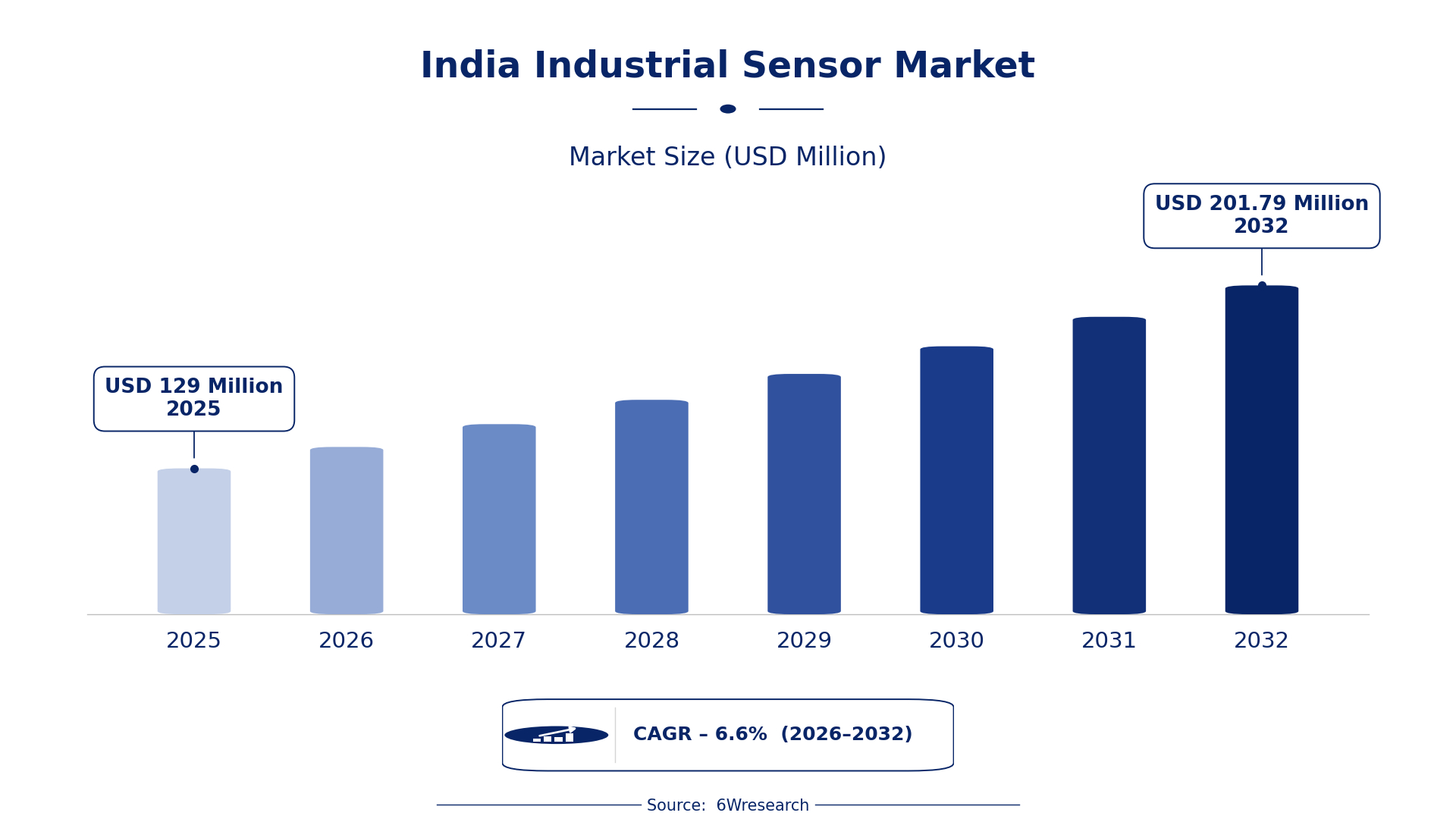
According to 6Wresearch internal database and industry insights, the India Industrial Sensor Market was valued at USD 129.0 million in 2025 and is projected to reach USD 201.79 million by 2032, growing at a CAGR of approximately 6.6% during 2026–2032.
India Industrial Sensor Market Highlights
| Report Metric | Details |
| Report Name | India Industrial Sensor Market |
| Market Size 2025 | USD 129.0 million |
| Market Size 2032 | USD 201.79 million |
| Absolute Growth 2025–2032 | USD 72.79 million |
| CAGR 2026–2032 | 6.6% |
| Peak Annual Growth | 8.7% in 2028 |
| Forecast Period | 2026–2032 |
| Historical Data | 2022–2025 |
| Base Year | 2025 |
| Leading Sensor Type, 2025 | Temperature Sensors (43% share) |
| Leading Application Area, 2025 | Process Monitoring (44% share) |
| Leading End User, 2025 | Electronics Factories (43% share) |
| Leading Distribution Channel, 2025 | Direct Sales (45% share) |
| Fastest-Growing Sensor Type | Pressure Sensors (8.7% CAGR) |
| Fastest-Growing Application Area | Robotics & Automation (8.3% CAGR) |
| Fastest-Growing End User | Semiconductor Plants (7.7% CAGR) |
| Fastest-Growing Distribution Channel | Engineering Distributors (8.1% CAGR) |
| Growing Sector | Electronics Manufacturing |
| Key End Users | Electronics Factories, Semiconductor Plants, Food Processing Industries, Chemical Industries |
India Industrial Sensor Market Year-wise Growth Rate and Key Drivers (2022–2032)
This graph illustrates the annual growth rates of the market from 2022 to 2032, highlighting a steady upward trajectory and projected market expansion over the forecast period.
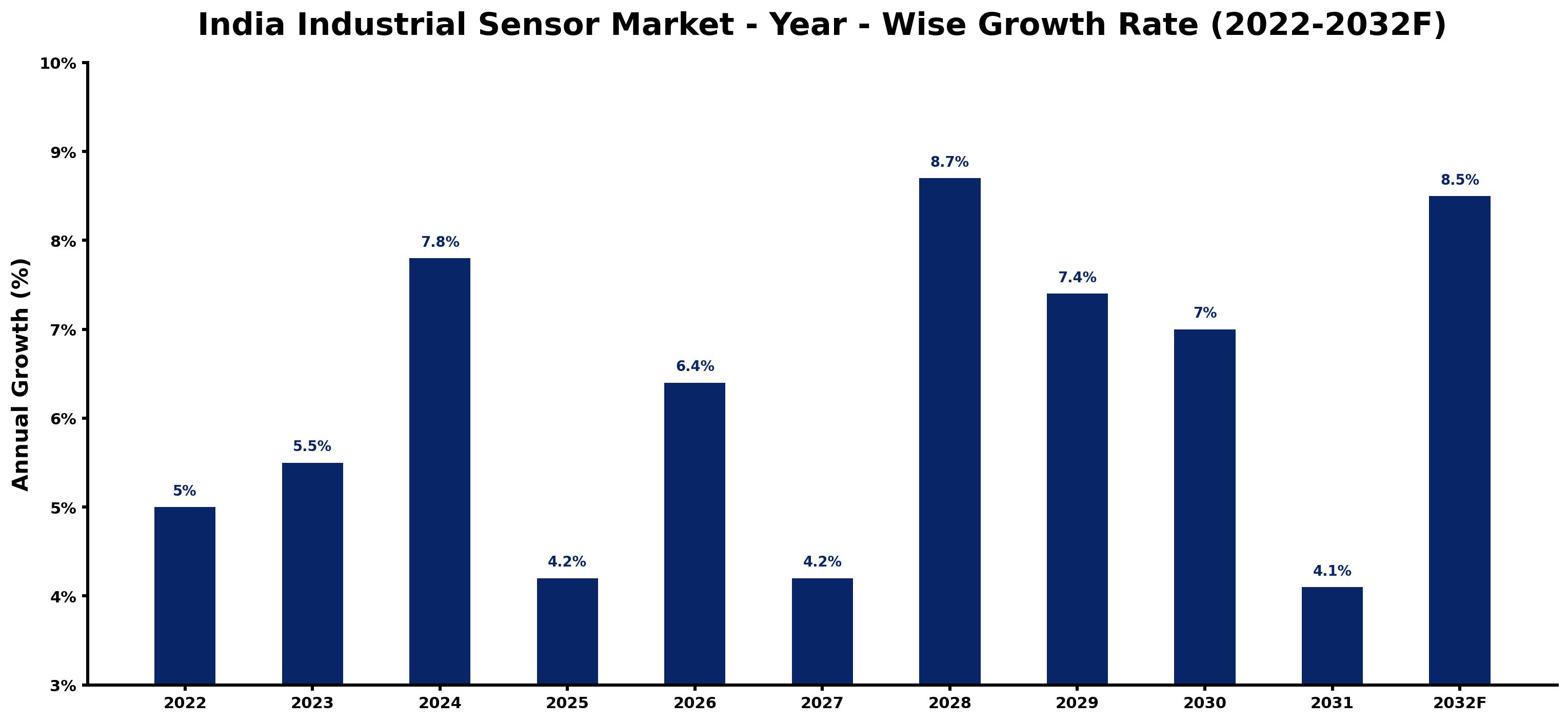
Annual growth estimates for each year appear below with the principal reason behind them, explaining the shifts that set the pace of the market.
| Year | Estimated Annual Growth (%) | Market Rationale |
| 2022 | 5.0 | The market experienced steady growth due to increased industrial activities driven by the National Manufacturing Policy. |
| 2023 | 5.5 | Demand rose as the manufacturing sector expanded, employing over 50 million people in various industries. |
| 2024 | 7.8 | Growth accelerated, driven by rising automation in manufacturing processes, particularly in electronics factories. |
| 2025 | 4.2 | A slowdown occurred as growth moderated following previous high rates, reflecting adjustments in production capacities. |
| 2026 | 6.4 | The market rebounded with renewed interest in smart manufacturing technologies and automation solutions. |
| 2027 | 4.2 | Growth slowed again, reflecting adjustments in production capacities and market conditions. |
| 2028 | 8.7 | The peak growth year saw a surge in demand for advanced sensors, particularly in semiconductor plants. |
| 2029 | 7.4 | Growth decelerated as demand stabilised after peak levels observed in the previous year. |
| 2030 | 7.0 | The market continued to grow, albeit at a slower pace than before, due to ongoing investments in automation. |
| 2031 | 4.1 | A further slowdown was noted as market conditions normalised, affecting production rates. |
| 2032 | 8.5 | Growth is expected to rise again, driven by new technology adoption in smart manufacturing. |
Note: Market size estimations and growth projections presented in this report are based on 6Wresearch's proprietary forecasting methodology, utilizing the latest available industry data, government publications, and primary research inputs.
India Industrial Sensor Market Synopsis
The India Industrial Sensor Market includes devices that detect changes in physical conditions for monitoring and control systems. These sensors, constructed from materials such as silicon and metals, play a crucial role in automation for manufacturing and environmental monitoring. The market is anticipated to expand, driven by the growing manufacturing sector and initiatives like the National Manufacturing Policy, which aims to increase the sector's contribution to GDP to 25% by 2025. Key buyer groups encompass electronics factories and semiconductor plants, both of which are ramping up their demand for advanced sensor technologies.
Market Dynamics Impact Analysis (2026–2032)
| Factor | Type | Impact | Primary Segment Affected |
| Growing demand for automation in manufacturing processes | Driver | High | Proximity Sensors |
| Rising investments in smart manufacturing technologies | Driver | High | Temperature Sensors |
| Increasing demand for sensors in electronics manufacturing | Opportunity | High | Electronics Factories |
| Expansion of the semiconductor industry in India | Opportunity | High | Semiconductor Plants |
| High costs associated with advanced sensor technologies | Restraint | Medium | Pressure Sensors |
| Limited availability of skilled workforce in sensor manufacturing | Restraint | Medium | Level Sensors |
| Supply chain disruptions affecting sensor availability | Challenge | High | Temperature Sensors |
| Regulatory hurdles in sensor approvals delaying market entry | Challenge | Medium | Temperature Sensors |
Evaluation of Drivers in India Industrial Sensor Market (2026–2032)
The factors lifting demand, and the evidence behind each, are summarised below.
| Drivers | Primary Segment Affected | Why It Matters (Evidence) |
| Increased automation in manufacturing processes | Proximity Sensors | This trend drives demand as manufacturers seek efficiency, with the electronics industry expected to grow at 25% from 2023. |
| Investment in smart manufacturing technologies | Temperature Sensors | The Indian government allocated ₹1,000 crore for smart manufacturing technologies, boosting sensor demand. |
| Growing electronics manufacturing sector | Electronics Factories | The sector's expansion leads to higher sensor purchases for quality control and automation, projected to increase substantially. |
| Rising demand for precision in semiconductor production | Semiconductor Plants | As semiconductor plants grow, they require more sensors for accurate manufacturing processes, resulting in increased purchases. |
| Expansion of food processing industries | Level Sensors | The food processing sector's growth drives demand for level sensors to ensure quality and safety in operations. |
The Industrial Sensor market in India is on the rise as automation in manufacturing, increased investments in smart technologies, and the expanding electronics sector generate new demand. The electronics industry is projected to grow by 25% from 2023, leading to higher purchases for quality control. The semiconductor industry is also growing, necessitating precision sensors for accurate production processes. The expansion of food processing industries is driving the need for sensors to ensure quality and safety in operations.
Evaluation of Restraints in India Industrial Sensor Market
Below mentioned are some major restraints and their influence on market dynamics.
| Market Restraint | Primary Segment Affected | Why It Matters (Evidence) |
| High costs of advanced sensor technologies | Pressure Sensors | These costs limit adoption among smaller manufacturers, impacting overall market growth, especially for new entrants. |
| Limited skilled workforce in sensor manufacturing | Level Sensors | The shortage of skilled professionals affects production efficiency and quality, resulting in increased operational costs. |
| Supply chain disruptions affecting sensor availability | Temperature Sensors | These disruptions cause delays in production and increase costs for buyers, impacting their procurement strategies. |
| Regulatory hurdles in sensor approvals | Proximity Sensors | These hurdles delay market entry for new products, affecting competitiveness and innovation in the sector. |
| Dependence on imported components for sensor production | Temperature Sensors | This reliance can create vulnerabilities in supply chains and pricing, impacting overall market stability. |
India Industrial Sensor Market Challenges
Over 50 million people are employed in India's manufacturing sector, yet fierce competition among industrial sensor suppliers can result in price reductions of up to 15% for producers. This price pressure compels manufacturers to seek lower-cost alternatives, which impacts their profit margins. Regulatory compliance with the Bureau of Indian Standards can delay product approvals by up to six months for new entrants, hindering timely market access for suppliers. A shortage of skilled technicians in sensor technology leads to an estimated annual loss of ₹500 crore for producers due to diminished operational efficiency, affecting their capacity to meet rising demand.
Trends in the India Industrial Sensor Market
The trends below show where the India Industrial Sensor Market is heading.
- Shift towards Smart Manufacturing: Since 2023, India has adopted smart manufacturing technologies, enhancing efficiency and productivity. The National Manufacturing Policy aims to boost the sector's GDP contribution, targeting 25% by 2025.
- Growing Adoption of Robotics in Manufacturing: The trend towards automation in manufacturing has accelerated, with robotics and automation experiencing a CAGR of 8.3%. This shift is evident in the increasing application of sensors in robotics.
- Integration of Sensors in Smart Cities: The Smart Cities Mission, launched in 2020, encourages the use of sensors for monitoring urban infrastructure. This initiative seeks to improve governance and efficiency in urban areas, backed by substantial investments.
- Expansion of Semiconductor Manufacturing: The semiconductor sector is rapidly advancing, with a projected CAGR of 7.7%. This growth is fuelled by rising demand for precision sensors in manufacturing processes.
Investment Opportunities in the India Industrial Sensor Market
Some of the investment opportunities in the India Industrial Sensor Market are mentioned below.
- Supply of Advanced Sensor Technologies: With the electronics sector expected to grow by 25%, there is a clear opportunity to supply advanced sensors. Electronics factories are key buyers, and forming partnerships with local manufacturers can facilitate entry into this growing market.
- Investment in Semiconductor Sensor Solutions: The semiconductor industry is anticipated to expand, creating a demand gap for precision sensors. Collaborating with semiconductor plants can offer promising opportunities for sensor manufacturers to address this increasing need.
- Development of Sensors for Food Processing: The food processing industry is on the rise, generating demand for level sensors. Investing in sensor solutions for this sector can yield substantial returns, particularly in Punjab's food processing hubs, where quality control is paramount.
- Partnerships for Smart Manufacturing Solutions: The government's ₹1,000 crore investment in smart manufacturing technologies opens avenues for collaboration. Establishing joint ventures with local firms can improve market entry and spur innovation.
Government Initiatives in the India Industrial Sensor Market
The National Policy on Electronics 2020 aims to boost the manufacturing of electronic components, including sensors, with a target of achieving $400 billion in electronics manufacturing by 2025. This policy promotes local production and reduces reliance on imports, benefiting both sensor manufacturers and buyers. Additionally, the Production-Linked Incentive Scheme launched in 2021 with a budget of ₹10,000 crore supports local manufacturing of industrial components, including sensors, encouraging manufacturers to enhance production capabilities.
The Atal Innovation Mission backs startups in developing cutting-edge sensor technologies, offering funding and mentorship to support growth in the sector. The MSME Competitiveness Program improves the competitiveness of small and medium enterprises in sensor manufacturing, facilitating access to resources and training. Furthermore, the Department of Heavy Industry oversees various projects and initiatives to bolster local manufacturing, improving the overall conditions for sensor production.
Future Insight of the India Industrial Sensor Market
The India Industrial Sensor Market is poised for considerable growth by 2032, driven by the Smart Cities Mission and the Make in India initiative. The government plans to invest ₹1,000 crore in smart manufacturing technologies, boosting production capabilities. Rising demand for sensors across various sectors will encourage innovation and diversification. The Electronics Industry is expected to grow at a CAGR of 25% from 2023 onwards, creating new opportunities for suppliers and buyers alike.
Market Segmentation Analysis
The analysis below covers each segmentation, its leading category in 2025 and its fastest-growing category through 2032.
By Sensor Type – Temperature Sensors Dominated, Pressure Sensors Expected to Grow Fastest
According to Sachin Kumar Rai, Senior Research Analyst at 6Wresearch, with a 43% revenue share in 2025, Temperature Sensors was the largest sensor type category. Temperature sensors hold the largest market share in India as they are critical for monitoring temperature in process control systems, particularly in the pharmaceutical sector. Their extensive application in Gujarat's pharmaceutical manufacturing underscores their importance in maintaining product quality and safety. Over 2026–2032, Pressure Sensors are expected to post the fastest growth, at a CAGR of 8.7%. Pressure sensors are experiencing rapid growth due to their essential role in measuring pressure in oil and gas operations, especially in Assam, where the sector is expanding. The increasing need for precise pressure measurement in these critical applications will likely continue to propel their growth. Suppliers should focus on enhancing the availability of temperature and pressure sensors to meet the rising demands of various industries.
By Application Area – Process Monitoring Dominated, Robotics & Automation Expected to Grow Fastest
Process Monitoring took a 44% share of application area in 2025, more than any other category. Process monitoring leads the market share as it is vital for ensuring optimal operation and safety in industrial processes across various sectors. This necessity is particularly evident in industries requiring stringent quality control measures to comply with established standards. Robotics & Automation is projected to grow fastest, at a CAGR of 8.3% during 2026–2032. Robotics and automation are growing swiftly, driven by the increasing integration of automated systems in manufacturing, which necessitate precise control and feedback mechanisms. The push towards smart manufacturing technologies is further accelerating this segment's growth. Buyers in the robotics and automation sector should seek advanced sensors to optimise operational efficiency and safety.
By End User – Electronics Factories Dominated, Semiconductor Plants Expected to Grow Fastest
The largest end user category in 2025 was Electronics Factories, with a 43% share of total revenue. Electronics factories dominate the market share as they are significant users of sensors for quality control and automation processes, particularly in the expanding electronics industry. The high employment in this sector indicates robust demand for industrial sensors, reflecting their critical role in production. The quickest growth will come from Semiconductor Plants, forecast to expand at a CAGR of 7.7% between 2026 and 2032. Semiconductor plants are witnessing the fastest growth due to their reliance on sensors for precision in manufacturing processes, which are essential for producing high-quality semiconductor components. The rising demand for electronics is further driving this segment's expansion. Suppliers should prioritise the development of sensors tailored for the semiconductor industry to capitalise on this growth opportunity.
By Distribution Channel – Direct Sales Dominated, Engineering Distributors Expected to Grow Fastest
In 2025, Direct Sales led the distribution channel split with a 45% share. Direct sales command the largest market share as they serve as the primary channel for selling industrial sensors directly to end-users, ensuring better customer relationships and tailored solutions. This approach is particularly effective in the manufacturing sector, where direct engagement is crucial for understanding customer needs. Engineering Distributors are set to record the highest CAGR in this split, 8.1% over 2026–2032. Engineering distributors are growing rapidly as they provide essential distribution services to various industries, facilitating access to a broader range of sensors. Their role in connecting manufacturers with end-users is becoming increasingly important as demand rises. Suppliers should consider strengthening partnerships with engineering distributors to enhance market reach and accessibility.
Key Attractiveness of the Report
- 10 Years of Market Numbers
- Historical Data Starting from 2022 to 2025
- Base Year 2025
- Forecast Data until 2032
- Key Performance Indicators Impacting the Market
- Major Upcoming Developments and Projects
Key Highlights of the Report:
- India Industrial Sensor Market Outlook
- Market Size of India Industrial Sensor Market, 2025
- Forecast of India Industrial Sensor Market, 2032
- Historical Data and Forecast of India Industrial Sensor Revenues & Volume for the Period 2022 - 2032F
- India Industrial Sensor Market Trend Evolution
- India Industrial Sensor Market Drivers and Challenges
- India Industrial Sensor Price Trends
- India Industrial Sensor Porter's Five Forces
- India Industrial Sensor Industry Life Cycle
- Historical Data and Forecast of India Industrial Sensor Market Revenues & Volume By Sensor Type for the Period 2022 - 2032F
- Historical Data and Forecast of India Industrial Sensor Market Revenues & Volume By Proximity Sensors for the Period 2022 - 2032F
- Historical Data and Forecast of India Industrial Sensor Market Revenues & Volume By Pressure Sensors for the Period 2022 - 2032F
- Historical Data and Forecast of India Industrial Sensor Market Revenues & Volume By Temperature Sensors for the Period 2022 - 2032F
- Historical Data and Forecast of India Industrial Sensor Market Revenues & Volume By Level Sensors for the Period 2022 - 2032F
- Historical Data and Forecast of India Industrial Sensor Market Revenues & Volume By Application Area for the Period 2022 - 2032F
- Historical Data and Forecast of India Industrial Sensor Market Revenues & Volume By Robotics & Automation for the Period 2022 - 2032F
- Historical Data and Forecast of India Industrial Sensor Market Revenues & Volume By HVAC Systems for the Period 2022 - 2032F
- Historical Data and Forecast of India Industrial Sensor Market Revenues & Volume By Process Monitoring for the Period 2022 - 2032F
- Historical Data and Forecast of India Industrial Sensor Market Revenues & Volume By Liquid Measurement for the Period 2022 - 2032F
- Historical Data and Forecast of India Industrial Sensor Market Revenues & Volume By End User for the Period 2022 - 2032F
- Historical Data and Forecast of India Industrial Sensor Market Revenues & Volume By Electronics Factories for the Period 2022 - 2032F
- Historical Data and Forecast of India Industrial Sensor Market Revenues & Volume By Semiconductor Plants for the Period 2022 - 2032F
- Historical Data and Forecast of India Industrial Sensor Market Revenues & Volume By Chemical Industries for the Period 2022 - 2032F
- Historical Data and Forecast of India Industrial Sensor Market Revenues & Volume By Water Treatment Plants for the Period 2022 - 2032F
- Historical Data and Forecast of India Industrial Sensor Market Revenues & Volume By Distribution Channel for the Period 2022 - 2032F
- Historical Data and Forecast of India Industrial Sensor Market Revenues & Volume By Direct Sales for the Period 2022 - 2032F
- Historical Data and Forecast of India Industrial Sensor Market Revenues & Volume By Component Suppliers for the Period 2022 - 2032F
- Historical Data and Forecast of India Industrial Sensor Market Revenues & Volume By Online Marketplaces for the Period 2022 - 2032F
- Historical Data and Forecast of India Industrial Sensor Market Revenues & Volume By Engineering Distributors for the Period 2022 - 2032F
- India Industrial Sensor Import Export Trade Statistics
- Market Opportunity Assessment By Sensor Type
- Market Opportunity Assessment By Application Area
- Market Opportunity Assessment By End User
- Market Opportunity Assessment By Distribution Channel
- India Industrial Sensor Top Companies Market Share
- India Industrial Sensor Competitive Benchmarking By Technical and Operational Parameters
- India Industrial Sensor Company Profiles
- India Industrial Sensor Key Strategic Recommendations
Market Covered
Segments analysed in this report are listed below.
By Sensor Type
- Proximity Sensors
- Pressure Sensors
- Temperature Sensors
- Level Sensors
By Application Area
- Robotics & Automation
- HVAC Systems
- Process Monitoring
- Liquid Measurement
By End User
- Electronics Factories
- Semiconductor Plants
- Chemical Industries
- Water Treatment Plants
By Distribution Channel
- Direct Sales
- Component Suppliers
- Online Marketplaces
- Engineering Distributors































