India Industrial Webbing Market Size & Growth Rate
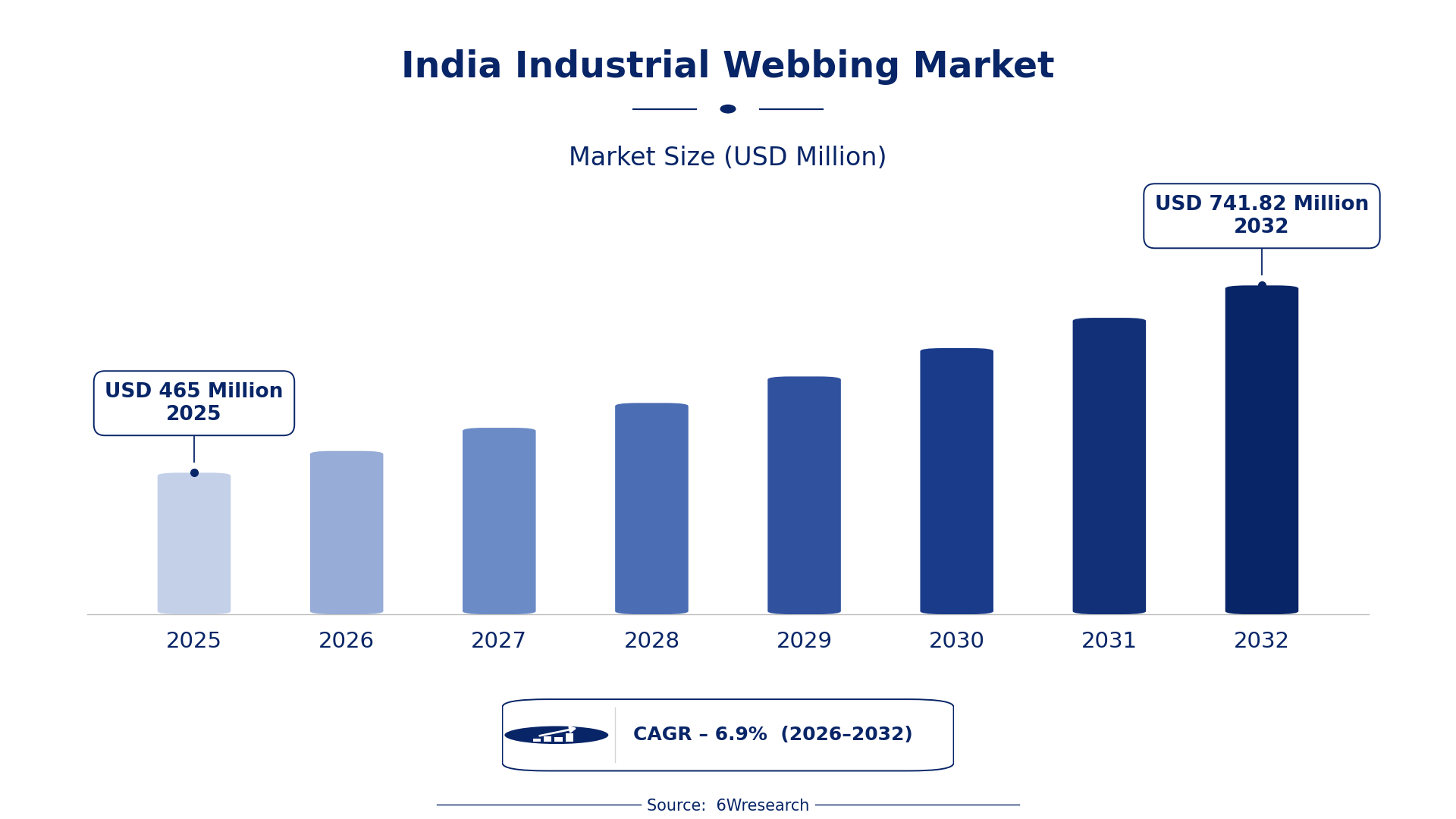
According to 6Wresearch internal database and industry insights, the India Industrial Webbing Market was valued at USD 465.0 million in 2025 and is projected to reach USD 741.82 million by 2032, growing at a CAGR of approximately 6.9% during 2026–2032.
India Industrial Webbing Market Highlights
| Report Metric | Details |
| Report Name | India Industrial Webbing Market |
| Market Size 2025 | USD 465.0 million |
| Market Size 2032 | USD 741.82 million |
| Absolute Growth 2025–2032 | USD 276.82 million |
| CAGR 2026–2032 | 6.9% |
| Peak Annual Growth | 9.1% in 2026 |
| Forecast Period | 2026–2032 |
| Historical Data | 2022–2025 |
| Base Year | 2025 |
| Leading Industrial Webbing, 2025 | Polyester Webbing (41% share) |
| Leading Material Type, 2025 | Polyester (41% share) |
| Leading Weaving Pattern, 2025 | Plain Weave (39% share) |
| Leading End Use Product, 2025 | Seat Belts (49% share) |
| Leading Distribution Channel, 2025 | OEM Supplies (38% share) |
| Fastest-Growing Industrial Webbing | Nylon Webbing (8.1% CAGR) |
| Fastest-Growing Material Type | Nylon (8.8% CAGR) |
| Fastest-Growing Weaving Pattern | Twill Weave (9.0% CAGR) |
| Fastest-Growing End Use Product | Harnesses (8.4% CAGR) |
| Fastest-Growing Distribution Channel | Industrial Distributors (9.6% CAGR) |
| Growing Sector | Industrial Distributors |
| Key End Users | OEM Supplies, Industrial Distributors, Government Tenders, Online B2B Platforms |
India Industrial Webbing Market Year-wise Growth Rate and Key Drivers (2022–2032)
This graph illustrates the annual growth rates of the market from 2022 to 2032, highlighting a steady upward trajectory and projected market expansion over the forecast period.
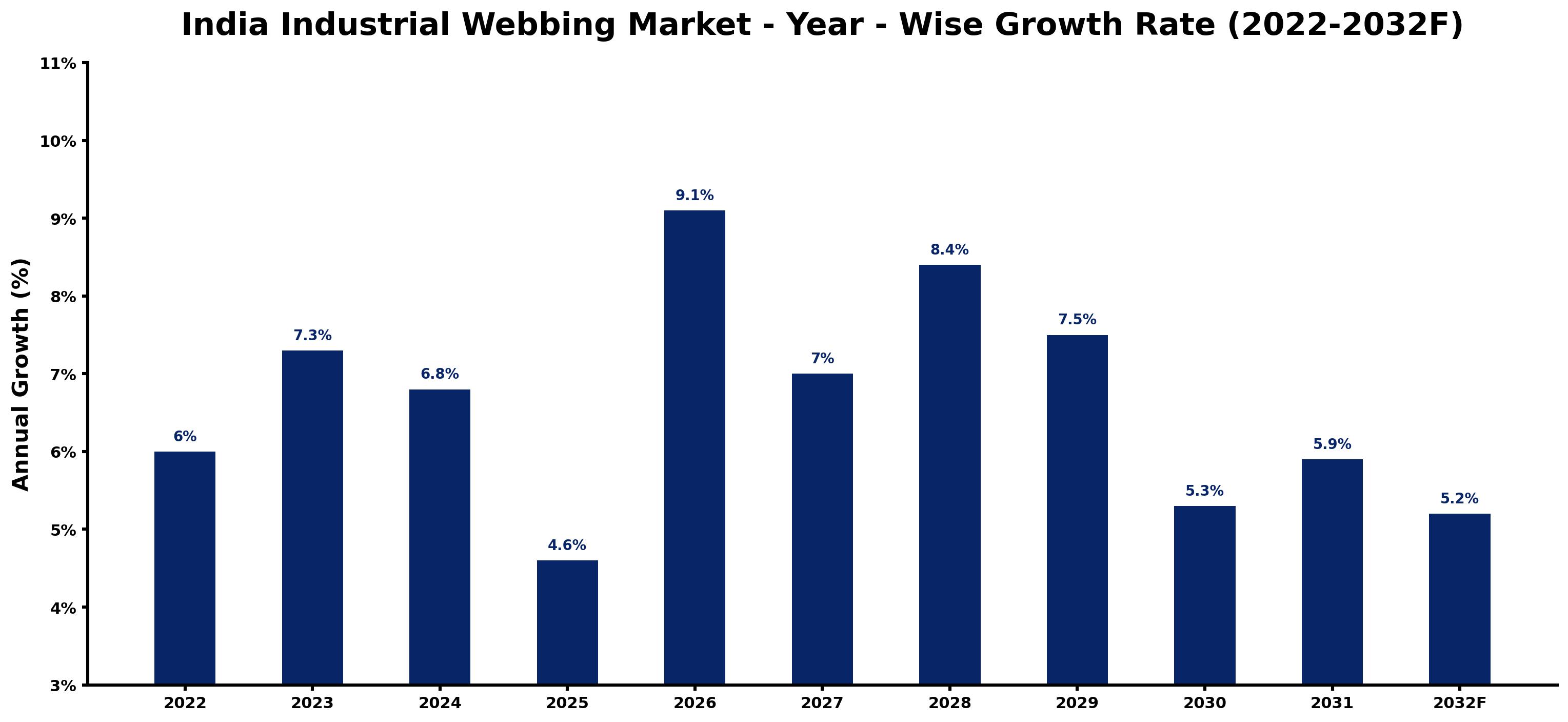
The table below sets out the estimated growth rate for each year and the main factor behind it.
| Year | Estimated Annual Growth (%) | Market Rationale |
| 2022 | 6.0 | The market showed steady growth due to increasing demand from the automotive sector. |
| 2023 | 7.3 | Growth accelerated as the automotive industry expanded, boosting demand for seat belts. |
| 2024 | 6.8 | Demand growth slowed as manufacturers adjusted to supply chain challenges. |
| 2025 | 4.6 | A further slowdown occurred as market saturation in some segments became evident. |
| 2026 | 9.1 | Growth surged again due to rising safety regulations and increased production capacity. |
| 2027 | 7.0 | Demand growth decelerated as competition intensified among suppliers. |
| 2028 | 8.4 | A rebound in growth occurred as new applications for webbing emerged. |
| 2029 | 7.5 | Growth slowed again as the market began to stabilise after rapid expansion. |
| 2030 | 5.3 | Demand continued to slow as economic factors influenced purchasing decisions. |
| 2031 | 5.9 | A slight increase in growth was noted as safety standards became more stringent. |
| 2032 | 5.2 | The market is expected to grow at a slower rate as it matures. |
Note: Market size estimations and growth projections presented in this report are based on 6Wresearch's proprietary forecasting methodology, utilizing the latest available industry data, government publications, and primary research inputs.
India Industrial Webbing Market Synopsis
Industrial Webbing in India includes robust, woven fabrics crafted from materials like polyester and nylon, designed for various applications such as safety harnesses and seat belts. The market is growing, propelled by a population surpassing 1.4 billion and heightened demand from the automotive industry. The 'Make in India' initiative and the National Textile Policy play crucial roles in this growth, promoting domestic manufacturing and advancements in technical textiles. As safety standards become stricter, the need for high-quality industrial webbing is set to increase, especially from the automotive and defence sectors.
Market Dynamics Impact Analysis (2026–2032)
| Factor | Type | Impact | Primary Segment Affected |
| Increasing automotive production and safety regulations drive demand for seat belts and harnesses. | Driver | High | Seat Belts |
| Growing focus on safety in public transportation increases government tenders for safety equipment. | Driver | High | Government Tenders |
| The rise of online B2B platforms allows easier access to industrial webbing products. | Opportunity | High | Online B2B Platforms |
| Investment in technical textiles provides a chance for manufacturers to innovate. | Opportunity | Medium | Polyester Webbing |
| Competition from low-cost imports can pressure local manufacturers' pricing. | Restraint | High | Nylon Webbing |
| Compliance with stringent safety standards can increase production costs for manufacturers. | Restraint | Medium | Harnesses |
| Buyers face challenges in sourcing high-quality materials amid fluctuating prices. | Challenge | High | Polypropylene Webbing |
| Suppliers struggle with meeting rising demand due to limited production capacity. | Challenge | Medium | Military Straps |
Evaluation of Drivers in India Industrial Webbing Market (2026–2032)
Key forces behind demand, with the segment each one moves most, are listed below.
| Drivers | Primary Segment Affected | Why It Matters (Evidence) |
| Rising automotive production increases demand for seat belts, which require durable webbing materials. | Seat Belts | This sector is projected to account for 49% of the market by 2025, driving demand for high-quality webbing. |
| Government initiatives promote local manufacturing, boosting demand for industrial webbing materials. | Nylon Webbing | The 'Make in India' initiative aims for a production increase of ₹1,500 crores, enhancing local supply chains. |
| The growth of online B2B platforms facilitates easier access to webbing products for buyers. | Online B2B Platforms | Transactions on these platforms are rising by 30% in 2023, allowing manufacturers to reach more customers. |
| Increased safety regulations in the automotive sector drive demand for compliant webbing materials. | Harnesses | The Bureau of Indian Standards' updated regulations require higher quality standards for safety equipment. |
| The rise in government tenders for safety equipment reflects a growing focus on public safety. | Military Straps | The Indian Army's requirements for high-strength materials are creating new opportunities for suppliers. |
Expansion of the Industrial Webbing market in India is backed by rising automotive production, increased safety regulations, and the growth of online B2B platforms. The automotive sector is a major consumer, with substantial demand for seat belts, projected to account for 49% of the market in 2025. Government initiatives, such as the 'Make in India' programme, promote local manufacturing, further driving demand for webbing materials. The rise of online B2B platforms has facilitated a 30% increase in transactions, allowing easier access to industrial webbing products. The National Textile Policy aims to boost production by 2025, supporting the overall market potential.
Evaluation of Restraints in India Industrial Webbing Market
The main factors holding the market back are set out below.
| Market Restraint | Primary Segment Affected | Why It Matters (Evidence) |
| Competition from low-cost imports pressures local manufacturers to lower prices. | Nylon Webbing | This competition can reduce profit margins for domestic producers, affecting sustainability and investment in quality. |
| Compliance with stringent safety standards increases production costs for manufacturers. | Harnesses | Manufacturers must invest in quality assurance to meet the Bureau of Indian Standards' requirements, raising operational costs. |
| Sourcing high-quality materials can be challenging due to fluctuating prices and availability. | Polypropylene Webbing | Buyers may face delays and increased costs when securing reliable supplies, impacting production timelines. |
| Limited production capacity can hinder suppliers from meeting rising demand effectively. | Military Straps | Manufacturers may struggle to fulfil contracts, impacting delivery timelines and customer satisfaction. |
| Market saturation in certain segments leads to slower growth rates as competition intensifies. | Seat Belts | As more players enter the market, differentiation becomes essential for maintaining market share and profitability. |
India Industrial Webbing Market Challenges
Buyers in the India industrial webbing market contend with high raw material costs, particularly for polyester and nylon, which can elevate production expenses by up to 15%. Importers face difficulties in adhering to the stringent safety standards established by the Bureau of Indian Standards, resulting in delays in product approvals that can extend timelines for distributors by several months. Producers encounter a shortage of skilled labour in textile weaving, which affects production efficiency and may decrease output by around 20%. Slow technology adoption persists, as many manufacturers lack modern weaving equipment, hindering their ability to capitalise on emerging market opportunities.
Trends in the India Industrial Webbing Market
The trends below show where the India Industrial Webbing Market is heading.
- Shift towards Online Procurement: Transactions on online B2B platforms are increasing by 30% in 2023, enabling buyers to access a broader array of products and suppliers. This shift is transforming purchasing practices in the industrial webbing market.
- Growing Demand for Safety Equipment: The automotive sector's emphasis on safety has resulted in more government tenders for safety equipment, particularly in public transportation. This change reflects a commitment to elevating safety standards across the industry.
- Innovation in Technical Textiles: The National Institute of Fashion Technology is championing innovation in textile materials, including industrial webbing. This initiative seeks to enhance the quality and functionality of webbing products, addressing evolving market demands.
- Expansion of Military Applications: The Indian Army's need for high-strength webbing materials is driving demand for specialised products. This focus on military applications is anticipated to grow, especially for military straps.
Investment Opportunities in the India Industrial Webbing Market
The following opportunities in the India Industrial Webbing Market pair current demand with a clear way in.
- Engaging Local Manufacturers: Collaborating with local manufacturers can ease entry into the Indian market for technical textiles. The 'Make in India' initiative supports such partnerships, aiming for a production increase of ₹1,500 crores.
- High-Strength Webbing Supply: There is a rising demand for high-strength webbing materials, particularly for military applications. The Indian Army's specifications for military straps offer suppliers a chance to fulfil these requirements.
- Investment in Technical Textiles: With the National Textile Policy aiming for increased production by 2025, there is a clear opportunity for investment in technical textiles. This policy seeks to strengthen domestic manufacturing capabilities.
- Safety Equipment for Public Transport: The rise in government tenders for safety equipment in public transportation reveals a market gap. Suppliers can tap into this segment by offering compliant and high-quality webbing materials.
Government Initiatives in the India Industrial Webbing Market
In 2023, the Ministry of Textiles launched the 'Technical Textiles Mission' with a budget of ₹1,500 crores to enhance the production of technical textiles, including industrial webbing. This initiative builds on the 'Make in India' programme, which has supported domestic manufacturing since 2014, aiming for self-sufficiency in the textile sector.
The Ministry of Textiles manages various schemes, including the 'Atmanirbhar Bharat' initiative, which encourages local manufacturing of safety equipment. This scheme motivates manufacturers to invest in domestic production, reducing reliance on imports and promoting growth in the industrial webbing market.
Future Insight of the India Industrial Webbing Market
Several forward-looking factors are expected to support the industrial webbing market in India in the coming years. The 'Make in India' initiative aims to strengthen domestic manufacturing capabilities, encouraging advancements in textile production. The Ministry of Textiles' subsidy scheme for technical textiles is set to stimulate growth, benefiting producers considerably. Increased government focus on safety regulations in public transportation will drive demand for compliant webbing materials, creating new opportunities for suppliers. In 2023, online B2B platforms experienced a 30% increase in transactions, facilitating greater market access for manufacturers.
Market Segmentation Analysis
The analysis below covers each segmentation, its leading category in 2025 and its fastest-growing category through 2032.
By Industrial Webbing – Polyester Webbing Dominated, Nylon Webbing Expected to Grow Fastest
According to Sachin Kumar Rai, Senior Research Analyst at 6Wresearch, Polyester Webbing took a 41% share of industrial webbing in 2025, more than any other category. Polyester webbing holds the largest share due to its widespread use in safety applications, particularly in seat belts for the automotive industry. Its compliance with established standards like IS 3521:1999 ensures reliability and builds trust among manufacturers and consumers. Over 2026–2032, Nylon Webbing is expected to post the fastest growth, at a CAGR of 8.1%. Nylon webbing is experiencing rapid growth, largely driven by its increasing adoption in outdoor gear and sports equipment. The rising popularity of adventure sports in India is significantly propelling the demand for nylon webbing products. Suppliers should focus on expanding their nylon webbing offerings to capitalise on the growing outdoor and sports markets.
By Material Type – Polyester Dominated, Nylon Expected to Grow Fastest
With a 41% revenue share in 2025, Polyester was the largest material type category. Polyester is the leading material type in the industrial webbing market, primarily due to its strength and resistance to wear and tear. Its established use in safety harnesses and seat belts solidifies its dominant market share. The quickest growth will come from Nylon, forecast to expand at a CAGR of 8.8% between 2026 and 2032. Nylon is the fastest-growing material type, driven by its elasticity and durability, making it ideal for harnesses and straps in various applications. The increasing popularity of outdoor activities further fuels this demand. Manufacturers should invest in nylon production capabilities to meet the rising market needs.
By Weaving Pattern – Plain Weave Dominated, Twill Weave Expected to Grow Fastest
Plain Weave held a 39% share of the India Industrial Webbing Market by weaving pattern in 2025. Plain weave is the most commonly used pattern in industrial webbing, providing strength and versatility for various applications. Its effectiveness in producing durable straps ensures its leading share in the market. Twill Weave is set to record the highest CAGR in this split, 9.0% over 2026–2032. Twill weave is growing rapidly due to its durability and flexibility, making it suitable for a range of applications, including safety harnesses. This pattern's adaptability to different uses is driving its increased adoption. Suppliers should consider expanding their product lines to include twill weave options to attract new customers.
By End Use Product – Seat Belts Dominated, Harnesses Expected to Grow Fastest
In 2025, Seat Belts led the end use product split with a 49% share. Seat belts are the leading end-use product in the industrial webbing market, essential for passenger safety in vehicles. Their critical role in meeting safety regulations secures a dominant market share among various applications. Harnesses are projected to grow fastest, at a CAGR of 8.4% during 2026–2032. Harnesses are the fastest-growing end-use product, particularly in industries such as construction and climbing where safety is a top priority. The increasing emphasis on safety standards in these sectors is driving the heightened demand for harnesses. Manufacturers should consider investing in innovative harness designs to meet the expanding safety requirements in various industries.
By Distribution Channel – OEM Supplies Dominated, Industrial Distributors Expected to Grow Fastest
OEM Supplies accounted for a 38% market share by distribution channel in 2025. OEM supplies dominate the distribution channel as they provide direct support to manufacturers, ensuring a steady demand for industrial webbing. This direct relationship reinforces their substantial market share across various applications. Over 2026–2032, Industrial Distributors are expected to post the fastest growth, at a CAGR of 9.6%. Industrial distributors are rapidly gaining traction as they effectively connect manufacturers with end-users in diverse industries. Their growing importance in the supply chain is a significant factor contributing to this segment's expansion. Suppliers should strengthen their collaborations with industrial distributors to enhance their market reach.
Key Attractiveness of the Report
- 10 Years of Market Numbers
- Historical Data Starting from 2022 to 2025
- Base Year 2025
- Forecast Data until 2032
- Key Performance Indicators Impacting the Market
- Major Upcoming Developments and Projects
Key Highlights of the Report:
- India Industrial Webbing Market Outlook
- Market Size of India Industrial Webbing Market, 2025
- Forecast of India Industrial Webbing Market, 2032
- Historical Data and Forecast of India Industrial Webbing Revenues & Volume for the Period 2022 - 2032F
- India Industrial Webbing Market Trend Evolution
- India Industrial Webbing Market Drivers and Challenges
- India Industrial Webbing Price Trends
- India Industrial Webbing Porter's Five Forces
- India Industrial Webbing Industry Life Cycle
- Historical Data and Forecast of India Industrial Webbing Market Revenues & Volume By Industrial Webbing for the Period 2022 - 2032F
- Historical Data and Forecast of India Industrial Webbing Market Revenues & Volume By Polyester Webbing for the Period 2022 - 2032F
- Historical Data and Forecast of India Industrial Webbing Market Revenues & Volume By Nylon Webbing for the Period 2022 - 2032F
- Historical Data and Forecast of India Industrial Webbing Market Revenues & Volume By Kevlar Webbing for the Period 2022 - 2032F
- Historical Data and Forecast of India Industrial Webbing Market Revenues & Volume By Polypropylene Webbing for the Period 2022 - 2032F
- Historical Data and Forecast of India Industrial Webbing Market Revenues & Volume By Material Type for the Period 2022 - 2032F
- Historical Data and Forecast of India Industrial Webbing Market Revenues & Volume By Polyester for the Period 2022 - 2032F
- Historical Data and Forecast of India Industrial Webbing Market Revenues & Volume By Nylon for the Period 2022 - 2032F
- Historical Data and Forecast of India Industrial Webbing Market Revenues & Volume By Aramid Fiber for the Period 2022 - 2032F
- Historical Data and Forecast of India Industrial Webbing Market Revenues & Volume By Polypropylene for the Period 2022 - 2032F
- Historical Data and Forecast of India Industrial Webbing Market Revenues & Volume By Weaving Pattern for the Period 2022 - 2032F
- Historical Data and Forecast of India Industrial Webbing Market Revenues & Volume By Plain Weave for the Period 2022 - 2032F
- Historical Data and Forecast of India Industrial Webbing Market Revenues & Volume By Twill Weave for the Period 2022 - 2032F
- Historical Data and Forecast of India Industrial Webbing Market Revenues & Volume By Basket Weave for the Period 2022 - 2032F
- Historical Data and Forecast of India Industrial Webbing Market Revenues & Volume By Satin Weave for the Period 2022 - 2032F
- Historical Data and Forecast of India Industrial Webbing Market Revenues & Volume By End Use Product for the Period 2022 - 2032F
- Historical Data and Forecast of India Industrial Webbing Market Revenues & Volume By Seat Belts for the Period 2022 - 2032F
- Historical Data and Forecast of India Industrial Webbing Market Revenues & Volume By Harnesses for the Period 2022 - 2032F
- Historical Data and Forecast of India Industrial Webbing Market Revenues & Volume By Military Straps for the Period 2022 - 2032F
- Historical Data and Forecast of India Industrial Webbing Market Revenues & Volume By Luggage Belts for the Period 2022 - 2032F
- Historical Data and Forecast of India Industrial Webbing Market Revenues & Volume By Distribution Channel for the Period 2022 - 2032F
- Historical Data and Forecast of India Industrial Webbing Market Revenues & Volume By OEM Supplies for the Period 2022 - 2032F
- Historical Data and Forecast of India Industrial Webbing Market Revenues & Volume By Industrial Distributors for the Period 2022 - 2032F
- Historical Data and Forecast of India Industrial Webbing Market Revenues & Volume By Government Tenders for the Period 2022 - 2032F
- Historical Data and Forecast of India Industrial Webbing Market Revenues & Volume By Online B2B Platforms for the Period 2022 - 2032F
- India Industrial Webbing Import Export Trade Statistics
- Market Opportunity Assessment By Industrial Webbing
- Market Opportunity Assessment By Material Type
- Market Opportunity Assessment By Weaving Pattern
- Market Opportunity Assessment By End Use Product
- Market Opportunity Assessment By Distribution Channel
- India Industrial Webbing Top Companies Market Share
- India Industrial Webbing Competitive Benchmarking By Technical and Operational Parameters
- India Industrial Webbing Company Profiles
- India Industrial Webbing Key Strategic Recommendations
Market Covered
Segments analysed in this report are listed below.
By Industrial Webbing
- Polyester Webbing
- Nylon Webbing
- Kevlar Webbing
- Polypropylene Webbing
By Material Type
- Polyester
- Nylon
- Aramid Fiber
- Polypropylene
By Weaving Pattern
- Plain Weave
- Twill Weave
- Basket Weave
- Satin Weave
By End Use Product
- Seat Belts
- Harnesses
- Military Straps
- Luggage Belts
By Distribution Channel
- OEM Supplies
- Industrial Distributors
- Government Tenders
- Online B2B Platforms































