India Infant Care Equipment Market Size & Growth Rate
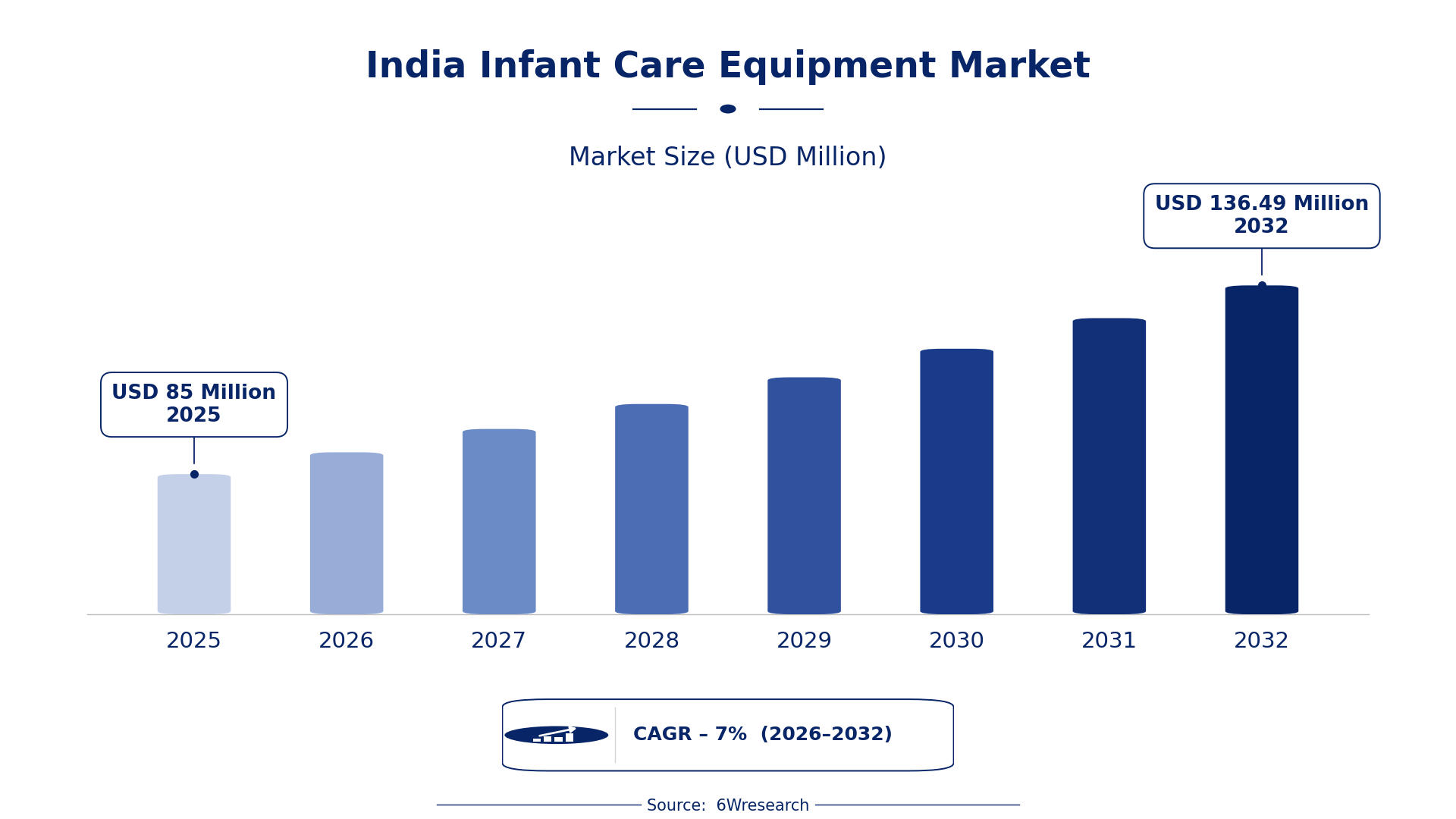
According to 6Wresearch internal database and industry insights, the India Infant Care Equipment Market was valued at USD 85.0 million in 2025 and is projected to reach USD 136.49 million by 2032, growing at a CAGR of approximately 7% during 2026–2032.
India Infant Care Equipment Market Highlights
| Report Metric | Details |
| Report Name | India Infant Care Equipment Market |
| Market Size 2025 | USD 85.0 million |
| Market Size 2032 | USD 136.49 million |
| Absolute Growth 2025–2032 | USD 51.49 million |
| CAGR 2026–2032 | 7% |
| Peak Annual Growth | 9.3% in 2028 |
| Forecast Period | 2026–2032 |
| Historical Data | 2022–2025 |
| Base Year | 2025 |
| Leading Equipment Type, 2025 | Infant Warmers (47% share) |
| Leading Application Area, 2025 | Temperature Regulation (41% share) |
| Leading End User, 2025 | Neonatal ICUs (43% share) |
| Leading Distribution Channel, 2025 | Hospital Equipment Dealers (45% share) |
| Fastest-Growing Equipment Type | Phototherapy Units (9.1% CAGR) |
| Fastest-Growing Application Area | Jaundice Treatment (8.8% CAGR) |
| Fastest-Growing End User | Pediatric Hospitals (8.2% CAGR) |
| Fastest-Growing Distribution Channel | Direct Sales (8.7% CAGR) |
| Growing Sector | Pediatric Hospitals |
| Key End Users | Neonatal ICUs, Pediatric Hospitals, Maternity Clinics, Emergency Services |
India Infant Care Equipment Market Year-wise Growth Rate and Key Drivers (2022–2032)
This graph illustrates the annual growth rates of the market from 2022 to 2032, highlighting a steady upward trajectory and projected market expansion over the forecast period.
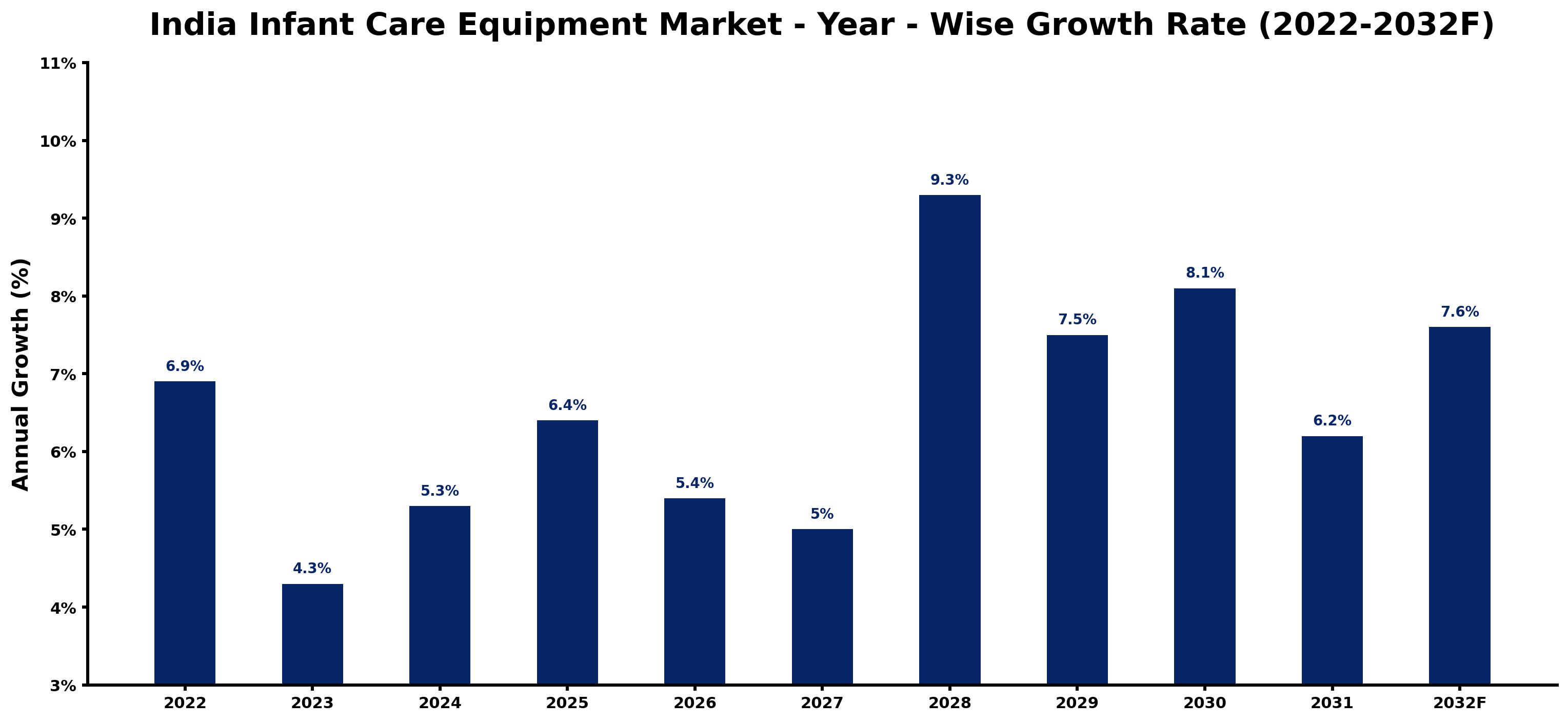
The following table presents the estimated annual growth rate for each year together with the principal factor influencing market performance.
| Year | Estimated Annual Growth (%) | Market Rationale |
| 2022 | 6.9 | Demand for infant care equipment was strong due to high birth rates and healthcare investments. |
| 2023 | 4.3 | Growth slowed as hospitals adjusted to previous years' supply increases and demand stabilised with the National Health Mission's initiatives. |
| 2024 | 5.3 | Increased adoption of advanced technologies in neonatal care drove higher demand for equipment like incubators. |
| 2025 | 6.4 | Expansion of neonatal ICUs contributed to a rise in the need for infant care devices. |
| 2026 | 5.4 | Growth is expected to slow as hospitals face challenges in budget allocations for new equipment. |
| 2027 | 5.0 | Demand is projected to continue rising, supported by ongoing healthcare initiatives and urbanisation trends. |
| 2028 | 9.3 | The market is expected to peak as new government initiatives boost funding for neonatal care equipment. |
| 2029 | 7.5 | Growth is projected to slow but remain strong due to sustained investments in healthcare infrastructure. |
| 2030 | 8.1 | Increased focus on reducing neonatal mortality rates is expected to drive further demand for equipment. |
| 2031 | 6.2 | Growth is expected to slow as market saturation begins to affect new equipment purchases. |
| 2032 | 7.6 | Demand is projected to rise as healthcare facilities continue to expand their neonatal services. |
Note: Market size estimations and growth projections presented in this report are based on 6Wresearch's proprietary forecasting methodology, utilizing the latest available industry data, government publications, and primary research inputs.
India Infant Care Equipment Market Synopsis
The India Infant Care Equipment Market encompasses devices designed to support the health of newborns, including incubators, warmers, and phototherapy units. These devices are vital for maintaining optimal body temperature and treating jaundice in vulnerable infants. The market is growing due to a high annual birth rate of approximately 25 million infants, alongside government initiatives like the National Health Mission aimed at improving maternal and child health. Increasing investments in neonatal care facilities and the expansion of pediatric hospitals are driving demand for advanced infant care equipment.
Market Dynamics Impact Analysis (2026–2032)
| Factor | Type | Impact | Primary Segment Affected |
| High birth rates and increasing healthcare investments drive demand for infant care equipment. | Driver | High | Incubators |
| Expansion of neonatal ICUs increases the need for specialized infant care devices. | Driver | High | Neonatal ICUs |
| Growing urbanisation leads to higher demand for advanced healthcare facilities. | Opportunity | Medium | Pediatric Hospitals |
| Government initiatives are promoting better neonatal care standards, creating new market opportunities. | Opportunity | High | Maternity Clinics |
| Budget constraints in hospitals limit the procurement of new equipment. | Restraint | High | Hospital Equipment Dealers |
| Market saturation in urban areas may slow down growth as demand stabilises. | Restraint | Medium | Transport Incubators |
| Healthcare providers face challenges in meeting the standards set by regulatory bodies. | Challenge | High | Phototherapy Units |
| Limited access to advanced training for neonatal care providers affects service quality. | Challenge | Medium | Emergency Services |
Evaluation of Drivers in India Infant Care Equipment Market (2026–2032)
The factors lifting demand, and the evidence behind each, are summarised below.
| Drivers | Primary Segment Affected | Why It Matters (Evidence) |
| High birth rates in India lead to increased demand for infant care equipment. | Infant Warmers | With approximately 25 million infants born annually, hospitals require more warmers to ensure infant health. |
| The expansion of neonatal ICUs is driving demand for incubators and related equipment. | Incubators | Over 800 neonatal ICUs across India necessitate a steady supply of incubators for premature infants. |
| Government initiatives like the National Health Mission are improving maternal and child health. | Phototherapy Units | Increased funding for neonatal care improves the procurement of phototherapy units for jaundice treatment. |
| Urbanisation is leading to a higher concentration of healthcare facilities in cities. | Temperature Regulation | Urban areas show a higher demand for equipment like incubators and warmers due to advanced healthcare facilities. |
| The growing population of children under five years is increasing the need for specialized care. | Neonatal ICUs | With an estimated 120 million children under five, the demand for neonatal care equipment is expected to rise. |
With approximately 25 million infants born each year, hospitals are compelled to procure more infant care devices. Urban areas are seeing a rise in advanced healthcare facilities, which leads to greater demand for phototherapy units. The substantial population of children under five years further boosts the market for infant care equipment.
Evaluation of Restraints in India Infant Care Equipment Market
The main factors holding the market back are set out below.
| Market Restraint | Primary Segment Affected | Why It Matters (Evidence) |
| Budget constraints limit the procurement of new infant care equipment in hospitals. | Hospital Equipment Dealers | Hospitals are struggling to allocate sufficient funds for purchasing advanced equipment, affecting supply. |
| Market saturation in urban areas may lead to slower growth rates as demand stabilises. | Transport Incubators | With many hospitals already equipped, new purchases may decline as facilities reach capacity. |
| Healthcare providers face challenges in meeting stringent regulatory standards for equipment. | Phototherapy Units | Compliance with standards set by the Bureau of Indian Standards can delay equipment procurement. |
| Limited access to training programs affects the quality of neonatal care. | Emergency Services | Without proper training, healthcare providers may struggle to utilise equipment effectively. |
| The reliance on traditional procurement methods may hinder the adoption of newer technologies. | Direct Sales | Healthcare facilities may be hesitant to shift from established suppliers to newer solutions. |
India Infant Care Equipment Market Challenges
The India Infant Care Equipment market faces a critical challenge with outdated technology, as many neonatal ICUs still rely on older incubators that lack essential features, delaying critical treatment for infants. Intense competition in urban areas, where the demand for incubators is highest, results in price wars that may compromise quality for hospitals and clinics. Buyers frequently encounter inconsistent availability of essential phototherapy units, disrupting neonatal services and increasing costs for healthcare providers. Regulatory compliance also poses hurdles, as government hospitals must adhere to stringent Bureau of Indian Standards, often causing procurement delays that affect patient care.
Trends in the India Infant Care Equipment Market
The trends below show where the India Infant Care Equipment Market is heading.
- Kangaroo Mother Care Initiative: In 2023, the Indian government launched the 'Kangaroo Mother Care' initiative to promote skin-to-skin contact for premature infants. This programme has a budget allocation of ₹1,500 crore, improving infant care services in hospitals.
- Shift Towards Advanced Phototherapy Units: Pediatric hospitals are increasingly adopting advanced phototherapy units for jaundice treatment. Currently, over 60% of these hospitals utilise such units, reflecting a growing trend towards improved neonatal care.
- Expansion of Neonatal ICUs: There is a significant increase in the establishment of neonatal ICUs across India. With over 800 units now operational, this trend indicates a strong commitment to enhancing infant healthcare services.
- Urbanisation Driving Demand for Equipment: Urban hospitals are expanding their neonatal services, leading to increased demand for infant care equipment. This trend is evident in metropolitan areas where healthcare facilities are upgrading their technologies.
Investment Opportunities in the India Infant Care Equipment Market
The following opportunities in the India Infant Care Equipment Market pair current demand with a clear way in.
- Investment in Pediatric Hospitals: Pediatric hospitals are expanding their services, creating opportunities for suppliers of advanced infant care equipment. The demand for such equipment is projected to rise significantly, with substantial government funding supporting these expansions.
- Partnerships with Maternity Clinics: Maternity clinics are increasingly incorporating neonatal care services, presenting opportunities for equipment suppliers. Collaborating with these clinics can facilitate market entry and expand distribution channels.
- Government Funding for Neonatal Care: The Indian government has allocated substantial funds for neonatal care initiatives, creating opportunities for equipment manufacturers. Engaging with government programmes can improve market presence and sales.
- Expansion of Online Medical Platforms: The rise of online medical platforms for purchasing infant care equipment presents a unique opportunity. Suppliers can utilise these platforms to reach a broader customer base, particularly in urban areas.
Government Initiatives in the India Infant Care Equipment Market
The Bureau of Indian Standards has established regulations for neonatal care equipment, ensuring safety and efficacy. The ISO 13485 standard, applicable to medical devices, was established to improve quality management systems in 2020. Additionally, the National Health Mission, initiated in 2013, aims to improve maternal and child health across India, further influencing the market for infant care equipment.
In 2023, the Ministry of Health launched the 'Kangaroo Mother Care' initiative, which allocates ₹1,500 crore for improving infant care in hospitals. The National Neonatology Forum of India plays a significant role in promoting best practices in neonatal care, supporting healthcare providers in meeting regulatory standards and improving service quality. These measures collectively improve the market environment for infant care equipment.
Future Insight of the India Infant Care Equipment Market
Several forward-looking factors are expected to support the India Infant Care Equipment market over the coming years. The National Health Mission's initiatives will improve access to neonatal services, driving demand for advanced equipment. By 2030, the government aims to achieve a neonatal mortality rate below 20 per 1,000 live births, prompting hospitals to invest in superior technology. The expansion of maternity clinics to include neonatal services will increase the availability of essential equipment, while ongoing training programs for neonatal care providers will enhance the quality of care delivery.
Market Segmentation Analysis
Each segment group is reviewed below, with the leader by share and the fastest grower by CAGR.
By Equipment Type – Infant Warmers Dominated, Phototherapy Units Expected to Grow Fastest
According to Shubham Deep, Research Manager at 6Wresearch, Infant Warmers held a 47% share of the India Infant Care Equipment Market by equipment type in 2025. Infant warmers hold the largest share as they are essential for maintaining the body temperature of newborns, particularly in neonatal ICUs where their presence is critical. With over 800 neonatal ICUs across India, the reliance on these devices remains consistently high. Phototherapy Units are set to record the highest CAGR in this split, 9.1% over 2026–2032. The rapid adoption of phototherapy units is driven by the increasing incidence of jaundice in newborns, with these units being implemented in over 60% of pediatric hospitals. As the market for infant warmers grows, the demand for phototherapy units will further enhance their market share. Suppliers should focus on product development to meet the rising demand for both infant warmers and phototherapy units.
By Application Area – Temperature Regulation Dominated, Jaundice Treatment Expected to Grow Fastest
The largest application area category in 2025 was Temperature Regulation, with a 41% share of total revenue. Temperature regulation leads the application area due to its vital role in ensuring the health and survival of newborns, especially in neonatal ICUs. The annual birth rate in India, approximately 25 million, significantly boosts the demand for effective temperature management solutions. Jaundice Treatment is projected to grow fastest, at a CAGR of 8.8% during 2026–2032. The increasing focus on jaundice treatment is driving the rapid growth of this application area, particularly with initiatives like the 'Kangaroo Mother Care' programme enhancing care standards. As the importance of temperature regulation remains, the gap between these two application areas is likely to narrow. Buyers should prioritise equipment that effectively addresses both temperature regulation and jaundice treatment for comprehensive neonatal care.
By End User – Neonatal ICUs Dominated, Pediatric Hospitals Expected to Grow Fastest
Neonatal ICUs took a 43% share of end user in 2025, more than any other category. Neonatal ICUs represent the largest end user segment due to their specialised focus on intensive care for newborns, with incubators being integral to over 70% of these units. This concentration of care generates substantial demand for infant care equipment. The quickest growth will come from Pediatric Hospitals, forecast to expand at a CAGR of 8.2% between 2026 and 2032. Pediatric hospitals are quickly expanding their services to include advanced neonatal care, essential for addressing the needs of a growing infant population. As neonatal ICUs continue to enhance their capabilities, the demand for equipment will further solidify their market position. Suppliers should strategically target neonatal ICUs and pediatric hospitals to align with the increasing demand for specialised infant care equipment.
By Distribution Channel – Hospital Equipment Dealers Dominated, Direct Sales Expected to Grow Fastest
In 2025, Hospital Equipment Dealers led the distribution channel split with a 45% share. Hospital equipment dealers dominate the distribution channel as they are vital in supplying necessary equipment to healthcare facilities, ensuring that neonatal ICUs and pediatric hospitals are well-equipped. Their established networks provide consistent access to essential infant care devices. Over 2026–2032, Direct Sales is expected to post the fastest growth, at a CAGR of 8.7%. Direct sales are gaining popularity as healthcare facilities seek more efficient purchasing processes, indicating a shift towards streamlined procurement methods. As hospital equipment dealers improve their offerings, competition will intensify, ultimately benefiting buyers. Suppliers should consider diversifying their distribution strategies to include direct sales, catering to changing buyer preferences.
Key Attractiveness of the Report
- 10 Years of Market Numbers
- Historical Data Starting from 2022 to 2025
- Base Year 2025
- Forecast Data until 2032
- Key Performance Indicators Impacting the Market
- Major Upcoming Developments and Projects
Key Highlights of the Report:
- India Infant Care Equipment Market Outlook
- Market Size of India Infant Care Equipment Market, 2025
- Forecast of India Infant Care Equipment Market, 2032
- Historical Data and Forecast of India Infant Care Equipment Revenues & Volume for the Period 2022 - 2032F
- India Infant Care Equipment Market Trend Evolution
- India Infant Care Equipment Market Drivers and Challenges
- India Infant Care Equipment Price Trends
- India Infant Care Equipment Porter's Five Forces
- India Infant Care Equipment Industry Life Cycle
- Historical Data and Forecast of India Infant Care Equipment Market Revenues & Volume By Equipment Type for the Period 2022 - 2032F
- Historical Data and Forecast of India Infant Care Equipment Market Revenues & Volume By Infant Warmers for the Period 2022 - 2032F
- Historical Data and Forecast of India Infant Care Equipment Market Revenues & Volume By Phototherapy Units for the Period 2022 - 2032F
- Historical Data and Forecast of India Infant Care Equipment Market Revenues & Volume By Incubators for the Period 2022 - 2032F
- Historical Data and Forecast of India Infant Care Equipment Market Revenues & Volume By Transport Incubators for the Period 2022 - 2032F
- Historical Data and Forecast of India Infant Care Equipment Market Revenues & Volume By Application Area for the Period 2022 - 2032F
- Historical Data and Forecast of India Infant Care Equipment Market Revenues & Volume By Temperature Regulation for the Period 2022 - 2032F
- Historical Data and Forecast of India Infant Care Equipment Market Revenues & Volume By Jaundice Treatment for the Period 2022 - 2032F
- Historical Data and Forecast of India Infant Care Equipment Market Revenues & Volume By Premature Infant Care for the Period 2022 - 2032F
- Historical Data and Forecast of India Infant Care Equipment Market Revenues & Volume By Mobile Infant Support for the Period 2022 - 2032F
- Historical Data and Forecast of India Infant Care Equipment Market Revenues & Volume By End User for the Period 2022 - 2032F
- Historical Data and Forecast of India Infant Care Equipment Market Revenues & Volume By Neonatal ICUs for the Period 2022 - 2032F
- Historical Data and Forecast of India Infant Care Equipment Market Revenues & Volume By Pediatric Hospitals for the Period 2022 - 2032F
- Historical Data and Forecast of India Infant Care Equipment Market Revenues & Volume By Maternity Clinics for the Period 2022 - 2032F
- Historical Data and Forecast of India Infant Care Equipment Market Revenues & Volume By Emergency Services for the Period 2022 - 2032F
- Historical Data and Forecast of India Infant Care Equipment Market Revenues & Volume By Distribution Channel for the Period 2022 - 2032F
- Historical Data and Forecast of India Infant Care Equipment Market Revenues & Volume By Hospital Equipment Dealers for the Period 2022 - 2032F
- Historical Data and Forecast of India Infant Care Equipment Market Revenues & Volume By Direct Sales for the Period 2022 - 2032F
- Historical Data and Forecast of India Infant Care Equipment Market Revenues & Volume By Online Medical Platforms for the Period 2022 - 2032F
- Historical Data and Forecast of India Infant Care Equipment Market Revenues & Volume By OEM Supply Chains for the Period 2022 - 2032F
- India Infant Care Equipment Import Export Trade Statistics
- Market Opportunity Assessment By Equipment Type
- Market Opportunity Assessment By Application Area
- Market Opportunity Assessment By End User
- Market Opportunity Assessment By Distribution Channel
- India Infant Care Equipment Top Companies Market Share
- India Infant Care Equipment Competitive Benchmarking By Technical and Operational Parameters
- India Infant Care Equipment Company Profiles
- India Infant Care Equipment Key Strategic Recommendations
Market Covered
This report examines the market across the segments below.
By Equipment Type
- Infant Warmers
- Phototherapy Units
- Incubators
- Transport Incubators
By Application Area
- Temperature Regulation
- Jaundice Treatment
- Premature Infant Care
- Mobile Infant Support
By End User
- Neonatal ICUs
- Pediatric Hospitals
- Maternity Clinics
- Emergency Services
By Distribution Channel
- Hospital Equipment Dealers
- Direct Sales
- Online Medical Platforms
- OEM Supply Chains































