India Infant Care Products Market Size & Growth Rate
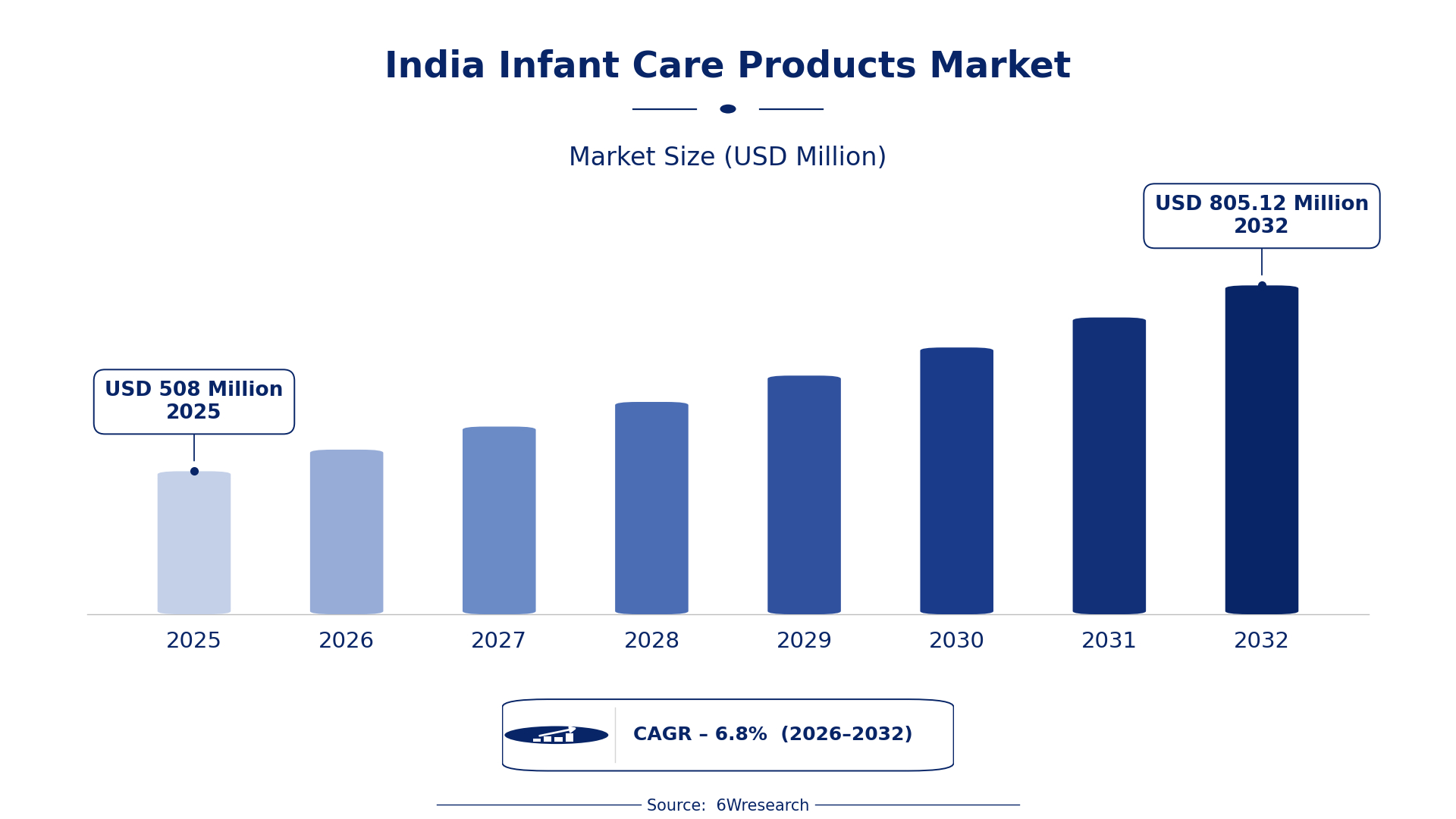
According to 6Wresearch internal database and industry insights, the India Infant Care Products Market was valued at USD 508.0 million in 2025 and is projected to reach USD 805.12 million by 2032, growing at a CAGR of approximately 6.8% during 2026–2032.
India Infant Care Products Market Highlights
| Report Metric | Details |
| Report Name | India Infant Care Products Market |
| Market Size 2025 | USD 508.0 million |
| Market Size 2032 | USD 805.12 million |
| Absolute Growth 2025–2032 | USD 297.12 million |
| CAGR 2026–2032 | 6.8% |
| Peak Annual Growth | 8.9% in 2029 |
| Forecast Period | 2026–2032 |
| Historical Data | 2022–2025 |
| Base Year | 2025 |
| Leading Product Type, 2025 | Baby Wipes (47% share) |
| Leading Use Case, 2025 | Hygiene (49% share) |
| Leading Target User, 2025 | Parents (35% share) |
| Leading Distribution Channel, 2025 | Supermarkets (38% share) |
| Fastest-Growing Product Type | Diaper Rash Creams (9.0% CAGR) |
| Fastest-Growing Use Case | Skin Care (9.0% CAGR) |
| Fastest-Growing Target User | Daycare Centers (8.1% CAGR) |
| Fastest-Growing Distribution Channel | Online Stores (8.8% CAGR) |
| Growing Sector | Online Stores |
| Key End Users | Supermarkets, Online Stores, Pharmacies, Baby Product Retailers |
India Infant Care Products Market Year-wise Growth Rate and Key Drivers (2022–2032)
This graph illustrates the annual growth rates of the market from 2022 to 2032, highlighting a steady upward trajectory and projected market expansion over the forecast period.
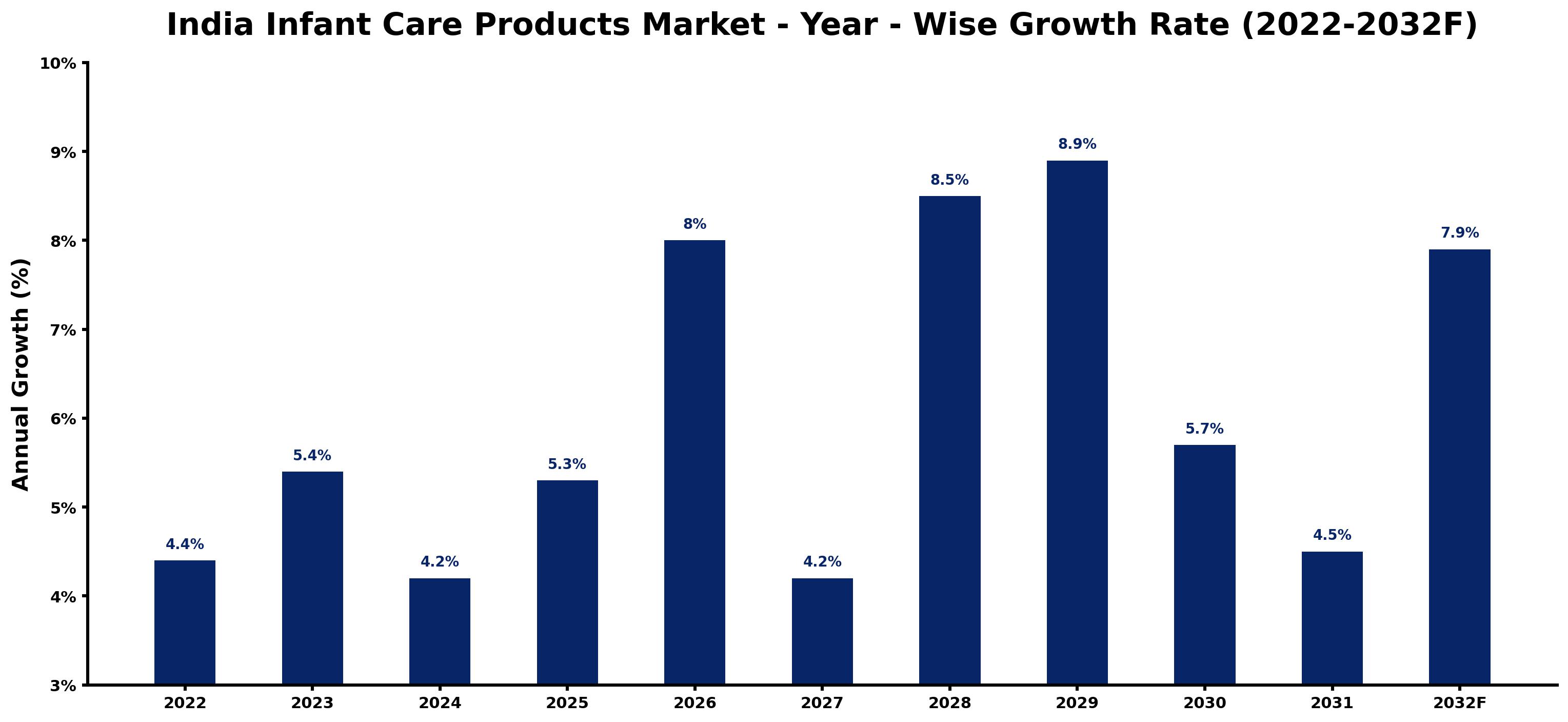
The table below sets out the estimated growth rate for each year and the main factor behind it.
| Year | Estimated Annual Growth (%) | Market Rationale |
| 2022 | 4.4 | The market experienced steady growth due to increasing awareness among parents about infant care products. |
| 2023 | 5.4 | Demand rose as parents sought safe and hypoallergenic products for their infants, influenced by the National Health Mission. |
| 2024 | 4.2 | Growth slowed as consumers became more selective about product safety and quality, particularly in urban areas. |
| 2025 | 5.3 | An uptick in purchasing occurred as supermarkets expanded their infant care product offerings, increasing accessibility. |
| 2026 | 8.0 | Demand surged with the introduction of eco-friendly products in urban daycare centers, aligning with consumer preferences. |
| 2027 | 4.2 | Growth slowed as competition intensified among manufacturers for market share in the hygiene segment. |
| 2028 | 8.5 | A rebound in growth was driven by a rise in online shopping for infant care products, especially baby wipes. |
| 2029 | 8.9 | The market peaked with heightened investment in innovative infant care solutions, particularly in skin care products. |
| 2030 | 5.7 | Growth decelerated as the market began to stabilise after rapid expansion in the previous years. |
| 2031 | 4.5 | A further slowdown occurred as product saturation became apparent in urban areas, affecting purchasing patterns. |
| 2032 | 7.9 | A resurgence in demand is anticipated as new health initiatives promote infant care, particularly in hospitals. |
Note: Market size estimations and growth projections presented in this report are based on 6Wresearch's proprietary forecasting methodology, utilizing the latest available industry data, government publications, and primary research inputs.
India Infant Care Products Market Synopsis
The India Infant Care Products Market encompasses a variety of items designed to ensure the health and well-being of infants. These products are primarily made from safe, hypoallergenic ingredients, essential for skin protection, hygiene, and comfort. The market is expected to grow due to increasing parental awareness and a rising population of approximately 1.4 billion, with a significant proportion being infants. The National Health Mission is enhancing healthcare access, further driving demand for safe infant care solutions.
Market Dynamics Impact Analysis (2026–2032)
| Factor | Type | Impact | Primary Segment Affected |
| Rising awareness about infant health and hygiene | Driver | High | Hygiene |
| Increasing demand for eco-friendly products | Driver | High | Baby Wipes |
| Growing urban population and infant demographic | Opportunity | High | Parents |
| Expansion of online retail channels | Opportunity | High | Online Stores |
| High competition among manufacturers leading to price wars | Restraint | Medium | Diaper Rash Creams |
| Concerns regarding product safety and quality standards | Restraint | High | Baby Lotions |
| Supply chain disruptions affecting product availability | Challenge | Medium | Hygiene |
| Rising production costs impacting pricing strategies | Challenge | High | Baby Wipes |
Evaluation of Drivers in India Infant Care Products Market (2026–2032)
The main growth drivers and the segments they affect most are set out below.
| Drivers | Primary Segment Affected | Why It Matters (Evidence) |
| Increased investment in eco-friendly product development | Baby Wipes | Urban daycare centers are adopting eco-friendly baby wipes, contributing to a projected market of 1.5 billion units by 2025. |
| Growing awareness of infant skin health | Diaper Rash Creams | Parents are increasingly purchasing specialized creams to treat diaper rashes, reflecting a broader trend towards targeted infant care solutions. |
| Rising disposable incomes among urban families | Hygiene | Higher disposable incomes allow parents to invest in premium hygiene products, boosting overall market demand. |
| Expansion of distribution channels in urban areas | Supermarkets | Supermarkets are increasing their product range, making infant care products more accessible to a larger consumer base. |
| Increased online shopping for convenience | Online Stores | Online retail sales of infant care products have surged by 30% in the last two years, reflecting consumer preference for convenience. |
Growth in the Infant Care Products market in India comes from increased investment in eco-friendly product development, particularly in baby wipes. Urban daycare centers are adopting these sustainable products, contributing to a projected market of 1.5 billion units by 2025. Growing awareness of infant skin health drives parents to purchase specialized diaper rash creams, reflecting a trend towards targeted care. Rising disposable incomes among urban families enable investment in premium hygiene products, boosting overall market demand. The expansion of distribution channels, especially in supermarkets, increases accessibility for consumers, while online shopping has surged by 30% over the past two years, driven by convenience preferences.
Evaluation of Restraints in India Infant Care Products Market
The main factors holding the market back are set out below.
| Market Restraint | Primary Segment Affected | Why It Matters (Evidence) |
| Supply inconsistencies for infant care products | Baby Wipes | Logistical challenges in distribution networks can lead to a 20% increase in retail prices for consumers. |
| Skills shortages among manufacturers | Diaper Rash Creams | A lack of trained personnel can lead to subpar product quality, ultimately affecting safety for infants. |
| Competition from unregulated local brands | Hygiene | This creates pricing pressure, making it difficult for compliant producers to maintain market share. |
| Lagging technology adoption | Baby Lotions | Many manufacturers do not utilise advanced production techniques, hindering efficiency and innovation. |
| Regulatory compliance challenges | Diaper Rash Creams | Navigating the updated safety standards can increase costs and delay product launches. |
India Infant Care Products Market Challenges
Parents and daycare centres in India encounter notable supply inconsistencies for infant care products, resulting in delays in availability. This challenge arises from logistical issues within distribution networks, which can inflate retail prices by 20% for consumers. A shortage of skilled workers among manufacturers complicates matters further, as insufficient training can lead to compromised product quality, directly affecting infant safety. Competition from unregulated local brands intensifies pricing pressures, making it challenging for compliant producers to maintain their market share. Outdated production techniques among many manufacturers hinder efficiency and restrict innovation in product offerings, ultimately impacting consumer choices.
Trends in the India Infant Care Products Market
Below mentioned are some of the trends shaping the India Infant Care Products Market growth.
- Shift Towards Eco-Friendly Products: Urban daycare centres in India are increasingly embracing eco-friendly infant care products, reflecting a growing consumer preference for sustainability. This trend is bolstered by the National Health Mission's initiatives, which advocate for health and safety standards.
- Growth of Online Retail Channels: The rise of online shopping for infant care products has transformed purchasing habits, with a 30% increase in sales over the last two years. This shift provides parents with greater convenience and access to a broader range of products.
- Increased Focus on Skin Health: There is a heightened emphasis on specialised infant skin care products, particularly diaper rash creams. Recommendations from the Indian Pediatric Association are encouraging parents to seek products that ensure skin health and safety.
- Expansion of Supermarkets as Distribution Channels: Supermarkets are broadening their range of infant care products, capturing a larger market share. This trend is evident as they enhance accessibility for consumers in urban areas.
Investment Opportunities in the India Infant Care Products Market
The following opportunities in the India Infant Care Products Market pair current demand with a clear way in.
- Partnerships with Daycare Centers: Collaborating with daycare centres to provide eco-friendly infant care products presents a substantial opportunity, especially in urban regions. The market for baby wipes is projected to reach 1.5 billion units by 2025.
- Investment in Online Retail Platforms: With online sales of infant care products rising by 30%, investing in e-commerce platforms is essential. Retailers can broaden their reach by partnering with local logistics providers.
- Focus on Premium Product Lines: As disposable incomes increase, there is an opportunity to develop and market premium infant care products. Parents are inclined to invest in high-quality items that ensure safety and comfort for their infants.
- Expansion into Maharashtra: Maharashtra serves as a key hub for the production of infant care products, offering opportunities for manufacturers to establish local operations. Collaborating with local suppliers can streamline distribution efficiency.
Government Initiatives in the India Infant Care Products Market
The 'National Health Mission' aims to improve healthcare services for mothers and children, launched by the Ministry of Health and Family Welfare in 2020. This initiative focuses on enhancing maternal and infant health, which directly influences the demand for infant care products. The government has set targets for increasing healthcare access, which includes promoting safe and effective infant care solutions. Additionally, the Ministry of Consumer Affairs updated safety standards for baby products in 2022, strengthening consumer protection measures for infant care products.
In 2021, the 'Beti Bachao Beti Padhao' scheme was expanded to include health education for infants, with a budget of 100 million INR allocated for awareness campaigns. The Ministry of Women and Child Development oversees this initiative, which aims to improve health outcomes for girls and infants. Furthermore, the 'Make in India' initiative encourages local production of infant care products, promoting domestic manufacturing and reducing reliance on imports. This initiative is crucial for improving the local supply chain and ensuring product availability.
Future Insight of the India Infant Care Products Market
The India infant care products market will transform by 2032, driven by increased awareness and supportive regulations. The 'National Health Mission' will improve healthcare access, leading to a heightened demand for safe infant care solutions. By 2025, the market for baby wipes will reach 1.5 billion units, reflecting a growing consumer preference for convenience. The rise of online retail, which has seen a 30% increase in sales over the last two years, will enhance market accessibility for buyers and expand their purchasing options.
Market Segmentation Analysis
Each segment group is reviewed below, with the leader by share and the fastest grower by CAGR.
By Product Type – Baby Wipes Dominated, Diaper Rash Creams Expected to Grow Fastest
According to Shubham Deep, Research Manager at 6Wresearch, with a 47% revenue share in 2025, Baby Wipes was the largest product type category. Baby Wipes command the largest market share as they are essential for hygiene during diaper changes, making them a staple in households across India. Their projected market size of 1.5 billion units by 2025 highlights their widespread adoption among parents. Diaper Rash Creams are projected to grow fastest, at a CAGR of 9.0% during 2026–2032. Diaper Rash Creams are experiencing rapid growth due to increasing parental awareness of effective treatments for diaper rashes, which is supported by recommendations from healthcare professionals. This segment's growth is likely to continue as parents prioritise skin health for their infants. Suppliers should consider expanding their product lines to include more effective diaper rash solutions to meet the rising demand.
By Use Case – Hygiene Dominated, Skin Care Expected to Grow Fastest
Hygiene took a 49% share of use case in 2025, more than any other category. Hygiene commands the largest share due to its essential role in preventing infections and ensuring infants' health. The increasing awareness among parents regarding hygiene practices has reinforced this segment's position in the market. Skin Care is set to record the highest CAGR in this split, 9.0% over 2026–2032. Skin Care is experiencing rapid growth as parents are becoming more conscious of their infants' skin health, influenced by recommendations from pediatric associations. This trend indicates a broader shift towards comprehensive infant care solutions. Suppliers should focus on developing products that address both hygiene and skin care needs to meet evolving consumer preferences.
By Target User – Parents Dominated, Daycare Centers Expected to Grow Fastest
Parents held a 35% share of the India Infant Care Products Market by target user in 2025. Parents hold the largest market share as they are the primary buyers of infant care products, motivated by their commitment to their children's well-being. Their purchasing behaviour significantly shapes the demand for various infant care solutions. The quickest growth will come from Daycare Centers, forecast to expand at a CAGR of 8.1% between 2026 and 2032. Daycare Centers are the fastest-growing user group, consistently using a diverse range of infant care products to ensure the health of multiple infants. Their increasing emphasis on eco-friendly options highlights a shift towards sustainable practices in infant care. Suppliers should tailor their offerings to cater to the specific requirements of daycare centers, especially in promoting environmentally friendly products.
By Distribution Channel – Supermarkets Dominated, Online Stores Expected to Grow Fastest
Supermarkets accounted for a 38% market share by distribution channel in 2025. Supermarkets capture the largest market share as they serve as a key distribution channel for consumers seeking convenience and variety in infant care products. Their widespread accessibility makes them a preferred shopping choice for parents. Over 2026–2032, Online Stores are expected to post the fastest growth, at a CAGR of 8.8%. Online Stores are rapidly expanding, with a 30% increase in sales over the past two years as parents increasingly prefer the convenience of online shopping. This shift signifies a notable change in consumer purchasing behaviour. Suppliers must enhance their online strategies and distribution channels to leverage the growing trend of online shopping for infant care products.
Key Attractiveness of the Report
- 10 Years of Market Numbers
- Historical Data Starting from 2022 to 2025
- Base Year 2025
- Forecast Data until 2032
- Key Performance Indicators Impacting the Market
- Major Upcoming Developments and Projects
Key Highlights of the Report:
- India Infant Care Products Market Outlook
- Market Size of India Infant Care Products Market, 2025
- Forecast of India Infant Care Products Market, 2032
- Historical Data and Forecast of India Infant Care Products Revenues & Volume for the Period 2022 - 2032F
- India Infant Care Products Market Trend Evolution
- India Infant Care Products Market Drivers and Challenges
- India Infant Care Products Price Trends
- India Infant Care Products Porter's Five Forces
- India Infant Care Products Industry Life Cycle
- Historical Data and Forecast of India Infant Care Products Market Revenues & Volume By Product Type for the Period 2022 - 2032F
- Historical Data and Forecast of India Infant Care Products Market Revenues & Volume By Baby Lotions for the Period 2022 - 2032F
- Historical Data and Forecast of India Infant Care Products Market Revenues & Volume By Baby Wipes for the Period 2022 - 2032F
- Historical Data and Forecast of India Infant Care Products Market Revenues & Volume By Talcum Powder for the Period 2022 - 2032F
- Historical Data and Forecast of India Infant Care Products Market Revenues & Volume By Diaper Rash Creams for the Period 2022 - 2032F
- Historical Data and Forecast of India Infant Care Products Market Revenues & Volume By Use Case for the Period 2022 - 2032F
- Historical Data and Forecast of India Infant Care Products Market Revenues & Volume By Skin Protection for the Period 2022 - 2032F
- Historical Data and Forecast of India Infant Care Products Market Revenues & Volume By Hygiene for the Period 2022 - 2032F
- Historical Data and Forecast of India Infant Care Products Market Revenues & Volume By Comfort for the Period 2022 - 2032F
- Historical Data and Forecast of India Infant Care Products Market Revenues & Volume By Skin Care for the Period 2022 - 2032F
- Historical Data and Forecast of India Infant Care Products Market Revenues & Volume By Target User for the Period 2022 - 2032F
- Historical Data and Forecast of India Infant Care Products Market Revenues & Volume By Parents for the Period 2022 - 2032F
- Historical Data and Forecast of India Infant Care Products Market Revenues & Volume By Daycare Centers for the Period 2022 - 2032F
- Historical Data and Forecast of India Infant Care Products Market Revenues & Volume By Home Use for the Period 2022 - 2032F
- Historical Data and Forecast of India Infant Care Products Market Revenues & Volume By Hospitals for the Period 2022 - 2032F
- Historical Data and Forecast of India Infant Care Products Market Revenues & Volume By Distribution Channel for the Period 2022 - 2032F
- Historical Data and Forecast of India Infant Care Products Market Revenues & Volume By Supermarkets for the Period 2022 - 2032F
- Historical Data and Forecast of India Infant Care Products Market Revenues & Volume By Pharmacies for the Period 2022 - 2032F
- Historical Data and Forecast of India Infant Care Products Market Revenues & Volume By Online Stores for the Period 2022 - 2032F
- Historical Data and Forecast of India Infant Care Products Market Revenues & Volume By Baby Product Retailers for the Period 2022 - 2032F
- India Infant Care Products Import Export Trade Statistics
- Market Opportunity Assessment By Product Type
- Market Opportunity Assessment By Use Case
- Market Opportunity Assessment By Target User
- Market Opportunity Assessment By Distribution Channel
- India Infant Care Products Top Companies Market Share
- India Infant Care Products Competitive Benchmarking By Technical and Operational Parameters
- India Infant Care Products Company Profiles
- India Infant Care Products Key Strategic Recommendations
Market Covered
Segments analysed in this report are listed below.
By Product Type
- Baby Lotions
- Baby Wipes
- Talcum Powder
- Diaper Rash Creams
By Use Case
- Skin Protection
- Hygiene
- Comfort
- Skin Care
By Target User
- Parents
- Daycare Centers
- Home Use
- Hospitals
By Distribution Channel
- Supermarkets
- Pharmacies
- Online Stores
- Baby Product Retailers































