India Infant Food Jar Market Size & Growth Rate
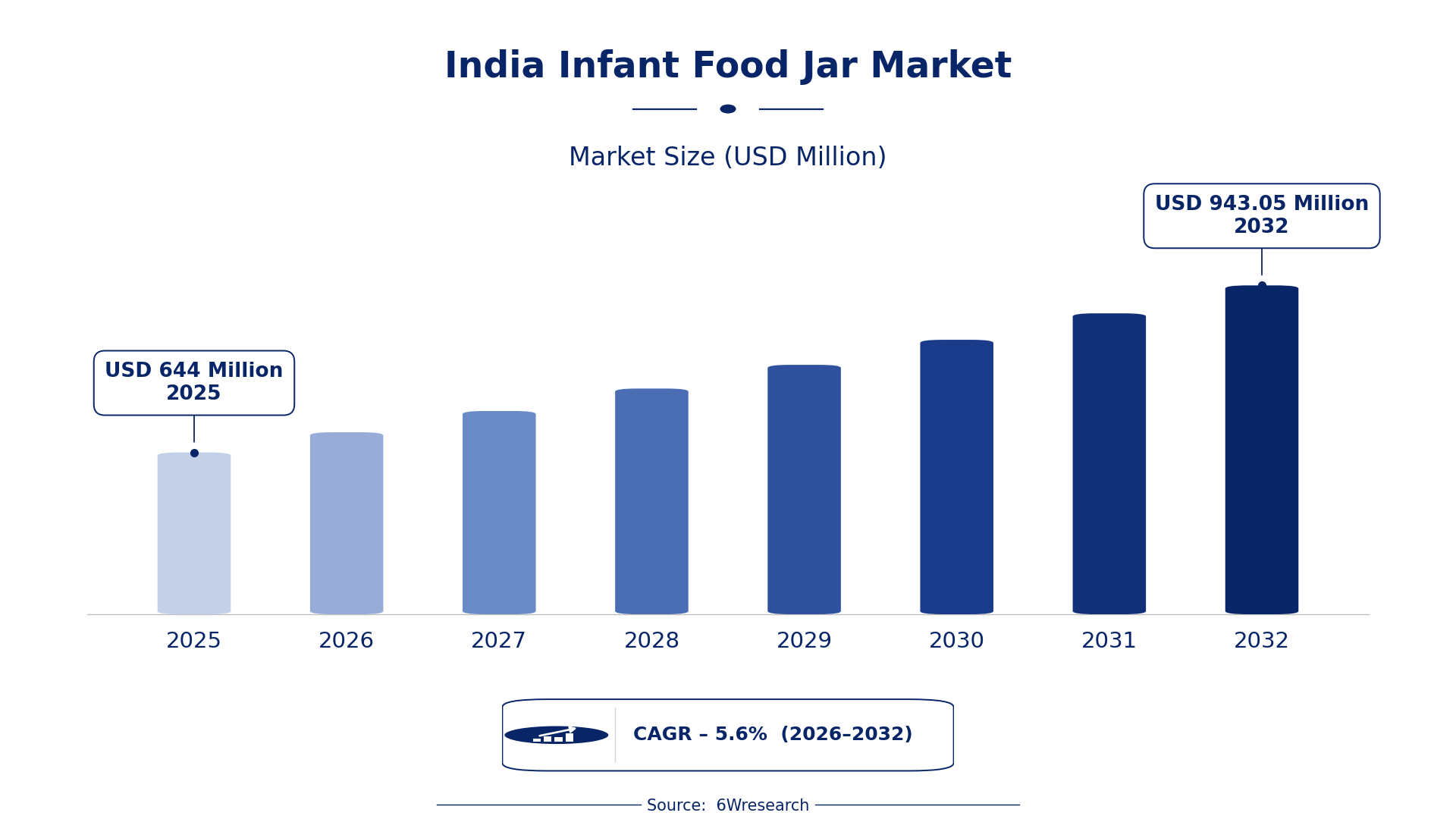
According to 6Wresearch internal database and industry insights, the India Infant Food Jar Market was valued at USD 644.0 million in 2025 and is projected to reach USD 943.05 million by 2032, growing at a CAGR of approximately 5.6% during 2026–2032.
India Infant Food Jar Market Highlights
| Report Metric | Details |
| Report Name | India Infant Food Jar Market |
| Market Size 2025 | USD 644.0 million |
| Market Size 2032 | USD 943.05 million |
| Absolute Growth 2025–2032 | USD 299.05 million |
| CAGR 2026–2032 | 5.6% |
| Peak Annual Growth | 8.2% in 2031 |
| Forecast Period | 2026–2032 |
| Historical Data | 2022–2025 |
| Base Year | 2025 |
| Leading Jar Type, 2025 | Glass Jars (36% share) |
| Leading Packaging Material, 2025 | Tempered Glass (34% share) |
| Leading Food Type, 2025 | Organic Purees (46% share) |
| Leading Distribution Channel, 2025 | Supermarkets (39% share) |
| Fastest-Growing Jar Type | Recyclable Packaging (6.8% CAGR) |
| Fastest-Growing Packaging Material | Eco-Friendly (8.1% CAGR) |
| Fastest-Growing Distribution Channel | E-commerce Channels (8.0% CAGR) |
| Growing Sector | baby food products |
| Key End Users | health-conscious parents, supermarkets, health food retailers, e-commerce platforms |
India Infant Food Jar Market Year-wise Growth Rate and Key Drivers (2022–2032)
This graph illustrates the annual growth rates of the market from 2022 to 2032, highlighting a steady upward trajectory and projected market expansion over the forecast period.
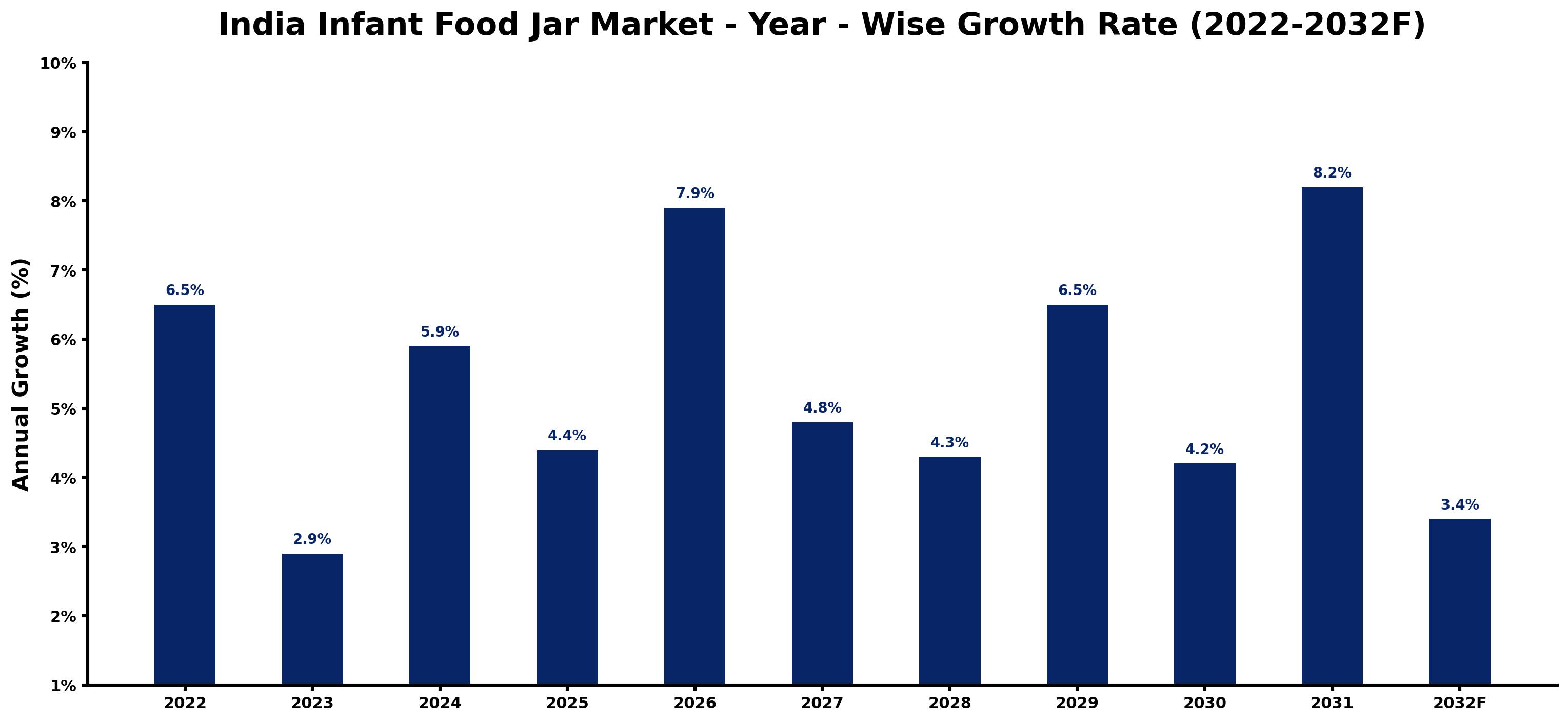
Below, each year's estimated growth is shown next to the factor that most influenced it.
| Year | Estimated Annual Growth (%) | Market Rationale |
| 2022 | 6.5 | The market experienced a solid demand due to health-conscious parents prioritising safe packaging. |
| 2023 | 2.9 | Growth slowed as consumers became more selective about organic product offerings. |
| 2024 | 5.9 | Increased awareness of nutritional benefits spurred demand for organic baby food. |
| 2025 | 4.4 | Market growth slowed as competition intensified among baby food brands. |
| 2026 | 7.9 | Rising demand for BPA-free packaging positively impacted market growth. |
| 2027 | 4.8 | The market saw a slowdown as consumers adjusted to new product standards. |
| 2028 | 4.3 | Demand for convenient packaging remained steady, but growth slowed slightly. |
| 2029 | 6.5 | Health-conscious parents drove demand for organic purees, boosting market growth. |
| 2030 | 4.2 | Growth slowed as market saturation began to affect new product introductions. |
| 2031 | 8.2 | The market peaked as innovative packaging solutions attracted more buyers. |
| 2032 | 3.4 | Growth slowed as the market stabilised after reaching a peak in 2031. |
Note: Market size estimations and growth projections presented in this report are based on 6Wresearch's proprietary forecasting methodology, utilizing the latest available industry data, government publications, and primary research inputs.
India Infant Food Jar Market Synopsis
India Infant Food Jar Market encompasses packaging solutions for baby food, primarily made from glass or plastic. These jars preserve nutritional value while ensuring safety for infants. The market is expanding as health-conscious parents increasingly prefer BPA-free options. Approximately 25 million infants in India drive demand for nutritious baby food products. The growing trend towards organic purees, supported by initiatives like 'Nutrition for All', further fuels market growth.
Market Dynamics Impact Analysis (2026–2032)
| Factor | Type | Impact | Primary Segment Affected |
| Increasing demand for BPA-free packaging | Driver | High | BPA-Free |
| Growing preference for organic baby food | Driver | High | Glass Jars |
| Rising trend towards eco-friendly packaging solutions | Opportunity | Medium | Eco-Friendly |
| Expansion of e-commerce channels for baby food products | Opportunity | High | E-commerce Channels |
| Intense competition among baby food brands | Restraint | High | Baby Food Brands |
| Regulatory compliance costs for packaging materials | Restraint | Medium | Glass Jars |
| Supply chain disruptions affecting product availability | Challenge | High | Glass Jars |
| Rising costs of raw materials impacting pricing | Challenge | Medium | Glass Jars |
Evaluation of Drivers in India Infant Food Jar Market (2026–2032)
Below mentioned are some major drivers and their influence on market dynamics.
| Drivers | Primary Segment Affected | Why It Matters (Evidence) |
| Health-conscious parents prefer BPA-free packaging | BPA-Free | This trend drives demand for safer packaging options, with 60% of parents prioritising BPA-free jars. |
| Increasing awareness of organic baby food benefits | Organic Purees | The demand for organic purees is growing at a 15% annual rate, appealing to health-focused consumers. |
| E-commerce sales of baby food products are rising | E-commerce Channels | E-commerce channels have seen a 30% increase in sales, catering to busy parents seeking convenience. |
| Popularity of tempered glass jars for safety | Tempered Glass | Tempered glass jars hold a 34% market share, preferred for their durability and safety features. |
| Single-serve packs cater to convenience needs | Single-Serve Packs | These packs are increasingly popular among parents, offering ready-to-use solutions for on-the-go feeding. |
The Infant Food Jar market in India is expanding as health-conscious parents increasingly prefer BPA-free packaging and organic baby food options. Approximately 60% of parents prioritise BPA-free jars, driving demand for safer packaging solutions. The demand for organic purees is growing at a 15% annual rate, appealing to health-focused consumers. E-commerce channels have seen a 30% increase in sales, catering to busy parents seeking convenience. The popularity of single-serve packs is rising, offering ready-to-use solutions that align with the needs of modern families.
Evaluation of Restraints in India Infant Food Jar Market
The table below lists the restraints and the evidence behind each.
| Market Restraint | Primary Segment Affected | Why It Matters (Evidence) |
| Intense competition among baby food brands | Baby Food Brands | This competition leads to price wars, affecting profitability for producers and limiting innovation. |
| Regulatory compliance costs for packaging materials | BPA-Free | Producers face increased costs to meet new BPA-free regulations, impacting pricing strategies. |
| Supply chain disruptions affecting product availability | Glass Jars | Disruptions in logistics can delay product deliveries, impacting sales for retailers and brands. |
| Rising costs of raw materials impacting pricing | Glass Jars | Increased prices for glass and plastic materials can lead to higher retail prices for consumers. |
| Consumer preference shifts towards organic options | Organic Purees | As health trends evolve, brands must adapt, which can strain resources and slow product development. |
India Infant Food Jar Market Challenges
Health-conscious parents in the India Infant Food Jar market face technological challenges, as many manufacturers still rely on outdated machinery that can delay production by 20%. Supply chain issues stem from inadequate infrastructure, causing costs to rise for producers and increasing retail prices by INR 5 per jar. Buyers encounter confusion due to unclear labelling on infant food jars, leading to potential safety risks and mistrust in products. A shortage of skilled workers limits innovation, restricting producers' ability to diversify offerings, which ultimately reduces choices for parents in a competitive market.
Trends in the India Infant Food Jar Market
The trends below show where the India Infant Food Jar Market is heading.
- Shift towards Eco-Friendly Packaging Solutions: India is experiencing a shift towards eco-friendly packaging, with rising demand for recyclable materials. In 2023, eco-friendly packaging options are expected to grow at an 8.1% CAGR, appealing to environmentally conscious parents.
- Transition from Glass to Plastic Jars: The market is shifting from glass to plastic jars, driven by the convenience of lightweight packaging. Plastic jars are gaining popularity, with a notable increase in sales due to their portability for on-the-go feeding.
- E-commerce Channels Gaining Prominence: E-commerce channels are becoming increasingly vital for baby food distribution, with a 30% increase in sales last year. This trend reflects changing consumer habits as parents seek convenience and variety in their purchasing options.
- Health-Conscious Parents Prioritising Organic Options: Health-conscious parents are placing greater importance on organic options for their infants, with organic purees leading the market. The demand for organic baby food is growing at a 15% annual rate, indicating a shift in consumer preferences.
Investment Opportunities in the India Infant Food Jar Market
Below are the investment opportunities with the strongest case in the India Infant Food Jar Market.
- Rising Demand for Organic Baby Food: With the demand for organic baby food increasing, suppliers can focus on organic purees. Health food retailers are expanding their offerings, creating a market opportunity worth capitalising on.
- Growth of E-commerce Channels: E-commerce channels are rapidly expanding, with a 30% increase in sales last year. Suppliers should consider partnerships with online retailers to tap into this growing market segment.
- Investment in Eco-Friendly Packaging Solutions: The shift towards eco-friendly packaging solutions presents an opportunity for suppliers to invest in recyclable materials. Health-conscious parents are driving this trend, particularly in urban areas.
- Focus on Single-Serve Packs: The increasing preference for convenience among parents creates an opportunity for suppliers to focus on single-serve packs. This segment is gaining traction, appealing to busy families seeking easy feeding solutions.
Government Initiatives in the India Infant Food Jar Market
In 2022, the Food Safety and Standards Authority of India updated regulations to mandate BPA-free packaging for all baby food products. This measure improves consumer safety and aligns with the growing preference for health-conscious packaging. Additionally, the 'Nutrition for All' initiative launched in 2021 aims to improve infant nutrition across India, targeting 10 million children and ensuring access to safe baby food products.
The National Health Mission oversees the implementation of nutrition programs, with a budget of INR 500 crore allocated in 2022. This funding supports initiatives that promote healthy eating habits among infants. The Ministry of Women and Child Development's 'Poshan Abhiyan' targets malnutrition among children under six years, ensuring that health standards are met for baby food products.
Future Insight of the India Infant Food Jar Market
The India Infant Food Jar market will experience notable changes by 2032, driven by several forward-looking factors. The 'Nutrition for All' program will boost the demand for safe packaging solutions, while e-commerce growth is anticipated to increase sales by 30%. New food labelling regulations will enhance transparency, benefiting health-conscious parents seeking reliable information. The rising preference for lightweight jars will compel producers to adjust their strategies, ensuring they meet the specific needs of buyers prioritising convenience and safety.
Market Segmentation Analysis
Each segment group is reviewed below, with the leader by share and the fastest grower by CAGR.
By Jar Type – Glass Jars Dominated, Recyclable Packaging Expected to Grow Fastest
According to Shubham Deep, Research Manager at 6Wresearch, Glass Jars held a 36% share of the India Infant Food Jar Market by jar type in 2025. Glass jars dominate the market share as they are the preferred choice for premium baby food products, appealing to health-conscious parents. Their safety and preservation qualities make them particularly popular in urban areas, where the demand for high-quality infant food is robust. Recyclable Packaging is set to record the highest CAGR in this split, 6.8% over 2026–2032. Recyclable packaging is experiencing rapid growth as sustainability becomes a priority for consumers, with increasing awareness of environmental impacts. This trend is reflected in the rising preference for eco-friendly options among parents who seek safe and responsible packaging for their infants' food. Suppliers should prioritise the development of sustainable packaging solutions to meet the growing demand for environmentally friendly products.
By Packaging Material – Tempered Glass Dominated, Eco-Friendly Expected to Grow Fastest
With a 34% revenue share in 2025, Tempered Glass was the largest packaging material category. Tempered glass holds the largest market share due to its durability and safety features, making it the preferred choice for parents concerned about their infants' health. This material's ability to preserve the nutritional value of food further solidifies its position among discerning buyers. Over 2026–2032, Eco-Friendly is expected to post the fastest growth, at a CAGR of 8.1%. Eco-friendly packaging is rapidly gaining traction, driven by the increasing consumer demand for sustainable products. This shift is evident as more health-conscious parents opt for packaging that aligns with their values regarding the environment and infant nutrition. Manufacturers need to invest in eco-friendly materials to attract environmentally conscious consumers.
By Food Type – Organic Purees Dominated and Is Expected to Record the Fastest Growth
The largest food type category in 2025 was Organic Purees, with a 46% share of total revenue. Organic purees lead the market share as they are a popular choice among health-conscious parents seeking nutritious options for their infants. The increasing awareness of the benefits of organic food contributes to their strong position in the market. Its lead should widen, with a projected CAGR of 7.4% during 2026–2032, the highest in this split. Organic purees are also the fastest-growing segment, benefiting from the same health trends that boost their market share. As parents continue to prioritise organic options, this segment's growth is likely to accelerate further, reinforcing its market leadership. Suppliers should expand their organic offerings to capitalise on the growing demand for healthy infant food choices.
By Distribution Channel – Supermarkets Dominated, E-commerce Channels Expected to Grow Fastest
Supermarkets took a 39% share of distribution channel in 2025, more than any other category. Supermarkets represent the largest share of the distribution channel, serving as the primary outlet for baby food products in urban areas. Their extensive reach and convenience make them the preferred choice for parents purchasing infant food jars. E-commerce Channels are projected to grow fastest, at a CAGR of 8.0% during 2026–2032. E-commerce channels are the fastest-growing distribution method, with a 30% increase in sales reflecting the shift towards online shopping for convenience and variety. This trend indicates a significant change in consumer behaviour, particularly among tech-savvy parents. Retailers must enhance their online presence to capture the growing segment of consumers preferring e-commerce for purchasing baby food products.
Key Attractiveness of the Report
- 10 Years of Market Numbers
- Historical Data Starting from 2022 to 2025
- Base Year 2025
- Forecast Data until 2032
- Key Performance Indicators Impacting the Market
- Major Upcoming Developments and Projects
Key Highlights of the Report:
- India Infant Food Jar Market Outlook
- Market Size of India Infant Food Jar Market, 2025
- Forecast of India Infant Food Jar Market, 2032
- Historical Data and Forecast of India Infant Food Jar Revenues & Volume for the Period 2022 - 2032F
- India Infant Food Jar Market Trend Evolution
- India Infant Food Jar Market Drivers and Challenges
- India Infant Food Jar Price Trends
- India Infant Food Jar Porter's Five Forces
- India Infant Food Jar Industry Life Cycle
- Historical Data and Forecast of India Infant Food Jar Market Revenues & Volume By Jar Type for the Period 2022 - 2032F
- Historical Data and Forecast of India Infant Food Jar Market Revenues & Volume By Glass Jars for the Period 2022 - 2032F
- Historical Data and Forecast of India Infant Food Jar Market Revenues & Volume By Plastic Jars for the Period 2022 - 2032F
- Historical Data and Forecast of India Infant Food Jar Market Revenues & Volume By Recyclable Packaging for the Period 2022 - 2032F
- Historical Data and Forecast of India Infant Food Jar Market Revenues & Volume By Single-Serve Packs for the Period 2022 - 2032F
- Historical Data and Forecast of India Infant Food Jar Market Revenues & Volume By Packaging Material for the Period 2022 - 2032F
- Historical Data and Forecast of India Infant Food Jar Market Revenues & Volume By Tempered Glass for the Period 2022 - 2032F
- Historical Data and Forecast of India Infant Food Jar Market Revenues & Volume By BPA-Free for the Period 2022 - 2032F
- Historical Data and Forecast of India Infant Food Jar Market Revenues & Volume By Eco-Friendly for the Period 2022 - 2032F
- Historical Data and Forecast of India Infant Food Jar Market Revenues & Volume By Convenience Focused for the Period 2022 - 2032F
- Historical Data and Forecast of India Infant Food Jar Market Revenues & Volume By Food Type for the Period 2022 - 2032F
- Historical Data and Forecast of India Infant Food Jar Market Revenues & Volume By Organic Purees for the Period 2022 - 2032F
- Historical Data and Forecast of India Infant Food Jar Market Revenues & Volume By Fruit Blends for the Period 2022 - 2032F
- Historical Data and Forecast of India Infant Food Jar Market Revenues & Volume By Vegetable Mixes for the Period 2022 - 2032F
- Historical Data and Forecast of India Infant Food Jar Market Revenues & Volume By Complete Meals for the Period 2022 - 2032F
- Historical Data and Forecast of India Infant Food Jar Market Revenues & Volume By Distribution Channel for the Period 2022 - 2032F
- Historical Data and Forecast of India Infant Food Jar Market Revenues & Volume By Supermarkets for the Period 2022 - 2032F
- Historical Data and Forecast of India Infant Food Jar Market Revenues & Volume By Baby Food Brands for the Period 2022 - 2032F
- Historical Data and Forecast of India Infant Food Jar Market Revenues & Volume By Health Food Retailers for the Period 2022 - 2032F
- Historical Data and Forecast of India Infant Food Jar Market Revenues & Volume By E-commerce Channels for the Period 2022 - 2032F
- India Infant Food Jar Import Export Trade Statistics
- Market Opportunity Assessment By Jar Type
- Market Opportunity Assessment By Packaging Material
- Market Opportunity Assessment By Food Type
- Market Opportunity Assessment By Distribution Channel
- India Infant Food Jar Top Companies Market Share
- India Infant Food Jar Competitive Benchmarking By Technical and Operational Parameters
- India Infant Food Jar Company Profiles
- India Infant Food Jar Key Strategic Recommendations
Market Covered
Segments analysed in this report are listed below.
By Jar Type
- Glass Jars
- Plastic Jars
- Recyclable Packaging
- Single-Serve Packs
By Packaging Material
- Tempered Glass
- BPA-Free
- Eco-Friendly
- Convenience Focused
By Food Type
- Organic Purees
- Fruit Blends
- Vegetable Mixes
- Complete Meals
By Distribution Channel
- Supermarkets
- Baby Food Brands
- Health Food Retailers
- E-commerce Channels































