India Infant Product Packaging Market Size & Growth Rate
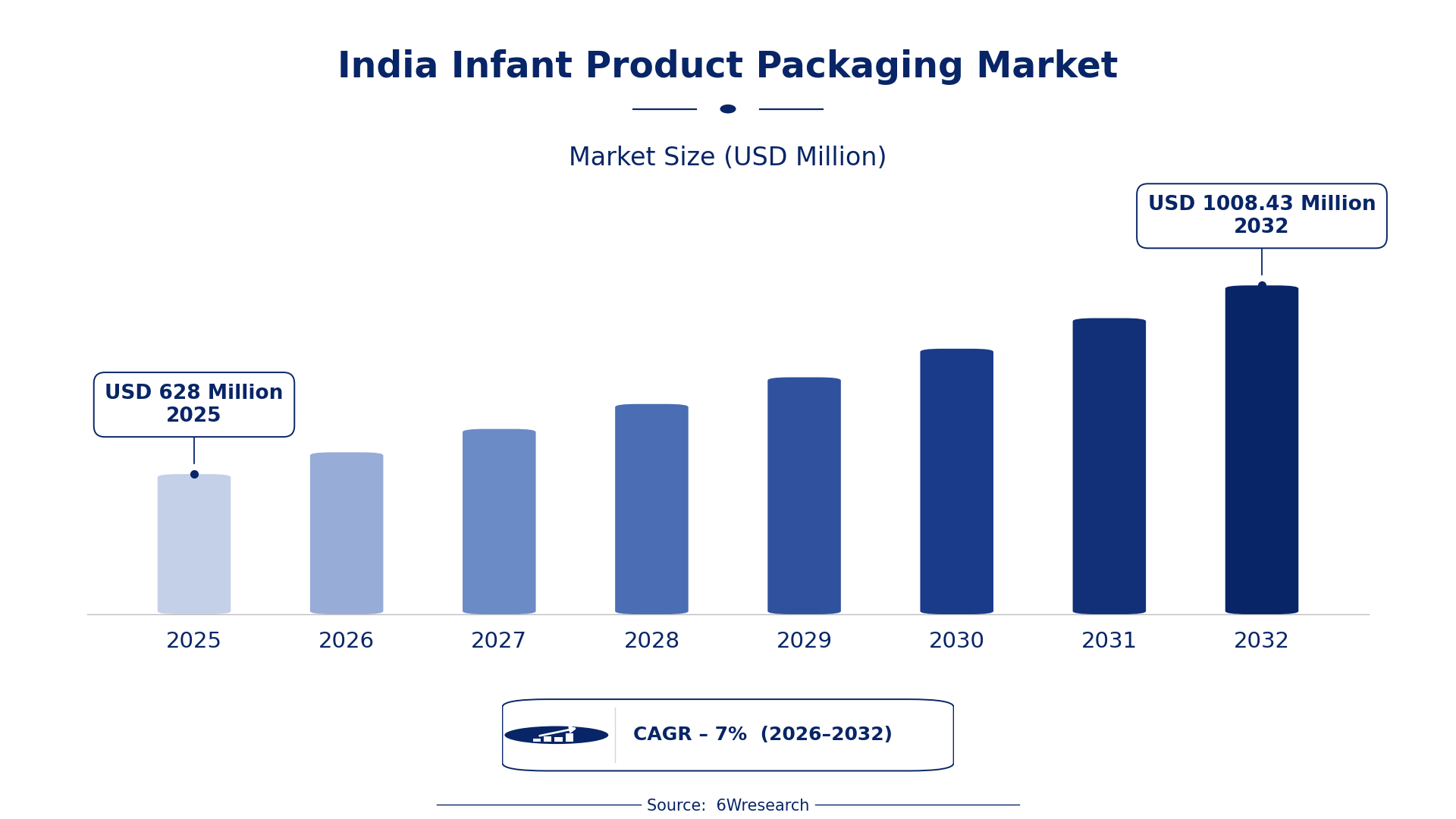
According to 6Wresearch internal database and industry insights, the India Infant Product Packaging Market was valued at USD 628.0 million in 2025 and is projected to reach USD 1,008.43 million by 2032, growing at a CAGR of approximately 7% during 2026–2032.
India Infant Product Packaging Market Highlights
| Report Metric | Details |
| Report Name | India Infant Product Packaging Market |
| Market Size 2025 | USD 628.0 million |
| Market Size 2032 | USD 1,008.43 million |
| Absolute Growth 2025–2032 | USD 380.43 million |
| CAGR 2026–2032 | 7% |
| Peak Annual Growth | 9.5% in 2031 |
| Forecast Period | 2026–2032 |
| Historical Data | 2022–2025 |
| Base Year | 2025 |
| Leading Infant Product Packaging, 2025 | Bottles & Jars (37% share) |
| Leading Packaging Type, 2025 | Resealable Caps (45% share) |
| Leading Material Used, 2025 | BPA-Free Plastic (40% share) |
| Leading Safety Feature, 2025 | Tamper-Proof Seal (42% share) |
| Leading End Use Product, 2025 | Baby Food (37% share) |
| Fastest-Growing Infant Product Packaging | Sachets & Pouches (8.3% CAGR) |
| Fastest-Growing Packaging Type | Single-use (9.3% CAGR) |
| Fastest-Growing Material Used | Food-Grade Foil (9.1% CAGR) |
| Fastest-Growing Safety Feature | Spill-Free Spouts (9.6% CAGR) |
| Fastest-Growing End Use Product | Nutraceuticals (9.3% CAGR) |
| Growing Sector | Baby Food |
| Key End Users | Manufacturers, Retailers, Health-focused brands |
India Infant Product Packaging Market Year-wise Growth Rate and Key Drivers (2022–2032)
This graph illustrates the annual growth rates of the market from 2022 to 2032, highlighting a steady upward trajectory and projected market expansion over the forecast period.
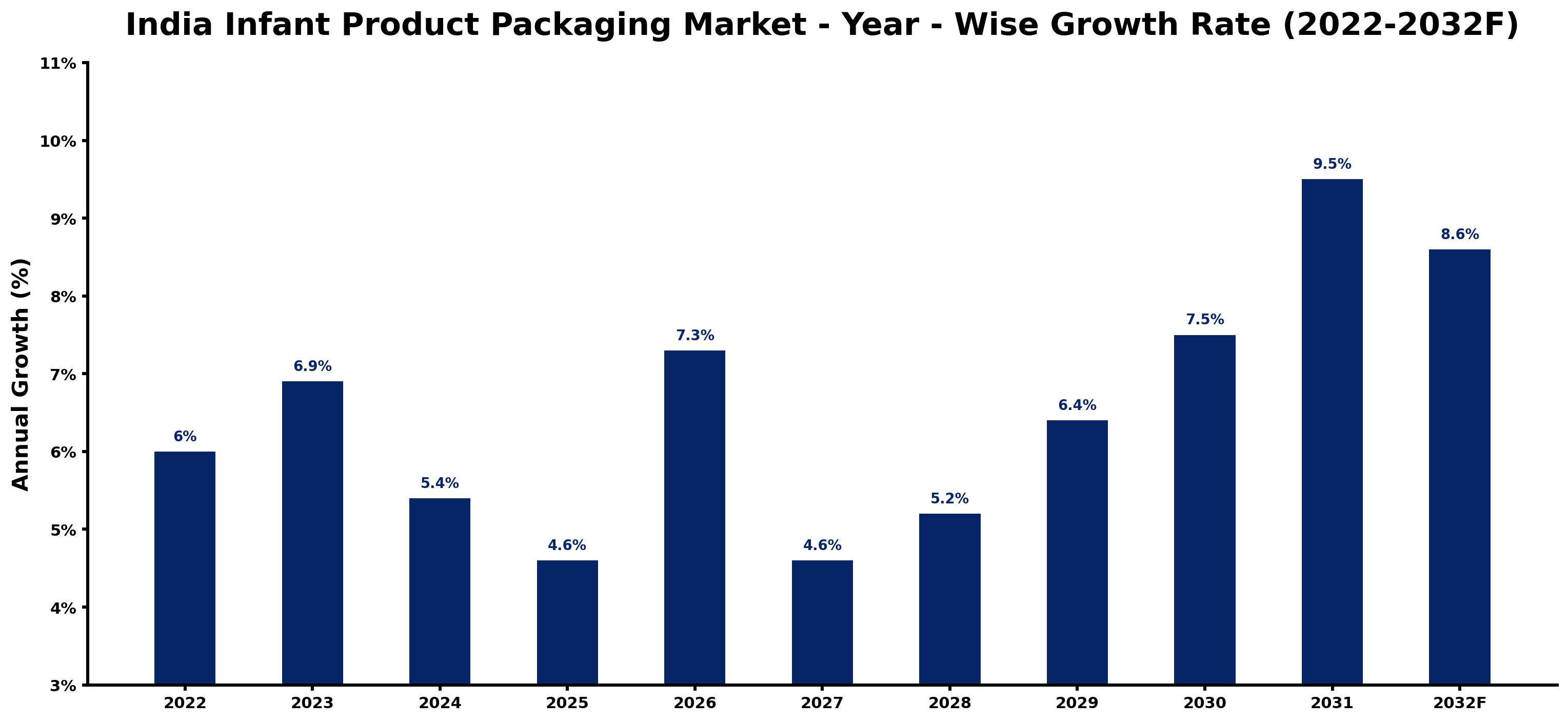
The table below sets out the estimated growth rate for each year and the main factor behind it.
| Year | Estimated Annual Growth (%) | Market Rationale |
| 2022 | 6.0 | The market saw steady demand from local manufacturers and increasing consumption of baby food. |
| 2023 | 6.9 | Health awareness among parents regarding infant nutrition drove growth this year. |
| 2024 | 5.4 | The market experienced a slowdown due to temporary supply chain disruptions affecting production. |
| 2025 | 4.6 | Demand remained strong as the population of children under 5 years continued to grow. |
| 2026 | 7.3 | The introduction of new eco-friendly packaging options is expected to spur increased consumer interest. |
| 2027 | 4.6 | A slowdown is projected as manufacturers adjust to new regulatory requirements for infant product safety. |
| 2028 | 5.2 | Investment in local packaging production facilities is anticipated to accelerate growth. |
| 2029 | 6.4 | Demand will increase as more parents shift to organic baby food options. |
| 2030 | 7.5 | Improved distribution channels and logistics infrastructure will benefit the market. |
| 2031 | 9.5 | Peak growth is anticipated due to heightened awareness of sustainable packaging solutions. |
| 2032 | 8.6 | A slowdown in growth is expected as the market stabilises after rapid expansion. |
Note: Market size estimations and growth projections presented in this report are based on 6Wresearch's proprietary forecasting methodology, utilizing the latest available industry data, government publications, and primary research inputs.
India Infant Product Packaging Market Synopsis
Infant Product Packaging in India includes specialised containers designed for the safe storage of baby food, creams, and other infant items. These packages primarily utilise BPA-free plastic, food-grade foil, and cardboard, ensuring both safety and hygiene. The India Infant Product Packaging Market is set to expand, driven by the growing baby food sector, which is expected to reach 1.5 billion USD by 2025. Key drivers include increasing health awareness among parents and government initiatives aimed at boosting local production, such as the 'Make in India' programme.
Market Dynamics Impact Analysis (2026–2032)
| Factor | Type | Impact | Primary Segment Affected |
| Increasing demand for eco-friendly packaging solutions | Driver | High | Bottles & Jars |
| Growing population of children under 5 years | Driver | High | Bottles & Jars |
| Expansion of local manufacturing capabilities | Opportunity | High | Bottles & Jars |
| Rising consumer preference for organic baby food products | Opportunity | High | Baby Food |
| Regulatory compliance costs for packaging materials | Restraint | Medium | Bottles & Jars |
| Limited awareness of sustainable packaging options among consumers | Restraint | Medium | Bottles & Jars |
| Challenges in meeting stringent safety regulations | Challenge | High | Bottles & Jars |
| Competition from imported packaging solutions | Challenge | Medium | Bottles & Jars |
Evaluation of Drivers in India Infant Product Packaging Market (2026–2032)
Below mentioned are some major drivers and their influence on market dynamics.
| Drivers | Primary Segment Affected | Why It Matters (Evidence) |
| Rising health awareness among parents | Baby Food | This trend leads to increased demand for safe and hygienic packaging solutions, with the baby food market projected to reach 1.5 billion USD by 2025. |
| Government initiatives promoting local production | Bottles & Jars | The 'Make in India' initiative encourages domestic manufacturers to invest in packaging, boosting local supply chains. |
| Growing preference for eco-friendly materials | BPA-Free Plastic | The mandated use of BPA-free plastic for infant food packaging drives demand from manufacturers looking to comply with safety standards. |
| Increase in disposable income among families | Nutraceuticals | As disposable incomes rise, parents are more willing to spend on premium, health-focused infant products. |
| Expansion of retail channels for baby products | Sachets & Pouches | Improved distribution networks enable easier access to infant products, increasing demand for convenient packaging options. |
The baby food market is anticipated to reach 1.5 billion USD by 2025, creating demand for safe packaging solutions. The mandated use of BPA-free plastic ensures compliance with safety standards, which in turn increases demand from manufacturers. The expansion of retail channels also improves accessibility, leading to higher purchases of infant products packaged in convenient formats. These elements contribute to a vibrant market environment.
Evaluation of Restraints in India Infant Product Packaging Market
The table below lists the restraints and the evidence behind each.
| Market Restraint | Primary Segment Affected | Why It Matters (Evidence) |
| Regulatory compliance costs for packaging materials | Bottles & Jars | Compliance with FSSAI regulations increases operational costs for manufacturers, impacting pricing strategies. |
| Limited awareness of sustainable packaging options among consumers | Bottles & Jars | This lack of awareness hinders the adoption of eco-friendly materials, affecting market growth. |
| Challenges in meeting stringent safety regulations | Bottles & Jars | Manufacturers face difficulties in ensuring compliance with evolving safety standards, delaying product launches. |
| Competition from imported packaging solutions | Sachets & Pouches | Imported options often offer lower prices, making it challenging for local manufacturers to compete. |
| Supply chain disruptions affecting production | Tubes & Containers | Recent disruptions have led to delays in sourcing materials, impacting overall production capacity. |
India Infant Product Packaging Market Challenges
In the India Infant Product Packaging market, producers face a skills shortage, as many lack the expertise to meet safety standards. This gap can delay production schedules, resulting in lost sales for manufacturers reliant on timely deliveries. Buyers encounter rising costs for eco-friendly materials, which can inflate prices for parents purchasing infant products, making them less affordable. Local suppliers also struggle with competition from imports, forcing them to lower prices that may compromise the quality and safety of packaging, ultimately affecting consumer trust in these essential products.
Trends in the India Infant Product Packaging Market
Four trends stand out in the India Infant Product Packaging Market.
- Shift Towards Eco-Friendly Packaging Solutions: The National Health Mission encourages the use of sustainable materials in packaging, with around 30% of manufacturers now embracing these practices.
- Transition from Traditional to Modern Packaging Formats: Since 2020, there has been a notable shift towards modern packaging formats like pouches and resealable caps, leading to a 25% increase in sales for these formats.
- Emergence of Smart Packaging Technologies: In 2021, the introduction of smart packaging technologies began to gain traction, improving product safety and consumer engagement, with a projected 15% adoption rate by 2025.
- Focus on Compliance with Safety Standards: The introduction of ISO 22000 standards in 2020 has resulted in a heightened focus on compliance among manufacturers, with approximately 40% of companies now investing in quality assurance measures.
Investment Opportunities in the India Infant Product Packaging Market
Some of the investment opportunities in the India Infant Product Packaging Market are mentioned below.
- Investment in Local Manufacturing Facilities: Maharashtra is a key region for infant product packaging production, offering opportunities for investment in local manufacturing, with an anticipated increase of 15% in local production capacity.
- Supply of Sustainable Packaging Materials: There is a growing demand for eco-friendly packaging solutions, particularly BPA-free plastic, allowing suppliers to enter this market by partnering with local manufacturers.
- Collaboration with Health-Focused Brands: The nutraceuticals segment is expanding rapidly, presenting opportunities for packaging suppliers to collaborate with health-focused brands to strengthen market presence.
- Certification for Eco-Friendly Packaging Solutions: With the rising demand for sustainable packaging, obtaining certifications can provide a competitive edge for manufacturers seeking to comply with the Green India Mission.
Government Initiatives in the India Infant Product Packaging Market
The Bureau of Indian Standards introduced new standards for infant product packaging in 2021, concentrating on quality and safety. These measures promote higher compliance among manufacturers, ensuring that products meet necessary requirements. In 2020, the Food Safety and Standards Authority of India updated guidelines for the safe packaging of infant food products, mandating the use of BPA-free materials, which enhances safety for consumers. The National Nutrition Mission, launched in 2018, aims to improve nutrition for infants and young children, indirectly influencing packaging standards. These initiatives support local manufacturers in enhancing their production capabilities and meeting safety regulations.
In 2022, subsidies were announced for manufacturers adopting sustainable packaging technologies under the Green India Mission. The Ministry of Commerce and Industry oversees this initiative, which encourages environmentally friendly practices in packaging. Furthermore, the National Health Mission provides funding for projects aimed at improving nutrition, which indirectly influences packaging standards. These initiatives enable manufacturers to enhance their production capabilities and meet compliance requirements, ultimately benefiting consumers.
Future Insight of the India Infant Product Packaging Market
Several forward-looking factors should support the India Infant Product Packaging market in the coming years. The government's 'Make in India' initiative will strengthen local production capabilities, while the demand for eco-friendly solutions will drive innovation in packaging design. By 2032, the population of children under 5 years is projected to be around 120 million, significantly expanding the market for infant products. Compliance with FSSAI regulations will ensure that packaging remains safe and trustworthy, reinforcing consumer confidence in local suppliers.
Market Segmentation Analysis
Each segment group is reviewed below, with the leader by share and the fastest grower by CAGR.
By Infant Product Packaging – Bottles & Jars Dominated, Sachets & Pouches Expected to Grow Fastest
According to Shubham Deep, Research Manager at 6Wresearch, in 2025, Bottles & Jars led the infant product packaging split with a 37% share. Bottles and jars command the largest share in the India Infant Product Packaging Market as they are extensively utilised for packaging baby food and creams. The substantial population of children under 5 years, approximately 120 million, fuels ongoing demand for these packaging solutions. Over 2026–2032, Sachets & Pouches are expected to post the fastest growth, at a CAGR of 8.3%. Sachets and pouches are witnessing rapid growth due to the increasing preference for single-serving baby food options, catering to modern parents' needs. This trend is becoming more pronounced as families seek convenient and portable feeding solutions for their infants. Suppliers should prioritise the development of sachets and pouches to meet the rising demand for convenience in infant product packaging.
By Packaging Type – Resealable Caps Dominated, Single-use Expected to Grow Fastest
The largest packaging type category in 2025 was Resealable Caps, with a 45% share of total revenue. Resealable caps lead the packaging type segment as they enhance usability for consumers, providing easy access and storage for baby food products. This feature resonates well with parents who seek practical and efficient solutions for their infants' feeding needs. Single-use is projected to grow fastest, at a CAGR of 9.3% during 2026–2032. Single-use packaging is the fastest-growing type, propelled by its convenience for on-the-go feeding, particularly for busy parents. As lifestyles continue to accelerate, the demand for single-use options is expected to increase further. Manufacturers should expand their single-use packaging offerings to align with the changing preferences of modern parents.
By Material Used – BPA-Free Plastic Dominated, Food-Grade Foil Expected to Grow Fastest
BPA-Free Plastic took a 40% share of material used in 2025, more than any other category. BPA-free plastic dominates the material used segment, ensuring safety for infant products while adhering to regulatory standards. This material is favoured by manufacturers for its reliability and safety in baby food packaging. Food-Grade Foil is set to record the highest CAGR in this split, 9.1% over 2026–2032. Food-grade foil is experiencing notable growth as it effectively protects contents from moisture and light, which is essential for maintaining product quality. This increasing focus on product integrity is prompting manufacturers to adopt food-grade foil more frequently. Suppliers must focus on incorporating food-grade foil in their product lines to meet the rising demand for high-quality infant product packaging.
By Safety Feature – Tamper-Proof Seal Dominated, Spill-Free Spouts Expected to Grow Fastest
Tamper-Proof Seal held a 42% share of the India Infant Product Packaging Market by safety feature in 2025. Tamper-proof seals are the leading safety feature in infant product packaging, ensuring product safety and integrity, which is crucial for parents. This feature plays a vital role in establishing consumer trust regarding the safety of baby food products. The quickest growth will come from Spill-Free Spouts, forecast to expand at a CAGR of 9.6% between 2026 and 2032. Spill-free spouts are rapidly gaining popularity due to their design that facilitates easy feeding without mess, appealing to parents who value convenience. This user-friendly feature is likely to attract more consumers seeking hassle-free feeding solutions. Packaging manufacturers should invest in developing spill-free spouts to address the growing demand for convenient safety features.
By End Use Product – Baby Food Dominated, Nutraceuticals Expected to Grow Fastest
With a 37% revenue share in 2025, Baby Food was the largest end use product category. Baby food is the leading end-use product packaged in infant product packaging, as it remains the primary focus for parents seeking nutritious options for their children. The substantial market size for baby food drives the demand for specialised packaging solutions. Over 2026–2032, Nutraceuticals are expected to post the fastest growth, at a CAGR of 9.3%. Nutraceuticals are the fastest-growing segment, reflecting a growing consumer interest in health-focused products for infants. This trend is supported by initiatives aimed at improving nutrition for young children in India. Suppliers should consider diversifying their product offerings to include nutraceutical packaging to capitalise on this expanding market.
Key Attractiveness of the Report
- 10 Years of Market Numbers
- Historical Data Starting from 2022 to 2025
- Base Year 2025
- Forecast Data until 2032
- Key Performance Indicators Impacting the Market
- Major Upcoming Developments and Projects
Key Highlights of the Report:
- India Infant Product Packaging Market Outlook
- Market Size of India Infant Product Packaging Market, 2025
- Forecast of India Infant Product Packaging Market, 2032
- Historical Data and Forecast of India Infant Product Packaging Revenues & Volume for the Period 2022 - 2032F
- India Infant Product Packaging Market Trend Evolution
- India Infant Product Packaging Market Drivers and Challenges
- India Infant Product Packaging Price Trends
- India Infant Product Packaging Porter's Five Forces
- India Infant Product Packaging Industry Life Cycle
- Historical Data and Forecast of India Infant Product Packaging Market Revenues & Volume By Infant Product Packaging for the Period 2022 - 2032F
- Historical Data and Forecast of India Infant Product Packaging Market Revenues & Volume By Bottles & Jars for the Period 2022 - 2032F
- Historical Data and Forecast of India Infant Product Packaging Market Revenues & Volume By Sachets & Pouches for the Period 2022 - 2032F
- Historical Data and Forecast of India Infant Product Packaging Market Revenues & Volume By Tubes & Containers for the Period 2022 - 2032F
- Historical Data and Forecast of India Infant Product Packaging Market Revenues & Volume By Carton Boxes for the Period 2022 - 2032F
- Historical Data and Forecast of India Infant Product Packaging Market Revenues & Volume By Packaging Type for the Period 2022 - 2032F
- Historical Data and Forecast of India Infant Product Packaging Market Revenues & Volume By Resealable Caps for the Period 2022 - 2032F
- Historical Data and Forecast of India Infant Product Packaging Market Revenues & Volume By Single-use for the Period 2022 - 2032F
- Historical Data and Forecast of India Infant Product Packaging Market Revenues & Volume By Squeeze Type for the Period 2022 - 2032F
- Historical Data and Forecast of India Infant Product Packaging Market Revenues & Volume By Foldable for the Period 2022 - 2032F
- Historical Data and Forecast of India Infant Product Packaging Market Revenues & Volume By Material Used for the Period 2022 - 2032F
- Historical Data and Forecast of India Infant Product Packaging Market Revenues & Volume By BPA-Free Plastic for the Period 2022 - 2032F
- Historical Data and Forecast of India Infant Product Packaging Market Revenues & Volume By Food-Grade Foil for the Period 2022 - 2032F
- Historical Data and Forecast of India Infant Product Packaging Market Revenues & Volume By HDPE for the Period 2022 - 2032F
- Historical Data and Forecast of India Infant Product Packaging Market Revenues & Volume By Cardboard for the Period 2022 - 2032F
- Historical Data and Forecast of India Infant Product Packaging Market Revenues & Volume By Safety Feature for the Period 2022 - 2032F
- Historical Data and Forecast of India Infant Product Packaging Market Revenues & Volume By Tamper-Proof Seal for the Period 2022 - 2032F
- Historical Data and Forecast of India Infant Product Packaging Market Revenues & Volume By Spill-Free Spouts for the Period 2022 - 2032F
- Historical Data and Forecast of India Infant Product Packaging Market Revenues & Volume By Airtight Lid for the Period 2022 - 2032F
- Historical Data and Forecast of India Infant Product Packaging Market Revenues & Volume By Moisture Resistant for the Period 2022 - 2032F
- Historical Data and Forecast of India Infant Product Packaging Market Revenues & Volume By End Use Product for the Period 2022 - 2032F
- Historical Data and Forecast of India Infant Product Packaging Market Revenues & Volume By Baby Food for the Period 2022 - 2032F
- Historical Data and Forecast of India Infant Product Packaging Market Revenues & Volume By Nutraceuticals for the Period 2022 - 2032F
- Historical Data and Forecast of India Infant Product Packaging Market Revenues & Volume By Creams & Lotions for the Period 2022 - 2032F
- Historical Data and Forecast of India Infant Product Packaging Market Revenues & Volume By Diaper Packaging for the Period 2022 - 2032F
- India Infant Product Packaging Import Export Trade Statistics
- Market Opportunity Assessment By Infant Product Packaging
- Market Opportunity Assessment By Packaging Type
- Market Opportunity Assessment By Material Used
- Market Opportunity Assessment By Safety Feature
- Market Opportunity Assessment By End Use Product
- India Infant Product Packaging Top Companies Market Share
- India Infant Product Packaging Competitive Benchmarking By Technical and Operational Parameters
- India Infant Product Packaging Company Profiles
- India Infant Product Packaging Key Strategic Recommendations
Market Covered
Segments analysed in this report are listed below.
By Infant Product Packaging
- Bottles & Jars
- Sachets & Pouches
- Tubes & Containers
- Carton Boxes
By Packaging Type
- Resealable Caps
- Single-use
- Squeeze Type
- Foldable
By Material Used
- BPA-Free Plastic
- Food-Grade Foil
- HDPE
- Cardboard
By Safety Feature
- Tamper-Proof Seal
- Spill-Free Spouts
- Airtight Lid
- Moisture Resistant
By End Use Product
- Baby Food
- Nutraceuticals
- Creams & Lotions
- Diaper Packaging































