India Infant Sleepwear Market Size & Growth Rate
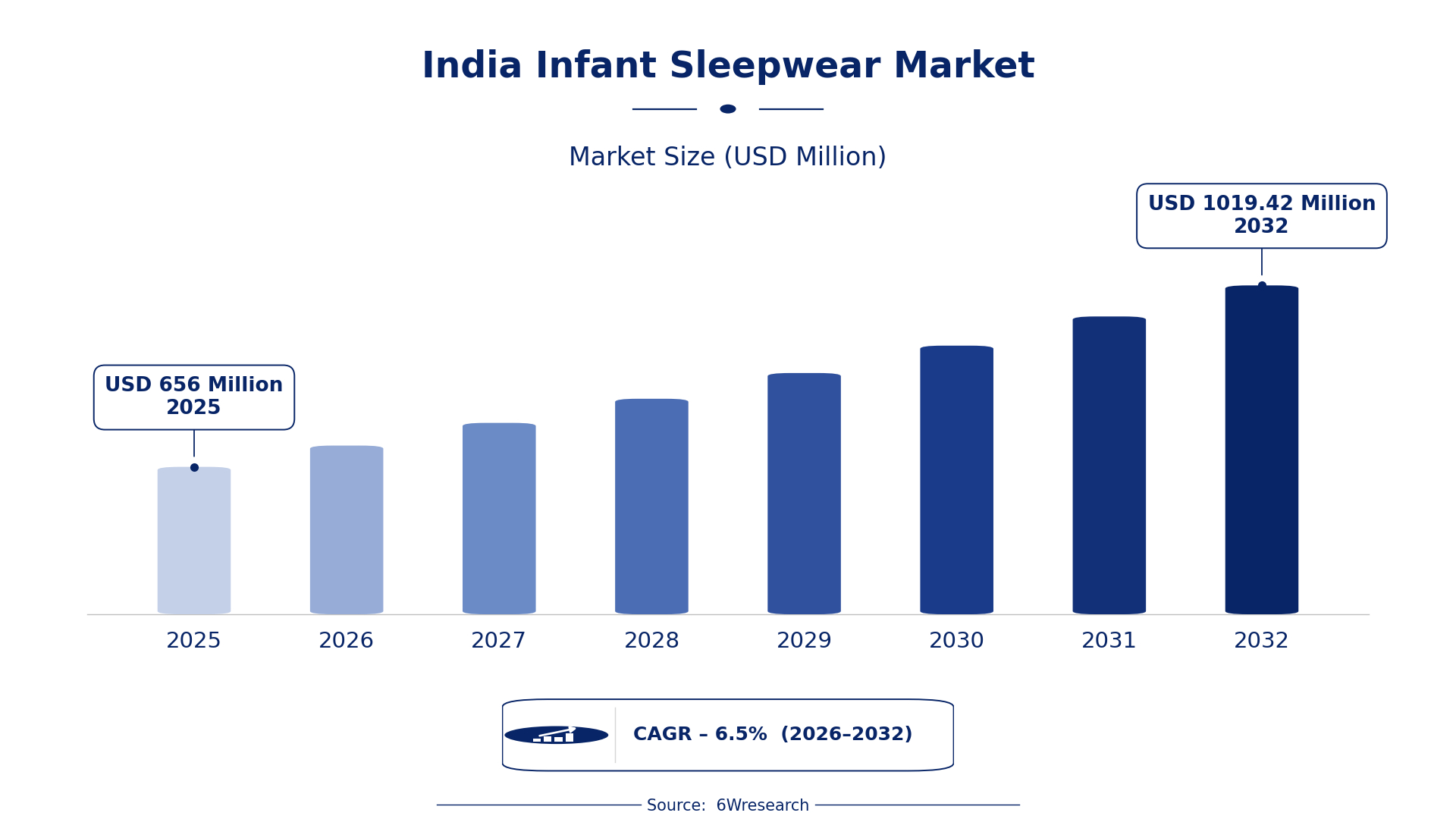
According to 6Wresearch internal database and industry insights, the India Infant Sleepwear Market was valued at USD 656.0 million in 2025 and is projected to reach USD 1,019.42 million by 2032, growing at a CAGR of approximately 6.5% during 2026–2032.
India Infant Sleepwear Market Highlights
| Report Metric | Details |
| Report Name | India Infant Sleepwear Market |
| Market Size 2025 | USD 656.0 million |
| Market Size 2032 | USD 1,019.42 million |
| Absolute Growth 2025–2032 | USD 363.42 million |
| CAGR 2026–2032 | 6.5% |
| Peak Annual Growth | 8.9% in 2031 |
| Forecast Period | 2026–2032 |
| Historical Data | 2022–2025 |
| Base Year | 2025 |
| Leading Infant Sleepwear, 2025 | Onesies (40% share) |
| Leading Product Type, 2025 | Long-Sleeve (40% share) |
| Leading Fabric Type, 2025 | Organic Cotton (36% share) |
| Leading Closure Style, 2025 | Snap Button (42% share) |
| Leading Size Segment, 2025 | 0–6 months (39% share) |
| Fastest-Growing Infant Sleepwear | Footed Pajamas (8.4% CAGR) |
| Fastest-Growing Product Type | 2-Piece Pajama (8.7% CAGR) |
| Fastest-Growing Closure Style | Zipper (8.4% CAGR) |
| Fastest-Growing Size Segment | 6–12 months (7.5% CAGR) |
| Growing Sector | Infant Sleepwear |
| Key End Users | Parents, local manufacturers, online retailers, textile producers |
India Infant Sleepwear Market Year-wise Growth Rate and Key Drivers (2022–2032)
This graph illustrates the annual growth rates of the market from 2022 to 2032, highlighting a steady upward trajectory and projected market expansion over the forecast period.
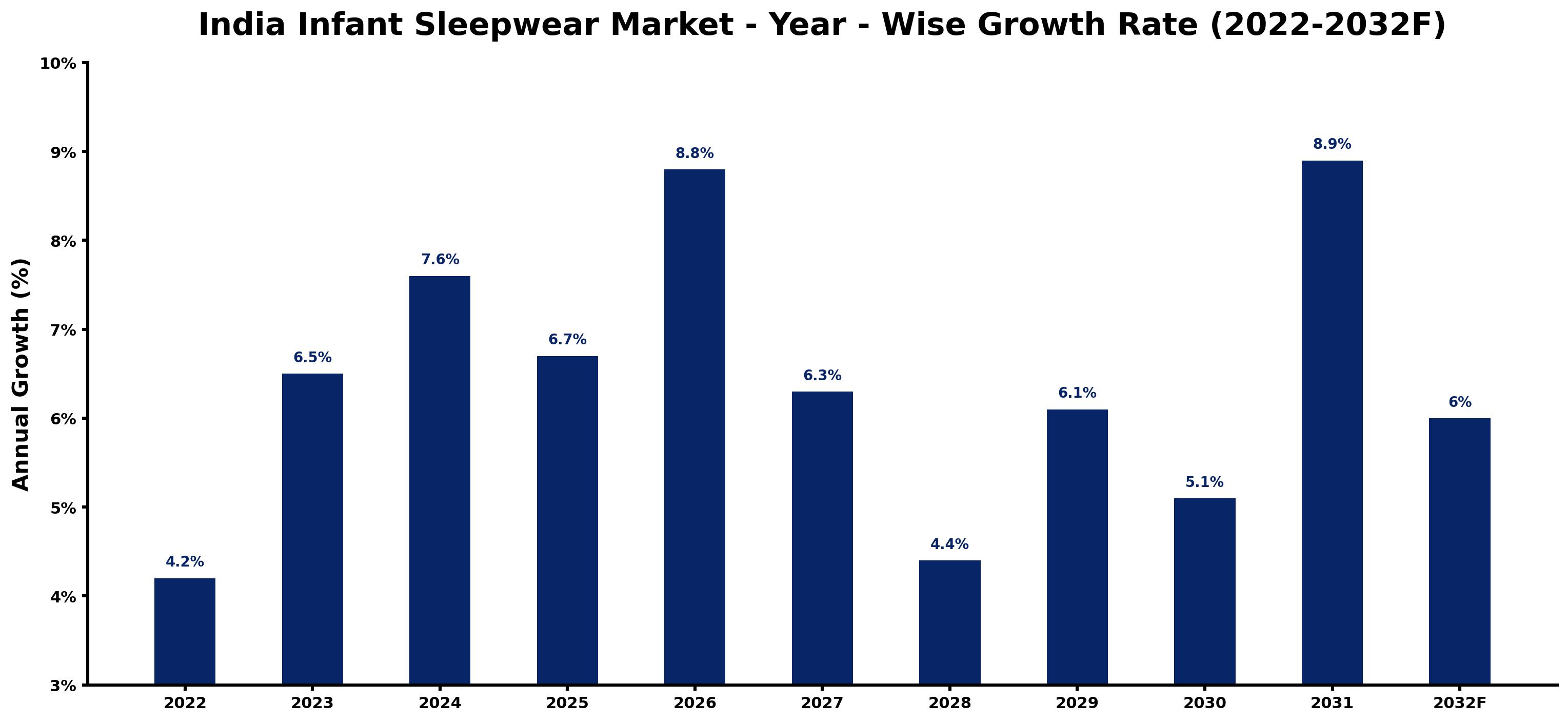
The following table presents the estimated annual growth rate for each year together with the principal factor influencing market performance.
| Year | Estimated Annual Growth (%) | Market Rationale |
| 2022 | 4.2 | The market experienced steady demand due to a consistent birth rate of 22 births per 1,000 people. |
| 2023 | 6.5 | Growth accelerated as online sales platforms expanded their reach, accounting for 40% of total sales. |
| 2024 | 7.6 | Increased awareness of safe sleep practices, driven by a health initiative, boosted demand for quality sleepwear. |
| 2025 | 6.7 | Adoption of 2-piece pajamas slowed slightly as preferences shifted towards convenience and comfort. |
| 2026 | 8.8 | The introduction of new safety standards in 2023 is expected to spur increased consumer confidence. |
| 2027 | 6.3 | Demand growth slowed as the market adjusted to new regulations and safety compliance requirements. |
| 2028 | 4.4 | Awareness of sustainable fabrics began influencing purchasing decisions, particularly among environmentally conscious parents. |
| 2029 | 6.1 | Sales improved as parents sought more comfortable options for infants, particularly in the 0-6 months segment. |
| 2030 | 5.1 | Growth decelerated due to market saturation in certain segments, particularly in onesies and footed pajamas. |
| 2031 | 8.9 | A surge in demand for organic cotton is projected to boost market performance as consumers prefer safer options. |
| 2032 | 6.0 | The market is expected to stabilise as consumer preferences become more defined, particularly around safety and comfort. |
Note: Market size estimations and growth projections presented in this report are based on 6Wresearch's proprietary forecasting methodology, utilizing the latest available industry data, government publications, and primary research inputs.
India Infant Sleepwear Market Synopsis
The India Infant Sleepwear Market encompasses clothing designed specifically for babies and toddlers, ensuring comfort and warmth during sleep. This category includes items made from soft, breathable fabrics like cotton and fleece. Valued at approximately 500 million USD as of 2023, the market is growing due to a high birth rate of around 22 births per 1,000 people. Factors such as the 'Make in India' initiative and the introduction of new safety standards are driving increased demand from domestic users.
Market Dynamics Impact Analysis (2026–2032)
| Factor | Type | Impact | Primary Segment Affected |
| High birth rate driving demand for infant products | Driver | High | Onesies |
| Growth of online sales channels increasing accessibility | Driver | High | Onesies |
| Rising interest in organic materials for infant clothing | Opportunity | High | Onesies |
| Increased focus on safe sleep practices among parents | Opportunity | High | Onesies |
| Regulatory compliance costs impacting local manufacturers | Restraint | High | Onesies |
| Limited awareness of sustainable fabric options among consumers | Restraint | Medium | Onesies |
| Challenges in sourcing quality materials for production | Challenge | High | Onesies |
| Competition from imported products affecting local sales | Challenge | Medium | Onesies |
Evaluation of Drivers in India Infant Sleepwear Market (2026–2032)
The table below links each growth driver to the segment it affects and the evidence for it.
| Drivers | Primary Segment Affected | Why It Matters (Evidence) |
| High birth rate | Onesies | With approximately 22 births per 1,000 people, demand for infant sleepwear continues to rise. |
| Expansion of online sales platforms | Onesies | Online sales accounted for 40% of total sales, increasing accessibility for consumers. |
| Growing preference for organic cotton | Organic Cotton | Organic Cotton is preferred for its softness, capturing 36% of the market share. |
| Introduction of new safety standards | Onesies | The 2023 safety standards boost consumer confidence, leading to increased purchases. |
| Rising awareness of safe sleep practices | Onesies | The 2023 health initiative educated parents, driving demand for compliant sleepwear. |
Market growth for Infant Sleepwear in India is underpinned by high birth rates, increasing online sales, and a growing preference for comfort-focused designs. The average birth rate of 22 births per 1,000 people drives consistent demand for infant products, particularly in the 0-6 months segment. Online platforms now account for 40% of sales, improving accessibility for parents. The introduction of new safety standards in 2023 boosts consumer confidence, encouraging informed purchasing decisions.
Evaluation of Restraints in India Infant Sleepwear Market
The main factors holding the market back are set out below.
| Market Restraint | Primary Segment Affected | Why It Matters (Evidence) |
| Regulatory compliance costs | Onesies | Compliance with updated safety regulations increases production costs for local manufacturers by approximately 15%. |
| Limited consumer awareness of sustainable fabrics | Onesies | Many consumers remain unaware of the benefits of organic materials, hindering growth in this segment. |
| Challenges in sourcing quality materials | Onesies | Manufacturers face difficulties in obtaining high-quality fabrics, affecting product availability and increasing costs. |
| Competition from imported products | Onesies | Imported infant sleepwear often undercuts local prices, impacting sales for domestic producers and reducing profit margins. |
| Market saturation in certain segments | Onesies | As certain product types reach saturation, growth opportunities become limited, particularly in the onesies category. |
India Infant Sleepwear Market Challenges
High supply chain costs challenge producers in the India infant sleepwear market, as sourcing quality fabrics can increase production expenses by 15%. Buyers encounter difficulties due to a scarcity of locally manufactured options, which can extend lead times and cause stock shortages, potentially impacting sales by 20%. Regulatory compliance adds complexity; new safety standards introduced in 2023 require additional testing, delaying product launches by up to six months for manufacturers. Competition from imported sleepwear forces local producers to lower prices, squeezing profit margins and restricting their capacity to invest in quality improvements.
Trends in the India Infant Sleepwear Market
Buyers and suppliers in the India Infant Sleepwear Market are adjusting to the following trends.
- Shift towards Organic Materials: Since 2021, there has been a notable shift towards organic cotton in infant sleepwear. This trend is supported by the 'Textile Policy of 2021', which promotes sustainable fabric production. Organic Cotton is expected to see a growth rate of 9.3%.
- Increase in Online Sales Channels: The rise of e-commerce platforms has transformed how infant sleepwear is sold. In 2023, online sales accounted for 40% of total sales, making it essential for manufacturers to establish a strong online presence.
- Growing Awareness of Safe Sleep Practices: In 2023, a health initiative was launched to educate parents on safe sleep practices for infants. This awareness is driving demand for compliant infant sleepwear, as parents seek products that ensure safety.
- Rise of 2-Piece Pajamas: The 2-piece pajama segment is gaining traction, with a projected 15% increase in adoption by 2025. This growth reflects changing consumer preferences for comfort and flexibility in infant clothing.
Investment Opportunities in the India Infant Sleepwear Market
The following opportunities in the India Infant Sleepwear Market pair current demand with a clear way in.
- Parents seeking safe sleepwear: With the average age of first-time parents around 26 years, demand for safe sleepwear is on the rise. Manufacturers can focus on producing compliant products to meet this need, particularly in the 0-6 months segment.
- Gap in sustainable fabric offerings: The market is experiencing a gap in sustainable fabric options, with organic materials becoming increasingly popular. Suppliers can invest in organic cotton production to cater to environmentally conscious parents, reflecting a shift in consumer preferences.
- Expansion of online retail platforms: Online sales channels are rapidly expanding, accounting for 40% of sales. Manufacturers should collaborate with e-commerce platforms to enhance visibility and reach a broader audience, capitalising on this growing trend.
- Focus on compliance with safety standards: With new safety standards in effect, manufacturers can invest in compliance to boost product appeal. This strategy will attract parents prioritising safety in their purchasing decisions, especially in the infant sleepwear segment.
Government Initiatives in the India Infant Sleepwear Market
The 'Textile Policy of 2021' by the Ministry of Textiles aims to promote sustainable fabric production for infant clothing. This policy encourages manufacturers to adopt eco-friendly practices and improve product quality. Additionally, the 'Make in India' initiative, reinforced in 2021, supports local manufacturing of infant products, focusing on safety and quality standards. These measures aim to strengthen the domestic textile industry and assist producers in meeting consumer demands. The Bureau of Indian Standards updated safety regulations in 2022, ensuring that infant sleepwear meets international safety requirements, benefiting both producers and buyers.
The Bureau of Indian Standards oversees the approval of safety regulations for children's clothing. In 2022, it updated safety regulations to align with international standards, ensuring that infant sleepwear meets safety requirements. The Ministry of Health also launched a campaign in 2023 to educate parents on safe sleep practices, indirectly influencing the infant sleepwear market by raising awareness and promoting the need for compliant products. These initiatives support local manufacturers by enhancing their ability to meet safety standards and consumer expectations.
Future Insight of the India Infant Sleepwear Market
Several forward-looking factors should support the India infant sleepwear market in the coming years. The 'Make in India' initiative will strengthen local production capabilities, while online sales channels are expected to expand, catering to evolving consumer preferences. By 2025, the 2-piece pajama segment will likely see a 15% increase in adoption, reflecting a shift towards comfort and practicality. Health initiatives aimed at educating parents about safe sleep practices will further drive demand for compliant and comfortable infant sleepwear.
Market Segmentation Analysis
Each segment group is reviewed below, with the leader by share and the fastest grower by CAGR.
By Infant Sleepwear – Onesies Dominated, Footed Pajamas Expected to Grow Fastest
According to Shubham Deep, Research Manager at 6Wresearch, with a 40% revenue share in 2025, Onesies was the largest infant sleepwear category. Onesies hold the largest share in the India Infant Sleepwear Market as they are highly valued for their ease of dressing and comfort, making them a go-to choice for parents. Their popularity is particularly strong in urban areas where convenience is paramount for busy caregivers. Footed Pajamas are projected to grow fastest, at a CAGR of 8.4% during 2026–2032. Footed Pajamas are rapidly gaining traction due to their effectiveness in keeping infants warm during sleep, which is a key concern for many parents. The segment is projected to see a 15% increase in adoption by 2025, highlighting a growing preference for this product type. Suppliers should focus on expanding their range of footed pajamas to align with the increasing consumer demand.
By Product Type – Long-Sleeve Dominated, 2-Piece Pajama Expected to Grow Fastest
Long-Sleeve accounted for a 40% market share by product type in 2025. Long-Sleeve infant sleepwear commands the largest market share as it is specifically designed to provide warmth in cooler climates, making it a preferred option among parents. This segment thrives particularly in regions of India that experience lower temperatures during the night. 2-Piece Pajama is set to record the highest CAGR in this split, 8.7% over 2026–2032. The 2-Piece Pajama segment is experiencing notable growth due to its flexibility in dressing and comfort, appealing to parents who value versatility. As more families seek adaptable options for their infants, this trend is likely to continue. Manufacturers should consider broadening their offerings of 2-piece pajamas to capitalise on this upward trend.
By Fabric Type – Organic Cotton Dominated and Is Expected to Record the Fastest Growth
The largest fabric type category in 2025 was Organic Cotton, with a 36% share of total revenue. Organic Cotton leads the market because it is preferred for its softness and safety, particularly for sensitive infant skin. The increasing awareness of sustainable materials among parents is further solidifying its position. Organic Cotton is also forecast to expand faster than any other category, at a CAGR of 9.3% over 2026–2032. Organic Cotton is also the fastest-growing segment, as its demand rises with the trend towards eco-friendly and safe infant clothing. This dual role as both leader and fastest indicates a strong market preference for sustainable options. Suppliers should prioritise sourcing and marketing organic cotton to align with consumer preferences for safety and sustainability.
By Closure Style – Snap Button Dominated, Zipper Expected to Grow Fastest
Snap Button took a 42% share of closure style in 2025, more than any other category. Snap Button closures are the leading choice among parents as they allow for easy dressing and changing, which is essential for busy caregivers. This practical feature has made snap buttons a staple in many households, ensuring their dominance in the market. Over 2026–2032, Zipper is expected to post the fastest growth, at a CAGR of 8.4%. Zipper closures are becoming increasingly favoured for their convenience during nighttime changes, attracting parents looking for efficient solutions. This trend indicates a shift towards more user-friendly designs in the infant sleepwear sector. Manufacturers should explore advancements in closure styles to meet the changing preferences of parents.
By Size Segment – 0–6 months Dominated, 6–12 months Expected to Grow Fastest
In 2025, 0–6 months led the size segment split with a 39% share. The 0-6 months size segment holds the largest share as it directly meets the specific needs of newborns, who require comfortable and safe sleepwear during their early months. This segment benefits from India's high birth rate, which drives consistent demand for infant sleepwear. 6–12 months are projected to grow fastest, at a CAGR of 7.5% during 2026–2032. The 6-12 months size segment is experiencing rapid growth as it caters to the evolving needs of infants who are becoming more active, making it increasingly attractive to parents. This surge is supported by the growing awareness of safe sleep practices among caregivers, leading to higher adoption rates. Suppliers should focus on expanding their offerings in the 6-12 months size range to capitalise on the increasing demand from parents.
Key Attractiveness of the Report
- 10 Years of Market Numbers
- Historical Data Starting from 2022 to 2025
- Base Year 2025
- Forecast Data until 2032
- Key Performance Indicators Impacting the Market
- Major Upcoming Developments and Projects
Key Highlights of the Report:
- India Infant Sleepwear Market Outlook
- Market Size of India Infant Sleepwear Market, 2025
- Forecast of India Infant Sleepwear Market, 2032
- Historical Data and Forecast of India Infant Sleepwear Revenues & Volume for the Period 2022 - 2032F
- India Infant Sleepwear Market Trend Evolution
- India Infant Sleepwear Market Drivers and Challenges
- India Infant Sleepwear Price Trends
- India Infant Sleepwear Porter's Five Forces
- India Infant Sleepwear Industry Life Cycle
- Historical Data and Forecast of India Infant Sleepwear Market Revenues & Volume By Infant Sleepwear for the Period 2022 - 2032F
- Historical Data and Forecast of India Infant Sleepwear Market Revenues & Volume By Onesies for the Period 2022 - 2032F
- Historical Data and Forecast of India Infant Sleepwear Market Revenues & Volume By Footed Pajamas for the Period 2022 - 2032F
- Historical Data and Forecast of India Infant Sleepwear Market Revenues & Volume By Sleep Gowns for the Period 2022 - 2032F
- Historical Data and Forecast of India Infant Sleepwear Market Revenues & Volume By Romper Sets for the Period 2022 - 2032F
- Historical Data and Forecast of India Infant Sleepwear Market Revenues & Volume By Product Type for the Period 2022 - 2032F
- Historical Data and Forecast of India Infant Sleepwear Market Revenues & Volume By Long-Sleeve for the Period 2022 - 2032F
- Historical Data and Forecast of India Infant Sleepwear Market Revenues & Volume By Full Body for the Period 2022 - 2032F
- Historical Data and Forecast of India Infant Sleepwear Market Revenues & Volume By Elastic Hem for the Period 2022 - 2032F
- Historical Data and Forecast of India Infant Sleepwear Market Revenues & Volume By 2-Piece Pajama for the Period 2022 - 2032F
- Historical Data and Forecast of India Infant Sleepwear Market Revenues & Volume By Fabric Type for the Period 2022 - 2032F
- Historical Data and Forecast of India Infant Sleepwear Market Revenues & Volume By Organic Cotton for the Period 2022 - 2032F
- Historical Data and Forecast of India Infant Sleepwear Market Revenues & Volume By Fleece for the Period 2022 - 2032F
- Historical Data and Forecast of India Infant Sleepwear Market Revenues & Volume By Bamboo Fabric for the Period 2022 - 2032F
- Historical Data and Forecast of India Infant Sleepwear Market Revenues & Volume By Cotton Blend for the Period 2022 - 2032F
- Historical Data and Forecast of India Infant Sleepwear Market Revenues & Volume By Closure Style for the Period 2022 - 2032F
- Historical Data and Forecast of India Infant Sleepwear Market Revenues & Volume By Snap Button for the Period 2022 - 2032F
- Historical Data and Forecast of India Infant Sleepwear Market Revenues & Volume By Zipper for the Period 2022 - 2032F
- Historical Data and Forecast of India Infant Sleepwear Market Revenues & Volume By Pull-On for the Period 2022 - 2032F
- Historical Data and Forecast of India Infant Sleepwear Market Revenues & Volume By Velcro for the Period 2022 - 2032F
- Historical Data and Forecast of India Infant Sleepwear Market Revenues & Volume By Size Segment for the Period 2022 - 2032F
- Historical Data and Forecast of India Infant Sleepwear Market Revenues & Volume By 0 6 months for the Period 2022 - 2032F
- Historical Data and Forecast of India Infant Sleepwear Market Revenues & Volume By 6 12 months for the Period 2022 - 2032F
- Historical Data and Forecast of India Infant Sleepwear Market Revenues & Volume By Newborns for the Period 2022 - 2032F
- Historical Data and Forecast of India Infant Sleepwear Market Revenues & Volume By 1 2 years for the Period 2022 - 2032F
- India Infant Sleepwear Import Export Trade Statistics
- Market Opportunity Assessment By Infant Sleepwear
- Market Opportunity Assessment By Product Type
- Market Opportunity Assessment By Fabric Type
- Market Opportunity Assessment By Closure Style
- Market Opportunity Assessment By Size Segment
- India Infant Sleepwear Top Companies Market Share
- India Infant Sleepwear Competitive Benchmarking By Technical and Operational Parameters
- India Infant Sleepwear Company Profiles
- India Infant Sleepwear Key Strategic Recommendations
Market Covered
This report examines the market across the segments below.
By Infant Sleepwear
- Onesies
- Footed Pajamas
- Sleep Gowns
- Romper Sets
By Product Type
- Long-Sleeve
- Full Body
- Elastic Hem
- 2-Piece Pajama
By Fabric Type
- Organic Cotton
- Fleece
- Bamboo Fabric
- Cotton Blend
By Closure Style
- Snap Button
- Zipper
- Pull-On
- Velcro
By Size Segment
- 0–6 months
- 6–12 months
- Newborns
- 1–2 years































