India Infant Utensils Market Size & Growth Rate
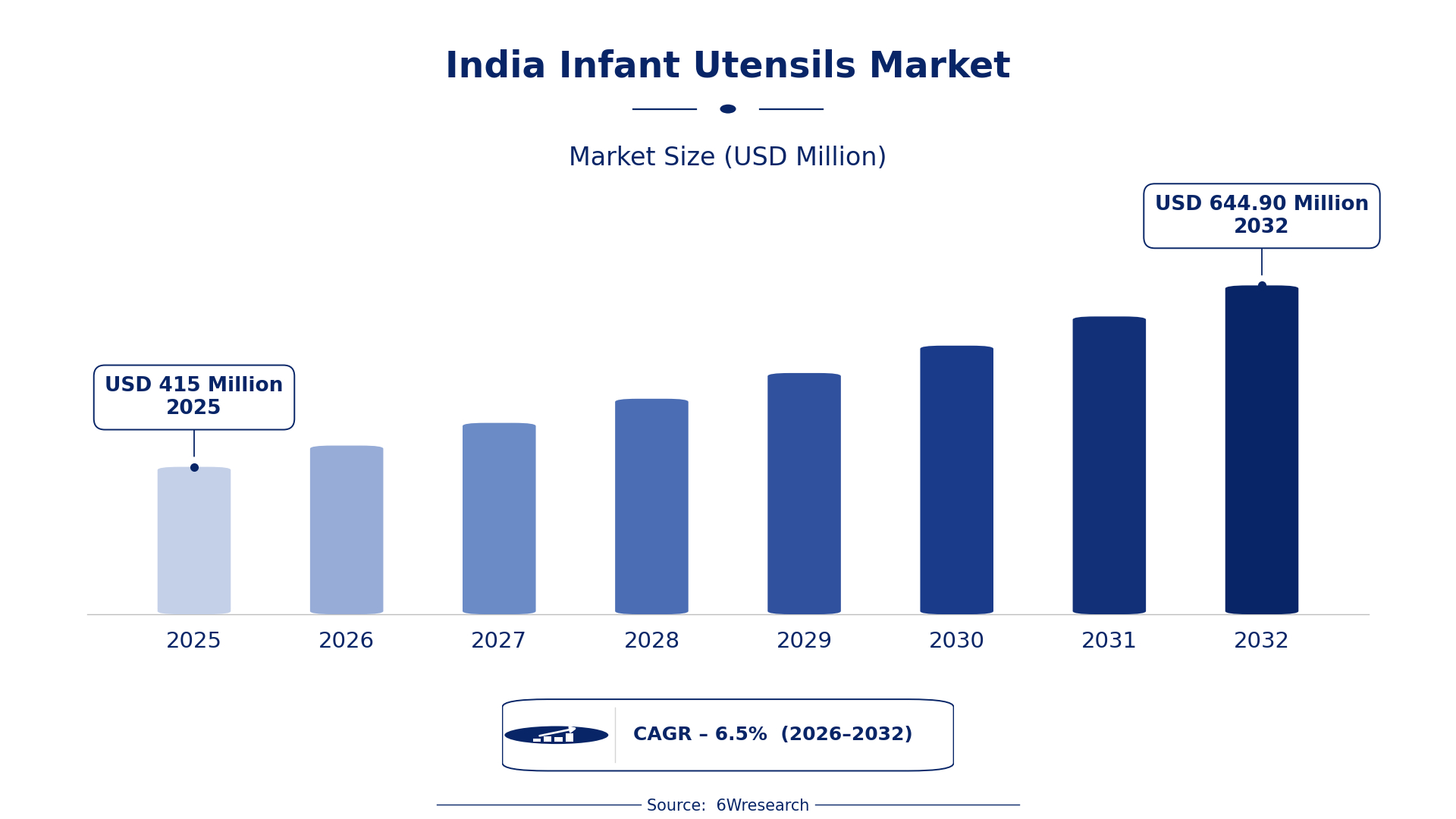
According to 6Wresearch internal database and industry insights, the India Infant Utensils Market was valued at USD 415.0 million in 2025 and is projected to reach USD 644.90 million by 2032, growing at a CAGR of approximately 6.5% during 2026–2032.
India Infant Utensils Market Highlights
| Report Metric | Details |
| Report Name | India Infant Utensils Market |
| Market Size 2025 | USD 415.0 million |
| Market Size 2032 | USD 644.90 million |
| Absolute Growth 2025–2032 | USD 229.90 million |
| CAGR 2026–2032 | 6.5% |
| Peak Annual Growth | 8.3% in 2028 |
| Forecast Period | 2026–2032 |
| Historical Data | 2022–2025 |
| Base Year | 2025 |
| Leading Infant Utensils, 2025 | Sippy Cups (45% share) |
| Leading Product Type, 2025 | Leakproof (42% share) |
| Leading Material Used, 2025 | BPA-Free Plastic (43% share) |
| Leading Design Feature, 2025 | Easy-Grip Handle (40% share) |
| Leading End User Age Group, 2025 | 6–24 months (45% share) |
| Fastest-Growing Infant Utensils | Baby Spoons (9.3% CAGR) |
| Fastest-Growing Product Type | Soft-Tip (8.5% CAGR) |
| Fastest-Growing Material Used | Silicone (7.9% CAGR) |
| Fastest-Growing Design Feature | Heat Indicator (9.2% CAGR) |
| Fastest-Growing End User Age Group | 4–18 months (7.6% CAGR) |
| Growing Sector | 4–18 months |
| Key End Users | 6–24 months, 4–18 months, 12–36 months |
India Infant Utensils Market Year-wise Growth Rate and Key Drivers (2022–2032)
This graph illustrates the annual growth rates of the market from 2022 to 2032, highlighting a steady upward trajectory and projected market expansion over the forecast period.
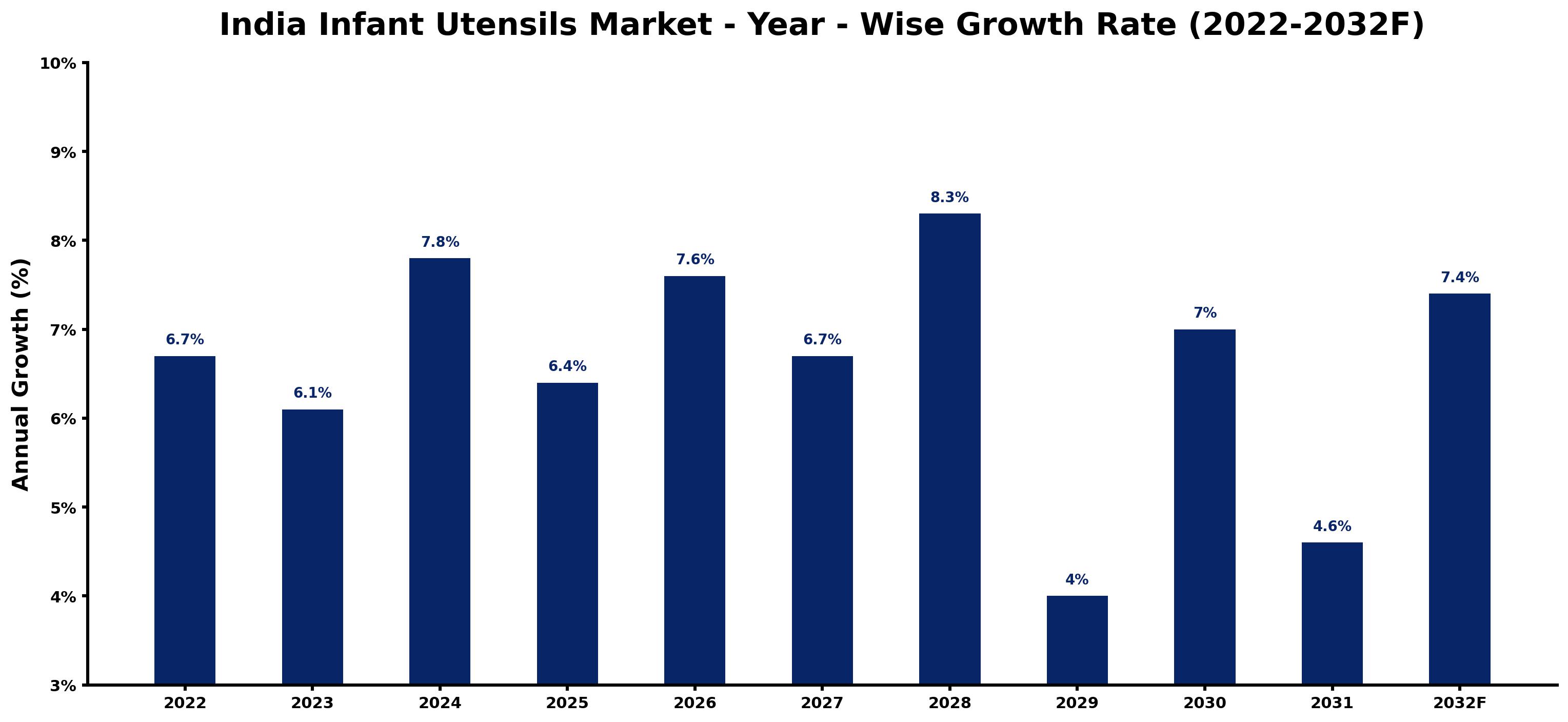
Each row of the following table gives one year's estimated growth and the event or demand shift that explains it.
| Year | Estimated Annual Growth (%) | Market Rationale |
| 2022 | 6.7 | The market experienced steady growth as parents increasingly sought quality infant utensils for their children. |
| 2023 | 6.1 | Growth slowed due to heightened competition among local manufacturers offering similar products. |
| 2024 | 7.8 | Demand surged as awareness of child safety standards gained traction among parents. |
| 2025 | 6.4 | Growth slowed again as supply chain challenges impacted production timelines for suppliers. |
| 2026 | 7.6 | The market rebounded with renewed interest in innovative designs and materials. |
| 2027 | 6.7 | Growth slowed as manufacturers faced challenges in adopting new technologies. |
| 2028 | 8.3 | A peak in demand occurred as parents prioritised safety and convenience in purchasing decisions. |
| 2029 | 4.0 | Growth slowed due to market saturation and increased competition among brands. |
| 2030 | 7.0 | Demand rose as eco-friendly materials gained popularity among environmentally conscious parents. |
| 2031 | 4.6 | Growth slowed as regulatory hurdles delayed product launches for some manufacturers. |
| 2032 | 7.4 | Demand increased as new safety regulations improved product quality and consumer trust. |
Note: Market size estimations and growth projections presented in this report are based on 6Wresearch's proprietary forecasting methodology, utilizing the latest available industry data, government publications, and primary research inputs.
India Infant Utensils Market Synopsis
The India Infant Utensils Market includes a range of products tailored for infants, such as sippy cups, baby spoons, and suction bowls. These utensils are designed with safety and usability in mind for young children. Growth in this market is driven by parents who prioritise quality and safety in their purchases. Contributing factors include increasing disposable incomes, greater awareness of child safety, and a trend towards eco-friendly materials.
Market Dynamics Impact Analysis (2026–2032)
| Factor | Type | Impact | Primary Segment Affected |
| Increasing disposable income among families | Driver | High | Sippy Cups |
| Rising awareness of child safety | Driver | High | Sippy Cups |
| Growing demand for eco-friendly products | Opportunity | High | Sippy Cups |
| Expansion of online retail channels | Opportunity | Medium | Sippy Cups |
| Intense competition among local manufacturers | Restraint | High | Sippy Cups |
| Frequent supply chain disruptions | Restraint | Medium | Sippy Cups |
| Regulatory compliance challenges | Challenge | High | Sippy Cups |
| Slow adoption of technological advancements | Challenge | Medium | Sippy Cups |
Evaluation of Drivers in India Infant Utensils Market (2026–2032)
The factors lifting demand, and the evidence behind each, are summarised below.
| Drivers | Primary Segment Affected | Why It Matters (Evidence) |
| Rising disposable income | Sippy Cups | Higher income levels encourage parents to purchase premium quality products, boosting sales. |
| Growing awareness of child safety | Sippy Cups | Parents increasingly seek safe utensils, leading to higher demand for compliant products. |
| Demand for unique designs | Sippy Cups | Distinctive features attract consumers, resulting in increased sales volumes for innovative products. |
| Increase in online shopping | Sippy Cups | The convenience of e-commerce platforms encourages parents to buy more infant utensils online. |
| Focus on eco-friendly materials | Sippy Cups | Sustainable options appeal to environmentally conscious buyers, enhancing market demand. |
The Infant Utensils market in India is expanding due to rising disposable income, growing awareness of child safety, and a demand for distinctive designs. By 2025, the market is projected to hit USD 415.0 million, as parents seek high-quality products for their children. The convenience of online shopping is boosting sales, with families increasingly opting to buy infant utensils through e-commerce platforms. A commitment to eco-friendly materials is appealing to environmentally aware consumers, prompting a shift towards sustainable choices. These elements are driving the market's growth potential.
Evaluation of Restraints in India Infant Utensils Market
The following restraints limit how fast demand can grow.
| Market Restraint | Primary Segment Affected | Why It Matters (Evidence) |
| Intense competition among local manufacturers | Sippy Cups | This leads to price wars, affecting profit margins for established brands. |
| Frequent supply chain disruptions | Sippy Cups | Dependence on imported raw materials can extend lead times by up to 30 days. |
| Limited product differentiation | Sippy Cups | Market saturation with similar products reduces brand uniqueness, impacting sales. |
| Rising raw material costs | Sippy Cups | Increased costs for materials can squeeze margins, affecting pricing strategies. |
| Stringent safety regulations | Sippy Cups | Compliance with safety standards requires extensive testing, delaying product launches. |
India Infant Utensils Market Challenges
Buyers and suppliers in the India infant utensils market contend with fierce competition, as numerous local manufacturers provide similar products at lower prices, which pressures profit margins for established brands. Supply chain challenges arise from a reliance on imported raw materials, causing production delays that can extend lead times by 30 days for suppliers. Regulatory challenges also exist; strict safety standards necessitate extensive testing, potentially delaying product launches by several months for manufacturers. Slow adoption of new technology hampers innovation, leading to outdated products that do not meet the evolving needs of modern parents.
Trends in the India Infant Utensils Market
Four trends stand out in the India Infant Utensils Market.
- Shift towards Eco-Friendly Materials: A growing number of parents, now 30%, prioritise eco-friendly infant utensils, driving demand for biodegradable materials. This trend reflects a marked change in consumer preferences towards sustainability.
- Growing Popularity of Online Shopping: In 2023, online sales of infant utensils accounted for 25% of total sales, highlighting a shift in consumer purchasing behaviour. This trend offers greater accessibility and convenience for parents.
- Increased Focus on Safety Features: Since 2022, there has been a noticeable shift towards utensils with enhanced safety features, such as BPA-free materials. This change is driven by increased awareness among parents regarding child safety.
- Rise of Innovative Designs: The introduction of utensils with ergonomic designs began in 2021, catering to the needs of young children. This innovation has led to a 15% increase in sales for products featuring these designs.
Investment Opportunities in the India Infant Utensils Market
Below are the investment opportunities with the strongest case in the India Infant Utensils Market.
- Investment in Local Manufacturing: With the market expected to reach USD 415.0 million by 2025, there is an opportunity for investment in local manufacturing facilities. This will help reduce reliance on imports and strengthen supply chain resilience.
- Expansion of E-commerce Platforms: The growing trend of online shopping, which accounted for 25% of sales in 2023, presents an opportunity for businesses to enhance their online presence. Collaborating with local e-commerce platforms can facilitate market entry.
- Development of Eco-Friendly Product Lines: As 30% of parents now prefer sustainable options, investing in eco-friendly product lines can capture this expanding market segment. Targeting environmentally conscious buyers will strengthen brand loyalty.
- Focus on Innovative Features: With a rising demand for unique designs, there is an opportunity to invest in research and development for innovative features. This can attract more consumers looking for advanced infant utensils.
Government Initiatives in the India Infant Utensils Market
The introduction of the Child Safety Standards Act in 2021 has tightened regulations governing infant utensils, requiring manufacturers to comply with stricter safety protocols. This law builds on previous regulations by ensuring that all products undergo rigorous testing before reaching the market, boosting consumer trust and safety.
The Bureau of Indian Standards oversees the enforcement of safety regulations for infant utensils, ensuring compliance with the Child Safety Standards Act. Manufacturers must submit their products for certification, which involves thorough testing to guarantee safety and quality, benefiting both producers and consumers.
Future Insight of the India Infant Utensils Market
Several forward-looking factors should support the India infant utensils market in the coming years. New safety regulations will enhance product quality, benefiting both buyers and suppliers. By 2032, investments in local manufacturing facilities are expected to increase by 30%, improving supply chain resilience. A growing emphasis on eco-friendly materials will drive innovation, allowing suppliers to attract environmentally conscious consumers. The market will likely see a rise in sustainable production practices, aligning with the preferences of modern parents.
Market Segmentation Analysis
Each segment group is reviewed below, with the leader by share and the fastest grower by CAGR.
By Infant Utensils – Sippy Cups Dominated, Baby Spoons Expected to Grow Fastest
According to Shubham Deep, Research Manager at 6Wresearch, Sippy Cups accounted for a 45% market share by infant utensils in 2025. Sippy cups hold the largest market share as they are essential for parents transitioning toddlers from bottles to cups, providing a practical solution for mess-free feeding. Their widespread adoption in households reflects a strong demand for convenient feeding options among caregivers. The quickest growth will come from Baby Spoons, forecast to expand at a CAGR of 9.3% between 2026 and 2032. Baby spoons are experiencing rapid growth as parents increasingly recognise the importance of utensils that promote self-feeding in infants. This rising awareness of developmental milestones is driving demand for products that facilitate early feeding skills. Suppliers should innovate baby spoon designs to capitalise on the growing interest in self-feeding among parents.
By Product Type – Leakproof Dominated, Soft-Tip Expected to Grow Fastest
In 2025, Leakproof led the product type split with a 42% share. Leakproof utensils dominate the market share because they address parents' concerns about spills during feeding, making them a preferred choice for busy families. The practicality of these products enhances their appeal, ensuring they remain a staple in infant feeding. Soft-Tip is projected to grow fastest, at a CAGR of 8.5% during 2026–2032. Soft-tip utensils are seeing fast growth due to their gentle design, which is perfect for infants learning to eat. As parents increasingly prioritise comfort and safety, the demand for soft-tip options is expected to rise significantly. Manufacturers need to focus on developing soft-tip products to align with the growing demand for safe and comfortable feeding solutions.
By Material Used – BPA-Free Plastic Dominated, Silicone Expected to Grow Fastest
The largest material used category in 2025 was BPA-Free Plastic, with a 43% share of total revenue. BPA-free plastic is the leading material choice as it addresses health concerns among parents regarding chemical exposure. This material is widely available and trusted, making it the preferred option for many infant utensils. Over 2026–2032, Silicone is expected to post the fastest growth, at a CAGR of 7.9%. Silicone is rapidly gaining popularity due to its flexibility and safety features, appealing to health-conscious parents. The material's durability and ease of cleaning are driving its adoption in the market. Suppliers should consider expanding their silicone product lines to cater to the growing preference for safer, more durable feeding materials.
By Design Feature – Easy-Grip Handle Dominated, Heat Indicator Expected to Grow Fastest
Easy-Grip Handle held a 40% share of the India Infant Utensils Market by design feature in 2025. Easy-grip handles are the most desired design feature as they facilitate independent feeding for infants. This design resonates with parents aiming to encourage self-feeding skills, making it a key selling point in the market. Heat Indicator is set to record the highest CAGR in this split, 9.2% over 2026–2032. Heat indicators are gaining popularity as they provide a visual cue for parents to ensure food safety. The increasing focus on child safety during feeding is propelling the demand for utensils equipped with this feature. Manufacturers should invest in developing utensils with heat indicators to align with the growing safety concerns of parents.
By End User Age Group – 6–24 months Dominated, 4–18 months Expected to Grow Fastest
With a 45% revenue share in 2025, 6–24 months was the largest end user age group category. The 6–24 months age group represents the largest segment as it includes the crucial phase for introducing solid foods to infants. Parents actively seek suitable feeding utensils during this period to support their child's nutritional needs and development. The quickest growth will come from 4–18 months, forecast to expand at a CAGR of 7.6% between 2026 and 2032. The 4–18 months age group is witnessing rapid growth as parents are introducing feeding utensils earlier than before. This trend indicates a shift towards encouraging self-feeding skills at a younger age, leading to increased demand for appropriate products. Suppliers should adjust their marketing strategies to cater to parents with younger infants, focusing on products designed for early feeding.
Key Attractiveness of the Report
- 10 Years of Market Numbers
- Historical Data Starting from 2022 to 2025
- Base Year 2025
- Forecast Data until 2032
- Key Performance Indicators Impacting the Market
- Major Upcoming Developments and Projects
Key Highlights of the Report:
- India Infant Utensils Market Outlook
- Market Size of India Infant Utensils Market, 2025
- Forecast of India Infant Utensils Market, 2032
- Historical Data and Forecast of India Infant Utensils Revenues & Volume for the Period 2022 - 2032F
- India Infant Utensils Market Trend Evolution
- India Infant Utensils Market Drivers and Challenges
- India Infant Utensils Price Trends
- India Infant Utensils Porter's Five Forces
- India Infant Utensils Industry Life Cycle
- Historical Data and Forecast of India Infant Utensils Market Revenues & Volume By Infant Utensils for the Period 2022 - 2032F
- Historical Data and Forecast of India Infant Utensils Market Revenues & Volume By Sippy Cups for the Period 2022 - 2032F
- Historical Data and Forecast of India Infant Utensils Market Revenues & Volume By Baby Spoons for the Period 2022 - 2032F
- Historical Data and Forecast of India Infant Utensils Market Revenues & Volume By Suction Bowls for the Period 2022 - 2032F
- Historical Data and Forecast of India Infant Utensils Market Revenues & Volume By Baby Fork Sets for the Period 2022 - 2032F
- Historical Data and Forecast of India Infant Utensils Market Revenues & Volume By Product Type for the Period 2022 - 2032F
- Historical Data and Forecast of India Infant Utensils Market Revenues & Volume By Leakproof for the Period 2022 - 2032F
- Historical Data and Forecast of India Infant Utensils Market Revenues & Volume By Soft-Tip for the Period 2022 - 2032F
- Historical Data and Forecast of India Infant Utensils Market Revenues & Volume By Spill-Proof Base for the Period 2022 - 2032F
- Historical Data and Forecast of India Infant Utensils Market Revenues & Volume By Rounded Tines for the Period 2022 - 2032F
- Historical Data and Forecast of India Infant Utensils Market Revenues & Volume By Material Used for the Period 2022 - 2032F
- Historical Data and Forecast of India Infant Utensils Market Revenues & Volume By BPA-Free Plastic for the Period 2022 - 2032F
- Historical Data and Forecast of India Infant Utensils Market Revenues & Volume By Silicone for the Period 2022 - 2032F
- Historical Data and Forecast of India Infant Utensils Market Revenues & Volume By Food-Grade Rubber for the Period 2022 - 2032F
- Historical Data and Forecast of India Infant Utensils Market Revenues & Volume By Stainless Steel for the Period 2022 - 2032F
- Historical Data and Forecast of India Infant Utensils Market Revenues & Volume By Design Feature for the Period 2022 - 2032F
- Historical Data and Forecast of India Infant Utensils Market Revenues & Volume By Easy-Grip Handle for the Period 2022 - 2032F
- Historical Data and Forecast of India Infant Utensils Market Revenues & Volume By Heat Indicator for the Period 2022 - 2032F
- Historical Data and Forecast of India Infant Utensils Market Revenues & Volume By Non-Skid Base for the Period 2022 - 2032F
- Historical Data and Forecast of India Infant Utensils Market Revenues & Volume By Ergonomic Grip for the Period 2022 - 2032F
- Historical Data and Forecast of India Infant Utensils Market Revenues & Volume By End User Age Group for the Period 2022 - 2032F
- Historical Data and Forecast of India Infant Utensils Market Revenues & Volume By 6 24 months for the Period 2022 - 2032F
- Historical Data and Forecast of India Infant Utensils Market Revenues & Volume By 4 18 months for the Period 2022 - 2032F
- Historical Data and Forecast of India Infant Utensils Market Revenues & Volume By 6 24 months for the Period 2022 - 2032F
- Historical Data and Forecast of India Infant Utensils Market Revenues & Volume By 12 36 months for the Period 2022 - 2032F
- India Infant Utensils Import Export Trade Statistics
- Market Opportunity Assessment By Infant Utensils
- Market Opportunity Assessment By Product Type
- Market Opportunity Assessment By Material Used
- Market Opportunity Assessment By Design Feature
- Market Opportunity Assessment By End User Age Group
- India Infant Utensils Top Companies Market Share
- India Infant Utensils Competitive Benchmarking By Technical and Operational Parameters
- India Infant Utensils Company Profiles
- India Infant Utensils Key Strategic Recommendations
Market Covered
The report offers an extensive study of the following market segments.
By Infant Utensils
- Sippy Cups
- Baby Spoons
- Suction Bowls
- Baby Fork Sets
By Product Type
- Leakproof
- Soft-Tip
- Spill-Proof Base
- Rounded Tines
By Material Used
- BPA-Free Plastic
- Silicone
- Food-Grade Rubber
- Stainless Steel
By Design Feature
- Easy-Grip Handle
- Heat Indicator
- Non-Skid Base
- Ergonomic Grip
By End User Age Group
- 6–24 months
- 4–18 months
- 12–36 months































