India Infection Control Devices Market Size & Growth Rate
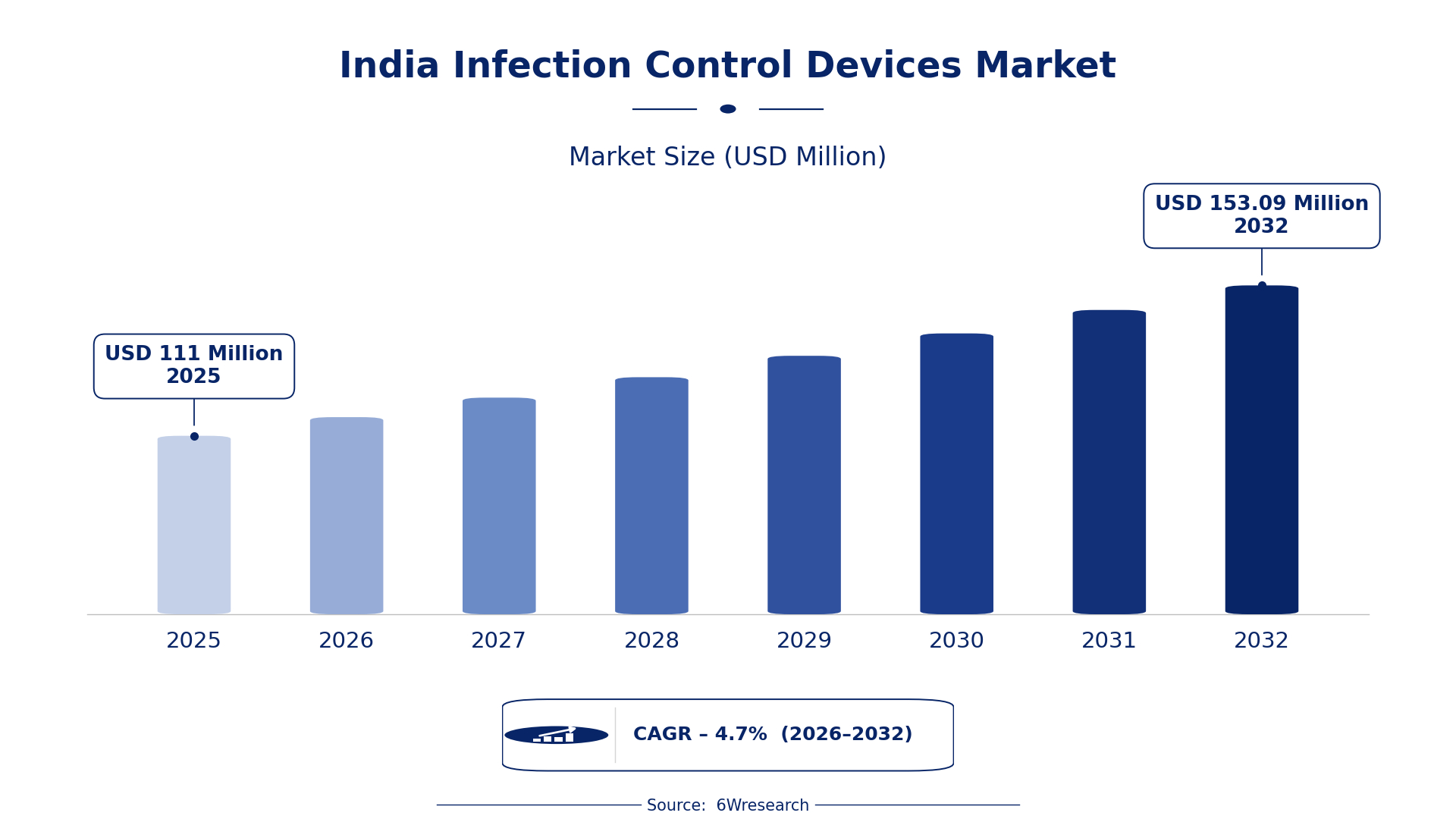
According to 6Wresearch internal database and industry insights, the India Infection Control Devices Market was valued at USD 111.0 million in 2025 and is projected to reach USD 153.09 million by 2032, growing at a CAGR of approximately 4.7% during 2026–2032.
India Infection Control Devices Market Highlights
| Report Metric | Details |
| Report Name | India Infection Control Devices Market |
| Market Size 2025 | USD 111.0 million |
| Market Size 2032 | USD 153.09 million |
| Absolute Growth 2025–2032 | USD 42.09 million |
| CAGR 2026–2032 | 4.7% |
| Peak Annual Growth | 6.9% in 2027 |
| Forecast Period | 2026–2032 |
| Historical Data | 2022–2025 |
| Base Year | 2025 |
| Leading Device Type, 2025 | UV Disinfection Units (51% share) |
| Leading Technology Used, 2025 | Ultraviolet Radiation (45% share) |
| Leading Target Use Area, 2025 | Hospital Wards (34% share) |
| Leading Distribution Channel, 2025 | Medical Equipment Dealers (53% share) |
| Fastest-Growing Device Type | Air Purifiers (6.4% CAGR) |
| Fastest-Growing Technology Used | HEPA / UV Combo (7.4% CAGR) |
| Fastest-Growing Target Use Area | Isolation Rooms (6.2% CAGR) |
| Fastest-Growing Distribution Channel | Direct Sales (5.7% CAGR) |
| Growing Sector | Healthcare |
| Key End Users | Hospitals, Clinics, Healthcare Facilities, Medical Equipment Dealers |
India Infection Control Devices Market Year-wise Growth Rate and Key Drivers (2022–2032)
This graph illustrates the annual growth rates of the market from 2022 to 2032, highlighting a steady upward trajectory and projected market expansion over the forecast period.
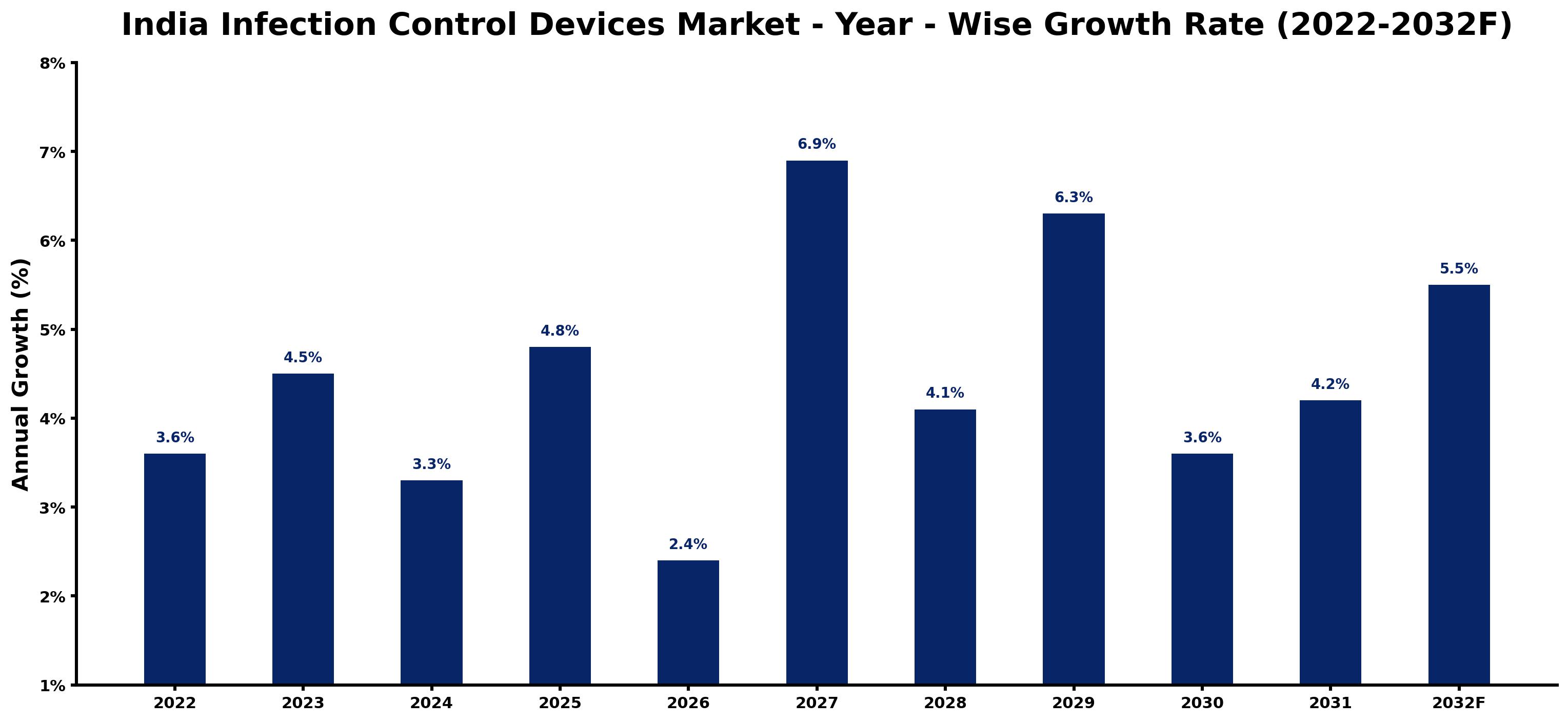
Annual growth estimates for each year appear below with the principal reason behind them, explaining the shifts that set the pace of the market.
| Year | Estimated Annual Growth (%) | Market Rationale |
| 2022 | 3.6 | The market experienced steady growth due to existing healthcare demands. |
| 2023 | 4.5 | Increased investments in healthcare infrastructure accelerated market expansion through the National Health Mission. |
| 2024 | 3.3 | The growth rate slowed as hospitals adjusted to new infection control standards set by the Indian Medical Association. |
| 2025 | 4.8 | Demand surged as hospitals implemented the Healthcare Quality Improvement Program to improve infection control measures. |
| 2026 | 2.4 | A slowdown occurred as market saturation began to affect growth rates in infection control technologies. |
| 2027 | 6.9 | The market peaked with significant advancements in UV disinfection technologies driven by healthcare investments. |
| 2028 | 4.1 | Growth slowed again as competition intensified among suppliers of infection control devices. |
| 2029 | 6.3 | A resurgence in demand was noted as hospitals upgraded their facilities under the Ayushman Bharat program. |
| 2030 | 3.6 | The growth rate decreased as hospitals focused on cost management amid rising healthcare expenses. |
| 2031 | 4.2 | Increased healthcare workforce improved the adoption of infection control devices across various facilities. |
| 2032 | 5.5 | The market is projected to grow as new technologies emerge, supported by ongoing government initiatives. |
Note: Market size estimations and growth projections presented in this report are based on 6Wresearch's proprietary forecasting methodology, utilizing the latest available industry data, government publications, and primary research inputs.
India Infection Control Devices Market Synopsis
Infection Control Devices in India are technologies designed to prevent the spread of infections in healthcare settings. These devices include ultraviolet light systems and filtration technologies, essential for sterilizing equipment and purifying air. The India Infection Control Devices Market is expanding due to rising healthcare infrastructure investments and the increasing implementation of infection control standards across hospitals. The National Health Mission's initiatives and the projected growth of the healthcare sector further drive demand for these devices. As hospitals improve their infection control measures, the market is set for notable growth.
Market Dynamics Impact Analysis (2026–2032)
| Factor | Type | Impact | Primary Segment Affected |
| Increased healthcare spending drives demand for advanced infection control technologies. | Driver | High | UV Disinfection Units |
| Growing awareness of infection prevention in healthcare facilities boosts device adoption. | Driver | High | Air Purifiers |
| The healthcare sector's projected growth creates opportunities for new suppliers. | Opportunity | High | Fogging Devices |
| Rising demand for air purifiers in hospitals opens new market avenues. | Opportunity | Medium | Air Purifiers |
| High costs of advanced infection control devices limit accessibility for smaller facilities. | Restraint | High | Autoclaves |
| Stringent regulatory approvals delay the introduction of new technologies. | Restraint | Medium | HEPA / UV Combo |
| Supply chain disruptions can affect the availability of essential devices. | Challenge | High | Fogging Devices |
| The need for skilled personnel to operate advanced devices presents a challenge. | Challenge | Medium | Autoclaves |
Evaluation of Drivers in India Infection Control Devices Market (2026–2032)
Key forces behind demand, with the segment each one moves most, are listed below.
| Drivers | Primary Segment Affected | Why It Matters (Evidence) |
| Rising healthcare investments increase the demand for infection control devices. | UV Disinfection Units | The healthcare sector in India is projected to reach $372 billion by 2022, prompting hospitals to invest in infection control measures. |
| The implementation of new infection control standards accelerates device usage. | Air Purifiers | Over 70% of hospitals in India are implementing UV disinfection technologies, driving purchases of air purifiers. |
| Growing population increases the demand for effective infection control solutions. | Fogging Devices | With a population of approximately 1.4 billion, healthcare facilities are expanding their infection control capabilities. |
| The rise in surgical procedures necessitates better infection control measures. | Autoclaves | Infection control devices are crucial in over 80% of surgical procedures in hospitals, leading to increased demand. |
| Technological advancements in disinfection methods boost market growth. | HEPA / UV Combo | The Indian Council of Medical Research supports research on infection control technologies, improving device effectiveness. |
Growth in the Infection Control Devices market in India comes from rising healthcare investments, increasing awareness of infection prevention, and a growing population. Substantial investments in healthcare infrastructure are prompting hospitals to adopt advanced infection control technologies. Over 70% of hospitals are implementing UV disinfection technologies, driving purchases of air purifiers. With a population of approximately 1.4 billion, healthcare facilities are expanding their infection control capabilities, increasing the demand for fogging devices. Infection control devices are vital in over 80% of surgical procedures, further boosting the market as hospitals prioritise safety.
Evaluation of Restraints in India Infection Control Devices Market
Below mentioned are some major restraints and their influence on market dynamics.
| Market Restraint | Primary Segment Affected | Why It Matters (Evidence) |
| High costs of advanced devices limit accessibility for smaller healthcare facilities. | Autoclaves | The Indian healthcare sector allocated INR 10,000 crore for health infrastructure, but smaller facilities struggle to afford advanced devices. |
| Stringent regulatory approvals delay the introduction of new technologies. | HEPA / UV Combo | The Central Drugs Standard Control Organization regulates infection control devices, which can prolong the approval process. |
| Supply chain disruptions can affect the availability of essential devices. | Fogging Devices | Over 200 medical equipment dealers operate in India, but disruptions can hinder supply to healthcare facilities. |
| Limited awareness of advanced infection control technologies affects adoption rates. | Air Purifiers | Despite a growing market, some facilities remain unaware of the latest technologies available. |
| The need for skilled personnel to operate advanced devices presents a challenge. | Autoclaves | As the healthcare workforce is expected to grow to 4.5 million by 2025, training remains a critical issue. |
India Infection Control Devices Market Challenges
The India Infection Control Devices Market faces supply chain delays, with producers experiencing a 20% increase in lead times due to raw material shortages. These shortages arise from the inconsistent availability of advanced materials, forcing hospitals to wait longer for essential infection control technologies. Competition is intense, as over 200 medical equipment dealers vie for market share, which drives down prices and squeezes profit margins for suppliers. Regulatory compliance is another hurdle; meeting ISO 14644 standards can take up to six months, inflating costs for producers. As a result, hospitals encounter rising expenses, as infection control devices are crucial in over 80% of surgical procedures, making timely access vital for patient safety.
Trends in the India Infection Control Devices Market
Several trends are reshaping the India Infection Control Devices Market; the most important are set out below.
- Shift from Traditional to Advanced Disinfection Methods: In 2023, hospitals are increasingly adopting advanced disinfection methods, such as UV disinfection technologies, with over 70% of facilities implementing these systems. This shift improves infection control capabilities and enhances patient safety.
- Transition from Manual to Automated Sterilization Processes: The introduction of automated sterilization processes began in 2022, with hospitals investing in advanced autoclaves. This change aims to reduce human error and improve efficiency in sterilising medical equipment.
- Emergence of Integrated Infection Control Solutions: Integrated infection control solutions are gaining traction in 2023, with healthcare facilities adopting HEPA / UV Combo devices. Approximately 60% of hospitals are now using these systems for better air quality and infection prevention.
- Focus on Air Quality Improvement in Healthcare: In 2023, hospitals are prioritising air quality improvement, leading to a 15% annual rise in demand for air purifiers. This trend is driven by the need to maintain safe environments for patients and staff.
Investment Opportunities in the India Infection Control Devices Market
Some of the investment opportunities in the India Infection Control Devices Market are mentioned below.
- Hospitals Seeking Advanced Infection Control Technologies: With over 1,500 hospitals in India, there is a notable opportunity to supply advanced infection control devices. The demand for these technologies is rising as hospitals improve their infection control measures.
- Partnerships with Medical Equipment Dealers: Forming partnerships with over 200 medical equipment dealers can facilitate market entry. The demand for infection control devices is rising, creating opportunities for collaboration.
- Investment in Air Purification Solutions: The demand for air purifiers in healthcare is projected to rise by 15% annually, presenting an opportunity to invest in innovative air purification technologies for hospitals.
- Expansion into Emerging Online Health Portals: As online health portals gain popularity, there is a chance to supply infection control devices through these channels. This emerging distribution method can tap into a growing consumer base.
Government Initiatives in the India Infection Control Devices Market
In 2022, the Indian government approved the 'Healthcare Quality Improvement Program' to improve infection control standards in hospitals, building upon the 'National Infection Prevention and Control Guidelines' launched in 2021. This program aims to standardise practices across healthcare facilities, ensuring better compliance with infection control measures. The emphasis on quality improvement will lead to increased investments in infection control devices and technologies across the country.
The Ministry of Health and Family Welfare oversees the implementation of various healthcare initiatives, including the 'Ayushman Bharat' program, which funds infection control measures in public hospitals. This program aims to improve healthcare access and quality, ensuring that hospitals have the necessary resources to implement effective infection control practices. The ministry also supports the 'National Health Policy 2017', which emphasises the importance of infection control in healthcare delivery systems, leading to better standards and practices in hospitals.
Future Insight of the India Infection Control Devices Market
Several forward-looking factors should support the India Infection Control Devices Market over the coming years. The government's 'Healthcare Infrastructure Development Program' will enhance hospital facilities, increasing demand for advanced infection control technologies. By 2025, the healthcare workforce is expected to grow to 4.5 million, driving higher usage of infection control devices. The demand for air purification technologies is anticipated to rise by 15% annually, reflecting a growing focus on maintaining high air quality standards in healthcare settings. These developments will create new opportunities for suppliers and improve access for hospitals.
Market Segmentation Analysis
The analysis below covers each segmentation, its leading category in 2025 and its fastest-growing category through 2032.
By Device Type – UV Disinfection Units Dominated, Air Purifiers Expected to Grow Fastest
According to Shubham Deep, Research Manager at 6Wresearch, UV Disinfection Units accounted for a 51% market share by device type in 2025. UV Disinfection Units hold the largest market share due to their critical role in infection control across over 70% of hospitals. Their effectiveness in disinfecting surfaces and air is essential for maintaining hygiene, especially in high-traffic areas like hospital wards. The quickest growth will come from Air Purifiers, forecast to expand at a CAGR of 6.4% between 2026 and 2032. The Air Purifiers segment is rapidly expanding, driven by a projected annual demand increase of 15% for improved air quality in healthcare settings. This growth is particularly noticeable in environments such as isolation rooms where air quality is paramount for patient safety. Suppliers should prioritise the development of advanced air purification technologies to meet the rising demand in healthcare.
By Technology Used – Ultraviolet Radiation Dominated, HEPA / UV Combo Expected to Grow Fastest
Ultraviolet Radiation took a 45% share of technology used in 2025, more than any other category. Ultraviolet Radiation technology holds the largest share due to its widespread recognition for effective germicidal properties in disinfection processes. Its established use in over 70% of hospitals implementing UV disinfection technologies highlights its critical role in infection control. HEPA / UV Combo is set to record the highest CAGR in this split, 7.4% over 2026–2032. The HEPA / UV Combo technology is witnessing rapid growth, as it effectively combines air purification with disinfection capabilities, increasingly sought after in healthcare environments. This technology's application in hospital wards and isolation rooms underscores its importance in comprehensive infection control. Buyers should prioritise investments in advanced HEPA / UV Combo systems to strengthen their infection control strategies.
By Target Use Area – Hospital Wards Dominated, Isolation Rooms Expected to Grow Fastest
Hospital Wards held a 34% share of the India Infection Control Devices Market by target use area in 2025. Hospital Wards account for the largest market share as they are the primary focus for infection control device application, crucial for ensuring patient safety. The high patient turnover in these wards necessitates robust infection control measures to prevent outbreaks effectively. Isolation Rooms are projected to grow fastest, at a CAGR of 6.2% during 2026–2032. Isolation Rooms represent the fastest-growing area for infection control devices, driven by the urgent need to prevent infection spread among isolated patients. This trend reflects an increasing emphasis on patient safety and effective infection management in healthcare settings. Suppliers must concentrate on developing tailored solutions for isolation rooms to capitalise on this growing demand.
By Distribution Channel – Medical Equipment Dealers Dominated, Direct Sales Expected to Grow Fastest
The largest distribution channel category in 2025 was Medical Equipment Dealers, with a 53% share of total revenue. Medical Equipment Dealers dominate the market share as they play a vital role in supplying infection control devices to healthcare facilities across India. Their established networks and relationships with hospitals facilitate the efficient distribution of these essential technologies. Over 2026–2032, Direct Sales is expected to post the fastest growth, at a CAGR of 5.7%. Direct Sales is the fastest-growing distribution channel, as hospitals increasingly prefer purchasing infection control devices directly from manufacturers to ensure quality and support. This shift indicates a trend towards streamlined procurement processes in the healthcare sector. Suppliers should enhance their direct sales strategies to align with the evolving purchasing preferences of healthcare facilities.
Key Attractiveness of the Report
- 10 Years of Market Numbers
- Historical Data Starting from 2022 to 2025
- Base Year 2025
- Forecast Data until 2032
- Key Performance Indicators Impacting the Market
- Major Upcoming Developments and Projects
Key Highlights of the Report:
- India Infection Control Devices Market Outlook
- Market Size of India Infection Control Devices Market, 2025
- Forecast of India Infection Control Devices Market, 2032
- Historical Data and Forecast of India Infection Control Devices Revenues & Volume for the Period 2022 - 2032F
- India Infection Control Devices Market Trend Evolution
- India Infection Control Devices Market Drivers and Challenges
- India Infection Control Devices Price Trends
- India Infection Control Devices Porter's Five Forces
- India Infection Control Devices Industry Life Cycle
- Historical Data and Forecast of India Infection Control Devices Market Revenues & Volume By Device Type for the Period 2022 - 2032F
- Historical Data and Forecast of India Infection Control Devices Market Revenues & Volume By UV Disinfection Units for the Period 2022 - 2032F
- Historical Data and Forecast of India Infection Control Devices Market Revenues & Volume By Air Purifiers for the Period 2022 - 2032F
- Historical Data and Forecast of India Infection Control Devices Market Revenues & Volume By Fogging Devices for the Period 2022 - 2032F
- Historical Data and Forecast of India Infection Control Devices Market Revenues & Volume By Autoclaves for the Period 2022 - 2032F
- Historical Data and Forecast of India Infection Control Devices Market Revenues & Volume By Technology Used for the Period 2022 - 2032F
- Historical Data and Forecast of India Infection Control Devices Market Revenues & Volume By Ultraviolet Radiation for the Period 2022 - 2032F
- Historical Data and Forecast of India Infection Control Devices Market Revenues & Volume By HEPA / UV Combo for the Period 2022 - 2032F
- Historical Data and Forecast of India Infection Control Devices Market Revenues & Volume By Aerosol Disinfection for the Period 2022 - 2032F
- Historical Data and Forecast of India Infection Control Devices Market Revenues & Volume By Steam Sterilization for the Period 2022 - 2032F
- Historical Data and Forecast of India Infection Control Devices Market Revenues & Volume By Target Use Area for the Period 2022 - 2032F
- Historical Data and Forecast of India Infection Control Devices Market Revenues & Volume By Hospital Wards for the Period 2022 - 2032F
- Historical Data and Forecast of India Infection Control Devices Market Revenues & Volume By Isolation Rooms for the Period 2022 - 2032F
- Historical Data and Forecast of India Infection Control Devices Market Revenues & Volume By Operating Theaters for the Period 2022 - 2032F
- Historical Data and Forecast of India Infection Control Devices Market Revenues & Volume By Equipment Sterilization for the Period 2022 - 2032F
- Historical Data and Forecast of India Infection Control Devices Market Revenues & Volume By Distribution Channel for the Period 2022 - 2032F
- Historical Data and Forecast of India Infection Control Devices Market Revenues & Volume By Medical Equipment Dealers for the Period 2022 - 2032F
- Historical Data and Forecast of India Infection Control Devices Market Revenues & Volume By Direct Sales for the Period 2022 - 2032F
- Historical Data and Forecast of India Infection Control Devices Market Revenues & Volume By Online Health Portals for the Period 2022 - 2032F
- Historical Data and Forecast of India Infection Control Devices Market Revenues & Volume By OEM Supply Chains for the Period 2022 - 2032F
- India Infection Control Devices Import Export Trade Statistics
- Market Opportunity Assessment By Device Type
- Market Opportunity Assessment By Technology Used
- Market Opportunity Assessment By Target Use Area
- Market Opportunity Assessment By Distribution Channel
- India Infection Control Devices Top Companies Market Share
- India Infection Control Devices Competitive Benchmarking By Technical and Operational Parameters
- India Infection Control Devices Company Profiles
- India Infection Control Devices Key Strategic Recommendations
Market Covered
Segments analysed in this report are listed below.
By Device Type
- UV Disinfection Units
- Air Purifiers
- Fogging Devices
- Autoclaves
By Technology Used
- Ultraviolet Radiation
- HEPA / UV Combo
- Aerosol Disinfection
- Steam Sterilization
By Target Use Area
- Hospital Wards
- Isolation Rooms
- Operating Theaters
- Equipment Sterilization
By Distribution Channel
- Medical Equipment Dealers
- Direct Sales
- Online Health Portals
- OEM Supply Chains































